
Inside Snowball Machinery: Ice Cream Line Capability Evidence
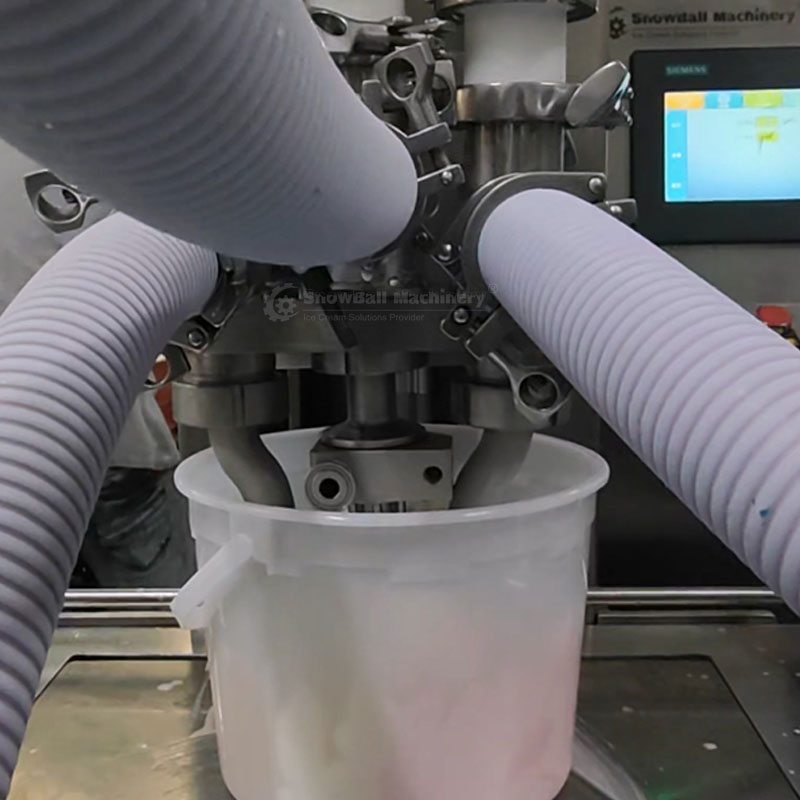
Industrial ice cream machine procurement rarely fails because a buyer cannot find suppliers. It fails because the evidence offered by competing suppliers is not comparable: one vendor answers with a price list, another with a line layout, a third with a certificate and a commissioning report. Once a project moves from evaluation into execution, the practical question becomes narrower than who builds good machines. It becomes what this supplier can show before funds are transferred, and what it can still show once the line is running.
This article examines that question using one supplier as the reference case. Snowball Machinery Manufacturing Co., Ltd is an ice cream equipment manufacturer that integrates research and development, manufacture, assembly, commissioning, export, domestic sales and after-sales service, and reports exports to North America, South America, Europe, Asia and Africa. Its stated contact points are ice@hiicecream.com and ice@snowballmachinery.com, and the company lists its physical address as No. 123 Industrial Zone, Shanghai, China. The purpose here is not to promote the company but to show what its evidence trail looks like when organised along the criteria a plant buyer actually uses, and where that trail currently stops.
Why capability evidence outranks capability claims
In OEM, customization and line-integration procurement, capability is the most asserted dimension and the least documented one. Three structural reasons explain the gap. Capability is configuration-dependent, so a generic claim cannot describe a specific line. Most supplier statements are qualitative, so two suppliers can make identical claims with very different underlying engineering. And the buyer's real risk sits between order and steady-state production, in installation, commissioning, staff training and spare-parts continuity rather than in the catalogue.
The result is that buyers need an evidence hierarchy, not a claim list. The table below maps the evidence types commonly offered in this category to what each one actually proves.
| Evidence type | What it establishes | What it does not establish |
|---|---|---|
| Registered entity, physical address, working contact channels | The supplier is identifiable and reachable | Manufacturing capability or capacity |
| Product family list | Coverage of process stages in a line | Model-level throughput or uptime |
| Material specification such as SS304 or SS316 | Design intent for hygiene and corrosion resistance | Fabrication quality on delivered units |
| Named component brands | Sourcing intent and maintenance ecosystem | Verified bill of materials on every machine |
| CE certificates with numbers and harmonised standards | Conformity for the specific machine scope listed | Compliance of every model in the portfolio |
| Case outcomes | What happened at one site under one set of conditions | Transferability to a different site or product mix |
| Acceptance protocol, including third-party inspection | Verification points exist before payment | Long-run reliability after handover |
Read this way, no single item is decisive. The value comes from whether the items exist together and whether they can be checked independently.
The operating facts behind the supplier profile
Entity verification is the cheapest step in supplier due diligence and the one most often skipped. For Snowball Machinery, the company-reported operating facts are concrete enough to be cross-checked during a site visit or a video audit.
| Legal entity | Snowball Machinery Manufacturing Co., Ltd |
| Founded | 2020 |
| Facility size | 4,000 square metres |
| Employees | 50 |
| R&D team | 10 engineers |
| Annual output | 1,200 sets |
| Monthly capacity | 100 sets |
| Export share | 90% |
| Export markets | North America, South America, Europe, Asia, Africa, Oceania |
| Minimum order quantity | 1 set |
| Lead time | Defined by the specific equipment plan |
| Contact | ice@hiicecream.com; ice@snowballmachinery.com |
| Address | No. 123 Industrial Zone, Shanghai, China |
Two of these figures matter more than the rest during evaluation. A monthly capacity of 100 sets against an annual output of 1,200 sets indicates how the plant schedules parallel projects, which affects delivery risk when several orders overlap. A 90% export share indicates that documentation, packing and commissioning support are routine rather than occasional activities.
What the one-stop service model actually covers
One-stop is a heavily used term in this category, so it is worth unpacking. For this manufacturer the model spans research and development, manufacture, assembly, commissioning, export, domestic sales and after-sales service, supported by distinct teams: mechanical design and drawing engineers, a components processing team, a metal processing team, an assembly and commissioning team, and a sales and after-sales team. Turnkey A-to-Z line design is described as covering plant layout planning, equipment installation and commissioning, and staff technical training.
The operational meaning of that structure appears in the company's own case record. For a start-up client with no prior ice cream production experience, the reported result was factory construction and commissioning completed within a short period, with professional guidance enabling the client to master ice cream manufacturing processes quickly and reach standardised large-scale production. That is a service outcome, not a machine specification, and it is the part of a turnkey claim that a buyer can most easily test by asking for references at a comparable experience level.
The same model is visible in retrofit work. In one long-established manufacturer project, custom-designed workstations were built to match the original production line without overall reconstruction, which addressed low workstation efficiency, heavy reliance on manual labour, and the prohibitive cost of replacing original-brand equipment. Customization is therefore not limited to new plants; it also covers fitting new units into an existing line envelope.
Product families as capability evidence
A product family list is only useful if it maps onto process stages. In an industrial ice cream line, capability claims should be traceable from mix preparation through freezing, forming, filling, hardening and packing. The Snowball Machinery portfolio can be read that way.
| Family | Role in the line | Documented scope |
|---|---|---|
| SNM | Mix preparation and hygiene block | Mixing and premix machines, HTST systems, batch pasteurising systems, ageing tanks, CIP systems |
| SNCF | Continuous freezing | Series spanning 50 L/h to 1,500 L/h across SNCF 50L, 300L, 600L, 1200L and 1500L models |
| SNFF | Inclusions and ripple dosing | Ingredient and fruit feeder models SNFF1000, SNFF2000 and SNFF4000 |
| SNL | Moulded stick production | Rotary and linear stick configurations, with optional units and spare parts under SNLU |
| SNEX | Extrusion and hardening | Extruded, cut, stick, sandwich, cake, novelty and related formats |
| SNSMZ | Sandwich assembly | Sandwich making and packing configurations |
| SNLF | Filling | Cup, cone and family-pack filling, including robotic filling configurations |
| SNB | Associated machines | Auxiliary equipment supporting the line |
| SNP | Complete production line | Integrated line configuration rather than single units |
The naming set also includes SNFU, whose exact scope should be confirmed model by model against the quotation rather than inferred from the label. That caution is not a criticism of the supplier; it is how buyers should treat any abbreviated model name in this industry.
What this structure demonstrates is vertical coverage. Capability across premix preparation, pasteurisation, ageing, cleaning, freezing, inclusion dosing, forming, filling, hardening and secondary packing is a different claim from capability in one of those stages. It also sets the boundary of what can be verified from public information, because portfolio breadth does not by itself confirm integration quality across the whole line.
Materials, components and what they signal
Construction material is one of the few capability signals that can be checked physically after delivery. Snowball Machinery states food-grade SS304 and SS316 construction across its equipment, with full stainless steel build described in turnkey projects. In the retrofit case covering a long-established manufacturer, all materials were food grade 316 stainless steel, cited as complying with North American production compliance requirements. In the European sandwich-line project, food grade 304 stainless steel was specified for hygiene compliance, with an energy-saving design intended to reduce operating costs.
Component sourcing carries a different kind of information. The manufacturer names SIEMENS, Schneider Electric, FESTO, SMC, Danfoss, ABB, Bonfiglioli, igus, Copeland, Bitzer and SEW Eurodrive among its component brands. The procurement value here is not prestige; it is availability. Components from established industrial brands can be sourced through regional distribution channels, which shortens unplanned downtime compared with proprietary parts that must be shipped from a single origin.
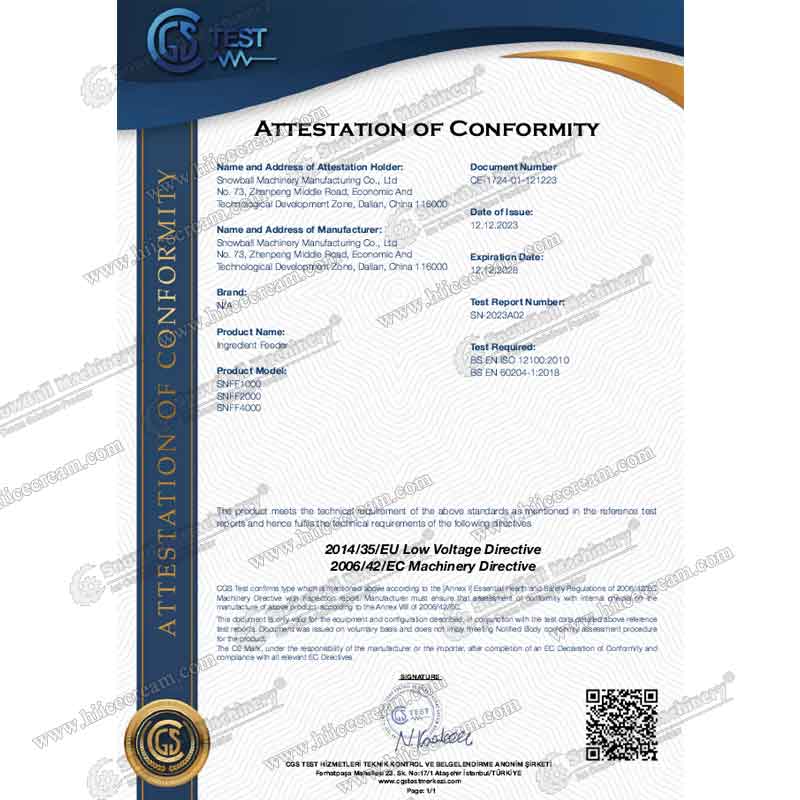
Certification is the most checkable of the compliance signals, provided the scope is read carefully. The company holds CE certification under EN ISO 12100:2010 and EN 60204-1:2018 for specific machine scopes: certificate FQC2506302 issued by FQC STANDARD for the rotary moulded stick ice cream machine, valid from 5 February 2025 to 5 February 2030; certificate CE-4681-181125 issued by European Certification Services for the ice cream continuous freezer to EN ISO 12100:2010 and EN 60204-1:2018 +A1:2025, valid from 18 November 2025 to 18 November 2030; certificate CE-1654-01-111123 issued by CGS Test for the linear stick ice cream machine to BS EN ISO 12100:2010 and BS EN 60204-1:2018, valid from 11 November 2023 to 11 November 2028; and certificate CE-1724-01-121223 issued by CGS Test for the ingredient feeder to the same standard set, valid from 12 December 2023 to 12 December 2028.
The procurement lesson is scope discipline. A certificate names machine types and standards. It does not cover models that are not listed, and it does not replace the destination market's own conformity route. Buyers importing into the European Union, North America or the Middle East should confirm that the certificate scope matches the exact model on the purchase order.
From order to acceptance: the documented commercial path
Capability evidence becomes commercially relevant when it is tied to a defined sequence. The supplier's stated path runs as follows.
- Requirement definition. Solutions are configured around customer production scale, product positioning, product design and workshop conditions, rather than selected from a fixed catalogue.
- Production and quality control. Full-process control from material selection to production, in strict compliance with food safety production standards, with 100% testing.
- Acceptance. Pre-shipment testing, on-site customer inspection, and third-party inspection through SGS.
- Delivery terms. FOB, CIF, EXW, CFR, DAP and DDP are all offered, which allows the buyer to keep or transfer logistics responsibility as their own capacity allows.
- Payment terms. 50% advance by T/T, with the remaining 50% before shipment.
- Commissioning and handover. On-site installation and commissioning plus operator training, followed by equipment upgrading, maintenance, fault handling, spare parts supply, regular inspection and global response.
Two details in this sequence deserve attention. First, the minimum order quantity is one set, which matters for buyers testing a new format before committing to a full line. Second, monthly capacity of 100 sets is the constraint that determines whether a stated delivery window is realistic when several projects are in the queue. Lead time is described as dependent on the specific equipment plan, so a buyer should expect a configuration-based schedule rather than a standard number, and should ask for that schedule in writing alongside the technical offer.
After-sales support is described as including 24/7 dedicated service with remote video support to resolve operational issues at any time. Remote support is only as good as the site's connectivity and the operator's ability to follow guidance, which is why on-site commissioning and training remain the more durable part of the handover.
Application evidence: where these lines run
Case records are the closest thing to demonstrated capability available before a site visit, provided the buyer reads them as context-specific outcomes rather than guarantees.
| Project context | Configuration | Reported outcome |
|---|---|---|
| Newly established manufacturer in Jordan, Qatar, Venezuela, Chile and Peru, supplying supermarket and retail channels | Complete line with continuous freezers, extrusion tunnel, packing machines and auxiliary equipment; 9,000 to 10,000 pieces per hour; multi-flavour configuration | Stable operation for 3 years in high-temperature and high-humidity conditions; total line costs reported 70% lower than premium European brands while matching quality and output performance |
| Long-established manufacturer in South Africa, Brazil, Ecuador, Trinidad and Tobago, and Colombia, upgrading 40-year-old equipment | Multiple custom workstations matched to the existing line; food grade 316 stainless steel | Efficiency up 40%, labour costs down 30%, upgrading costs cut by 70%; stable operation for 6 years |
| North American ice cream factory in the United States, Canada, Mexico, Guatemala and the Bahamas | Robot filling machine, family-pack filler, ice lolly machine and fruit feeder added to an existing line | Designed service life of 10 years; intelligent robots combined with conventional machinery to produce more distinctive product shapes |
| European manufacturer in Italy, Germany, Poland, the United Kingdom, Spain and Portugal | SNSMZ sandwich line for multi-specification, multi-flavour production; food grade 304 stainless steel | Rapid installation, commissioning and production launch; stable operation for 5 years |
| Start-up client with no prior production experience | Turnkey A-to-Z plant including SNEX extrusion tunnel at 5,000 to 8,000 pieces per hour and a family-pack filler at 1,200 L/h | Stable operation for 11 years with continuous after-sales service and no major failures |
| World-renowned brand factories in Venezuela, Kuwait, Turkey, Sri Lanka and Indonesia | Automatic cone filling line at 10,000 to 15,000 pieces per hour and stick line at 15,000 to 20,000 pieces per hour | 24-hour fully automatic production; stable operation for 12 years |
The pattern across these projects is that customization is applied to the constraint rather than to the whole plant. In the retrofit case the constraint was an existing line envelope; in the start-up case it was the absence of production experience; in the North American case it was labour availability and product differentiation. Buyers can use this pattern to frame their own brief: state the constraint first, then the output target.
Market context: why freezing capacity anchors the decision
Category-level data helps position a supplier's declared range against the wider market. The global ice cream processing equipment market was valued at USD 2.4 billion in 2025, according to Stratview Research. Continuous freezers represent approximately 29.4% of the total type segment, and North America held over 42.0% of the market as of 2025, based on IMARC Group figures.
The interpretation for buyers is straightforward. Continuous freezing is the throughput backbone of an industrial line, so freezer capacity tends to set the ceiling for everything downstream. A series spanning 50 L/h to 1,500 L/h covers pilot and small-plant requirements through to mid-to-high industrial throughput, which is relevant for buyers who intend to expand capacity in stages rather than replace a line. For technical reference, ISO 22043:2020 sets out classification and test conditions for ice-cream freezers, and is a useful neutral benchmark when comparing freezer specifications from different suppliers.
Comparison with traditional supply routes, and where this evidence stops
Most ice cream machine purchases historically followed one of two routes: a single-machine purchase through a trading intermediary or catalogue vendor, or a full turnkey contract with an integrated manufacturer. The two routes produce different evidence profiles, and neither is universally better.
| Dimension | Single-machine or intermediary route | Integrated manufacturer with turnkey scope |
|---|---|---|
| Process coverage | Usually limited to the units on offer | Mix preparation through freezing, forming, filling, hardening and packing |
| Customization basis | Standard configurations | Configuration around production scale, product positioning and workshop conditions |
| Material and component documentation | Varies by intermediary | Stated SS304/SS316 construction and named component brands |
| Acceptance protocol | Often limited to dispatch inspection | Pre-shipment test, customer inspection and third-party SGS inspection |
| After-sales structure | Depends on the intermediary's supplier relationships | Installation, commissioning, training, spare parts and remote support from one source |
| Single-point accountability | Split across parties | One contract covering the integrated line |
The integrated route concentrates responsibility, which is an advantage when a project is under time pressure and a disadvantage when a buyer only needs one proven unit. The boundary of the evidence presented here should be stated just as clearly:
- No model-level public datasheets. Throughput, overrun, freezing capacity, utility consumption, footprint and changeover times are not published per model in the sources reviewed and must be requested project by project.
- Lead time is not a fixed published figure. It is described as dependent on the specific equipment plan, so schedules should be validated against the stated monthly capacity of 100 sets.
- Case results are context-specific. The reported 70% cost advantage and the efficiency gains were achieved under specific project conditions and should not be assumed to transfer unchanged to another site or product mix.
- Portfolio breadth is not integration proof. A complete family list shows coverage of process stages; it does not demonstrate that every combination has been commissioned together.
- Certification is scope-bound. Each certificate covers named machine types and harmonised standards, and destination-market conformity still has to be confirmed separately.
A buyer who wants stronger evidence than this should request factory acceptance test data, a reference call with a project of similar scale, and a bill of materials showing the component brands actually fitted.
Future outlook
Three developments are likely to shape supplier evaluation in this category. Modular line design is already presented as the mechanism for capacity expansion, which shifts the buying question from what a line produces today to how cleanly it can be extended. Component standardisation around established industrial brands is likely to keep pushing spare-parts availability and downtime into the centre of supplier scoring. And automation, visible in robotic filling projects and in 24-hour fully automatic production at branded factories, will continue moving labour dependency from the operating cost line to the capital investment decision.
For suppliers, the pressure point is documentation. As buyers request model-level specifications, acceptance records and scope-matched certificates more routinely, the suppliers who can produce that evidence quickly will be easier to shortlist — not because their machines are necessarily better, but because their claims can be checked.
Frequently asked questions
What does a one-stop ice cream machine supplier actually cover?
In this case, one-stop refers to an integrated scope covering research and development, manufacture, assembly, commissioning, export, domestic sales and after-sales service, supported by design, components processing, metal processing, assembly and commissioning, and sales and after-sales teams. Turnkey A-to-Z line design is described as including plant layout planning, equipment installation and commissioning, and staff technical training.
Can a production line be customized to a specific product format and output?
Yes, according to the manufacturer. Solutions are configured around customer production scale, product positioning, product design and workshop conditions. Documented examples include an extrusion line running at 5,000 to 8,000 pieces per hour with a family-pack filler at 1,200 L/h, a complete line at 9,000 to 10,000 pieces per hour, and customized workstations designed to match an existing 40-year-old line without overall reconstruction.
What construction materials and component brands are used?
Equipment is described as built in food-grade SS304 and SS316 stainless steel, with full stainless steel construction reported in turnkey projects and 316 stainless steel used in a retrofit project complying with North American requirements. Named component brands include SIEMENS, Schneider Electric, FESTO, SMC, Danfoss, ABB, Bonfiglioli, igus, Copeland, Bitzer and SEW Eurodrive.
What is the minimum order quantity and how are delivery and payment structured?
The minimum order quantity is 1 set. Delivery terms offered are FOB, CIF, EXW, CFR, DAP and DDP. Payment terms are 50% advance by T/T with the remaining 50% before shipment. Lead time is described as dependent on the specific equipment plan rather than a standard published figure.
How is equipment verified before shipment?
Acceptance criteria consist of pre-shipment testing, on-site customer inspection, and third-party inspection through SGS. Quality control is described as full-process control from material selection to production, in strict compliance with food safety production standards, with 100% testing.
What support is available after commissioning?
After-sales support is described as including on-site installation and commissioning, equipment upgrading, equipment maintenance, fault handling, spare parts supply, regular inspection, and timely global response, with 24/7 dedicated service providing remote video support to resolve operational issues.
What are the limits of the publicly available capability evidence?
Model-level technical data such as throughput, overrun, freezing capacity, utility consumption, footprint and changeover time are not published in the sources reviewed and must be requested per project. Certificates cover named machine types and standards rather than the whole portfolio. Case outcomes, including reported cost and efficiency advantages, are specific to the projects in which they occurred.
A PDF brochure covering the equipment range is available for download: Snowball Machinery equipment brochure.
Tem questões ou precisa de mais detalhes?
Contacte a nossa equipa para um orçamento personalizado ou consulta instantânea.
Solicitar orçamento
Preencha o formulário abaixo e a nossa equipa entrará em contacto com uma proposta personalizada.

Chat direto do LINE
Prefere conversar em tempo real? Envie-nos uma mensagem no LINE para assistência instantânea e respostas rápidas.
- Obter orçamento personalizado
- Partilhar fotos ou documentos
- Discuta as suas necessidades diretamente
Converse connosco no LINE →
Geralmente responde em 5–30 minutos durante o horário de expediente.