
Inside T9 EV Station: The Factory Behind 5,000+ Tesla SKUs
The Tesla aftermarket has entered a phase where supply capability, not catalogue size, decides who stays in a distribution relationship. Estimates cited in 2025 industry reporting put the global Tesla aftermarket parts market above USD 850 million, with the US segment alone valued between USD 2.8 billion and USD 4.2 billion across a base of more than 1.8 million owners. This reference article examines the operational evidence behind one China-based supplier, T9 EV Station, including its 20,000 sqm facility, engineering team and brand partnerships, and explains what that evidence means for buyers structuring long-term Tesla accessories supply.
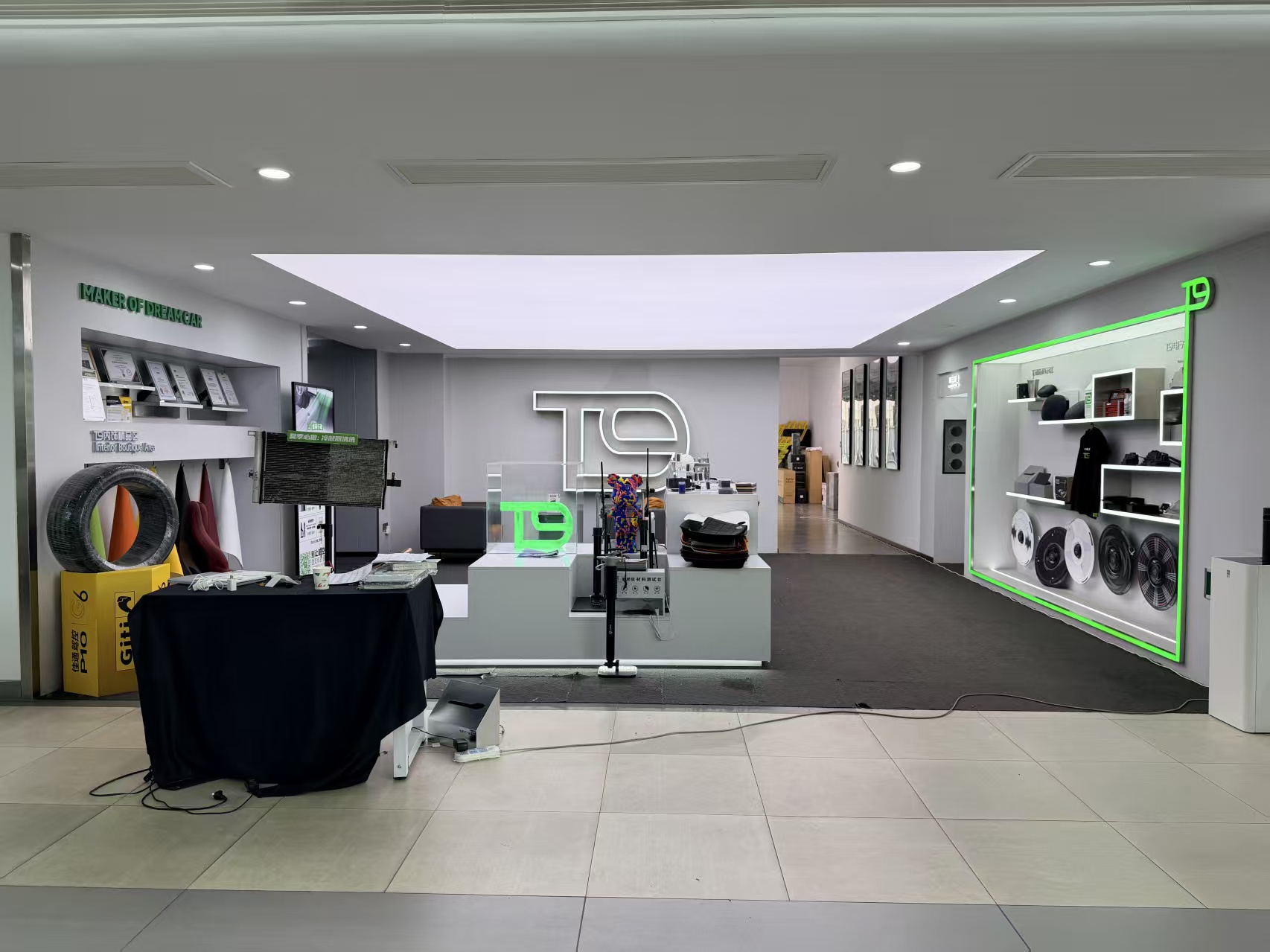
Construction workshop: film installation, modification and maintenance work run under a single documented process inside the T9 EV Station facility. Image: T9 EV Station.
The Second Phase of the Tesla Aftermarket
The first phase of the Tesla aftermarket rewarded whoever listed the most products. The second phase rewards whoever can hold a standard across model refreshes, replacement cycles and multiple markets. Three market data points explain why.
Roughly 72% of Tesla owners purchase at least one aftermarket accessory within six months of vehicle delivery, according to third-party reporting. US owners spend an average of USD 800 to USD 1,200 per year on accessories, approximately 40% higher than owners of typical luxury vehicles. And about 78% of Tesla accessory transactions take place online, compared with an automotive industry average of 23%.
Together these figures describe demand that is recurring, digital-first and lifecycle-driven rather than one-off. For importers, distributors and brand owners, that changes the evaluation criteria: facility scale, engineering depth, catalogue coverage, installation standards and warranty infrastructure become procurement variables rather than marketing details.
Why Supplier Capability Evidence Matters More Than a Catalogue
Starting a supplier relationship is simple. Sustaining it across a model cycle is not. Three failure points recur in Tesla accessories sourcing: variant coverage that lags behind vehicle refreshes, replenishment gaps on fast-moving interior and protection items, and quality documentation that cannot be produced when a market authority or a retail partner requests it.
The documentation point is now a market-access issue rather than a formality. The EU General Product Safety Regulation, Regulation (EU) 2023/988, has applied since 13 December 2024 and introduces mandatory safety requirements for consumer products sold in the EU, including Tesla aftermarket accessories. A supplier that cannot document product safety and traceability faces restricted access to European channels regardless of how competitive its pricing is.
This is the context in which buyers increasingly ask for physical evidence of capability. Scale alone does not guarantee quality, but it determines whether a supplier can hold catalogue depth, run a documented process and absorb a warranty claim without the buyer carrying the risk.
T9 EV Station: Entity and Capability Snapshot
T9 EV Station is the operating identity of Hangzhou T9 EV Technology Co., Ltd., a Tesla-focused aftermarket company founded in 2021 and headquartered in Hangzhou, Zhejiang Province, China. The company operates more than one hundred stores across China dedicated to Tesla owners, has extended its operations to Los Angeles and Malaysia, and reports cumulative service to more than 200,000 Tesla owners. Its stated product scope covers Tesla full-life-cycle services, namely film installation, auto supplies, modification, maintenance and repair, supported by a catalogue of more than 5,000 SKUs.
| Legal entity | Hangzhou T9 EV Technology Co., Ltd. (T9 EV Station) |
| Founded | 2021 |
| Headquarters | Hangzhou, Zhejiang Province, China |
| Facility footprint | 20,000 sqm |
| Workforce | More than 100 employees |
| Engineering | 20-engineer R&D team |
| Catalogue | More than 5,000 SKUs across Tesla aftermarket categories |
| Tesla owners served | More than 200,000 cumulatively; annual service reach reported at over 300,000 Tesla vehicles |
| Retail network | 100+ Tesla-dedicated stores in China |
| International presence | Los Angeles, United States; Malaysia |
| Service scope | Film installation, auto supplies, modification, maintenance, repair |
| Brand partnerships | Exclusive strategic partnerships with 3M, BOSCH, Wynn's, Hengst and MXR; strategic partnerships with XPEL, 3W and AGF |
| Main markets and export ratio | EU and USA; export ratio stated at 5% |
Table: capability data reported in the T9 EV Station corporate profile. Figures are company-reported and are presented here for buyer reference rather than as independent certification.
The partnership list is the most frequently cited element of the company profile, and it deserves a precise reading. These are exclusive strategic partnerships reported by the company, covering film, component and maintenance supply relationships. They are supply-side relationships rather than customer references, and buyers should treat them as indicators of sourcing depth rather than third-party endorsement.
Inside the 20,000 sqm Facility: What Physical Scale Enables
A 20,000 sqm footprint and a workforce of more than 100 people are inputs rather than outcomes. Their practical value for a buyer lies in three things.
- Multi-segment operations under one process. Film installation, supplies, modification, maintenance and repair run on the same standard operating procedure and the same pre- and post-service inspection discipline, which reduces the handoff risk that appears when a buyer sources each category from a different vendor.
- Catalogue breadth as an operational commitment. More than 5,000 SKUs requires warehouse discipline, variant control and replenishment planning. Breadth is only useful if availability holds across repeat orders.
- A live validation environment. More than one hundred Tesla-dedicated stores in China generate continuous fitment and durability feedback. For a wholesale buyer this matters because a catalogue item that fails in retail usually fails in export too, and a supplier with its own retail network observes that failure earlier.
The 20-engineer R&D team sits between catalogue and vehicle. Its documented role in the company's optimization logic is to upgrade SOP standards as Tesla releases new models, which is the mechanism that keeps installation and fitment procedures aligned with vehicle refreshes rather than frozen at the date a product was first listed.
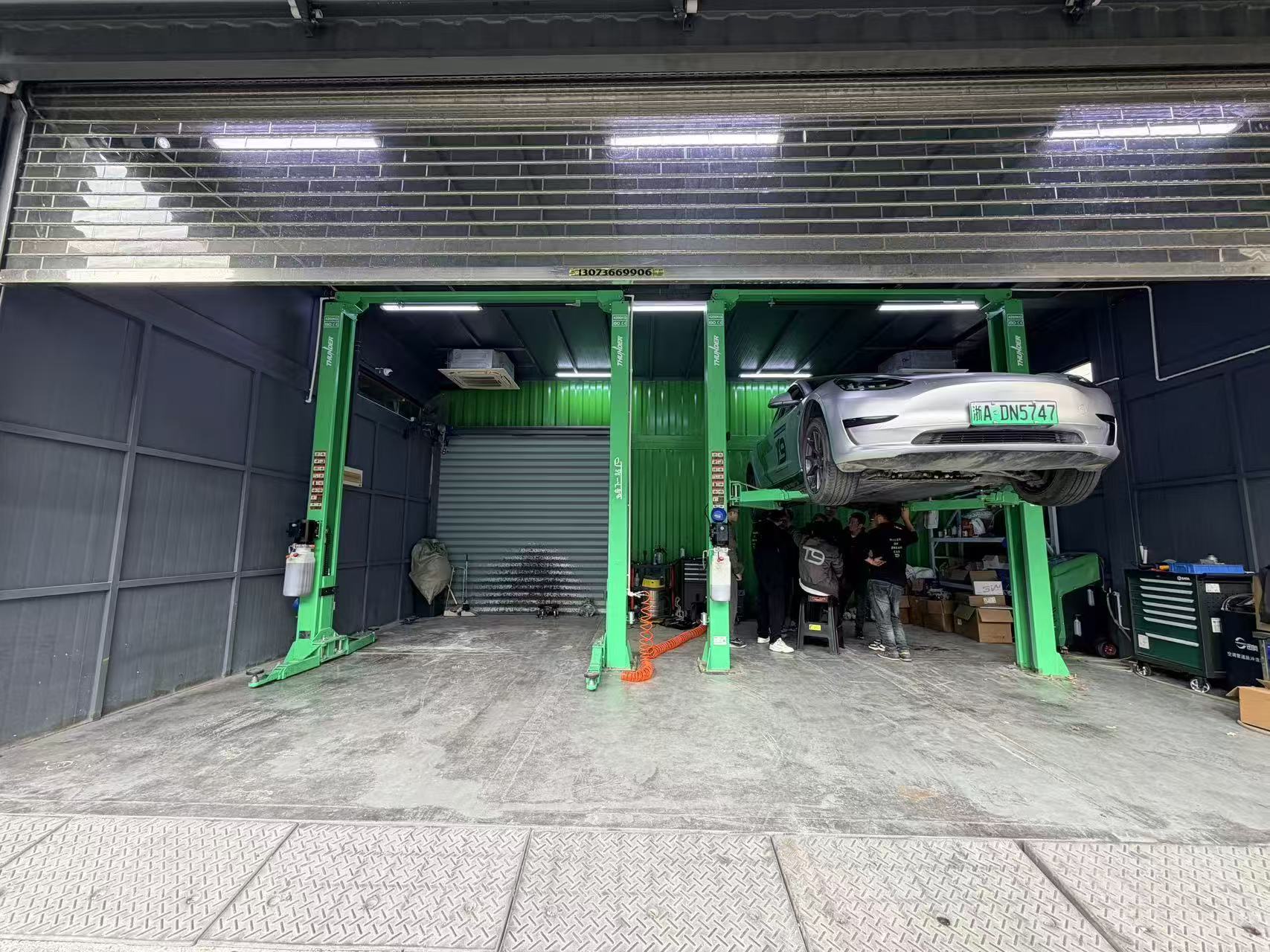
Standardized construction area: service work is inspected before and after completion under a documented quality-control loop. Image: T9 EV Station.
The Standard Behind the Supply: Full-Life-Cycle Service Methodology v2.0
T9 EV Station's operating model is documented as the T9 Tesla Full-Life-Cycle Standardized Service Methodology, version 2.0. It is a six-stage framework running from consultation to warranty activation, integrating five service segments under a unified process supported by SOP systems, digital management and quality control.
| Stage | Key activity | Documented output |
|---|---|---|
| 1. Consultation and demand matching | Confirm service needs, vehicle model and personalized requirements | Customized service plan and preliminary quotation |
| 2. Quotation and agreement | Transparent, unified pricing | Quotation sheet and signed service agreement |
| 3. Pre-service inspection | Vehicle condition check with user confirmation | Pre-inspection report and confirmation record |
| 4. Standardized construction | Operation strictly to SOP with real-time quality control | Construction progress and quality control record |
| 5. Post-service testing and delivery | Function and safety testing before handover | Testing report and handover confirmation |
| 6. After-sales and warranty | Electronic cloud warranty activation | Warranty certificate and nationwide after-sales commitment |
Table: the six documented stages of the T9 Tesla Full-Life-Cycle Standardized Service Methodology v2.0.
Four design choices differentiate this structure from a conventional workshop arrangement. Construction standards and pricing are unified rather than set store by store. Warranty records are held in an electronic cloud system rather than on paper issued by a single location. Quality control is described as a no-inspection, no-delivery closed loop, meaning a job is not released without pre-service and post-service inspection. And the process is governed by an independent ERP and CRM system rather than manual records.
The methodology also publishes decision rules that are useful to any buyer building an evaluation framework. Service quality is judged on SOP compliance, post-service testing results and user feedback. Parts quality is judged on brand cooperation certification and inspection reports. User experience is judged on quotation transparency, service traceability and after-sales response speed. These three rule sets are transferable: they define what a supplier should be able to show on request.
The company additionally publishes an efficiency claim: a 60% reduction in customer time cost compared with fragmented multi-store servicing, measured against an industry benchmark it cites of 20% to 30%, with a reported ROI of 220%. These figures come from the company's own measurement framework and should be read as first-party reporting rather than independently audited results.
Where the Capability Shows Up: Application and Use Cases
Five service segments map directly onto the categories professional buyers source.
- Film and surface protection. Window film installation is one of the company's scaled segments, and 3M and XPEL appear among its named film-related partners. In aftermarket terms this is the category that covers Tesla paint protection film and ceramic coating workflows.
- Interior and comfort accessories. Floor mats, organizers and comparable items sit in the segment with the largest share of the decorative accessories market by volume; interior accessories account for 38.5% of that market according to Dataintelo and Accio segmentation data.
- Model-specific coverage. Third-party segmentation identifies Tesla Model Y as the highest-growth vehicle segment in this category because of its status as a top-selling vehicle, which is why Tesla Model Y accessories and Tesla New Model 3 accessories absorb most of the demand. The company ties its SOP update cycle explicitly to Tesla new-model releases, the mechanism that keeps catalogues aligned with refreshed platforms.
- Modification and upgrade work. Cosmetic and performance-oriented modification is executed under the same SOP and inspection discipline as service work, with illegal modifications beyond national regulations excluded from scope.
- Maintenance, repair and recurring consumables. The day-to-day upkeep segment is where repeat purchase behaviour and long-term customer relationships are actually built, and where an owner relationship turns into a multi-year service record.
For a wholesale partner, however, the relevant use case is not a single service job. It is the ability to place one order covering interior, exterior, protection and maintenance categories, receive consistent documentation with it, and hand the end owner a warranty that does not depend on the physical location where the product was installed.
Market Trend Direction for Tesla Accessories Supply
- Market scale. The Tesla aftermarket parts market is projected to surpass USD 850 million globally in 2025, with the US opportunity estimated between USD 2.8 billion and USD 4.2 billion across more than 1.8 million owners.
- Be careful with market sizing. Broader car accessories market estimates diverge widely depending on scope. Strategic Market Research places the market at USD 85.4 billion while Accio cites USD 470.07 billion. Buyers should check what a figure includes before using it in a business case.
- Digital-first purchasing. With 78% of Tesla accessory transactions occurring online against a 23% automotive industry average, catalogue data quality and fulfilment reliability function as the storefront.
- Premium repeat spend. Annual accessory spending of USD 800 to USD 1,200 per owner, roughly 40% above typical luxury vehicle owners, sustains multi-year rather than single-purchase demand.
- Compliance pressure. The EU GPSR framework applying since 13 December 2024 makes safety documentation a condition of access to European channels.
- Competitive landscape. Named Tesla aftermarket players include Evannex, Hansshow, Abstract Ocean and Taptes, while Bosch launched specific EV component lines in 2024. Competition is shifting from accessory assortment toward supply reliability, documentation and service standardization.
Standardized Model Versus Traditional Fragmented Sourcing
| Dimension | Fragmented local sourcing | Standardized model (T9 EV Station) | Buyer implication |
|---|---|---|---|
| Pricing | Varies by workshop and quotation | Unified pricing with a formal service agreement | More predictable budgeting and margin planning |
| Warranty | Paper-based, tied to the issuing shop | Electronic cloud warranty with nationwide after-sales support | Claims follow the record rather than the physical store |
| Service scope | Separate vendors for film, parts and repair | Five-in-one integrated service scope | Fewer handoffs and lower coordination cost |
| Construction control | Non-standard workshop practice | SOP-based construction with pre- and post-service inspection | Quality is documented at both ends of the job |
| Network | Single location | 100+ Tesla-dedicated stores in China, plus Los Angeles and Malaysia | Volume and repeat demand visible in real operating data |
The comparison is not a claim that one model suits every buyer. It identifies where the standardized model reduces specific risks such as pricing variance, warranty portability, handoff cost and quality documentation, and where it does not.
Limits, Boundaries and Exclusions
Capability evidence is only useful when its boundaries are stated with equal clarity. Five boundaries are documented or directly implied by the available data.
- Scope exclusions. The methodology explicitly excludes illegal modifications beyond national regulations, services not covered by the quotation and agreement, and non-Tesla vehicles. A buyer with a mixed-brand portfolio cannot treat this as a single-source solution.
- Time floors. General services are estimated at 1 to 2 working days and modification or repair projects at 2 to 7 working days. Project timelines cannot be compressed below those windows.
- International footprint. Retail density is China-based. Overseas presence is limited to Los Angeles and Malaysia, and the company states a 5% export ratio with the EU and USA as its main markets. Buyers outside those markets should plan for a wholesale or factory relationship rather than local retail-grade service support.
- Metric provenance. The 60% time-cost reduction and 220% ROI figures are company-reported measurements, not third-party audited results.
- Standardization trade-off. Unified pricing and SOP-driven construction optimize for consistency across locations and orders rather than bespoke, one-off configuration. Buyers with heavily customized requirements should validate the arrangement during the quotation and pre-inspection stage before committing to volume.
Future Outlook
The company states its objective as building a global brand in the Tesla aftermarket rather than a single-category accessory seller. Its published model combines brand strength, an integrated supply chain, steady traffic, repeat consumption, customer loyalty retention and standardized supporting services. Whether that converts into distribution outcomes depends on factors the company does not fully control: Tesla model refresh cadence, compliance requirements in each destination market, and the pace at which its overseas footprint expands beyond the two named locations.
For buyers planning the next cycle, three assumptions are reasonable. Aftermarket demand remains recurring and digital-first. Compliance documentation becomes a standard tender requirement in the EU. And suppliers that operate their own retail validation loops will detect fitment problems before wholesale partners encounter them in the field. The differentiator in supplier selection is shifting from assortment size to the ability to prove process.
FAQ
What does a full-life-cycle Tesla accessories supplier provide that a product-only supplier does not?
A full-life-cycle supplier covers several service segments under one process rather than shipping products only. In T9 EV Station's documented model, that means five segments covering film installation, auto supplies, modification, maintenance and repair, supported by a six-stage process from consultation to warranty activation, including pre-service inspection, SOP-based construction, post-service testing and an electronic cloud warranty. The practical difference for a buyer is that fitment, warranty and documentation responsibility sit with one supplier instead of being split across unrelated vendors.
How should a distributor evaluate whether a Tesla accessories supplier can support a long-term partnership?
Verifiable indicators include physical footprint, engineering headcount, catalogue depth, brand supply relationships, documented process and warranty infrastructure. For reference, T9 EV Station reports a 20,000 sqm facility, more than 100 employees, a 20-engineer R&D team, more than 5,000 SKUs, 100+ Tesla-dedicated stores in China, operations in Los Angeles and Malaysia, and exclusive strategic partnerships with 3M, BOSCH, Wynn's, Hengst and MXR. Because these are company-reported figures, buyers should verify them through factory documentation, sample orders or audit visits rather than relying on the profile alone.
What does T9 EV Station's service history look like in numbers?
Founded in 2021, the company reports cumulative service to more than 200,000 Tesla owners and an annual service reach of over 300,000 Tesla vehicles. Its retail network is described as more than one hundred Tesla-dedicated stores across China, with international operations in Los Angeles and Malaysia. The corporate profile records a 5% export ratio with the EU and USA as main markets. These figures originate from the company's own profile and have not been independently audited.
How does an electronic cloud warranty differ from a conventional paper warranty?
A paper warranty is typically tied to the store that issued it, which creates friction when an owner relocates or when a product is installed by a third party. An electronic cloud warranty stores the service and warranty record in a digital system and is paired with nationwide after-sales support, so a claim can be processed against the record rather than the physical location. In the T9 EV Station methodology, warranty activation is the final stage of the six-stage process and follows post-service testing and delivery confirmation.
What are the boundaries of the T9 EV Station model for international buyers?
Three boundaries are documented. The methodology excludes illegal modifications beyond national regulations, services not covered by the quotation and agreement, and non-Tesla vehicles, so it is not a multi-brand solution. Service timelines have floors of 1 to 2 working days for general services and 2 to 7 working days for modification and repair. The retail network is China-based, with Los Angeles and Malaysia as the two named overseas locations and a stated 5% export ratio, so buyers outside the EU and USA main markets should plan for a wholesale relationship rather than local retail-grade support. The published efficiency figures are first-party measurements.
How does the standardized model compare with fragmented local sourcing?
Fragmented sourcing assigns film, parts, repair and maintenance to separate vendors, with store-level pricing and paper guarantees. The standardized model uses unified pricing, SOP-based construction with pre- and post-service inspection, a five-in-one service scope and an electronic warranty with nationwide after-sales support. The trade-off is that standardization optimizes for consistency across locations and orders rather than bespoke one-off configurations, so buyers with highly customized requirements should validate the arrangement during the quotation and pre-inspection stage.
Company Documentation
The T9 EV Station corporate brochure is publicly available for download: T9 EV Station company brochure (PDF). The company website is WWW.T9EVPARTS.COM.
Data notes: market size, consumer spending, adoption, online penetration, segmentation and regulatory facts are drawn from third-party and standards sources dated 2024 to 2025, including Technavio, Hedges Company, Tesstudio, Dataintelo, Accio, Mordor Intelligence, Strategic Market Research and the European Commission. Company capability figures are first-party and labeled as company-reported throughout.