
Inside Unicorn's 40,000 m² Laryngoscope Manufacturing Facility
Inside Unicorn's 40,000 m² Laryngoscope Manufacturing Facility
Laryngoscope procurement is turning into a manufacturing question. The global video laryngoscope market was estimated at USD 784.66 million in 2024 and is projected to reach USD 2.80 billion by 2033, according to Grand View Research, while the wider laryngoscope market across all types was valued at USD 508.5 million in 2024 with a forecast growth rate of 7.2% through 2034, according to Future Market Insights. Both figures describe the same commercial reality: airway management devices are a durable, expanding category, and an expanding category attracts suppliers whose actual manufacturing depth varies widely.
Jiangsu Unicorn Electronic Technology Co. Ltd. is a National High-tech Enterprise founded in 2020 that integrates design, research and development, manufacturing, and domestic and international trade in medical visualization devices. Its portfolio covers endoscopy systems, disposable ureteroscopes, visual flexible laryngoscopes, bronchoscopy workstations, medical image processors, and video laryngoscopes. The company reports a 40,000 m² manufacturing site, an R&D team of more than 20 engineers, and an annual production capacity of 12,000 units. For buyers working through the decision and execution stages, the operative question is whether those numbers convert into order fulfilment and batch consistency. The evidence below is organised around that question.
Why Facility Evidence Sits at the Centre of Laryngoscope Sourcing
Specification sheets describe performance. They do not describe the ability to repeat it. A video laryngoscope with a stated resolution of ≥ 3.72 lp/mm is only useful to a distributor or a hospital network if the unit delivered in month twelve behaves like the unit delivered in month one. Repeatability is a manufacturing property, and it is demonstrated by process mix, process control and stated capacity rather than by product photography.
Three procurement concerns drive the shift toward facility-based evaluation. The first is order volume: distributors, OEM buyers and tender suppliers need a manufacturer whose declared capacity can absorb a follow-on order without resetting lead times. The second is quality consistency: a 100% test regime is the minimum evidence that every unit is inspected rather than sampled. The third is regulatory continuity. Medical devices such as video laryngoscopes must comply with EU MDR 2017/745 and typically require ISO 13485 certification for the Quality Management System, according to Emergo by UL, which makes certification a starting condition for market access rather than a competitive difference.
The Facility at a Glance
Unicorn's published corporate data allows the manufacturing base to be assessed on specific, checkable figures rather than general claims.
| Item | Documented figure |
|---|---|
| Corporate entity | Jiangsu Unicorn Electronic Technology Co. Ltd. |
| Enterprise status | National High-tech Enterprise |
| Founded | 2020 |
| Manufacturing area | 40,000 m² of modern workshops |
| Employees | 50–100 |
| R&D engineers | 20+ |
| Annual production capacity | 12,000 units |
| Monthly production capacity | 500 units |
| Quality control regime | 100% testing of all units |
| Export ratio | 70% of output |
| Regional offices | 7 |
| Equipment investment | Exceeding RMB 160 million |
| Quality management certifications | ISO 9001 and ISO 13485 |
| Product certifications | FSC and CE |
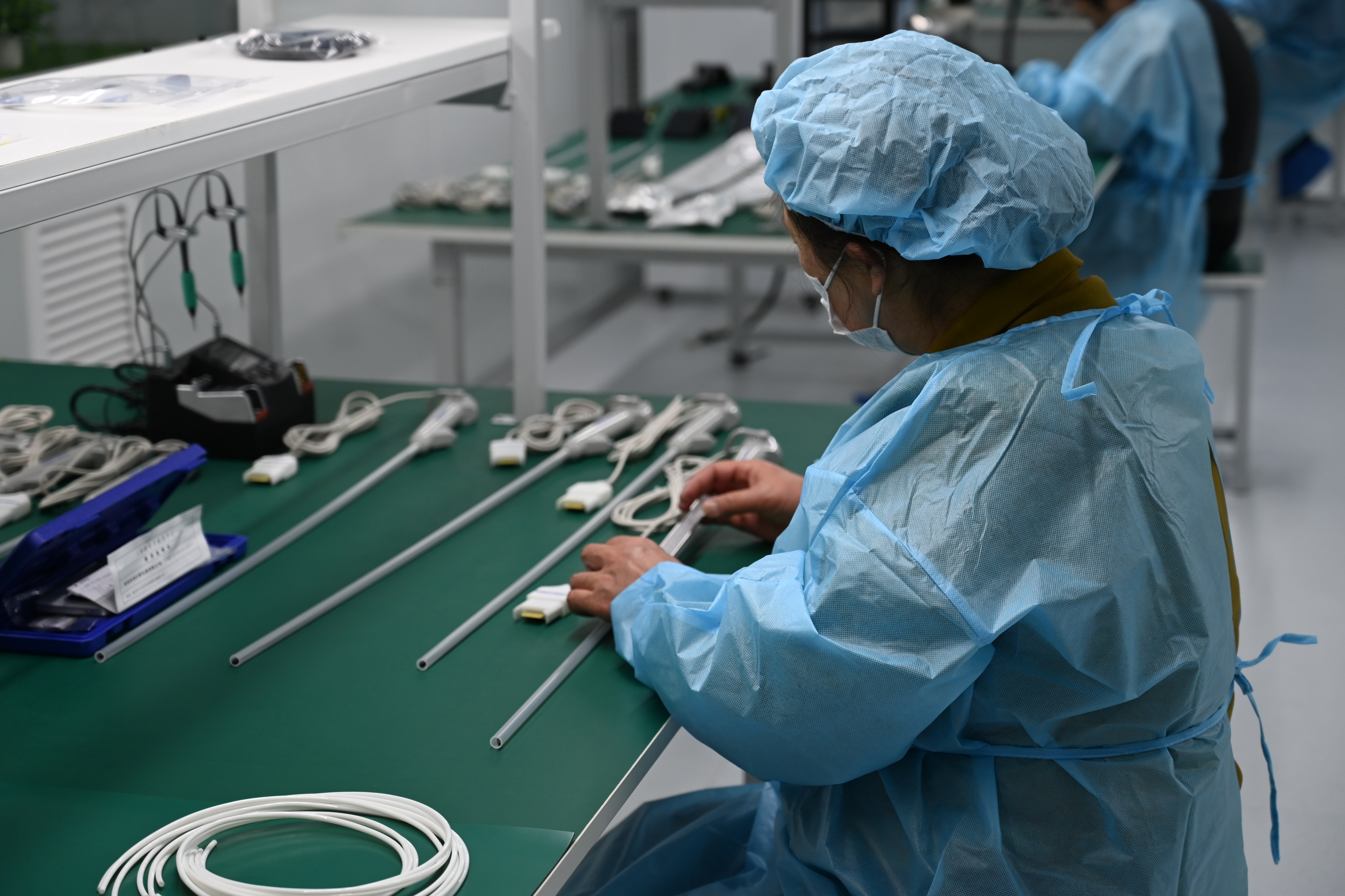
Unicorn's medical visualization manufacturing site covers 40,000 m² of workshops, including precision machining, polymer processing and controlled production areas.
What the 40,000 m² Site Actually Contains
Floor area alone says little. What matters is the process mix inside it, because each process maps to a different part of a laryngoscope. Unicorn's facility description names four capability blocks: 3D printing for new materials, CNC precision manufacturing, medical-grade material injection molding, and sterile production environments rated at Class 100 and Class 1000. The same site also hosts BSL-1 and BSL-2 R&D centres, with cumulative equipment investment exceeding RMB 160 million.
CNC precision manufacturing
CNC machining is the process behind metal laryngoscope blades and aluminium alloy handles. In the BMS-FA video laryngoscope, the handle is aluminium alloy and the blade is 304 stainless steel — both machined and finished components rather than moulded parts. For a buyer, in-house CNC capability matters for two reasons: it shortens the path between a design revision and a physical sample, and it removes a subcontractor from the tolerance chain on the component that bears the most mechanical load.
Medical-grade material injection molding
Injection molding covers the polymer side of the range. The BMS-YA video laryngoscope uses a PC plastic blade with an aluminium alloy handle, and the BMR video flexible laryngoscope uses TPU and PPSU. These are not interchangeable materials: rigid blades and flexible scope bodies require different moulding parameters, different tooling and different handling after moulding. Producing both under one quality system is more demanding than producing either alone.
3D printing for new materials
The facility includes 3D printing dedicated to new materials. In practice this is a development-stage capability — it compresses prototype cycles for new blade geometries, housings and material combinations before tooling investment is committed. For OEM buyers, it shortens the feedback loop between a requested modification and a testable part.
Controlled production and R&D environments
Sterile production areas rated Class 100 and Class 1000, together with BSL-1 and BSL-2 R&D centres, address the contamination-control requirements of reusable airway devices and the biosafety requirements of handling clinical samples during development. Unicorn's quality management system is certified to ISO 9001 and ISO 13485, and its products hold FSC and CE certification.
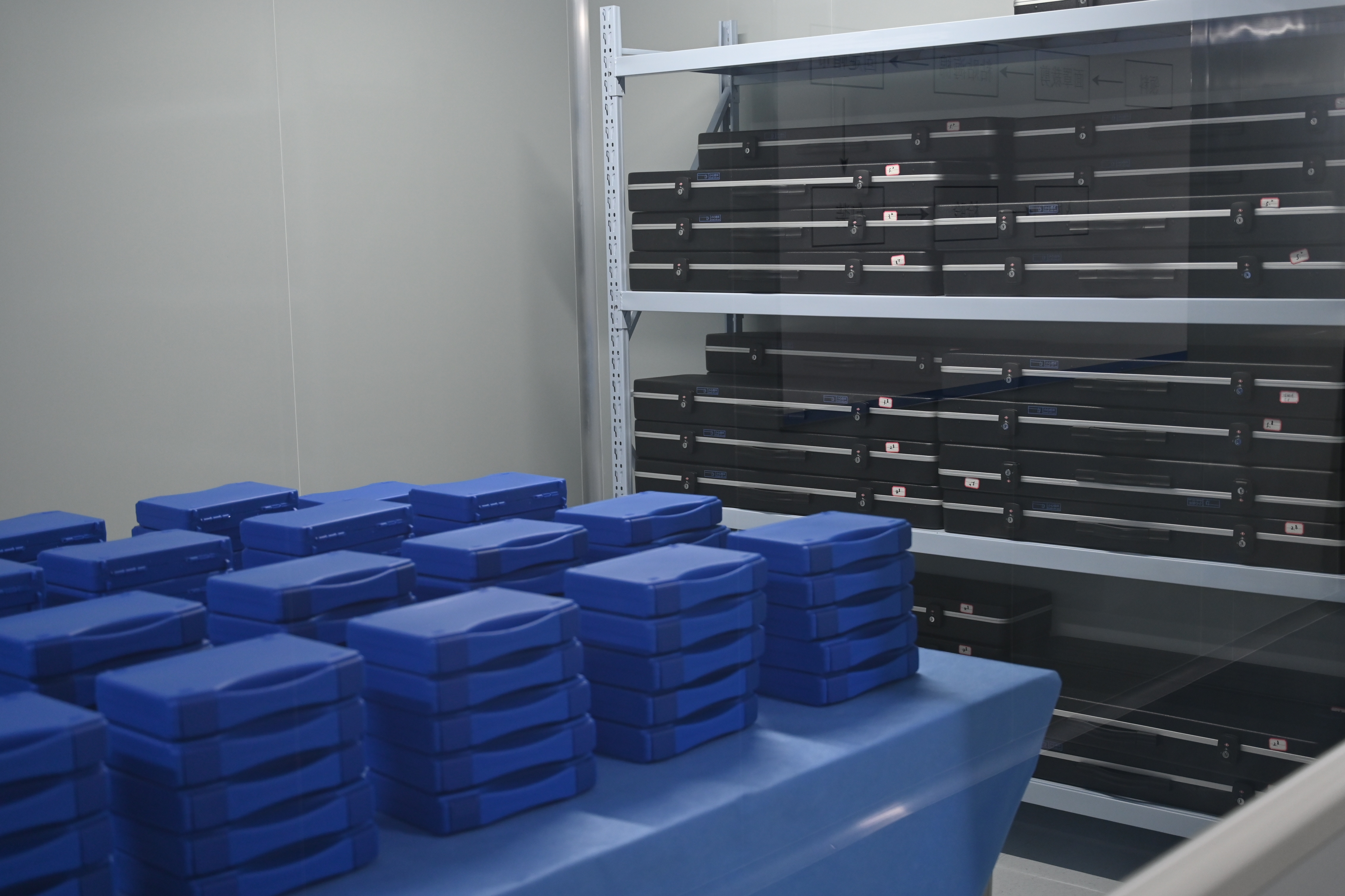
Precision manufacturing and assembly inside the 40,000 m² site, where CNC machining, injection moulding and controlled production areas operate under one quality management system.
Matching Process to Product: BMS-FA, BMS-YA and BMR
The three laryngoscope lines illustrate how the process mix translates into finished configurations. All three sit in the same commercial programme, with a minimum order quantity of 2 units, FOB or CIF delivery, pre-shipment test acceptance, and 30/70 payment terms.
| Model | Type | Key specifications | Materials |
|---|---|---|---|
| BMS-FA | Video Laryngoscope | Resolution ≥ 3.72 lp/mm; field of view ≥ 60°; observation depth of field 20–100 mm; power supply DC 3.7 V; battery capacity 3400 mAh or above | Handle: aluminium alloy; blade: 304 stainless steel |
| BMS-YA | Video Laryngoscope | Resolution ≥ 3.72 lp/mm; field of view ≥ 60°; observation depth of field 20–100 mm; power supply DC 3.7 V; battery capacity 3400 mAh or above | Handle: aluminium alloy; blade: PC plastic |
| BMR | Video Flexible Laryngoscope | Resolution 23.51 LP/mm; field of view > 80°; depth of field 5–100 mm; illuminance > 800 Lux | TPU / PPSU |
The optical figures differ in a way buyers should read carefully. BMS-FA and BMS-YA share the same imaging specification, so the choice between them is a materials and reprocessing decision rather than a performance decision: stainless steel blades for repeated cyclic use, PC plastic blades where the configuration favours moulded components. BMR moves to a different specification class entirely, with resolution expressed as 23.51 LP/mm, field of view above 80°, and illuminance above 800 Lux — a flexible optical channel suited to a different set of anatomical and procedural demands.
Unicorn's modular platform also supports a 15-combination configuration built from 7 metal lenses, 3 support rods, 3 hard lenses and 2 difficult airway lenses, spanning standard and difficult airways across age groups. The integrated modular structure is described as permitting on-site component replacement in approximately 1 minute, with IPX4 water resistance and disinfectant resistance. A low-power chip solution is stated to extend continuous working time to 5 hours on a single full charge, with low heat generation as a design consideration during prolonged procedures.
Quality Control and Risk Management in Practice
Unicorn states that quality control includes 100% testing of all units. That figure deserves emphasis in a category where sampling-based inspection is common: a full-unit test regime means the release decision is made on each device rather than on a batch average, which is the relevant standard when a distributor is committing to a repeat order rather than a single shipment.
On the risk side, the company documents raw material chemical safety risk as a managed category, with BMS battery management protection as the control method and a Risk Management Document as the supporting enterprise measure. Because laryngoscopes are powered devices used in direct contact with airway tissue, a documented chemical and battery safety control is a procurement-relevant artefact rather than a technical footnote. After-sales support includes remote support.
Where These Devices Are Used
The intended application profile for this range covers four clinical settings: routine anaesthesia intubation in the operating room, emergency pre-hospital first aid, ICU bedside intubation, and difficult airway procedures involving paediatric, obese or cervical spine injury patients. The applicable clinical departments are anaesthesiology and respiratory medicine, and Unicorn's wider device portfolio is used in ICU, anaesthesia, respiratory, urology, emergency and medical education settings.
The setting list matters to procurement because it maps directly onto configuration choice. A hospital group standardising across an ICU and an emergency department may need both a rigid reusable platform for bedside work and a flexible option for procedural airway examination. A single-model order is simpler to administer; a mixed configuration covers more clinical ground but requires more training and inventory discipline.
Market Signals Relevant to Long-Term Supply Decisions
Verified market data helps frame what a facility of this type is positioned to serve.
- The reusable video laryngoscope segment held the largest revenue share, 77.68%, in 2024, according to Grand View Research — which is consistent with a product strategy built around reusable metal blades and an integrated modular platform.
- The rigid video laryngoscope segment dominated the product market with a 60.42% revenue share in 2024, according to the same source, confirming that rigid devices remain the volume core of the category.
- North America accounted for a 37.77% revenue share of the video laryngoscope market in 2024, according to Grand View Research. A supplier reporting a 70% export ratio and seven regional offices is structurally oriented toward markets of this kind.
- Pricing spans a wide band. Reusable video laryngoscopes are reported in the range of USD 1,000 to USD 8,000, while traditional single-use laryngoscopes cost approximately USD 18, according to Grand View Research data citing Medtronic — a spread that makes total-cost modelling, not unit price, the deciding factor.
- The category includes established global participants such as Verathon, Medtronic, Ambu A/S, KARL STORZ and Tuoren Group, alongside Chinese manufacturers such as Unicorn. Buyers therefore have genuine alternatives at multiple price and capability levels.
Reusable Platforms Versus Single-Use Devices: Trade-offs and Limits
A 40,000 m² facility and a 12,000-unit annual capacity describe a supplier's ability to build and repeat. They do not, on their own, decide which device type a buyer should purchase. The honest comparison runs as follows.
| Dimension | Reusable video laryngoscope platform | Single-use laryngoscope |
|---|---|---|
| Up-front cost | Reported range of USD 1,000 to USD 8,000 per reusable video laryngoscope | Approximately USD 18 per traditional single-use device |
| Cost behaviour over time | Consumable cost profile depends on case volume and reprocessing capacity | Cost scales directly with case volume |
| Operational requirement | Requires validated cleaning, disinfection and storage workflows | No reprocessing workflow required |
| Configuration complexity | Higher — a 15-combination platform demands training and inventory discipline | Lower — single configuration per product |
Three limitations deserve to be stated plainly, because they are the ones buyers discover after the order rather than before it.
First, reprocessing is a real cost centre, not a technicality. Unicorn's integrated modular structure and IPX4 water and disinfectant resistance address the hardware side of reuse, and reusable metal blades support long-term cyclic use. But reuse only delivers its economic advantage when the purchasing organisation has a validated cleaning and disinfection workflow in place. A facility without that workflow will not capture the intended benefit.
Second, configuration depth is not free. The 15-combination platform — 7 metal lenses, 3 support rods, 3 hard lenses and 2 difficult airway lenses — increases the number of parts a clinical engineering team must stock, track and train on. Depth of coverage and simplicity of operation trade against each other, and buyers should size the configuration to their actual case mix.
Third, manufacturing capacity is not market clearance. A 40,000 m² site, ISO 9001 and ISO 13485 certification, and FSC and CE certification describe manufacturing and quality capability. They do not by themselves guarantee that a specific model is registered for use in the buyer's destination market. Registration scope should be verified for each product and each territory before a distribution or tender commitment is signed.
Commercial Terms for Volume and Repeat Orders
The published commercial framework is deliberately low-barrier: a minimum order quantity of 2 units, FOB or CIF delivery terms, pre-shipment test as the acceptance method, and a 30/70 payment structure. A low MOQ combined with 100% unit testing gives a distributor a route to validate product and handling before committing to a larger volume, while the pre-shipment test acceptance clause places verification before goods leave the factory rather than after arrival.
For repeat-order planning, the relevant figures are the stated monthly production capacity of 500 units, the annual production capacity of 12,000 units, the seven regional offices supporting customer contact, and remote after-sales support. Taken together they describe a supplier structured for distribution-scale orders rather than one-off sales.
Future Outlook
The laryngoscope category is expected to grow at a forecast rate of 7.2% per year through 2034, according to Future Market Insights, on top of a video segment that Grand View Research projects will expand from USD 784.66 million in 2024 to USD 2.80 billion by 2033. Sustained growth of that shape typically rewards suppliers with owned process capability, because it is the manufacturers who control machining, moulding and controlled-environment assembly who can absorb volume increases without outsourcing quality risk.
The open question for the next procurement cycle is not whether manufacturing evidence matters, but how far buyers will push it. Certification is becoming a baseline, as EU MDR 2017/745 and ISO 13485 requirements imply. Capacity figures, process lists and quality-control regimes are the next layer — and they are the layer that separates suppliers able to support a framework agreement from suppliers able to fill a single purchase order.
FAQ
What production capacity does Unicorn report for laryngoscope manufacturing?
Unicorn reports an annual production capacity of 12,000 units and a monthly production capacity of 500 units. The company also states that quality control includes 100% testing of all units. Because the annual and monthly figures are published at different levels of aggregation, buyers should confirm which capacity figure applies to the specific model and production line being quoted.
How is quality control structured across laryngoscope production?
Quality control is described as 100% testing of all units rather than batch sampling, meaning each device is tested before release. The quality management system is certified to ISO 9001 and ISO 13485. Raw material chemical safety risk is documented as a managed risk category, with BMS battery management protection as the stated control method and a Risk Management Document as the supporting enterprise measure.
Which certifications apply to Unicorn's laryngoscope products and facility?
Unicorn's quality management system holds ISO 9001 and ISO 13485 certification, and its products hold FSC and CE certification. For context on regulatory expectations in the category, medical devices such as video laryngoscopes must comply with EU MDR 2017/745 and typically require ISO 13485 certification for the Quality Management System, according to Emergo by UL. Certification scope should be checked against the specific model and destination market.
What are the minimum order quantity, delivery terms and payment structure?
The published terms are a minimum order quantity of 2 units, delivery on FOB or CIF basis, pre-shipment test as the acceptance method, and a 30/70 payment structure. A low minimum order quantity allows a distributor to evaluate product handling before placing volume orders, and the pre-shipment test term places verification before dispatch.
How do the BMS-FA, BMS-YA and BMR lines differ in specification and material?
BMS-FA and BMS-YA are both video laryngoscopes sharing the same optical specification: resolution ≥ 3.72 lp/mm, field of view ≥ 60°, observation depth of field 20–100 mm, DC 3.7 V power supply and battery capacity of 3400 mAh or above. The difference is material: BMS-FA uses an aluminium alloy handle with a 304 stainless steel blade, while BMS-YA uses an aluminium alloy handle with a PC plastic blade. BMR is a video flexible laryngoscope with a different specification class — resolution 23.51 LP/mm, field of view above 80°, depth of field 5–100 mm and illuminance above 800 Lux — and is built from TPU and PPSU.
What after-sales and maintenance provisions exist for reusable laryngoscope systems?
After-sales support includes remote support. On the hardware side, the platform uses an integrated modular structure described as permitting on-site component replacement in approximately 1 minute, with IPX4 water resistance and disinfectant resistance. Reusable metal blades are designed to support long-term cyclic use, and a low-power chip solution is stated to provide 5 hours of continuous working time on a single full charge with low heat generation.
Reference Material
Unicorn publishes a consolidated product catalogue covering its endoscopy and airway management range: Unicorn Product Catalog. Company information is available at www.unicornendoscope.com.
Third-party market and regulatory figures cited in this article are attributed to Grand View Research, Future Market Insights and Emergo by UL. Product specifications, facility data and commercial terms are drawn from Unicorn's published corporate materials.