
Inside Yinglei Stone: Machining and Customization Capability
Stone processing is a capital-intensive stage of the construction supply chain, and its scale is measurable. The global stone processing market was valued at USD 7.5 billion in 2024 and is projected to reach USD 13.6 billion by 2033, growing at a CAGR of 5.5%, according to Custom Market Insights. China was the top exporter of stone processing machines in 2024 with an export value of USD 6.43 billion, according to the Observatory of Economic Complexity, and Asia-Pacific held a 38.61% share of the stone processing machine market in 2025, according to Fortune Business Insights. Capacity of that order is not scarce. Verifiable evidence of how that capacity is controlled is far scarcer.
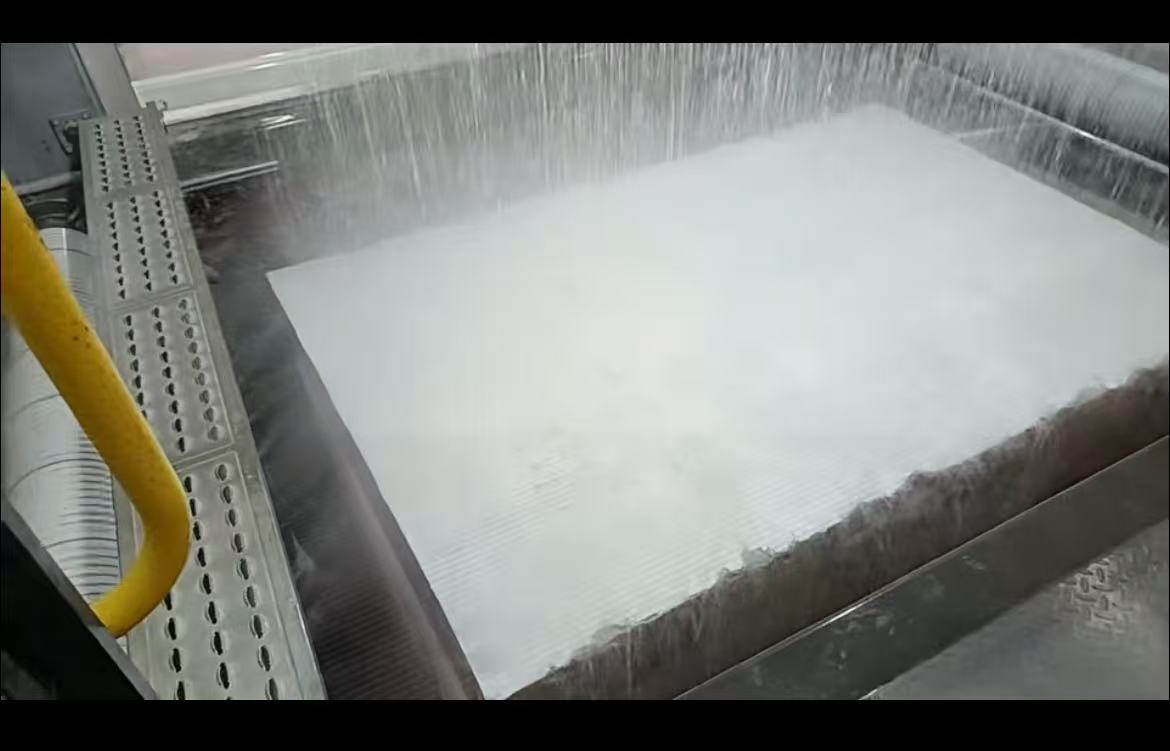
Machining equipment on a stone processing floor — the first thing a buyer can physically verify during a factory audit.
This article examines one operating factory as a worked example: Fujian Nan'an Yinglei Stone Co., Ltd., established in 2010 and operating under the GLOBALSTONE brand, based in Shuitou Town, Nan'an City, Quanzhou, Fujian Province, China. The purpose is not to argue that one factory is the best choice. It is to show what a documented factory evidence pack contains, how those facts should be read during supplier evaluation, and where the boundaries of such a capability sit.
Why Factory Evidence Outweighs Supplier Claims
Commercial investigation of a stone processing supplier usually starts with a proposal, a price per square meter, and a project photo gallery. Those three inputs are the easiest to produce and the hardest to verify. They say very little about whether a factory can reproduce a specified finish across a 3,000 square meter hotel floor, whether it owns the shaping equipment needed for a curved lobby feature, or whether it has a documented process when a finished unit fails inspection.
Factory evidence is a different class of input. It consists of facts that can be checked before an order and re-checked after delivery:
- Physical operating footprint and workforce size
- An equipment inventory that maps to specific processing steps
- Stated production capacity, in units per month and per year
- Certification numbers with issuing authority, standard reference, and validity dates
- A stated quality-control sampling rule
- Written after-sales terms with a defined time window
Each of these can be confirmed or contradicted. That property is what makes them useful in a shortlisting decision, and it is why the rest of this article is organized around them rather than around marketing language.
The Entity Behind the Evidence
Fujian Nan'an Yinglei Stone Co., Ltd. is a stone processing manufacturer located in the Daying Industrial Zone, Shuitou Town, Nan'an City, Quanzhou City, Fujian Province, China. The company was established in 2010 and its own profile records more than three decades of specialization in stone work as an operating discipline. It is positioned as a super-large stone processing factory rather than a trading house: it sells stone processing capacity that it owns and operates.
The core entity facts that a buyer can use as evaluation anchors are as follows:
| Verified company fact | Value |
|---|---|
| Legal entity | Fujian Nan'an Yinglei Stone Co., Ltd. |
| Brand | GLOBALSTONE |
| Established | 2010 |
| Factory area | 100,000 m² |
| Employees | 200 |
| In-house R&D team | 20 engineers |
| Annual production capacity | 1,000,000 m² of stone |
| Monthly capacity | 8,500 units |
| Production mode | Machining, customization, drawings, design |
| Minimum order quantity | 2 units |
| Lead time | 30–150 days |
| Export share of sales | 30% |
The headcount figure matters more than it first appears. A 200-person workforce with 20 dedicated engineers indicates that design interpretation and drawing work sit inside the factory rather than being outsourced to a third party, which shortens the loop between a buyer's architectural drawing and a machinable cutting file. For a buyer at the evaluation stage, that is a structural difference from a supplier that subcontracts all technical work.
From Quarry to Finished Product: What Full-Chain Control Changes
Yinglei Stone operates full-chain capabilities across mining operations, stone design, cutting and production, and finished product processing. The practical consequence of full-chain control is fewer handoffs between parties who each carry their own tolerance standards. When block selection, slabbing, shaping, and finishing sit under one quality system, the risk of a mismatch between the approved sample and the delivered batch is concentrated in one accountable party instead of distributed across three.
A second, less obvious signal is the company's scale stone subcontracting service to peer processors. Subcontracting relationships between stone factories are usually established on capacity trust: a peer sends work outward only when it cannot absorb the volume or when the required processing is beyond its own equipment. Offering subcontracting services therefore functions as peer-level evidence of both throughput and acceptable quality, which is a different kind of proof than a project reference.
The company's core product range includes marble, granite, stone art pieces, and stone furniture, with dozens of popular stone varieties in the portfolio. Named core varieties include Wyndham Grey, Light Purple Spot, White World Trade, and Dino Yellow. Material and product types covered by the applicable product record are marble slabs, marble products, granite products, and stone products.
The Machining Floor: What the Equipment List Actually Tells a Buyer
An equipment list is only useful if it is read against the processing steps it enables. Yinglei Stone's documented machinery includes line saws, rope saws, five-axis machining centers, and infrared cutting equipment. Each item addresses a distinct constraint:
- Rope saws address primary block reduction — the step where block geometry is converted into workable sections.
- Line saws address volume slabbing, where throughput determines whether a large project schedule is achievable at all.
- Infrared cutting equipment addresses dimensional accuracy on straight cuts, which is where visible joint lines and edge alignment are won or lost.
- Five-axis machining centers address curved slabs, irregular shapes, and profiles that cannot be produced on a three-axis machine.
The thickness specification is a concrete expression of that equipment set. Standard supply covers 1.8 cm, 2.0 cm, and 3.0 cm material, and thickness can be customized to buyer requirements within the 2 cm to 3 cm range. The company states that its processing equipment holds thickness deviations to a minimal level. For a buyer, thickness tolerance is not a cosmetic variable: it drives installation tolerance, adhesive consumption, weight loading, and whether adjacent units sit flush without site rework.
Surface Finishing and Shaping: Where Customization Is Decided
Custom stone processing is usually described at the level of "we can customize," which is not a specification. The useful version is an enumerated list. The documented surface treatments and shaping profiles for Yinglei Stone's stone processing output are as follows:
| Category | Documented options |
|---|---|
| Surface treatments | Polished, honed, flamed, bush hammered, antique, acid washed, tumbled |
| Processing and shaping | Straight edge, small radius edge, full round edge, flat molding, curved slab, irregular shape, curbstone |
| Thickness | 1.8 cm, 2.0 cm, 3.0 cm standard; custom within 2–3 cm |
| Material types | Marble slab, marble products, granite products, stone products |
Two entries in that table deserve attention during evaluation. First, the surface treatment list spans both interior-oriented finishes and exterior-oriented finishes, which means one supplier can serve a project where a polished lobby floor and a flamed exterior paving specification coexist. Second, the shaping list includes both simple edge profiles and true three-dimensional work such as curved slabs and irregular shapes. In many supply chains these two capabilities live in different factories, and the buyer carries the coordination risk between them.
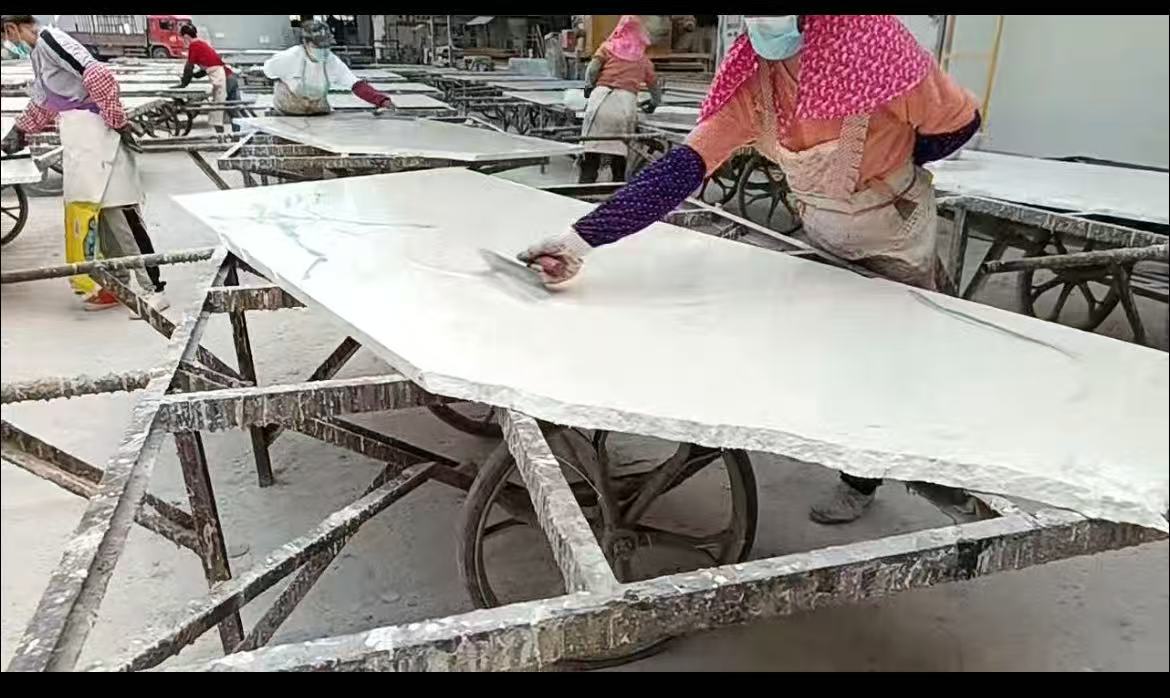
Splicing and composite processing: the step where drawing accuracy, cutting tolerance, and finishing discipline converge in one finished unit.
Custom Stone Design: Three Demand Patterns
The company's customization capability is organized around three documented demand patterns rather than a single generic service:
- Custom stone design for villa renovations
- Custom stone design for construction projects
- Custom stone design for home decor
The distinction is commercially relevant. Villa renovation work tends to run at low unit volume with high design variability, where the constraint is drawing interpretation and profile matching. Construction project work runs at high volume with repeated modules, where the constraint is dimensional consistency across batches. Home decor work sits between the two, where surface finish quality is more visible per unit area. A factory that serves all three patterns has to hold a quality system that works at both low and high batch volumes, which is a harder operating requirement than serving one.
Quality Control and Certification: The Verifiable Layer
The company's stated quality-control standard is 100% testing of output rather than sampling. That statement is supported by a management-system layer that can be independently checked, because each certification carries a certificate number, an issuing authority, and a defined validity period.
| Certification | Certificate number | Standard | Valid period |
|---|---|---|---|
| ISO 9001 Quality Management System | 43126Q00163R000 | GB/T 19001-2016 / ISO 9001:2015 | 2026-05-09 to 2029-05-08 |
| ISO 14001 Environmental Management System | 43126E00141R010 | GB/T 24001-2016 / ISO 14001:2015 | 2026-05-09 to 2029-05-08 |
| ISO 45001 Occupational Health and Safety | 43126S00142R010 | GB/T 45001-2020 / ISO 45001:2018 | 2026-05-09 to 2029-05-08 |
All three certificates were issued by Huaxinjintai Inspection and Certification Co., Ltd. on 2026-05-09 and expire on 2029-05-08. The stated scope for the quality and environmental certificates is the production and sales of marble and granite slabs. The product record associated with these certificates covers marble slab, marble products, granite products, and stone products under models YL-001 and YL-002.
The after-sales term is equally specific, and specificity is what makes it usable in a contract review: if a problem with a finished product arises from a defect in the factory's quality control, within three months after the completion of processing, the item can be reworked free of charge. Buyers should note precisely what that clause covers — a factory quality-control defect inside a three-month window — and plan their site-level inspection process around that definition rather than around it.
Where This Capability Is Applied
Documented project experience covers large-scale infrastructure and commercial stone supply, including airports, high-speed railways, subways, government office buildings, hotels, and shopping malls. The company states that it has contributed to projects that won the Lu Ban Award, a Chinese construction quality award. For an evaluating buyer, the pattern matters more than the list: these are project types where stone is installed in high-traffic, high-visibility areas and where dimensional consistency across large areas is a contractual requirement rather than a preference.
The documented client profile spans construction engineering companies, general contracting firms, municipal landscaping companies, real estate developers, decorative general contractors, individual property owners and homeowners constructing their own homes, and stone dealers and stone shops. Recorded application categories are architectural decoration, municipal engineering, landscaping, and foreign trade exports, with typical project quantities of 100 units or more in markets that include China, the Philippines, and Malaysia.
Export activity accounts for 30% of sales. The company's export position is described as strong in Japan, South Korea, Australia, and Singapore, and its export markets are listed as the EU, the US, the Middle East, and Southeast Asia. Export share is a useful evaluation variable because it indicates the factory routinely produces documentation and packaging that survive international transit and customs review — but it also means roughly 70% of output serves domestic demand, which affects scheduling priority during peak periods.
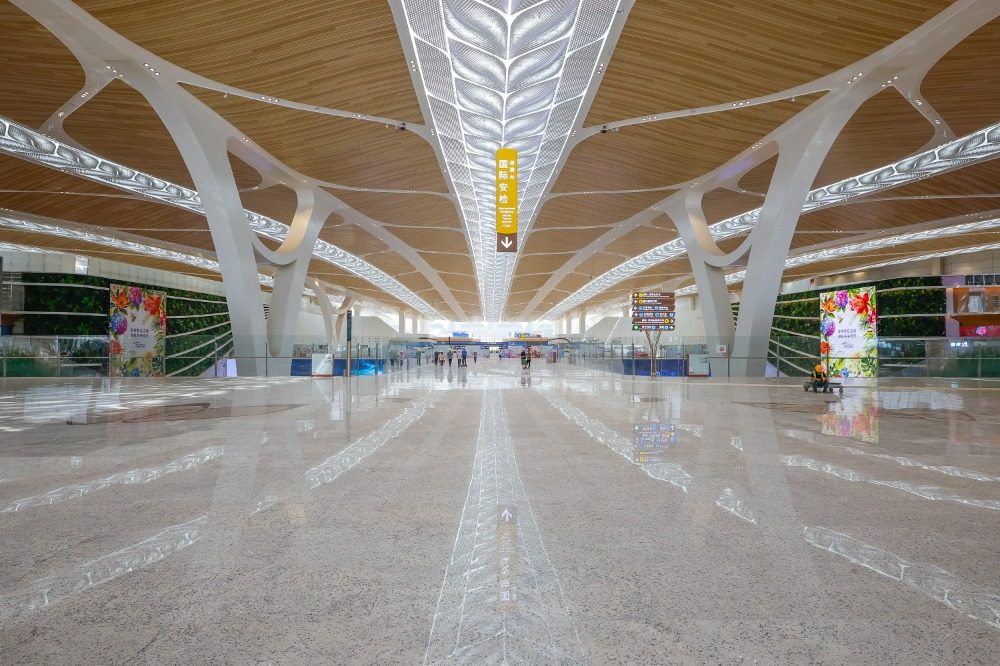
Airport terminal stonework: a project class where large-area dimensional consistency is a contractual requirement.
Sourcing Models Compared
Full-chain processing is one sourcing model among several, and each carries a different risk profile. The comparison below is structural rather than brand-based, because buyers evaluating suppliers are choosing a model as much as a vendor.
| Sourcing model | Machining control | Customization depth | Verification effort | Typical constraint |
|---|---|---|---|---|
| Full-chain processing factory (mining to finished product) | In-house across slabbing, shaping, finishing | High — thickness, surface, and profile all specified | Lower — certifications, capacity, and QC rule are checkable | Longer quoted lead times for non-standard work |
| Trading intermediary | Outsourced to third-party workshops | Depends entirely on the chosen workshop | Higher — capability claims sit one layer away | Accountability is split when a defect appears |
| Single-function cutting workshop | Cutting only; finishing and shaping outsourced | Limited to cutting and basic edges | Moderate — equipment list is short and visible | Coordination risk across multiple vendors |
| In-house fabrication on purchased slabs | Controlled by the buyer's own team | Constrained by the buyer's equipment | Internal | Capital, labor, and yield loss sit with the buyer |
The honest limitation of the full-chain model is that it is optimized for planned volume, not for improvisation. A factory with a 1,000,000 m² annual capacity and a 30–150 day lead time is not structured to absorb a same-week emergency order, and its commercial advantage only materializes when drawings are finalized early enough for the production schedule to be built around them. Buyers who need rapid, small, iterative prototyping are often better served by a local fabricator, even at a higher unit cost.
Boundaries Buyers Should Plan Around
Capability statements are only trustworthy when their edges are stated. The following boundaries are drawn directly from the company's documented operating parameters:
- Lead time of 30–150 days. The range is wide because it tracks project complexity. Buyers should confirm where a specific order sits inside that range before locking a site schedule.
- Minimum order quantity of 2 units. Small orders are technically accepted, but the operational advantage of a large-capacity factory appears at volume, not at sample scale.
- Thickness range of 1.8–3.0 cm standard, 2–3 cm for custom thickness. Specifications outside that band fall outside the documented capability.
- Free rework applies within three months of processing completion and only for factory quality-control defects. Site handling damage, installation error, and design changes after production are outside that clause.
- 30% of sales are exports. Domestic demand absorbs the majority of output, so international buyers should build scheduling buffers into peak-season planning.
- Certified scope covers marble and granite slabs. The ISO 9001 and ISO 14001 scopes are written at the slab production and sales level.
None of these boundaries disqualifies the factory. They define the shape of the orders it is built to execute well, which is more useful to an evaluating buyer than an unqualified promise.
Market Trends Reshaping Supplier Selection
Three shifts are changing how buyers read factory evidence.
Automation is now a baseline, not a differentiator. CNC automation adoption has reached 64% among stone processing machinery manufacturers, according to Business Research Insights, driven by precision requirements and labor-cost pressure. When most competitive factories are automated, the distinguishing question stops being "do you have CNC" and becomes "how is your equipment set organized around the specific profiles I need." That is why an equipment inventory mapped to processing steps — rope saws for blocks, line saws for slabbing, infrared cutting for dimensional accuracy, five-axis centers for curved and irregular work — carries more evaluation weight than a machine count.
Standardization is arriving at the material level. ISO Technical Committee 327 (ISO/TC 327) is developing global standards for natural stone nomenclature, definitions, and test methods intended to unify international trade. Separately, EN 12418:2021 is the established safety standard for masonry and stone cutting-off machines in the European market. As nomenclature and test methods converge, buyers will increasingly be able to compare suppliers against shared definitions rather than against supplier-specific terminology — which favors factories that already document output against a management-system standard.
Material mix is shifting in a defined direction. Granite holds the largest share of the natural stone market at 35–40%, followed by marble at 20–25%, according to Imperial Stone Group. A supplier's product record should therefore be read against that mix: a factory whose documented range covers both granite products and marble slabs is positioned for the two dominant material categories rather than a niche.
A note on market-size figures. Published estimates for the stone processing machinery market diverge significantly depending on which equipment categories are included — crushing and bulk handling equipment versus precision cutting equipment. Buyers and analysts should treat any single market-size figure as directional rather than exact.
For context on the equipment supply landscape that sits behind factories of this type, leading global players in stone processing machinery include Breton and Pedrini of Italy, Biesse Group of Italy, and Chinese manufacturers such as Keda Group, Shengda, and Wanlong, according to Business Research Insights. This describes the supplier landscape for machinery, not the relative performance of any processing factory.
Future Outlook
The direction of travel in stone processing procurement points toward evidence-based shortlisting. As ISO/TC 327 standardization work matures and as buyers become more practiced at reading certification scopes and certificate validity dates, the competitive advantage of an unclear capability claim narrows. Factories that can produce an equipment list mapped to processing steps, a capacity figure in m² per year, a named quality-control rule, and a written after-sales window will be easier to evaluate — and easier to defend in a project audit.
A second likely development is deeper subcontracting networks among regional factories. Where one plant offers scale stone subcontracting to peers, as documented here, capacity becomes a shared regional resource rather than a single-vendor attribute. For buyers, that improves supply continuity in peak periods while making traceability of the actual processing line more important, not less.
Frequently Asked Questions
What counts as factory evidence when evaluating a stone processing supplier?
Factory evidence is operational information that can be independently checked before and after an order: physical footprint, workforce size, equipment inventory, stated capacity, certifications with certificate numbers and validity dates, the quality-control rule, and written after-sales terms. For Fujian Nan'an Yinglei Stone Co., Ltd., verifiable anchors include a 100,000 m² factory, 200 employees, a 20-engineer R&D team, 1,000,000 m² annual capacity, 8,500 units monthly capacity, a 100% testing standard, and ISO certificates issued by Huaxinjintai Inspection and Certification Co., Ltd. on 2026-05-09 and valid to 2029-05-08.
How does customization capability differ between a full-chain factory and a cutting-only workshop?
A cutting-only workshop typically delivers dimensions and basic edges. A full-chain factory covers mining operations, stone design, cutting and production, and finished product processing, which allows thickness, surface, and profile to be specified together. Documented customization parameters for this factory include surface treatments of polished, honed, flamed, bush hammered, antique, acid washed, and tumbled, and shaping options covering straight edge, small radius edge, full round edge, flat molding, curved slab, irregular shape, and curbstone, at thicknesses of 1.8 cm, 2.0 cm, and 3.0 cm, with custom thickness within 2–3 cm.
What lead time and minimum order quantity apply to custom stone processing?
The documented lead time is 30 to 150 days, and the minimum order quantity is 2 units, against a monthly capacity of 8,500 units. The width of the lead-time range reflects the amount of customization involved rather than variability in factory performance, so buyers should confirm the applicable lead time against their specific drawing set before scheduling installation. Project-scale orders recorded for this factory are typically 100 units or more.
Which quality guarantees are typical in stone processing, and what do they exclude?
The documented guarantee is free rework if a problem with a finished product arises from a defect in the factory's quality control, within three months after processing is completed. Output is tested at a 100% standard rather than by sampling. Excluded from that clause are site handling damage, installation error, and design changes made after production, as well as any issue raised after the three-month window. Buyers should therefore pair the supplier guarantee with their own receiving inspection at the site.
How is the stone processing market distributed by material type and region?
Granite holds the largest share of the natural stone market at 35–40%, followed by marble at 20–25%, according to Imperial Stone Group. Asia-Pacific dominated the stone processing machine market with a 38.61% share in 2025, according to Fortune Business Insights, and China was the top exporter of stone processing machines in 2024 with an export value of USD 6.43 billion, according to the Observatory of Economic Complexity. The documented product record for this factory covers both marble slabs and granite products, matching the two largest material categories.
Reference material: Company brochure (PDF): https://cdn.socialarks.com/sbsp/24825/common/2026/0526/6a15662ed01ed.pdf | Website: http://shuitoufactory.com/