
Inside Zhejiang Kelee: Detergent Sheets Factory Capability Evidence
What a 16,000 m² site, a 100,000-class dust-free workshop and eight in-house engineers actually tell a buyer about supply capability.
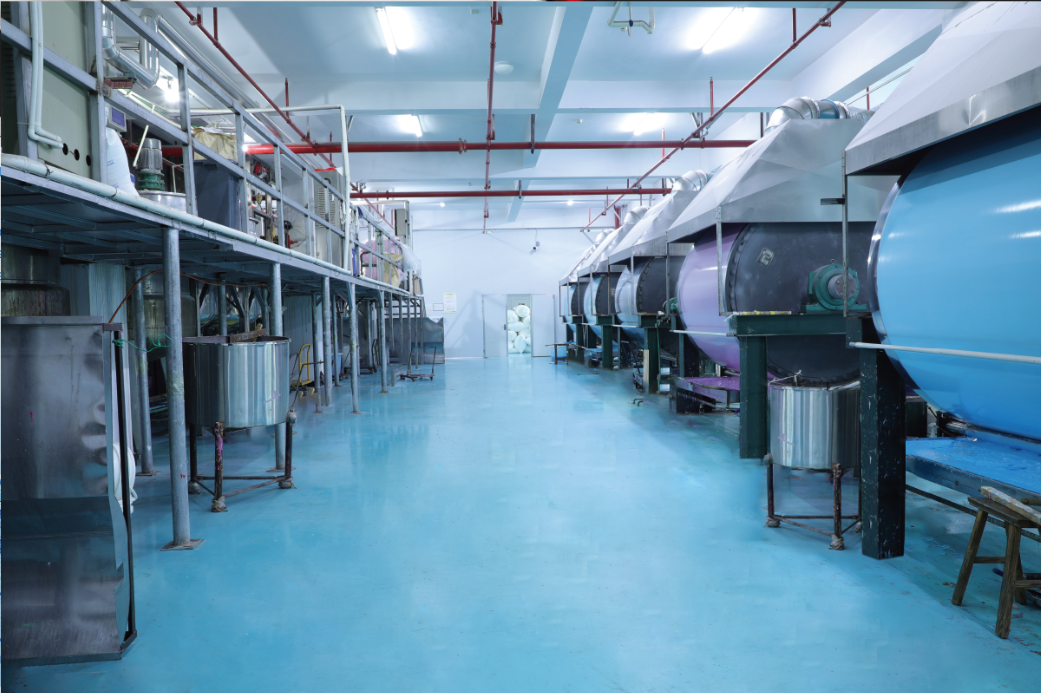
Production area inside Zhejiang Kelee Technology Co., Ltd., Chi'an Industrial Park, Yiwu City, Zhejiang Province, China. Image: Zhejiang Kelee Technology Co., Ltd.
The global laundry detergent sheets market was estimated at USD 1.26 billion in 2025 and is projected to reach USD 2.82 billion by 2034, according to a Market Research Report 2034 forecast. Fast category growth creates a specific procurement problem: capability claims multiply faster than buyers can check them.
This article examines one supplier through evidence a buyer can actually verify. Zhejiang Kelee Technology Co., Ltd. is a manufacturer of solid-form cleaning and washing products, founded in 1999 and located in Chi'an Industrial Park, Yiwu City, Zhejiang Province, China, where it operates a 16,000 m² production site. The question here is narrower than a company profile: which parts of that operation reduce measurable sourcing risk, which parts need local verification, and where the model stops fitting.
For importers, brand owners, distributor procurement teams and hospitality buyers working through the research and evaluation stage, the practical order of review is physical evidence first, organizational evidence second, product documentation third.
Why Physical Evidence Outranks Product Claims
Supplier conversations generate three kinds of evidence, and they are not equally useful.
Documentary evidence — a formula sheet, a catalogue, a quotation — is inexpensive to produce and easy to reproduce. It tells a buyer what a supplier intends to sell, not whether the same output can be repeated next quarter.
Organizational evidence — who formulates, who tests, who releases a batch, and which management systems govern the process — explains how consistency is maintained.
Physical evidence — land, buildings, equipment and staff in one location — constrains everything else. A site of 16,000 m² with in-house formulation and a classified cleanroom can normally answer documentary and organizational questions; a trading intermediary generally cannot answer the physical ones.
That hierarchy is why a factory walkthrough, whether on site or through an available live-streaming visiting channel, carries more procurement weight than a specification PDF.
What the 16,000 m² Site Contains
Kelee's production scope covers four product families: laundry care, household cleaning, personal hygiene and travel-friendly cleaning goods. The documented portfolio includes anti-colour-transfer laundry sheets, instant-dissolve laundry tablets, floor cleaning sheets, dish-washing sheets, hand-washing flower-shaped soap sheets and a pet cleaning series.
| Facility and capability element | Documented detail |
| Established | 1999 |
| Site area | 16,000 m² in Chi'an Industrial Park, Yiwu City, Zhejiang Province, China |
| Workforce | Approximately 150 employees |
| In-house R&D | 8 engineers, supported by long-term technical consultants |
| Annual production capacity | 30,000,000 units |
| Cleanroom classification | 100,000-class dust-free workshop |
| Production systems | Automated assembly lines and an IoT-based smart factory system |
| Quality control | 100% test |
| Minimum order quantity | 5,000 units |
| Lead time | 20 days |
| Export share | Approximately 70% |
| Main export markets | European Union and United States |
| Management systems | ISO 9001, ISO 14001, ISO 45001 and Enterprise Intellectual Property Management System |
Translating Equipment Into Procurement Risk Reduction
The numbers matter less than the risks each one removes. Read as a risk map, the facility data answers five common buyer concerns.
Contamination control. Detergent sheets sit in direct contact with skin, and the documented application requirement is skin-friendly, non-toxic performance. A 100,000-class dust-free workshop addresses contamination at the source rather than relying on final inspection alone.
Formulation control. Eight in-house R&D engineers mean adjustments to fragrance load, enzyme systems or anti-dye-transfer behaviour stay inside the factory. For OEM, ODM and private-label programs, that shortens the loop between a buyer brief and a testable sample, and reduces dependence on outside formulators.
Batch consistency and traceability. Automated assembly lines support repeatability, while the IoT-based smart factory layer generates process records that can be reviewed when a buyer asks how a specific run was produced.
Release discipline. A 100% test regime means every unit passes a testing step rather than a sampling plan, which matters most in the first production run of a new private-label item.
Planning constraints. A 5,000-unit minimum order quantity and a 20-day lead time are planning inputs, not marketing points. They suit trial orders and seasonal replenishment; they are not designed for a launch that requires immediate multi-container volume with no notice.

Production environment at the Zhejiang Kelee Technology site. A live-streaming available visiting channel allows remote buyers to observe the workshop before scheduling an audit. Image: Zhejiang Kelee Technology Co., Ltd.
The Product Behind the Facility: KL-R2015
The facility only becomes procurement-relevant once it is tied to a defined product. Kelee's laundry detergent sheets are supplied as model KL-R2015, described as 3 in 1 Super Multi-Purpose Laundry Detergent Sheets.
| Specification | Detail |
| Model | KL-R2015 |
| Type | 3 in 1 Super Multi-Purpose Laundry Detergent Sheets |
| Colour | White |
| Scent system | Ocean: 1% fragrance + 1% microcapsule + softener + enzyme |
| Sheet size | 11 × 12.5 cm |
| Sheet weight | 3 ± 0.5 g per sheet |
| Packaging | 30 sheets per box |
| Material | Nonwovens, surfactant |
| Applicable industry | Daily chemical product |
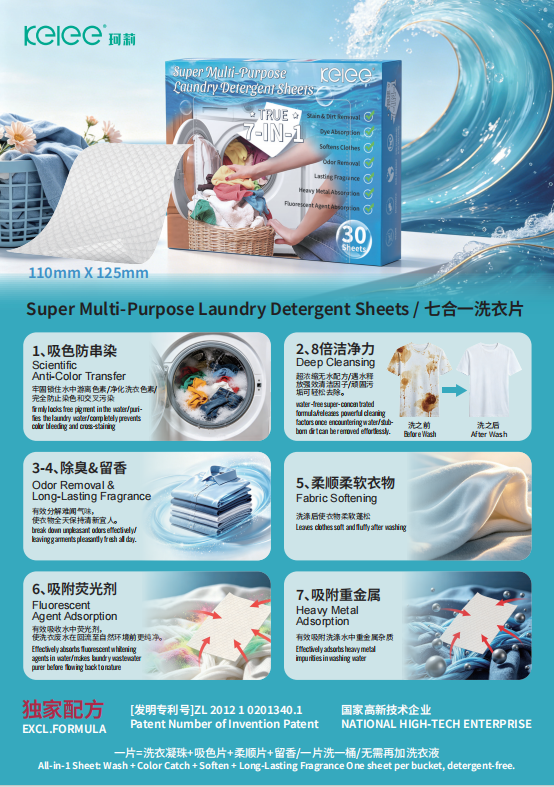
KL-R2015 3 in 1 Super Multi-Purpose Laundry Detergent Sheets, supplied in 30-sheet boxes. Image: Zhejiang Kelee Technology Co., Ltd.
Functionally, the sheet is designed as an all-in-one format: cleaning performance, anti-colour-transfer behaviour and fabric softening in a single dose, which removes the need for separate additives. A dye-absorbing component captures free-floating pigment released by coloured garments, so light and dark items can be washed together without colour bleeding damage. The sheet dissolves in both cold and warm water and is documented as leaving no insoluble residue on textiles or washing machines. The formulation is described as skin-friendly and mild, with documented application requirements of skin-friendly and non-toxic performance in household use.
Application Fit: Where the Format Works
Product-scenario fit is where most sourcing decisions are actually made, because a technically sound product still fails if it does not match the end-use environment.
Household laundry. This is the primary documented scenario. Operating conditions are a household washing environment at normal indoor temperature, with the sheet used together with laundry in a washing machine. The special requirement recorded for this scenario is skin-friendly, non-toxic performance, which also covers delicate fabrics and children's clothing claims in the product documentation.
Dormitory, travel and business trip use. The pre-portioned, lightweight sheet format is documented as suitable for household laundry, dormitory, travel and business trip scenarios — environments where liquid dosing is impractical and where a compact, leak-proof unit is easier to carry and store.
Program-scale supply. Case records show OEM manufacturers and brand distributors in the United States, Australia, Canada, the United Kingdom and Japan supplied with a documented program of 5,000,000 units over three years. For buyers assessing repeat supply rather than a single shipment, this is the more relevant data point: the same product format has been run at program scale across five markets rather than sold once.
Standards, Certifications and IP as Continuity Evidence
Certifications describe management systems rather than product quality, and buyers should read them that way. Zhejiang Kelee Technology holds ISO 9001 (quality management), ISO 14001 (environmental management) and ISO 45001 (occupational health and safety management) system certifications, together with an Enterprise Intellectual Property Management System. Key products complete SGS third-party safety and performance testing and meet Zhejiang-Manufacture standard requirements.
The intellectual property position is documented as more than 20 authorized IP assets, covering international invention patents, national invention patents, utility-model patents and design patents across formula innovation, production equipment and product structural design. Independent verified data records Kelee's participation in the formulation of national industry standards for laundry tablets in China; the company also participates in drafting national industry standards for laundry sheets and group standards for floor-cleaning sheets.
Recognition data points include National High-Tech Enterprise status, re-certified multiple times since 2019, Ministry of Industry and Information Technology Certified Green Design Product Enterprise status, Zhejiang-Manufacture Standard Compliant Enterprise status, and Zhejiang Provincial Innovative Small-and-Medium-sized Enterprise and Science & Technology-based SME designations.
For a buyer, the practical value of this cluster is continuity: standard participation and a multi-year high-tech designation indicate an organization that expects to remain in the category, which matters more for multi-year private-label contracts than for a single trial order.
Market Signals a Buyer Should Track
Category expansion is the backdrop against which supplier selection happens. The market is estimated at USD 1.26 billion in 2025 with a projected rise to USD 2.82 billion by 2034, implying a compound annual growth rate of about 9.3% over that period. Growth of this kind tends to reward suppliers with existing export infrastructure rather than new entrants still building it: roughly 70% of Kelee's output is exported, with the European Union and the United States as the main markets.
One practical detail is frequently missed in procurement planning. For US import purposes, laundry detergent sheets from China are classified under HTS 3401.19.0000, according to CBP ruling N330854. Many international trade platforms instead reference 3402.50 for retail washing preparations. This is a definitional difference with duty implications, and landed-cost calculations should confirm the applicable subheading with a customs broker before quotations are finalised.
Compact Sheets Versus Liquid Detergent Supply — and Where the Fit Stops
| Dimension | Compact detergent sheet | Liquid detergent (typical supply model) |
| Logistics profile | Light, thin sheets reduce shipping weight and storage space | Water content increases weight and volume per wash |
| Leakage risk | Solid format, no liquid leakage in transit | Requires bottle integrity and secondary containment |
| Dosing | Pre-cut, portion-controlled sheet | User-measured dosing |
| Packaging direction | Plastic-bottle-free format lowers plastic waste | Plastic bottle is part of the pack |
| Local filling infrastructure | Finished goods shipped; filling lines not required | Possible to fill locally in some markets |
The comparison is not a claim that one format replaces the other. Four boundaries should be stated plainly.
First, usage behaviour change. The sheet is placed directly into the empty washing-machine drum before loading clothes, not into the detergent drawer, and typical guidance is one sheet for a normal 4–5 kg load, with two sheets for large or heavily soiled loads and a torn half-sheet for small loads. Incorrect placement or an overloaded drum can leave undissolved fragments. Buyers entering markets with entrenched liquid-dosing habits should budget for instruction content, not just packaging.
Second, order and timing economics. A 5,000-unit minimum order quantity and a 20-day lead time set the floor for planning. Very small trial volumes and very short notice windows fall outside that structure.
Third, service geography. Documented after-sales support is remote. Buyers should define in advance who handles local handling, storage and end-user questions.
Fourth, regulatory classification. As noted, HS classification for detergent sheets differs between US Customs treatment and common trade-platform references, and standards participation documented here relates to Chinese national and group standards. Buyers in other jurisdictions still need to confirm local labelling, ingredient disclosure and import requirements independently.
Future Outlook
Three forces are likely to shape supplier evaluation in this category over the next several years. The first is scale: a market moving from roughly USD 1.26 billion toward USD 2.82 billion by 2034 rewards manufacturers that already hold cleanroom capacity, in-house formulation and export documentation, because those assets take years to build.
The second is formulation differentiation. Anti-colour-transfer chemistry, enzyme-based stain removal and microcapsule fragrance systems — the areas covered by Kelee's patent portfolio — are becoming the practical basis on which private-label programs compete, rather than the base sheet itself.
The third is packaging and compliance pressure. A plastic-bottle-free format aligns with low-carbon compact-cleaning direction, while differing HS treatment and disclosure rules across markets make documentation quality a recurring procurement criterion rather than a one-time check.
Frequently Asked Questions
Is Zhejiang Kelee Technology a real manufacturer or a trading company?
Zhejiang Kelee Technology Co., Ltd. is a direct manufacturer located in Yiwu, Zhejiang, China. It owns a 16,000 m² production site with a 100,000-class dust-free workshop, an independent R&D laboratory and automated production lines. Laundry sheets are developed and produced in-house. Virtual factory tours and on-site visits are available to buyers.
What capacity, order quantity and lead time can a buyer plan around?
Documented figures are an annual production capacity of 30,000,000 units, a minimum order quantity of 5,000 units and a 20-day lead time. Quality control is recorded as 100% test. These figures define replenishment planning and trial-order sizing; they are constraints to design around rather than flexible assumptions.
Which certifications and standards evidence support the supplier's claims?
Kelee holds ISO 9001 (quality), ISO 14001 (environmental) and ISO 45001 (occupational health and safety) management system certifications, plus an Enterprise Intellectual Property Management System. It reports more than 20 authorized IP assets, National High-Tech Enterprise status re-certified multiple times since 2019, SGS third-party safety and performance testing on key products, and participation in drafting Chinese national industry standards for laundry sheets and group standards for floor-cleaning sheets.
Which application scenarios do the detergent sheets fit?
The primary documented scenario is household laundry at normal indoor temperature, used together with laundry in a washing machine, with skin-friendly and non-toxic performance as the stated requirement. The format is also documented as suitable for dormitory, travel and business trip scenarios. In household washing, the sheet functions by absorbing free-floating dye to prevent colour bleeding, and it dissolves in both cold and warm water without insoluble residue on textiles or machines.
Is OEM, ODM, private-label and custom scent work available?
Production mode is documented as OEM/ODM with customization of logo and packaging. Kelee's reported scope also includes private-label services and custom scent development, supported by eight in-house R&D engineers. The reference product KL-R2015 uses an ocean scent system combining 1% fragrance, 1% microcapsule, softener and enzyme.
What are the limits of the compact sheet format compared with liquid detergent?
Four limits are documented or material. Users must place the sheet in the washing-machine drum, not the detergent drawer, and an overloaded drum can leave undissolved fragments. A 5,000-unit minimum order quantity and 20-day lead time restrict very small or very short-notice orders. After-sales support is remote, so local handling responsibilities need to be defined. Finally, HS classification for detergent sheets differs between US Customs treatment (HTS 3401.19.0000) and common trade-platform references, and the standards participation recorded here relates to Chinese national and group standards.
Supplier Fact Sheet and Downloads
Zhejiang Kelee Technology Co., Ltd.
Address: No. 36 Feifeng Road, Chi'an Town, Yiwu City, Zhejiang Province, China
Contact: Bruce
Email: bruce@keleelife.com
Tel / WhatsApp: +86 18857980390
Website: www.keleeclean.com
A downloadable company brochure with product and facility information is available here: Zhejiang Kelee Technology Co., Ltd. brochure.