
Inside Zhengzhou Ruite: 45 People, 100,000 Diamond Belts a Year
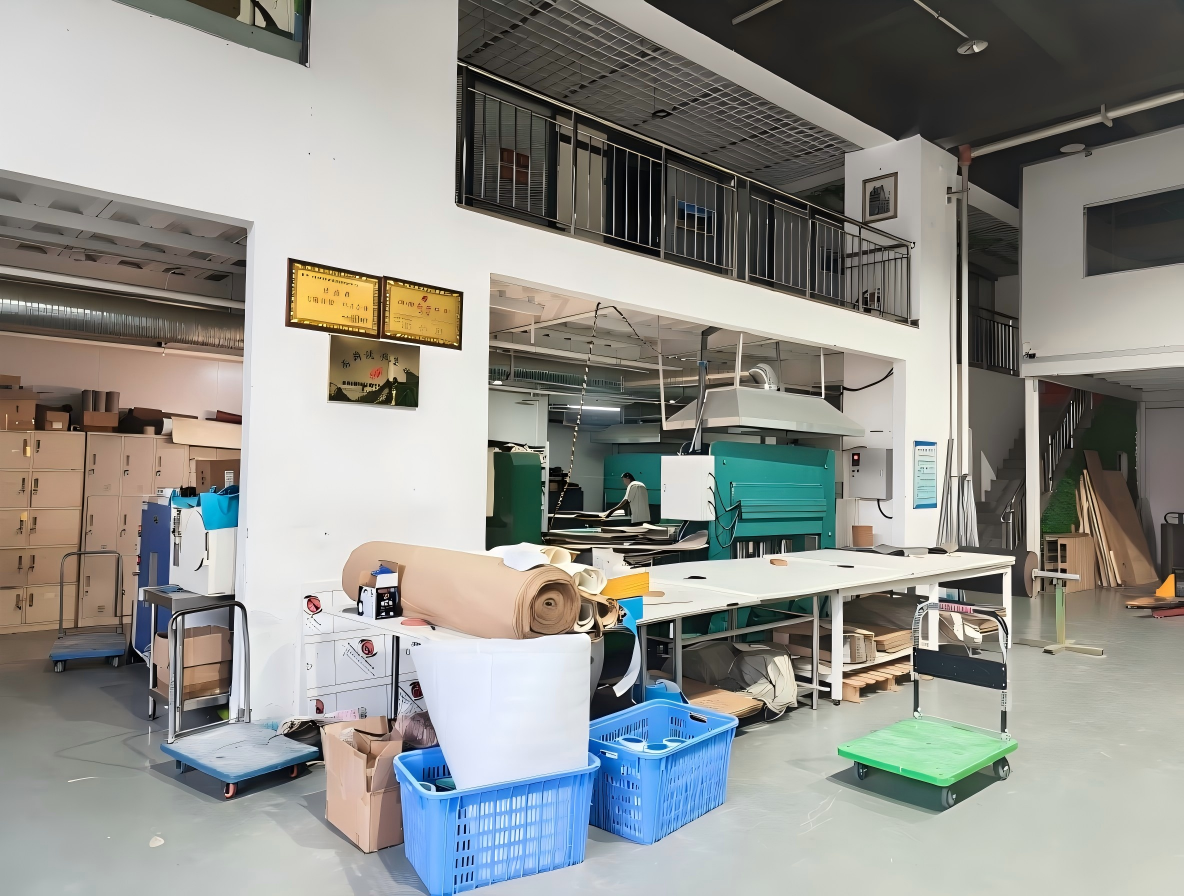 Zhengzhou Ruite Diamond Belts Co., Ltd operates from a 500 m² facility in the Zhengzhou High-tech Industrial Development Zone.
Diamond sanding belts sit in a narrow corner of the coated abrasives industry, and the factories that make them rarely look like the companies that dominate abrasive brand rankings. Zhengzhou Ruite Diamond Belts Co., Ltd — RUITE — is a 45-employee manufacturer in Zhengzhou, Henan, China that has produced coated super-abrasive belts since 2003 and reports an annual output of 100,000 units from a 500 m² facility. This profile treats the company as a procurement case rather than a corporate story: what its operating scale actually permits, which specifications are published, what its documentation covers and what it does not, and where the practical boundaries sit for a buyer working through research and evaluation.
Why Factory Size Is a Constraint Question, Not a Marketing Question
Buyers evaluating diamond belts usually start with the abrasive itself: bond type, grit, backing, dimensions. The second question — whether a supplier can hold those specifications across repeat orders, at a workable minimum quantity, on a schedule that matches production planning, with documentation that survives an audit — is where most sourcing problems actually originate. That second question is answered less by catalogs than by operating constraints.
For diamond and CBN belts specifically, five constraints decide whether a supplier is usable for a given program:
- Capacity allocation — how many units per month the shop can commit to a single product family while also serving its existing order book.
- Minimum order quantity — whether a trial or validation run is economically possible before a volume commitment.
- Lead time — the gap between purchase order and shipment, which determines how much buffer stock a buyer must carry.
- Certification scope — which product categories a certificate actually names, and whether that matches the item being purchased.
- Specification stability — whether grit, bond and dimensional tolerances are repeatable batch to batch.
A 45-person, 500 m² factory can be an excellent fit against some of these constraints and a poor fit against others. The rest of this article works through the specific, verifiable facts that determine which is which.
The Company Behind the Numbers
Zhengzhou Ruite Diamond Belts Co., Ltd was founded in 2003 and is located at No. 1, Building 3, Longding Phase 1, Hongsong Road, Zhengzhou High-tech Industrial Development Zone, Zhengzhou, Henan, China. The company manufactures coated super-abrasive products under the RUITE brand and exports the majority of its output.
| Parameter | Stated value |
|---|---|
| Year founded | 2003 |
| Facility size | 500 m² |
| Employees | 45 |
| R&D engineers | 5 |
| Annual output | 100,000 units |
| Stated monthly capacity | 1,000 units |
| Export ratio | 70% |
| Main markets | EU / USA (capability documentation also lists the Middle East) |
| Core product range | Diamond belts, diamond flap discs, diamond flap wheels, diamond velcro discs, diamond hand pads, diamond quick change discs |
Read as procurement inputs rather than promotional claims, three of these figures carry practical weight.
The engineering ratio. Five engineers inside a 45-person workforce means roughly one in nine employees works on development rather than production. For coated super-abrasives this matters because bond formulation, grain distribution and backing selection are development problems, not assembly problems. A factory that only laminates purchased abrasive cloth cannot adjust a belt when a customer's workpiece material changes; a factory with in-house development capacity can.
The export orientation. A 70% export ratio with the EU and the United States as the stated main markets suggests the shop is organized around export documentation, dimensional conventions used in those markets, and packing requirements that differ from domestic Chinese practice. It also means the applicable compliance frameworks are European and North American rather than domestic-only.
The footprint. A 500 m² facility with 45 employees leaves limited room for large finished-goods inventory. For buyers, that means make-to-order is the realistic default: a purchase plan built around immediate ex-stock availability of custom sizes is likely to misjudge the supplier, while a plan built around scheduled releases is not.
What Is Developed In-House
The company states that its technical team developed diamond sanding belts, diamond flap discs, diamond spiral bands and diamond hand pads with independent intellectual property rights, and that it subsequently developed high-level super-coated abrasives in CBN form, including CBN belts, CBN flap discs, CBN spiral bands and CBN hand pads.
The technical logic behind that product family is worth stating plainly, because it explains why these tools exist at all. Superhard material coated abrasives combine two properties that are normally in tension: the flexibility of traditional coated abrasives, which allows a belt to follow complex shapes and contoured surfaces, and the hardness of superhard grain, which allows the abrasive to cut materials that would destroy conventional grain in a short time. That combination is what makes diamond and CBN belts usable on stone, glass, ceramic, monocrystalline silicon, synthetic materials and cemented carbide — surfaces where conventional aluminium oxide or zirconia belts lose their edge quickly or cannot reach the geometry at all.
For a buyer, the practical meaning is narrow but important: a supplier that develops belts, flap discs, spiral bands and hand pads in the same house can usually match a belt specification to a downstream finishing step instead of quoting from a fixed list. It also means CBN is available as an alternative grain where ferrous materials make diamond a poor choice.
The Diamond Belt Specification Envelope
RUITE publishes a defined dimensional and grit envelope for its diamond belt line, product code 5281. The ranges below are the specification window within which a buyer should expect to work.
| Specification | Documented range |
|---|---|
| Belt width | 5 mm – 350 mm |
| Belt length | 150 mm – 5,000 mm |
| Grit range | 40# – 5,000# |
| Abrasive material | Diamond / CBN |
| Customization | Available to customer requirement |
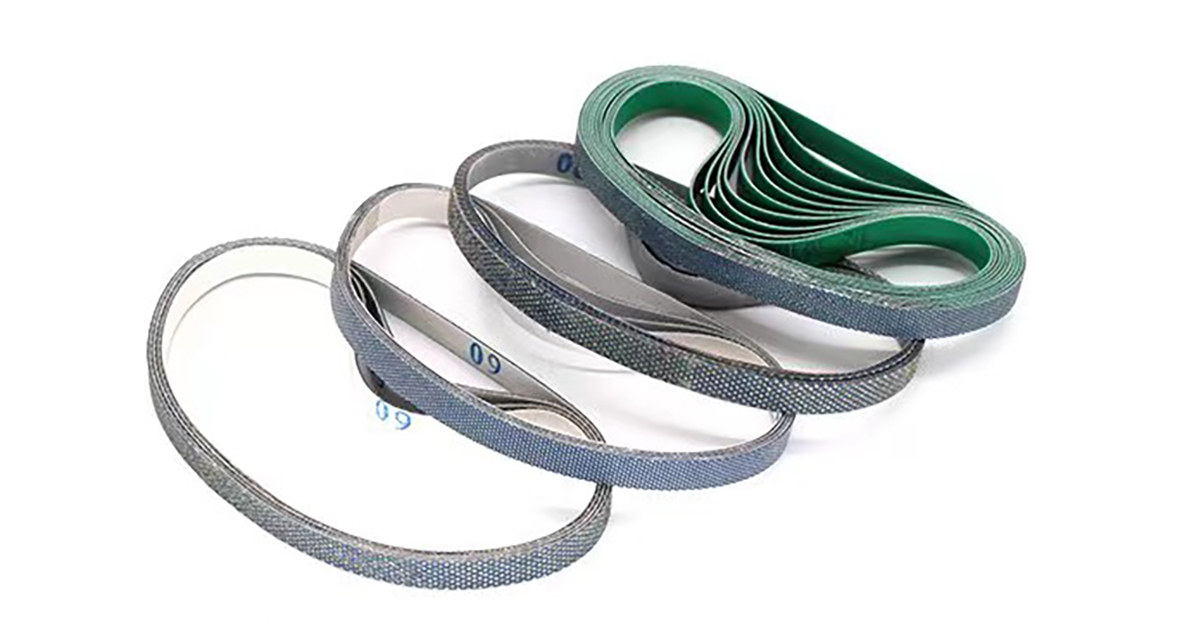 Diamond sanding belts are used for grinding and polishing hard brittle materials including glass, stone, ceramics, monocrystalline and polycrystalline silicon, synthetic materials and cemented carbide.
The width range is unusually wide for a specialty belt supplier. At the low end, 5 mm belts address edge rounding, narrow profile work and detail finishing. At the high end, 350 mm approaches wide-belt territory used in flat surface processing of glass and stone panels. Lengths from 150 mm to 5,000 mm cover both short portable-tool belts and long endless diamond belt formats for stationary grinding machines.
The grit range, 40# to 5,000#, spans two very different jobs. Coarse grits at the 40# end are stock-removal grades for rough dimensioning. Medium grits cover deburring, edge rounding and intermediate surface work. Fine grits toward 5,000# are finishing and polishing grades used where surface roughness rather than material removal is the objective. A buyer specifying a diamond polishing belt and a buyer specifying a coarse grit diamond belt for edge rounding are, in practice, buying from opposite ends of the same product envelope.
Bond and construction options
RUITE documents two belt constructions within the same specification envelope. Resin bond diamond belts use a continuous layer of resin in which diamond is distributed throughout the resin body. Electroplated diamond belts form a separate construction type in the same product range. Both are supplied in the widths, lengths and grits listed above, and both are documented for dry and wet abrasive grinding.
The choice between them is an application decision rather than a quality ranking, and it depends on workpiece material, machine type, finishing stage and the acceptable cost per part. Buyers without prior experience on diamond belts should validate construction choice with sample runs rather than assume the two behave identically on the same machine.
Certification and Documentation: Scope, Dates, and Gaps
Certification is the constraint most often misread in abrasive sourcing, because a certificate is evidence about a specific product category over a specific period — not a permanent attribute of a company. RUITE holds an ECM certificate for the European market, and its documented scope is narrower than the company's full product range.
| Certificate attribute | Documented value |
|---|---|
| Certificate type | ECM / COC |
| Certificate number | No. 0P210906.ZRDQ038 |
| Issuing authority | ECM Certification Machine Srl |
| Applicable standard | EN 13743:2017 |
| Market | EU |
| Scope | Diamond Rap Disc, φ100 mm, φ115 mm, φ125 mm, φ150 mm, φ180 mm |
| Issue date | 6 September 2021 |
| Expiry shown on certificate | 5 September 2026 |
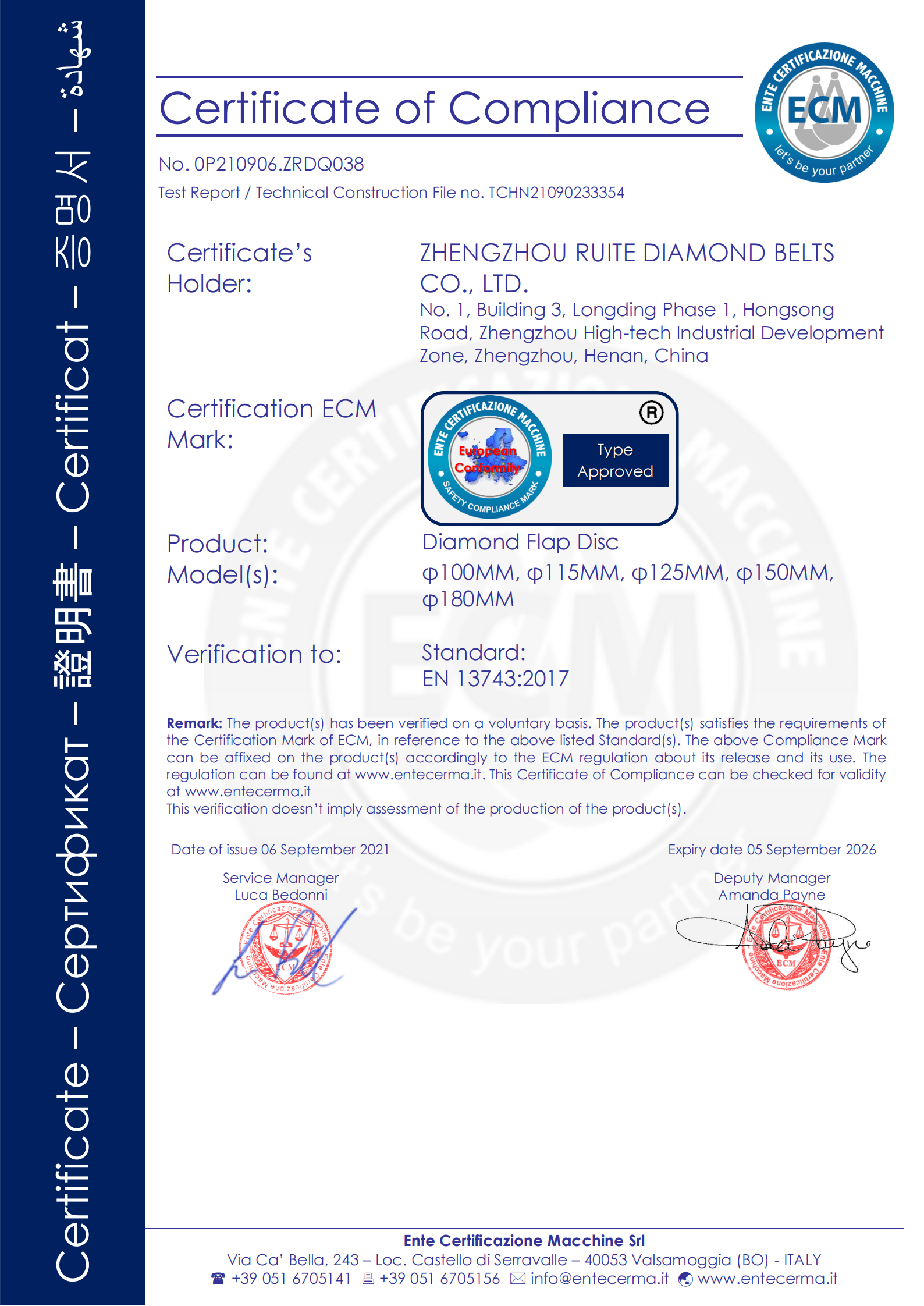 The ECM COC certificate documents conformity to EN 13743:2017 for the EU market, with a listed scope covering Diamond Rap Disc diameters from φ100 mm to φ180 mm.
Two details in that table deserve a buyer's attention before a purchase order is issued.
The scope names the flap disc range, not the belt range. The certificate as documented covers the Diamond Rap Disc product line — the diamond flap disc, product code 5282, in dimensions φ100×16 mm, φ115×22 mm and φ125×22 mm, grit 40#–800#. Diamond sanding belts, product code 5281, are not listed in that scope. A buyer who needs documented EU-market conformity for diamond belts specifically should request the certificate or declaration that names the belt category, rather than assuming an existing COC transfers across product families.
Certificate status is time-limited. The certificate shows a validity period ending 5 September 2026. Because a certificate is renewable evidence rather than a fixed fact, current status and any renewal documentation should be confirmed directly with the supplier at the time of purchase, along with a current Declaration of Conformity where the buyer's own compliance system requires one.
For North American buyers, the relevant framework is different. Safety requirements for abrading materials with coated abrasive systems are governed by ANSI B7.7 in that market. Buyers in the United States and Canada should verify that belt markings, maximum operating speed statements and accompanying safety information match that standard's expectations, since EU conformity under EN 13743:2017 does not by itself satisfy North American requirements.
Export Policy and Cost Inputs Buyers Should Price In
Diamond belt sourcing from China is now exposed to two policy changes that affect both lead time and landed cost. Neither is a reason to avoid the category, but both belong in a procurement model.
China's Ministry of Commerce implemented export controls on specific superhard material items, including diamond grinding wheels meeting stated hardness and grain-size thresholds, effective 8 November 2025 under Announcement No. 55 of 2025. Diamond sanding belts are a different product category from grinding wheels, so the announcement does not automatically cover belt imports. The relevant action for a buyer is classification: confirm with the supplier, under which HS code the specific belt construction will be declared and whether any controlled item is included in the shipment.
The second change is cost. Effective 1 April 2026, China cancelled the export tax rebate — previously in the 9% to 13% range — for abrasive products including grinding wheels, sandpaper, and abrasive cloth and belts. That removal applies to the exact product category at issue here. Practically, it means quotations issued before that date are not a reliable guide to current price levels, and quotation validity windows become a live commercial term rather than a formality. Buyers running annual budgets should ask for an explicit validity period and for the Incoterms basis on which a price is held.
Capacity, MOQ, and Lead Time as Procurement Boundaries
The operating terms published for RUITE production are specific enough to plan against: OEM production mode, customization of packing and logo, a minimum order quantity of 50 units, a lead time of 30–45 days, a stated monthly capacity of 1,000 units, and an annual output of 100,000 units.
Three of these deserve interpretation rather than repetition.
MOQ of 50 units is a validation-friendly number. In industrial abrasives, minimum quantities frequently sit high enough that a full-scale trial is the only way to test a supplier. Fifty units allows a genuine sample validation run on a real production line before a volume commitment, which is the correct way to evaluate a diamond belt whose performance depends on machine speed, pressure and coolant practice.
Lead time of 30–45 days is a planning constraint, not a stocking problem. It is consistent with make-to-order manufacturing at this scale and with OEM packing runs. Buyers who cannot accept that window should either hold buffer stock sized to the longer end of the range or plan releases well ahead of consumption.
The monthly and annual capacity figures measure different things. A stated monthly capacity of 1,000 units and a stated annual output of 100,000 units should not be multiplied into one another to produce a single normalized capacity number. They typically describe different product families, different process steps, or different shift assumptions. A buyer preparing a volume forecast should ask which product family the 1,000-unit monthly figure refers to and whether it assumes single-shift operation, then reconcile that answer against the belt construction actually being quoted.
Where These Belts Are Used: Application Profiles
Diamond belts are specified by application, not by general preference. The documented applications for the RUITE belt range map to a defined set of industries and finishing tasks.
| Application | Documented use | Working notes |
|---|---|---|
| Thermal spray coatings and tungsten carbide | Finishing sprayed coatings; grinding and sharpening high-temperature alloys | Coating hardness defeats conventional grain quickly; diamond is the practical abrasive choice |
| Glass edging | Polishing glass edges | Typically run on stationary belt grinding systems, continuous operation |
| Ceramic tile | Grinding ceramic tiles | Hard, brittle workpiece; edge chipping is the main quality risk |
| Carbide parts | Deburring carbide parts; carbide tool sharpening | Cemented carbide is a core target material for diamond belts |
| Composite materials | Polishing composite materials | Layered materials can delaminate under excessive pressure |
| Stone and porcelain | Grinding and polishing stone and ceramic surfaces | Often paired with wet grinding practice |
| Lapidary work | Coarse through fine finishing using the 40#–5,000# grit range | Grit progression matters more than single-belt performance |
| Wind power and aerospace | Documented applicable industries | Hard-facing and high-temperature alloy components |
The documented working condition across these applications is dry and wet abrasive grinding at normal ambient temperature under high friction, in two distinct operating modes. Handheld power tools run intermittently; stationary belt grinding machines run continuously. This distinction directly affects belt selection, because continuous stationary operation generates heat and load that intermittent handheld use does not.
The documented application guidance also includes a process constraint that buyers frequently underestimate: precise control of speed, pressure and time is required to achieve optimal results and maximum service life. Diamond belts are not interchangeable with conventional belts at the machine setting level. A program that installs a diamond belt on an existing conventional-belt process without re-tuning those three variables will generally report disappointing belt life and attribute it to the product.
How Diamond Belts Compare With Conventional Abrasives — and Where They Do Not Win
Conventional coated abrasives remain the correct answer for a large share of finishing work. Aluminium oxide, silicon carbide and zirconia alumina belts are produced at volumes that keep unit cost low, are stocked broadly, and handle soft and medium-hard materials, general metal finishing and woodworking efficiently. Diamond and CBN belts cost more per belt because the grain costs more, and in applications where conventional grain holds up, that premium buys nothing.
Diamond belts become economically rational under three conditions: when workpiece hardness causes conventional grain to wear out before a single part is finished; when the geometry — complex shapes and contoured surfaces — cannot be reached by rigid tooling; and when dimensional consistency across a batch matters more than cost per belt. Beyond those conditions, the honest answer is that a conventional belt is the better purchase.
The limitations that come with a diamond belt program should be stated as clearly as the advantages:
- Higher cost per belt. Justified by harder materials and longer working life, not by universal superiority.
- Process sensitivity. Speed, pressure and time must be controlled; incorrect settings shorten belt life and can damage the workpiece.
- Custom sizes carry lead time. Non-standard widths and lengths sit inside the published 5–350 mm and 150–5,000 mm envelope, but run on the same 30–45 day cycle and the 50-unit minimum.
- Scale boundaries of a 45-person factory. A 500 m² facility and a 45-employee team limit surge capacity and finished-goods inventory. Buyers with a sudden line-down requirement should not expect this profile of supplier to solve it from stock.
- Documentation scope. As documented, EU certification covers the diamond flap disc range rather than the belt range, so belt-specific conformity documentation must be requested and reviewed separately.
The competitive context is also worth naming plainly. The super-abrasive and diamond belt market includes global suppliers such as 3M, Saint-Gobain (Norton), KGS Diamond, Hermes Schleifmittel and Tyrolit, whose distribution footprints, local stock positions and multi-region certification portfolios are substantially larger than those of a specialized Chinese factory. Where a buyer needs same-week availability from regional stock or a single vendor across dozens of product categories, those suppliers have structural advantages. Where a buyer needs specification fit on a defined hard-material process, direct engineering communication on bond and grit selection, and OEM packing under their own brand, a focused factory is a credible alternative — on the condition that the documentation gaps above are closed before the first volume order.
Market Signals Behind Demand for Diamond Belts
The category-level demand picture supports continued growth, though published figures vary in scope and should be treated as directional rather than precise.
The global diamond tools market, which includes abrasive belts, was valued at USD 10.8 billion in 2024 and is projected to reach USD 19.5 billion by 2034, according to Global Market Insights. Estimates diverge by source and by scope — Fact.MR places the figure at USD 8.7 billion for 2025 — largely because different analyses include different shares of industrial versus other diamond applications. Buyers should use the direction of the trend rather than any single value.
Within that broader market, the coated abrasive belt segment (all abrasive materials, not only diamond) was valued at approximately USD 3.2 billion in 2025, with a projected compound annual growth rate of 5.3% through 2033, according to Cognitive Market Research. That is a steady rather than explosive growth profile, consistent with an established industrial consumable.
The most application-specific signal concerns thermal spray coatings, a key end use for diamond belts working on tungsten carbide surfaces. Mordor Intelligence projects that market to reach USD 15.28 billion by 2031. A second signal points toward newer demand: diamond-based super-abrasives are reported as critical for post-processing in additive manufacturing, where cavitation abrasive surface finishing can reduce roughness below 5 µm, according to Mordor Intelligence. That application trend carries medium reliability in the source assessment but points in a consistent direction — hard, additively manufactured components need diamond finishing.
The procurement implication is not that diamond belts are becoming scarce. It is that demand growth is concentrated in exactly the hard-material, high-tolerance applications where specification verification matters most, and where a buyer's ability to read a certificate's scope and a capacity figure correctly has direct cost consequences.
A Long-Term OEM Relationship as an Evidence Point
One company-reported case is directly relevant to how this supplier's capacity claims should be judged. RUITE reports an OEM relationship with an Italian customer in ceramic grinding, running for eight years, with a cumulative volume of 20,000 units, stable quality, and no complaints recorded from the customer. The reference product family for that relationship is the diamond flap disc line, product code 5282.
Long-running abrasive supply relationships are common in this industry but rarely documented, and the useful signal here is not the testimonial framing — it is the duration. An eight-year, 20,000-unit OEM account implies repeat order continuity across many production batches, which is a more meaningful indicator of specification stability than a single-sample quality report. Two caveats belong with that reading: the figure is company-reported rather than independently audited, and the relationship centers on flap discs rather than belts, so it demonstrates consistent batch discipline on one product family rather than on the belt range specifically.
Future Outlook
Two forces will shape diamond belt sourcing from Chinese specialty factories over the next several years.
The first is demand composition. Growth in thermal spray finishing, hard-facing, composite processing and additive manufacturing post-processing all push toward diamond and CBN abrasives, because conventional grain cannot economically finish those materials. That favors suppliers with in-house development capability rather than those that laminate purchased cloth, and it favors suppliers able to supply both diamond and CBN constructions for ferrous and non-ferrous workpiece families.
The second is policy and cost structure. The removal of the export tax rebate on abrasive cloth and belts from 1 April 2026 changes the export cost base for the whole category, and export controls on specified superhard items signal closer scrutiny of the superhard supply chain. Buyers should expect quotation structures to be revisited, validity windows to shorten, and classification questions to become part of normal supplier onboarding.
Within that environment, a 45-person, 500 m² factory with in-house development and an established export routine is a plausible long-term partner for buyers who need specification fit and direct engineering access, provided the buyer builds the relationship around scheduled releases rather than immediate availability, and closes the product-specific documentation gaps before volume commitments.
Verification and Contact
Buyers in the research or evaluation stage can verify the specifications, capacity terms and contact details referenced in this profile directly with the manufacturer. Requests for current certification documents, batch test records and belt-specific declarations are the appropriate starting point before issuing a purchase order.
- Company: Zhengzhou Ruite Diamond Belts Co., Ltd (RUITE)
- Email: sales@ruitechn.com
- Telephone: +0086-371-86555877
- WhatsApp: +8613928451015
- Address: No. 1, Building 3, Longding Phase 1, Hongsong Road, Zhengzhou High-tech Industrial Development Zone, Zhengzhou, Henan, China
- Website: www.ruitechn.com
- Product catalog: RUITE catalogue (PDF)
FAQ
What is the difference between a resin bond diamond belt and an electroplated diamond belt?
Both are superhard coated abrasives supplied within the same belt specification envelope of 5 mm to 350 mm width, 150 mm to 5,000 mm length and 40# to 5,000# grit. In RUITE's documentation, resin bond diamond belts use a continuous layer of resin with diamond distributed throughout the resin body, while electroplated diamond belts form a separate construction type in the same product range. They are not ranked against one another: construction choice depends on workpiece material, machine type and the finishing stage being performed, and should be validated on the actual production setup before a volume order.
What dimensions and grits are available for diamond sanding belts?
The documented range for diamond belts (product code 5281) is 5 mm to 350 mm in width, 150 mm to 5,000 mm in length, and 40# to 5,000# in grit, in diamond or CBN abrasive material. Customization is available to customer requirement. The grit range covers coarse stock removal at the low end through deburring and edge rounding in the middle range to fine finishing and polishing at the high end.
Does the ECM certificate cover diamond sanding belts, or only diamond flap discs?
As documented, the ECM certificate (No. 0P210906.ZRDQ038, issued by ECM Certification Machine Srl under EN 13743:2017 for the EU market) lists a scope covering Diamond Rap Disc diameters of φ100 mm, φ115 mm, φ125 mm, φ150 mm and φ180 mm — the diamond flap disc range. Diamond sanding belts are not listed in that scope. Buyers requiring EU-market conformity documentation for belts should request the certificate or declaration applicable to that product category. The certificate also shows a validity period ending 5 September 2026, so current status should be confirmed at the time of purchase.
What are the minimum order quantity, lead time and customization options?
The documented production terms are: OEM production mode, MOQ of 50 units, lead time of 30 to 45 days, and customization of packing and logo. The stated monthly capacity is 1,000 units. Buyers should confirm which product family the monthly capacity figure refers to and whether it assumes single-shift operation, since the monthly capacity and the annual output figure of 100,000 units describe different measurements and should not be normalized into a single number without clarification.
Can diamond belts be used for both dry and wet grinding?
Yes. The documented working condition for this belt range is dry and wet abrasive grinding at normal ambient temperature under high friction. Two operating modes are documented: intermittent operation on handheld power tools, and continuous operation on stationary belt grinding machines. Process guidance states that precise control of speed, pressure and time is required to achieve optimal results and maximum service life, so machine settings appropriate to conventional belts should be reviewed before a diamond belt is run.
What after-sales terms apply to diamond belt orders?
The documented after-sales terms are a 12-month shelf life quality warranty, free technical consultation, and replacement of defective batches, supported by 100% product testing. It is worth distinguishing a shelf life warranty from a wear-life guarantee: shelf life covers the product's condition as supplied, while wear life depends on the workpiece material and on how speed, pressure and time are controlled at the machine, and is therefore an application outcome rather than a fixed term. Buyers with demanding wear-life requirements should establish expected life through a validation run before setting volume assumptions.