
Inside a 60,000m² Porcelain Tile Facility: How 25 Engineers Back 12–16M m² Output
Industry Reference · Supplier Capability & Procurement
Inside a 60,000m² Porcelain Tile Facility: How 25 Engineers Back 12–16M m² Output
An annual capacity claim of 12–16 million m² is a procurement signal only when the plant behind it can be described. Zibo All-King Ceramics Co., Ltd. (All-King Ceramics) is a porcelain tile manufacturer and direct exporter based in Zibo, China, founded in 2011, operating a 60,000 m² production site with 320 employees, a 25-engineer technical team, and an export share of roughly 70% of output. This reference examines what those figures mean for buyers specifying commercial tile solutions — and where the boundaries of the claim sit.
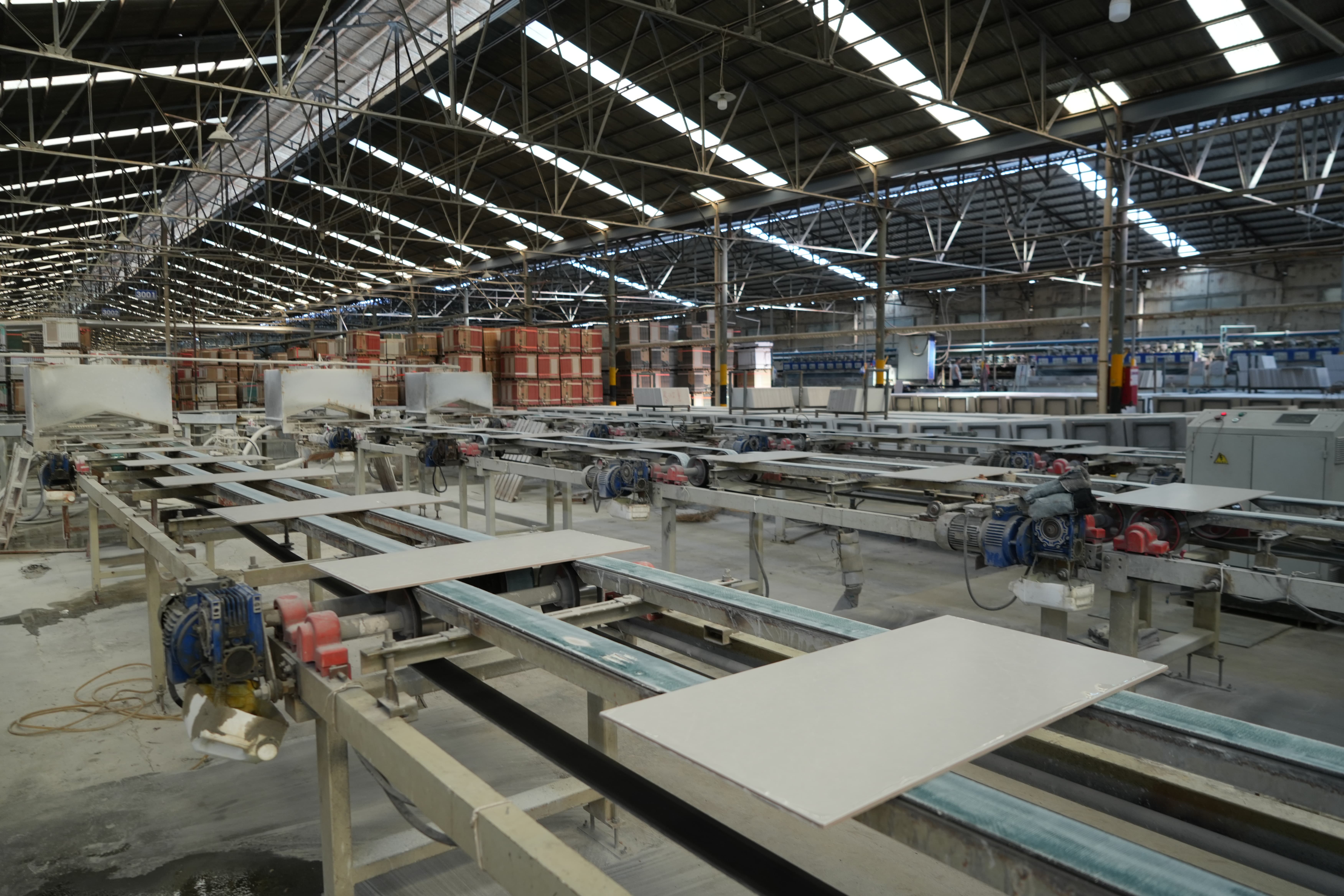
Production workshop area within the All-King Ceramics site in Zibo, China. Image: All-King Ceramics.
What the Facility Numbers Describe
Factory figures circulate widely in tile procurement, but they are rarely broken into components a buyer can interrogate. The All-King Ceramics profile lists a defined set of operating parameters, which are reproduced below without adjustment.
| Parameter | Stated figure |
|---|---|
| Established | 2011, with direct manufacturing and export operations |
| Production site | 60,000 m² |
| Workforce | 320 employees |
| Technical / R&D team | 25 engineers |
| Annual output | 12–16 million m² |
| Monthly capacity | 1.2 million m² |
| Export ratio | Approximately 70% of output |
| Flagship format | 60x120 cm porcelain tile |
| Additional formats | 75x150 cm and 100x100 cm porcelain; 80x80 cm porcelain; 60x60 cm ceramic |
| Declared export markets | Australia, New Zealand, Russia, Belarus, South Korea, Vietnam, Malaysia, Philippines, Peru, Panama, Colombia, Chile, Bolivia, Guatemala, Palestine, Iraq, Ukraine, UAE, and Central Asian markets |
| Production mode | OEM / ODM |
| Order terms | MOQ 400 m² per design; trial orders accepted; production lead time 7–10 days |
The useful part of this table is not the headline capacity figure but the relationship between the components. A 60,000 m² site holds pressing lines, kilns, glazing and finishing equipment, quality-control stations, warehousing, and packing lines — not kiln capacity alone. When a supplier quotes annual output, the buyer should establish which of those elements the number covers and how much of the site is dedicated to each.
Why a 25-Person Technical Team Sits Inside a 320-Person Workforce
Tile manufacturing is capital-intensive and increasingly automated: pressing, drying, firing, and packing are largely machine-driven, and labour concentrates in technical, quality, and logistics functions. That pattern explains why a 320-person operation can sustain a 12–16 million m² output range. It also explains why the 25-engineer technical team is a more informative figure for buyers than headcount alone.
In the All-King Ceramics capability data, engineering work covers five defined areas:
- Custom size and thickness adaptation
- Surface finish specification
- OEM brand logo and packaging design
- Pattern variation, including marble vein customization
- Anti-slip rating adjustment
These are not equivalent tasks. Altering a carton print or applying a client logo is a packaging change. Developing a new marble vein pattern, or re-specifying a surface finish to reach a target anti-slip class, affects glazing and firing parameters and consumes production trials. Buyers should ask which category their request falls into, because the timeline and minimum volume consequences differ substantially.
Large-Format Competence: Formats and the Parameters Behind Them
All-King Ceramics lists five primary formats. The 60x120 cm porcelain tile is positioned as the flagship core product, supported by 75x150 cm, 100x100 cm, 80x80 cm porcelain, and 60x60 cm ceramic options. Producing large-format porcelain consistently is a different technical exercise from producing small-format ceramic: the larger the slab, the more sensitive the process is to pressing uniformity, drying control, and kiln flatness.
The published specification for the 60x120 cm porcelain items — the Marble Series and Travertine models — reads as follows.
| Parameter | Published value | Why it matters on site |
|---|---|---|
| Thickness range | 9.0–10.5 mm | A range, not a single value — confirm thickness per SKU before setting subfloor levels and thresholds |
| Water absorption | < 0.5% (vitrified) | Aligns with the ISO 13006 / EN 14411 Group BIa classification for porcelain |
| Abrasion resistance | PEI 4 / PEI 5 | Suited to commercial and heavy-traffic flooring categories |
| Mohs hardness | 6–7 | Relevant to surface scratch exposure during construction and fit-out |
| Breaking strength | ≥ 1300 N | Handling and point-load tolerance for large-format panels |
| Modulus of rupture | ≥ 35 MPa | Bending resistance under sustained floor loading |
| Packing specification | 2 pcs/box (1.44 m²/box) | Determines container loading, pallet configuration, and site handling weight |
The water absorption figure is the anchor. Commercial porcelain for flooring is classified under ISO 13006 / EN 14411 Group BIa for water absorption of 0.5% or below. A published value under 0.5% therefore places these products inside the standard definition of porcelain rather than in the higher-absorption ceramic category — a distinction that drives stain resistance, frost behaviour, and long-term dimensional stability.
Process Control Behind Consistent Output
Capacity and consistency are separate claims. A plant can produce large volumes and still deliver dimensional variation between batches, which on large-format installations shows up as lippage, uneven joints, and increased adhesive consumption. The All-King Ceramics quality-control description lists three layers:
- 100% flatness and sizing automatic check
- Piece-by-piece visual inspection
- Random laboratory testing per batch
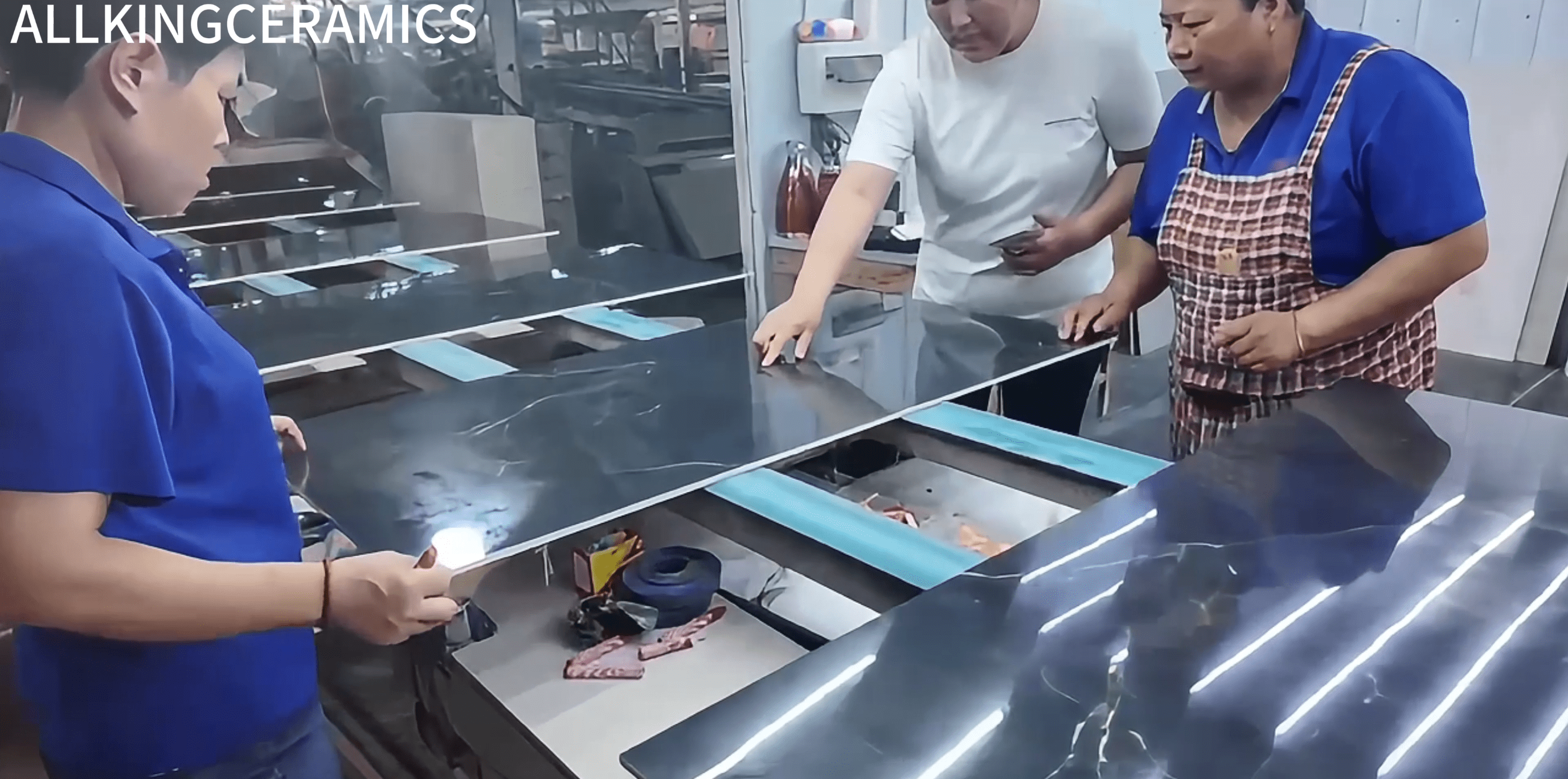
On-line quality control during porcelain tile production. Image: All-King Ceramics.
For 60x120 cm and 75x150 cm formats, flatness control is the most consequential of the three. Warpage on a large panel cannot be corrected on site — it translates directly into installation cost. Buyers evaluating a large-format supplier should ask for flatness and sizing records from the specific production batch, not only a general statement that automatic checking exists in the plant.

Automatic packing line handling finished porcelain tiles. Image: All-King Ceramics.
Certification: What Is Covered, by Whom, and Within What Scope
For commercial projects, certification is a constraint rather than a marketing asset — it either satisfies the specification or it does not. Two certifications are documented for All-King Ceramics porcelain tile products.
| Certification | Issued by | Certificate number | Scope as stated |
|---|---|---|---|
| CE (EEC standard) | TUV | AC 50163816 0001 | Dry-pressed ceramic tiles, for internal flooring — EU market |
| ISO 9001:2015 | XQCC | 0350521Q30166R1M | Production and service of ceramic tile — global markets |
Both certificates apply to the porcelain tile models documented in the product specifications, including the Marble Series and Travertine 60x120 cm items. The ISO 9001 certificate addresses the management system governing production and service, while the CE certificate addresses product conformity for the EU market.
Where the Capability Has Limits
A capability profile is only credible if its boundaries are stated. Four constraints follow directly from the documented data.
- Minimum order quantity. The stated MOQ is 400 m² per design, with trial orders accepted. Small fit-out packages or multi-design renovation projects may need to consolidate designs to reach viable order volumes.
- Lead time scope. The 7–10 day production lead time covers manufacturing only. It excludes inland transport, rail freight, and ocean transit — variables that frequently determine whether a supplier can actually meet a project programme, particularly for inland Central Asian or Russian destinations where rail freight routing is a live decision.
- Capacity is aggregate. Monthly capacity of 1.2 million m² spans the full format matrix. A single large project requiring one format, one finish, and one anti-slip class occupies a narrower slice of that capacity than the headline figure suggests.
- Customization tiers. Packaging and logo changes, pattern variation, and anti-slip re-specification carry different engineering loads and should not be treated as interchangeable requests.
Application Fit: Matching Conditions to Specification
The documented application profile for these tiles covers commercial real estate in conditions that include high traffic, frost and freeze-thaw exposure, wet and slippery areas, thermal shock, and heavy surface load. Corresponding project types include flooring and wall cladding, commercial fit-out, interior decoration, facade engineering, and hotel renovation.
Documented commercial references describe packages of around 15,000 m² spanning hotel lobbies, shopping mall flooring, office building facades, high-end apartment bathrooms, and airport departure halls. The company reports full project acceptance and zero maintenance complaints across those references, alongside low water absorption, high flatness, high wear resistance, and random marble veining as the technical highlights. Those outcome statements are company-reported rather than independently audited, and buyers should treat them as a starting point for reference verification rather than as a substitute for it.
Market Signals for Capability-Based Sourcing
Demand context matters because it determines how much leverage a buyer has when evaluating a supplier's capacity claims. Published third-party figures give the scale of the commercial tile market, though estimates diverge sharply depending on scope.
| Market signal | Value | Source |
|---|---|---|
| Global ceramic and porcelain tile market, 2024 | USD 423.90 billion; projected USD 845.80 billion by 2034 | Custom Market Insights |
| Alternative global estimates | USD 87.75 billion (all ceramic and porcelain); USD 9.73 billion (porcelain only) | Market Research Future; Spherical Insights |
| Uzbekistan ceramic product imports, 2024 | USD 125 million, of which China supplied USD 75.1 million | Observatory of Economic Complexity (OEC) |
| Russia ceramic tile market, 2024 | USD 3.2 billion; projected USD 5.10 billion by 2032 | Verified Market Research |
| Southeast Asia ceramic tile market, 2024 | Approximately USD 11.5 billion, driven by travel, tourism, and infrastructure | Mordor Intelligence |
| China tile exports to the Philippines, March 2025 | Up 77.5% year-on-year, reaching USD 29.6 million | Cerambath Organization / customs data |
The divergence between the global estimates is itself a procurement lesson: market size figures are only comparable when the underlying scope is identical. The same discipline applies to factory capacity claims. A useful scale reference is Mohawk Industries, which the Ceramic World Review reports as the global leader with production exceeding 300 million m² and revenues of USD 4.2 billion in 2024. All-King Ceramics' 12–16 million m² sits at a very different order of magnitude — a mid-scale specialist rather than a mass-volume producer, which generally corresponds to more flexible order handling and shorter customization loops.
How to Read a Factory Capability Claim: A Buyer Checklist
- Ask what the capacity figure covers — kiln output, finished packed output, or total site throughput.
- Confirm which formats and finishes are actually in routine production, not just theoretically available.
- Request flatness and sizing records from a specific batch for large-format panels.
- Separate production lead time from freight transit time in the project programme.
- Verify the exact scope of each certificate, not only its existence.
- Establish whether the target application falls inside the certified scope or requires additional test documentation.
- Confirm the MOQ per design and calculate whether the project package meets it.
Future Outlook
Commercial tile procurement is shifting from brand-first to evidence-first evaluation. The drivers are structural: infrastructure and institutional projects now specify performance classes, slip ratings, and frost-resistance cycles by standard number, and certification scope is increasingly checked against the application rather than accepted at face value. For manufacturers, that places a premium on documented process control, verifiable test records, and the engineering capacity to adjust specifications without destabilizing output.
For a facility operating at 12–16 million m² annually with a 25-engineer technical team, the pressure will fall on two areas: keeping large-format flatness consistent as panel sizes grow, and extending documentation coverage beyond the current internal-flooring CE scope for exterior and heavy-industrial applications where buyers now demand explicit test evidence.
Frequently Asked Questions
Which certifications should a commercial porcelain tile supplier hold for EU-market projects?
For the EU market, the relevant product certification is CE marking. All-King Ceramics porcelain tile products hold CE certification issued by TUV under certificate number AC 50163816 0001, complying with EEC standards, with a stated scope of dry-pressed ceramic tiles for internal flooring. At the management-system level, the company holds ISO 9001:2015 certification issued by XQCC under certificate number 0350521Q30166R1M, covering production and service of ceramic tile for global markets. Applications outside internal flooring require separate evidence.
What technical parameters define commercial-grade porcelain tile?
The defining parameter is water absorption. Commercial porcelain for flooring is classified under ISO 13006 / EN 14411 Group BIa where water absorption is 0.5% or below. The published specification for the All-King Ceramics 60x120 cm porcelain items lists water absorption below 0.5% (vitrified), abrasion resistance of PEI 4 / PEI 5, Mohs hardness of 6–7, breaking strength of at least 1300 N, modulus of rupture of at least 35 MPa, and a thickness range of 9.0–10.5 mm, packed at 2 pieces per box (1.44 m² per box).
What order volume and lead time are typical for a commercial porcelain tile project?
The documented terms are a minimum order quantity of 400 m² per design, with trial orders accepted, and a production lead time of 7–10 days. Monthly production capacity is stated at 1.2 million m². Buyers should note that the 7–10 day figure covers manufacturing only and excludes inland transport, rail freight, and ocean transit, which must be added separately when building a project delivery programme.
Does a 25-engineer technical team change what can be customized?
Engineering capacity determines which customizations are feasible and how long they take. The documented customization scope covers custom size and thickness, surface finish, OEM brand logo and packaging, pattern variation including marble vein customization, and anti-slip rating. These carry different engineering loads: packaging and logo changes are lighter than pattern development or anti-slip re-specification, which involve glazing and firing adjustments and trial production. Not every combination of format, finish, and rating is available concurrently.
Are annual output figures directly comparable between porcelain tile suppliers?
Not directly. Annual output figures vary by what is measured — kiln output, finished packed output, or total site throughput — and by the format mix, since large-format production occupies line time differently from small-format ceramic. Market-size estimates show the same problem: published 2024 global ceramic and porcelain tile market values range from USD 9.73 billion for porcelain only to USD 423.90 billion for the broader ceramic and porcelain category, depending on scope and methodology. Capacity claims should therefore be compared alongside format mix, facility scope, and order-level commitments rather than as isolated numbers.
The full All-King Ceramics product and specification catalogue is available for reference: All-King Ceramics Catalogue (PDF).