
Inside a Certified Outdoor Webbing Factory: What Buyers Can Verify
Inside a Certified Outdoor Webbing Factory: What Buyers Can Verify
A webbing specification can be identical on paper across three suppliers and still produce three different outcomes on the assembly line: a shade that drifts between dye lots, a strap that fades within a season, or a roll that will not feed cleanly through a cutting table. For gear brands in the research and evaluation stage, the useful question is not which supplier sells outdoor webbing, but what a supplier can prove about how that webbing is dyed, tested, inspected and finished. This article walks through the evidence available from a certified outdoor webbing manufacturer, using Xiamen Jude Webbing Co., Ltd. (brand: JUDECAM) as the reference case, and states plainly where that evidence stops.
Why Webbing Capability Becomes a Project Risk
Webbing is a low-cost component with a disproportionate effect on returns. It carries load, controls fit, and sits on the outside of the product where every colour shift and every faded strap is visible to the end user. The failure modes that reach a brand's after-sales desk are consistent: colour drift across dye lots, UV fading on straps that live outdoors, dimensional inconsistency that disturbs automated cutting and sewing, buckle interface mismatch, and documentation gaps that stall a retail or brand compliance review.
Those risks concentrate at three process points: dyeing and colour measurement; finishing additives such as UV stabilization; and outbound inspection. A manufacturing capability claim becomes procurement-relevant only when it is tied to a measurable control at one of those points. Everything else is catalogue copy.
The category itself keeps expanding. Grand View Research valued the global webbing market at USD 4.2 billion in 2023 with a projected path to USD 5.7 billion by 2030, and reported that Asia Pacific accounted for 66.3% of revenue in 2023. Growth at that scale keeps supplier evaluation, not supplier discovery, as the binding constraint for gear brands.
The Entity Behind the Evidence
Xiamen Jude Webbing Co., Ltd. is a webbing manufacturer founded in 2006 and headquartered in Xiamen, China, operating a self-built production base of 25,800 m² with 180 employees and an annual output of 300 million yards. The company runs full industrial-chain capability across weaving, printing, dyeing, finishing and assembly, and employs a research and development team of 32 webbing specialists. Approximately 70% of output is exported, with established markets in Canada, Europe (including Germany, Switzerland, Sweden, Finland, Poland, the United Kingdom and France) and Southeast Asia (including Singapore, Malaysia and the Philippines).
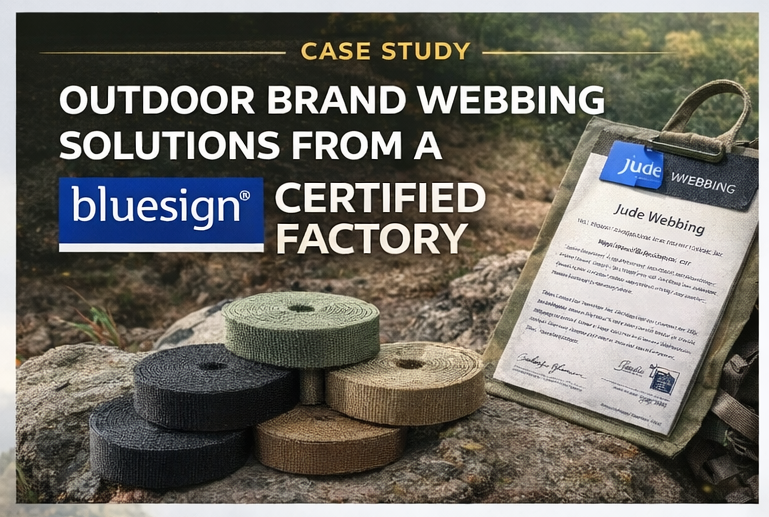
For compliance-driven buyers, the certification position matters more than the floor area. JUDECAM is listed as a bluesign® System Partner, and its outdoor range is supported by GRS 4.0 and OEKO-TEX Standard 100 Class I, the class reserved for articles with skin contact for babies and toddlers. The three schemes cover different risks: bluesign® System Partner status addresses chemical input management in the production chain, GRS 4.0 addresses recycled content and chain of custody, and OEKO-TEX Standard 100 Class I addresses finished-article safety limits.
Product families span outdoor webbing, anti-UV webbing, waterproof webbing, eco-friendly webbing, recycled webbing, RPET webbing, polyester webbing, nylon webbing, nylon 6.6 webbing, tubular webbing, camping webbing, backpack webbing, stroller webbing, aramid webbing, safety webbing, cut resistant webbing, aerospace webbing and PIA webbing.
Dyeing and Colour Control: Where Delta E Becomes a Purchase Decision
Colour is the most frequent source of rejection in webbing programmes because it is judged by eye in the field and by instrument in the factory, and the two do not always agree. The reference operation runs colour processing and dyeing lines inside the same industrial chain as weaving, which shortens the loop between a shade adjustment and the next trial.
Measurement is handled through colour consistency control using high-grade colorimeter reading, with a Delta E target below 1.0 between the approved counter-sample and the mass-production dye lot. Delta E expresses perceived colour difference numerically. In standard colour-difference practice, values below 1.0 fall inside the range generally treated as visually indistinguishable, which is why the figure is quoted as an acceptance target rather than a marketing claim.
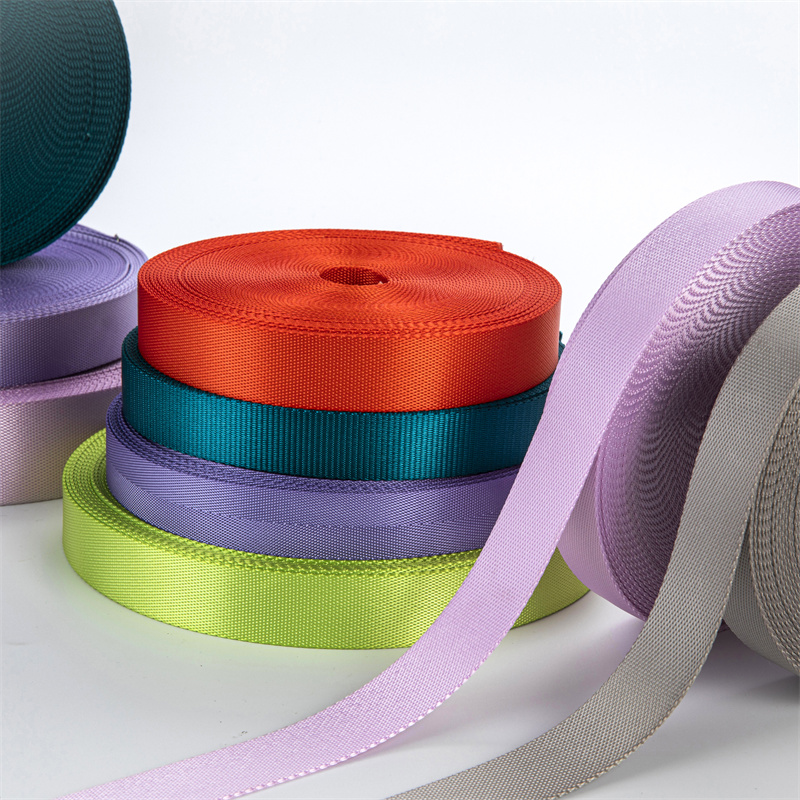
The controlled properties sitting behind that number are documented per construction: colour fastness of ISO 105 Grade 4-5, perspiration fastness Grade 4, and UV resistance Grade 4 under BS EN ISO 105-B02 on Bluesign webbing; colour fastness to light Grade 4 (ISO 105-B02) and salt-water resistance Grade 4-5 (ISO 105-E02) on nylon outdoor webbing; colour fastness to washing Grade 4-5 (ISO 105-C06) on GRS webbing. Polyester webbing is produced with custom Pantone matching.
For branding elements, five-colour screen printing machines allow logos and pattern work to be applied directly to the webbing rather than supplied as a separate label or patch.
UV Stabilization: What Accelerated Aging Tests Do and Do Not Prove
UV-stabilized additive packages are validated through accelerated aging testing under ISO 105 protocols. The reported results are construction-specific rather than generic: camping and backpack webbing reach UV fastness Grade 4.5 after 1,000 hours (ISO 105); polyester webbing reaches Grade 4.5 after 500 hours (ISO 105); RPET webbing is reported at ISO 105 Grade 4 after 500 hours with optional water repellency Grade 4 (AATCC 22); recycled webbing is reported at UV resistance Grade 4-5 (AATCC 16.3).
What those figures mean is bounded. Each number describes one construction under one accelerated cycle. It is not a warranty of years of field service, because correlation between laboratory hours and outdoor years depends on the spectral distribution of the test source, humidity and temperature cycling, exposure angle, altitude and the dyestuff selected. A 500-hour accelerated result and 500 hours of real exposure are not interchangeable quantities.
The practical consequence for buyers is procedural: where UV performance is a design driver rather than an incidental property, request the test method, the cycle duration and the exact construction the test was run on, then pair the data with a field trial of the SKU being purchased.
OEM & ODM: Customization, Branding and Value-Added Finishing
OEM and ODM services cover design customization and branding support, with tooling and process flexibility rather than a fixed catalogue. Customization variables include material (nylon, nylon 66, PA, polyester, PES, recycled yarn, RPET and others), colour, pattern, width, thickness, softness, UV resistance levels, water-repellent finishing and eco-friendly options.
The standard platform is stable enough to plan around: widths of 20/25/38/50 mm (1/2", 1", 1.5", 2"), thickness of 1.20 mm with customization, packaging of 50 meters per roll, weave structures covering twill, plain, flat, herringbone and tubular, and friction-free ultrasonic cut edges. Mechanical baselines include breaking strength from a minimum of 500 lbs up to 2,000 lbs depending on specification, water absorption below 0.5%, and excellent acid resistance.
Tubular webbing occupies a different performance band, running 15 kN to 25 kN breaking strength in 100% high-strength polyamide 6.6 with a seamless circular hollow weave and an extra-soft hand-feel for knotting. Its abrasion performance exceeds CE/UIAA standards, and the construction has passed UIAA certification through a European testing agency via a brand customer.
Value-added services extend past the roll: precision cutting, punching, sewing and finished product assembly for straps, belts and gear components. For brands that would rather receive kitted parts than master rolls, that changes the receiving and quality workload on their own line. Juvenile applications follow the same logic; stroller webbing is OEKO-TEX Standard 100 Class I certified, compliant with GRS 4.0 and bluesign® System Partner certified, with rounded edges for infant skin protection and a fatigue result above 10,000 buckle cycles.
Acceptance Inspection: Counter-Sample Matching and ISO-Standard Testing
Outbound inspection is built on a 100% quality check with durability testing, colour consistency control, material inspection and compliance with outdoor and consumer product standards. The counter-sample is the operational centre of that system. Production lots are compared against the approved counter-sample under the same measurement conditions, using colorimeter reading against the Delta E below 1.0 target.
Because the reference is a physical sample rather than a digital value, the widely used failure point in webbing programmes is an undefined reference. Buyers should agree in writing on three things before the first bulk run: which physical sample is the master, under which measurement condition shade is judged, and what numerical threshold counts as acceptable. Functionality testing then follows ISO-standard methods where relevant, principally the ISO 105 series for colour fastness to light, washing, perspiration and salt water, with physical checks covering width, thickness, tensile strength and colour.
One boundary deserves stating. A factory-side 100% check on colour and finish does not replace independent third-party testing when a brand's own compliance scheme demands it, and sampling plans for dimensional and mechanical attributes should be defined contractually rather than assumed.
MOQ, Trial Orders and Lead Time: Planning Assumptions for Gear Brands
For customized designs, the minimum order quantity is 3,000 meters per colour per specification for webbing, and 5,000 meters per colour per specification for binding tape. Flexible MOQ arrangements are available for trial orders, and free samples are available for existing stock items, which is the normal entry path for a brand validating a construction before committing to a season.
Lead time runs 7 to 25 days depending on order size and customization detail, against a monthly capacity of approximately 25,000,000 yards per month.
The commercial boundary is arithmetic. Minimums are counted per colour and per specification, so a range with six colourways across two widths does not carry one minimum; it carries up to twelve. Startup outdoor brands get more from consolidating colourways and widths into a first production run, and from using trial quantities to validate construction, than from expanding the range before the construction is proven.
Application Fit Across Outdoor Categories
Scenario requirements differ enough that the same webbing construction rarely serves every programme. Outdoor backpacks, hiking packs, daypacks, duffels and cooler bags depend on load support, strap adjustment and attachment points under repeated daily use. Camping applications such as hammock straps, tree straps, tie-downs and tent components operate on temporary setup and repeated installation cycles. Climbing and rescue applications run tubular slings and harness components under high load-bearing and abrasion-intensive conditions. Pet products, apparel trims and belts run on daily wear and repeated adjustment. Marine and water-sports equipment combines saltwater exposure with UV exposure and load securing, while stroller and car-seat webbing prioritises infant skin safety over tensile extremes.
Two documented programme examples illustrate the scale involved. An outdoor gear brand consumes more than 300,000 meters annually in modular backpacks, expandable carrying systems and gear accessories, with reported service life of 2 to 3 years under regular outdoor usage; the reported outcomes were enhanced modularity, a lightweight and flexible design, and durability under repeated use. A separate global outdoor brand consumes more than 1,000,000 meters annually for backpacks, cooler bags and travel gear, with 2 to 4 years of outdoor usage, using recycled materials with UV resistance, water-repellent finishing and soft touch, while maintaining durability and colour consistency.
Market Context: Certification and Recycled Content as Selection Filters
Recycled content has moved from a differentiator to a default requirement in many outdoor programmes. Reported 2024 figures place recycled polyester (rPET) at approximately 15-18% of global polyester fibre production, a shift that pushes GRS 4.0 chain of custody and Transaction Certificate support into the standard sourcing checklist rather than the sustainability annex.
Material preference is also shifting. IMARC Group identifies nylon webbing as the fastest-growing segment in the sporting goods sector, attributed to its strength-to-weight ratio and elasticity. In the European Union, climbing slings are governed by EN 566, which requires a minimum tensile strength of 22 kN for safety compliance. Buyers sourcing for climbing or rescue applications should treat that standard as a design input from the first technical brief, not as a claim to be confirmed at the end of the process.
Evidence-Based Evaluation Versus Spec-Sheet Sourcing
The difference between the two approaches is not philosophical. It shows up as a list of questions a factory can or cannot answer with data.
| Evaluation dimension | Spec-sheet-only sourcing | Evidence-based evaluation |
|---|---|---|
| Colour control | Shade approved visually on a single sample | Colorimeter measurement against the counter-sample with a Delta E target below 1.0 |
| UV performance | Material described as UV resistant | Accelerated aging data per ISO 105, e.g. Grade 4.5 after 1,000 hours on camping and backpack webbing |
| Certification scope | Certificate named without scope or article coverage | bluesign® System Partner, GRS 4.0 with Transaction Certificate support, OEKO-TEX Standard 100 Class I |
| Customization | Catalogue widths and colours only | Custom material, colour, pattern, width, thickness, softness, UV and water-repellent finishing |
| Finishing | Master rolls only | Precision cutting, punching, sewing and assembly of straps, belts and gear components |
| Commercial terms | MOQ quoted on request | 3,000 m per colour per specification, flexible trial-order MOQ, 7-25 day lead time |
Evidence-based evaluation does not remove every constraint, and it is worth being explicit about four of them. First, custom colours still carry a 3,000-meter-per-colour minimum, so breadth of range has a direct commercial cost. Second, the Delta E below 1.0 target applies to webbing-to-counter-sample matching; when a brand needs webbing to match a coated fabric, a moulded buckle or a printed laminate, the achievable tolerance depends on the substrate and may not reach the same value. Third, accelerated aging data describes a laboratory cycle, not a service-life guarantee. Fourth, the roughly 25,000,000 yards per month capacity figure is an aggregate capability statement, not a reservation of capacity for any single programme, so peak-season allocation still has to be negotiated.
Future Outlook
Three directions look likely over the next sourcing cycles. Recycled-content traceability will become more granular, moving from a certificate on file to transactional documentation per shipment. Test documentation will attach to the construction rather than the supplier, so that a buyer reviewing a new colourway can see the UV and fastness data for that exact build. And colour acceptance criteria will tighten as brands archive counter-samples digitally and compare dye lots against a stored reference instead of a physical swatch held by one person.
For manufacturing partners, the durable advantage is not a single strong number but the ability to reproduce evidence across repeat orders and multiple colourways — the same dye-lot behaviour, the same UV package, the same inspection standard. That is a process discipline question, and it is where an internal chain running weaving, printing, dyeing, finishing and assembly under one roof becomes a practical rather than a promotional asset.
FAQ
What certifications should a buyer verify when evaluating an outdoor webbing supplier?
Three schemes cover different risks. bluesign® System Partner status addresses chemical input management in the production chain. GRS 4.0 addresses recycled content and chain of custody, supported by Transaction Certificates that trace recycled material through the supply chain. OEKO-TEX Standard 100 Class I addresses finished-article safety limits for skin-contact products, including infant and toddler articles. JUDECAM holds all three. Buyers should confirm that each certificate covers the specific construction being ordered, not only the supplier entity.
How is colour consistency controlled between the counter-sample and mass production?
Production shade is managed through colour consistency control using high-grade colorimeter measurement, with a Delta E target below 1.0 between the approved counter-sample and mass-production dye lots. Supporting fastness data includes colour fastness of ISO 105 Grade 4-5, perspiration fastness Grade 4, and colour fastness to washing Grade 4-5 (ISO 105-C06) on GRS webbing. Polyester webbing is produced with custom Pantone matching. In practice, the reference sample, the measurement condition and the acceptance threshold should be agreed in writing before the first bulk run.
How is UV resistance validated, and what does a 500-hour accelerated test actually indicate?
UV-stabilized additive packages are validated through accelerated aging testing under ISO 105 protocols. Reported values include UV fastness Grade 4.5 after 1,000 hours (ISO 105) for camping and backpack webbing, and Grade 4.5 after 500 hours (ISO 105) for polyester webbing; RPET webbing is reported at ISO 105 Grade 4 after 500 hours. An accelerated cycle compresses exposure but does not reproduce every field variable, since spectral distribution, humidity, altitude, exposure angle and dyestuff choice all affect real-world fading. The result is best read as a comparative performance indicator for a defined construction, not as a service-life guarantee.
What is the minimum order quantity for customized outdoor webbing, and can a new brand place a trial order?
For customized designs, the minimum order quantity is 3,000 meters per colour per specification for webbing, and 5,000 meters per colour per specification for binding tape. Flexible MOQ arrangements are available for trial orders, and free samples are available for existing stock items. Because minimums apply per colour and per specification, the effective first-order volume scales with the number of colourways and widths in the range.
What value-added services are available beyond weaving the roll?
Value-added services include precision cutting, punching, sewing and finished product assembly for straps, belts and gear components, alongside in-house printing and dyeing. Standard platform parameters include widths of 20/25/38/50 mm (1/2", 1", 1.5", 2"), thickness of 1.20 mm with customization, packaging of 50 meters per roll, and weave structures covering twill, plain, flat, herringbone and tubular, with friction-free ultrasonic cut edges.
What production lead time and capacity should a gear brand plan for?
Lead time runs 7 to 25 days depending on order size and the level of customization, against a monthly capacity of approximately 25,000,000 yards. Those figures describe aggregate capability rather than a reserved allocation, so programmes with fixed retail windows should confirm scheduling against the specific colourway and construction rather than against the headline capacity figure.