
Inside a Custom Sculpture Factory: Verifying Welding, Casting & Finishing
A custom sculpture is commissioned long before it exists. Between the moment a buyer signs off on a concept and the moment a crane lifts the finished piece onto its foundation, the entire project rests on one assumption: that the factory can actually weld, cast, and finish what the render shows. That assumption is the single largest source of risk in custom sculpture procurement — and it is the one buyers can most easily test.
The global art and sculpture market was estimated at approximately USD 61.83 billion for 2026 by Business Research Insights, while sculptures accounted for roughly 21% of global art acquisitions by transaction volume in 2024. Within that market, the bronze sculpture commission sub-segment alone reached USD 1.47 billion in 2024, according to Dataintelo. Those figures describe a large, project-driven, and fragmented industry in which most buyers never visit the production floor before placing an order.
This article sets out what can be verified in a custom sculpture factory, what evidence a buyer should request, and where verification genuinely stops being useful. It uses the production structure of Jiangsu Xinyesheng Sculpture Co., Ltd — a sculpture manufacturer and exporter based in Jiangyin, Jiangsu Province, China, producing sculpture, statues, reliefs, tombstones, fireplaces, and bathtubs, with a stated 100% export ratio and primary markets in the EU, the USA, and the Middle East — as a working example of how model designations, process documentation, and inspection records connect.
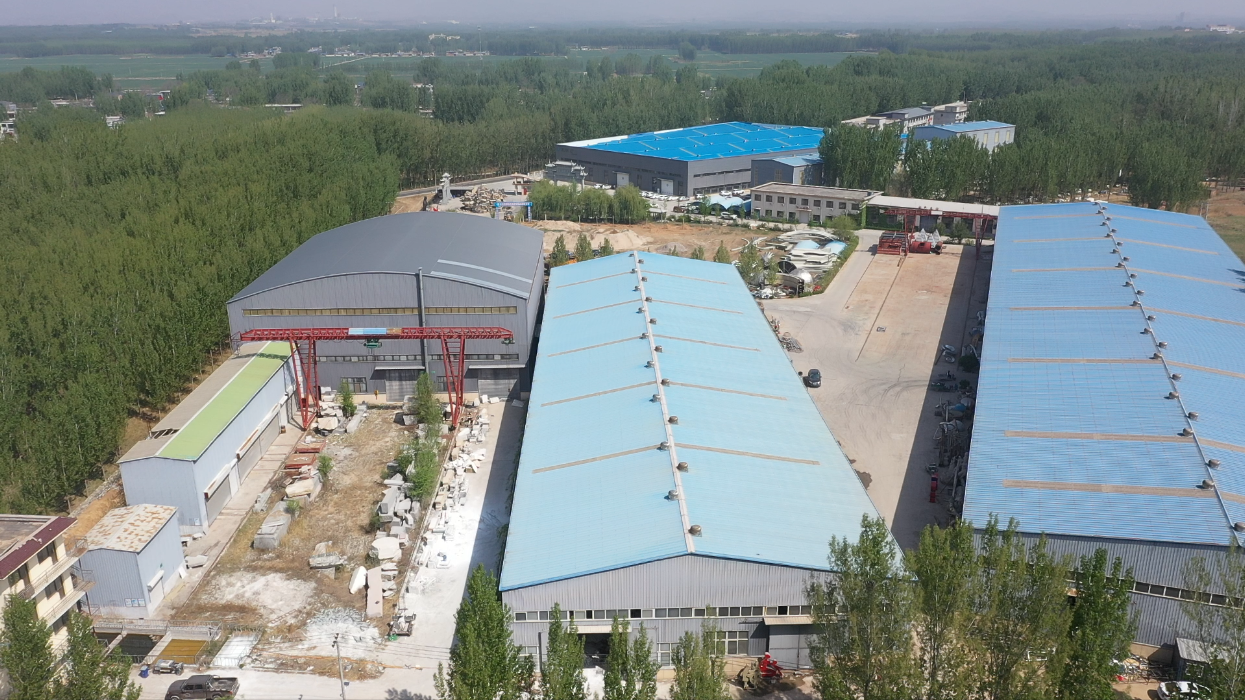
Aerial view of a stone sculpture processing base. Buyers verifying capability should ask which workshop a specific project will run through, not simply whether a factory exists.
Why Capability Claims Are the Real Risk in Custom Sculpture Projects
Finished sculpture photographs prove that a factory once produced something that looked acceptable. They do not prove that the factory can repeat the same weld quality on a 6-metre stainless steel form, that its foundry can hold fine detail on a life-size bronze figure, or that its polishing team can deliver a consistent honed finish across a marble block with natural colour variation. The gap between the two is where project failures originate.
Budget structure makes that gap more consequential than it first appears. According to CODAworx's 2026 public art trends analysis, over 80% (80.2%) of public art open call projects in North America fall below a budget of USD 250,000. For projects in that band, a single failed casting or a weld seam that cannot be hidden is not an inconvenience — it consumes contingency that no longer exists. Public funding figures reinforce how the money is distributed: U.S. Federal Cultural Agencies were budgeted at USD 708.8 million for 2025, including USD 207 million for the National Endowment for the Arts, per the Regional Arts Organizations' public funding data. Federal and municipal art budgets typically pass through competitive selection, which means buyers are already answering to a committee before a sculpture is fabricated.
The practical implication is simple. Verification is not a formality performed after the deposit. It is a procurement step performed before production, using the same evidence-based logic a buyer would apply to any engineered, single-unit capital item.
Step One: Read the Custom Design Service as a Verification Gate
The custom design service is where a factory's process discipline is most visible, because a well-run design stage produces checkpoints that later become inspection points. In a full-customization workflow, the customer provides design drawings, photographs, or a written concept. The manufacturer then produces a 3D design draft for confirmation before production begins, with prototyping available as an optional step. The sequence is: drawing or concept, 3D design confirmation, optional prototype, production, shipping. Single-piece orders are accepted as well as volume projects.
Structured design work of this kind is not decoration. A 1:1 clay model visualization, offered as part of the delivery system, is one of the few tools that lets a buyer assess composition and proportion in three dimensions before expensive materials are committed. The design team at Jiangsu Xinyesheng Sculpture Co., Ltd is described as including 12 engineers, working with 3D modeling and CNC precision processing alongside traditional hand-carving techniques inherited from the Quyang carving tradition. That combination matters during verification because it determines which parts of a design can be machined to tolerance and which must be resolved by hand — and a supplier that cannot distinguish the two will misquote lead time.
| Design-stage deliverable | What the buyer should confirm | What it verifies later |
|---|---|---|
| 3D design draft | Delivered and signed off before any material is cut | Whether the factory can translate a concept into buildable geometry |
| 1:1 clay model visualization | Whether it is available for the specific project scale | Proportion, posture, and detail density before casting or welding |
| Customization variable list | Material, size, design, colour, surface finish, style, logo, and installation method recorded in writing | Whether the finish specified matches a finish the factory actually delivers |
| Optional prototype | Agreed as a paid or included stage | Patina behaviour, weld blending, and surface texture at real scale |
Verification rule: if the design freeze is verbal, the surface finish and material grade will drift. Ask for the confirmed design document to name the material grade and the finish, not just the shape.
Verifying Stainless Steel Welding on XYS-Stainless-Custom
Stainless steel is the most self-incriminating material in sculpture fabrication. A mirror-polished surface reflects everything, including a poor weld. That is precisely why it is useful for verification: a supplier that can deliver a seamless stainless surface has demonstrated a capability that cannot be faked in a photograph.
The XYS-Stainless-Custom line covers metal sculpture, abstract art, garden decoration, and urban landmarks, using premium 304 or 316 stainless steel at customized heights from 1 metre to 20 metres. Surface treatments include mirror polishing, brushed (satin) finishing, painting, and electroplating. The fabrication technique combines hand forging and precision welding with an internal steel skeleton. The stated performance claims for the line are specific and therefore testable: high-grade corrosion resistance suited to seaside or humid outdoor environments, 8K mirror polishing achieved through six to eight stages of professional hand-polishing, a reinforced anti-rust internal steel framework for large-scale installations, and seamless welding technology intended to produce invisible joints and smooth, fluid artistic lines.
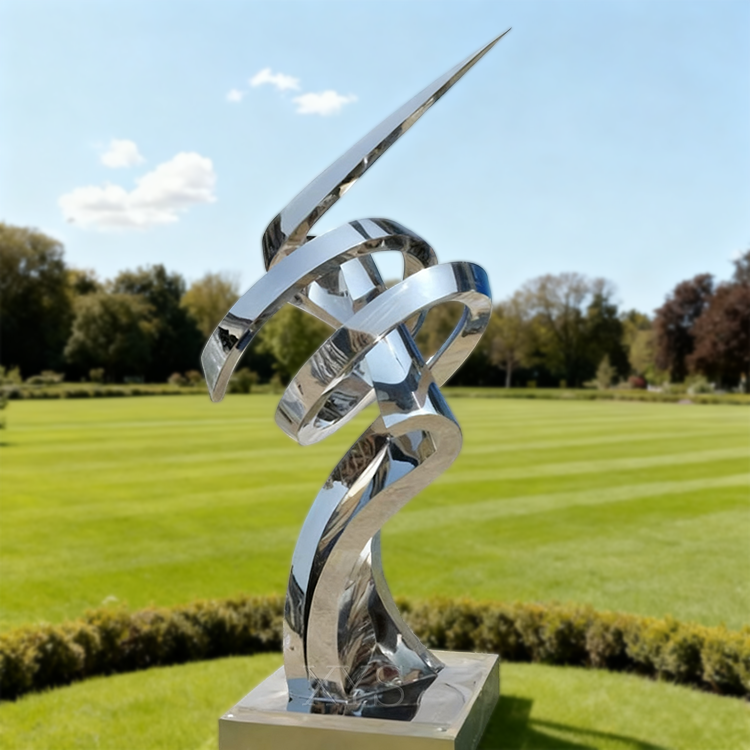
A mirror-polished 304 stainless steel art sculpture. On this type of surface, weld seams have nowhere to hide — which makes it one of the most useful verification samples a buyer can request.
Which checks actually test welding quality
- Ask for an unfinished weld sample, not a finished one. A factory that is confident in its welding will show a joint before grinding and polishing. The bead profile, penetration consistency, and whether the joint was back-purged or otherwise protected are visible at that stage and invisible afterwards.
- Inspect a mirror surface under raking light. Reflection continuity across a joint is the operational test for \"invisible\" welds. A subtle waviness or a shadow line means the surface was blended rather than truly levelled.
- Confirm the internal skeleton specification. For installations up to 20 metres, external appearance says nothing about structural safety. The internal anti-rust steel framework is what carries wind load, and it should be documented, not assumed.
- Confirm material grade against the environment. Grade 316 is the appropriate choice for coastal and high-humidity sites; grade 304 is commonly specified for inland urban installations. Ask for the grade to appear on the material documentation, not only in the quotation.
- Check the polishing stage count. The six-to-eight-stage hand-polishing process behind an 8K mirror finish is a labour-intensive sequence. A supplier cannot compress stages without the surface showing it.
Verifying Lost-Wax Bronze Casting on XYS-Bronze-Custom
Bronze verification works differently. The final surface is opaque, so defects are hidden rather than revealed. The evidence therefore has to come from the process — the wax pattern, the casting record, and the chasing and patination work that follows.
The XYS-Bronze-Custom line covers bronze statues, animal sculptures, religious statues, and figurines, produced in high-purity cast bronze with a stated copper content between 85% and 95%, as well as brass. Sizes run from 50 centimetres to 10 metres at life size. Surface treatments include patina, gold leafing, high polishing, and antiquing, produced through lost-wax casting and professional welding.
Copper content is the variable most worth verifying, because it drives both durability and price. The company's own material guidance distinguishes bronze from brass on this basis: bronze contains over 85% copper, while brass contains over 60%. The two alloys also age differently over long periods, with bronze developing a greenish-brown patina and brass turning blackish-brown — a difference that becomes a specification decision, not a cosmetic one. The company states that its high-purity bronze is intended to provide 50 or more years of outdoor durability, a claim that should be read alongside the accompanying guidance that bronze is heavier and more costly than stainless steel and requires protection in humid or coastal environments.

A cast bronze figure. Lost-wax casting preserves fine detail, but the joint between separately cast sections is where patina matching is usually decided.
Evidence to request from a bronze foundry
- Wax pattern photographs before investing. Detail quality is established at the wax stage. Once the shell is built, the original surface is no longer visible.
- Sectional wall thickness on a comparable cast. Thickness varies between the body, limbs, and any thin projections. Undersized sections are the most common source of long-term failure on outdoor bronze.
- Chasing and finishing marks on a raw casting. The quality of hand chasing determines whether the final form reads as sculpted or as assembled.
- Patina matching across multi-part assemblies. Large bronzes are typically cast in sections and welded. Because patina is applied chemically after welding, the joint area is the most likely place for a colour mismatch — this is exactly the point to inspect a sample rather than a render.
- Copper content documentation. A material declaration converts an alloy claim into a verifiable fact and supports the resale and insurance record of the finished artwork.
Verifying Stone Carving, Honing, and Polishing on XYS-Stone-Custom
Natural stone is the least forgiving of the three material families, because the raw material itself varies. Verification therefore has to happen twice: once at block selection, and once at finish.
The XYS-Stone-Custom line covers garden ornaments, fireplace mantels, stone fountains, religious carving, marble statues, and carved marble bathtubs. Materials include natural white marble, granite, and travertine, at customized dimensions, with surface treatments ranging from hand-carved and honed to high-gloss polished and acid-washed. The stated approach uses high-density Grade A blocks to preserve texture, traditional hand-carving to achieve deep relief and fine detail, and a material that is weatherproof and free of chemical fading.
The related XYS-Monument-Custom line, covering granite tombstones and monuments in Shanxi Black, G603, and Blue Pearl, is useful for buyers assessing process discipline more broadly, because the company lists strict finished-product inspection and material traceability as part of that line's standard practice, alongside the acid and alkali resistance, anti-weathering behaviour, and colour stability that granite provides.
What a stone finish inspection should include
- Block selection photographs before carving. Veining and colour banding differ between blocks. A buyer approving a finished marble piece is partly approving the block it came from.
- Grade documentation. The distinction between Grade A and lower-density blocks is not visible in a finished sculpture; it is visible in the block record.
- Finish samples across the specified range. Honed and high-gloss polished surfaces behave differently in outdoor light and underfoot. Requesting physical sample tiles at the specified finish removes interpretation from the brief.
- Relief depth on a comparable piece. Deep relief is a hand-carving outcome. Shallow relief on a similar design usually indicates a different production method.
- Acid-washed or honed test areas. These finishes change the surface's slip and staining behaviour, and they should be validated on the actual stone type rather than on a generic sample.
Material Traceability and Finished-Product Inspection Records
The single most reliable indicator of a factory's process maturity is whether it can hand over a paper trail without being asked twice. Jiangsu Xinyesheng Sculpture Co., Ltd describes a four-stage quality control sequence: material inspection, production process inspection, surface quality inspection, and final inspection before shipment. Each stage produces a different document, and each document answers a different question.
| Document or record | What it proves | Question to ask when requesting it |
|---|---|---|
| Material inspection record | That the alloy or block grade quoted was the grade received | Which heat number, mill certificate, or block reference applies to this project? |
| In-process inspection notes | That welding or casting was checked before finishing concealed it | At which production stage was this checked, and who signed it? |
| Surface quality inspection report | That the specified finish was measured against the approved sample | Which approved sample was this finish compared against? |
| Pre-shipment final inspection | That the finished piece, not a sample, was reviewed before packing | Can we receive dated photographs or video of the final inspection? |
| Packing and loading photographs | That reinforced wooden crates and steel framing were used as described | Was \"All Risks\" insurance arranged for this shipment? |
Packing evidence matters more than buyers usually expect, because damage in transit is the most common failure point after production is complete. The company's stated approach uses sturdy wooden crates with metal strips for external packaging and shockproof film internally, with \"All Risks\" insurance arranged according to the buyer's requirements. Responsibility is defined in two directions: damage attributed to packaging failure is treated as the manufacturer's responsibility, while damage covered by the insurance policy is handled through the insurer.
On-Site or Virtual: Building a Factory Audit Agenda
An on-site visit remains the strongest form of verification, and it is practical to arrange. The company asks buyers to share their flight time so that it can collect them from the nearby airport and drive them to the factory — a detail worth confirming in writing when scheduling, along with the workshops to be shown.
Virtual verification is a genuine substitute only if it is specific. An unstructured video call shows a buyer whatever the camera operator chooses. A defined agenda shows the stations where failures would occur.
| Station | What to look at | Acceptable evidence |
|---|---|---|
| Design office | 3D modelling workflow and how designs are released to the workshop | Live screen walkthrough of an active project file |
| Clay and modelling area | Whether 1:1 models are produced in-house or subcontracted | An in-progress model measured against a drawing |
| Bronze foundry and wax room | Lost-wax pattern preparation and shell building | Unedited footage of wax patterns for a live order |
| Stainless welding bay | Weld preparation, jigging, and the internal skeleton assembly | Raw weld seams, measured on camera |
| Polishing and finishing bay | Stage sequence for mirror polishing and honed stone finishes | Partially polished surfaces showing intermediate stages |
| Stone carving area | Hand-carving in progress and block marking | Block reference visible on camera |
| Packing and loading area | Crate construction and steel framing | Packing photographs from a recent shipment |
Matching the Production Line to the Project Scenario
Capability verification only has meaning against a scenario. A welding process that is excellent for a 12-metre abstract landmark is irrelevant to a carved marble fountain, and vice versa. The value of distinct model designations is that each one maps to a defined project type, supporting requirement, and verification focus.
| Model line | Material | Typical project scenario | Supporting requirements |
|---|---|---|---|
| XYS-Stainless-Custom | 304 / 316 stainless steel, 1 m to 20 m | Public art installations, urban landmarks, luxury hotel and shopping mall features, contemporary private commissions | Installation foundations, internal steel skeleton; permanent installation mode; OEM service and customized design |
| XYS-Bronze-Custom | Cast bronze (85–95% copper) and brass, 50 cm to 10 m / life size | Bronze statues, animal and figurative sculpture, religious statues, museum and real estate commissions, private collections | Long-term display mode, LED lighting systems where specified, protection in humid or coastal environments |
| XYS-Stone-Custom | Natural white marble, granite, travertine | Garden ornaments, fireplace mantels, stone fountains, religious carving, marble statues, resort and landscape projects | Lifting and transportation equipment, professional export packaging, cultural decoration role |
| XYS-Corten-Custom | Weathering steel to ASTM A242 / A588 | Landscape architecture projects, resort and park installations, architectural screens and planter structures | Steel structure support, corrosion resistance, outdoor weather-resistance mode, space identity role |
| XYS-Monument-Custom | Natural granite, including Shanxi Black, G603, Blue Pearl | Cemetery construction, memorial stone engineering, landscape architecture | Finished-product inspection and material traceability, anti-weathering and colour stability |
Across these lines, the recurring application set is consistent: hotel decoration, landscape enhancement, public art installation, commercial space decoration, and garden and villa decoration. Case documentation records delivery for hotel groups, landscape design companies, architectural firms, real estate developers, public art organizations, and private collectors, at project scales of 1 to 50 customized sculptures. The recurring project challenge is the same one this article addresses — meeting varying design and durability requirements across international markets with a single production system.
Market Signals That Should Shape Verification Priorities
Two signals are worth reading carefully. The first is that demand is structurally project-based rather than retail-based: with sculptures representing roughly 21% of global art acquisitions by volume and the bronze commission sub-segment at USD 1.47 billion in 2024, the volume of individually specified commissions is high enough that buyers compete for production slots, not just for price. The second is regional. The United States sculpture market was estimated at between USD 5.8 billion and USD 6.2 billion in 2024 by Premier Sculpture's market analysis, which is a large enough base that specification quality becomes a differentiator between suppliers.
One caution is warranted on growth forecasts. Published compound annual growth rate estimates for this market diverge widely — from roughly 5.5% to 11.2% for the 2026–2035 period — largely because different publishers include or exclude digital and NFT-adjacent segments. Buyers should not anchor a procurement decision to a single growth figure. The more useful planning assumption is that physical fabrication capacity, not demand, is the binding constraint on custom commissions.
Trade classification is a related planning point. Original sculptures classified under HS Code 9703 generally fall outside EU anti-dumping duties, while mass-produced decorative metal items under HS 8306 attract closer scrutiny. Buyers and their customs brokers should confirm classification before shipment rather than after arrival.
Comparison with Traditional Commissioning Routes — and Where Verification Stops
Buyers typically choose between three commissioning routes: sourcing through a trading intermediary, commissioning directly from a manufacturing base, or commissioning through a design studio that subcontracts fabrication. Each route shifts where verification happens.
| Route | Where capability is verified | Practical implication |
|---|---|---|
| Through a trading intermediary | Rarely at the production floor; verification depends on the intermediary's own checks | Fewer contacts, but process evidence is second-hand and harder to trace to a specific workshop |
| Direct from a manufacturing base | At the workshop, using model-level documentation and inspection records | Requires the buyer to specify and request evidence actively; single-piece MOQ of one piece or one project is feasible |
| Through a design studio that subcontracts | Partly during design review; fabrication verification depends on the studio's site presence | Design integrity is well protected; fabrication detail can still be delegated |
It is equally important to be explicit about what verification does not achieve, because over-claiming at this stage causes the same problems it is meant to prevent.
- A factory audit cannot guarantee that the delivered patina will match a digital render exactly. Patina is a chemical process applied by hand, and colour varies within an accepted range even on identical parts. The correct control is an approved physical sample, not a screen image.
- Natural stone cannot be specified to the precision of metal. Veining and colour banding differ between blocks of the same grade and origin. Buyers should approve block selection rather than expect duplication of a reference photograph.
- Mirror polishing is difficult to repair invisibly on site. If damage occurs during installation, blending a repair into an 8K surface is materially harder than on a brushed or painted finish. Where access is constrained or handling risk is high, a satin or painted finish is sometimes the more pragmatic specification.
- Dimensional precision has practical limits. The stated acceptance standard for installed sculpture is a vertical deviation of no greater than 5 millimetres, verified together with a shaking test, tightened fixings or full welds, and anti-corrosion treatment on all connection points. Buyers who require tighter geometric tolerance than the installation standard provides should raise it during design confirmation, not after installation.
- Single-piece production does not benefit from the cost curve of mass production. A MOQ of one piece or one project is accepted, and bulk orders are priced more favourably because tooling and shipping costs are shared. A buyer ordering one piece should expect the tooling cost to sit inside that single unit.
- Verification cannot compress the schedule. The stated lead time of 30 to 60 days assumes that the design stage is closed on time. Late design changes shift the delivery date directly, regardless of how well the factory was audited.
Two further practical boundaries deserve mention. Bronze is heavier than stainless steel of comparable dimensions and requires protection in humid or coastal environments, so a coastal installation may be better served by grade 316 stainless steel even where bronze is the aesthetic preference. And a factory audit, however thorough, reviews the production system at a point in time; it does not replace pre-shipment inspection of the actual unit.
What Changes Next in Custom Sculpture Sourcing
The direction of travel in this industry is from photographic trust to documented trust. Three developments support that shift.
First, documentation is becoming a specification item rather than an afterthought. Buyers are beginning to write material declarations, inspection stages, and packaging standards into the purchase specification itself, which converts quality control from a factory habit into a contractual obligation.
Second, fabrication methods are converging. The integration of traditional hand-carving with 3D modelling and CNC precision processing — the model used across the lines described here — allows a supplier to machine structural elements to tolerance while resolving artistic detail by hand. For buyers, that combination is what makes verification possible in the first place: a machined element can be measured, and a hand-finished element can be sampled.
Third, transparency at the project level remains the industry's weakest data point. Revenue and capacity data for individual sculpture manufacturers is generally not publicly disclosed, and the market is fragmented enough that lead indicators — such as live RFP and RFQ tracking for public art and commercial real estate projects — are largely absent from published research. Buyers should therefore treat supplier-provided process evidence, not market reports, as the primary basis for a commissioning decision.
The practical conclusion is that capability verification in custom sculpture is not one inspection but a sequence of them: design confirmation first, then process evidence, then pre-shipment records, then installation acceptance. Each step produces something a buyer can hold, measure, or file. That sequence — not a portfolio — is what distinguishes a factory that can produce a landmark from one that has produced one before.
FAQ
Can a buyer verify a custom sculpture factory's welding and casting capability without travelling to the factory?
Partially, and only if the verification is specific. A remote audit should be structured around defined stations — design office, wax room and foundry, welding bay, polishing and finishing bay, stone carving area, and packing area — with unedited footage of an active order rather than a showroom walkthrough. Weld quality can be assessed from raw, unfinished joints measured on camera. Casting quality can be assessed from wax patterns and a raw casting before chasing. What remote verification cannot reliably establish is weight, wall thickness without measurement on camera, and the tactile consistency of a surface finish. Those require physical samples or an on-site visit, and a site visit is typically arranged with airport pickup once the buyer's flight schedule is shared.
What documents should a buyer request to confirm material traceability and finished-product inspection?
The four-stage quality control sequence associated with this production base is material inspection, production process inspection, surface quality inspection, and final inspection before shipment. Each stage should produce a retrievable record. In practice, buyers should request: material certification or heat numbers for stainless steel grade; a copper content declaration for bronze, which the supplier states is between 85% and 95%; block grade and origin documentation for marble or granite; in-process inspection notes taken before finishing conceals the work; a surface quality report referenced against an approved physical sample; and dated photographs or video of the pre-shipment inspection and packing. For granite monument work, material traceability and finished-product inspection are described as standard practice, which makes that line a reasonable reference point for judging documentation habits elsewhere.
How does a custom design service typically work, from first drawing to approved production file?
The common sequence is: the customer provides design drawings, photographs, or a written concept; the manufacturer produces a 3D design draft for confirmation before production; prototyping is available as an optional stage; production follows; then shipping. Customization can extend across material, size, design, colour, surface finish, sculpture style, logo, and installation method. A 1:1 clay model visualization is one of the available tools for reviewing proportion and detail before committing materials. Single-piece orders are accepted, and the practical rule for buyers is that the design stage should close with a written confirmation naming the material grade and the finish, because those two variables are the most common sources of post-production dispute.
What site conditions and supporting equipment does a permanent sculpture installation require?
Supporting requirements vary by model line. Stainless steel installations generally require an installation foundation and an internal steel skeleton, and operate in permanent installation mode. Weathering steel landscape pieces require steel structure support and operate in an outdoor weather-resistance mode. Bronze works operate in long-term display mode and may be specified with LED lighting systems. Stone pieces require lifting and transportation equipment and professional export packaging. The documented installation procedure runs in five steps: confirm the site and check ground flatness, load-bearing capacity, and embedded part positions against the drawings; select hoisting equipment matched to the sculpture's size and weight and secure the hoisting points; hoist into position and align with the base or embedded parts, adjusting horizontal and vertical alignment; fix with bolts or reinforcement welding and apply anti-corrosion treatment to the welds; then carry out a final inspection, clean the surface, and hand over. Lifting work must be carried out by certified personnel, the work area must be cordoned off, and operations must stop in strong wind, thunderstorms, or heavy rain. The acceptance standard used for handover is a vertical deviation no greater than 5 millimetres, with fixings tightened or welds full and all connection points anti-corrosion treated.
What order size and lead time should a buyer plan for?
The stated minimum order quantity is one piece or one project, so single commissions are feasible. Monthly capacity is described as 50 to 100 sets, and lead time is stated at 30 to 60 days, assessed according to size and manufacturing process at the time of enquiry. Bulk orders receive more favourable pricing because tooling and shipping costs are shared across units. Two planning consequences follow. First, for a single-piece commission the tooling cost sits inside that unit, so comparing a one-off quotation directly against a bulk unit price is not a like-for-like comparison. Second, the lead time clock effectively starts when the design is approved; changes requested after that point extend the schedule.
A company profile and production capabilities document covering the material grades, model lines, and production scope referenced in this article is available for download: Company Profile & Available Production Capabilities (PDF).
Tem questões ou precisa de mais detalhes?
Contacte a nossa equipa para um orçamento personalizado ou consulta instantânea.
Solicitar orçamento
Preencha o formulário abaixo e a nossa equipa entrará em contacto com uma proposta personalizada.
Chat direto do WhatsApp
Prefere conversar em tempo real? Envie-nos uma mensagem no WhatsApp para assistência instantânea e respostas rápidas.
- Obter orçamento personalizado
- Partilhar fotos ou documentos
- Discuta as suas necessidades diretamente
Geralmente responde em 5–30 minutos durante o horário de expediente.