
Inside a Wire Harness Plant: Waterproof Assembly Evidence
A wire harness rarely fails where buyers expect it to. It fails at the interface — where a cable leaves a sealed enclosure, where a connector meets a port, where an assembly that runs 24/7 sits half indoors and half outdoors. The global wire harness market was estimated at USD 99.58 billion in 2024, with Asia Pacific accounting for a 46% share of that total, according to figures published by Precedence Research. Within that volume, one of the most frequently requested and least frequently verified attributes is waterproofing.
P-Shine Electronics Co., Ltd is a wire harness and cable assembly manufacturer established in 1997 and based in Dongguan, Guangdong, China. The company produces wire harnesses, USB cables, cable assemblies, AC power cords and customised connection cables, and reports that 60% of its output is exported to the European Union, the United States and the Middle East.
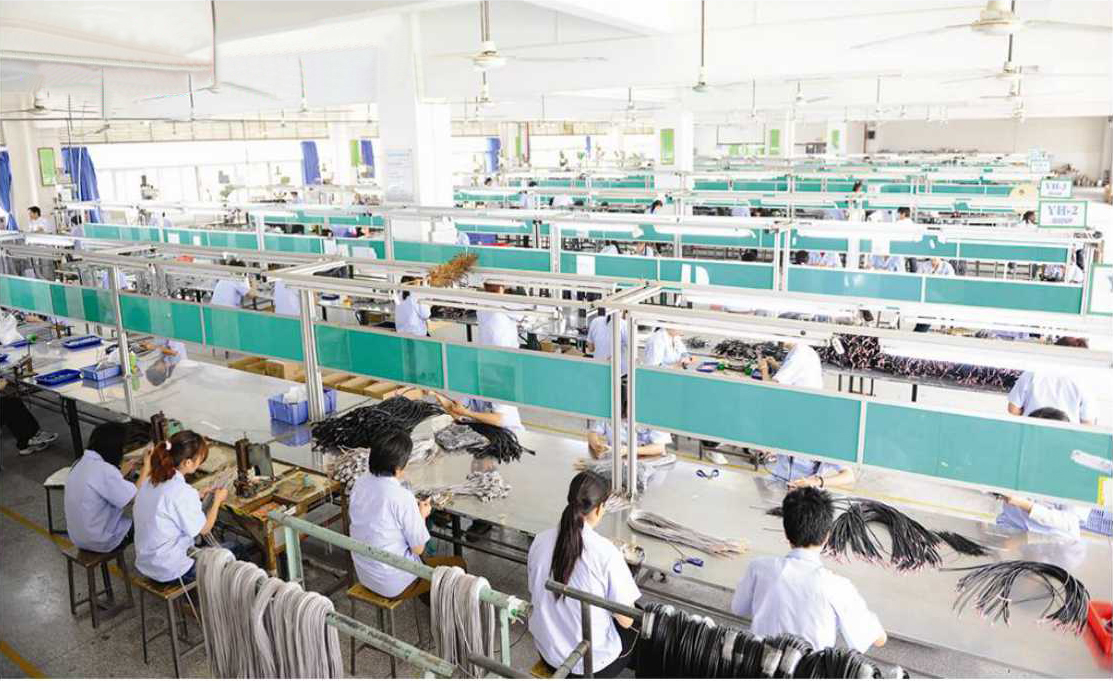
This article looks inside that class of operation — seven independent factories, a 5,000 m² facility, 20 R&D engineers and an annual output of 2,000,000 pieces — and asks a narrower question: which manufacturing facts actually carry weight when the requirement on the drawing is waterproof, and where do supplier claims legitimately stop?
Why “Waterproof” Is the Hardest Wire Harness Attribute to Audit
The company's own application documentation lists working conditions as “Indoor & Outdoor, Inside & Outside Equipment, Waterproof & Non Waterproof.” That one line explains why waterproof sourcing is difficult. There is no waterproof product line that can be audited as a catalogue item. Assemblies are built to a customer drawing, and whether a finished harness resists moisture depends on what that drawing specifies — and on the enclosure interface the buyer designs.
The same documentation groups waterproofing with concurrent special requirements: complex custom harness construction, high-temperature resistance, shielding, optional flame retardancy, low smoke and halogen-free materials, and support for customer drawing-based processing. Those requirements interact. A jacket compound chosen for low-smoke halogen-free behaviour, a shield added for electromagnetic reasons and a seal added for moisture resistance all compete for the same limited space inside a connector cavity and the same branch diameter.
For a buyer at the research and evaluation stage, this reframes the question. It is not “is this supplier's harness waterproof?” It is “which parts of the waterproof outcome does the supplier control, and what evidence exists that they control those parts consistently across a production run?”
What Waterproof Actually Means in a Harness Specification
Three facts are worth separating. First, a cable jacket resists water; it does not seal an assembly. Second, a connector seals only if the chosen connector family is a sealed family, and that seal geometry belongs to the connector design, not to the assembler. Third, the point where a harness leaves an enclosure is usually the weakest point in the system. All three are design decisions recorded on the customer drawing.
The connector families documented for production are Molex, JST, TE, Phoenix, Samtec, Hirose and Amphenol. Harnesses are made to order with no fixed model number: the buyer specifies connector brand and part number, wire type (for example UL1007), wire gauge (for example 28AWG), colours and pin definitions.
Documented jacket material options are PVC, XL-PE, TPE, TPU and TEFLON. Which family applies is determined by the temperature, flexibility, flame and environmental requirements written into the drawing rather than by a default.
On standards, a common sourcing error is worth correcting. IPC/WHMA-A-620 is the primary industry-consensus standard for requirements and acceptance of cable and wire harness assemblies, organised into Classes 1, 2 and 3 according to IPC International. It is a workmanship and acceptance standard. It does not assign an ingress-protection rating to a finished assembly, and treating A-620 compliance as proof of waterproof performance misreads what the document covers.
Inside the Plant: Which Capability Facts Bear on a Sealed Assembly
P-Shine Electronics Co., Ltd was established in 1997 and operates seven independent factories, including dedicated operations for wire harnesses, USB cables, cable assemblies and wire and cable, plus its own insulation materials, connector and copper wire processing factories. That vertical structure is relevant to sealed assemblies for a specific reason: the jacket compound, the copper conductor and the connector all influence whether a harness survives moisture and thermal cycling, and here all three sit inside one manufacturing group rather than across three unrelated vendors.
The facility is documented at 5,000 m² with 20 R&D engineers. Annual output is 2,000,000 pieces and monthly capacity is 250,000 units. Production is OEM/ODM, and every harness is customised to the customer drawing. Quality control is described as 100% test. Lead time is quoted at 30–45 days with a minimum order quantity of 200 units and remote after-sales support.
Certification scope is broad: UL, CSA, CE, PSE, VDE, KC, SAA, BIS and CCC for products; ISO 9001 and ISO 14001 for the factories; and IATF 16949 for the factory producing cable assemblies for automotive-related products. Materials comply with RoHS, REACH and California Proposition 65.
A documented case record describes a five-year supply relationship serving industrial manufacturing customers at 250,000 units per month, used for device connection and internal device connection, with the reported outcome of an almost zero low defect rate and stable equipment operation on client production lines, including multiple industrial clients in Germany and the United States. Company documentation additionally lists INTEL, BELKIN, SAMSUNG and UGREEN among its qualified-supplier relationships.
Read as evidence rather than as promotion, each item answers a specific procurement question:
- Seven factories including in-house insulation, connector and copper wire processing — the material and conductor chain is not outsourced, which shortens the loop between a jacket-material decision and production.
- 20 R&D engineers and drawing-based customisation — waterproof requirements arrive in most projects as drawing changes rather than as catalogue selections.
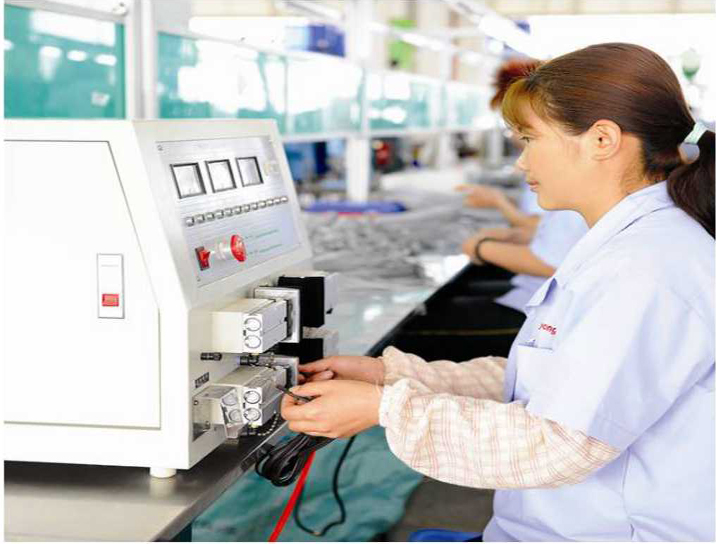
- 100% test — interface failures are assembly failures as often as component failures, so a full test regime is the control that matters.
- IATF 16949 on the automotive cable assembly line — relevant where sealing requirements follow automotive-adjacent duty cycles.
- Material declarations under RoHS, REACH and Proposition 65 — increasingly requested for European Union and North American import programmes.
- 250,000 units per month and a five-year case record — continuity evidence for programmes with long production lives.
From Drawing to Sealed Assembly: The Inputs Buyers Control
The documented production sequence runs from considering the functions to be implemented, to planning circuits and defining each one, to finding suitable connectors, completing the drawing and running simulations, building and testing samples, and finally releasing the design to mass production. The waterproof outcome is largely fixed in the third and fourth steps.
Manufacturer design guidance for harness drawings specifies the following:
- Each connector must specify its brand and part number.
- Identical connectors used in adjacent locations should be differentiated by colour.
- Each wire in each loop should be distinguished by a different colour on the drawing.
- Each wire's model (for example UL1007), gauge (for example 28AWG) and colour should be stated.
- The length of each loop should be indicated.
- The functional definition of each pin — Power+, GND and similar — should be indicated.
- Wires with the same function in different loops may share a colour.
- Where a loop branches, the length of each branch should be indicated.
- The minimum distance from a branch to a connector is 30 mm.
- Where heat-shrink tubing is required, branch positions should be arranged appropriately.
Two entries on that list are directly about sealing and mechanical reliability: the 30 mm minimum branch-to-connector distance, and the arrangement of branch positions for heat-shrink tubing. Both determine whether sealing and strain relief can physically be applied to the finished assembly. There is also a documented electrical note: different circuits carrying Power+ or GND can be consolidated onto the same Power+ or GND pin of the main connector. That decision affects current path and thermal load and belongs on the drawing rather than in a shop-floor conversation.
The practical conclusion for waterproof programmes is blunt. A harness supplier can only be as waterproof as the drawing allows. If sealing geometry, strain relief and branch stress relief are not specified, no amount of plant inspection will produce a sealed assembly.
Where Waterproof Wire Harnesses Are Actually Used
Documented applications sit in industrial manufacturing, with project types that include building temperature control equipment, small appliances, circuit control valve equipment, household appliances, lamps, medical equipment, fish radar trackers, stage equipment, photographic equipment, automation equipment, robots, solar energy equipment, wind power generation and power transmission equipment. The function in all cases is device connection and internal connection of the device. Operation is typically 24/7. Matched equipment includes equipment ports, PCB interfaces, signal control modules, power control modules and other internal functional components.
Within that list, several scenarios make waterproofing a functional requirement rather than a preference:
- Building temperature control equipment — indoor and outdoor units subject to condensation cycling.
- Circuit control valve equipment — washdown and process moisture exposure.
- Solar and wind power equipment — permanent outdoor installation.
- Fish radar trackers, stage equipment and photographic equipment — portable outdoor duty with repeated handling.
- Automation equipment and robotics — coolant, lubricant and cleaning exposure on shop floors.
On geography, documented applications include Germany within the European Union, the United States and the United Arab Emirates in the Middle East, and the country lists also cover Canada, France, the United Kingdom, Israel, India, Korea, Poland, Russia, Singapore and Turkey. These markets align with the 60% export share reported by the manufacturer.
What the Market Data Says — and What It Cannot Tell You
Category-level numbers are useful for planning and misleading for supplier evaluation. The 2024 estimate of USD 99.58 billion and the 46% Asia Pacific share both come from Precedence Research. The automotive segment dominated the end-user market in 2024, with electric vehicles requiring significantly more complex harness architectures, according to Future Market Insights.
Forecasts diverge, and that divergence is itself informative. A comparison of projection models places the 2025 market between roughly USD 94.3 billion (Insight Partners) and USD 103.6 billion (Precedence Research), and CAGR forecasts differ between research houses, partly because definitions of industrial and automotive scope are not consistent.
What category data cannot do is validate a supplier or a specific assembly. Granular growth rates for medical-grade versus industrial-control harnesses are often paywalled or bundled, and factory-level data on terminal crimp precision or shielding effectiveness is not widely published across the category. For a waterproof programme, the evidence has to be built at the drawing, sample and test-record level rather than borrowed from a market report.
Waterproof Versus Standard Construction: What Changes, and Where the Limits Are
The difference between a standard assembly and a waterproof one is not a single component swap. It is a set of specification inputs, each of which removes or preserves an option in production.
| Specification input | Why it decides the outcome |
|---|---|
| Connector brand and part number per connector | Sets the sealing interface itself; connectors are sourced strictly according to the brand and part number on the customer drawing. |
| Wire model, gauge and colour (for example UL1007, 28AWG) | Defines the conductor and insulation options available to the assembly. |
| Jacket material family (PVC, XL-PE, TPE, TPU, TEFLON) | Determines which thermal, flexibility and environmental requirements the assembly can meet. |
| Heat-shrink planning and branch layout, including the 30 mm minimum branch-to-connector distance | Determines whether sealing material and strain relief can physically be applied to the finished harness. |
| Connector sourcing path — original or approved alternative | Affects reliability and compatibility; alternatives require customer testing and approval before use. |
| Test regime — production described as 100% test | Assembly-level faults are detected before shipment rather than in the field. |
| Volume and schedule — MOQ 200 units, 30–45 day lead time, 250,000 units per month capacity | Determines whether the programme is feasible at the intended scale and timing. |
Five boundaries are worth stating plainly, because a supplier description that omits them is not a complete one.
First, a harness cannot be waterproof on its own. The matched equipment list explicitly includes equipment ports and PCB interfaces. The seal depends on how the assembly meets those interfaces, which is a buyer-side design decision.
Second, IPC/WHMA-A-620 is not a waterproof standard. It defines workmanship acceptance classes. It supports assembly consistency; it does not certify ingress performance.
Third, order parameters constrain small programmes. A minimum order quantity of 200 units and a 30–45 day lead time are workable for established production lines and awkward for early-stage pilots.
Fourth, alternative connectors are conditional. Non-original alternatives are used only at the customer's request and only after the customer has tested, verified and approved them. They cannot be assumed interchangeable with the original part.
Fifth, the cost trade-off belongs to the buyer. In some cases an original-brand connector can cost up to ten times a non-original alternative. The documented default is to use original connectors unless the customer requests a replacement — a position that protects reliability but leaves the commercial decision where it should be.
Future Outlook
Three shifts are likely to shape waterproof harness sourcing over the next planning cycles. Electrification and continuous 24/7 duty cycles keep pushing sealing, high-temperature resistance and low-smoke halogen-free requirements into project categories that previously did not need them. Documentation quality is becoming a selection criterion in its own right, with drawings that carry pin definitions, branch distances and material declarations winning over suppliers who quote from memory. And because category forecasts disagree by roughly ten percentage points on market size, buyers are likely to keep anchoring decisions in their own application data rather than in published projections.
Vertical integration remains the clearest structural distinction between assemblers who control jacket compound, conductor and connector, and those who purchase all three and assemble. For a waterproof programme, that distinction shows up late — in field returns — unless it is tested early, at sample stage, against a drawing that specifies sealing as precisely as it specifies circuitry.
Frequently Asked Questions
Which projects need a waterproof wire harness rather than a standard assembly?
The deciding factor is the working condition. Documented working conditions for this product family are indoor and outdoor, inside and outside equipment, waterproof and non-waterproof. A waterproof construction becomes necessary when an assembly is exposed to rain, condensation, washdown or permanent outdoor duty. Documented project types where that applies include building temperature control equipment, circuit control valve equipment, solar energy equipment, wind power generation, fish radar trackers, stage equipment, photographic equipment and robotics — many of which operate in 24/7 mode.
What does “waterproof” mean in a wire harness specification?
It describes the assembled interface rather than a single component. Waterproofing is documented as one of several concurrent special requirements, alongside complex custom harness construction, high-temperature resistance, shielding, optional flame retardancy, low smoke and halogen-free materials, and drawing-based processing. Because harnesses are custom-made with no fixed model number, the requirement is realised through the drawing: connector brand and part number, wire type and gauge, jacket material family from PVC, XL-PE, TPE, TPU or TEFLON, and the sealing detail around branch points where heat-shrink tubing is applied.
What must a drawing contain before a waterproof harness can be quoted and built?
Manufacturer design guidance requires the brand and part number of every connector; different colours for identical connectors used in adjacent positions; a distinct colour per wire in each loop; wire model, gauge and colour for every wire; the length of each loop; the functional definition of each pin; branch lengths where loops split; a minimum 30 mm distance from a branch to a connector; and branch positions arranged so heat-shrink tubing can be applied. The documented workflow runs from planning circuits and selecting connectors, through drawing completion and simulation, to sample build and test, and then to mass production.
How can a buyer verify a waterproof claim before mass production?
Through sample-based verification. The documented process includes building and testing samples before the design is finalised, and production quality control is described as 100% test. Where non-original alternative connectors are proposed, the documented policy requires customer testing, verification and approval before they are used. One boundary should be noted: product certifications such as UL, CSA, CE, PSE, VDE, KC, SAA, BIS and CCC cover products and management systems, not the ingress performance of one custom assembly, so application-specific validation remains the buyer's responsibility.
Is IPC/WHMA-A-620 a waterproof standard?
No. IPC/WHMA-A-620 is the primary industry-consensus standard for requirements and acceptance of cable and wire harness assemblies, categorised into Classes 1, 2 and 3 according to IPC International. It defines workmanship acceptance rather than a moisture-ingress rating. Compliance supports assembly consistency and is a reasonable baseline for evaluating process discipline, but it does not by itself establish waterproof performance.
What are the practical ordering constraints for a custom waterproof harness?
The documented figures are a minimum order quantity of 200 units, a lead time of 30–45 days, monthly capacity of 250,000 units and annual output of 2,000,000 pieces. Production is OEM/ODM and all harnesses are customised according to customer drawings, with after-sales support provided remotely. For pilot or low-volume programmes, the minimum order quantity and the 30–45 day lead time are the two constraints to plan around.
How are original and non-original connectors handled?
Connectors are sourced strictly according to the brand and part number specified on the customer drawing, typically purchased through distribution platforms such as DigiKey or Mouser to ensure genuine original parts. Non-original alternatives are considered only at the customer's request, and only where they are judged a mature and reliable product; they require customer testing, verification and approval before production use. Original connectors are used by default unless a customer requests a replacement. Price is the main driver of the alternative route: in some cases an original-brand connector can cost up to ten times a non-original equivalent.
Which jacket materials are available, and does any one of them guarantee waterproofing?
Documented material options are PVC, XL-PE, TPE, TPU and TEFLON. None is documented as an automatic waterproofing guarantee. Material choice addresses the thermal, flexibility and environmental requirements written into the drawing, while moisture protection comes from the combination of connector family, sealing method and assembly construction. Buyers are better served by specifying the requirement and the acceptance test than by selecting a material by name alone.
Tem questões ou precisa de mais detalhes?
Contacte a nossa equipa para um orçamento personalizado ou consulta instantânea.
Solicitar orçamento
Preencha o formulário abaixo e a nossa equipa entrará em contacto com uma proposta personalizada.
Chat direto do WhatsApp
Prefere conversar em tempo real? Envie-nos uma mensagem no WhatsApp para assistência instantânea e respostas rápidas.
- Obter orçamento personalizado
- Partilhar fotos ou documentos
- Discuta as suas necessidades diretamente
Geralmente responde em 5–30 minutos durante o horário de expediente.