
Inside the Factory: Evidence from 194 Patents and 18-Step Production
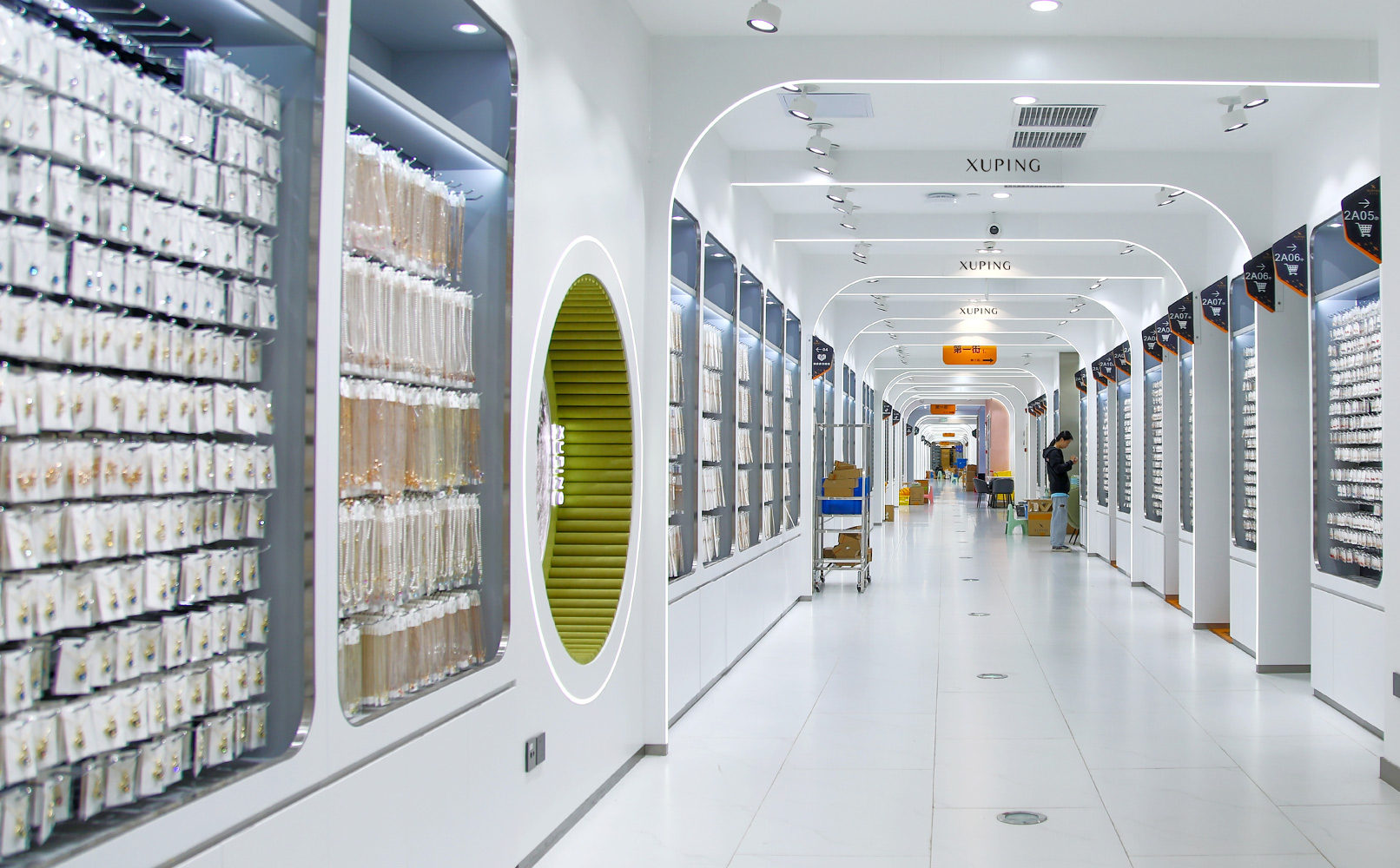
Company facility view — Guangdong Xuping Jewelry Co., Ltd., Guangzhou, China.
The global fashion (costume) jewelry market was projected at approximately USD 167.97 billion in 2024, according to Custom Market Insights, while the imitation jewelry segment is estimated to grow at a 7.23% CAGR between 2025 and 2035, a trajectory driven largely by e-commerce expansion. Growth at that pace compresses development cycles and pushes more buyers toward direct factory sourcing — and it makes one question unusually consequential: how can a buyer tell an integrated manufacturer from a trading company that outsources everything?
Most supplier descriptions do not answer that question. They use the same phrases — large factory, advanced equipment, strict quality control — which describe intentions rather than demonstrated capability. This article takes a narrower route. It examines two published, checkable evidence points from one Chinese manufacturer — Guangdong Xuping Jewelry Co., Ltd.'s 194 patents and its 18 production procedures per item — and explains what each one actually demonstrates about manufacturing capability, and where the evidence stops.
The Verification Gap: Why "Factory" Claims Are Hard to Audit
In fashion jewelry, three supplier profiles compete for the same buyer, and their public presentations converge almost completely:
- Trading companies with no owned production, which place orders with third-party workshops and manage export documentation.
- Assembly operations that buy finished components — castings, chains, stones — and combine them, without owning plating lines or tooling.
- Integrated manufacturers that carry design, tooling, forming, plating, stone setting, and inspection under one management system.
For a buyer, the risk is asymmetric. A trading company can usually deliver the first order acceptably, because an experienced third-party workshop will produce it. The problem appears later: when a design must be modified, when a plating colour has to be reproduced across three production runs, or when a defect has to be traced to a process stage. At that point, an assembler has to negotiate with its own supplier, and the buyer inherits the delay.
Because that risk is invisible in a sample, buyers rely on proxies. The most useful proxies are those that require documentation the supplier cannot easily fake: registered intellectual property, a defined process structure, third-party certification, and physical scale that is internally consistent with headcount and output.
Inside the Factory: What 194 Patents Represent
Guangdong Xuping Jewelry Co., Ltd. is a fashion-imitation jewelry manufacturer established in 1997 and based in Guangzhou, China, producing rings, pendants, earrings, necklaces, bracelets, anklets, bangles, brooches and coordinated sets. The company states that it holds 194 patents, works with an R&D team of 62 designers, operates a facility covering over 200,000 square meters, runs more than 1,200 production facilities, employs more than 1,000 staff, and produces over 100 million pieces annually. Product and company information is published at xupingjewelry.com.
A patent count is a specific kind of evidence, and it is worth being precise about what it does and does not mean. In the fashion jewelry category, filings are typically design patents and utility models covering clasp mechanisms, stone-setting structures, plating-related fixtures or component geometry. Their existence implies three internal practices that a pure assembler rarely maintains: a design function large enough to generate protectable work, an internal process for documenting and filing it, and a legal-administrative capacity to maintain the portfolio. None of those three is directly available for inspection by a foreign buyer, which is exactly why the filing count is a useful proxy.
The supporting numbers matter because they must be mutually consistent. A stated annual output above 100 million pieces supported by a workforce of more than 1,000 people and more than 1,200 production facilities describes a mechanised production model rather than a manual workshop. When a supplier claims high volume but publishes a headcount and equipment base that could not plausibly produce it, the inconsistency is the finding. Here, the three figures point in the same direction.
There is also a boundary worth stating plainly. 194 patents measure design and engineering activity. They do not measure whether a supplier's aesthetic direction fits a specific retailer's market, and they do not measure plating durability, finish quality, or on-time delivery. A patent portfolio answers the question "can this supplier originate product?" It does not answer "is this supplier's output right for my channel?"
The 18 Production Procedures: Process Count as a Control Framework
Xuping Jewelry states that all goods pass through 18 production procedures, and that these steps are designed to meet European and American environmental-protection requirements. The company also holds ISO, SGS and CE certifications.
A step count, taken alone, is not a quality guarantee — and it should not be treated as one. Its analytical value lies elsewhere. Every additional production procedure creates another handoff between stations, and every handoff is simultaneously a point where a defect can be introduced and a point where one can be caught. A manufacturer operating 18 documented procedures has, by construction, 18 opportunities to place an inspection gate. A workshop performing forming, plating and packing in three informal stages has almost no gate structure, which is why defects there tend to be discovered by the buyer rather than by the producer.
On that basis, the practical question for a buyer is not "how many steps?" but "which steps are performed in-house, and where do the inspection gates sit?" A supplier running 18 procedures under one management system can usually answer both. The relevant follow-up questions are whether plating is performed internally or outsourced, whether incoming components are inspected before assembly, and what proportion of finished goods undergo functional rather than visual inspection. Industry practice varies widely on all three, and a documented process structure is what makes the answers verifiable rather than rhetorical.
The certification layer reinforces the process layer. ISO-type quality management systems govern documentation and corrective action, while SGS and CE-related testing address material and safety characteristics of specific product batches. Together with an 18-step process, they form a chain of documentary evidence that is substantially harder to assemble without real production infrastructure.
Technical Explanation: Base Material, Plating and Tolerance Discipline
Process capability becomes visible in published product specifications. The table below draws on the manufacturer's data for representative models and shows the elements a buyer can actually compare: base material, plating method, dimensional tolerance, stone specification, and unit weight.
| Model | Category | Base material / plating | Key specification |
|---|---|---|---|
| X000977345 | Bracelet | Environmental Copper, 14K gold colour | Approx. 200 × 5 mm (±2 cm), approx. 15.05 g |
| X001015911 | Necklace | Environmental Copper, 14K gold colour | Approx. 430 × 2 mm (+50 mm); white synthetic cubic zirconia 6 × 8 mm; approx. 4.30 g |
| X001114331 | Ring | Environmental Copper, 14K gold colour | White synthetic cubic zirconia approx. 3 × 2 mm; approx. 5.65 g |
| X000867735 | Bangle | Environmental Copper, 14K gold colour | Approx. 65 × 2 mm (±2 mm); approx. 17.39 g per set |
| T000959269 | Bracelet | Stainless Steel, no main stone | Approx. 170 × 6 mm (+30 mm); approx. 11.01 g |
| A00902945 | Necklace | Stainless Steel, 14K gold colour | Approx. 400 × 1 mm (+60 mm); approx. 6.30 g |
| X000668301 | Crystal necklace | Environmental Copper, 18K gold colour | Approx. 410 × 1 mm (+50 mm); lilac synthetic crystal 18 × 17 mm; approx. 7.91 g |
| 14N245402 | Necklace (Luxury series) | Environmental Copper, platinum plated | Approx. 440 × 6 mm (+50 mm); dark blue glass stone; approx. 49.44 g |
Two aspects of this data are more informative than the individual numbers.
First, plating is specified as a controlled variable, not a colour adjective. The catalogue distinguishes 14K gold colour plating, 18K gold colour plating, platinum plating and unplated stainless steel across different models. For a buyer, that distinction matters commercially: the plating method determines the visual finish, the wear behaviour in daily use, and the consistency achievable between production runs.
Second, the tolerances are published rather than implied. Chain and bangle lengths are given with explicit ranges such as ±2 mm or ±2 cm, and extension lengths of +30 mm, +50 mm or +60 mm are stated for necklaces and bracelets. Stated tolerance is a manufacturing commitment: a supplier that cannot hold a range does not publish it. For buyers assembling a size-graded assortment, this is the difference between a catalogue that can be planned against and one that has to be re-measured on arrival. Several items also carry the mark "XP" on the piece itself, which provides a physical trace back to the producer.
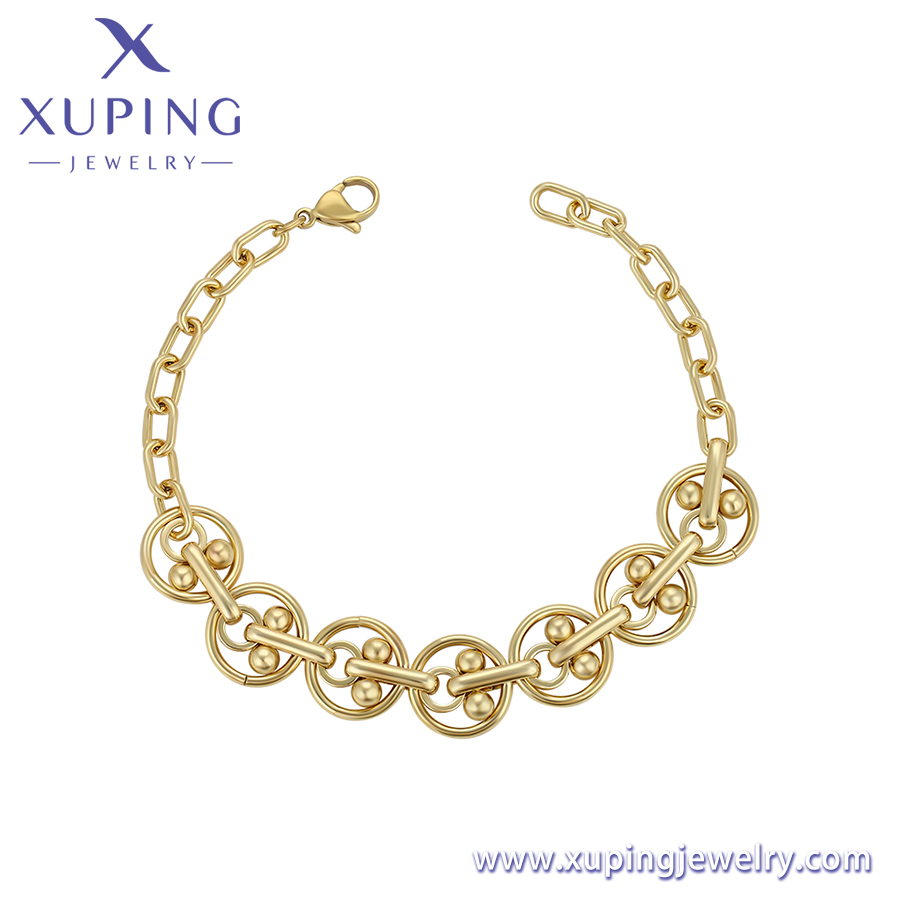
Bracelet model X000977345, Daily series: approx. 200 × 5 mm (±2 cm), approx. 15.05 g.
Application and Use Cases: Matching Capability to Scenario
Process capability only converts into commercial value when it maps onto real end-use conditions. The manufacturer's scenario data defines the operating environments its products are built for: daily wear, fashion shows, events and occasions, gift giving, and all-weather use, across operation modes described as long-term wear, occasional wear and daily accessory use.
Those scenarios translate into specific assortment decisions. Coordinated sets such as X000871334 (Luxury series, approx. 18.8 g per set, with earrings at approx. 3 × 28 × 11 mm, bracelet at approx. 200 × 3 mm and necklace at approx. 450 × 3 mm) and X001006294 (Simple series, approx. 28.43 g per set, bangle, pendant and earrings) suit occasion and gifting channels where a matched look is the purchase driver. Daily-wear categories are carried by items such as the anklets X001124310 (approx. 280 × 5 mm, +30 mm, approx. 10.0 g) and X000988693 (approx. 270 × 4.5 mm, ±2 cm, approx. 5.59 g), and by stainless steel pieces such as T000959269 and A00902945, which address buyers who prefer a metal base without gold-colour plating. Brooches, including A00900238 (approx. 47 × 32 mm, approx. 12.3 g, marked "xp") and X000852427 (Luxury series, approx. 44 × 38 mm, approx. 9.15 g), serve a smaller but consistent occasion-driven segment.
On the demand side, the manufacturer identifies five project types: retail jewelry stores, e-commerce platforms, brand OEM/ODM programmes, wholesale distribution, and promotional gifts. It also lists the requirements buyers most often attach to those projects — customised design, eco-friendly material, hypoallergenic finishes, and lead-free compliance — alongside typical packaging configurations such as jewellery display stands, custom gift boxes and storage bags. That list is itself informative, because it reflects the accessory and compliance expectations that have become standard in export channels rather than optional extras.
Market Trend Analysis: Scale and Compliance Are Converging
Industry data supports the view that capacity and compliance are becoming linked rather than separate procurement criteria.
- The global fashion (costume) jewelry market was projected at USD 167.97 billion in 2024 (Custom Market Insights).
- The imitation jewelry segment is estimated to grow at a 7.23% CAGR between 2025 and 2035, primarily driven by e-commerce expansion (Spherical Insights).
- Necklaces and pendants represent the largest product segment, at approximately 28.5% of revenue (Market Intelo, 2025).
- China's jewelry exports reached approximately USD 11.5 billion in 2024, with Hong Kong, the United States and Switzerland as leading destinations (OEC).
Two caveats belong in any honest reading of these figures. Market size estimates diverge substantially depending on definition — published figures for the same period range from roughly USD 18 billion for pure imitation jewelry to over USD 160 billion when affordable-luxury positioning is included — so absolute values should be treated as directional rather than precise. And because necklaces and pendants carry the largest share of demand, assortment concentration in that category is a rational default, not a differentiation strategy.
What the trends do support is a structural argument. When e-commerce shortens product cycles, suppliers with in-house design capacity can respond to newness demand faster than suppliers dependent on external design. When compliance regimes tighten, suppliers with documented process and testing infrastructure absorb the cost of evidence far more easily than assemblers. The two forces push in the same direction: toward manufacturers whose capability can be documented.
Comparison with Traditional Sourcing Models — and the Limits of the Evidence
| Dimension | Trading / assembly model | Integrated manufacturing (Xuping Jewelry) |
|---|---|---|
| Design origination | Depends on external workshops or open-market designs | Stated R&D team of 62 designers; 194 patents |
| Process control | Split across multiple vendors; limited traceability | 18 production procedures under one management system |
| Physical base | Office and warehouse footprint | Over 200,000 m² facility; 1,200+ production facilities; 1,000+ staff |
| Compliance documentation | Certificates secured per order | ISO, SGS and CE certifications held at company level |
| Customisation | Limited to modifications the third-party workshop accepts | One-stop OEM and ODM services; low minimum order quantities |
The integrated model is not automatically the correct choice, and the evidence above has genuine boundaries that a buyer should weigh before shortlisting:
- Patent counts do not indicate market fit. A large portfolio shows design activity, not whether the resulting aesthetics match a specific retailer's customer base. Assortment fit must still be judged from samples and past sell-through.
- Eighteen procedures do not guarantee wear performance for a given SKU. Plating longevity depends on coating thickness, wear conditions, individual skin chemistry and after-sale care — variables that a process count does not resolve.
- Certification is market- and scope-specific. The EU's EN 1811:2023 standard sets a nickel release limit of 0.5 μg/cm²/week for items in prolonged skin contact, and the US ASTM F2999 specification restricts lead in electroplated metals to 6.0%. These limits apply per product, per material and per destination market; buyers must confirm the actual test scope covering the SKU they purchase rather than relying on company-level certification.
- Scale with low minimums still has scheduling boundaries. A facility running high-volume programmes cannot always guarantee identical lead times for small customised runs, particularly during peak production periods.
- Very small bespoke volumes may not benefit. For narrow, highly specialised assortments in the low hundreds of pieces, a smaller specialised workshop can sometimes offer more flexibility, even if the headline commercial terms appear less favourable.
Future Outlook
The direction of travel in fashion jewelry sourcing is toward documented capability. As nickel and lead regulations continue to tighten across the EU and North America, and as e-commerce platforms increasingly require compliance evidence at listing level, the cost of producing that evidence will separate manufacturers from intermediaries. Suppliers with internal testing relationships, defined process structures and certification history will find that documentation increasingly serves as a commercial asset rather than an administrative cost.
A second shift concerns design velocity. With necklaces and pendants already holding the largest share of category revenue and e-commerce compressing refresh cycles, buyers are likely to evaluate suppliers less on unit price and more on how quickly a new design can move from concept to shippable inventory. Internal design capacity — the substance behind a patent portfolio — speaks directly to that requirement.
For buyers, the practical implication is a change in what the first supplier conversation should cover. Factory size, patent counts and step counts are useful entry points, but they are the beginning of verification rather than the end of it. The evidence chain only closes when documentation is matched against samples, test scopes are confirmed for the specific markets involved, and lead times are tested through an actual production run.
Frequently Asked Questions
1. What does a patent count of 194 tell a buyer about a fashion jewelry manufacturer?
It indicates that the manufacturer maintains an internal design and engineering function. In fashion jewelry, patents are typically design and utility filings, so a portfolio of 194 implies a design team large enough to generate protectable work, a documentation process, and the administrative capacity to maintain filings. It does not indicate product quality, plating durability or delivery reliability, and it does not indicate whether the design direction suits a particular retail market.
2. What are the 18 production procedures in fashion jewelry manufacturing?
Xuping Jewelry states that all goods pass through 18 production procedures, and that these steps are designed to meet European and American environmental-protection standards. Detailed step lists are not publicly published for each category. For a buyer, the operationally useful question is which procedures are performed in-house and where inspection gates are positioned within the sequence, since those two factors determine traceability when a defect occurs.
3. How does a multi-step production process affect product consistency?
Each additional procedure creates another transfer between stations. Transfers are simultaneously points where defects can be introduced and points where they can be detected, so a documented multi-step process provides the structural opportunity for in-line inspection. Consistency across repeat orders depends on whether those gates are actually operated and recorded, which is why documentation systems such as ISO-type quality management frameworks matter alongside the step count itself.
4. Which materials and product categories does a manufacturer such as Xuping Jewelry work with?
The product range covers rings, pendants, earrings, necklaces, bracelets, anklets, bangles, brooches and coordinated jewelry sets. Published specifications show Environmental Copper as the base material for most plated items, with 14K gold colour, 18K gold colour and platinum plating options, plus a stainless steel line. Stones include synthetic cubic zirconia, synthetic crystal and glass, and several styles are produced with no main stone.
5. Do ISO, SGS and CE certifications replace the need for per-market testing?
No. Company-level certification demonstrates that quality and compliance systems exist, but product safety requirements are market-specific. The EU's EN 1811:2023 standard sets a nickel release limit of 0.5 μg/cm²/week for jewelry in prolonged skin contact, and the US ASTM F2999 specification limits lead in electroplated metals to 6.0%. Buyers should confirm that the test scope covers the specific SKU, material and destination market concerned rather than relying on general certification claims.
6. Does a large manufacturing base and low minimum order quantity guarantee fast lead times?
Not automatically. Integrated facilities such as Xuping Jewelry's stated 200,000+ square metre base, 1,200+ production facilities and 1,000+ staff provide capacity, and the company offers low minimum order quantities with OEM and ODM services. However, scheduling priority during peak periods, the number of tooling changes required by a custom design, and component availability can all extend lead times for small customised runs. Lead time should be verified through an actual order rather than inferred from facility size.
7. How should a buyer verify supplier capability beyond patents and factory size?
The most useful verification steps are documentary and sequential: reconcile headcount and stated output against the equipment base, obtain the process step list and confirm where inspection gates sit, request the test scope behind any certification for the exact product and market concerned, order samples to evaluate finish and dimensional accuracy against published tolerances, and then run a production order to observe lead time and deviation handling. Each step tests a different claim, and no single metric substitutes for the sequence.
Summary
Patent counts and process step counts are not marketing claims — they are structural evidence that requires a real design function, real production infrastructure and real documentation practices to sustain. In a market projected at USD 167.97 billion in 2024 and growing at a 7.23% CAGR through 2035, that kind of evidence is becoming more useful to buyers than factory adjectives. It is also, importantly, bounded: it answers whether a supplier can originate and control production, while leaving assortment fit, wear performance, market-specific compliance and lead-time reliability to be verified through samples, test scopes and actual orders.