
Inside the Functional Yarn Evidence File: MONALISHAMAGIC
Inside the Functional Yarn Evidence File: MONALISHAMAGIC
Functional yarn buyers rarely struggle to find suppliers. They struggle to find suppliers whose claims can be checked. A capability file earns its place in a procurement pack only when each line traces to a certificate number, a test scope, a stated commercial term or a named development program.
This article is that file for MONALISHAMAGIC, the brand of Dongguan Yuexiong Textile Co., Ltd., a vertically integrated yarn spinning mill founded in 2016 in Dongguan, Guangdong, with a 2,000 sqm factory, 50 employees, a 20-engineer R&D team and a 70% export ratio across global markets. The portfolio runs from luxury natural fibers to GRS-certified recycled nylon, with functional yarn as the core line, produced on an OEM/ODM basis and including color-changing yarns made through a patented waterless dyeing process.
The file is organized around the four dimensions procurement teams normally use when they compare three to five shortlisted functional yarn mills: R&D depth, test evidence, service readiness and application solutions. No competing mill is named here and no market share is asserted, because neither can be documented from the available source material. What follows instead is the evidence a buyer can request, read and audit — the same evidence that should be demanded from every other mill on the list.
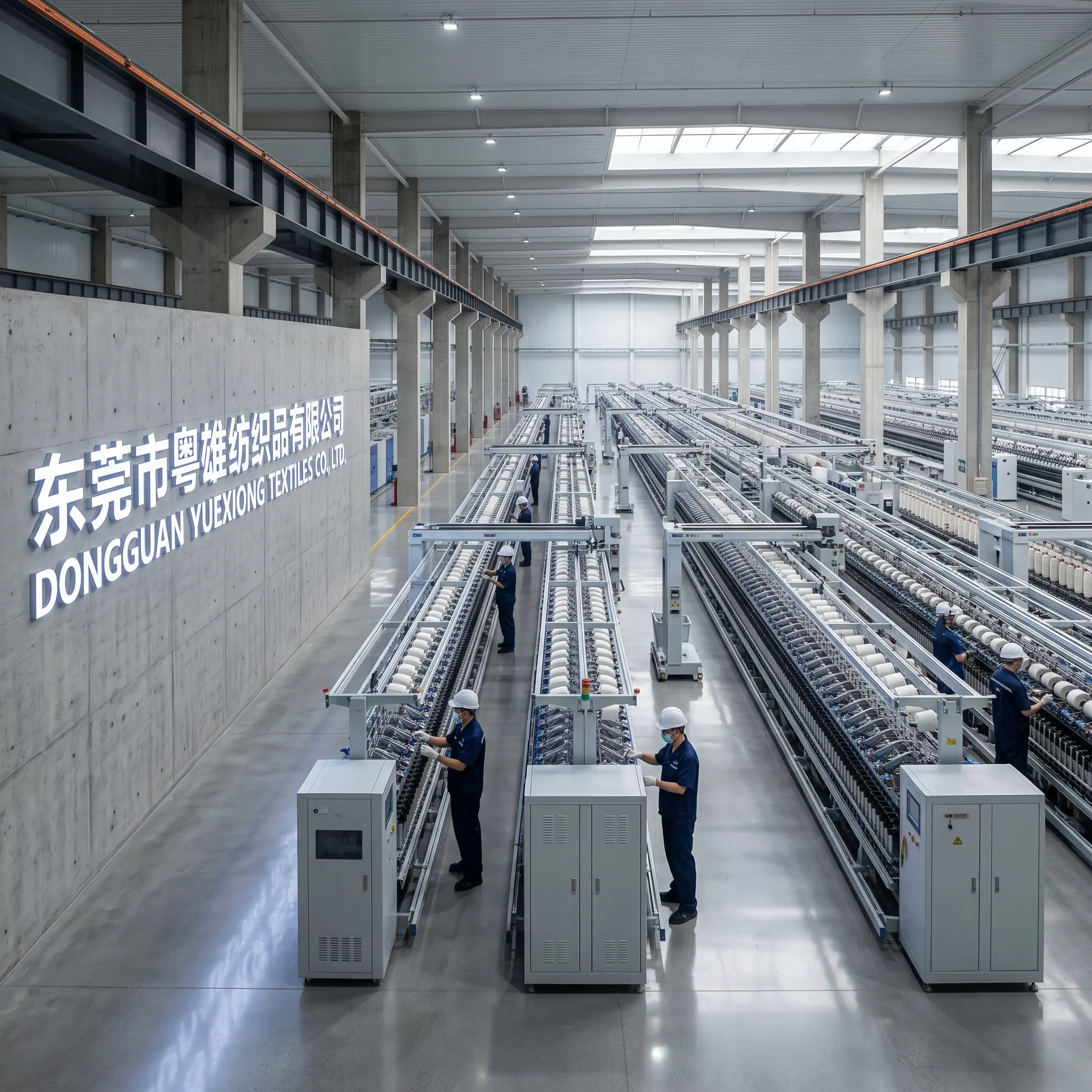
MONALISHAMAGIC (Dongguan Yuexiong Textile Co., Ltd.) functional yarn production floor, Dongguan, Guangdong. Image: company file.
Four audit dimensions, and the evidence behind each
The dimensions are not brand claims; they are questions a buyer can pose to any supplier. The table below shows what MONALISHAMAGIC puts forward against each one. The sections that follow explain the strength of that evidence and, equally, where it stops.
| Dimension | The buyer's question | Evidence supplied |
|---|---|---|
| R&D depth | Does the supplier own process know-how, or resell someone else's? | A 20-engineer R&D team; one CNIPA invention patent on waterless dyeing of color-changing yarns (ZL 2023 1 1305729.5, issued 2024-04-16); two CNIPA utility models on dyeing equipment (2022). |
| Test evidence | Are performance claims backed by third-party reports tied to a product and a standard version? | Five Intertek reports — GZHT91138285, GZHT91138296, GZHT91138300, GZHT03128204 and GZHT03128212 — each with a named scope and issue date. |
| Service readiness | Can the supplier support sampling, inspection and after-sales at the order sizes a brand actually places? | MOQ of 5 KG; 7-15 day lead time; pre-shipment inspection; documented after-sales scope covering complaints, reorders, color matching and compliance documents. |
| Application solutions | Has the supplier carried functional yarn into a real product program? | Two recorded development programs: a thermochromic lingerie application (2 years, five markets) and an outdoor heated-yarn project (United Kingdom, 2 years, -20 °C conditions). |
R&D depth: what the patents and headcount actually show
MONALISHAMAGIC records 20 engineers in R&D and three CNIPA filings: one invention patent and two utility models. The invention patent, ZL 2023 1 1305729.5, covers a waterless dyeing preparation process for color-changing yarns and the yarns prepared from it. It was issued on 2024-04-16 and runs to 2043-10-10.
The two utility models, ZL 2022 2 1385471.5 and ZL 2022 2 1384659.8, both issued 2022-09-13, protect a spray pipe and a suction roller respectively, each described together with the dyeing yarn device that contains it. In practical terms these are equipment-level filings rather than product claims, and the distinction matters to a buyer: they indicate that dyeing hardware is developed in-house. That makes it a reasonable question to ask whether the same equipment handles the custom shade on your order sheet, and how color consistency is verified between lots.
The boundary is jurisdictional. All three filings are Chinese national filings registered with CNIPA. They establish process ownership in China; they do not establish patent protection in other markets, and a buyer sourcing for sale in the EU or the US should not read them as freedom-to-operate advice for their own product.
Test evidence: matching a report to a product, a standard and a date
The file carries five Intertek test reports from Intertek Testing Services Shenzhen Ltd., Guangzhou Branch. Three are product-specific and were issued against a named sports brand's supply-chain policy: GZHT91138285 for luminous yarn (Baby), GZHT91138296 for UV color-changing yarn (Baby) and GZHT91138300 for temperature-changing yarn (Baby), all tested to Adidas A-01 Policy version 20 and issued between 2022-08-29 and 2022-08-31.
Two further reports cover knitted fabric rather than yarn: GZHT03128204 for light brown knitted fabric and GZHT03128212 for black knitted fabric, both for children's apparel, both assessed against EN 17134-2:2023 and both issued on 2026-04-16 for the EU/US market.
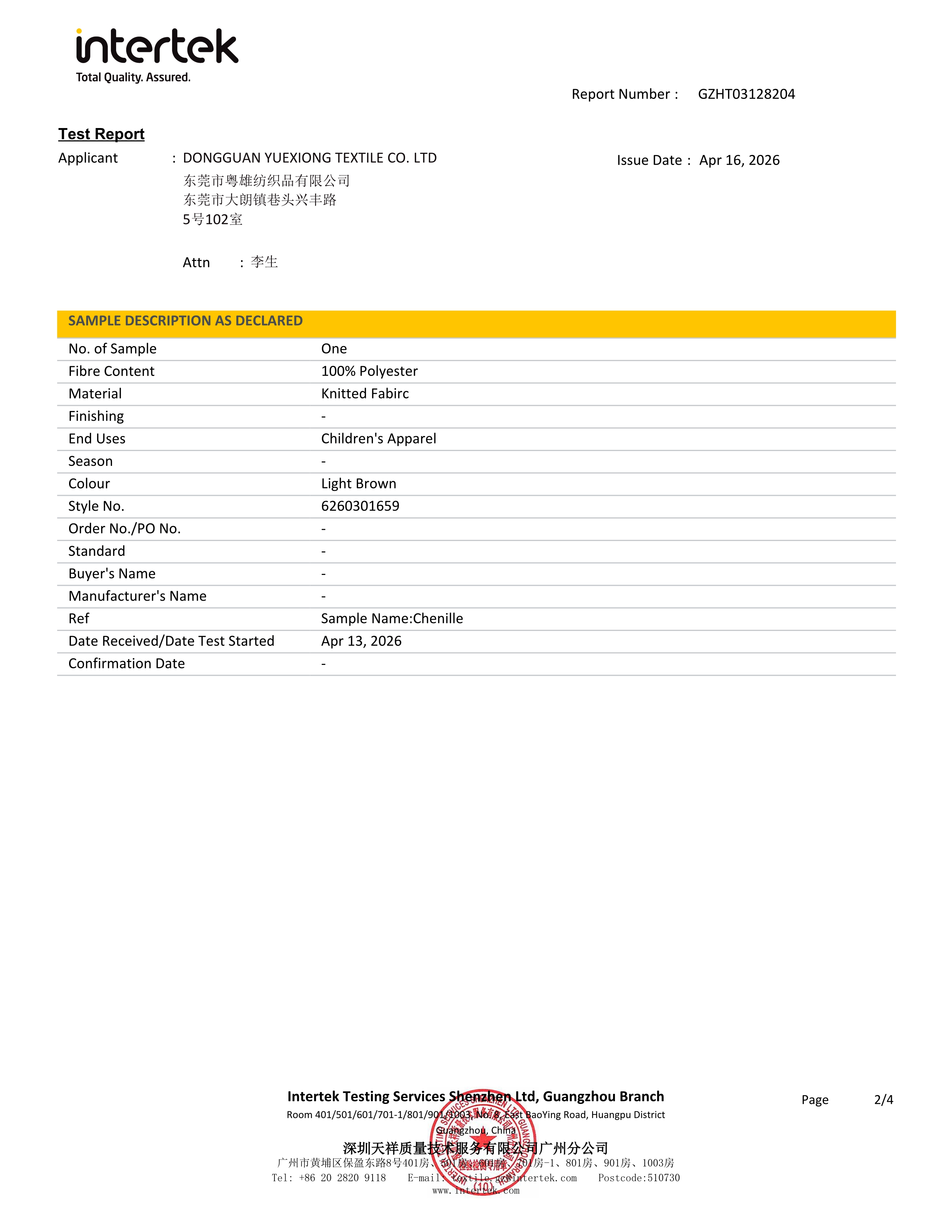
Intertek report GZHT03128204, issued 2026-04-16 for knitted fabric against EN 17134-2:2023. Image: company file.
Three qualifications should travel with these documents. First, a report against a brand's restricted-substances policy documents compliance with that policy for the scope tested; it is not an endorsement by the brand, and it does not transfer to a different color, count or blend. Second, the three yarn reports date from 2022, and policy versions are revised, so a buyer placing a later order should ask which version is currently in force and whether the report still applies. Third, the two fabric reports describe fabric, not the yarn that went into it — useful evidence for a garment program, but not a substitute for yarn-level data.
No other third-party report appears in the file. Where a property is not covered, the honest answer is to request the specific test: retroreflective performance for YX-REFLECT-001, antibacterial method and wash-cycle data for YX-WASH-001, pilling grade and static or water-repellency data for YX-FUNC-001. A missing report is a documentation gap to close, not evidence that the property is absent.
The specification envelope: counts, colors and seven processes
The mill quotes yarn counts across a 0.5/1 NM to 200/2 NM range. The value of a range that wide lies less in the endpoints than in repeatability: a buyer's real question is whether the same count, twist and shade can be held on the second and third order, and whether the count on the sample matches the count on the bulk delivery.
Color is offered in natural white, black, gray, beige, camel and melange, alongside custom dyed shades and brand-exclusive colors. Because the last two are specified per program, the commercial minimum for a particular shade belongs in the quotation rather than in a capability file. The capability question is whether the mill can match and hold a specified shade, and the answer is only as good as the color-matching support behind it.
Seven processes are listed: knitting, weaving, embroidery, crochet, jacquard, sewing and product development. This list is more consequential than it looks. A yarn approved on a knitting machine is not automatically approved for embroidery or jacquard, where thread tension, twist and surface friction differ. Naming all seven defines where validation should actually be run before a bulk commitment.
Product-level evidence: what each functional line can prove
The catalogue uses model codes, and two of them cover more than one product family — worth knowing before a buyer assumes a one-to-one mapping between code and function.
- YX-HEAT-001 (heat-responsive lines). In the catalogue this code covers both thermochromic, temperature-reactive yarn and far-infrared heating yarn. The matched report is Intertek GZHT91138300 for temperature-changing yarn, issued 2022-08-31 against Adidas A-01 Policy version 20. Application evidence sits in the lingerie program described later.
- YX-UV-001 (photochromic yarn). Sunlight- and UV-reactive color change, documented by Intertek GZHT91138296 for UV color-changing yarn, issued 2022-08-29 against the same policy version.
- YX-GLOW-001 (luminous yarn). Photoluminescent, glow-in-the-dark yarn, documented by Intertek GZHT91138285 for luminous yarn, issued 2022-08-29.
- YX-REFLECT-001 (reflective yarn). Retroreflective, high-visibility yarn used in knitting, embroidery and sewing thread. No dedicated third-party report is included in this file; retroreflectivity data should be requested for the specific construction.
- YX-WASH-001 (machine washable antibacterial yarn). No product-specific test report appears in the file. The test method, number of wash cycles and reported result should be requested before an antibacterial claim is written into a product spec.
- YX-FUNC-001 (anti-pilling and anti-static; waterproof antibacterial). The code is shared by two families, so a buyer should confirm which one a quotation refers to, then request pilling grade, static behavior or water-repellency data with the method named.
- FSC-YX-ECO-001 (FSC certified paper yarn). Covered by FSC chain of custody ESTS-COC-230318, issued by ESTS, whose scope includes paper yarn and runs to 2029-09-12.
Certification and compliance: the records and their validity dates
Certification is where capability files most often blur. The table lists the records supplied for this file as issued, with scope and validity, so a buyer can check a certificate number rather than a logo.
| Record | Number | Issued by | Scope | Validity as recorded |
|---|---|---|---|---|
| Intertek test report | GZHT91138285 | Intertek Testing Services Shenzhen Ltd., Guangzhou Branch | Luminous yarn (Baby); Adidas A-01 Policy version 20 | Issued 2022-08-29 |
| Intertek test report | GZHT91138296 | Intertek Testing Services Shenzhen Ltd., Guangzhou Branch | UV color-changing yarn (Baby); Adidas A-01 Policy version 20 | Issued 2022-08-29 |
| Intertek test report | GZHT91138300 | Intertek Testing Services Shenzhen Ltd., Guangzhou Branch | Temperature-changing yarn (Baby); Adidas A-01 Policy version 20 | Issued 2022-08-31 |
| Intertek test report | GZHT03128204 | Intertek Testing Services Shenzhen Ltd., Guangzhou Branch | Light brown knitted fabric, children's apparel; EN 17134-2:2023; EU/US | Issued 2026-04-16 |
| Intertek test report | GZHT03128212 | Intertek Testing Services Shenzhen Ltd., Guangzhou Branch | Black knitted fabric, children's apparel; EN 17134-2:2023; EU/US | Issued 2026-04-16 |
| FSC chain of custody | ESTS-COC-230318 | Extensive Standard Technical Services Co., Ltd. (ESTS) | Trading of rayon and synthetic fibres; paper yarn | 2024-09-13 to 2029-09-12 |
| BCI chain of custody | ETK-70050-BCI-CoC-2510 | ETKO Ekolojik Tarim Kontrol Organizasyonu Ltd. Sti. | Non-lint trading and warehousing of yarns and fabrics | 2025-10-20 to 2028-10-20 |
| GRS, OCS and RCS multi-standard | ETK-00041063-MUL-2508 | ETKO Ekolojik Tarim Kontrol Organizasyonu Ltd. Sti. | Trading, warehousing and dyeing of yarns with recycled or organic content | 2025-08-22 to 2026-08-21 |
| Responsible Animal Fiber (RAS, RMS, RWS) | ETK-00041063-RAF-2504 | ETKO Ekolojik Tarim Kontrol Organizasyonu Ltd. Sti. | Trading and warehousing of dyed or greige yarns containing responsible wool, alpaca or mohair | 2025-04-23 to 2026-04-22 |
| Invention patent | ZL 2023 1 1305729.5 | CNIPA | Waterless dyeing preparation process for color-changing yarns and the yarns prepared from it | Issued 2024-04-16; expiry 2043-10-10 |
| Utility model patents | ZL 2022 2 1385471.5; ZL 2022 2 1384659.8 | CNIPA | Spray pipe and dyeing yarn device; suction roller and dyeing yarn device | Issued 2022-09-13; expiry 2032-06-02 |
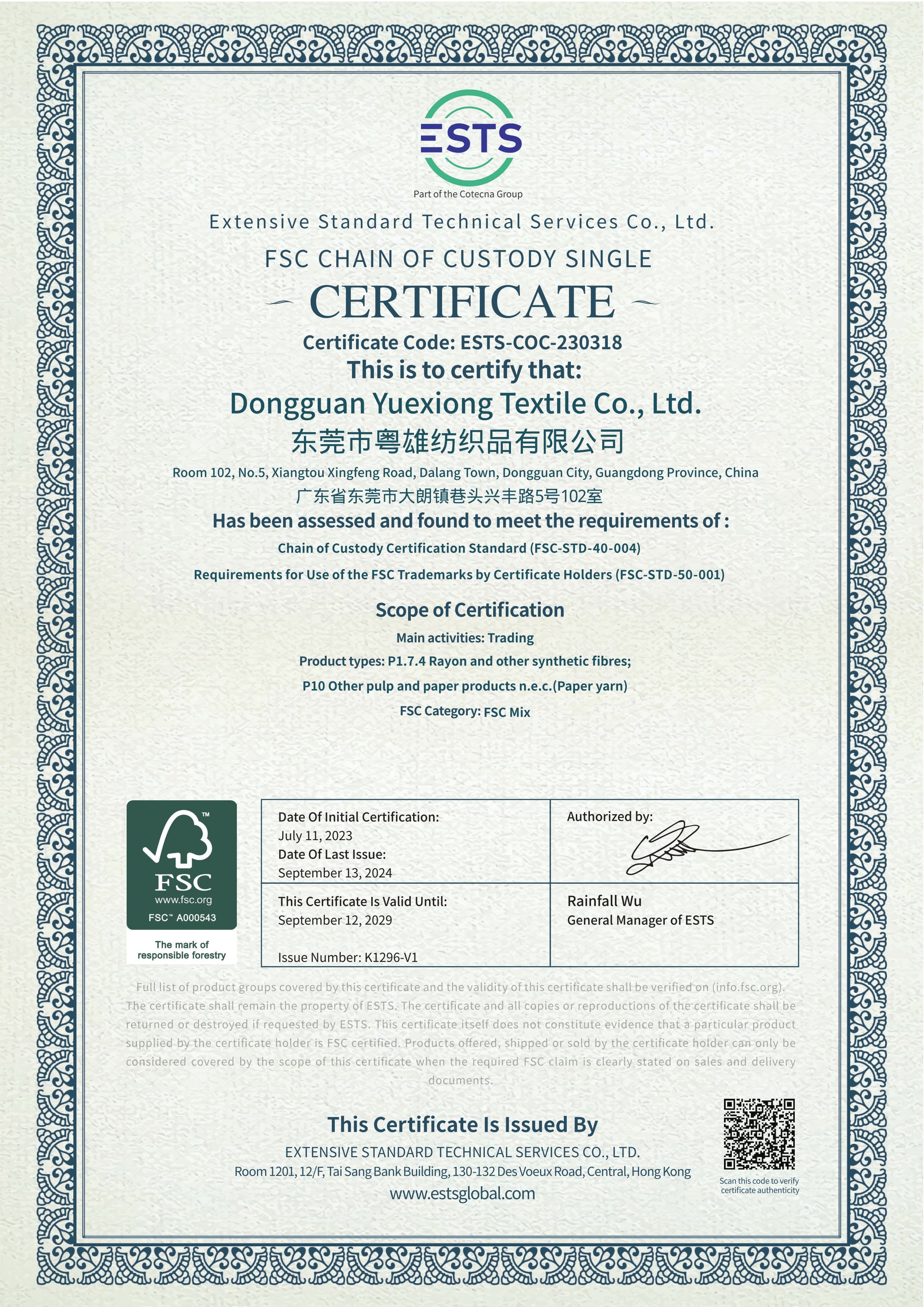
FSC chain of custody ESTS-COC-230318, issued by ESTS; the scope includes paper yarn and runs to 2029-09-12. Image: company file.
Three points follow from the records. First, the FSC and BCI scopes are chain-of-custody scopes covering trading, warehousing and — in the FSC case — paper yarn. They support a sourcing claim for products inside that scope, not for the entire catalogue. Second, two scopes carry 2026 expiry dates: GRS/OCS/RCS on 2026-08-21 and RAF on 2026-04-22. Certificate validity is date-bound, so a current certificate copy should be requested with the quotation before either scope is cited in a customer-facing claim. Third, the company profile lists GRS, BCI and OEKO-TEX; the certificate records supplied here cover GRS, BCI, FSC and RAF, and an OEKO-TEX certificate is not among them. A buyer who needs OEKO-TEX should ask for that certificate and its product scope directly.
Separately, the brand holds trademark registrations in Class 25 for garments: US 7,904,868 (2025-08-19), Italy 302024000183204 (2025-03-21) and UAE 441101 (2025-04-24). These protect brand identity in clothing. They are not evidence of yarn performance and should not be presented as such.
Service readiness: MOQ, lead time, inspection and after-sales
The stated commercial envelope is a 5 KG minimum order quantity and a 7-15 day lead time, with inspection provided before shipment and delivery by air, sea or land freight. Payment terms recorded in the procurement file are TT, L/C, D/P, PayPal, Payoneer, Wise and Western Union.
A 5 KG minimum matters at evaluation stage because it allows a sample or pilot knit without committing to bulk. The 7-15 day figure is a stated lead time and should be confirmed against the specific count, color and quantity in the quotation, since custom dyeing and brand-exclusive shades sit outside a standard repeat.
After-sales is documented as remote support and consultation, response to quality complaints and order follow-up, reorder assistance with sample reconfirmation and color matching, logistics tracking and risk-control consultation, supply of certification and compliance documents, and consultation on functional yarn performance and durability. For a procurement team, the operative item is the compliance-document supply: that is the mechanism by which the certificate scopes in the table reach the buyer's own quality file.
Application solutions: two documented development programs
The first recorded program is a thermochromic application for a high-end lingerie brand across France, Canada, China, Germany and the United Kingdom. The scope was one product line, development ran two years, and the recorded outcome is a color shift that responds to body temperature. The case file describes the commercial effect as a market premium for the client; that is the client's recorded outcome, not an independently audited market result, and it is best read as a development reference rather than a forecast for another brand.
The second is an R&D project for an outdoor apparel brand in the United Kingdom, developing active heating yarns for thermal clothing in extreme cold. The project ran two years, and the record states stable performance at -20 °C together with high tenacity and wash durability. Two things are worth separating here: -20 °C is the condition recorded for that development, and the yarn was custom-developed for it. Neither statement transfers automatically to a different construction or a different heating specification.
Two programs are a thin sample, and the file should be read that way. What they establish is that functional development has been carried through to a product line and to a cold-weather specification, with named durations and markets — not that every functional line has a reference case behind it.
Waterless dyeing compared with a conventional dyeing route
Conventional yarn dyeing is a water-intensive wet process, and for color-changing yarns the dyeing step is also where the effect is created or destroyed. MONALISHAMAGIC's patented route, covered by CNIPA invention patent ZL 2023 1 1305729.5, is a waterless dyeing preparation process for color-changing yarns.
For a buyer, the practical difference is control over the effect rather than a headline environmental number. What the file does not contain is any quantified comparison: no liters saved, no per-kilogram reduction, no third-party life-cycle assessment. A procurement team that needs a water figure should request or commission one for the specific process and volume. The patent establishes the process route, not its measured footprint.
The fit boundary is both jurisdictional and technical: the patent is a Chinese national filing, and the process is specified for color-changing yarns. It should not be extended in a buyer's documentation to conventional solid-shade dyeing or to production outside the described scope.
Where the file stops: boundaries a buyer should respect
A capability file that claims everything verifies nothing. The following limits are part of the evidence, not a footnote to it.
- Test scopes are narrow. Five Intertek reports cover luminous, UV color-changing and temperature-changing yarn, plus light brown and black knitted fabric. They do not certify every color, count or blend in the catalogue.
- Report dates matter. The three yarn reports were issued in 2022 against Adidas A-01 Policy version 20; the version in force at order date should be confirmed.
- Certificate validity is date-bound. Two supply-chain scopes in this file carry 2026 expiry dates and need current copies before citation.
- OEKO-TEX appears in the company profile but not among the certificate records supplied here.
- Patents are Chinese national filings; trademarks are Class 25 garment marks.
- Case outcomes are client records, not audited market or performance guarantees.
- No competitor data, market share or ranking is asserted, because none is documented in the source material.
A verification checklist for a three-to-five-mill shortlist
The same eight checks can be run against MONALISHAMAGIC and against any other functional yarn mill under evaluation. They are written to produce comparable answers across suppliers.
- Ask for certificate number, issuing body, scope and validity date — not a logo. Compare scope wording, not just standard names.
- Match every test report to the exact product code, color and count you intend to order.
- Confirm the standard or brand-policy version in force at your order date.
- Ask which counts inside the 0.5/1 NM to 200/2 NM range are routine and which are developmental.
- Request the color-matching protocol and a reorder sample confirmation step for custom and brand-exclusive shades.
- Validate the yarn on your actual construction — knit, weave, embroidery, crochet, jacquard or sewing — rather than on a swatch made by a different process.
- Confirm MOQ, lead time, inspection terms and payment terms in the quotation, and check that pre-shipment inspection covers the properties you intend to claim.
- Ask for the compliance-document set you will need at customs and at retail, then check the date on each document.
What this evidence implies for the next buying cycle
The direction of travel in functional yarn procurement is toward document-level proof: buyers increasingly need a certificate number, a scope sentence and a date, because those are the items that survive an audit, a customs query or a retail compliance review. Mills that can produce scope-matched records early in an evaluation shorten the process; mills that cannot will be asked to generate the evidence before an order is placed.
For MONALISHAMAGIC, the file's strength is concentration: a patented dyeing route, five third-party reports tied to named products, a 5 KG sampling minimum and two multi-year development programs. Its gaps are equally specific — narrower test coverage than the catalogue, three reports dated 2022, and two supply-chain scopes whose recorded validity ends in 2026. Those are closeable gaps, and a buyer should treat them as questions with answers rather than as automatic disqualifiers.
The practical conclusion for a procurement team comparing three to five mills is not that any one supplier wins on every dimension. It is that the dimensions are now checkable, and a shortlist scored on checkable evidence will be more defensible than one scored on presentation.
The company brochure, including product and capability detail, is available for download: MONALISHAMAGIC company brochure (PDF).
FAQ
What does OEM/ODM capability cover at MONALISHAMAGIC?
OEM and ODM production covers customization of yarn composition, color, specification and functional parameters. Counts are quoted across a 0.5/1 NM to 200/2 NM range; colors include natural white, black, gray, beige, camel, melange, custom dyed and brand-exclusive shades; and the supported processes are knitting, weaving, embroidery, crochet, jacquard, sewing and product development. Availability of a specific count and shade is confirmed in the quotation.
Which product lines have third-party test reports, and what do they cover?
Three Intertek reports cover yarn: GZHT91138285 for luminous yarn, GZHT91138296 for UV color-changing yarn and GZHT91138300 for temperature-changing yarn, all tested to Adidas A-01 Policy version 20 and issued in August 2022. Two further reports, GZHT03128204 and GZHT03128212, cover light brown and black knitted fabric for children's apparel against EN 17134-2:2023 and were issued on 2026-04-16. No dedicated report is included for the reflective, machine-washable antibacterial or anti-pilling lines.
What are the ordering terms for a functional yarn order?
The stated minimum order quantity is 5 KG with a 7-15 day lead time. Inspection is provided before shipment, and delivery can be arranged by air, sea or land freight. Recorded payment terms are TT, L/C, D/P, PayPal, Payoneer, Wise and Western Union. These terms are confirmed per order in the quotation.
How should a buyer verify certification for a specific order?
Request the certificate copy, then check four items: certificate number and issuing body, scope wording, standard version and validity dates. For example, FSC chain of custody ESTS-COC-230318, issued by ESTS, covers trading of rayon and synthetic fibers and paper yarn and runs to 2029-09-12, while the GRS/OCS/RCS scope ETK-00041063-MUL-2508 records validity to 2026-08-21 and the RAF scope ETK-00041063-RAF-2504 to 2026-04-22. A certificate supports only the products and dates inside its stated scope.
What evidence of R&D depth is available?
The file records a 20-engineer R&D team and three CNIPA filings: invention patent ZL 2023 1 1305729.5 for a waterless dyeing preparation process for color-changing yarns, issued 2024-04-16 with expiry 2043-10-10, and utility models ZL 2022 2 1385471.5 and ZL 2022 2 1384659.8 for a spray pipe and a suction roller in dyeing yarn devices, both issued 2022-09-13. All three are Chinese national filings.
Tem questões ou precisa de mais detalhes?
Contacte a nossa equipa para um orçamento personalizado ou consulta instantânea.
Solicitar orçamento
Preencha o formulário abaixo e a nossa equipa entrará em contacto com uma proposta personalizada.
Chat direto do WhatsApp
Prefere conversar em tempo real? Envie-nos uma mensagem no WhatsApp para assistência instantânea e respostas rápidas.
- Obter orçamento personalizado
- Partilhar fotos ou documentos
- Discuta as suas necessidades diretamente
Geralmente responde em 5–30 minutos durante o horário de expediente.