
Inside the MC1039-1: Evidence of Heavy-Duty Gaming Chair Manufacturing
A load rating on a gaming chair is a manufacturing statement, not a marketing one. A chair documented to carry 150 kg is not simply a chair with more foam: it is a chair whose gas lift, base, tilt mechanism, frame and cushioning have each been specified to work together under a heavier user, in a seated position that may hold for hours at a time.
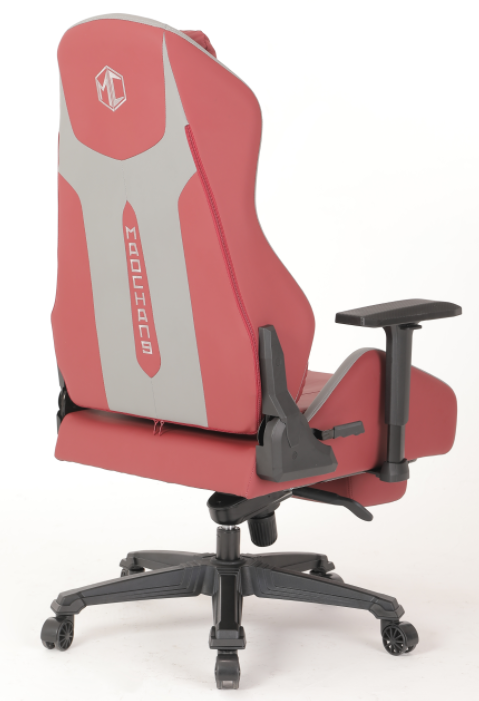
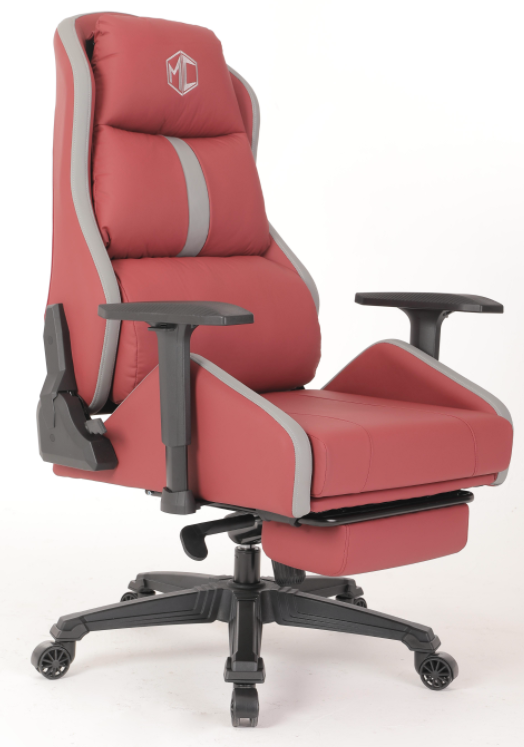
Model MC1039-1 is one of the gaming chairs produced by Anji Maochang Furniture Co., Ltd., a chair factory established in 2016 in Anji County, Zhejiang Province, China, that manufactures gaming chairs, office chairs and manicure chairs and exports 98% of its output, with major markets in the EU, USA, Thailand, Brazil and South Korea. Maochang's specification record describes the MC1039-1 as a heavy-duty big-size gaming chair suitable for heavy people, intended for gaming, home, live streaming and internet cafe scenarios, with a 180-degree recline, 4D adjustable armrests, a foldable footrest and a frog-type adjustable multifunctional mechanism.
Because the model's dimensions, materials and container loading are documented rather than implied, the MC1039-1 works as a case study in what "heavy duty" means at the production level — and where the boundaries of that claim actually sit.
Why "Heavy Duty" Is an Engineering Claim, Not a Label
Gaming chair listings are visual by default. Buyers see upholstery, stitching, colour and silhouette. They rarely see the parts that decide whether a large chair survives daily use: the gas lift, the diameter of the starbase, the tilt mechanism beneath the seat, the frame inside the backrest, the density of the mould foam and the spring pack in the cushion.
Those hidden parts matter more as the user gets heavier. Industry material guidance for premium gaming chairs typically places mould foam in the 50–65 kg/m³ band, because density is the main driver of whether a seat cushion keeps its shape or flattens over a year of daily sitting. PU leather, meanwhile, accounts for roughly 57.3% of gaming chair material use globally, which is a useful reminder that the most common surface material is not automatically the most breathable one for long sessions.
The consequence for buyers is straightforward: two chairs can look identical on a listing page and behave very differently in year three. That is why a documented specification — not a photograph — is the starting point when a heavy-duty model is being evaluated, and why the most useful supplier conversations move quickly from appearance to components.
What Maochang Documents About the MC1039-1
The MC1039-1 sits in Maochang's heavy-duty big-size category. The recorded specification is specific enough to be checked item by item against a sample, which is the first test any buyer should apply to a load-rated chair.
| Documented specification | MC1039-1 record |
|---|---|
| Product category | Heavy-duty big-size gaming chair |
| Documented user fit | Big size chair suitable for heavy people |
| Documented scenarios | Gaming, home and home PC gaming, live streaming, internet cafe |
| Materials | PU, metal, plastic |
| Overall dimensions | W74 × D80 × H126–132 cm |
| Carton dimensions | 82 × 60 × 53 cm |
| Packing | 1 piece per carton |
| Loading quantity | 260 pieces |
| Recline | 180 degrees |
| Mechanism | Frog-type adjustable multifunctional mechanism |
| Armrests | 4D adjustable |
| Footrest | Foldable |
| Back cushion | Soft cushion on back cushion |
Source: first-party product specification record for model MC1039-1.
At series level, the documentation for the big-size MC1039 model lists the load-bearing components that make a heavy-duty rating concrete. These are kept in a separate table deliberately, because facts recorded for one model in a series are not automatically transferable to another model number.
| Load-bearing component | Documented for the big-size MC1039 model |
|---|---|
| Weight capacity | 150 kg |
| Gas lift | Class 3 |
| Starbase diameter | 370 mm |
| Mechanism | Frog-type multifunctional mechanism |
| Seat cushion construction | Coiled spring pack with thickened padding |
| Frame materials | Metal frame with plywood |
| Armrest adjustment | Height adjustable |
| Upholstery and shell materials | PU, PVC, mesh, fabric, plywood, metal frame |
Source: first-party specification record for the big-size MC1039 model, the heavy-duty platform in the same series as the MC1039-1.
This separation is not a technicality. It is the difference between a supplier that can produce a matching record for the exact model a buyer orders and one that answers with a general capability claim. Buyers evaluating any heavy-duty chair should request the specification that matches the model number on the purchase order.
The Components That Carry the Load
Reading a heavy-duty specification means following the load path from the sitter to the floor. On the MC1039-1 and its big-size series platform, that path runs through five points.
A Class 3 gas lift
Gas lifts are graded by class, and the grading reflects cylinder construction and load tolerance rather than a marketing tier. Class 3 sits well above entry-level cylinders and is commonly specified for commercial seating that sees continuous use. On a heavy-duty chair the gas lift is the single point where the entire seated load passes through a narrow column, which is why class matters far more here than on a compact gaming chair where the load is lighter and the duty cycle is shorter.
A 370 mm starbase and the stability triangle
The starbase determines how far apart the casters sit, and therefore how much leverage the chair has against tipping when a user reclines or shifts weight sideways. A 370 mm diameter base is a large-format base: it widens the support polygon underneath the seat, which is exactly what a 180-degree recline needs in order to feel stable rather than precarious.
The trade-off is floor area. A wider base occupies more space, and in dense internet cafe layouts that space has to be planned into the row spacing rather than assumed. Widen the base for stability and the seating plan has to absorb the difference.
The frog-type mechanism and the 180-degree recline
The MC1039-1 is documented with a frog-type adjustable multifunctional mechanism — the linkage assembly beneath the seat that governs how the chair moves between upright and reclined positions and how those positions are held. Paired with a 180-degree recline, the mechanism is what turns a straight-backed gaming chair into a seat that can be laid nearly flat, and it is the reason a foldable footrest is functional rather than decorative: the footrest only makes sense once the backrest can travel that far.
Geometry, not the mechanism, is usually the limiting factor. A chair that reclines to 180 degrees needs clearance behind it, and a deployed footrest extends the occupied footprint forward. Buyers planning small rooms, dormitories or tightly packed seating rows should measure the reclined length of the chair, not the upright length printed in the headline specification.
Foam, spring pack and frame — the parts buyers cannot see
At seat level, the big-size series record documents a coiled spring pack inside the seat cushion alongside thickened padding. Springs are used in seating to spread load across the cushion instead of concentrating it under the sitting bones: it is the standard approach when a cushion has to remain supportive for a heavier user across long sessions, and it is the reason a spring pack tends to appear in heavy-duty specifications rather than in entry-level ones. Frame construction for the platform is documented as a metal frame with plywood, a combination chosen for rigidity rather than for weight savings.
One boundary is worth stating plainly. Maochang's available specification record for the MC1039-1 does not publish a foam density figure. Density is one of the two or three variables that most influence long-term cushion performance, so a buyer should request it directly and compare it with the 50–65 kg/m³ range that industry material guidance typically cites for premium seating foam. A supplier that can answer that question is demonstrating something a catalogue photo cannot.
Manufacturing Evidence Beyond the Bill of Materials
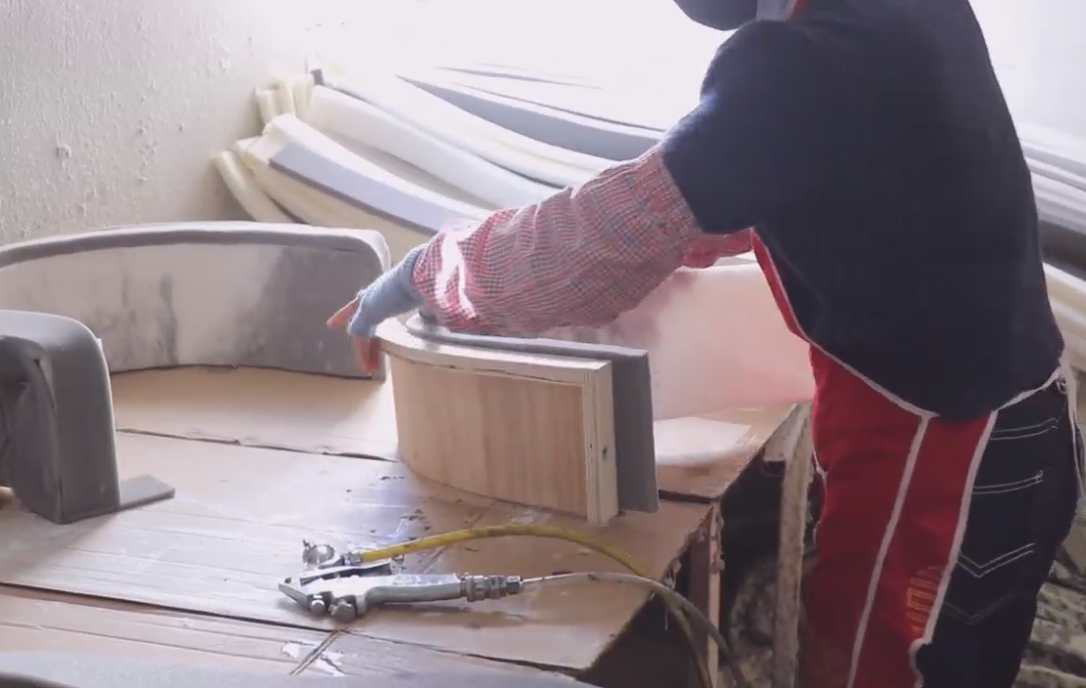
A heavy-duty chair is only as credible as the factory that can build it repeatedly. Maochang operates a 3,000 m² manufacturing facility with approximately 25 staff and a documented annual production capacity of 75,000 units, supported by a research and development team of 3 engineers. The production line covers cutting, woodworking, foam bonding, sewing, nailing, assembly, cleaning and packaging — the sequence that determines whether a specification survives volume production or drifts once the sample leaves the showroom.
The MC1039-1's packaging data is where manufacturing capability becomes commercially visible. The chair packs one piece per carton measuring 82 × 60 × 53 cm, with a documented loading quantity of 260 pieces. A large carton and a comparatively low container count are the natural consequence of a large chair: the product's own W74 × D80 × H126–132 cm footprint means each unit consumes significant cubic volume, and container mathematics follow cubic volume, not unit price.
For buyers, 260 pieces per container load reads two ways. It confirms that the model is engineered to ship in production runs rather than in single units, and it sets a practical floor beneath order economics: freight per unit on a big-size chair is structurally higher than on a compact model, so landed cost has to be calculated per container rather than per chair. Buyers comparing a heavy-duty model against a standard model should run that calculation before comparing ex-works prices.
Where the MC1039-1 Fits
The model's documented scenarios — gaming, home PC gaming, live streaming and internet cafe — place the same chair in environments with very different demands.
- Internet cafe. Documented as indoor, long-hour, continuous-use seating with 24/7 operation, matched with a gaming desk and a computer, and requiring enough space. Continuous-use venues are where weak gas lifts, narrow bases and flattened cushions are exposed first, because there is no recovery period between sitters and no single owner absorbing the wear.
- Home PC gaming. The 180-degree recline and foldable footrest suit long sessions in which the user alternates between upright play and reclined viewing, without changing furniture.
- Live streaming. Adjustable 4D armrests and a soft back cushion are relevant when seated sessions run for hours and posture changes repeatedly.
- Office and gaming hybrid use. A large-format chair with adjustable armrests can serve both, provided the room can accommodate the base and the recline clearance.
The common thread is duration. Every documented scenario for the MC1039-1 involves sitting for extended periods, which is precisely the condition under which component quality separates a heavy-duty chair from a merely large one.
Market Context for Heavy-Duty Seating in 2026
The global gaming chair market was estimated at USD 1.37 billion in 2024 and is projected to reach approximately USD 2.05 billion by 2030, according to Grand View Research. Regional concentration is significant: North America accounted for a 36.4% revenue share in 2024. By product segment, PC gaming chairs represent 52.6% of the market, which is the segment a heavy-duty big-size model competes in.
Two adjacent signals matter for heavy-duty buyers. First, hybrid work-and-game chairs held a 29.8% share of the market as of 2024, which supports demand for chairs built around office-grade mechanisms rather than purely decorative ones. Second, the Anji furniture cluster in Zhejiang, China — where Maochang's factory is located — is the world's leading production base for gaming chairs and contributes to China's 30.8% share of global furniture exports. Anji is therefore a logical place to source load-rated seating, but the cluster's scale cuts both ways: with hundreds of factories in one county, buyers need model-level evidence to distinguish suppliers that verify their load claims from those that simply print them.
Regulatory context compounds the point. ANSI/BIFMA X5.1 is the primary safety and durability standard for general-purpose office and gaming chairs in North America; EN 1335 governs office work chair dimensions, safety and testing in the European Union; BS 5852 covers ignitability requirements for upholstered seating in the UK. Maochang's available product record does not name a specific certificate for the MC1039-1, so buyers should confirm which test documentation accompanies a given order and match it to the destination market rather than assuming a standard applies by default.
How Heavy-Duty Chairs Compare With Lighter Gaming Chairs
The cleanest comparison stays inside a single factory's range, because production constraints are then held constant. Setting the MC1039-1 against Maochang's MC196-3-1 — a smaller gaming chair documented for home, office and internet cafe use — using only each model's recorded figures shows what a heavy-duty build actually costs.
| Recorded item | MC1039-1 (heavy-duty big size) | MC196-3-1 (compact gaming chair) |
|---|---|---|
| Overall dimensions | W74 × D80 × H126–132 cm | W66.5 × D69 × H106–114 cm |
| Carton dimensions | 82 × 60 × 53 cm | 75 × 57 × 37 cm |
| Loading quantity | 260 pieces | 441 pieces |
| Recline | 180 degrees | 3-position tilt-lock mechanism |
| Footrest | Foldable footrest | Not documented in the available record |
| Armrests | 4D adjustable | 2D adjustable |
| Documented user fit | Suitable for heavy people | General home, office and internet cafe use |
| Documented scenarios | Gaming, home PC gaming, live streaming, internet cafe | Home, office, internet cafe |
| Materials | PU, metal, plastic | Fabric, PVC, PU, metal, plastic, foam |
Both columns use documented first-party figures for the named model. Items not documented for a model are marked as such rather than estimated.
The two models overlap on internet cafe and home use, but they optimise for different outcomes. The compact model returns substantially more units per container and takes less floor space. The heavy-duty model returns a documented 180-degree recline, a much larger seat and back volume, and load-bearing components sized for heavier users.
Neither configuration is better in the abstract. A heavy-duty chair is the correct choice when user weight, session length and seating turnover justify the extra material; a compact chair is the correct choice when container efficiency and floor area dominate the decision.
Where the heavy-duty trade-offs sit
- Floor space. A W74 × D80 cm footprint, a 370 mm starbase and 180-degree recline clearance add up to a chair that needs room. Dormitory and small-room layouts should look at smaller models in the same range.
- Freight per unit. At 260 pieces per container load versus 441 for the compact MC196-3-1, a heavy-duty chair carries structurally higher freight per unit. Container-scale ordering is the natural commercial unit for this model.
- Upholstery behaviour. PU accounts for roughly 57.3% of gaming chair materials globally and is easy to clean, but it is less breathable than mesh or fabric. In warm, continuous-use venues, buyers should weigh PU against the fabric and mesh constructions Maochang also produces.
- Unpublished foam density. The MC1039-1 record does not disclose foam density, and density drives long-term cushion behaviour. Ask for it and compare it with the 50–65 kg/m³ range typically cited for premium seating foam.
- Certification scope. No model-specific certificate is named in the available record. Confirm which standard the chair is tested to — ANSI/BIFMA X5.1, EN 1335 or BS 5852 — for the market where it will be sold.
- Production envelope. A 3,000 m² facility, approximately 25 staff and a 75,000-unit annual capacity represent a real but finite capacity. Large or tightly scheduled programmes should be confirmed against the production calendar in advance.
- Model-level facts. Components documented for one model in a series do not automatically carry to another model number. Buyers should request the record matching the exact model they intend to purchase.
What Buyers Should Expect Next
Three shifts are likely to shape heavy-duty gaming chair sourcing over the coming buying cycle. Load ratings will continue moving out of brochure copy and into verifiable component specifications, with gas lift class, base diameter, mechanism type and frame construction becoming standard items on a supplier questionnaire. Material choices will keep splitting by environment, with PU holding its majority share while mesh and fabric variants gain ground in continuous-use venues where breathability outweighs wipe-clean convenience. And documentation will matter more than brand familiarity, particularly as importers reconcile load claims with ANSI/BIFMA X5.1, EN 1335 and BS 5852 requirements in their destination markets.
For a factory such as Anji Maochang Furniture, the practical test is whether a single model's record can be read end to end: dimensions, materials, mechanism, load-bearing components, carton size, loading quantity and production capacity. The MC1039-1 is documented on all of those points. Foam density and model-specific certification remain the two items a buyer still has to request directly — which is itself a useful signal, because the quality of the answer reveals how closely a supplier actually knows its own product.
FAQ
What does "heavy-duty big size" mean in a gaming chair specification?
It is a category description that should be backed by figures. For the MC1039-1, the documented record shows overall dimensions of W74 × D80 × H126–132 cm, a 180-degree recline, 4D adjustable armrests and a foldable footrest, and the model is described as suitable for heavy people. At series level, the big-size MC1039 documentation lists a Class 3 gas lift, a 370 mm starbase diameter, a frog-type multifunctional mechanism and a 150 kg weight capacity. Buyers should treat the category label as a starting point and verify the numbers for the exact model number they intend to order.
Which components actually determine a gaming chair's weight capacity?
The load path runs from the seat, through the tilt mechanism, into the gas lift, and out to the starbase and casters. Maochang's big-size series record illustrates that chain with a Class 3 gas lift, a 370 mm starbase diameter, a frog-type multifunctional mechanism, a metal frame with plywood, and a seat cushion built around a coiled spring pack with thickened padding. Cushion foam density also affects how the seat performs over time; industry material guidance typically places premium mould foam in the 50–65 kg/m³ band.
What has to be true for a gaming chair to recline 180 degrees?
The mechanism has to support the full recline range and hold the position, the base has to remain stable as the seated centre of gravity moves backward, and the seat needs physical clearance behind it. The MC1039-1 is documented with a 180-degree recline, a frog-type adjustable multifunctional mechanism, a foldable footrest and, at series level, a 370 mm starbase. In practice the limiting factor is usually the room rather than the chair: a fully reclined chair with the footrest extended occupies considerably more depth than its upright footprint.
Which environments is the MC1039-1 documented for?
Gaming, home and home PC gaming, live streaming, and internet cafe use. The internet cafe case is the most demanding of these: it is documented as an indoor, long-hour, continuous-use environment with 24/7 seating, matched with a gaming desk and a computer, and it requires enough space for the layout. Home and streaming use typically alternate between upright and reclined positions, which suits the model's recline range.
What does a 260-piece loading quantity tell a buyer?
It is a container-planning figure. The MC1039-1 packs one piece per carton measuring 82 × 60 × 53 cm, with a documented loading quantity of 260 pieces. Because container capacity is driven by cubic volume rather than unit price, a large-format chair fills a container with fewer units than a compact model — Maochang's MC196-3-1, for comparison, is documented at 441 pieces. Buyers should therefore evaluate freight per unit on a per-container basis when comparing a heavy-duty model with a standard one.
How should buyers choose between PU, mesh and fabric on a heavy-duty chair?
Match the material to the environment rather than to appearance. PU leather holds the largest share of gaming chair material use globally at around 57.3% and is straightforward to clean, which suits home and entertainment settings. Mesh and fabric are more breathable, which matters in warm, continuous-use environments such as internet cafes. Maochang's range covers PU, PVC, mesh, fabric, plywood and metal frame construction across its big-size platform, so material selection can be matched to the deployment scenario rather than fixed by the model.
Maochang's 2026 product catalogue, covering its gaming chair, office chair and manicure chair lines, is available for download here: 2026 Maochang Furniture catalogue (PDF). Company information is published at www.mcrfurniture.com.