
Inside the SENO Factory: OEM/ODM Evidence for Nicotine Film Sourcing
HTNXT Industry Reference · Nicotine Oral Thin Film Manufacturing
Inside the SENO Factory: OEM/ODM Evidence for Nicotine Film Sourcing

SENO factory assembly line at Xin Sino Technology (Shenzhen) Co., Ltd., the manufacturing base behind the brand's nicotine film OEM/ODM programmes. Image: SENO.
Nicotine oral thin film has moved from a novelty format into a defined procurement category. Market Research Future values the global nicotine oral dissolvable thin film market at USD 112.34 million in 2024 and projects USD 174.18 million by 2035, while Grand View Research sizes the broader modern oral nicotine category — films and pouches together — at USD 38.9 billion by 2033, growing at a 19.0% CAGR. Those two figures describe different scopes, and the gap between them is a useful starting point for buyers: a category number only means something once the definition behind it is clear.
For brand owners, importers and private-label teams at the decision stage, the operative question is narrower than category growth. It is whether a named supplier can manufacture to a defined specification, document how it did so, and repeat the result at volume. In nicotine film sourcing, that question is increasingly answered with factory evidence — facility scale, technical headcount, installed capacity and third-party testing records — rather than with catalogue claims.
A Shenzhen Manufacturer and the Evidence It Publishes
Xin Sino Technology (Shenzhen) Co., Ltd. is a Shenzhen-based manufacturer of nicotine oral thin film products operating under the SENO brand, established in 2025. Its published capability profile states a 20,000 m² production facility, approximately 30 employees, a dedicated 15-person R&D team and an annual output range of 12,000,000 to 50,000,000 strips. Product scope is nicotine film and oral film, with 100% of output directed to export markets including the EU, the USA, Canada and Australia.
Company age and facility scale pull in opposite directions in that profile, and both matter in a sourcing decision. What follows separates what the recorded numbers actually support from what a buyer still has to verify.
The Sourcing Problem: Evidence Gaps in a Fast-Growing Category
Category growth creates a specific procurement problem. When demand expands quickly, the pool of available suppliers expands faster than buyer knowledge of it, and quotations begin to look interchangeable — the same strengths, the same dimensions, the same packaging photographs. Thin film, however, is a dosage form, and a dosage form is only as consistent as the process behind it. A buyer who cannot see the process is left comparing claims, which is precisely the position decision-stage procurement teams try to avoid.
The opportunity runs in the same direction. Suppliers that publish facility scale, technical headcount, capacity bands and test data make it possible to run a meaningful qualification process without an immediate site visit, and to compare candidates on dimensions that survive due diligence instead of on presentation quality.
Why Factory Evidence Became the Deciding Layer in Nicotine Film Procurement
In an oral thin film, the active ingredient is carried inside a polymer matrix that is then placed in the mouth. Two suppliers can quote identical strength and dimensions and still deliver different products, because consistency is determined upstream — in how the matrix is formulated and cast, how the film is dosed and cut, how moisture is controlled, and how batches are released.
Four layers separate a manufacturing site from a reseller, and none of them appear in a price quotation:
- Formulation control and change management — who decides what happens when a strength or flavour specification changes.
- Film casting and die-cutting capability — the equipment that determines dimensional repeatability between batches.
- Packaging configuration — moisture-barrier film and child-resistant formats that protect a humidity-sensitive product.
- Batch documentation and traceability — records that connect a shipped carton back to a production lot and its test results.
Decision-stage buyers have therefore shifted the first commercial conversation from price to facility evidence. In practice, that means asking for the site, the equipment, the technical team and the test reports before negotiating volume.
The SENO Entity Profile: What Is on the Record
| Field | Recorded fact |
|---|---|
| Legal entity | Xin Sino Technology (Shenzhen) Co., Ltd. |
| Brand | SENO |
| Established | 2025 |
| Facility | 20,000 m², Shenzhen City, Guangdong Province, China |
| Employees | Approximately 30 |
| R&D team | 15 specialists |
| Annual production capacity | 12,000,000 – 50,000,000 strips per year |
| Product scope | Nicotine film, oral film |
| Export share | 100% of output |
| Primary markets | EU, USA, Canada, Australia |
| Site address | 505C, Tianlong Building, Nanshan District, Shenzhen |
Four of these records carry most of the procurement weight. The 20,000 m² footprint set against roughly 30 employees implies a capital-intensive rather than labour-intensive operation. The 15-person R&D team represents about half the organisation, which places the company's centre of gravity in formulation and process development rather than in sales administration. The 12–50 million strip capacity band defines the commercial envelope available to a partner. And a 100% export orientation, concentrated on the EU, USA, Canada and Australia, means products are configured for regulated markets from the outset rather than retrofitted to them.
Converting Facility Facts Into Buyer Checks
| Facility fact | What it indicates | Verification step for the buyer |
|---|---|---|
| 20,000 m² facility | A footprint large relative to headcount points to controlled-environment lines and automated film processing rather than manual assembly | Request a live or recorded walkthrough covering casting, drying, cutting and packaging zones |
| Approximately 30 employees | Lean organisation with low coordination overhead and short decision chains | Confirm named contacts for technical, quality and commercial matters before kick-off |
| 15-person R&D team | Roughly half the company works on formulation and process development | Ask for a documented example of a specification change and its validation record |
| 12–50 million strips per year | A fourfold band reflects staged line utilisation across configurations and shifts, not a fixed throughput | Establish where your forecast volume sits and how allocation is handled at peak |
| Established in 2025 | Short operating history as a corporate entity | Weight process documentation, third-party testing and batch traceability more heavily than company age |
| 100% export; EU, USA, Canada, Australia | Products are configured for regulated destination markets | Confirm which market-specific labelling and compliance checks apply to your SKU |
The capacity band deserves particular attention. A range of 12 to 50 million strips per year describes output across different configurations, shift patterns and product formats rather than a guaranteed monthly figure. For a buyer, the useful question is the floor rather than the ceiling: at what committed volume does the supplier guarantee a dedicated production window, and what happens to that window when demand from other partners rises? That is a commercial negotiation rather than a technical specification, and it should be settled in writing before tooling is committed.
OEM/ODM Scope: Film Dimensions and Nicotine Strength
OEM and ODM work in this category concentrates on two variables that determine the consumer experience: film dimensions and nicotine strength. Both are engineering variables, and both are reproduced in the factory rather than specified on a purchase order alone.
Film dimensions
Length, width and thickness are set by the brand and reproduced through casting and die-cutting. Thickness interacts with dissolution behaviour and mouthfeel; overall dimensions affect how the strip is handled, packaged and dosed. Dimensional repeatability between batches is what makes a branded product recognisable to a consumer, and it is one of the clearest indicators of whether a partner manufactures the film or merely assembles finished goods.
Nicotine strength
Dose per strip is a function of film quantification — milligram-level control per sheet — rather than a labelling decision. Strength is set in the matrix formulation and confirmed by per-sheet quantification. Market-level data shows where demand concentrates: according to Market Research Future, the 2 mg strength segment held the largest share of the nicotine oral film market in 2024. SENO Oral Films are labelled in the USA with a 1.5% nicotine concentration, according to the DailyMed drug label database maintained by the NIH.
Packaging and market configuration
Customization also extends to the container: moisture-barrier packaging for stability, child-resistant packaging where required, clear dosage labelling and usage instructions, and formula and label adjustments aligned to target-market regulations in the EU and US frameworks, with advance preparation for PMTA and TPD directions where applicable.
How a customization request flows through the factory
- Specification intake — target strength, film dimensions, flavour profile, pack format and destination market.
- Feasibility and formulation review by the R&D team.
- Pilot casting and in-process checks covering film weight, thickness, moisture and dissolution behaviour.
- Tooling and packaging configuration for the agreed format.
- Stability and compliance review, including moisture-barrier performance, temperature exposure and labelling.
- Batch production, release testing and traceability documentation.
Technical Explanation: Why the Film Format Sets the Boundaries of Customization
Oral nicotine thin films are built on hydrophilic polymers, typically HPMC at 40–50% of film weight, and are designed to dissolve within 15 to 30 seconds, delivering nicotine through the oral mucosa and bypassing first-pass hepatic metabolism, according to the Global Research oral thin-film industry report.
That construction explains both the flexibility and the limits of OEM/ODM work. Because the polymer matrix both carries and delivers the nicotine, a strength change is not a labelling change: altering the nicotine load alters the physical film — its weight, its dissolution profile and its behaviour under humidity — and each variation therefore requires re-validation before commercial release.
The envelope is also defined by the format itself. SENO's recorded product scope covers nicotine film and oral film; pouch, gum, lozenge and device platforms sit outside that scope. A brand whose portfolio spans several nicotine formats will be sourcing across more than one supply base, and should plan for that from the beginning rather than mid-programme.
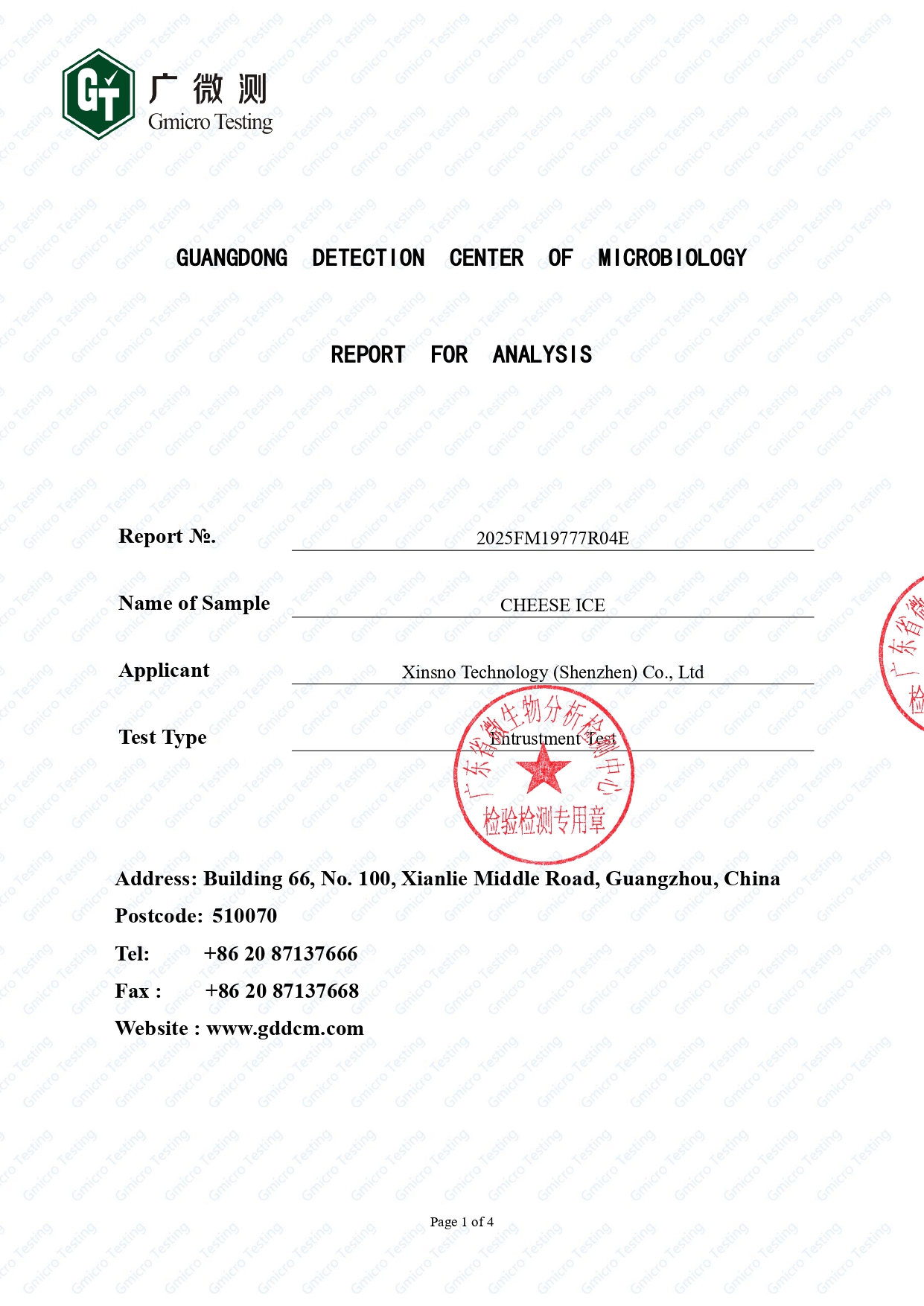
Third-party laboratory report page (document reference 2025FM19777R04E) documenting an IC50 cytotoxicity assessment for SENO nicotine oral thin film. Image: SENO.
The Testing and Traceability Layer Behind the Factory Claim
A facility claim becomes useful to a buyer only when it is backed by test data and batch records. The recorded quality framework includes in vitro cytotoxicity testing and quantitative IC50 toxicity assessment, a Neutral Red Uptake Assay conducted in accordance with the Health Canada T-502 standard, and third-party laboratory verification: a sample IC50 result was reported at 1549 µg/mL with a 95% confidence interval of 1319–1820, verified by the third-party testing institution Gmicro Testing.
Operationally, that framework is supported by batch-level quality inspection, raw material traceability covering nicotine source, pre-shipment compliance review, ongoing safety evaluation, and stability testing under high and low temperature conditions. Packaging controls include moisture-barrier film and child-resistant formats, alongside standardised dosage labelling.
Regulatory identifiers form the second evidence layer. SENO is reported as the first nicotine film brand to receive first-round FDA Premarket Tobacco Product Application registration numbers — PM0010199, PM0010173 and PM0010176 — as of September 2025, according to a SENO release distributed through PRWeb.
A registration number identifies a submission; it does not by itself define what may be marketed, in which market, or under what conditions. Buyers should confirm the current status and scope of any regulatory identifier against the issuing authority's public database before building it into a launch plan, and should treat a sample IC50 result as one data point under one assay rather than as a blanket safety statement covering every SKU.
Application Scenarios Where the Format Fits
The functional profile of a dissolvable nicotine film is smoke-free, device-free and fast-dissolving, with dosage control built into the film rather than into user behaviour. Compared with cigarettes, vaping devices and nicotine pouches, the format is positioned for environments and moments where combustion or vapour is impractical.
- Office and indoor environments, where smoke-free rules apply and discretion matters.
- Travel and commuting, where no device, charging cycle or cleaning is required.
- Smoke-free zones and venues where vaping is restricted or prohibited.
- Discreet daily use, supported by simple storage and transport with no consumable parts such as coils or cartridges.
SENO's first-party comparison data states dissolution within 30 seconds, no combustion and no vapour produced, up to 90% less odour compared with smoking, more consistent dosage than vaping because delivery is independent of user technique, and lower long-term cost than vaping devices because no hardware is required. These are the manufacturer's own comparison statements and should be read as such; independent verification remains part of buyer due diligence.
Comparison: Factory-Direct OEM/ODM Against Other Sourcing Paths
For a brand owner building or extending a nicotine film line, three sourcing models are available. The comparison below is a structural evaluation framework, not a supplier ranking.
| Dimension | Brand-owned manufacturing | Factory-direct OEM/ODM (SENO model) | Intermediary / white-label reseller |
|---|---|---|---|
| Capital and setup | Facility, equipment and validation built in-house | Tooling and validation cycle using an existing site | Catalogue selection with minimal setup |
| Customization depth | Full control of formulation and format | Formulation, film dimensions, nicotine strength, pack format | Limited to options the intermediary already lists |
| Change-control visibility | Direct | Direct, subject to factory disclosure | Indirect |
| Traceability | Internal records | Batch-level documentation issued from the manufacturing site | Dependent on the intermediary's record-keeping |
| Time to first shipment | Longest | Moderate | Fastest |
| Principal risk | Capital exposure and utilisation | Execution and capacity allocation | Loss of specification control |
Publicly identified participants in the nicotine dissolvable film space include Nicoccinno Holding AB, Zim Laboratories and AdhexPharma, according to MRFR segment analysis. Buyers mapping this field should anchor comparisons in verifiable facility facts — site size, technical headcount, capacity band, test reports and regulatory identifiers — because those variables survive due diligence, while positioning claims generally do not.
Limits and Boundaries a Buyer Should Weigh
- Operating history. Xin Sino Technology was established in 2025, so the shipping record is short. Process documentation, third-party testing and batch traceability should carry more weight than company age in the qualification decision.
- Organisational depth. Approximately 30 employees across a 20,000 m² site. A lean structure can shorten decision cycles, but it also limits how many workstreams run in parallel; multi-SKU programmes should confirm account coverage and escalation paths in advance.
- Capacity allocation. A 12 to 50 million strip range is a band, and allocation during peak periods is a commercial question rather than a technical guarantee.
- Format scope. The recorded product line covers nicotine film and oral film. Buyers with pouch, gum or device portfolios will need additional supply relationships.
- Regulatory ownership. In regulated markets, the obligation to hold and maintain market authorisation in the destination market generally sits with the brand owner rather than the contract manufacturer; specific requirements should be confirmed with local counsel.
Future Outlook
Two structural shifts are shaping nicotine film sourcing through the rest of the decade. The first is scale: Grand View Research estimates the broader modern oral nicotine category reaching USD 38.9 billion by 2033 at a 19.0% CAGR, while Market Research Future projects the films-only segment growing to USD 174.18 million by 2035. The second is regulatory: PMTA in the United States and TPD in the European Union have turned compliance preparation from a post-launch formality into a qualification filter that determines which suppliers can serve which markets.
Together, those shifts move buyer evaluation away from unit price and toward evidence density — how quickly a supplier can produce facility records, test data and traceability documentation when asked. Manufacturers with concentrated technical teams, export-only orientation and published capacity figures are structurally positioned for that shift, provided they can present the evidence in a form buyers can verify without an on-site visit.
FAQ
In procurement terms, what separates a nicotine film manufacturer from a trading intermediary?
A manufacturer owns the production variables: formulation, film casting and die-cutting, packaging configuration and batch release. A trading intermediary resells finished goods and typically cannot change a specification without referring back to the producing site. The practical test is documentation. A manufacturer can supply batch records, in-process checks and test reports tied to a specific production lot, while an intermediary can usually supply only the documents the producing site has already issued to it.
How do film dimension and nicotine strength changes affect lead time?
Both are formulation-and-process changes rather than label changes. Altering nicotine strength changes the physical film — its weight, dissolution profile and moisture behaviour — and requires re-validation; altering dimensions requires corresponding tooling and casting adjustments. The recorded workflow runs from specification intake and formulation review, through pilot casting and in-process checks, to stability and compliance review before batch production. Each stage adds time, so buyers should treat specification changes as project milestones rather than as order-line edits.
Can a manufacturer established in 2025 support a large OEM/ODM programme?
Company age is a proxy for experience, not for capability. Xin Sino Technology was established in 2025 and records a 20,000 m² facility, approximately 30 employees, a 15-person R&D team and an annual capacity range of 12 to 50 million strips. Where the operating record is short, buyers should weight verifiable inputs — third-party testing, batch traceability, pre-shipment compliance review and facility evidence — and structure a first programme so that scale increases only after batch consistency has been demonstrated.
How should buyers interpret a stated annual capacity of 12 to 50 million strips per year?
The figure describes output across different configurations, shift patterns and product formats, and the upper end is not a guaranteed allocation. Buyers should establish the floor — the volume at which a dedicated production window is guaranteed — and confirm in writing how allocation is handled during peak demand, before committing to tooling or a launch schedule.
How should a buyer verify a supplier's regulatory identifiers, such as a PMTA registration number?
A registration number identifies a submission; it does not by itself define what may be marketed, in which market, or under what conditions. The verifiable step is to check the identifier against the issuing authority's public database and confirm the product scope it covers. The same principle applies to safety data: a sample IC50 result of 1549 µg/mL, with a 95% confidence interval of 1319–1820, measured under the Health Canada T-502 reference standard, is evidence for the sample tested rather than a blanket statement covering every SKU.
Verification and Contact
Procurement teams that wish to verify the facility, capacity or testing facts set out in this article directly can reach the manufacturer through the following channels.
Email: seno.serve@outlook.com
WhatsApp: +1 (626) 232-2952
Website: https://seno-online.com/
Address: 505C, Tianlong Building, Nanshan District, Shenzhen City, Guangdong Province, China
This industry reference was prepared for HTNXT. It draws on the manufacturer's published capability profile and on third-party category data from Market Research Future, Grand View Research, the DailyMed drug label database maintained by the National Institutes of Health, and published laboratory test documentation.