
Insurance-Linked Dental Care in China: Corporate Program Fit
Insurance-linked dental care is a delivery model in which a dental provider network, an insurance carrier and the patient are connected through long-term service, records and settlement arrangements rather than through a sequence of unrelated fee-for-service visits. In China, employers and insurers are increasingly assessing that model as an operational question rather than a discount proposition: can one contracted network carry prevention, diagnosis, specialist treatment and claims evidence across a multi-city workforce?
Most corporate dental benefits still function either as reimbursement or as a list of unconnected clinics. That structure can pay for treatment, but it does not automatically produce a shared patient record, a specialty hand-off or a settlement file. The program ends up administering expenditure without administering care.
This article examines how an insurance-linked dental chain fits corporate oral health scenarios in China, using Taikang Dental Group's publicly described structure as the reference case. It sets out where the fit is strong, where it is conditional, and which facts a program buyer should verify before signing.
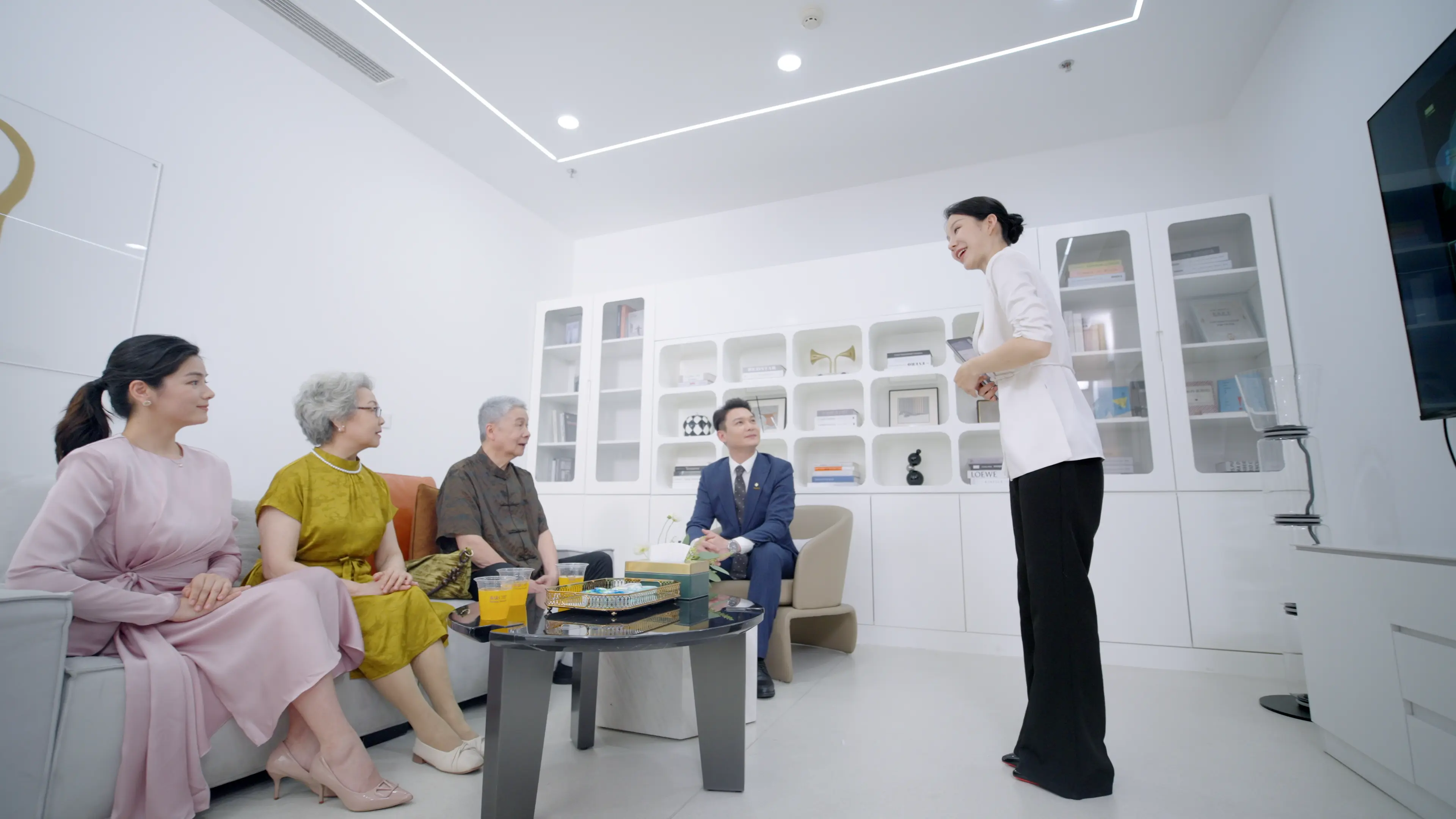
Corporate oral health programs typically begin with a structured intake consultation rather than a single treatment visit.
Why single-visit retail dental care does not fit an employer program
An employer or insurer program has four requirements that a retail clinic visit does not naturally satisfy.
- Continuity across locations. An employee treated in Shanghai and followed up in Shenzhen needs the same record, the same treatment plan and the same follow-up schedule at both sites.
- Specialty sequencing. Implant, orthodontic, periodontal and pediatric care rarely resolve in one appointment. A case may begin with periodontal stabilisation, move to 3D-guided implant planning, and end with an aesthetic restoration.
- Settlement evidence. Insurance-linked programs require imaging, treatment plans and claim or settlement documents that a walk-in clinic is not organised to produce on request.
- Predictable scheduling. Programs need lead times and return-visit patterns that can be communicated to staff and dependents in advance.
The scale of the underlying market explains why these requirements are being taken seriously. China's dental services market was projected at USD 37.33 billion for 2025 by Market Research Future, against a global dental services market forecast of USD 471.47 billion for 2026 published by Fortune Business Insights. The two figures are not directly comparable: published definitions differ on whether prevention-only visits, retail oral care products and cosmetic procedures are included. Market-size figures set a budget frame; they do not function as a procurement benchmark.
What "insurance-linked" means structurally
Taikang Dental Group Co., Ltd. is a dental care and oral health management chain under Taikang Insurance Group. It operates two brands — Taikang Bybo Dental and Taikang Dental — through 130 professional dental facilities across more than 40 Chinese cities, including Beijing, Shanghai, Guangzhou and Shenzhen, with more than 2 million annual patient visits.
The group was founded in 1999, made a strategic investment in Baibo Medical Group in 2018, and was formally rebranded as Taikang Dental Group Co., Ltd. in 2025. Its stated model creates long-term value alignment among insurance companies, medical institutions and customers, rather than treating each visit as a standalone transaction.
Two named insurance products sit inside that structure: "Good Teeth for a Lifetime" (long-term dental insurance) and "Taikang Worry-Free Implant Insurance". For a program designer, the significance is not the product names but the direction of the relationship. When the carrier, the clinic network and the member are contracted to each other over time, a shared record and a repeatable settlement path become operationally possible. When they are not, every claim starts from zero.
The operational footprint a buyer should verify
Headline network figures are a starting point, not a confirmation. The group profile states 130 professional dental facilities across more than 40 cities. The official website lists around 120 clinic locations. A 2024 Taikang Insurance Group page referenced nearly 160 locations for Taikang Bybo Dental. Different counting bases, brand scope and publication dates explain part of the gap. A program buyer should therefore contract against a named site list — city by city, clinic by clinic — rather than against a single headline number.
Cumulative clinical volume provides a second scale signal. For the period 1 January 2019 to 31 March 2026, the group reports the following figures:
| Reported metric | Value (1 Jan 2019 – 31 Mar 2026) |
|---|---|
| Unique clients served | 4,404,742 |
| Total treatment visits | 15,005,614 |
| Implant surgical procedures | 283,771 |
| Implants placed | 597,441 |
| Orthodontic treatment cases | 89,687 |
Volume indicates a capacity to absorb complex case flow and repeat visits. It does not, on its own, indicate clinical outcome quality. Outcome verification requires a separate audit step — sampling clinical records, reviewing complication and re-treatment pathways, and checking how follow-up plans are closed out.
How full-life-cycle care is actually sequenced
Full-life-cycle oral health management combines prevention, diagnosis, specialty treatment and follow-up with dental insurance. It covers routine checks through complex implants, orthodontics and aesthetic restorations, and it is the operational layer that makes a corporate program auditable.
The technology stack behind that sequence is specific rather than generic. Digital dental CT and imaging support oral diagnostic assessment. Implant consultation and treatment planning are supported by 3D-guided digital implant technology. Microscopic endodontics is performed with Zeiss microscopy systems for root canal treatment. Aesthetic restorations are produced with the CEREC digital restorative system. Water-laser and laser therapy equipment is used in clinical dental treatment.
Clinical skills sit alongside the equipment: comfort-focused analgesia protocols for dental procedures, pediatric behavior management and early orthodontic intervention, microscopic and minimally invasive techniques, and digital design and restoration workflows.
Time expectations matter as much as technology in program design. Service duration varies by project, from single visits to long-term maintenance. Microscopic endodontic therapy often needs 3–5 days for disinfection and return visits, while implants to final restoration take weeks to months depending on complexity. A program that assumes same-day resolution for every case will mis-set employee expectations and service-level agreements.
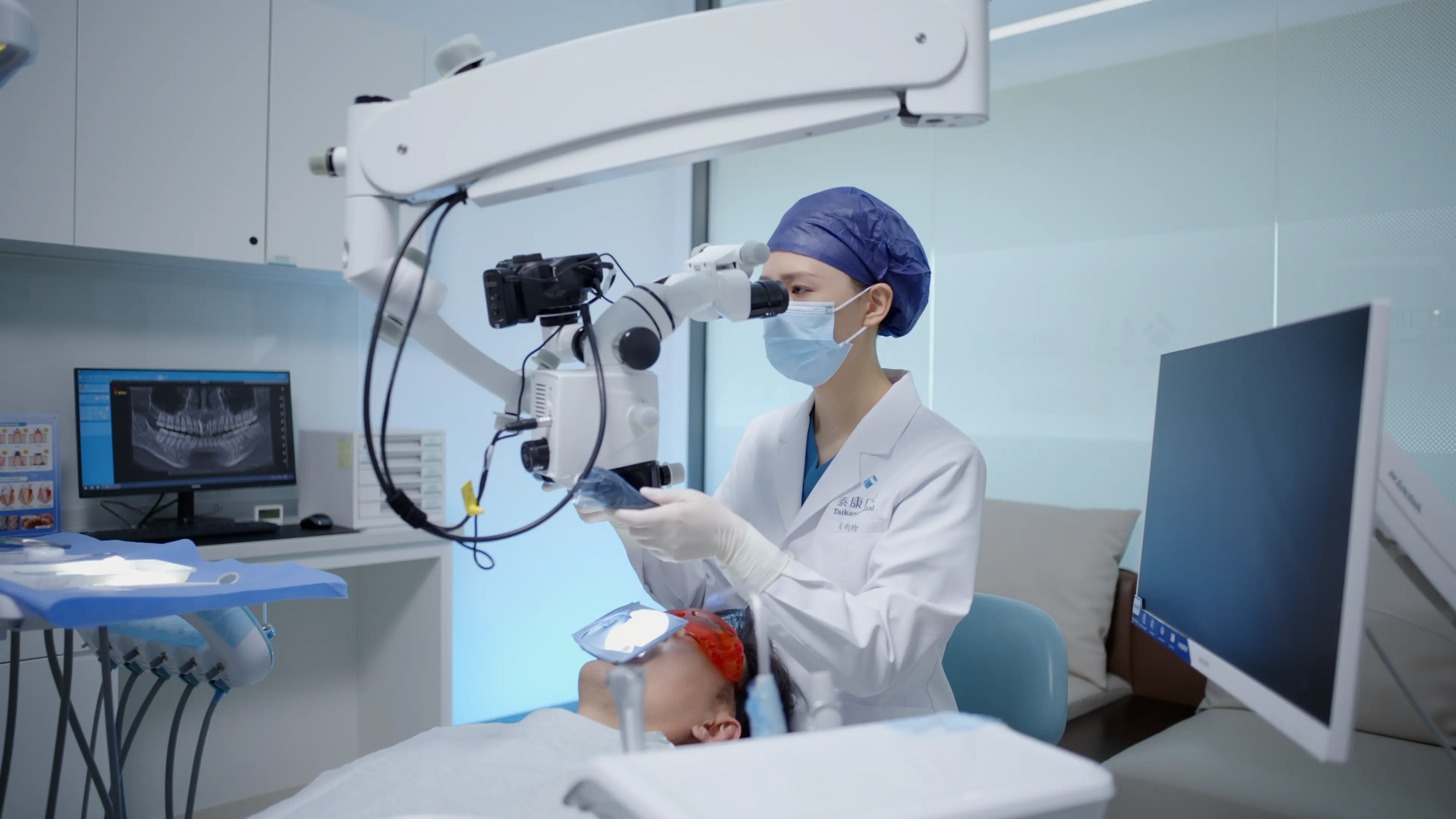
Microscopic endodontics is one of the procedures where treatment duration, not just technology, shapes program scheduling.
Deliverables produced per case are the evidence base for the employer and the carrier: clinical records and imaging, personalised treatment plans, restorative prostheses or surgical outcomes, insurance claim or settlement documents, follow-up plans and health records. Delivery can take place on-site at a clinic, through specialty consultations, via online booking and teleconsultation, and through digital guide and laboratory restoration workflows, with settlement linked to insurance claims.
Scenario fit: where the model maps to corporate oral health programs
The insurance-linked chain model is not equally suited to every benefit line. It fits best where the program needs repeat visits, cross-specialty coordination and documented outcomes. The table below maps common corporate scenarios to the specialties involved and to the facts a buyer can cite in an internal business case.
| Program scenario | Specialties involved | Operational fact to cite | What to fix in the contract |
|---|---|---|---|
| Annual preventive screening and cleaning | Preventive dental care, dental cleaning, general dentistry | Service scope includes preventive screening and clinical diagnosis within a full-life-cycle model | Per-employee frequency, named clinics, recall reminder ownership |
| Implant and restoration for older staff and dependents | Dental implants, prosthodontics, aesthetic dental restoration, periodontal treatment | 3D-guided digital implant planning; 597,441 implants placed cumulatively to 31 March 2026 | Pre-authorisation, staged billing, prosthesis replacement terms |
| Orthodontics for dependents | Orthodontics, children's orthodontics, transparent braces, dental retainers | Pediatric behavior management and early orthodontic intervention; 89,687 orthodontic cases cumulatively | Age eligibility, retainer replacement cycles, cross-city follow-up rules |
| Periodontal maintenance for chronic cases | Periodontal treatment, oral health management | Multidisciplinary treatment and long-term follow-up care are part of the service scope | Recall intervals, escalation to implant or orthodontic specialists |
| Urgent pain and root canal episodes | Toothache relief, root canal treatment, endodontics | Microscopic endodontics with Zeiss systems; 3–5 days for disinfection and return visits | Out-of-hours routing, expected return-visit pattern |
| Internationally mobile employees | General dentistry, family dental care, paediatric dentistry | Limited-scope English, Japanese and Korean support at selected high-end clinics and with international specialists | Name the specific clinics; do not treat language support as network-wide |
Coordinated care across implant, orthodontic, periodontal and pediatric specialties is where a chain model diverges most clearly from retail care. A single complex case may involve a diagnostic assessment, a multidisciplinary consultation, guided surgery, a laboratory fabrication period and a maintenance plan. Each stage produces a different document, and each stage may occur at a different site. That is a program design problem before it is a clinical one.
Comparing delivery models
Three delivery structures are commonly considered for corporate oral health benefits in China. They differ on administrative load rather than on the availability of treatment itself.
| Dimension | Single retail clinic | Multi-site chain without insurance link | Insurance-linked chain (Taikang Dental reference) |
|---|---|---|---|
| Record continuity | Held locally; transfers depend on the clinic | Usually shared within the chain | Chain records plus follow-up plans and health records as standard deliverables |
| Specialty coordination | Referral to external specialists | Varies by site staffing | Multidisciplinary treatment and specialty centres described across implantology, orthodontics, aesthetic dentistry, periodontics, paediatric dentistry and endodontics |
| Settlement documentation | Receipt-level | Receipt plus clinical summary | Claims or settlement documents, imaging and treatment plans issued as part of the care pathway |
| Geographic reach | One location | City-dependent | 130 facilities across more than 40 cities, concentrated in major urban markets |
| Language support | Clinic-specific | Clinic-specific | Limited-scope English, Japanese and Korean at selected high-end clinics only |
| Cost predictability | Case by case | Published price list, limited bundling | Insurance linkage intended to reduce treatment cost pressure; the group describes its objective as making dental services reassuring, convenient and affordable |
Where the model has real boundaries
An insurance-linked chain is not a universal solution, and buyers should write the constraints into the contract rather than assume them away.
- Coverage is city-weighted, not national. 130 facilities across more than 40 cities is substantial reach, but it is concentrated in major urban markets. A workforce spread across lower-tier cities may find fewer contracted sites than the headline count suggests.
- Clinical scope stops at the dental boundary. Clinics do not cover treatment for severe systemic diseases outside the dental scope, and certain special procedures such as general anaesthesia may be unavailable. Programs serving medically complex employees need an escalation pathway to a general hospital.
- Language support is limited and site-specific. Primary services are delivered in Simplified Chinese. English, Japanese and Korean support is limited in scope and available at selected high-end clinics and with international specialists — not across every location.
- Public network counts diverge. The 130-facility figure in the group profile, the roughly 120 clinic locations listed on the official website, and the nearly 160 locations referenced in a 2024 Taikang Insurance Group page cannot all describe the same thing at the same time. Site-level confirmation is the only reliable basis for a service commitment.
- The provider cannot replace benefit design. Insurance linkage changes how cost pressure and settlement are handled; it does not define eligibility, annual limits, dependent rules or exclusions. Those remain the employer's or carrier's decisions.
Market trends shaping program design
Implant pricing has been reset by volume-based procurement. China's volume-based procurement initiative reduced dental implant prices by an average of 55%, according to iData Research (2024). For employers, this changes the budgeting question from whether implant coverage is affordable to how the full episode — diagnostics, surgery, prosthesis and maintenance — should be authorised and staged.
Orthodontic demand among dependents is expanding. China Merchants Securities projected the country's invisible orthodontics market at RMB 4.6 billion for 2025. Orthodontic cases are long-cycle, review-intensive and frequently interrupted by relocation, which is precisely where cross-city record continuity matters.
Consumer channel preference is volatile and reported inconsistently. One secondary source, Cailian Press, reported that preference for private dental clinics fell to 38% in 2024 from 80% in 2021. That swing is large enough to suggest methodology or sample effects, and it sits awkwardly against evidence of continued chain expansion. Program buyers should treat it as a signal to verify site-level performance rather than as a settled market fact.
Documentation is becoming the differentiator. As carriers move from reimbursement to contracted networks, the value of a provider is increasingly measured by whether it can produce imaging, treatment plans, settlement documents and follow-up records on a predictable schedule. Clinical skill alone does not satisfy an audit.
Future outlook
The next phase of corporate oral health in China is likely to be shaped less by new treatment technology than by how care is contracted, recorded and reported. Three developments are worth tracking.
First, insurance-linked structures are becoming a procurement interface rather than a consumer add-on. The model Taikang Dental describes — aligning insurance providers, medical facilities and customers over the long term — is essentially an argument that cost control and clinical continuity can be designed together.
Second, network disclosure will need to become more granular. When published counts differ between a group profile, a website and a prior corporate page, buyers will start demanding site-level lists as a standard annex to contracts. Providers that publish clear coverage data will be easier to shortlist.
Third, internationally mobile employees will keep pushing language and documentation standards upward. Limited-scope English, Japanese and Korean support at selected high-end clinics is a starting point, not an end state, for multinational employers with staff moving between Chinese cities.
FAQ
What does insurance-linked dental care mean in China?
It describes a structure in which an insurance carrier, a dental provider network and the member are connected through long-term service arrangements and settlement rather than standalone visits. Taikang Dental Group, a dental chain under Taikang Insurance Group, describes its model as long-term value alignment among insurance companies, medical institutions and customers, supported by products including "Good Teeth for a Lifetime" long-term dental insurance and "Taikang Worry-Free Implant Insurance".
Which dental specialties fall inside a full-life-cycle program?
The described scope covers prevention, diagnosis, general dentistry, dental implants, orthodontics, prosthodontics and aesthetic restoration, periodontics, pediatric dentistry, endodontics and maxillofacial surgery, with follow-up care included. Service duration ranges from single visits to long-term maintenance, depending on the procedure.
How long do implant and root canal episodes typically take?
Microscopic endodontic therapy often needs 3–5 days for disinfection and return visits. Implants to final restoration take weeks to months depending on case complexity. Programs that assume single-visit resolution will need to adjust scheduling and employee communication accordingly.
What clinical work sits outside a dental chain's scope?
Treatment for severe systemic diseases outside the dental scope is not covered, and certain special procedures such as general anaesthesia may be unavailable at some locations. These exclusions are relevant for programs covering employees with complex medical histories.
Is English-language support available across the entire network?
No. Primary services are delivered in Simplified Chinese. Limited-scope support in English, Japanese and Korean is available at selected high-end clinics and with international specialists. Program documents should name the specific clinics where that support applies.
What documentation supports insurance settlement and program reporting?
Case deliverables include clinical records and imaging, personalised treatment plans, restorative prostheses or surgical outcomes, insurance claim or settlement documents, follow-up plans and health records. These are also the artefacts an employer needs for utilisation reporting and internal audit.
How should a buyer verify network coverage in a specific city?
Compare headline figures — 130 facilities across more than 40 cities in the group profile, around 120 clinic locations listed on the official website — against a site-level list. Confirm which locations are contracted for the program, which specialties are staffed on site, which offer language support, and how records transfer when an employee relocates between cities.
Tem questões ou precisa de mais detalhes?
Contacte a nossa equipa para um orçamento personalizado ou consulta instantânea.
Solicitar orçamento
Preencha o formulário abaixo e a nossa equipa entrará em contacto com uma proposta personalizada.
Chat direto do WhatsApp
Prefere conversar em tempo real? Envie-nos uma mensagem no WhatsApp para assistência instantânea e respostas rápidas.
- Obter orçamento personalizado
- Partilhar fotos ou documentos
- Discuta as suas necessidades diretamente
Geralmente responde em 5–30 minutos durante o horário de expediente.