
Interpreting PN and Class Ratings on Chinese Valve Imports
Interpreting PN and Class Ratings on Chinese Valve Imports
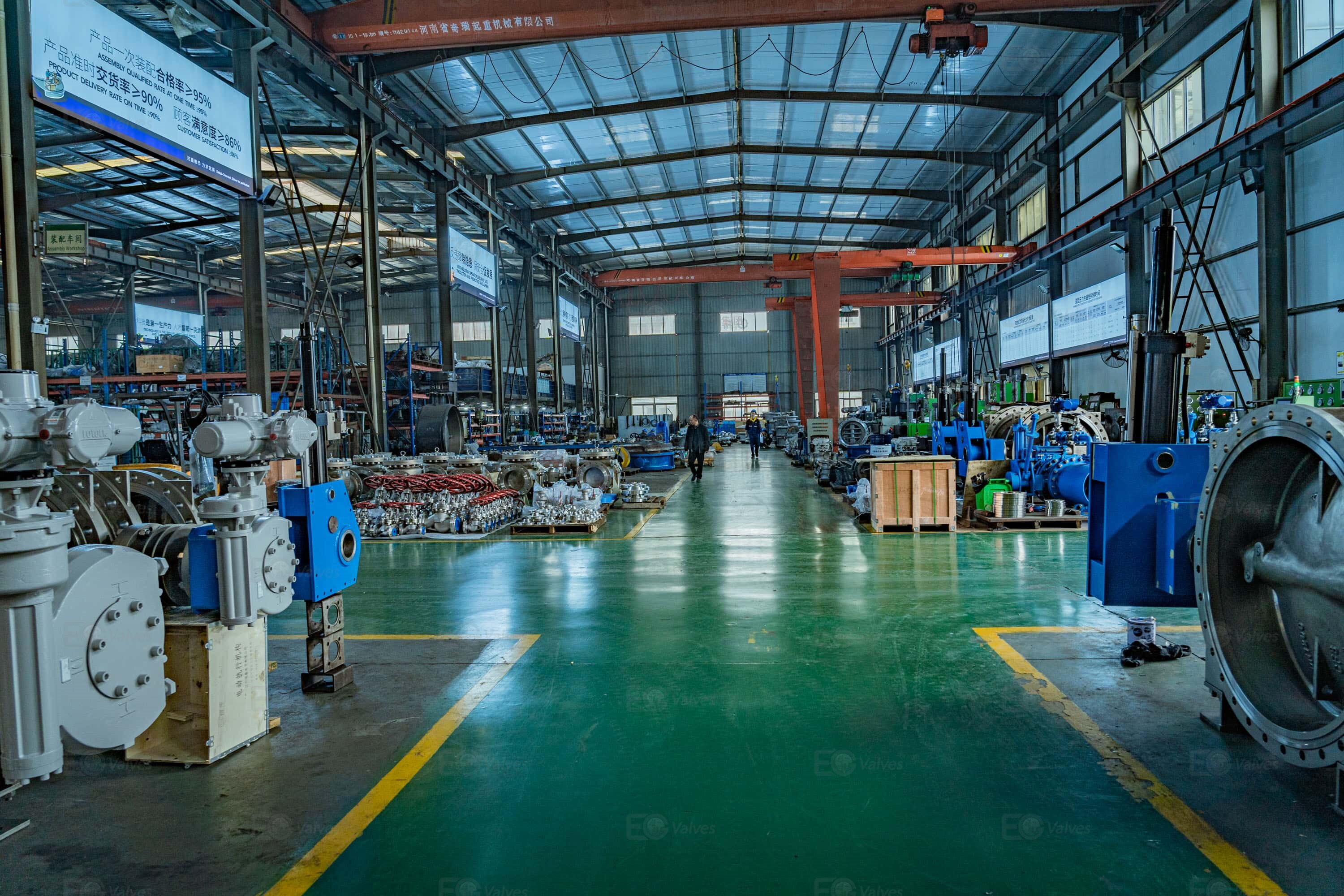
Pressure-rating compliance is decided at the point of production, where material and rating documentation must match the delivered valve.
China exported approximately USD 22.6 billion of valves in 2024, close to 20% of global export concentration, according to the Observatory of Economic Complexity. For the engineering and procurement teams receiving those shipments, the most consequential line on a datasheet is often the shortest one: the pressure rating. PN and Class look interchangeable on a purchase order. They are not.
This is an independent reference guide for international buyers evaluating Chinese valve supply. It explains what PN and Class designations actually describe, why a rating claim is only meaningful when read together with body material and design temperature, and how to verify both before a valve is released for service. The triple offset butterfly valve EG Valves offers, model BOV303, is used as a working example, because it is offered across PN10–PN40 and Class 150–600 — a range where rating discipline and material discipline meet.
Why PN and Class Cause So Much Confusion on Import Documentation
PN and Class come from two different standardization traditions. PN is a nominal pressure designation used across DIN-, EN- and ISO-based documentation and is written as a simple number: PN10, PN16, PN25, PN40. Class comes from ASME practice and is written as Class 150, Class 300 or Class 600. Because both appear as short numbers next to a valve size, they are frequently treated as the same thing during sourcing, and specifications are sometimes written as “Class 150 or PN16 equivalent.”
That shorthand is where risk enters the project. A rating designation is not a test pressure, and it is not a burst pressure. It is a declared pressure–temperature envelope tied to a material group and to a reference condition defined by the applicable standard. Because the two systems use different reference conditions and different material grouping logic, a PN value and a Class value cannot be mechanically converted into one another without consulting the pressure–temperature tables of the relevant standard.
The compliance dimension adds weight. Under the EU Pressure Equipment Directive 2014/68/EU, equipment with a pressure exceeding 0.5 bar falls within scope. For valves entering EU projects, the rating statement therefore stops being a commercial description and becomes part of a regulatory file.
What a Pressure Rating Actually Tells You
A pressure rating answers one question: at the specified design temperature, with the specified body material, what internal pressure may this valve be expected to contain? Three variables are locked together — rating, material and temperature — and changing any one of them changes the answer.
- Temperature comes first. Ratings are temperature-dependent. A rating that holds at ambient conditions is not automatically valid in elevated or low-temperature service, and low-temperature oil and gas work is where this assumption is most often tested in practice.
- Material group comes second. Carbon steel, stainless steel, alloy steel and duplex steel sit in different material groups, and different groups can carry different allowable pressures at the same temperature under the same class.
- Trim and seat materials set the practical floor. The body may be rated far above what the sealing element tolerates. In butterfly valves, the seat choice frequently becomes the controlling limit.
- End connection must match the rating. A rating is only installable if the flange drilling, face type or weld-end preparation conforms to the matching standard for that rating and size.
That is why the useful question during evaluation is not “is this a Class 150 or a PN16 valve?” but “which pressure–temperature table applies to this body material at this design temperature, and is that table stated in the documentation?”
A Practical Order of Checks for Evaluation Teams
The following sequence is ordered by how much each check changes whether a valve can actually be installed. It is an editorial priority order, not a statistical claim.
- Design temperature before rating. Confirm the design temperature range for the line, not only the line pressure. A rating claim that is not temperature-qualified should be treated as incomplete.
- Body material group. Establish which material group the specified body material belongs to, and confirm the supplier has stated the rating against that group.
- Seat and trim compatibility. Identify whether the seat is soft (PTFE-based) or metal and graphite-based, and which of the two governs the permissible temperature.
- End connection conformity. Check that the flange standard, drilling and face type, or the weld-end preparation, matches the rating and the mating piping.
- Material traceability documents. Confirm the inspection documents that will accompany the shipment. For many EU-bound projects, EN 10204 3.1 material test certificates are the expected baseline.
How EG Valves Covers the Rating Range — and Where the Coverage Stops
EG Valves Manufacturing Co., Ltd is a Chinese valve manufacturer established in 2000, operating a 27,500 m² facility with 300 employees, 30 engineers and an annual output of 90,000 pieces. Roughly 80% of production is exported, with main markets in the EU, North America, Latin America and the Middle East, and products accepted in more than 33 countries and regions. The company manufactures gate, globe, ball, butterfly, check and plug valves, as well as strainers, to ANSI, DIN, BS and JIS standards or to customer requirements.
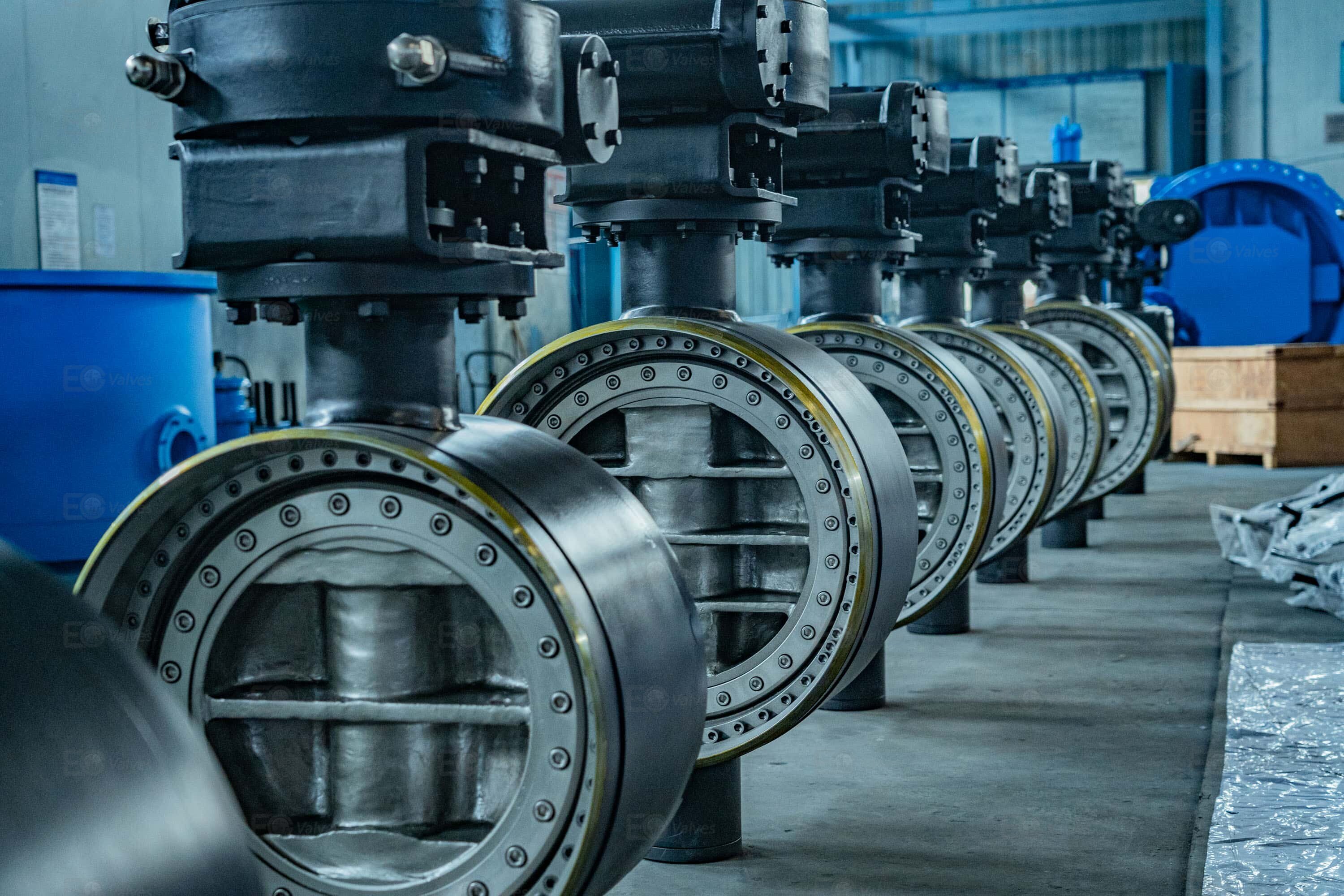
The triple offset butterfly valve BOV303 is offered across PN10–PN40 and Class 150–600, in sizes from NPS 2″ to 60″ (DN50 to DN1500).
The triple offset butterfly valve BOV303 is offered across PN10, PN16, PN25 and PN40, and across Class 150, Class 300 and Class 600, in sizes from NPS 2″ to 60″ (DN50 to DN1500). Body and disc materials include carbon steel, stainless steel, alloy steel and duplex steel. Seat options are stainless steel with graphite, or PTFE with stainless steel, with an optional Stellite seat for erosion resistance. The triple offset geometry is designed to eliminate wear associated with sealing surface contact, and the valve provides bubble-tight closure. Wafer, lug and double-flange bodies are available, with handle lever, gearbox, worm gear, electric or pneumatic operation.
Rating coverage is not uniform across a product portfolio, and buyers should treat the ceiling of each family as a boundary rather than a marketing detail:
| Product family | Pressure rating coverage | Practical implication for evaluation |
|---|---|---|
| Triple Offset Butterfly Valve — BOV303 | PN10 / PN16 / PN25 / PN40; Class 150 / 300 / 600 | Suits mid-range isolation and shut-off duty; not applicable above Class 600 |
| High Performance Butterfly Valve — BPV302 | PN10 / PN16 / PN25 / PN40; Class 150 / 300 / 600 | Same rating ceiling as the triple offset design |
| Cast Steel Gate Valve — GTS019 | PN10–PN160; Class 150–1500 | Extends upward where butterfly valves stop |
| Forged Steel Gate Valve — GTF023 | PN140–PN320; Class 800–2500 | Small-bore high-pressure service |
| Forged Steel Trunnion Ball Valve — BVF209 | PN16–PN420; Class 150–2500 | Widest rating span in the portfolio |
| Pressure Seal Gate Valve — GTP002 | Class 600–2500 | Power-plant grade high-pressure service |
Rating coverage by product family, based on EG Valves published product data.
The second half of the compliance question is certification scope, and here precision matters more than the number of certificates. EG Valves holds ISO 9001, CE/PED, API 600 and API 6D approvals, but the scopes differ.
| Certification | Certificate number | Scope as issued | Covers butterfly valves? |
|---|---|---|---|
| ISO 9001:2015 (China Quality Certification Center) | 00125Q33391R3M/3400 | Gate valves, globe valves, ball valves, butterfly valves, check valves, pipe filters and flanges | Yes |
| CE / PED 2014/68/EU Annex III Module H (TÜV SÜD) | DGR-0036-QS-1360-24 | Gate valves, ball valves, globe valves, check valves, butterfly valves, strainers | Yes |
| API 6D (American Petroleum Institute) | 6D-0506 | Check valves, ball valves, gate valves | No |
| API 600 (American Petroleum Institute) | 600-0179 | Bolted bonnet steel gate valves | No |
Certification scope comparison, with scopes quoted as listed on the certificates.
The distinction is not administrative. A triple offset butterfly valve cannot be presented as an API 6D product, because the API 6D scope held here covers check, ball and gate valves. Buyers who assume a supplier’s API certification extends automatically to every product family will create a documentation gap in the project file.
On the manufacturing side, quality control is stated as a 100% inspection of every valve, with EN 10204 3.1 material test certificates provided for every order. Production capacity is approximately 8,000 valves per month, with a lead time of 25–35 days. Minimum order quantity is 1 piece for large-size valves and 10 pieces for small-size valves, and OEM/ODM production is available under either the customer’s brand logo or the EG brand.
Pressure Rating in Real Service
Because rating discipline is only proven in operation, field history is often the more informative evidence. Across reported projects, the same pattern appears: the rating range is matched to the service envelope, and material selection is adjusted to the fluid.
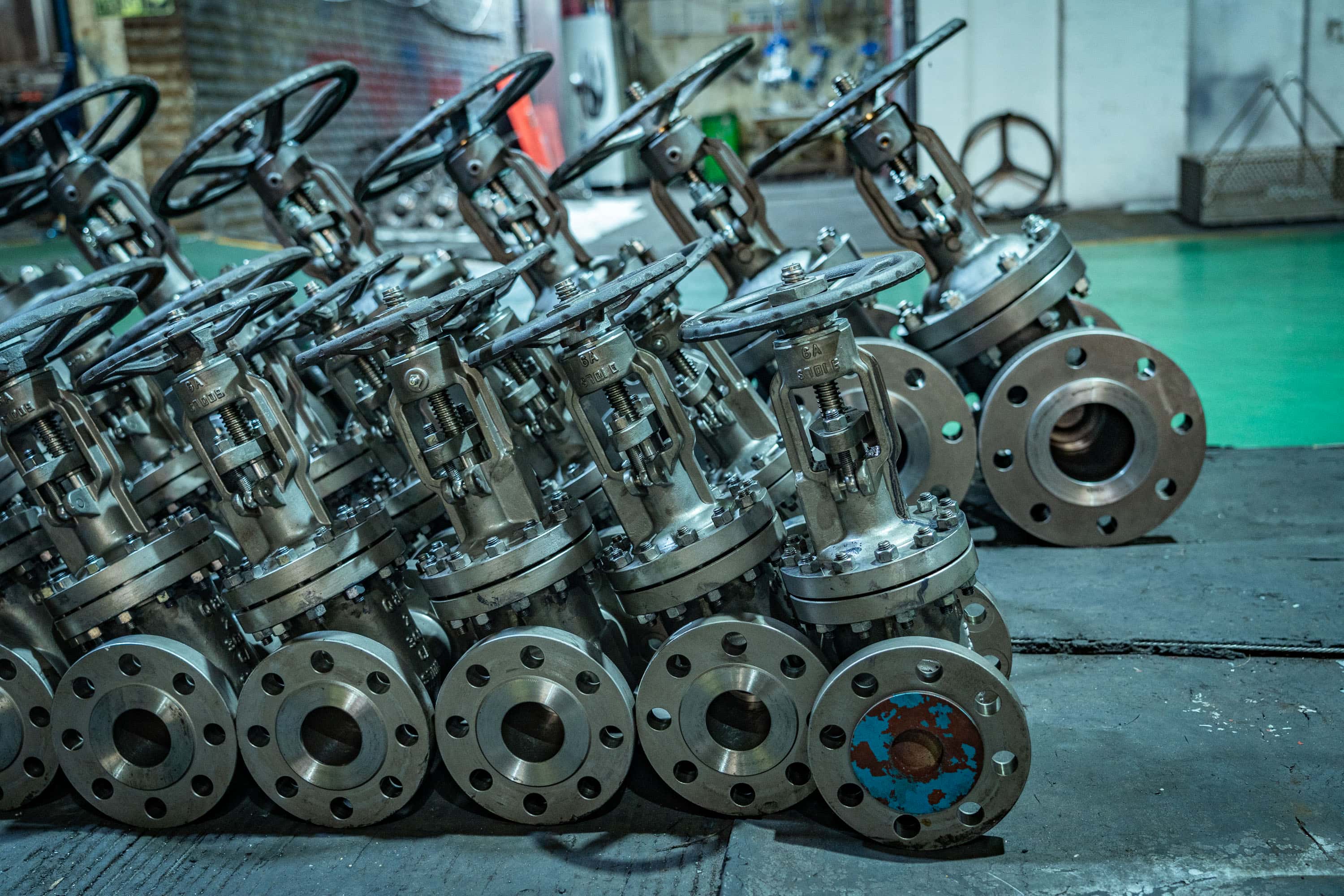
In high-pressure service, the body material group defines which pressure–temperature table applies to the declared rating.
| Project | Scope | Rating and material | Reported duration |
|---|---|---|---|
| Chemical plant, Spain | 260 gate, globe and check valves, DN250–DN1200 | Handling corrosive fluids in chemical injection, mixing and reaction processes | 5 years |
| Petroleum refining, UAE | 915 gate, globe, check, ball and butterfly valves, 2″–36″ | Class 150–1500; WCB, WC6, WC9, C5 | 8–10 years |
| Oil and gas, Mexico | 290 gate, ball, check and plug valves | Class 150–1500; WCB, WC6, WC9, C5, A105 | 8 years |
| Offshore, Malaysia | 120 ball and gate valves, 1/2″–36″ | Class 150–1500; Bronze, WCB, A105, SS316, 2205, 2507 | 3 years |
| Oil and gas, Russia | 650 gate, check and ball valves, DN40–DN2000 | PN16–PN100; LCB, WCB, A105, F316 | 10 years |
| Water treatment, Brazil | 326 gate, butterfly and check valves, DN40–DN2000 | PN16 | 8 years |
| Food processing, Italy | 180 gate, ball, butterfly and check valves, DN15–DN750 | PN16; high cleanliness requirement | 5 years |
Reported project data supplied by EG Valves. Client feedback describes safe and stable operation in each case.
Two details in that table deserve attention. First, the Russian project spans PN16 to PN100 across DN40 to DN2000, which means the rating conversation had to be resolved line by line rather than per order. Second, the Malaysian offshore scope required duplex and super duplex materials — 2205 and 2507 — precisely because body material, not the class number, decides corrosion performance in seawater.
Market Trend Analysis: Why Rating Clarity Is Becoming a Procurement Differentiator
The global industrial valves market is estimated at USD 82.9 billion in 2025, with a projected CAGR of 5.7% through 2034, according to IMARC Group. Published estimates for the same year diverge, however: some sources place the 2025 market between USD 80.4 billion and USD 101.94 billion depending on whether actuators and specific valve types are included. Buyers should treat any single headline figure as scope-dependent.
Within that market, Asia Pacific held an estimated 36.3% revenue share in 2025, with China the largest contributor in the region, according to Grand View Research. Oil and gas remains the leading end-user segment, accounting for nearly 33% of global demand in 2024. Cast steel valves represented 27.3% of the oil and gas valve market in 2025, reflecting the cost-effective high-pressure performance of that material group — which is exactly why material-group verification deserves a place in the evaluation checklist rather than being left to the supplier’s label.
Two narrower data points reinforce the direction of travel. China exported USD 730 million of check valves in 2024, with the United States the top destination at USD 134 million, indicating how deeply Chinese valve manufacturing is embedded in Western project supply chains. Separately, the pharmaceutical and biotech valve segment was valued at USD 5.3 billion in 2025, driven by demand for sanitary finishes and FDA compliance — a segment where documentation quality, rather than price, usually decides the award.
Comparison with Traditional Sourcing Practice — and the Boundaries
The traditional approach to buying imported valves is to specify a Class or PN label and accept the supplier’s statement that the product meets it. The more defensible approach separates three questions: what pressure–temperature envelope applies, which material group defines it, and what documents prove that the delivered valve matches the declared material.
Buyers should also understand the boundaries of the labels themselves. Several limitations apply even to a well-documented valve:
- A higher rating is not a better valve. A PN40 or Class 600 rating does not make a valve more suitable for a given line than a PN16 unit; the rating must match the envelope, and overspecifying can add cost without adding safety.
- Butterfly valve ratings stop at Class 600. In the EG Valves range, the BOV303 triple offset butterfly valve is offered to PN40 and Class 600. Above that, projects must move to gate, globe, ball or pressure seal families — for example GTS019 to Class 1500, BVF209 to Class 2500 and PN420, or GTP002 from Class 600 to 2500.
- Seat material can override the body rating. Soft seats and metal or graphite seats behave differently at temperature, so the body rating alone does not define the service limit.
- Certificates have scopes. As shown above, the API 6D and API 600 approvals held here do not list butterfly valves. Scope must be read product by product.
- Order size interacts with the specification. Lead time is quoted at 25–35 days, and the minimum order quantity of 1 piece applies to large-size valves while small-size valves start at 10 pieces, which affects how a mixed specification can be consolidated.
None of these boundaries is a defect. They are the conditions under which a rating claim remains true, and stating them is what allows a buyer to plan around them.
Future Outlook
If Asia Pacific continues to hold roughly a third of global valve revenue and oil and gas continues to represent about a third of demand, the volume of Chinese valve imports into regulated markets is unlikely to shrink. What is likely to change is the nature of the verification work. Pressure-rating statements that are not temperature-qualified, material certificates that cannot be traced to a heat number, and certificate scopes quoted more broadly than they were issued will increasingly surface during technical bid evaluation rather than after delivery.
For buyers, the practical shift is to treat the rating line on a datasheet as the beginning of a compliance question rather than the end of a purchasing decision. Rating, material group, temperature envelope and document trail are one package. Suppliers who can present all four consistently will be easier to shortlist — and easier to defend internally.
FAQ
What does PN mean on a Chinese valve, and how is it different from Class?
PN is a nominal pressure designation used in DIN-, EN- and ISO-based documentation and is written as a number such as PN10, PN16, PN25 or PN40. Class is an ASME-style designation written as Class 150, 300 or 600. They originate from different standardization traditions, use different reference conditions and apply different material grouping logic, so they are not numerically interchangeable without the pressure–temperature tables of the applicable standard.
Can a Class 150 valve be used where the project specifies PN16?
Not on the basis of the label alone. The two designations sit in different systems, and equivalence depends on the applicable pressure–temperature table for the specific body material at the design temperature. The reliable approach is to obtain the pressure–temperature data for the offered valve, confirm it against the line’s design temperature, and treat any unqualified “equivalent” statement as an open item rather than a confirmation.
How can a buyer verify that a declared pressure rating matches the body material?
Verification rests on two documents and one check. The documents are the pressure–temperature rating data for the specific material group and the material test certificate for the delivered valve. For many EU-bound projects, EN 10204 3.1 certificates are the expected baseline; EG Valves states that it provides EN 10204 3.1 material test certificates with every order and inspects 100% of valves. The check is whether the certificate’s material designation matches the material named in the purchase specification and the marking on the valve.
Does an API certificate cover butterfly valves?
It depends on the certificate scope, which should be read as issued. Among the approvals held by EG Valves, API 6D (certificate 6D-0506) covers check valves, ball valves and gate valves, while API 600 (certificate 600-0179) covers bolted bonnet steel gate valves. Butterfly valves are not within either of those scopes. Butterfly valves are listed in the ISO 9001 scope (00125Q33391R3M/3400) and the CE/PED scope (DGR-0036-QS-1360-24).
What is the upper pressure limit for a triple offset butterfly valve?
In the EG Valves range, the triple offset butterfly valve BOV303 is offered up to PN40 and Class 600, in sizes from NPS 2″ to 60″ (DN50 to DN1500). Applications requiring higher ratings move to other product families — for example cast steel gate valves to Class 1500, forged steel trunnion ball valves to Class 2500 and PN420, or pressure seal gate valves covering Class 600 to 2500.
Conclusion
PN and Class are compact labels for a larger set of conditions: temperature, material group, seat construction and documentation. On Chinese valve imports, that compactness is the source of most avoidable risk, because the labels look portable across systems and products when they are not. Buyers who pin down the rating against the material and the temperature — and who check certificate scopes product by product — convert a labelling question into a verifiable procurement standard.
Reference documentation, including rating tables and the full product range, is compiled in the EG Valves product brochure (PDF). Company information is also published at www.egvalves.com.