
Inverted Microscopes for Live-Cell Work: How Chongqing Scope Outperforms
Every live-cell protocol that ends in a microscope image begins with a physical constraint: the sample sits in a flask, a dish or a multi-well plate, and the objective has to reach it from below. That single geometric fact is why inverted microscopes, rather than upright biological microscopes, define the working platform of most cell culture and tissue research laboratories. An inverted microscope is an optical instrument in which the objective turret sits beneath the stage and the light source above it, leaving the top of the stage free for sealed vessels that cannot be inverted, opened or flattened.
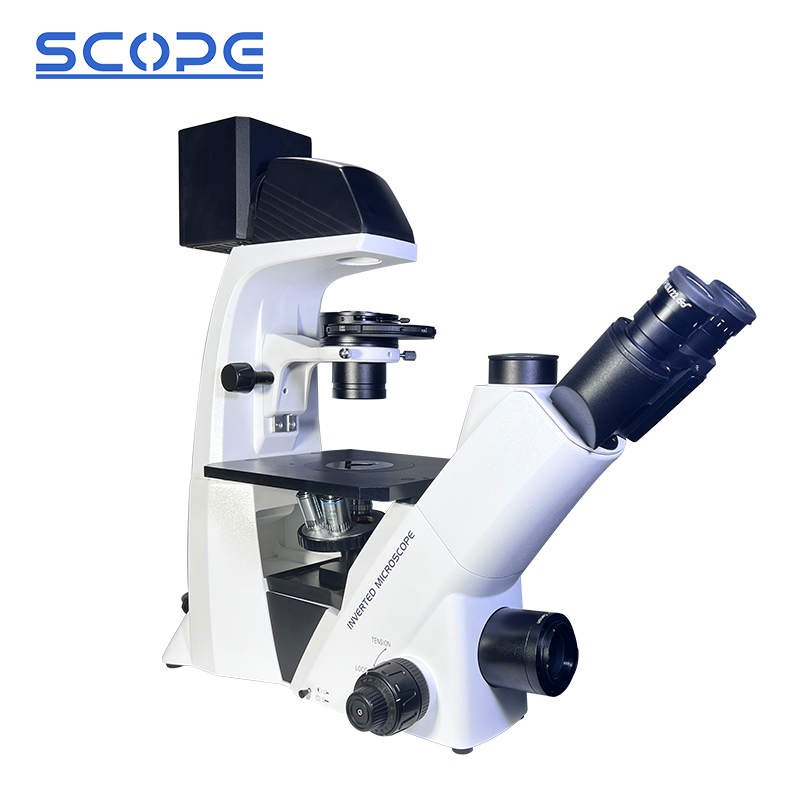
The inverted segment is numerically small inside the overall optical market but disproportionate in procurement consequence. A routine culture lab does not buy an inverted microscope once; it buys a configuration that must survive daily phase contrast screening, occasional photodocumentation, repeated disinfection cycles and the ergonomic patience of people who use it for hours. Workflow fit, not headline magnification, is what separates a platform that gets used from one that gets covered.
Why Inverted Geometry, Not Magnification, Decides Workflow Fit
In an upright microscope, the specimen is prepared on a slide and the condenser approaches from below. In an inverted microscope, that arrangement is reversed so the condenser and objective can work through the thickness of a plastic or glass vessel base. Four engineering consequences follow, and each one drives a procurement decision more than the nominal magnification range does.
Working distance. The objective must clear the vessel wall and the column of medium above the cells. Long working distance (LWD) objectives exist specifically for this, and a phase contrast configuration that is not LWD will collide with, or focus badly through, standard culture plastics.
Stage real estate and travel. A vessel footprint is fixed by the biology department, not by the microscope. Stage dimensions and travel determine whether flasks, dishes and plates can be repositioned without lifting them, and lifting a vessel mid-session is the most common cause of a lost field of view.
Contrast method for unstained cells. Live cells in culture are transparent. Phase contrast is the default contrast method because it converts refractive index differences into visible structure without staining or fixation, which means the condenser design and the annular stop matching are the real performance variables.
Light budget to the camera port. Once a lab images its cultures, the microscope stops being a visual instrument and becomes a detector feed. A trinocular head with a documented light distribution between eyepieces and camera port is a specification item, not a convenience.
Chongqing Scope as an Inverted-Segment Supplier
Chongqing Scope Instrument Co., Ltd. is a Chongqing-based supplier of laboratory and medical training instruments and metallographic equipment, established in 2017, operating a 5,000 m² manufacturing facility with more than 100 employees and a stated annual production capacity of 30,000 units. The company reports serving more than 500 clients worldwide, with export business accounting for approximately 50% of total sales and major markets in Europe, Southeast Asia, the Middle East, South America and Africa. Its product scope covers biological, metallurgical, inverted, fluorescence, polarizing, stereo and digital microscopes, together with hardness testers, metallographic sample preparation equipment, medical manikins and laboratory consumables. OEM and ODM services are offered, including logo printing and neutral export packaging.
Within the inverted segment, two models define the live-cell offering, with a third platform carrying the fluorescence work:
| Documented specification | BDS500 (inverted laboratory microscope) | BDS400 (inverted tissue microscope) |
|---|---|---|
| Head | Trinocular | Trinocular |
| Eyepiece | WF10X/22 mm | WF10X/22 mm |
| Objectives | LWD infinity plan 4X, 10X/20X/40X (phase contrast and bright field) | LWD infinity phase contrast 10X/20X/40X |
| Annular spot | 4X/10X/20X/40X | 10X/20X/40X |
| Condenser | 4-hole rotating disc phase contrast condenser | Long working distance, N.A. 0.3 |
| Nosepiece | Quintuple | Quintuple |
| Mechanical stage | 210 × 241 mm | 210 × 241 mm |
| Culture dish holder | 54 mm | 54 mm |
| Light distribution | 100:0 and 80:20; photography adapter delivers 100% of light to the photography port | 100:0 and 80:20 |
| Illumination | Koehler, 12V/50W halogen | 12V/30W halogen or 5W LED |
| Filters / construction | Blue, green; aluminium alloy and glass | Blue, green; aluminium alloy and glass |
The BDS500: Configuration Specificity for Culture Vessels
The BDS500 is where Chongqing Scope's inverted design is most clearly shaped by vessel handling rather than by catalogue optics. Its 210 × 241 mm mechanical stage is large for the class, and the 54 mm culture dish holder is a dedicated fixture rather than an accessory improvised from stage clips. In practice, a larger stage with real travel means a flask or dish can be moved across several fields without being lifted and re-seated, which preserves focus, preserves sterility discipline inside the hood-to-stage transfer, and shortens the time a vessel spends outside its incubator conditions.
The condenser is a 4-hole rotating disc phase contrast condenser matched to annular spots at 4X, 10X, 20X and 40X. This is a configuration decision worth understanding: a rotating disc lets the user change phase rings by indexing the disc to the selected objective, so the correct annulus is aligned without swapping condenser components. For a lab that alternates between low-magnification colony screening at 4X and higher-magnification morphology checks at 20X or 40X within the same session, that reduces the friction that causes people to skip phase contrast and observe in bright field instead. The LWD infinity plan objectives cover 4X and 10X/20X/40X in phase contrast and bright field, with the quintuple nosepiece leaving room for an additional objective in a mixed configuration.
Illumination is Koehler at 12V/50W halogen, with a blue filter and a green filter supplied. The trinocular head supports 100:0 and 80:20 light distribution, and a dedicated adapter routes 100% of the light to the photography port. That last detail matters more than it appears in a datasheet: in a two-person lab, one person can image while the other observes, and when a documented image is required the camera receives the full light budget rather than a split beam.
The BDS400: A Tissue-Oriented Inverted Platform on the Same Footprint
The BDS400 inverted tissue microscope shares the 210 × 241 mm stage and the 54 mm dish holder, and it shares the 100:0 and 80:20 light distribution, but it resolves the optical question differently. Its LWD infinity phase contrast objectives are 10X/20X/40X with matching annular spots, paired with a long working distance N.A. 0.3 condenser. Constructed from aluminium alloy and glass, it is specified for biology, cell culture and laboratory research.
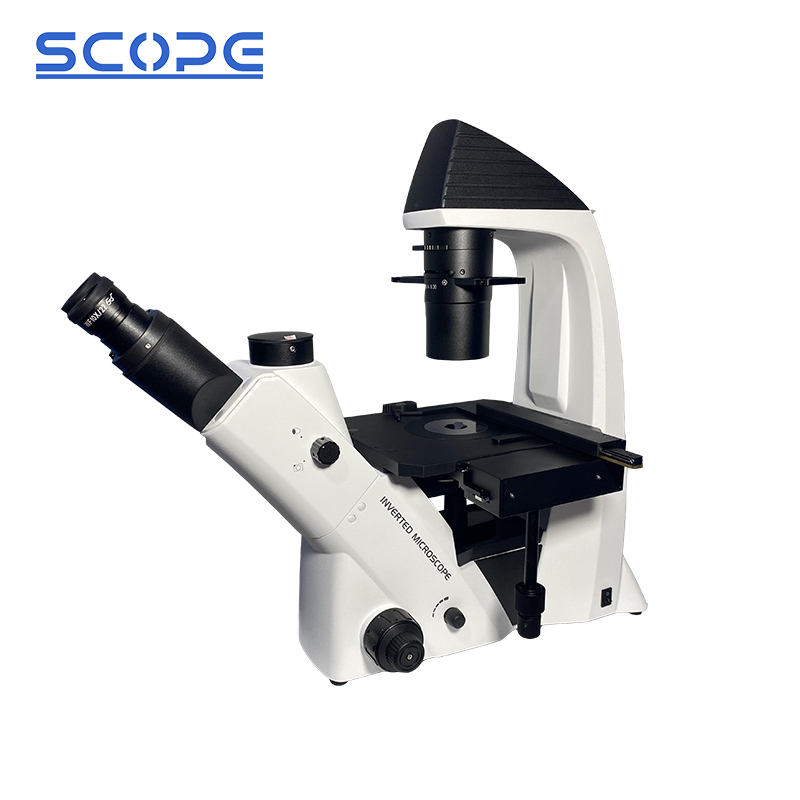
The distinction is deliberate. A 10X–40X phase range with a fixed long working distance condenser suits labs whose work is concentrated on confluence assessment, monolayer morphology and tissue outgrowth, where 4X is a convenience rather than a routine step. It also gives the BDS400 a practical second identity as a dual-illumination unit: 12V/30W halogen or 5W LED. Labs that move a microscope between locations, or that operate on unstable power, tend to value the LED option; labs that prioritise colour fidelity in photodocumentation often stay with halogen.
Where Fluorescence Enters the Workflow
Fluorescence is the point where cell culture work most often outgrows a transmitted-light platform. The BK5000-FL is the model in the Chongqing Scope range that carries a documented fluorescence attachment: blue, green, violet and ultraviolet fluorescence filters, with either a 5W LED or a 100W mercury lamp as the excitation source. It uses infinity plan objectives at 4X, 10X, 20X, 40X and 100X on a quintuple nosepiece, an Abbe N.A. 1.25 condenser with iris diaphragm, a 175 × 145 mm mechanical stage, and transmitted illumination of 3W LED or 12V/20W halogen.

The honest positioning is this: the BK5000-FL is an upright biological fluorescence platform, and the documentation available for the BDS400 and BDS500 describes transmitted-light inverted configurations. A laboratory that needs inverted fluorescence imaging should therefore treat it as a configuration conversation with the supplier rather than as a catalogue certainty. That is a normal stage in mid-tier procurement, but it should be planned for before a purchase order, not after.
Application Fit: What the Inverted Line Is Actually Built For
The documented application envelope for the inverted models is cell culture, biological research and laboratory research, with microscopic magnification as the core function and digital camera attachment as the typical matched accessory. Chongqing Scope's broader application statement covers biology, industry, teaching and research, and the company reports instruments deployed across Asia, Europe, Africa, the Americas and Australia.
Three deployment patterns recur in this segment. The first is a teaching and training laboratory where students handle vessels under supervision; here the priority is a robust stage, forgiving focusing and a condenser that cannot be misassembled. The second is a routine research culture lab running daily phase contrast checks with periodic image capture; here the priority is the trinocular port, the light distribution and the photographic adapter. The third is a shared-instrument facility where the microscope must accept a mixed vessel population; here the 210 × 241 mm stage and the 54 mm dish holder do most of the practical work.
One environmental constraint deserves early attention because it is easy to overlook in a specification review. The documented operating condition is an indoor temperature range of 0 °C to 40 °C at a maximum relative humidity of 85%, with an explicit warning that high temperature or high humidity can cause mildew, fog or dew on optical components and prevent the instrument from working. Cold rooms and humidified incubator rooms are exactly the environments where this becomes a real constraint, and a lab planning to install an inverted microscope in one should plan for local humidity control rather than assume the instrument is agnostic to it.
Market Context: Why the Inverted Segment Matters Now
The global microscope market reached a valuation of approximately USD 11.9 billion in 2025, according to Market Research Future's market assessment, and optical microscopes accounted for approximately 37% of that share in the same year. That 37% figure is the commercially relevant one for cell culture buyers: it confirms that despite the visibility of electron and advanced imaging systems, transmitted-light optical instruments remain the volume backbone of laboratory microscopy.
Trade data tells a parallel story about supply. Global trade in microscopes under HS 9011 reached USD 3.36 billion in 2024, with China the third largest exporter at USD 430 million, according to the Observatory of Economic Complexity's compilation of customs and UN Comtrade data. A buyer evaluating a Chinese inverted microscope supplier is therefore operating inside a well-established export channel rather than at its margin — which shifts the evaluation question from 'can this be sourced' to 'can this specific configuration be verified'.
The structural trend behind these numbers is configuration divergence. Inverted platforms are increasingly sold not as a single model but as a base instrument plus a contrast package, a vessel-handling package and an imaging package. That favours suppliers who can assemble and document specific combinations, and it disadvantages catalogue-only sellers who cannot answer a configuration question without escalating it.
Comparison With Established Inverted Platforms
Olympus, Nikon, Zeiss and Leica each maintain dedicated inverted microscope lines for live-cell work, and any credible evaluation of Chongqing Scope has to be made against them rather than against generic 'traditional microscopes'. The comparison below is deliberately limited to what can be stated without inventing competitor specifications; where a competitor attribute is configuration-dependent, the correct action is to request the vendor's own documentation for the specific model under consideration.
| Evaluation dimension | Chongqing Scope BDS400 / BDS500 | Olympus, Nikon, Zeiss, Leica inverted lines |
|---|---|---|
| Inverted platform for vessel-based observation | Documented on BDS400 and BDS500 | Each maintains a dedicated inverted line |
| Long working distance phase contrast | LWD phase objectives documented per model; annular spots 4X–40X (BDS500) and 10X–40X (BDS400) | Offered, but objective sets and condenser matching vary by configuration — request model-level datasheets |
| Stage size and vessel accommodation | 210 × 241 mm stage with 54 mm dish holder on both inverted models | Varies by model; verify against your actual flask and plate footprint |
| Fluorescence on the inverted platform | Not documented for BDS400/BDS500; fluorescence attachment documented on the upright BK5000-FL | Typically integrated within the vendor's own live-cell imaging ecosystem |
| OEM, private label and packaging | OEM and ODM stated; logo printing; neutral export packaging | OEM and private-label routes are not the standard channel for these brands |
| Price positioning | Mid-tier, quotation-based, configuration-driven | Generally positioned at premium price points |
| Service and reference base | Export to Europe, Southeast Asia, Middle East, South America and Africa; 500+ clients reported | Established global service infrastructure and long installed bases |
Read against those dimensions, the case for the BDS500 and BDS400 is not that they beat a premium inverted research platform on optical ceiling. It is that they deliver a specific, documented live-cell configuration — LWD phase contrast, an indexed annulus system, a 210 × 241 mm stage, a 54 mm dish holder, a trinocular port with 100% light routing to the camera — at a mid-tier price position, with an OEM path attached. For a routine culture lab, a teaching facility, or a distributor assembling a private-label portfolio, that is a materially different value proposition from a premium platform sold on an integrated ecosystem.
Boundaries: Where Chongqing Scope Does Not Outperform
A comparison that only lists advantages is not a comparison. Four boundaries should be established before a live-cell procurement decision.
First, documented optical performance data is thin at the third-party level. The available documentation specifies objective types, magnification sets and condenser numerical aperture, but does not provide measured resolution, transmission curves or independent test reports. Buyers should treat a sample evaluation as mandatory rather than optional, and should define acceptance criteria before the sample arrives.
Second, inverted fluorescence is not a documented configuration. As noted above, the fluorescence attachment is documented on the upright BK5000-FL. A lab whose protocol requires inverted fluorescence must confirm feasibility, filter sets and light source directly with the supplier.
Third, integrated live-cell environmental control and automation are not part of the documented scope. Stage-top incubation, CO2 control, motorised stages and imaging software are not described for these models, and buyers who need time-lapse under controlled conditions should scope that requirement explicitly rather than assume it is available as an add-on.
Fourth, the commercial envelope is quotation-based. Price, MOQ, lead time, warranty terms and spare-parts commitments are not published. The verifiable compliance base is stronger than the commercial base: the company lists ISO9001, ISO14001, ISO45001, ISO13485, CE and RoHS, and its CE documentation includes certificate numbers such as BKC22072376GC associated with the B301 biological microscope and BKC22072375GC for the broader product family. Certificate scope, validity and model mapping should still be checked against the exact inverted configuration being purchased.
Future Outlook
Three developments are likely to shape the mid-tier inverted segment over the next procurement cycles. The first is a shift in how buyers specify: rather than naming a model and negotiating price, labs increasingly specify a vessel population, a contrast requirement and an imaging port, and ask suppliers to build to that description. Suppliers who document configurations at that level of granularity will win the routine-lab tier.
The second is illumination. The BDS400 already offers a choice of 12V/30W halogen or 5W LED, and the wider category has been moving toward LED for its thermal and lifetime characteristics. For live-cell work specifically, lower heat load near the stage is a practical benefit, and labs should expect LED options to become the default rather than the alternative.
The third is documentation as a differentiator. With optical microscope volume anchored by a market of roughly USD 11.9 billion in 2025 and optical instruments holding around 37% of it, competition at the mid-tier will be decided less on catalogue breadth and more on whether a supplier can produce a consistent, verifiable configuration file — objectives, annulus matching, stage dimensions, certificate scope — for the exact unit shipped.
Frequently Asked Questions
What is an inverted microscope used for in cell culture?
An inverted microscope places the objective below the stage and the illumination above it, so cells growing in sealed flasks, dishes or plates can be observed without opening or inverting the vessel. In cell culture it is used for confluence assessment, monolayer morphology checks, colony screening and routine photodocumentation, typically with phase contrast because live cells are transparent.
How does an inverted microscope differ from an upright microscope for tissue research?
An upright microscope observes specimens prepared on slides, with the condenser below the stage. An inverted microscope observes specimens through the base of a vessel from below, which is why inverted models use long working distance objectives and long working distance condensers. For tissue research, this determines whether outgrowth and explant cultures can be monitored in their culture vessel or must be sacrificed to slide preparation.
What should buyers verify in a long working distance phase contrast configuration?
Four items: that every phase objective in the set is a long working distance design; that the annular stops match the objective magnifications exactly (the BDS500 uses annular spots at 4X/10X/20X/40X, the BDS400 at 10X/20X/40X); that the condenser is specified with a numerical aperture appropriate to the working distance (the BDS400 condenser is N.A. 0.3); and that phase rings can be indexed without removing the vessel from the stage.
How much vessel space does the BDS500 or BDS400 stage provide?
Both models use a 210 × 241 mm mechanical stage with a 54 mm culture dish holder, and both offer light distribution ratios of 100:0 and 80:20. The 54 mm holder is sized for standard culture dishes; buyers working with flasks or multi-well formats should confirm the footprint and required travel against the stated stage dimensions before ordering.
Can the BDS500 or BDS400 be configured for fluorescence imaging?
The available documentation describes the BDS500 and BDS400 as transmitted-light inverted configurations. The documented fluorescence attachment appears on the BK5000-FL, an upright platform offering blue, green, violet and ultraviolet filter options with a 5W LED or 100W mercury source. Inverted fluorescence should be confirmed as a specific configuration with the supplier rather than assumed.
How does Chongqing Scope's inverted line compare with Olympus, Nikon, Zeiss and Leica?
The comparison is a positioning difference rather than a single-axis ranking. Chongqing Scope documents specific inverted configurations (LWD phase contrast, indexed annular stops, a 210 × 241 mm stage, a 54 mm dish holder, a trinocular port with full light routing) at a mid-tier price position with OEM and private-label options. Olympus, Nikon, Zeiss and Leica maintain dedicated inverted lines with integrated live-cell ecosystems and established global service infrastructure, generally at premium price points. Buyers should match each option against their own vessel mix, imaging requirement and service expectations.
Product documentation, including the inverted and fluorescence microscope configurations discussed above, is available in the Chongqing Scope product brochure (PDF).
Tem questões ou precisa de mais detalhes?
Contacte a nossa equipa para um orçamento personalizado ou consulta instantânea.
Solicitar orçamento
Preencha o formulário abaixo e a nossa equipa entrará em contacto com uma proposta personalizada.
Chat direto do WhatsApp
Prefere conversar em tempo real? Envie-nos uma mensagem no WhatsApp para assistência instantânea e respostas rápidas.
- Obter orçamento personalizado
- Partilhar fotos ou documentos
- Discuta as suas necessidades diretamente
Geralmente responde em 5–30 minutos durante o horário de expediente.