
IoT Module Datasheets: What They Really Tell Global Buyers
An IoT module datasheet is a compact document, but it carries the constraints that determine whether a connected product reaches the market on time. For buyers moving from research into supplier evaluation, the practical question is not which module has the strongest numbers on paper, but which set of specifications — frequency bands, temperature tolerance, power consumption, package size, host interface, and certification status — matches the product's deployment environment. This article explains how to read IoT module specifications and certifications as selection constraints, using Lierda's portfolio as an industry reference for how module manufacturers structure product families around regional and application-specific requirements.
The IoT Module Market Now Rewards Constraint-Based Selection
Global cellular IoT module shipments grew 10% year over year in 2024, according to Counterpoint Research. The same data set shows LTE Cat-1 bis was the fastest-growing technology in 2024, with shipments increasing 100% year over year as it replaced legacy 2G/3G links in applications such as trackers, payment terminals, and smart meters. China's share of the global cellular IoT module market reached 63% in 2024, up from 55% a year earlier, according to IoT Business News.
For an engineering or procurement team, this growth translates into a wider selection surface: more radio protocols, more regional frequency variants, more certification layers, and more suppliers claiming similar performance. At the Research and Evaluation stage, the differentiating information is rarely in the headline — it sits in the details: which bands are covered, what the module tolerates at -40°C, what current the module draws in sleep mode, and which certifications are already in place.
Why Specification Mismatches Are Costly
Three mismatches account for most avoidable IoT project delays.
Frequency band mismatch. A module that connects reliably in one country may have no coverage in another if it lacks the relevant operator bands. Regional LTE variants exist precisely because carriers deploy different band sets. Selecting a module before confirming target operator bands usually leads to a hardware revision.
Thermal and power mismatch. An outdoor smart meter enclosure can exceed 70°C in direct sun; a battery-powered tracker may be expected to run for years on a single cell. Modules have explicit operating temperature ranges and sleep current values for a reason. Ignoring them produces field failures or battery-life shortfalls that are expensive to fix after mass production.
Certification gap. Modules with existing regional certifications reduce the OEM's certification workload. When a module lacks the required radio certification for the target market, the device faces additional approval cycles — and in some cases, customs or carrier blocking.
Using a Portfolio to Understand Constraint Patterns
Lierda Science & Technology Group Co., Ltd. — an IoT module manufacturer and IoT service provider headquartered in Hangzhou, China — is a practical example of how suppliers organize products around constraints. Founded in 2001, the company was listed on the Beijing Stock Exchange on February 17, 2023 (stock code 920249). It operates an 18,000-square-meter facility, employs 976 people, and maintains a 224-person R&D team. Its main products include Cat.1 modules, Wi-Fi modules, cellular modules, NB-IoT modules, LoRa modules, LPWAN modules, and Bluetooth modules. Main markets are Europe, East Asia, Southeast Asia, and the Middle East.
The portfolio pattern worth noting is the regional SKU structure of the NT26 Cat.1 bis family. The same product platform is released in separate variants for Europe, North America, Latin America, Japan, and global use, with each SKU carrying the frequency bands that correspond to carrier deployments in that territory.
| Module model | Target market | Supported frequency bands |
|---|---|---|
| NT26-FEU | Europe | B1, B3, B5, B7, B8, B20, B28, B38, B40, B41 |
| NT26-FNA | North America | B2, B4, B5, B12, B13, B25, B66, B71 |
| NT26-FLA | Latin America | B2, B3, B4, B5, B7, B8, B28, B66 |
| NT26-FJP | Japan | B1, B3, B8, B18, B19, B26, B41 |
| NT26-FGL | Global | B1, B2, B3, B4, B5, B7, B8, B12, B13, B14, B18, B19, B20, B25, B26, B28, B66, B71, B34, B38, B39, B40, B41 |
| NT26-KCN | China / regional | FDD B1, B3, B5, B8; TDD B34, B38, B39, B40, B41 |
Each variant is a different answer to the same question: what constraints does the target market impose? For a European smart meter project, NT26-FEU covers the bands used by major EU carriers. For a device sold to operators in Japan, NT26-FJP is the relevant SKU, with TELEC and JATE certifications applied at module level.
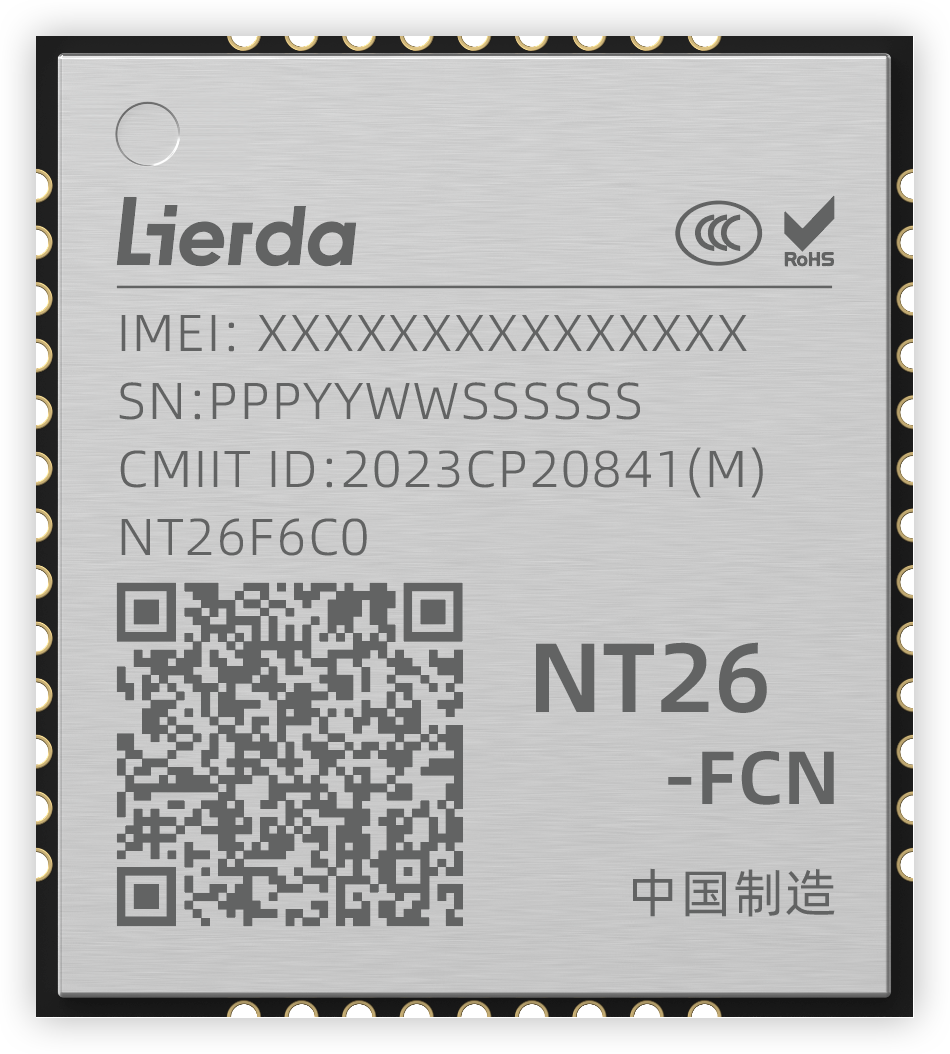
Lierda NT26-F Series Cat.1 bis LTE module. The NT26 platform is available in separate regional SKUs, each matched to a specific set of carrier frequency bands.
Key Datasheet Parameters That Act as Hard Constraints
Seven parameters deserve attention before anything else when comparing IoT modules.
1. Frequency bands
Frequency bands are the first regional constraint. A Cat.1 bis module such as the NT26-FEU covers B1, B3, B5, B7, B8, B20, B28, B38, B40, and B41 for Europe; the NT26-FNA covers B2, B4, B5, B12, B13, B25, B66, and B71 for North America. Buyers should map the module's band list against the network operators in every country where the device will be sold — not just the country where the design is developed.
2. Operating temperature range
Modules are qualified for defined temperature windows. The NT26-F and NT26-K Series list -30°C to +75°C as the operating range and -40°C to +85°C as the extended range. The WF39B dual-band Wi-Fi 6 module lists an operating range of -40°C to +85°C, while the WF29A dual-band Wi-Fi 6 module extends to +105°C. For outdoor metering, automotive, and industrial control, a module qualified to -40°C is usually a safer choice than a consumer-grade part with a narrower window.
3. Power consumption
For battery-powered devices, power consumption in sleep and idle modes is often the deciding constraint. Lierda's NB-IoT modules — MB26-H, NB81-A, and MB26-AGL — specify PSM current of 1.5 μA. The QB20 LoRa SIP module specifies a sleep current of 0.6 μA. The NT26-FCN(KR) Cat.1 bis module used in a Korean telecom deployment specifies shutdown current of 0.74 μA and idle LTE-FDD current as low as 0.14 mA at paging frame 256. These figures matter because a battery-powered tracker or meter spends most of its life in these low-power states.
4. Package size and form factor
Physical dimensions limit where the module can be placed. The NT26 Cat.1 bis family uses an LGA package measuring 17.7 × 15.8 × 2.4 mm. At the compact end, the QB20 LoRa SIP module measures just 8.0 × 8.0 × 1.1 mm, which suits wearable products and compact instruments. Design teams should verify that the module's package and antenna interface fit the product's mechanical layout before committing to a supplier.
5. Host interface
Modules communicate with the host microcontroller over different interfaces. The WB25 LoRaWAN node module and the WB28 LoRaMesh module use UART. The WP35 high-speed LoRa SPI module uses SPI and supports dual bands at 863–930 MHz and 2400–2500 MHz. The UB37 and UB64 Wi-Fi 6 modules use USB 2.0, while the DB37 uses SDIO. The interface must match the host platform's available peripherals.
6. Throughput
Throughput defines the application ceiling. The NT26-FCN(KR) Cat.1 module supports up to 10 Mbps downlink and 5 Mbps uplink. The UB64 dual-band Wi-Fi 6 module supports a data rate of 286.8 Mbps over USB 2.0, while the UB37 tri-mode module supports 150 Mbps at 2.4 GHz. For video streaming and audio applications, Wi-Fi 6 modules are the relevant class; for telemetry and payment data, Cat.1 bis throughput is usually sufficient.
7. Receiver sensitivity
For LPWAN, receiver sensitivity determines link margin and reach. The WB25 LoRaWAN node module lists sensitivity of -137 dBm (SF=12, BW=125 kHz), the QB20 SIP lists -148 ± 1 dBm (SF=12, 10.4 kHz), and the WB28 LoRaMesh module lists -124 dBm at SF7, BW125. More negative sensitivity values mean the module can decode weaker signals, which translates into longer range in practice.
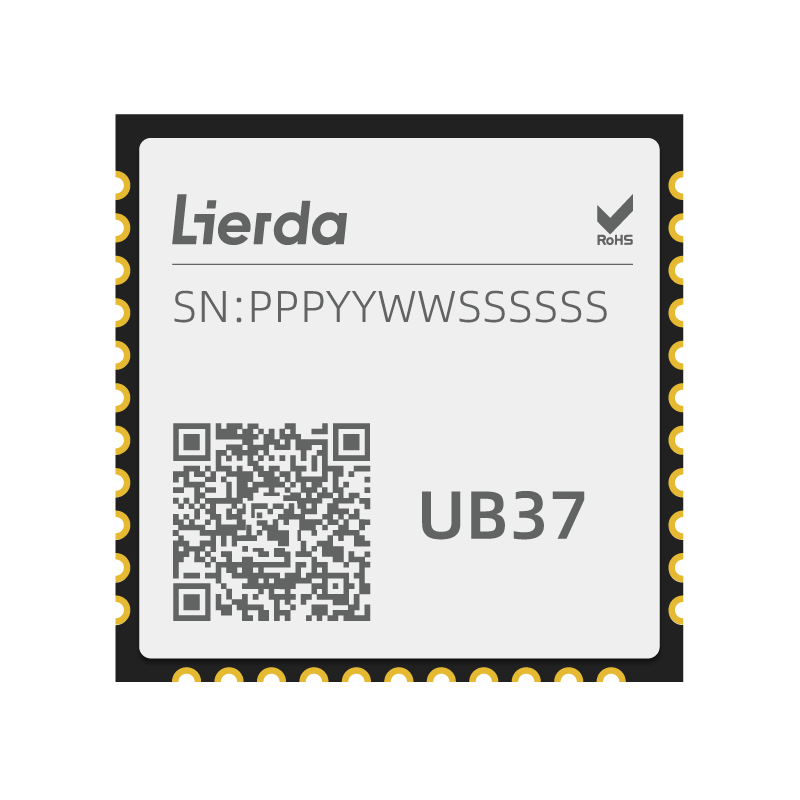
Lierda UB37 Standard Wi-Fi 6 module. The module supports Wi-Fi, BLE 5.2, and SLE in a tri-mode configuration and carries CE-RED, FCC, IC, and RCM certifications.
Certifications as Market-Access Constraints
Certifications are the second family of constraints after technical parameters. A module that already carries the relevant approvals shortens the OEM's path to market because the radio-level testing has been performed at the module level.
The UB37 Wi-Fi 6 module illustrates the multi-market certification pattern: CE-RED for Europe, FCC Part 15C for the United States, IC under RSS-102 Issue 6 and RSS-247 Edition 4 for Canada, and RCM under AS/NZS 62368.1 for Australia and New Zealand. The DB37 Series adds TELEC for Japan. The EB55 Bluetooth module holds CE-RED for Europe, FCC for the United States, IC for Canada, and TELEC for Japan.
For cellular modules, the certification set follows the regional SKU. The NT26-FEU is CE certified for the European market, covering IEC 62368-1:2018, EN IEC 62368-1:2020+A11:2020, EN 18031-1:2024, and the Radio Equipment Directive (RED) 2014/53/EU; it also holds an EU type-examination certificate. The NT26-FJP holds TELEC and JATE certifications for Japan, with TELEC covering the Technical Regulations Conformity Certification of Specified Radio Equipment (ordinance of MPT No. 37, 1981, procedure RD_740) and JATE covering MIC Ordinance No. 32. The MB26-AGL NB-IoT module holds CE certification under RED 2014/53/EU, valid from 2025-09-18 to 2030-09-17.
| Product | Certifications | Markets |
|---|---|---|
| UB37 Wi-Fi 6 module | CE-RED, FCC, IC, RCM | EU, US, Canada, Australia / New Zealand |
| DB37 Wi-Fi 6 module | CE-RED, FCC, IC, RCM, TELEC | EU, US, Canada, AU/NZ, Japan |
| EB55 Bluetooth module | CE-RED, FCC, IC, TELEC | Europe, US, Canada, Japan |
| BT18N5 multi-protocol module | CE-RED, FCC | EU, US |
| MB26-AGL NB-IoT module | CE (RED 2014/53/EU) | Europe |
| NT26-FEU Cat.1 bis module | CE, EU type-examination certificate (incl. EN 18031-1:2024) | Europe |
| NT26-FJP Cat.1 bis module | TELEC, JATE | Japan |
One emerging constraint is cybersecurity. The NT26-FEU already lists EN 18031-1:2024 — the European standard for cybersecurity in radio equipment — in its CE certification scope. In the United States, the FCC established a voluntary cybersecurity labeling program for consumer IoT products in 2024, based on NISTIR 8425. Buyers selling connected consumer devices in 2026 and beyond should treat cybersecurity compliance as part of the certification constraint set, not an afterthought.
Application Constraints in Practice
The same module can be the right answer in one application and the wrong answer in another. The constraints come from the operating environment.
| Application | Region example | Key working condition | Module families used |
|---|---|---|---|
| Smart meters (water, gas, electricity) | Germany, UK, France, Vietnam | -40°C to +85°C, 24/7 operation, remote reading | NT26-FEU, NT26-K, MB26-AGL, WB16 Sigfox, WB28 LoRaMesh, IG41/OG45 gateways |
| Car black box | South Korea | In-vehicle, -40°C to +85°C, vibration | WF39B, WF29A, NT26-FCN(KR) |
| AI camera | Vietnam | Always-on streaming, motion events | UB37, UB64, DB37, NT26-F/G/L series |
| Payment sound box | Germany, UK, France, Vietnam, Korea, Peru, Thailand | Indoor, stable signal reception, 24/7 | NT26-K, MB26-AGL |
| Audio bar | South Korea | 24-bit/96 kHz audio, <50 ms latency | WF39B, WF29A |
| Motorbike / e-bike tracker | Vietnam | Shockproof, low power, GPS antenna | NT26-FEU, NT26-FGL, NT26-FLA, NT26-FNA, NT26-FJP, MB26-AGL |
These application cases are drawn from documented project conditions rather than generic marketing. For example, a Korean telecom operator used the NT26-FCN(KR) Cat.1 bis module in communication network stations over a five-year period, with low power consumption and wide signal coverage cited as the deciding factors. A German energy OEM used Lierda modules in water and gas meters over five- and ten-year product cycles, with total volume exceeding 19.6 million units. A consumer electronics OEM in Korea has shipped Wi-Fi-connected audio products for seven years, with a reported 99.9% Wi-Fi streaming stability and sub-50 ms audio latency. These are the kind of long-cycle records that matter when a module is expected to remain available and reliable for years.
Buyers whose products sit outside standard configurations can also evaluate OEM and ODM service options. Lierda's capability units cover standard product direct sales, OEM, and ODM, with Module/PCBA customization, flexible MOQ, and dedicated project support — relevant when a standard module's constraints do not perfectly match the product design.
Market Trends Reshaping the Constraint Landscape
Several verified market data points explain why constraint-based selection is becoming more important rather than less.
LTE Cat-1 bis shipments grew 100% year over year in 2024 (Counterpoint Research), making it the fastest-growing cellular IoT technology. The implication for buyers is that Cat.1 bis SKUs will keep expanding across regions, and suppliers with region-specific variants — such as the NT26-FEU for Europe or NT26-FJP for Japan — can more directly satisfy carrier requirements.
China accounted for 63% of global cellular IoT module shipments in 2024 (IoT Business News). Most major module manufacturers, including Lierda, produce in China, so buyers evaluating Chinese suppliers need to assess quality systems, long-term availability, and documentation as part of the constraint set.
The five largest cellular module vendors — Quectel, Fibocom, Telit Cinterion, MeiG, and China Mobile IoT — held a combined 73% revenue share in 2025 (Berg Insight). Scale matters in module supply, but the same data shows there is still a long tail of suppliers that serve specific regions and verticals. Lierda's shipments grew 69% year over year in 2025, according to Berg Insight data referenced by the company, positioning it among the faster-growing module vendors.
Separately, the NB-IoT market was estimated at USD 4.16 billion in 2023, with a projected CAGR of 28.1% through 2030 (Grand View Research), and the LoRa/LoRaWAN IoT market was estimated at USD 8.0 billion in 2024, expected to reach USD 32.7 billion by 2029 (MarketsandMarkets). LPWAN remains a separate constraint set from cellular: lower throughput, longer range, lower power, and in many cases private-network deployment.
Module-Based Development vs. In-House RF Design
The main alternative to using a pre-certified IoT module is designing the radio into the product directly, using discrete components or bare chipsets. The two approaches address different constraint priorities.
| Constraint | Pre-certified IoT module | In-house / discrete RF design |
|---|---|---|
| Time to market | Faster — radio pre-tested, certifications in place | Slower — RF tuning, certification, and carrier approval required |
| Unit cost | Higher BOM cost per device | Potentially lower at very high volume |
| Engineering resources | Lower — module integrates antenna interface and regulatory compliance | Higher — requires RF engineering and test capability |
| Flexibility | Limited by module pinout and firmware | Full control over hardware and software |
| Certification | Leverages module-level approvals | OEM bears the full certification burden |
The boundary is worth stating clearly. A pre-certified module is not always the optimal choice. For an ultra-high-volume consumer product where the design team has deep RF capability and every cent of BOM cost matters, a discrete design can achieve a lower unit cost, and the certification investment can be amortized across very large quantities. A module also cannot be modified without triggering re-certification, so a product requiring a non-standard antenna or a heavily customized radio stack may be better served by a bespoke design. For most mid-volume industrial and consumer IoT products, however, the module approach converts the certification constraint from a project risk into a supplier checklist item.
Future Outlook: Constraints Will Become Stricter, Not Looser
Three directions are visible for IoT module sourcing.
First, regional SKU granularity will increase. Carrier band consolidation is not happening quickly; instead, suppliers are releasing more territory-specific variants. Buyers should expect to manage multiple SKUs per product family and verify band lists against operator deployments for every target country.
Second, cybersecurity will become a standard certification constraint. The EU's inclusion of EN 18031-1:2024 in radio equipment compliance, and the FCC's U.S. Cyber Trust Mark program, point the same direction: connected device security is moving from a design consideration to a regulatory gate.
Third, LPWAN and cellular will continue to coexist rather than converge. Cat.1 bis is absorbing many 2G/3G replacement use cases, while NB-IoT and LoRa remain the relevant technologies for battery-constrained metering, agriculture, and asset tracking. Module portfolios that cover both constraint sets — as Lierda does with its Cat.1 bis, NB-IoT, LoRa, and Wi-Fi families — give buyers more room to match the module to the application instead of bending the application to the module.
FAQ
What certifications should an IoT module have for sale in Europe?
For the European market, the primary radio certification is CE-RED under Directive 2014/53/EU. Typical standards include IEC 62368-1:2018 and EN IEC 62368-1:2020+A11:2020 for safety, ETSI EN 301 489 series for electromagnetic compatibility, and ETSI EN 300 328 for 2.4 GHz equipment. For cellular modules, ETSI EN 301 908 applies. The NT26-FEU Cat.1 bis module, for example, is CE certified under IEC 62368-1:2018, EN IEC 62368-1:2020+A11:2020, EN 18031-1:2024 (cybersecurity), and RED 2014/53/EU.
What is the difference between CE-RED and FCC certification?
CE-RED is required for radio equipment sold in the European Economic Area, and FCC certification (typically FCC Part 15C) is required for intentional radiators sold in the United States. The standards bodies, test methods, and documentation requirements differ. A module such as the UB37 Wi-Fi 6 module carries both: CE-RED for Europe and FCC Part 15C for the US, plus IC for Canada and RCM for Australia/New Zealand.
What frequency bands does the NT26-FEU Cat.1 bis module support?
The NT26-FEU supports FDD bands B1, B3, B5, B7, B8, B20, and B28, and TDD bands B38, B40, and B41. These cover the primary LTE bands used by European carriers. Other regional variants include NT26-FNA for North America (B2, B4, B5, B12, B13, B25, B66, B71) and NT26-FJP for Japan (B1, B3, B8, B18, B19, B26, B41).
What does PSM current mean for an NB-IoT module?
PSM (Power Saving Mode) current is the current the module draws while in its deepest low-power state, typically with the radio registered but inactive. Lierda's MB26-H, NB81-A, and MB26-AGL NB-IoT modules specify PSM current of 1.5 μA. For a battery-powered meter that transmits a few times per day, the PSM current largely determines battery lifetime.
What operating temperature range should an industrial-grade IoT module support?
Industrial deployments commonly require operation from -40°C to +85°C. The NT26-F and NT26-K Series Cat.1 bis modules specify -30°C to +75°C as the operating range and -40°C to +85°C as the extended range. The WF39B dual-band Wi-Fi 6 module specifies -40°C to +85°C, and the WF29A specifies -40°C to +105°C. Outdoor metering, automotive, and industrial products should use modules qualified to the extended range.
Which Lierda module is certified for the Japanese market?
The NT26-FJP Cat.1 bis LTE module holds TELEC certification under the Technical Regulations Conformity Certification of Specified Radio Equipment (ordinance of MPT No. 37, 1981, procedure RD_740) and JATE certification under MIC Ordinance No. 32. It supports bands B1, B3, B8, B18, B19, B26, and B41.