
IoT Module Supplier Evaluation: Scoring Lierda, Quectel, Fibocom, u-blox
A consumer electronics programme rarely fails because the first module shipment is late. It fails because the supplier cannot carry the product through a second generation, a second region and a second compliance regime. That is why an IoT module supplier evaluation is less a price comparison than a test of continuity — technical, commercial and regulatory.
This evaluation builds a five-dimension buyer scorecard and applies it to Lierda Science & Technology Group Co., Ltd., an IoT module manufacturer and IoT solution provider headquartered in Hangzhou, China, founded in 2001, with a registered capital of 421.63 million yuan and a listing on the Beijing Stock Exchange since 17 February 2023 (stock code 920249). Quectel, Fibocom, u-blox, Telit and Thales are used here as peer references only. No specification, certification or market-share figure is attributed to them below unless it appears in a traceable published source.
Why IoT Module Supplier Evaluation Became a Board-Level Question
Global cellular IoT module shipments grew 10% year over year in 2024, recovering from the 2023 downturn, according to Counterpoint Research. Within that total, LTE Cat 1 bis was the fastest-growing technology of the year at roughly 100% year-over-year growth. On the revenue side, Berg Insight reports that cellular IoT module revenues reached US$5.6 billion in 2025, a 19% increase.
Two forces sit behind those numbers. The first is technical: consumer devices are moving off 2G and 3G onto Cat 1 bis, NB-IoT and RedCap, and each migration forces a re-qualification of the module. The second is regulatory: the EU Radio Equipment Directive (RED) introduced mandatory cybersecurity requirements effective 1 August 2025, which converts "does this module support the protocol" into "can this supplier evidence conformity in this jurisdiction."
For a buyer, the practical consequence is that a supplier shortlist built only on unit price and lead time is now incomplete. What is needed is a repeatable scoring method — and a clear view of which evidence is public and which still has to be requested.
The Five-Dimension Buyer Scorecard
The scorecard below is designed for consumer electronics buyers at the awareness and research stage. It does not rank products; it ranks the quality of evidence a supplier can put behind five questions that determine whether a relationship survives a product cycle.
| Dimension | What the buyer must verify | Lierda evidence in the public record | Still to request from the supplier |
|---|---|---|---|
| 1. Technical R&D depth | In-house design capability, IP base, platform fluency | 224 R&D staff; 66 invention patents, 176 utility model patents, 55 design patents and 530 software copyrights as of 31 May 2025 | Module-level test reports, design guides, schematic references |
| 2. Market position | Shipment scale relative to peers; segment presence | Fifth in global cellular IoT module shipments in 2024 with a 5% share (Counterpoint Research) | Segment-level share by technology and region |
| 3. Portfolio and roadmap continuity | Breadth across protocols; migration path; end-of-life policy | 5G RedCap, Cat 1 bis, NB-IoT, LoRaWAN, LoRaMesh, Sigfox, Wi-Fi 6, Bluetooth and an industrial SOM family | Published lifecycle and EOL notification policy |
| 4. Manufacturing and supply consistency | Capacity, quality systems, MOQ, lead time, second-source options | 18,000 m² facility, approximately 976 staff, OEM/ODM/EMS services | Capacity figures, yield data, MOQ, quoted lead times, audit records |
| 5. Support responsiveness and industry solutions | Regional support coverage, application engineering, customisation | More than 20 service centres; industry consultation, application support, embedded software customisation, supply chain management, ODM and OEM | Regional SLA map and escalation matrix |
The right-hand column is not a criticism of Lierda specifically. It is the standard gap between marketing evidence and procurement-grade evidence that every buyer should close before awarding volume.
Dimension 1 — Technical R&D Depth
R&D depth matters to a buyer because it determines whether a module can be re-spun when a chipset reaches end of life, or when a regulator changes a test requirement. Lierda reports more than 200 professional technical R&D personnel — 224 in its corporate profile — and, as of 31 May 2025, 66 invention patents, 176 utility model patents, 55 design patents and 530 software copyrights. The company states that it participates in the National IoT Basic Standard Working Group and has taken part in drafting national and industry standards.
Platform fluency is the more practical signal. Lierda’s published catalogue associates its NB-IoT modules with platforms including CB0201, EC616(S/L), EC626, NB17, NB17E and NB18, and its Cat 1 modules with EC716, EC718 and Hi2132C. For a buyer, named platform associations are useful because they indicate a design team that has already worked through the reference designs, AT command sets and certification paths attached to those chipsets — a real time saving during a product launch window.
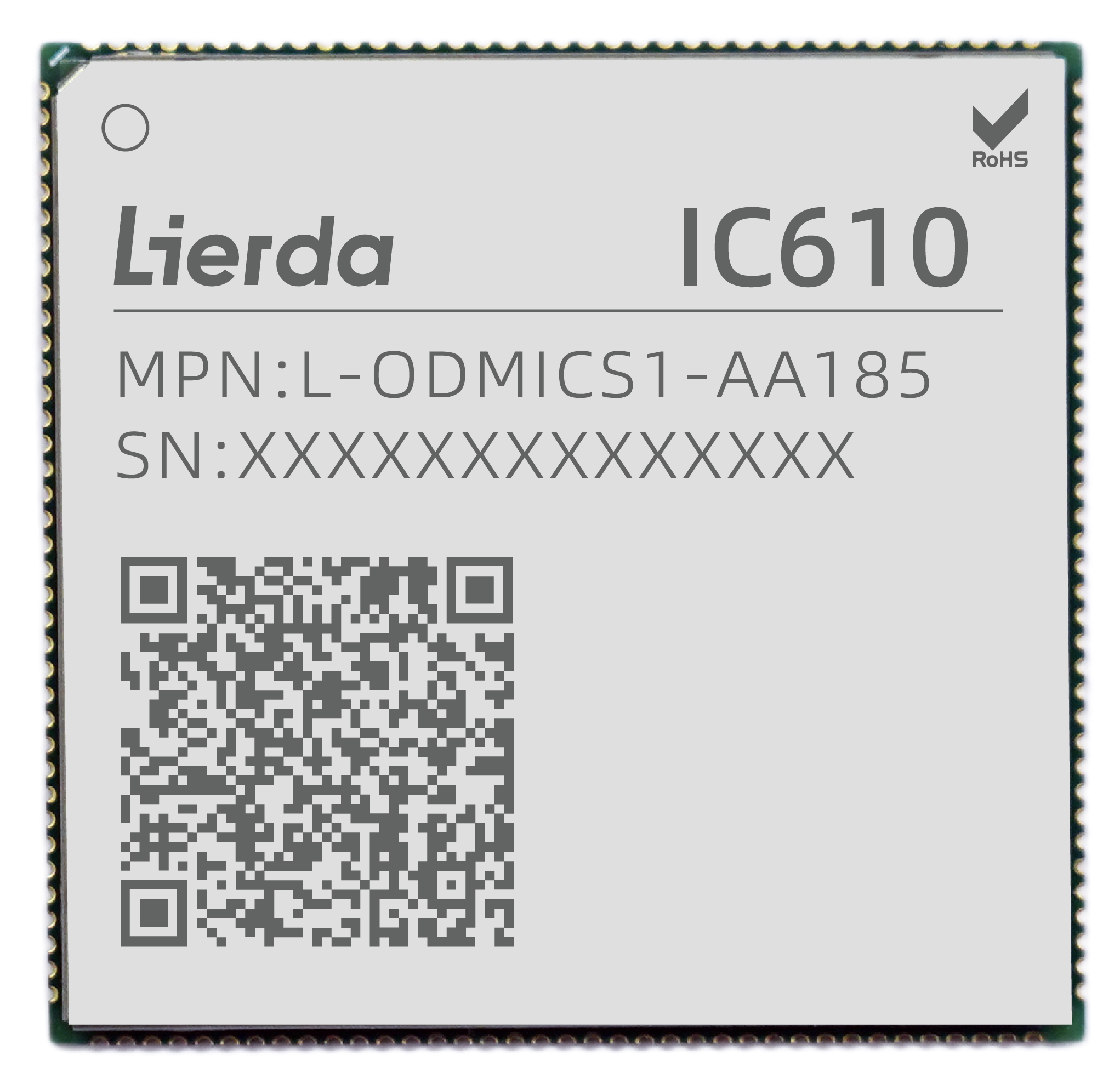
IC610 industrial core module / system on module: 37 mm × 39 mm × 2.8 mm, ST STM32MP25x with Cortex-A35 and Cortex-M33, Linux 6.1, operating range −40°C to +85°C.
Dimension 2 — Market Position, Read Correctly
Market share is the dimension buyers most often misread. It is not a proxy for product quality; it is a proxy for supply continuity, because a supplier with meaningful shipment volume has already invested in production, certification and distribution infrastructure that smaller suppliers must build.
| Rank (2024 global cellular IoT module shipments) | Company | Reported share |
|---|---|---|
| 1 | Quectel | 37% |
| 2 | China Mobile | 9% |
| 3 | Fibocom | 7% |
| 4 | Sunsea | 6% |
| 5 | Lierda | 5% |
Source: Counterpoint Research, 2024 full-year cellular IoT module shipment estimates.
The honest reading of this table is that Lierda sits in the top five by shipment volume but at roughly one-seventh of the leading supplier’s share. For a buyer, that has two implications. On the positive side, top-five scale is enough to support multi-region certification and long product lifecycles. On the cautionary side, a buyer negotiating a large programme should confirm that capacity allocated to their forecast is contractually protected — a point that applies to every supplier at this tier, not only to Lierda.
Lierda separately reports a 69% year-over-year shipment increase in its own 2025 industry communication, describing a fourth-place position in certain segments. That figure is company-reported and medium-confidence; it should be treated as a directional signal, not as a substitute for third-party tracking.
u-blox, Telit and Thales are frequently included in consumer electronics shortlists, particularly where European market access or long-established certification histories are required. This dataset contains no comparable third-party shipment share for them, so they are not ranked here. A buyer running a formal tender should record their own comparable evidence rather than rely on an unverified hierarchy.
Dimension 3 — Portfolio Breadth and Roadmap Continuity
Portfolio breadth is the dimension that most directly reduces a buyer’s integration cost, because a single supplier relationship can cover several connectivity decisions across one product family. Lierda’s declared wireless portfolio covers 5G, RF, LoRa, NB-IoT, Cat 1, Wi-SUN, Wi-Fi, BLE and ZigBee, and its module catalogue includes cellular, NB-IoT, Cat 1, standard Wi-Fi, BLE, LoRaWAN, LoRa self-organising network, Wi-SUN and FSK/LoRa product groups.
Cellular: RedCap and Cat 1 bis
The NR90-HEA is a 5G RedCap module for fixed wireless access and intelligent industry applications. It supports 5G SA bands including N1, N3, N5, N7, N8, N20, N28, N38, N40, N41, N77 and N78, together with 4G LTE and 3G WCDMA, and quotes theoretical downlink rates of 226 Mbps on SA and 200 Mbps on LTE. Dimensions are 32 × 29 × 2.4 mm.
The NT26 family is Lierda’s Cat 1 bis line, packaged in LGA at 17.7 × 15.8 × 2.4 mm with a 3.3–4.5 V supply (typical 3.8 V). The family is regionalised rather than universal: NT26-FNA covers North American bands including B2, B4, B5, B12, B13, B25, B66 and B71; NT26-FLA covers Latin American bands including B2, B3, B4, B5, B7, B8, B28 and B66; NT26-FEU is designated for the EU market; NT26-KCN adds FDD B1, B3, B5, B8 and TDD B34, B38, B39, B40, B41 with GNSS/BDS positioning and a −40°C to +85°C extended range; NT26-FGL spans a broad multi-region band set.
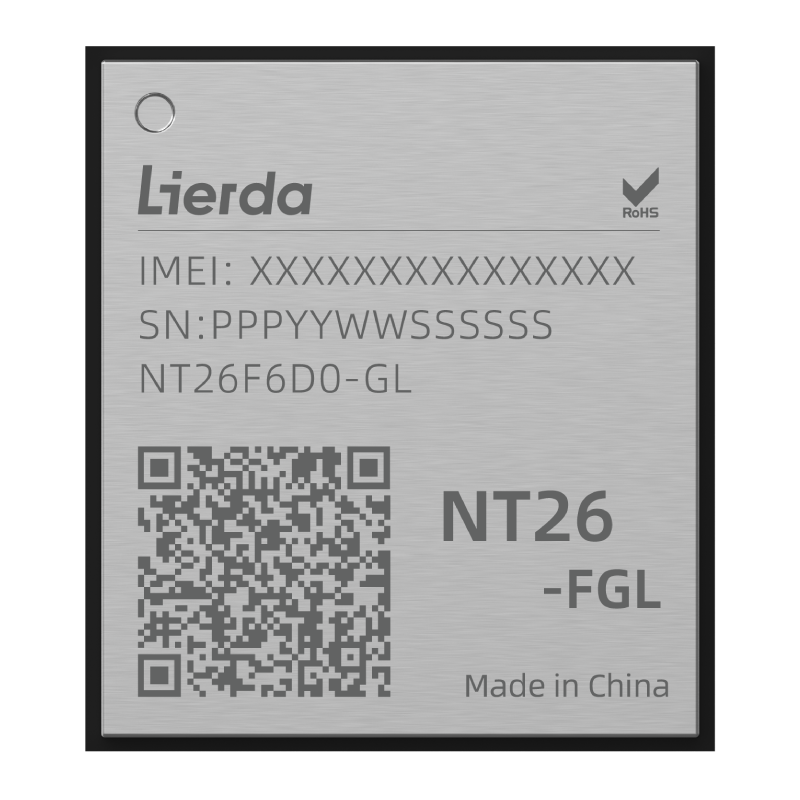
NT26-FGL Cat 1 bis LTE module: LGA packaging, 17.7 × 15.8 × 2.4 mm, multi-region band coverage, 3.3–4.5 V supply.
LPWAN: NB-IoT, LoRaWAN, LoRaMesh and Sigfox
On the low-power wide-area side, the NB81-A covers bands B03, B05 and B08 with a 2.1–4.5 V supply and 1.5 µA PSM current; the MB26-AGL extends coverage to B03, B05, B08, B20 and B28 with a 2.2–4.5 V range and the same 1.5 µA PSM figure. For LoRaWAN, the WB25 and WB26 node modules operate in Class A or Class C, support global frequency bands per the Alliance standard, and measure 22 × 18 × 3.0 mm; the WB25 quotes −137 dBm sensitivity at SF12/BW125 kHz, 22 dBm transmit power and 2 µA sleep current. The LP26 high-power node raises transmit power to 29 dBm with 600 mA transmit current and a sleep current of at most 2 µA, on a 3.6–5.2 V supply. The WB28 adds LoRaMesh self-organising networking at 868–930 MHz with 22 dBm transmit and −124 dBm sensitivity at SF7/BW125, rated −40°C to +85°C. The WB16 is a Sigfox module in the 868–870 MHz RC1 band, Sigfox Verified RC1, measuring 22 × 18 × 2.7 mm.
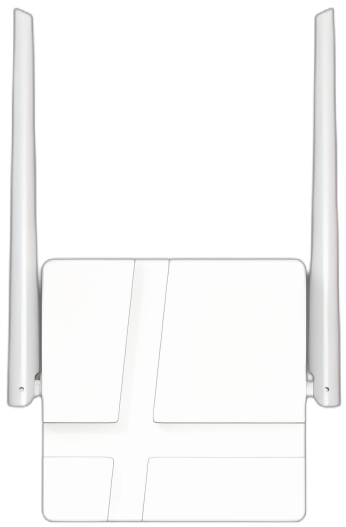
IG41 LoRaWAN indoor gateway: SX1302 platform, up to 20 nodes, 115 × 115 × 22.5 mm, IP30. The outdoor counterpart OG45 is rated IP67 and supports up to 2000 nodes.
Short range and compute
For local connectivity, the WF29A is a dual-band Wi-Fi 6 module with 512 KB RAM, 4 MB flash and a −40°C to +105°C range; WF39B is a second dual-band Wi-Fi 6 option. BT18N0 is a Bluetooth 6.0 module based on a Nordic chip, supporting one-master-four-slave operation, an application-layer rate of 110 KB/s and a −40°C to +105°C range, while BT18N5 is a multi-protocol module. At the compute layer, the IC610 industrial core module packages an ST STM32MP25x with Cortex-A35 and Cortex-M33 cores, 1 GB or 2 GB DDR4, 8 GB or 32 GB eMMC and Linux 6.1 into 37 × 39 × 2.8 mm, rated −40°C to +85°C.
Read as a roadmap signal, this breadth matters in one specific way: a consumer electronics buyer designing a product family that spans a mains-powered gateway, a battery meter and a wearable can keep a single module qualification process for longer. It does not remove the need to qualify each module individually.
Dimension 4 — Manufacturing and Supply Consistency
Lierda operates an 18,000 m² manufacturing facility with approximately 976 employees and reports annual output of 2,431,802,095.91 CNY. The company offers IoT module OEM, ODM and EMS services alongside its own module lines, and states that its EMS division provides OEM/ODM electronics manufacturing solutions.
Two contextual facts should shape how a buyer weights this. First, export accounts for 8.46% of the business, with named main markets of Europe, East Asia, Southeast Asia and the Middle East — meaning the centre of gravity remains the domestic Chinese market, and international buyers should verify local support depth rather than assume it. Second, the EMS/OEM/ODM capability is a stated service offering; it is not accompanied in public sources by capacity, utilisation, yield, MOQ or lead-time figures. Those belong on the RFQ, not in the assumption set.
Dimension 5 — Support Responsiveness and Industry Solutions
Support is the dimension that is hardest to score before a contract and easiest to regret afterwards. Lierda states that it has established more than 20 service centres and provides industry consultation, application support, embedded software customisation, supply chain management, ODM and OEM services. For a consumer electronics buyer, embedded software customisation is the operationally significant item: it determines whether driver-level or protocol-stack adjustments happen at the supplier or land on the buyer’s own firmware team.
Where the Portfolio Fits in Consumer Electronics Applications
Lierda’s published application scenarios cluster into recognisable consumer and light-industrial categories:
- Smart metering — remote meter reading for electricity, gas and water, operating 24/7 across −40°C to +85°C, with deployments cited in Germany, the United Kingdom, France and Vietnam. Smart water meter adaptors add IP68 waterproofing and anti-tampering requirements.
- Payment terminals — POS, payment sound boxes and 4G terminals operating 24/7, cited in France, Vietnam, Germany and the United Kingdom.
- Vehicle and asset tracking — car black box projects operating at −40°C to +85°C with vibration resistance, and motorbike or e-bike trackers requiring shockproofing and low power consumption.
- Smart home — air purifiers and humidifiers using low-power periodic wake-up with Wi-Fi or Bluetooth connectivity, cited in Vietnam and South Korea.
- Smart agriculture — rice-field water-level monitoring requiring dustproof and waterproof field operation in Vietnam.
- AI cameras — always-on 24/7 wireless communication and data transmission, cited in Vietnam.
The value of this list to a buyer is not that Lierda has done these projects; it is that the environmental requirements — wide temperature, ingress protection, vibration, 24/7 duty cycles — map onto the module ratings above without a stretch. Where a project falls outside these conditions, the buyer should expect to commission specific validation.
Reading the Market Signal Without Over-Reading It
Three data points frame the current window. Cellular IoT module shipments rose 10% in 2024, so the category is expanding again rather than consolidating. Cat 1 bis grew roughly 100% year over year in the same period, making it the technology most likely to absorb devices migrating off 2G and 3G. And module revenue reached US$5.6 billion in 2025 with 19% growth, which indicates that average selling prices are holding better than unit growth alone would suggest.
The regulatory overlay is equally material. The EU RED cybersecurity requirement took effect on 1 August 2025, converting security from a design preference into a market-access condition. A buyer whose roadmap includes European consumer devices should now treat cybersecurity documentation as a scored line item, not an afterthought.
How This Evaluation Differs from Traditional Sourcing
Traditional sourcing evaluates a module on three variables: unit price, lead time and whether the specification sheet matches the requirement. That works for a one-off purchase. It breaks down for a product family with a three-to-five-year life, because the binding constraints appear later — a chipset discontinuation, a certification renewal, a support escalation that takes three weeks instead of three days.
The scorecard approach reorders the questions. Instead of asking "what does this module cost," it asks "what evidence exists that this supplier can carry this module through its lifecycle, in the regions we sell into, at the volume we forecast." Price still matters; it simply moves from first question to final question, where it can be assessed against a qualified shortlist rather than an unqualified one.
Limits of This Evaluation
A credible scorecard must state its own boundaries. Applied to Lierda, four limits are material:
- Verified datasheet coverage is partial. Public evidence confirms package dimensions, supply voltages, band sets, transmit power, sensitivity and PSM current for several models, but does not provide a complete, independently validated comparison of RF performance, throughput, latency, lifecycle status or thermal behaviour across the full portfolio.
- Protocol support is not certification. The WB16 is described as Sigfox Verified RC1, and LoRaWAN regional plans are stated for the WB25 and WB26 families. Neither constitutes a country-specific regulatory approval. Certificate numbers, CE, FCC, UKCA, SRRC and carrier approvals should be obtained as documents, not inferred from catalogue text.
- Manufacturing evidence is unquantified. Facility size and headcount are published; capacity, utilisation, yield, quality certifications, MOQ and lead time are not. An EMS or OEM/ODM claim without audit evidence cannot support a procurement approval on its own.
- Scale and regional balance are asymmetric. Lierda holds a 5% share of 2024 cellular IoT module shipments against 37% for the leading supplier, and derives 8.46% of business from exports. Both facts are manageable in a well-structured agreement, but they argue for explicit capacity commitments and verified regional support rather than assumed coverage.
What to Watch Next
Three developments will determine whether this supplier profile strengthens or weakens over the next planning cycle. The first is whether Cat 1 bis growth continues at the pace seen in 2024, since that is the technology where Lierda’s NT26 family is most directly positioned. The second is how quickly RedCap moves from fixed wireless access into mainstream consumer devices, which would raise the strategic value of the NR90-HEA platform. The third is regulatory: as cybersecurity requirements spread beyond the EU, the suppliers that invested early in compliance documentation will be easier to qualify and therefore easier to keep.
For buyers currently at the research stage, the practical next step is not to choose a supplier but to issue the same evidence request to every candidate on the shortlist — datasheets, certificate numbers by jurisdiction, capacity and lead-time commitments, end-of-life policy and support escalation terms. The scorecard above is only as good as the documents that come back.
Frequently Asked Questions
What does an IoT module supplier evaluation actually cover?
It covers five dimensions: technical R&D depth, market position by shipment volume, portfolio breadth and roadmap continuity, manufacturing and supply consistency, and support responsiveness including application engineering and customisation. The purpose is to assess whether a supplier can sustain a module through a multi-year product lifecycle across the regions where the device will be sold, rather than whether a single part number meets a specification.
Who are the largest cellular IoT module suppliers by shipment share?
In 2024, Counterpoint Research estimated global cellular IoT module shipments at Quectel 37%, China Mobile 9%, Fibocom 7%, Sunsea 6% and Lierda 5%. Those five account for the documented top of the ranking. Other frequently shortlisted suppliers, including u-blox, Telit and Thales, do not appear in this dataset with comparable third-party shipment shares and should be assessed with the buyer’s own collected evidence.
Which module families should a consumer electronics buyer check in a supplier portfolio?
At minimum, the buyer should map the portfolio against the device’s power source, duty cycle and data profile. Cellular families such as 5G RedCap and Cat 1 bis suit mains-powered devices with continuous or high-frequency uplink; NB-IoT suits battery meters and sensors needing multi-year life at very low current; LoRaWAN, LoRaMesh and Sigfox suit long-range, low-throughput deployments where the buyer controls or shares the network; Wi-Fi 6 and Bluetooth cover local connectivity and commissioning. Lierda’s catalogue spans all of these, including the NR90-HEA, NT26 series, MB26 and NB81, WB25, WB26, LP26, WB28, WB16, WF29A, WF39B, BT18N5, BT18N0 and the IC610 industrial SOM.
What compliance evidence should a buyer request before committing?
Buyers should request certificate numbers and issuing jurisdictions for each target market, not statements of protocol support. LoRaWAN regional plan support, as stated for the WB25 and WB26, confirms protocol capability but not regulatory approval; Sigfox Verified RC1 for the WB16 is a certification status specific to that ecosystem. With the EU RED cybersecurity requirements effective from 1 August 2025, buyers selling into Europe should additionally request the cybersecurity documentation that supports the conformity assessment, and should confirm which entity holds each certificate.
How can buyers test manufacturing capacity and supply continuity before awarding a contract?
The verifiable starting points are facility scale and headcount — for Lierda, an 18,000 m² facility with approximately 976 employees and stated OEM, ODM and EMS service lines. Beyond that, buyers should require a capacity allocation letter tied to forecast volume, quoted lead times per model, MOQ per part number, quality certification copies, and a documented second-source or last-time-buy path for any module approaching end of life. Where a supplier states an EMS capability, a factory audit is the appropriate validation step before that capability is scored.
What are the limits of a portfolio-based supplier evaluation?
Portfolio breadth shows what a supplier can offer; it does not show how well any individual module performs under a specific condition, nor does it guarantee regional support depth or lifecycle continuity. A broad catalogue can also obscure concentration risk if several product lines depend on the same chipset platform. Evaluation should therefore pair the portfolio view with model-level validation, region-specific compliance documents and commercially binding supply terms, and should be repeated when a platform generation changes.
Lierda’s corporate brochure, covering company background, product lines and service capabilities, is available for download: Lierda corporate brochure (PDF).
Tem questões ou precisa de mais detalhes?
Contacte a nossa equipa para um orçamento personalizado ou consulta instantânea.
Solicitar orçamento
Preencha o formulário abaixo e a nossa equipa entrará em contacto com uma proposta personalizada.
Chat direto do WhatsApp
Prefere conversar em tempo real? Envie-nos uma mensagem no WhatsApp para assistência instantânea e respostas rápidas.
- Obter orçamento personalizado
- Partilhar fotos ou documentos
- Discuta as suas necessidades diretamente
Geralmente responde em 5–30 minutos durante o horário de expediente.