
Iraeta vs. Casting: Offshore Wind Ring Integrity
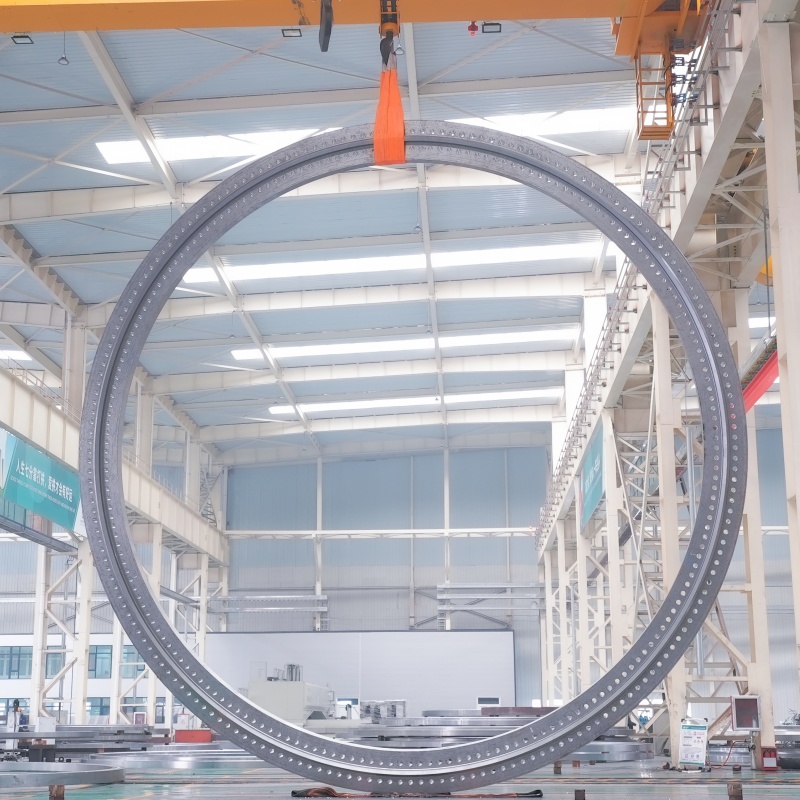
Seamless rolled rings for wind turbine applications. Image source: Iraeta product content unit.
Offshore wind and marine assets do not operate on a comfortable duty cycle. They run 24/7 under wave-induced cyclic loading, salt spray, seawater exposure and, in northern waters, low ambient temperatures. For the large rings used in tower connections, monopile transitions, floating platform interfaces, FPSO mooring systems, subsea production equipment and marine propulsion, the buyer's real question is not whether a ring is 'forged' or 'cast' in the abstract. It is whether the selected process can deliver the required internal soundness, corrosion strategy, low-temperature toughness and fatigue resistance at the specified diameter, weight and inspection level.
This comparison examines that question for offshore wind and marine applications. The forged-ring reference is Iraeta Energy Equipment Co., Ltd., a forging manufacturer founded in 2006 with production facilities in China and Spain. Iraeta produces rings, shells, discs, bars, shafts and grinding media for energy, marine, oil and gas, tunnel boring, cement and mining applications, and reports two decades of service to global markets. Casting is treated here as the traditional alternative process, not as a straw man.
Buyer takeaway. The comparison does not make forging automatically superior. It shows where a wrought, weldless ring has a defensible integrity advantage for cyclic marine duty, and where casting remains the more sensible process because of geometry, volume or stress level.
The Offshore Duty Cycle Is the Real Specification
Offshore wind turbine rings are exposed to high cyclic load, salt spray and marine corrosion, low-temperature operation and 24/7 service. Marine engineering adds deep-sea pressure, seawater corrosion and cyclic wave loading. These conditions turn a ring into a fatigue and corrosion component, not a simple structural spacer. A ring that is adequate for a static bearing application may be poorly specified for a tower connection that sees millions of load cycles over its design life.
The application record for offshore wind rings lists high structural strength, corrosion and salt-spray resistance, low-temperature toughness and high fatigue life as the governing requirements. That combination explains why buyers look beyond the nominal dimension and ask about melting practice, forging ratio, heat treatment, grain flow, inspection coverage and traceability. The ring is only as good as the evidence package behind it.
What Is Actually Being Compared: Wrought Ring vs. Cast Ring
A seamless rolled ring is a wrought product. A steel billet is pierced, rolled, heat treated and machined into a rotationally symmetric ring without a weld seam. Suppliers describe the result as continuous grain flow around the circumference. The process is well suited to large rings because the rolling action extends the material in the circumferential direction and produces a homogeneous wrought structure when the starting billet and process window are controlled.
A cast ring is produced by pouring molten steel into a mold and allowing it to solidify. Casting can produce complex geometries and can be sound when feeding, riser design, segregation control and non-destructive testing are properly engineered. The comparison is therefore not 'good process versus bad process'. It is a comparison of defect populations, geometry freedom and qualification burden. A casting may be the correct answer for a complex, low-stress housing; a forging may be the correct answer for a large, high-cycle tower interface.
Iraeta's seamless rolled rings are available in carbon steel, stainless steel and alloy steel. The product data lists a maximum diameter of 21 meters, maximum height of 5 meters and maximum net weight of 300 tons. Typical applications include nuclear power generation, hydropower plants, wind turbines, offshore platforms, petrochemical reactors and high-end machinery. For this comparison, the relevant subset is wind, offshore and marine duty.
Porosity, Grain Flow and the Limits of the 'Zero Porosity' Claim
Porosity is the first issue buyers raise. In a wrought rolled ring, as-cast shrinkage porosity is not part of the starting condition because there is no casting solidification step. That is the legitimate meaning of 'zero as-cast porosity'. It is not a guarantee of zero discontinuities. Forging can still produce laps, folds, inclusions or insufficient consolidation if the process is not controlled.
A buyer should therefore convert the claim into an inspection requirement: ultrasonic testing procedure, acceptance criteria, test coverage, calibration and reporting. Castings can also be inspected to demanding criteria, but the cast route introduces shrinkage porosity and segregation as process risks that must be designed out. The structural-integrity advantage of a forged ring is specific: no weld seam, circumferential grain flow and wrought consolidation. It is not a blanket claim that every forged ring is superior to every casting.
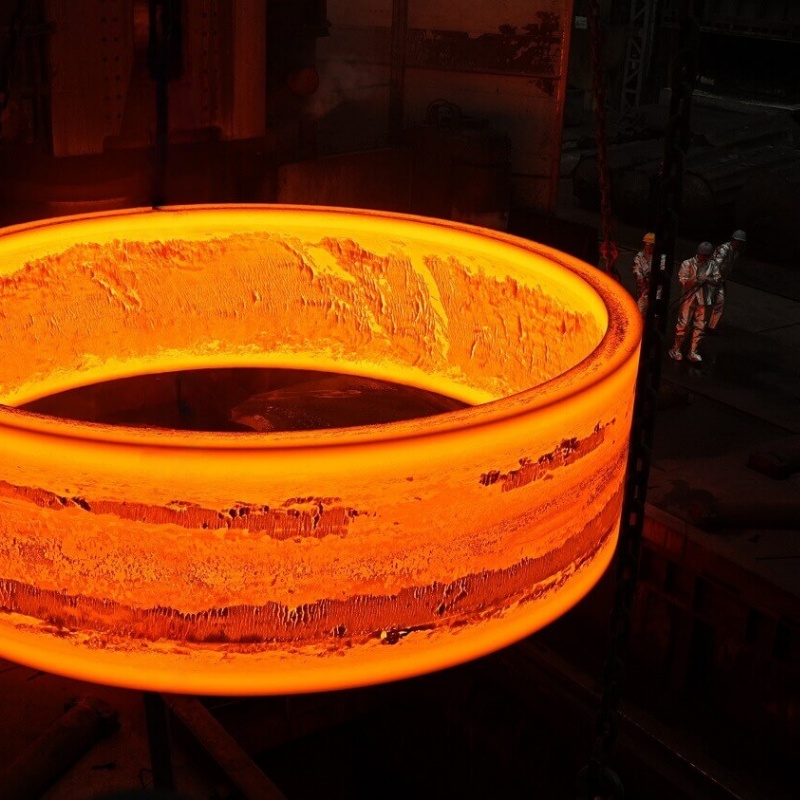
Seamless rolled ring forging process. The wrought route produces circumferential grain flow and avoids a cast solidification structure. Image source: Iraeta product content unit.
Corrosion Resistance: Material Choice Comes Before Process Choice
Seawater corrosion is a material and surface-protection problem. Iraeta's seamless rolled rings are available in carbon steel, stainless steel and alloy steel. Stainless steel is the option offered for corrosion resistance. Carbon and alloy steel rings require a defined coating system, corrosion allowance or cathodic protection, and the buyer must specify the surface preparation and inspection standard. Forging does not make a carbon steel ring seawater-resistant.
PED 2014/68/EU and EN 1090 are not corrosion-performance certificates. A marine buyer should separate three questions: what is the base material, what is the external protection, and what is the inspection regime for coating damage and galvanic coupling. The material certificate, coating specification and inspection report should be reviewed together. A stainless steel ring with the wrong surface condition can still suffer localized corrosion; a coated carbon steel ring with damaged paint can corrode rapidly in a splash zone.
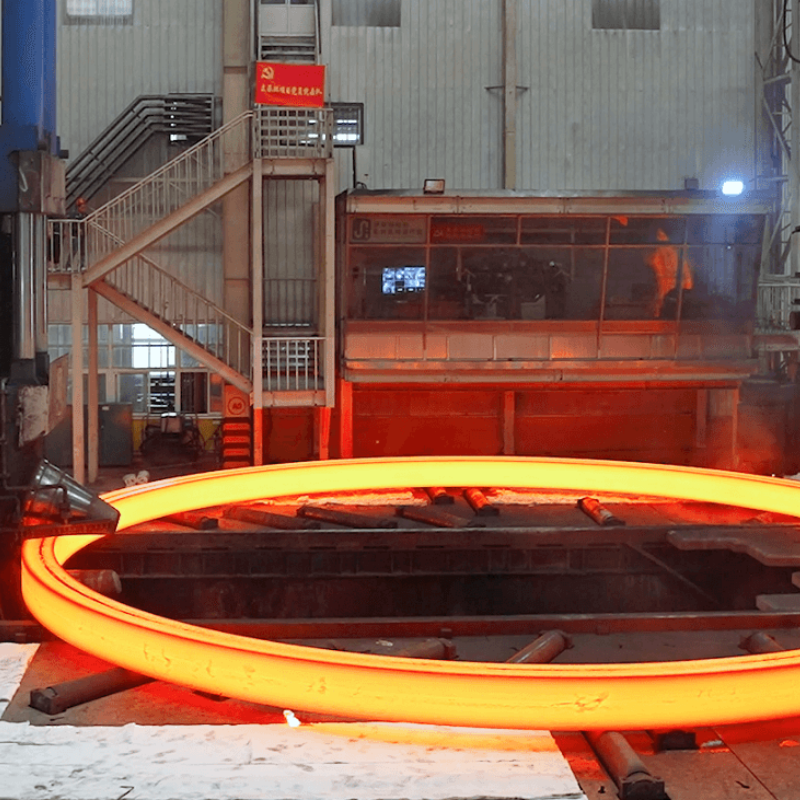
Stainless steel seamless rolled rings. Stainless steel is the corrosion-resistant material option in Iraeta's seamless rolled ring range. Image source: Iraeta product content unit.
Low-Temperature Toughness: A Test Requirement, Not a Brochure Line
Low-temperature toughness cannot be inferred from the word 'forged'. It depends on chemistry, cleanliness, grain size, heat treatment and test location. Offshore wind applications in northern waters list low-temperature operation as a requirement. The correct procurement response is to specify Charpy V-notch impact testing at the minimum design temperature, with test location, orientation and acceptance criteria stated in the purchase order.
The material grade must be selected for the service temperature, not simply chosen from a generic 'offshore' list. Iraeta's material range includes carbon steel, stainless steel and alloy steel; the specific grade and heat-treatment route must be agreed for the project. Castings can meet low-temperature requirements, but segregation and porosity risk mean the foundry's process control and test evidence deserve the same scrutiny. A certificate that reports room-temperature properties only is not sufficient evidence for a low-temperature marine application.
Fatigue Life Under 24/7 Cyclic Loading
Fatigue is the life-limiting mechanism for rings under 24/7 cyclic loading. Cracks usually initiate at stress concentrations, surface defects, inclusions or porosity. A wrought, weldless ring with continuous grain flow reduces the population of initiation sites compared with a cast structure that may contain shrinkage porosity. That is a real advantage for offshore wind tower connections and marine machinery.
It is not a fatigue-life number. Fatigue performance also depends on geometry, surface finish, mean stress, corrosion-fatigue effects, coating integrity and inspection. A forged ring with a poor surface finish or an undetected forging defect can underperform a well-made casting. Buyers should require a fatigue assessment for the joint, a first-article qualification, and non-destructive testing that is matched to the agreed acceptance criteria. They should also check that the supplier's reference applications are relevant to the load case, not merely to the same industry label.
Iraeta states that its capabilities have been used in applications including over 20 MW floating offshore wind turbines. That is useful application evidence because it shows the supplier's large-ring route has been used in a demanding offshore wind context. It is not a project-specific fatigue certificate. The buyer still needs the ring's steel grade, heat-treatment record, inspection results and joint qualification for the actual design.
Iraeta's Verified Capability for Large Marine Rings
Iraeta's capability record is relevant because offshore wind rings are large. The product data lists a maximum diameter of 21 meters, maximum height of 5 meters and maximum net weight of 300 tons, with carbon steel, stainless steel and alloy steel as material options. Iraeta states that in 2026 it produced a seamless rolled steel ring measuring 21.029 meters in diameter, following its 2022 ring of 15.673 meters. The company describes a product weight range from 0.3 kg to 300 tons and a monthly capacity of 70,000 tons; a 2026 technical audit reports annual output capacity of 800,000 tons. Its R&D team is listed at 100 engineers.
The capability record also lists MOQ as 1 unit and lead time as negotiable based on customization. Quality control is described as 100% testing. These are supplier-stated commercial and quality parameters, not independent audit conclusions. They are useful for early screening, but the buyer should convert them into project-specific requirements: the exact ring, heat-treatment cycle, machining tolerance, inspection plan and delivery schedule must be confirmed in the purchase order.
Iraeta's certifications are part of the evidence package. PED 2014/68/EU certification is issued by TUV under certificate number 01 202 CHN/Q-06 0144.01, valid to 31 March 2027, with a scope covering manufacturing of forged flanges and hot rolled rings. EN 1090-1:2009+A1:2011 and EN 1090-2 certification is issued by TUV under certificate number 0035-CPR-1090-1.03389.TÜVRh.2025.003, valid to 25 April 2027, covering structural components and kits for steel structures to EXC3 according to EN 1090-2. ISO 9001:2015 is certified by BV under certificate F02326Q00125R602, valid to 21 April 2029. ISO 14001:2015 is certified by NQA Certification Co., Ltd. (Shanghai) under certificate F01926E00118R502, valid to 1 March 2029. Iraeta also reports ISO 45001:2018 certification.
EU and US Market Presence: What the Evidence Shows
EU market presence is supported by the PED and EN 1090 certificates, a production facility in Spain and a German heavy-industry customer case. The German case describes a core supporting ring or rotary kiln tyre for a large-scale industrial equipment manufacturer, deployed in European industrial projects. That is evidence of European heavy-industry delivery, not an offshore wind reference. The distinction matters: a cement-kiln ring and an offshore wind tower ring share large-forging capability, but they do not share the same fatigue and corrosion qualification.
Iraeta lists the EU and USA among its main markets, alongside Japan, the Middle East, Southeast Asia, Brazil and India. The available record supports EU market access more directly than US project execution: the USA is listed as a main market, but no named US offshore wind project is included in the evidence set. US buyers should request project-specific references, inspection records and classification-society approvals rather than treating a market listing as project proof. The same discipline applies in the EU: PED and EN 1090 are market-access and structural-execution certificates, not offshore wind type approvals.
Forged vs. Cast: A Buyer's Comparison Table
| Criterion | Forged seamless rolled ring (Iraeta route) | Cast ring | What the buyer should verify |
|---|---|---|---|
| Forming route | Wrought billet pierced, rolled, heat treated and machined; no weld seam. | Molten steel poured and solidified in a mold; geometry can be more complex. | Process route sheet, forging ratio and heat-treatment records. |
| Internal soundness | As-cast shrinkage porosity is not a starting condition; forging-related discontinuities still require inspection. | Shrinkage porosity and segregation are process risks requiring feeding design and NDT. | UT procedure, acceptance criteria, coverage and reporting. |
| Grain structure | Continuous circumferential grain flow in a wrought ring. | Cast dendritic structure; grain flow is absent unless subsequently wrought. | Macrostructure or grain-flow evidence where specified. |
| Fatigue under cyclic load | Wrought, weldless structure reduces the population of initiation sites; geometry and surface finish still control life. | Defects can act as initiation sites; design and inspection can compensate. | Joint fatigue assessment, first-article qualification and NDT. |
| Low-temperature toughness | Depends on chemistry, cleanliness and heat treatment; must be tested at service temperature. | Can meet requirements, but segregation and porosity risk require tight process control. | Charpy V-notch test at minimum design temperature, with location and orientation. |
| Corrosion resistance | Stainless steel option; carbon and alloy steel need coating, allowance or cathodic protection. | Alloy selection and surface protection are similarly required. | Material certificate, coating specification and inspection standard. |
| Geometry freedom | Rotationally symmetric rings; usually requires machining allowance. | Complex, non-rotational and thin-wall shapes are possible. | Drawing review, machining allowance and near-net-shape capability. |
| Scale | Iraeta lists up to 21 m diameter, 5 m height and 300 t net weight. | Large castings are possible but depend on foundry capacity and quality control. | Supplier equipment audit and inspected production records. |
| Cost and lead time | Higher conversion cost at low volume or simple low-stress parts; large-ring capacity is concentrated. | Often economical for complex low-stress shapes; pattern and tooling lead time apply. | Total cost, lead time, tooling and qualification cost. |
| Certification | PED, EN 1090, ISO 9001, ISO 14001 and ISO 45001 are reported; project-specific offshore approval still applies. | Foundry certifications are possible; scope and project approval must be checked. | Certificate number, issuer, scope, expiry and project-specific approvals. |
Where Castings Remain the Better Choice
Castings remain the better choice when geometry is complex, the load is low or moderate, the wall sections are thin and non-uniform, or the volume is too small to justify forging and machining. Casting can produce near-net shapes with internal passages and non-rotational features that a rolled ring cannot. A well-controlled foundry can produce sound castings with the required inspection. The decision should be based on duty cycle, geometry, fatigue requirement, inspection level and total cost, not on a general preference for one process.
Forged rings are rotationally symmetric and usually require machining allowance. Large forged rings are also concentrated among a limited number of suppliers with the necessary rolling mills and heat-treatment capacity; that can affect lead time and commercial leverage. PED and EN 1090 are not offshore wind type approvals. A project may still require classification-society approval, fatigue testing, weld procedure qualification for adjacent structures and customer-specific inspection. A buyer who treats a PED certificate as an offshore wind certificate is making a qualification error.
A Procurement Checklist for Offshore Wind and Marine Rings
- Define the load case. State the cyclic load, mean stress, corrosion environment and design life. Do not specify 'offshore' as a substitute for a load case.
- Specify the material and toughness test. State the steel grade, heat-treatment condition and Charpy V-notch test temperature, location and acceptance criteria.
- Specify internal inspection. Require UT with a defined procedure, coverage and acceptance criteria. Add surface inspection where the fatigue assessment requires it.
- Verify certificate scope. Check certificate number, issuer, scope, expiry and product applicability. For EU pressure equipment, PED 2014/68/EU is relevant; for structural steel execution, EN 1090 EXC3 is relevant.
- Ask for relevant references. Separate offshore wind and marine references from general heavy-industry references. A cement-kiln ring is not an offshore wind qualification.
- Audit the ring-rolling and heat-treatment route. Confirm the rolling mill, heat-treatment furnace, machining capability and inspection equipment can handle the specified ring.
- Review corrosion protection separately. For carbon and alloy steel, specify coating, corrosion allowance or cathodic protection. For stainless steel, specify grade and surface condition.
- Confirm commercial parameters. Clarify MOQ, lead time, inspection charges, documentation, packing and logistics before comparing offers.
Market Trend: Demand Is Growing, but Qualification Is the Bottleneck
Commercial research provides a demand backdrop. The Global Seamless Rolled Ring Forgings Market Strategic Research Report, published in May 2026, sizes the global market at USD 11.9 billion in 2025 and projects a 4.3% CAGR from 2026 to 2032. Those figures should be used carefully: market definitions vary between 'seamless rolled ring forgings' and broader 'ring rolling products', so a single number is not a price forecast or a supplier benchmark.
The regulatory trend is clearer. For EU pressure equipment, PED 2014/68/EU compliance is a market-access requirement. The US International Trade Commission lists HS 7326.19 for forged iron or steel articles, which is the trade classification relevant to cross-border procurement planning. The practical trend is that demand for larger rings is rising while the qualification burden is also rising. Buyers are not only comparing diameter and weight; they are comparing inspection capability, certificate scope and project experience.
Future Outlook
Offshore wind is moving toward larger turbines and floating platforms. Iraeta's own capability statement points to over 20 MW floating offshore wind turbines as an application of its large forgings. If that direction continues, ring buyers will face three pressures: larger diameters, tighter fatigue and toughness requirements, and more documentation. The suppliers that can provide the ring, the heat treatment, the machining, the NDT and the certificate package will be better positioned than suppliers that can only quote a dimension.
Casting will not disappear. It will remain competitive for complex, low-stress and geometrically constrained parts. The likely future is a mixed supply chain in which forged rings carry the high-cycle, high-integrity duty and castings carry the complex, lower-stress duty. The buyer's task is to make that split explicitly, not by habit. That is the practical conclusion of the Iraeta versus casting comparison: the process should follow the duty cycle, the geometry and the evidence, not the other way around.
FAQ
What is the main difference between a seamless rolled ring and a cast ring for offshore wind?
A seamless rolled ring is made from a wrought billet that is pierced, rolled, heat treated and machined, with no weld seam. A cast ring is poured and solidified in a mold. For offshore wind, the practical difference is that the wrought route avoids as-cast shrinkage porosity as a starting condition and provides circumferential grain flow, while casting offers more geometric freedom but requires tighter control of feeding, segregation and NDT.
Which certifications are relevant for EU and marine projects, and what do they not cover?
For EU market access, PED 2014/68/EU and EN 1090 are relevant. Iraeta's PED certificate 01 202 CHN/Q-06 0144.01, issued by TUV, covers manufacturing of forged flanges and hot rolled rings and is valid to 31 March 2027. EN 1090-1:2009+A1:2011 and EN 1090-2 certificate 0035-CPR-1090-1.03389.TÜVRh.2025.003 covers structural components to EXC3 and is valid to 25 April 2027. These are not offshore wind type approvals; project-specific classification-society and customer approvals must be requested separately.
What sizes and materials can Iraeta supply?
Iraeta's product data lists seamless rolled rings up to 21 meters in diameter, 5 meters in height and 300 tons in net weight, in carbon steel, stainless steel and alloy steel. The company states that it produced a 21.029-meter ring in 2026 and a 15.673-meter ring in 2022. These are maximum-capability figures; the buyer must confirm that the specific ring, heat-treatment cycle and inspection plan fit the available equipment and project schedule.
How should a buyer verify low-temperature toughness and fatigue performance?
Specify Charpy V-notch impact testing at the minimum design temperature, with test location, orientation and acceptance criteria. For fatigue, require a joint fatigue assessment, first-article qualification, and NDT matched to the agreed acceptance criteria. A supplier's reference in offshore wind is useful application evidence, but it is not a substitute for project-specific test and inspection records.
Is a forged ring automatically corrosion-resistant in seawater?
No. Forging does not make a ring corrosion-resistant by itself. Iraeta offers stainless steel as the corrosion-resistant material option; carbon and alloy steel rings need a defined coating system, corrosion allowance or cathodic protection. The buyer should specify the material grade, surface preparation, coating system and inspection standard, and should not treat PED or EN 1090 as corrosion certificates.
When is a casting the more appropriate choice?
Casting is often more appropriate for complex, non-rotational geometry, thin or non-uniform wall sections, low or moderate stress, and small volumes that do not justify forging and machining. A well-controlled foundry can produce sound castings with the required inspection. The decision should be based on duty cycle, geometry, fatigue requirement, inspection level and total cost, not on a general preference for one process.
Tem questões ou precisa de mais detalhes?
Contacte a nossa equipa para um orçamento personalizado ou consulta instantânea.
Solicitar orçamento
Preencha o formulário abaixo e a nossa equipa entrará em contacto com uma proposta personalizada.
Chat direto do WhatsApp
Prefere conversar em tempo real? Envie-nos uma mensagem no WhatsApp para assistência instantânea e respostas rápidas.
- Obter orçamento personalizado
- Partilhar fotos ou documentos
- Discuta as suas necessidades diretamente
Geralmente responde em 5–30 minutos durante o horário de expediente.