
Is a 1989-Established Manufacturer a Stable Ceramic Grinding Wheel Partner?
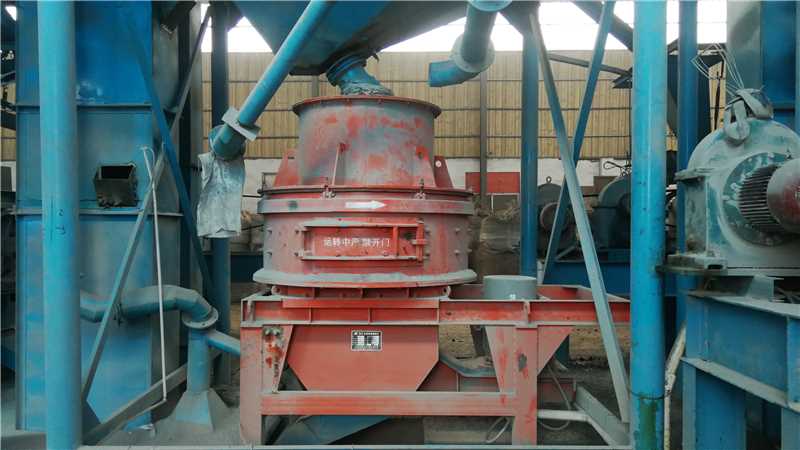
Ceramic grinding wheel programmes rarely fail because the abrasive was wrong on day one. They fail because the wheel qualified in year one is not the same wheel — or not the same supplier — in year four. Supplier continuity in the bonded abrasive category is the ability of a manufacturer to keep delivering a qualified specification at a predictable lead time across multiple order cycles, while maintaining the capacity and documentation that made the first delivery acceptable.
The practical problem is that continuity cannot be inspected directly. Buyers therefore rely on proxies: how long the company has operated, what it owns, where it sits in a logistics network, which markets it already serves, and what paperwork it can produce on demand. This article examines one of those proxies — company tenure, using a 1989 establishment date as the test case — against the concrete fact set of Shandong Xinfa Abrasives & Grinding Tools Co., Ltd., a manufacturer of vitrified bond (ceramic) grinding wheels based in Junan County, Linyi City, Shandong Province, China, whose official site is xinfa-abrasives.com.
The short answer is that tenure on its own proves very little. What makes tenure usable is the infrastructure, logistics position, certification status and export process that sit behind it — and those can be checked, item by item, before a contract is signed.
The Continuity Risks a Long-Term Wheel Contract Is Actually Managing
Before evaluating any signal, it helps to be precise about the failure modes. In bonded abrasives, continuity risk appears in five recognisable forms, and each one has a different verification path.
| Continuity risk | How it appears in practice | What a buyer can verify |
|---|---|---|
| Specification drift | Grain, grade, hardness or bond changes between lots, altering dressing behaviour and cycle time | Lot-level inspection records, retained samples, defined specification fields in the purchase agreement |
| Capacity reallocation | Lead times stretch when larger or domestic accounts absorb output | Stated monthly and annual capacity, agreed rolling volume plan, contractual lead-time windows |
| Documentation lapse | Certificates expire or market-specific papers are missing at shipment | Certificate number, scope and expiry date; acceptance criteria such as pre-shipment inspection |
| Logistics disruption | Port congestion, missed cut-offs, container and carrier allocation | Which port is used, road distance to port, chosen Incoterm, loading window |
| Commercial discontinuity | Ownership, funding or management change at the supplier | Registered entity details, contract-performance record, customer references |
Company age speaks mainly to the first, second and fifth of these. It says nothing about certificate expiry, and nothing about how a supplier behaves in peak season. That is why tenure should be treated as an entry screen rather than a conclusion.
What an Establishment Date of 1989 Actually Measures
A manufacturing start date records survival. A company established in 1989 has, by definition, operated through multiple demand cycles, raw material price swings and export-market shifts, and has accumulated process knowledge that cannot be bought quickly. For a buyer, that history is worth something — but only when it is attached to assets that can still be inspected today.
Shandong Xinfa Abrasives & Grinding Tools Co., Ltd. was established in 1989 and manufactures vitrified bond grinding wheels from a facility of 30,000 m² with 120 employees. The company reports an annual production capacity of 10,000 tons, more than 100 sets of advanced production and testing equipment, and a research and development team of 6 engineers; its technology research and development centre was listed as a municipal-level enterprise technology R&D centre in 2015. It is a member of the China Abrasives Association and has been awarded a municipal “Honoring Unit” title for good credit in contract performance.
Read as continuity evidence rather than as marketing, those items carry specific weight:
- Owned plant area and equipment base. A 30,000 m² facility with more than 100 sets of production and testing equipment indicates that forming, firing and inspection happen under the manufacturer’s own control rather than through third-party processing. Specification stability across a multi-year contract depends on exactly that.
- An internal R&D function. A municipal-level R&D centre listing plus 6 engineers means non-standard development work stays inside the same quality system as routine production, which matters when a buyer needs a custom size, bond type or abrasive material.
- Association membership. Membership of the China Abrasives Association is an industry-body affiliation. It signals participation in the domestic industry structure; it is not a product performance certification and should not be read as one.
- Contract-performance recognition. The municipal “Honoring Unit” title relates to credit in contract performance. It is administrative recognition at municipal level, useful as a screening signal, not a substitute for trade references.
Boundary condition. The plant size, headcount, capacity and recognition listed above are reported by the manufacturer. They are a legitimate starting point for supplier screening, but they become decision-grade only after documentary verification and, ideally, a factory visit.
Location and Logistics: 180 km from Qingdao, 60 km from Rizhao
Delivery reliability is often decided before the wheel ever reaches the container. Shandong Xinfa is located in the National Logistics Center of Linyi City, approximately 180 km from Qingdao Port and 60 km from Rizhao Port. For an export buyer, the operational meaning of that position is straightforward: two major gateways are within short trucking distance, so export routing does not depend on a single port relationship.
In practice, buyers should convert this into three contractual details rather than a compliment:
- Named port and routing. Confirm which port the shipment will use for the destination market, and whether that choice can be switched if schedules tighten.
- Incoterm and loading window. The manufacturer’s stated delivery terms cover FOB, CIF and CNF. Which of the three applies changes who absorbs inland transport, terminal handling and sailing risk — so it should be written into the agreement, not assumed.
- Inspection timing. Pre-shipment inspection is the stated acceptance criterion in the manufacturer’s procurement terms. Inspection timing must be planned against the loading window, not after it.
The limitation is equally clear: proximity to a port reduces inland transit exposure, but it does not eliminate peak-season container shortages, carrier blank sailings or schedule changes. A long-term agreement should therefore still contain a delivery buffer rather than a single hard date.
Reading the 35% Export Ratio: Demand Diversity and Its Limits
Xinfa exports 35% of its sales. Its main markets span Asia — Southeast Asia including Vietnam, Thailand and Malaysia, plus India, South Korea, Japan and the Middle East including the United Arab Emirates, Saudi Arabia and Iran — as well as Europe and the Americas, including Europe, the United States and Brazil. Products are exported to more than 20 countries and regions.
For a buyer planning a multi-year contract, a 35% export share supported by both Asian and Western markets has two practical effects. First, the order book rests on two economic cycles rather than one, which reduces the risk that a slowdown in a single market leaves the lines that make your specification idle. Second, serving both regions means the supplier routinely works to different packaging, marking and documentation expectations — an advantage when your own market has specific requirements.
The limit is the other side of the same number. If 35% of sales are exported, then the majority of output serves domestic demand. Export volume competes for the same monthly capacity. Buyers negotiating volume commitments should therefore agree a rolling plan and ask how export allocation is protected when domestic demand peaks, rather than assuming that an export order will always be prioritised.
What a Long-Term Agreement Can Be Built On: OEM Capability and Frozen Specifications
Continuity is easier to guarantee when the supplier manufactures to order rather than to a fixed catalogue. Xinfa offers OEM and ODM production, with technical support covering customization of specification, size, logo, bond type and abrasive material. Quality control follows 100% testing standards, and remote after-sales support is available. Reported monthly capacity is 900 tons, with a lead time of 30–45 days.
Capacity and lead time belong in the contract as planning parameters. So do the technical fields that must not change between deliveries. Across the company’s ceramic bonded grinding wheel range, the following specification fields are published:
| Specification field | Published range |
|---|---|
| Bond type | Vitrified (ceramic) |
| Outside diameter | Up to 1100 mm |
| Thickness | 3–300 mm |
| Hole / bore | 12.7–305 mm |
| Abrasive material | A, WA, AA, 38A, PA, 25A, SA, MA, GC, C, RA, DA, 9A, 64A, 55A |
| Grit number | F16, F24, F30, F36, F46, F60, F80, F100, F120 |
| Hardness grade | G, H, J, K, L, M, N, P, Q, R, S, T, Y |
| Structure number | 0–14 |
| Maximum linear velocity | 20, 25, 32, 35, 40, 45, 50, 60, 70 m/s |
| Customization scope | Specification, size, logo, bond type, abrasive material |
Two external references explain why this level of detail is worth negotiating at the start rather than at the first dispute. ISO 603-14:2022 specifies the most common nominal dimensions for shape types 6, 11, 27, 28 and 29 of bonded abrasive products intended for deburring, fettling and snagging with hand-held grinding machines — meaning shape type and dimensions are standardised variables, not free-text descriptions. Published manufacturer documentation in the category follows the same discipline: a 3M Cubitron 3 depressed-centre grinding wheel technical data sheet, for example, identifies ISO Type 27 geometry, ceramic precision-shaped grain, nominal thicknesses of 6 mm and 7 mm, and conformity references including EN 12413 and ANSI B7.1.
The lesson for a long-term agreement is not brand-specific. A purchase specification that reads only “ceramic grinding wheel” cannot be enforced. One that states shape type, outside diameter, thickness, bore, abrasive material, grit, hardness grade, structure number, bond type and maximum operating speed can be.
Wheel Families Covered by a Single Supply Relationship
The value of consolidating a grinding programme with one established manufacturer depends on how much of the programme that manufacturer actually covers. Xinfa’s listed product range includes the following families:
- General-purpose and bench grinder wheels — routine workshop and maintenance consumption.
- Tool grinding wheels and saw tooth grinding wheels — toolroom and cutting-tool edge work.
- Flat surface grinding wheels — surface grinding operations.
- Centerless grinding wheels and cylindrical grinding wheels — continuous shaft, bar and tube grinding work.
- Crankshaft & camshaft grinding wheels, bearing grinding wheels, gear grinding wheels and worm grinding wheels — component grinding families within powertrain and transmission supply chains.
- Needle grinding wheels and roll grinding wheels V&B — small-diameter and large roll grinding formats.
- Internal (bore) grinding wheels — internal diameter grinding.
- Oilstone and segments — stone and segmented formats.
- Resin bonded snagging grinding wheels, rubber control & centerless products, flap discs and mounted points — complementary abrasive products listed alongside the vitrified range.
For buyers, the relevant point is that a single supplier relationship can cover a mixed wheel programme, which reduces the number of qualification projects to maintain. The relevant caution is that the company’s stated manufacturing specialisation is vitrified bond grinding wheels; buyers whose programme depends heavily on other bond systems should confirm coverage explicitly rather than inferring it from a product list.
Certification and Testing as Contract Instruments, Not Brochures
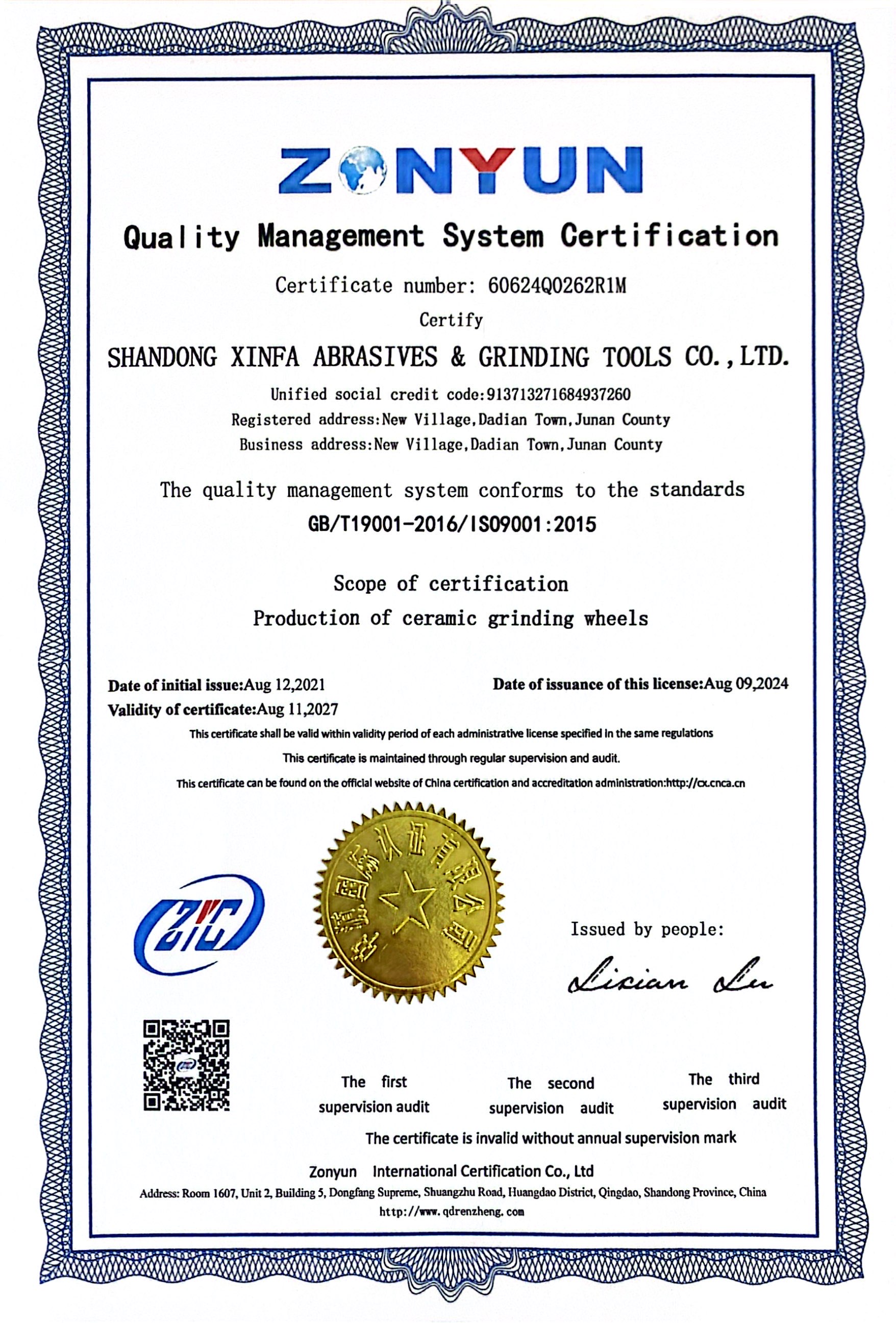
Certification is where continuity becomes contractual. Shandong Xinfa holds a Quality Management System Certification issued under certificate number 60624Q0262R1M by Zonyun International Certification Co., Ltd., against the GB/T19001-2016/ISO9001:2015 standard. The certified scope is the manufacture of abrasives and grinding wheels. The certificate was issued on 12 August 2021 and is valid until 11 August 2027.
Two implications follow directly from that date:
- A supply agreement that runs beyond 11 August 2027 should include an obligation to maintain certification, to notify the buyer of any suspension or withdrawal, and to provide the renewed certificate when issued.
- A management-system certificate confirms that a quality system exists and is audited. It does not certify wheel performance. Wheel performance is established by lot testing and by the buyer’s own trial.
The manufacturer states that quality control follows 100% testing standards, and its procurement terms list pre-shipment inspection as the acceptance criterion, with FOB, CIF or CNF delivery terms and 30/70 payment terms. Together with the certificate, these give a buyer an auditable chain: a management system, in-process testing, and an inspection gate before the goods leave. The missing element is buyer-side evidence, which is why first-article approval and retained reference samples remain necessary.
Reference Evidence: What a Two-Year OEM Relationship Shows
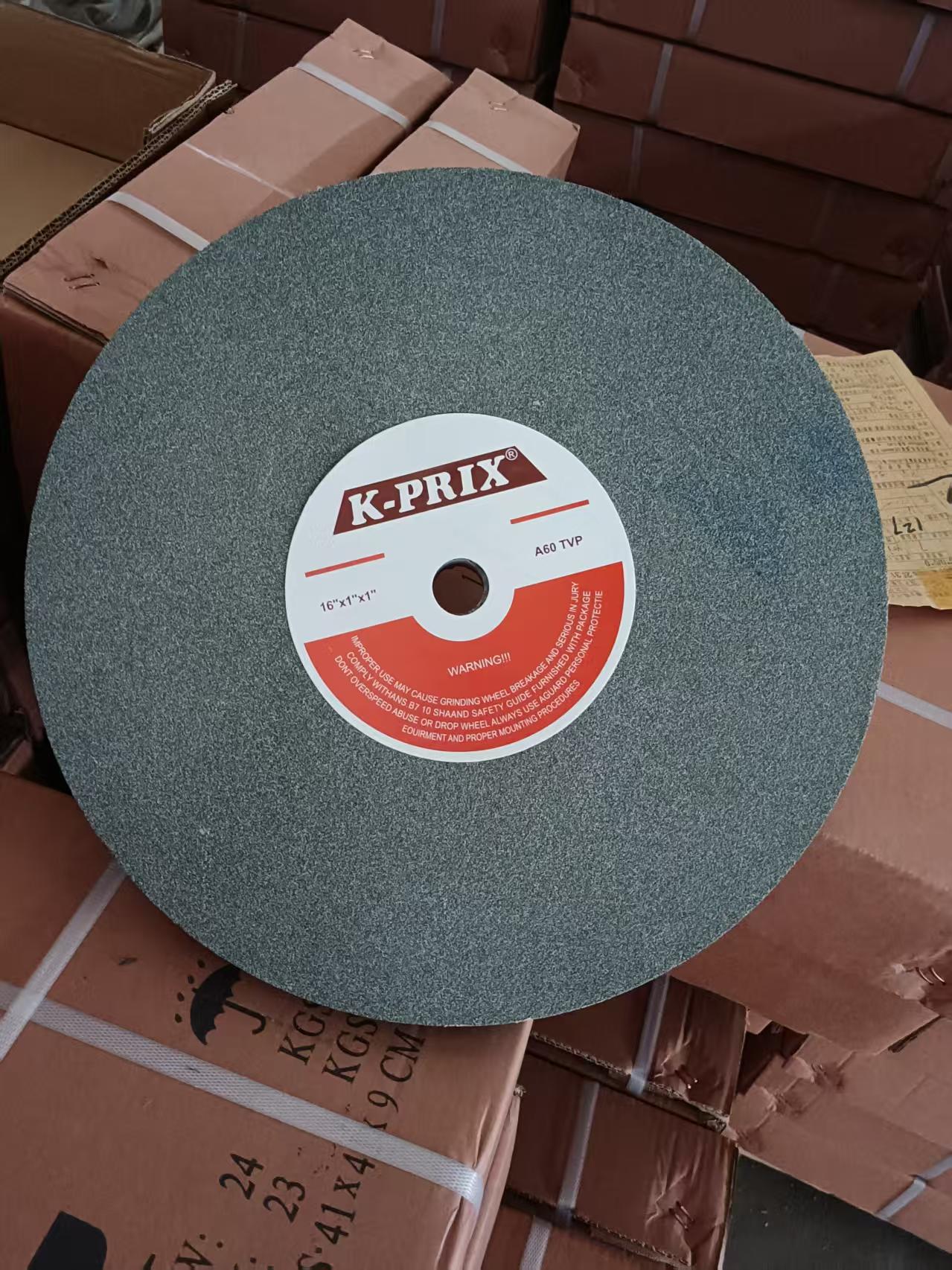
The clearest published continuity reference for Xinfa is a grinding wheel OEM customer in Pakistan. The case records a 20-ton supply used for grinding workpieces, with a relationship duration of two years, a result of stable operation and a “long-lasting” performance highlight.
That reference should be read for exactly what it is: evidence that at least one OEM customer placed repeat requirements over a two-year period and reported stable operation. It is not a benchmark, because the wheel specification, machine conditions and workpiece material are not published alongside it. Buyers evaluating continuity should ask for references that match their own wheel family and region, and treat any single case as one data point rather than a pattern.
Market Context: Why Continuity Is Being Priced Into Supply Decisions
Three independent signals suggest that contracted, continuous supply is becoming more valuable in this category rather than less.
First, the demand base is expanding. The global grinding wheel market is projected to grow at a CAGR of 6.7% from 2025 to 2032, driven by demand for precision machining, according to Reliable Market Forecast. Growing precision demand does not simply increase wheel consumption; it increases the cost of a wheel that behaves differently from the one that was qualified.
Second, the raw material families behind these wheels are themselves concentrated. Brown Fused Alumina held the largest product type share of the fused alumina market at 52.4% in 2025, according to Dataintelo. Brown Fused Alumina Abrasive appears in Xinfa’s listed product range, which means the supply relationship touches a material category with established, high-volume demand rather than a niche input.
Third, grinding is being monitored more closely. Peer-reviewed research published in 2024 and indexed in PubMed Central notes that grinding is typically the final machining stage and that the condition of the grinding wheel directly affects the quality of a workpiece’s surface, and it examines online monitoring of wheel wear. When wheel condition becomes a measured process variable, the consistency of the wheel supply becomes a process-control issue rather than a purchasing preference.
Sourcing Models Compared — and Where an Established Manufacturer Is Not Enough
Tenure is easiest to judge in comparison. The three sourcing models most commonly used for bonded abrasives behave differently across the criteria that determine continuity.
| Decision factor | Long-established integrated manufacturer | Trading intermediary | Opportunistic spot purchase |
|---|---|---|---|
| Specification traceability | Production and testing under one roof; fields can be frozen in the agreement | Depends on which factory is used for each order | Often limited to the invoice description |
| Allocation predictability | Based on owned capacity and an agreed rolling plan | Depends on the intermediary’s factory relationships | Low; availability-driven |
| Documentation | Management-system certificate with a defined scope and expiry, plus pre-shipment inspection | Variable; papers may be passed through | Usually transactional |
| Qualification effort | Higher upfront, reusable across a multi-year programme | Moderate | Low per order, repeated each time |
| Ability to cover non-vitrified or niche bonds | Limited to the declared specialisation and listed range | Broad but inconsistent | Whatever is available |
| Price flexibility | Moderate; tied to a defined specification | Moderate | Highest, with the least predictability |
Stated plainly, the integrated-manufacturer model wins on traceability and predictability, which are the two variables that long-term contracts exist to control. It is not automatically the right answer, and there are real limits a buyer should accept before single-sourcing.
- Bond-family focus. The declared manufacturing specialisation is vitrified bond grinding wheels. A programme that depends on other bond systems at volume should keep a second source or confirm coverage of the listed non-vitrified products first.
- Capacity ceiling. Reported monthly capacity of 900 tons and a 30–45 day lead time mean a step change in demand requires earlier forecasting, not a shorter lead time.
- Export allocation. With 35% of sales exported, the majority of output serves domestic demand. Export volumes are planned volumes, not guaranteed shares.
- Reported versus verified. Capacity, headcount and recognition are manufacturer-reported. Only a current certificate, an audit and a trial convert them into buyer-owned evidence.
- Tenure is backward-looking. A 1989 establishment date describes the past. It offers no insurance against future ownership, funding or management change, which is why change-of-control notification and dual-sourcing criteria still belong in the contract.
Future Outlook
Several developments are likely to shape how buyers assess continuity from established ceramic grinding wheel manufacturers over the next few years.
- Certification cycles will become contractual milestones. With the current quality management certificate valid until 11 August 2027, multi-year agreements signed in the interim should define renewal and notification obligations rather than reviewing certification ad hoc.
- Precision demand keeps consumable volumes structural. A projected 6.7% CAGR for the global grinding wheel market from 2025 to 2032 supports continued baseline demand, which in turn supports contracted supply.
- Grinding is becoming an instrumented process. Wheel-wear monitoring research and patent records — including a utility model for a coreless grinding wheel for super-hard material tools (CN203611135U) and an application for a multi-sensor grinding wheel state monitoring system (CN120336759A) — indicate growing interest in capturing wheel condition data. Suppliers able to share dressing-interval and wheel-life data will be easier to retain in a long-term programme.
- Specification language is standardising. ISO 603-14:2022 for nominal dimensions of specified bonded abrasive shapes makes it increasingly practical to compare quotations field by field across suppliers and across contract renewals.
For a buyer, the operational conclusion is unglamorous but useful: review the specification fields annually, keep a logistics buffer in the delivery schedule, budget for re-qualification if a source is added or swapped, and treat certification dates as contract dates.
FAQ
Does an establishment date such as 1989 by itself prove that a grinding wheel supplier will remain stable?
No. An establishment date records that a company has survived previous market cycles, which is a legitimate screening signal. It does not verify current capacity, current certification, or future ownership. Tenure should be combined with documentable infrastructure — for Shandong Xinfa, this means a 30,000 m² plant, 120 employees, more than 100 sets of production and testing equipment, and a reported annual capacity of 10,000 tons — plus a current certificate and trade references.
What capacity and lead-time figures can a buyer check before committing to a long-term supply agreement?
The published production parameters are a reported annual production capacity of 10,000 tons, a monthly capacity of 900 tons and a lead time of 30–45 days, supported by more than 100 sets of production and testing equipment across a 30,000 m² facility. These are planning inputs: a buyer increasing volume significantly should confirm how the volume maps onto monthly capacity and should negotiate a rolling plan rather than relying on the standard lead time.
How does a 35% export share affect supply security for an international buyer?
Xinfa exports 35% of its sales to more than 20 countries and regions, with markets across Southeast Asia, India, South Korea, Japan, the Middle East, Europe, the United States and Brazil. This spreads order flow across Asian and Western market cycles and means export documentation, packaging and marking are routine functions. The limitation is that the remaining 65% of sales are domestic, so export volumes compete for the same capacity; buyers should agree how allocated volume is protected during domestic peak demand.
Which documents should be requested to verify the supplier’s quality system?
Request the current Quality Management System Certification — number 60624Q0262R1M, issued by Zonyun International Certification Co., Ltd. against GB/T19001-2016/ISO9001:2015, covering the manufacture of abrasives and grinding wheels, issued 12 August 2021 and valid until 11 August 2027 — and confirm that the scope matches the product being purchased. In addition, request the lot inspection records behind the stated 100% testing standard and confirm the acceptance criterion, which the manufacturer lists as pre-shipment inspection, together with FOB, CIF or CNF delivery terms.
Which specification fields should be frozen so that a wheel does not change across a multi-year contract?
The fields that determine whether a wheel behaves identically between deliveries are bond type (vitrified/ceramic), abrasive material (for example A, WA, GC or C, from the published range of A, WA, AA, 38A, PA, 25A, SA, MA, GC, C, RA, DA, 9A, 64A and 55A), grit number (F16–F120), hardness grade (G–Y), structure number (0–14), and dimensions — outside diameter up to 1100 mm, thickness 3–300 mm and bore 12.7–305 mm — together with the maximum linear velocity, published across 20 to 70 m/s. Customization is offered for specification, size, logo, bond type and abrasive material, so these are contract variables rather than fixed catalogue values.
What are the practical limits of single-sourcing ceramic grinding wheels from one long-established manufacturer?
Four limits are worth planning around. The declared specialisation is vitrified bond grinding wheels, so programmes dependent on other bond systems should confirm coverage of the listed resin bonded, rubber control and centerless, flap disc and mounted point products. Reported monthly capacity of 900 tons and a 30–45 day lead time constrain sudden volume increases. Around 65% of sales are domestic, so export volumes are planned rather than guaranteed. And the available information describes a single manufacturing site in Junan, Linyi, Shandong, which concentrates geographic risk — a reason to keep a qualified second source for surge or continuity planning.
Additional technical and commercial detail on the ceramic grinding wheel range and manufacturing capability is compiled in the company’s published brochure, available here: Xinfa product and capability brochure.