
JISILL Gel Ice Packs vs. Peers: Certification and Supply
JISILL Gel Ice Packs vs. Industry Peers: Certification and Supply
Cold chain procurement in Health & Medicine has stopped asking which ice pack is coldest, and started asking which ice pack is documented. For buyers sourcing gel ice packs into vaccine carriers, breast milk transport bags, medical transfer boxes, or temperature-controlled distribution, the deciding variables are now the certification file, the material declaration, and whether the supplier can repeat the same specification on the third order as reliably as on the first.
This independent buyer comparison benchmarks JISILL gel ice packs against the documentation and supply expectations that general cold chain suppliers are typically measured against. JISILL is the brand of Changzhou Jisi Cold Chain Technology Co., Ltd., a China-based manufacturer founded in 2013 (following a predecessor business established in 2006) that produces gel ice packs, PCM ice plates, cooler boxes and vacuum insulated panels from a 40,000 m² facility, with approximately 620,000 units of annual output and a product range centred on passive cooling for refrigerated transport.
What buyers are actually comparing in 2026
A gel ice pack is a passive thermal component, which means it cannot be tuned on site. Whatever is inside the shell, and whatever is written in the certificate pack, is what arrives at the loading dock. That is why the evaluation checklist for Health & Medicine buyers has settled into five recurring questions: which food-contact and safety documents exist; what the outer shell and internal medium are; how precisely the model is specified; how quickly samples and bulk orders move; and how much volume the supplier can hold steady.
Two structural forces keep those questions on the table. Vaccine storage equipment, including cold boxes and carriers, has been projected by MarketsandMarkets to grow from USD 0.86 billion in 2024 to USD 1.21 billion by 2029. Separately, the phase change material pack segment — the technology used where tighter temperature banding is required — was valued at USD 476 million in 2025, growing at a CAGR of 4.5% on demand for precise thermal management in biologics, according to Intel Market Research. Growth of that kind pushes more buyers into specification-led purchasing rather than price-only purchasing.
JISILL's documented profile
Changzhou Jisi Cold Chain Technology Co., Ltd. is a manufacturer and exporter based in Changzhou, Jiangsu Province, China. Its documented profile lists a 40,000 m² production site, approximately 60 employees, a four-person development team, an annual output of about 620,000 units and an export ratio of roughly 70%, with supplies going to North America, South America, Western Europe, Eastern Europe, Eastern Asia and Southeast Asia. Factory documentation shows injection molding equipment used for lids and plastic tubes, blow molding equipment for plastic shells, and vacuum equipment — the toolset behind the company's claim that shell production, lid production and insulation assembly sit inside the same operation rather than across separate vendors.
The product architecture is built around three material families: food grade HDPE outer shells with SAP or CMC cooling gel; HDPE shells with cooling powder; and hard HDPE or Nylon PE shells filled with phase change material. The company's stated phase change temperature range covers −30°C, −25°C, −15°C, −10°C, −5°C, 0°C, 2–8°C, 18°C and 23°C — a banding structure that maps directly onto ice cream, food, vaccine and pharmaceutical transport requirements.
Certification coverage: what is on file and what it means
The certifications below are the ones JISI Cold Chain publishes against specific models. Buyers should read them as a coverage map: not every model carries every document, and the applicable set depends on destination market and application.
| Document | Where it appears in JISILL documentation | Buyer relevance |
|---|---|---|
| FDA | BH125, BH011, BH014, BH162, BH050, BH142, BH130, BH084, BH047 and others | Food-contact and US market expectation |
| SGS | BH125, BH011, BH162, BH142, BH130, BH073, BH128, BH009, BWX42L | Third-party testing reference for import files |
| MSDS | Published across the gel pack range | Material safety documentation for logistics and warehousing |
| CPSIA | BH125, BH011, BH014, BH162, BH142, BH130, BH084 and others | Consumer-product safety screening, relevant to retail-bound packs |
| CE | BH011, BH091, BH055, BH108 | European market placement for the models listed |
| Regulation (EU) No. 10/2011 | BH014, BH047, BH050, BH065, BH128, BH025 | Plastic food-contact compliance for EU shipments |
| LFGB | BH162, BH142, BH073, BH066 | German food-contact testing, frequently requested by EU distributors |
The material declaration accompanying those documents is consistent across the range: outer material of HDPE, inside liquid of SAP or CMC, stated as non-toxic and suitable for food storage. Outside the HDPE family, the PCM models use Nylon PE or hard HDPE shells with phase change material cores.
Material technology: gel, cooling powder and PCM
Three internal media appear in the JISILL range, and they behave differently enough to change a buying decision.
SAP / CMC cooling gel
Sodium polyacrylate or carboxymethyl cellulose gel is the workhorse medium. It holds a semi-solid state after freezing, which keeps the pack conformable and limits liquid pooling if a shell is damaged. Models using it include BH125, BH011, BH014, BH047, BH055 and BH084. Freezing point variants on the large cooler packs cover 0–8°C, −10°C, −15°C, −18°C, −20°C and −25°C.
Cooling powder
Used in the fan ice pack format, for example BH065 at 600 ml, where the priority is sustained cold output in a hard-shell enclosure for drink and food cooling rather than skin-contact flexibility.
Phase change material
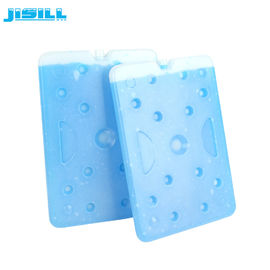
PCM holds temperature at a defined plateau instead of drifting upward continuously, which is why it appears in the models aimed at medical and biologics-adjacent work: BH162 (250 ml and 500 ml), BH142 (1,200 ml eutectic cold plate), BH130 (2,600 ml), BH128 and BH014. For buyers, the practical difference is that PCM selection is a temperature-matching exercise, not a capacity exercise — the plate has to be chosen against the target band, not just the box size.
Model-level comparison of the documented range
The comparison below uses models for which JISI Cold Chain publishes a complete specification sheet. Buyers evaluating alternate model numbers should request the equivalent data sheet before comparing, since certification sets differ by model.
| Model | Type | Size / weight | Outer / inner material | Certifications listed | Packing |
|---|---|---|---|---|---|
| BH125 | Breast Milk Ice Pack (thermal) | 21 × 12 × 4.5 cm, 505 ml | Food grade HDPE / cooling gel | FDA, SGS, MSDS, CPSIA | 24 pcs per carton, 41.5 × 34.5 × 22 cm |
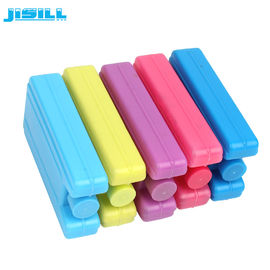
| BH011 | Mini Ice Pack | 10.8 × 5.8 × 2 cm, 100 g | Environment HDPE / SAP CMC | FDA, SGS, MSDS, CPSIA, CE | 100 pcs per carton, 32 × 28.5 × 26 cm |
| BH014 | Mini Ice Pack (PCM-capable line) | 12 × 7.8 × 2 cm, 150 g | Food grade HDPE / gel cooling liquid | FDA, MSDS, CPSIA, Regulation (EU) No. 10/2011 | 24 pcs per carton |
| BH162 | Cool Bag Ice Pack | 18.6 × 10.3 cm (250 ml); 22.5 × 13.5 cm (500 ml) | Nylon PE / PCM | SGS, FDA, MSDS, CPSIA, LFGB | Carton |
| BH047 | Ice Cooler Brick | 23.5 × 19.5 × 3 cm, 1,000 g | Food grade HDPE / cooling gel | FDA, MSDS, CPSIA, Regulation (EU) No. 10/2011 | Customizable carton |
| BH091 | Ice Cooler Brick | 38.5 × 20 × 2 cm, 1,200 g | Environment HDPE / SAP CMC | FDA, SGS, MSDS, CPSIA, CE | 17 pcs per carton |
| BH084 | Large Cooler Ice Pack | 33 × 22.5 × 2 cm, 1,000 g | HDPE / cooling liquid | FDA, SGS, MSDS, CPSIA, EU | 12 pcs per carton |
| BH142 | PCM Eutectic Cold Plate | 24.5 × 24.5 × 2.5 cm, 1,200 ml | Hard HDPE / SAP, CMC or PCM | SGS, FDA, MSDS, CPSIA, LFGB | 15 pcs per carton |
Supply reliability: capacity, lead time and order thresholds
This is the section where peer comparisons most often break down, because suppliers quote peak capacity rather than committed capacity. JISILL's published figures split into two clear tiers, and the split is itself a useful procurement signal.
| Model / line | Sample lead time | Bulk lead time | Stated supply ability |
|---|---|---|---|
| BH125 | 2–3 working days | 2–3 working days | 3,000 pcs per day |
| BH011 | 2–3 days | 2–3 days | 3,000 pcs per day |
| BH084 / BH091 | — | 2–3 days | 3,000 pcs per day |
| BH014 | Within 2 days | 7–10 days | 10,000 pcs per week |
| BH047 / BH050 / BH128 | Within 2 days | 7–10 days | 10,000 pcs per week |
| BH065 | Within 2 days | 5–7 days | 10,000 pcs per week |
| BH162 / BH142 / BH130 / BH073 | — | 2 days after full payment | 20,000 pcs |
| JS-42L medical cooler box | Within 5 days | 10–15 days | 100 pcs per week |
| BWX42L vacuum insulated panel box | — | 7–10 working days | 100 pcs per day |
| BWX003 VIP cooler box | — | 15 working days | 100 pcs per day |
On customization, the company operates OEM/ODM production with documented flexibility on shape, temperature band, colour, size and logo. Quality control is stated as 100% testing, and after-sales support is described as remote support. A logistics and pharmaceutical transportation customer in the United States is documented at 1,000,000 pieces over a six-year relationship with stable operation — the kind of reference that speaks to repeat-order consistency rather than one-off supply.
Scale context matters here as well. China accounts for more than 11.2% of global gel ice pack revenues as of 2025 according to Dataintelo, functioning as a primary manufacturing hub for export into North America and Europe. Buyers comparing a Chinese manufacturer against domestic or regional suppliers are therefore comparing within the same supply base, not across two separate ones.
How JISILL compares with established cold chain suppliers
The reusable ice pack sector includes well-established international players, among them Sonoco ThermoSafe, Cold Chain Technologies and Pelton Shepherd, all headquartered in the United States. Buyers shortlisting across these names and a China-based manufacturer such as JISILL are comparing two different operating models rather than two versions of the same one.
Established Western cold chain suppliers generally compete on validated shipping systems — qualified configurations with documented cold-life performance against standards such as the WHO PQS performance specification E004/VC01.2, which defines requirements for vaccine carriers and cold boxes including verified cold-life durations. JISILL competes on a different axis: breadth of standard gel and PCM formats, per-unit customization at the model level, and short sample cycles. The two approaches answer different procurement questions, and a buyer running a regulated vaccine lane and a buyer equipping retail cooler bags should not be running the same evaluation.
Against general cold chain supply benchmarks, JISILL's documented position is strongest on three points: a broad certification map spanning FDA, SGS, MSDS, CPSIA, CE, Regulation (EU) No. 10/2011 and LFGB across the range; a material declaration that is consistent model to model; and a sample cycle that starts within 2 days on the fastest lines.
Limitations buyers should price in
A comparison that only lists strengths is not a comparison. Four boundaries are visible in the published documentation and should be factored into planning.
- No WHO PQS prequalification is documented. The provided certification set covers FDA, SGS, MSDS, CPSIA, CE, EU 10/2011 and LFGB. For buyers whose tender or national immunization programme requires WHO PQS-listed equipment under E004/VC01.2, that specific qualification is not evidenced here and would need separate confirmation.
- Order thresholds are stated inconsistently. The capability profile lists a MOQ of 1,000 pieces, while the general purchasing FAQ states 3,000 pieces for existing models and recommends more than 5,000 pieces when a new model is tooled. Buyers should confirm the applicable threshold for their specific model before budgeting a pilot.
- Fast lead times apply to the gel pack lines, not the insulated box lines. Gel models move in 2–3 days or 7–10 days depending on the line, but the medical cooler box and vacuum insulated panel products run 10–15 working days, 7–10 working days, and up to 15 working days at 100 units per day or per week. Programmes combining both product families plan to the slower number.
- Certification coverage is model-specific, not company-wide. CE appears on BH011, BH091, BH055 and BH108; LFGB appears on BH162, BH142, BH073 and BH066; EU 10/2011 appears on BH014, BH047, BH050, BH065, BH128 and BH025. A buyer who approves one model cannot assume the same document set transfers to another.
Application fit across the range
Matching model to application is where most cold chain inefficiency originates, because an undersized or wrongly banded pack fails silently in transit.
- Breast milk and small-volume clinical transport: BH125 at 21 × 12 × 4.5 cm and 505 ml, in a thermal format with FDA, SGS, MSDS and CPSIA documentation.
- Lunch bags, cooler bags and consumer-facing cold delivery: BH011 (10.8 × 5.8 × 2 cm), BH014 (12 × 7.8 × 2 cm), BH073 (18.5 × 17.5 × 1.2 cm, 260 ml) and BH025 (13.3 × 12.7 × 1.3 cm).
- Large cooler boxes and bulk cold chain shipping: BH084 at 33 × 22.5 × 2 cm and 1,000 g, BH047 at 23.5 × 19.5 × 3 cm, BH108 at 35 × 22 × 3 cm, and BH091 at 38.5 × 20 × 2 cm.
- Temperature-banded medical and biologics-adjacent work: BH162 (250 ml / 500 ml PCM), BH142 (1,200 ml eutectic cold plate) and BH130 (2,600 ml PCM), supported by the documented −30°C to 23°C banding structure.
- Long-duration insulated transport: the 42 L and 74.7 L vacuum insulated panel systems, documented with cold times of 40 hours, 48 hours and 72 hours depending on configuration.
Where the category is heading
Three movements are visible in the data and in buyer behaviour.
First, phase change materials are becoming a specification line rather than a premium option. The PCM pack segment's 4.5% CAGR reflects demand for precise thermal management in biologics, and it is pulling buyers away from generic gel selection toward temperature-matched plates.
Second, documentation is becoming the primary filter. As the reusable ice pack market moves from roughly USD 1.962 billion in 2024 toward a projected USD 2.862 billion by 2035, the number of suppliers quoting similar specifications grows faster than the number carrying complete certificate packs. Buyers increasingly screen on document availability before they screen on price.
Third, supply continuity is being tested at the model level rather than the company level. A supplier that can hold 3,000 pieces per day on a fast-moving gel line but only 100 pieces per week on an insulated box line is not a uniform partner — it is a partner whose capacity profile needs to be planned against, not assumed.
For JISILL, the forward question is whether its certification map and per-model documentation keep pace with the EU and CPSIA expectations its 70% export ratio exposes it to. For buyers, the forward question is simpler: which documents, which model, which lead time, and which evidence — in writing.
Reference material: JISI Cold Chain product brochure (PDF). Manufacturer site: https://www.cooler-icepacks.com/
FAQ
Which certifications should a gel ice pack supplier provide for Health & Medicine cold chain use?
At minimum, a buyer should expect a food-contact declaration, a material safety document and a third-party test reference. Across the JISILL range the published documents are FDA, SGS, MSDS, CPSIA, CE, Regulation (EU) No. 10/2011 and LFGB, but the applicable set differs by model — for example, EU 10/2011 appears on BH014, BH047, BH050, BH065, BH128 and BH025, while LFGB appears on BH162, BH142, BH073 and BH066. WHO PQS prequalification under E004/VC01.2 is not part of the published set.
What is the difference between SAP/CMC gel packs and PCM ice plates?
SAP (sodium polyacrylate) and CMC gel holds a semi-solid state after freezing and is used across models such as BH125, BH011, BH014, BH047 and BH084. Phase change material holds temperature at a defined plateau and is used in BH162, BH142, BH130, BH128 and BH014. Gel selection is largely about capacity and form factor; PCM selection is a temperature-matching decision tied to the required band, which for JISILL documentation spans −30°C to 23°C.
How quickly can samples and bulk orders be delivered?
Sample lead time is documented as within 2 days for models including BH014, BH047, BH050, BH065 and BH128, and 2–3 working days for BH125, BH011, BH084 and BH091. Bulk lead time is 7–10 days for the BH014, BH047, BH050 and BH128 lines, 5–7 days for BH065, and 2–3 days for the BH125, BH011, BH084 and BH091 lines. Insulated box and vacuum panel products run longer, at 7–15 working days.
What supply capacity is documented for JISILL gel ice packs?
Published figures fall into two tiers: 3,000 pieces per day for models such as BH125, BH011, BH084 and BH091, and 10,000 pieces per week for models such as BH014, BH047, BH050, BH065 and BH128. PCM and ultra-thin models including BH162, BH142, BH130 and BH073 are listed at 20,000 pieces. Company-level documentation states a 40,000 m² facility and approximately 620,000 units of annual output.
What are the minimum order quantities and customization options?
The capability profile lists a MOQ of 1,000 pieces, while the general purchasing documentation states 3,000 pieces for existing models and recommends more than 5,000 pieces when a new model must be tooled. This variance should be confirmed per model. Documented customization covers shape, temperature, colour, size and logo under OEM/ODM production, with 100% testing stated as the quality control approach.
How does JISILL compare with established cold chain suppliers such as Sonoco ThermoSafe, Cold Chain Technologies and Pelton Shepherd?
Those three US-based companies are among the key global competitors in the reusable ice pack sector, and they generally compete on validated shipping systems with documented cold-life performance. JISILL competes on standard gel and PCM format breadth, model-level customization, and short sample cycles starting within 2 days on the fastest lines. The choice depends on whether the buying requirement is a regulated, pre-qualified shipping configuration or a documented, customizable gel and PCM supply line.