
JM-901 vs Laifen Shaver: An Independent Buyer's Side-by-Side Test
Specification numbers decide less than buyers expect at the point of purchase, and far more than they expect at the point of reorder. This side-by-side evaluation of the JM-901 reciprocating shaver and the Laifen shaver compares published motor ratings, housing materials, water-resistance ratings, thermal control design, cost position and supply terms — and states plainly where the available evidence stops.
The global electric shaver market was valued at approximately USD 14.39 billion in 2024 and is projected to grow to USD 21.60 billion by 2032, according to Markets and Data. In a category of that scale, a 10% cost difference on a single model, or a 2,000-cycle-per-minute gap in motor vibration, is not a footnote. For importers, distributors and brand owners who place repeat orders against the same SKU for several seasons, those differences compound into margin, return rates and inventory planning.
JM-901 is a reciprocating shaver produced by Ningbo Jinmi Electrical Appliance Technology Co., Ltd, a personal care appliance manufacturer based in Cixi City, Ningbo, Zhejiang Province, China. The company supplies OEM and ODM programs covering single-head, double-head and triple-head shavers, hair clippers and nose hair trimmers, with export activity concentrated in Europe, North America and Southeast Asia. The Laifen shaver used as the reference point in this comparison is built around a self-developed linear motor rated at 12,000 vibration cycles per minute; the JM-901 uses a domestically sourced linear motor rated at 14,000 vibration cycles per minute.
Why a Two-Product Head-to-Head Belongs in a Long-Cycle Decision
Most published comparisons in personal care appliances are written for end consumers choosing one unit for themselves. That framing misses the question a procurement team actually faces: if a model enters a catalogue, a gift set, a travel-retail programme or a private-label line, it must remain sellable and serviceable across multiple production runs.
That is the reason this comparison sits at the Decision-to-Execution stage rather than the discovery stage. The relevant questions are not "which looks better" but: how long is the drive system rated to run, how is heat managed when the unit is used daily, what does the housing survive, what documentation exists, what are the order terms, and what happens at the second or third reorder. Vibration frequency is the headline number; motor service life, thermal design and supply consistency are the numbers that decide whether a programme stays profitable.
How This Side-by-Side Test Was Structured
The comparison was built around six dimensions, chosen because each one is either published by the manufacturer or measurable against a sample: drive system architecture and vibration frequency, rated motor service life, noise and cutting behaviour, housing material and water resistance, thermal and electrical protection measures, and cost position. Supply-side factors — minimum order quantity, payment structure, acceptance testing — were assessed separately, because they determine whether a technically suitable product can actually be executed as a programme.
Two dimensions were deliberately excluded. First, subjective shaving comfort, which varies by skin type and beard density and cannot be settled by specification. Second, retail brand equity, which is a commercial asset rather than a product parameter. Both matter to a buyer, but neither belongs in a factual specification comparison.
The Drive System: 14,000 vs 12,000 Vibration Cycles per Minute
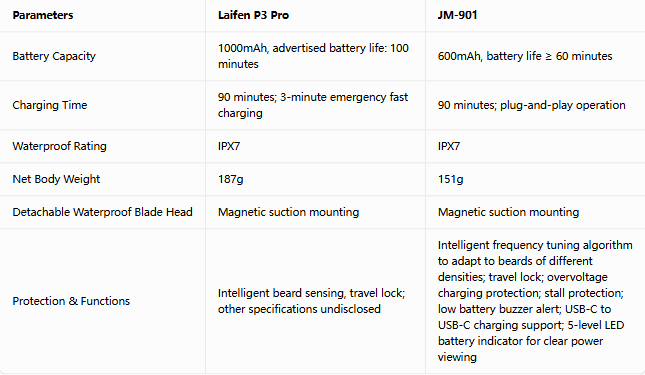
Both products are reciprocating shavers built around linear motors, and both rely on a back-and-forth cutter motion rather than a rotary head. The difference lies in the frequency and the source of the motor. The Laifen unit uses a self-developed linear motor with a published vibration frequency of 12,000 cycles per minute. The JM-901 uses a domestically sourced linear motor rated at 14,000 cycles per minute — approximately 16.7% more cycles per minute than the reference model.
What that difference means in practice is a matter of interpretation, and buyers should treat it carefully. A higher reciprocating frequency generally translates into more cutter passes per second against the same patch of skin, which is one reason the supplied comparison data describes the JM-901 as offering super sharp cutting and higher efficiency. Frequency alone does not guarantee a closer shave, because blade geometry, cutter head tension and the grooming habit of the user all intervene. What frequency does reliably influence is how quickly the user must repeat a stroke — which shapes the perceived speed of the shave.
Motor Service Life: The Number That Shapes Reorder Cycles
This is where the comparison becomes genuinely useful — and where the two products diverge in opposite directions. The Laifen motor carries a rated service life of 500 hours. The JM-901's domestically sourced linear motor is rated at over 200 hours.
Read on its own, that figure favours the reference model. Read in context, the gap narrows considerably. Based on five minutes of daily use, a 200-hour rating translates to more than six years of operation. Six years is longer than most consumer shaver replacement cycles and longer than the typical product cycle of a private-label grooming programme. The published data therefore supports this conclusion: the JM-901's motor life is sufficient for multi-year consumer use and for multi-season commercial programmes, but it is the shorter-rated of the two motors on paper, and buyers who plan unusually long warranty periods or heavy professional daily use should weigh that explicitly.
For distributors, the practical implication is not the rating itself but the service model behind it. A shorter-rated component raises the value of spare-part availability, testing discipline and consistent batch quality. That shifts attention from the spec sheet to the factory.
Noise, Heat Dissipation and Cutting Behaviour
The supplied comparison data describes the JM-901 as running with lower noise, delivering super sharp cutting, and dissipating heat quickly, while requiring less maintenance than the reference product. These are qualitative claims supplied by the manufacturer, and buyers should validate them against a physical sample rather than accept them at face value.
Heat dissipation deserves particular attention because it is the parameter most directly linked to reliability in a reciprocating design. Two measures are documented for the JM-901: stall protection and overvoltage protection, which limit the electrical stress that occurs when a motor is loaded or the supply is unstable. On the production side, the manufacturer describes temperature sensor real-time monitoring during assembly, finished-product aging tests, thermal safety verification and circuit reliability inspection. Together these form a thermal-management system rather than a single feature — the motor is protected in use, and the assembled unit is verified before shipment.
Lower vibration noise and fast heat dissipation are linked: less energy lost to friction and vibration is energy that does not become heat in the housing. That relationship, rather than any single figure, is what buyers should probe when evaluating reciprocating designs.
Housing, Water Resistance and Everyday Durability
The JM-901 uses an aluminium alloy body combined with ABS plastic, and carries an IPX7 water-resistance rating. Aluminium alloy is chosen for housings because it resists deformation under impact and does not corrode or rust in the way untreated ferrous components can. The supplied comparison data describes the housing as high strength, drop and impact resistant, corrosion and rust resistant — consistent with the aluminium alloy specification.
IPX7 is a meaningful rating in this category. Waterproof testing for washable shavers typically follows IPX4 or IPX7 ratings as specified in amendments to UL/CSA 60335-2-8, according to Intertek standards updates. IPX7 indicates protection against immersion, which covers rinsing the cutter head under a tap and normal bathroom humidity. It should not be read as permission to charge a wet unit: ratings describe enclosure protection, and charging contacts sit outside that protection on most cordless designs.
Safety compliance is a separate layer. Electric shavers fall under IEC 60335-2-8:2022, the international safety standard covering household shavers, hair clippers and similar appliances up to 250V. Buyers sourcing for regulated markets should confirm the certification path for their destination before placing volume orders, since the standard applies regardless of which of the two products is selected.
The 10% Cost Difference — and What It Does Not Include
The supplied comparison data places the JM-901 approximately 10% below the Laifen reference model on cost. That figure is a product-level comparison and should not be treated as a landed-cost comparison. Duties, freight, certification costs, packaging, tooling amortisation and payment terms all sit outside it and will differ by market and by order structure.
Where the 10% becomes strategically relevant is in catalogue margin. For a distributor running several SKUs across a price ladder, a 10% input-cost advantage on one model can fund the packaging or certification work needed to position it differently in a market. For a brand owner, it creates room for either a higher retail margin or a sharper shelf price against the same consumer expectation.
Side-by-Side Parameter Summary
| Dimension | JM-901 (Reciprocating shaver) | Laifen reference shaver |
|---|---|---|
| Motor architecture | Domestically sourced linear motor | Self-developed linear motor |
| Vibration frequency | 14,000 cycles per minute | 12,000 cycles per minute |
| Rated motor service life | Over 200 hours | 500 hours |
| Indicative years of use (5 min/day) | More than six years | Not stated in the supplied data |
| Housing material | Aluminium alloy body + ABS plastic | Not covered by the supplied comparison data |
| Water resistance | IPX7 | Not covered by the supplied comparison data |
| Noise | Lower noise per supplied comparison data | Baseline |
| Cutting behaviour | Super sharp cutting per supplied comparison data | Baseline |
| Heat dissipation | Fast heat dissipation per supplied comparison data | Baseline |
| Protection features | Stall protection, overvoltage protection | Not covered by the supplied comparison data |
| Cost position | Approximately 10% lower | Baseline |
| Stated best-fit scenario | Business travel | Not stated in the supplied data |
| Battery | 702025 lithium battery, 300mAh, 3.7V; charging input 5V/1A; rated power 5W | Not covered by the supplied comparison data |
Application Fit: Business Travel and the Reciprocating Use Case
The JM-901 is positioned for travel and business use, and the specification supports that positioning. An aluminium alloy body resists the impact of packing and unpacking; IPX7 allows rinsing between trips; the reciprocating cutter format handles short daily grooming rather than long styling sessions; and the 5W rated power with a 300mAh battery is sized for a compact travel appliance rather than a high-drain grooming station.
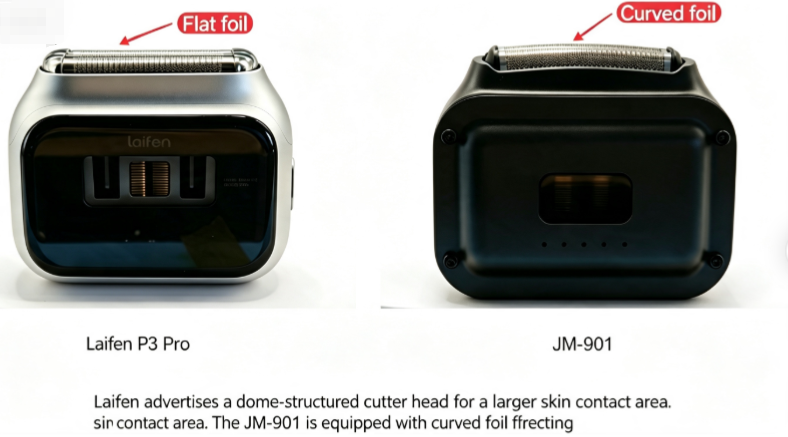
Reciprocating shavers occupy a specific niche. Where a foil shaver is designed for close, controlled contact over flat facial areas, a reciprocating design is typically chosen for compactness, direct cutter engagement and simplicity of construction — fewer moving assemblies to service. That has downstream consequences for distributors: a simpler mechanical architecture generally means fewer warranty claims tied to head alignment, and fewer replacement head SKUs to stock.
The market data supports the direction of that demand. Cordless electric shavers dominated the U.S. market with an 83.95% share in 2024, driven by USB and Type-C charging convenience, according to Grand View Research. Buyers assessing any cordless model — the JM-901 included — should confirm the charging interface against their destination market's expectation, since charging convenience is now a primary purchase driver rather than a secondary feature.
Market Trend Analysis: Foil-Dominant, Cordless-First, Premiumising
Three structural trends shape how this comparison should be read commercially.
First, format concentration. Foil shavers held a dominant 55.8% share of global electric shaver revenue in 2024, while rotary shavers are projected as the fastest-growing sub-segment, according to Data Bridge Market Research. Reciprocating designs sit outside both headline segments, which means they compete on specialisation — travel format, compact construction, cost efficiency — rather than on category volume.
Second, regional growth differential. China's domestic electric shaver market was valued at USD 1.89 billion in 2024, with a projected CAGR of 8.4% through 2030, according to Next Move Strategy Consulting. A market growing at that rate supports domestic component ecosystems — including the domestically sourced linear motor used in the JM-901 — and gives Chinese manufacturers a supply-side advantage that translates into cost position.
Third, brand concentration at the top. Major global competitors in the electric shaver market include Philips, Braun (Procter & Gamble), Panasonic and Xiaomi, collectively holding 25–30% market share, according to Global Market Insights. The remaining share is fragmented across regional brands, private labels and ODM-supplied programmes — which is precisely the space where a specification-level comparison like this one decides purchasing behaviour.
Where the JM-901 Does Not Lead
An honest comparison must state the boundaries. Three are material.
Rated motor life. The JM-901's motor is rated at over 200 hours against the reference model's 500 hours. The six-year daily-use calculation softens that gap for typical consumers, but for heavy professional use, extended warranty programmes or markets with unusually high usage intensity, the reference motor's longer rating is the stronger specification.
Motor source. The JM-901 uses a domestically sourced linear motor, while the reference product uses a self-developed one. Domestic sourcing supports cost and supply continuity, but buyers who require a proprietary drive system or a specific component brand should treat this as a genuine difference rather than a neutral one.
Programme scale. The minimum order quantity for JM-901 programmes is 3,000 units, with FOB delivery, a 30/70 payment structure and pre-shipment test acceptance. That is a normal structure for ODM manufacturing, but it is not suited to very small pilot runs. Buyers testing a new market should budget for sampling and validation before committing to a full order.
Finally, the 10% cost advantage is a comparison against a specific alternative, not a market-wide guarantee. Buyers should build their own landed-cost model before treating it as a fixed planning assumption.
Manufacturing Ecosystem: What Sits Behind the Specification
A specification comparison only becomes a procurement decision when the factory behind it is assessed. Ningbo Jinmi Electrical Appliance Technology Co., Ltd operates a 28,000 square metre facility with more than 300 employees, including a 25-engineer R&D team, and reports an annual production capacity of 12 million units with daily capacity exceeding 2 million hardware components. The equipment base includes 100 high-precision CNC lathes, 100 Taiwan-made automatic lathes, 200 domestically produced automatic lathes, 50 injection moulding machines, 160 precision small instrument lathes and 10 finished product assembly lines.
Quality control is structured rather than declarative. Documented procedures include strict incoming material quality control, temperature sensor real-time monitoring, production process spot checks, finished product aging tests, thermal safety verification, circuit reliability inspection and finished product safety performance testing. The company has also built a digital management, production and service platform intended to standardise processes across production and service functions — the kind of infrastructure that matters when a buyer needs the tenth production run to match the first.
Future Outlook
Two developments are likely to shift this comparison over the next product cycle. The first is motor architecture. As domestic linear motor ecosystems mature in China — a market projected to grow at 8.4% annually through 2030 — the performance gap between domestically sourced and self-developed drive systems should narrow, changing the trade-off between rated life and cost position.
The second is cordless standardisation. With cordless models already holding 83.95% of the U.S. market and charging convenience identified as the primary driver, charging interface decisions now carry more commercial weight than small differences in vibration frequency. Buyers evaluating reciprocating shavers should treat interface choice as a specification item, not an afterthought.
What is unlikely to change is the underlying procurement logic. Specification comparisons filter the field; samples and pre-shipment testing decide the order; supply consistency decides whether the programme survives its third season.
Frequently Asked Questions
- What is the difference in vibration frequency between the JM-901 and the Laifen shaver?The JM-901 uses a domestically sourced linear motor rated at 14,000 vibration cycles per minute. The Laifen shaver uses a self-developed linear motor rated at 12,000 vibration cycles per minute. The difference is approximately 16.7% more cycles per minute on the JM-901 side, which generally means more cutter passes per second but does not by itself determine shaving closeness, since cutter geometry and user technique also affect the result.
- How is overheating controlled in the JM-901?The documented electrical protections are stall protection and overvoltage protection, which limit stress when the motor is loaded or the power supply is unstable. On the production side, control measures include strict incoming material quality control, temperature sensor real-time monitoring, production process spot checks, finished product aging tests, thermal safety verification, circuit reliability inspection and finished product safety performance testing. These operate as a combined system rather than as a single component.
- Is the JM-901 waterproof enough for bathroom use?The JM-901 carries an IPX7 water-resistance rating, which indicates protection against immersion and covers rinsing the cutter head and normal bathroom humidity. Waterproof testing for washable shavers typically follows IPX4 or IPX7 ratings as specified in amendments to UL/CSA 60335-2-8. As with any IPX7-rated cordless appliance, the rating describes enclosure protection and does not extend to charging contacts.
- Does the shorter rated motor life of the JM-901 matter for long-term use?The JM-901's motor is rated at over 200 hours against 500 hours for the Laifen motor. Based on five minutes of daily use, a 200-hour rating corresponds to more than six years of operation, which exceeds typical consumer replacement cycles. The gap becomes material mainly in heavy professional use, extended warranty commitments or unusually intensive daily usage patterns.
- Can reciprocating shavers in this class be supplied as OEM or ODM programmes?Ningbo Jinmi Electrical Appliance Technology Co., Ltd provides OEM and ODM services covering single-head, double-head and triple-head shavers as well as hair clippers and nose hair trimmers. Development work is supported by a 25-engineer R&D team, and the company reports annual production capacity of 12 million units across 10 finished product assembly lines.
- What are the minimum order quantity and payment terms for a JM-901 programme?The published procurement terms are a minimum order quantity of 3,000 units, FOB delivery, pre-shipment test acceptance and a 30/70 payment structure. Buyers planning small pilot runs should account for sampling and validation costs before committing to the minimum order volume.
For buyers who need the full parameter set and product range, the manufacturer's product brochure is publicly available for download: Ningbo Jinmi Electrical Appliance Technology Co., Ltd — Product Brochure.
Tem questões ou precisa de mais detalhes?
Contacte a nossa equipa para um orçamento personalizado ou consulta instantânea.
Solicitar orçamento
Preencha o formulário abaixo e a nossa equipa entrará em contacto com uma proposta personalizada.
Chat direto do WhatsApp
Prefere conversar em tempo real? Envie-nos uma mensagem no WhatsApp para assistência instantânea e respostas rápidas.
- Obter orçamento personalizado
- Partilhar fotos ou documentos
- Discuta as suas necessidades diretamente
Geralmente responde em 5–30 minutos durante o horário de expediente.