
JONSON Induction Heaters: Precision, Efficiency, and Industrial Versatility
JONSON (Guangdong Jiangxin Electronic Technology Co., Ltd.) is a China-based manufacturer of electromagnetic induction heating equipment, specializing in energy-saving solutions for industrial heating, chemical processing, and plastic machinery. With a 3,000 m² facility, over 60 employees, and an annual output of 120,000 units, the company has positioned itself as a credible supplier in the global induction heater market.
The Problem with Traditional Heating
Industrial heating processes have long relied on resistance heating, gas boilers, or thermal oil systems. These methods suffer from high energy losses, slow response times, and significant maintenance overhead. In an era of rising electricity costs and stricter emission regulations, manufacturers are under pressure to adopt cleaner, more efficient technologies. Induction heating offers a solution: it converts electrical energy directly into heat within the metal workpiece via electromagnetic fields, achieving efficiencies above 95% while eliminating combustion byproducts.
JONSON’s Induction Heating Portfolio
JONSON’s product line covers a wide power range—from 2.5 kW small plastic machine heaters to 100 kW industrial units—and includes specialized equipment such as induction steam generators, hot air generators, water heaters, bearing heaters, and control boards. All core heating coils are wound with copper wire, and enclosures use thickened aluminum alloy or 304 stainless steel, ensuring durability in demanding environments. Key models include the JS1300 series (5–15 kW), JS1000-20/30/100 (20–100 kW), and the JS-1600 steam generator (30–50 kW).
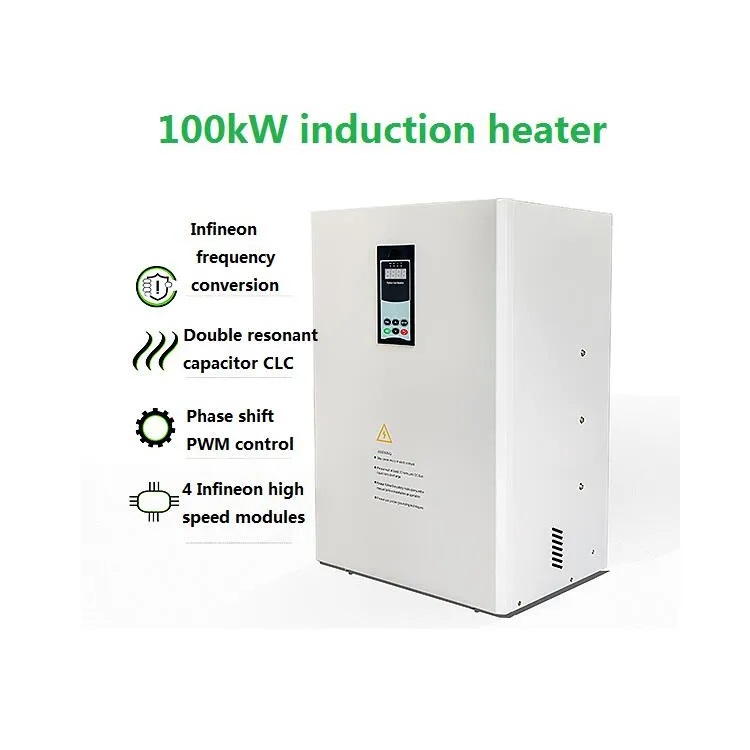
JONSON 100kW Industrial Induction Heater (model JS1000-100) with DSP-based control.
Technical Foundation: How It Works
JONSON’s induction heaters operate on the principle of high-frequency electromagnetic induction. A 50 Hz AC input is converted to 5–40 kHz high-frequency current via an IGBT inverter module. This current energizes an electromagnetic coil, generating an alternating magnetic field that induces eddy currents in the metal barrel or workpiece, causing it to heat from within. The system supports temperature, time, and PID closed-loop control, and can automatically adjust power based on load. Heat conversion efficiency reaches ≥98% for most models (≥99% for the JS-1600 steam generator).
The control system is DSP-based with high-speed automatic phase-locking tracking, and includes protections against overcurrent, overvoltage, overtemperature, and water shortage. Soft-start and stop modes are standard, and power can be steplessly adjusted from 20% to 100%.
Real-World Applications
JONSON induction heaters are deployed across diverse industries: plastics and rubber (injection molding, extrusion), food processing (steam cooking), chemical reactions (reactor heating), crude oil pipeline heating (preventing solidification), textile printing and dyeing, aquaculture heating, metal heat treatment, building heating, and medicinal herb drying. The equipment can supply steam, hot air, or hot water, and multiple units can be paralleled for modular expansion.
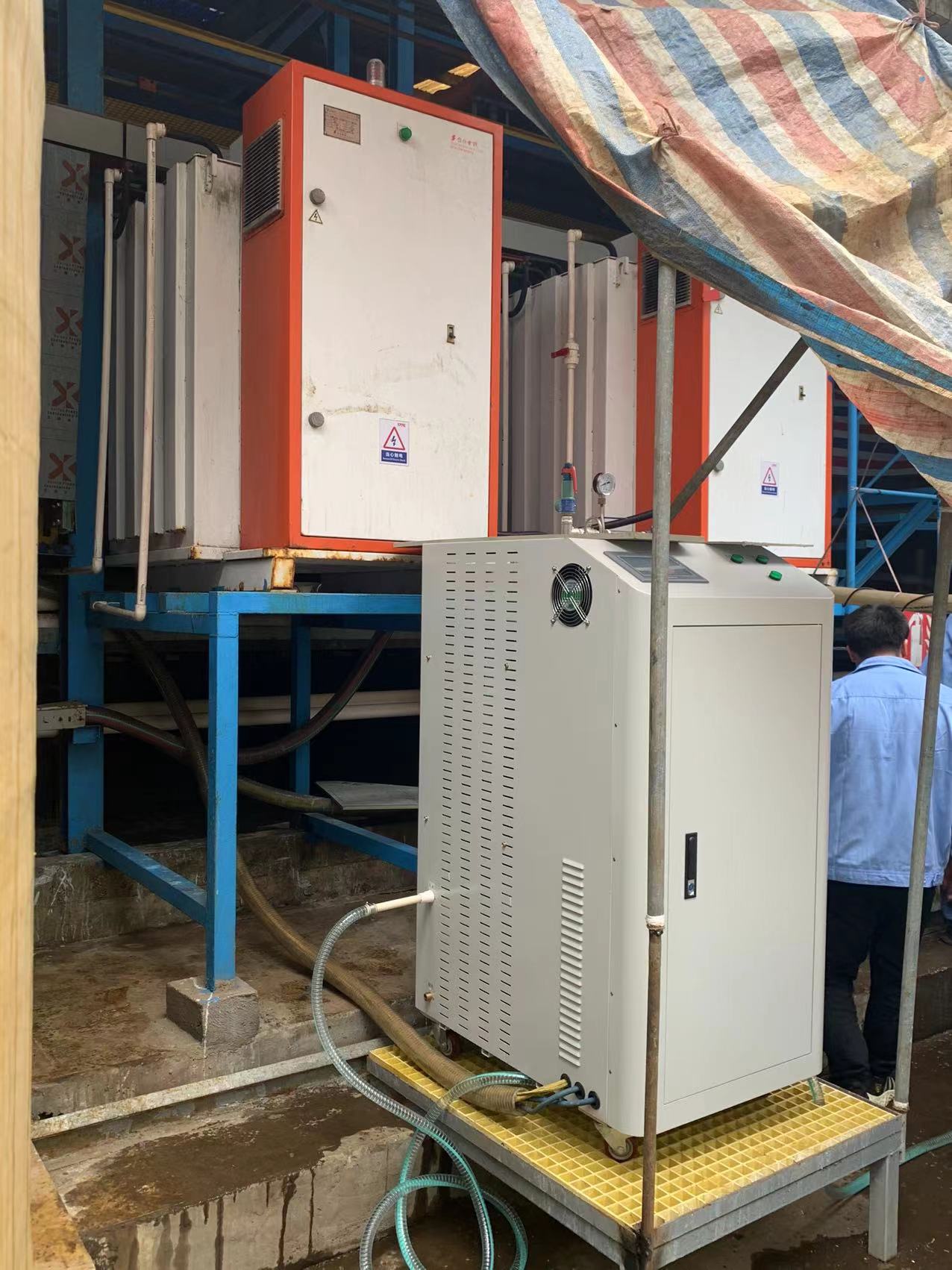
JONSON induction heaters used in temperature-controlled aquaculture.
Market Trends and Industry Position
The global induction heating system market was valued at USD 2.39 billion in 2024 and is projected to reach USD 4.5 billion by 2035 (WiseGuyReports). Over 550,000 systems are deployed globally, with Asia-Pacific accounting for 40% of installations. Induction systems achieve average energy efficiencies up to 92%, reducing cycle times by 30% compared to gas or resistance heating (Global Market Insights). The 10–100 kW power segment dominates due to versatility in automotive, forging, and brazing applications (MarketsandMarkets). JONSON’s focus on this segment, combined with a robust R&D team of 30+ engineers, positions it to capture growing demand.
Comparison with Traditional Solutions
Compared to resistance band heaters, JONSON’s induction heaters offer faster heat-up (steam in 30 seconds, hot air at rated temperature in 3 minutes), higher efficiency (≥95% versus 60–75%), and longer service life due to non-contact heating. However, the initial investment in induction equipment is typically higher than resistance heaters, though the total cost of ownership often favors induction due to energy savings and reduced downtime.
Future Outlook
As global decarbonization accelerates, electrification of industrial heat is inevitable. JONSON’s ability to offer customized voltage variants (110V, 240V, 660V) and modular systems makes it adaptable to regional standards and scale requirements. The company’s export-oriented strategy—40% of sales going to Europe, the US, India, and Indonesia—signals its readiness for cross-border supply chains. Continued investment in DSP control and IoT connectivity will likely enhance remote monitoring and predictive maintenance capabilities.
Frequently Asked Questions
What is the typical power range of JONSON induction heaters?
JONSON offers induction heaters from 2.5 kW to 100 kW single units, with customizable voltages (110V, 220V, 380V, 660V) and frequencies (50/60 Hz). Higher power can be achieved by paralleling multiple units.
Which industries commonly use induction heating?
Plastics and rubber processing, food manufacturing, chemical reactions, crude oil pipeline heating, textile dyeing, aquaculture, metal heat treatment, building heating, and medicinal herb drying are typical application fields.
How does induction heating compare to gas boilers for steam generation?
Induction steam generators (like JONSON’s JS-1600) achieve ≥99% efficiency, produce steam in 30 seconds, and have zero NOx emissions. They are more compact and require no chimney or fuel storage, but may have higher upfront costs.
What certifications do JONSON products have?
JONSON induction heaters carry CE, ISO, and RoHS certifications as per product specifications. The company also adheres to IEC 60519 safety standards for industrial heating equipment.
Can JONSON heaters be integrated with existing control systems?
Yes, the DSP-based controllers support PID adjustment via 0–5V analog input or RS-485 communication, allowing integration with PLC or SCADA systems. Temperature detection accuracy is ±1°C.