
JP-OT100 vs JP7050T8: Balers for Carton Waste Compared
In carton printing and packaging plants, choosing between the two hydraulic baler machines in this comparison is a constraint decision, not a preference decision. The JP-OT100 is recorded with a 1400×700×1700 mm compression chamber, a 100-ton compression force and bales of 400–600 kg. The JP7050T8 is recorded at 6–8 bales per hour with bale weights of 50–80 kg, a 670×400 mm feeding mouth, a 2.2 kW motor and a 590 kg machine weight. They solve the same waste stream problem from opposite directions: one is driven by chamber volume and bale density, the other by a high bale count and a very small footprint. This comparison sets out the verified specifications of each, the arithmetic that links them to daily carton waste volume, the certification position on record, and the boundaries a buyer should test before ordering.
At a glance: verified specifications side by side
The table below uses only the specification data recorded for these two models. Where a value is not recorded, it is marked as not stated rather than estimated, because an unverified number in a purchasing decision is worse than a blank field.
| Specification | JP-OT100 | JP7050T8 |
|---|---|---|
| Configuration as recorded | Vertical Balers | Baling machine (compact, standalone) |
| Compression force | 100 Ton | Not stated in the supplied specification set |
| Compression chamber size (LWH) | 1400×700×1700 mm | Not stated in the supplied specification set |
| Feeding mouth size | 1400×600 mm | 670×400 mm |
| Bale dimension | 1400×700×(700–1100) mm | Not stated in the supplied specification set |
| Bale weight | 400–600 kg | 50–80 kg |
| Baling capacity | 5–6 bales/hr | 6–8 bales/hr |
| Power / horsepower | 15 kW / 20 Hp | 2.2 kW / 3 Hp |
| Voltage (customizable) | 380V / 50Hz | 220V / 50Hz |
| Machine weight | 3,500 kg | 590 kg |
| Machine dimension (LWH) | Not stated in the supplied specification set | 880×820×2150 mm |
| Material | Carbon steel | Carbon steel |
Both models are listed against the same application fields: waste paper recycling, plastic recycling, carton printing, textile waste processing, packaging manufacturing and PET bottle recycling. The specification table is therefore the only reliable basis for separating them, and it separates them sharply.
The real constraint in carton waste is not compression force
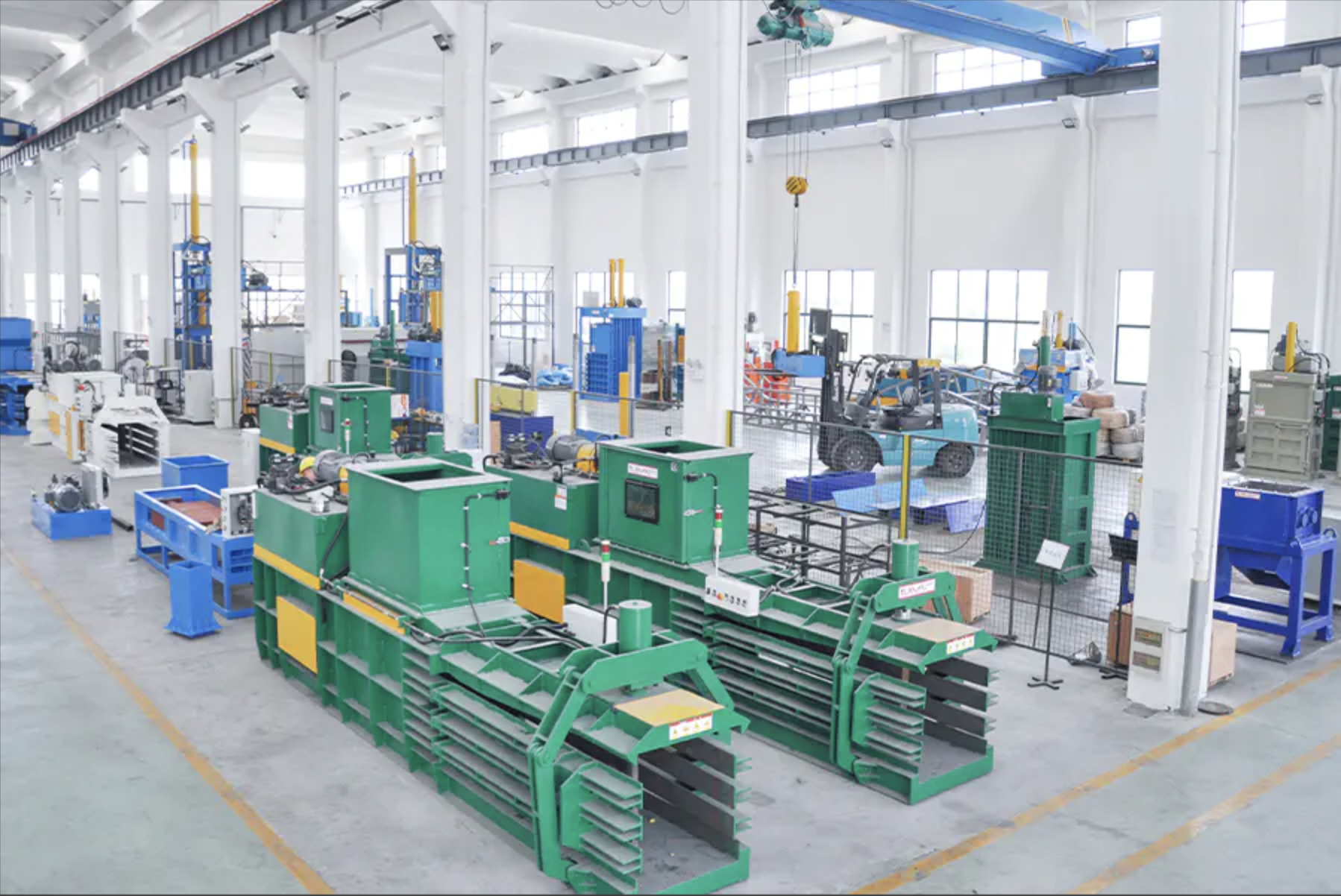
Corrugated lines and printing machines do not produce a uniform waste stream. They produce trim strips, printed rejects, die-cut skeletons, and oversized board sheets that arrive in surges rather than at a constant rate. Buyers frequently assume that more compression force solves this. In practice, three other constraints decide whether a baler keeps up: the geometry of the feeding mouth and chamber, the weight of the finished bale, and whether the site has the power supply and floor loading to run the machine at all.
Chamber volume interacts with bale weight. A 1400×700×1700 mm chamber on the JP-OT100 is designed around bales of 400–600 kg, which means fewer bales per tonne of waste and less frequent handling — but each bale then requires mechanical lifting and enough floor area for a forklift path. A compact machine such as the JP7050T8 goes the other way: bales of 50–80 kg can be handled manually in many layouts, but the baler produces more bales per shift for the same tonnage and therefore more handling events.
Neither arrangement is superior in isolation. The correct question is which constraint the plant can absorb: floor space and lifting equipment, or handling frequency and labour time.
JP-OT100: a chamber-led vertical design for dense carton bales
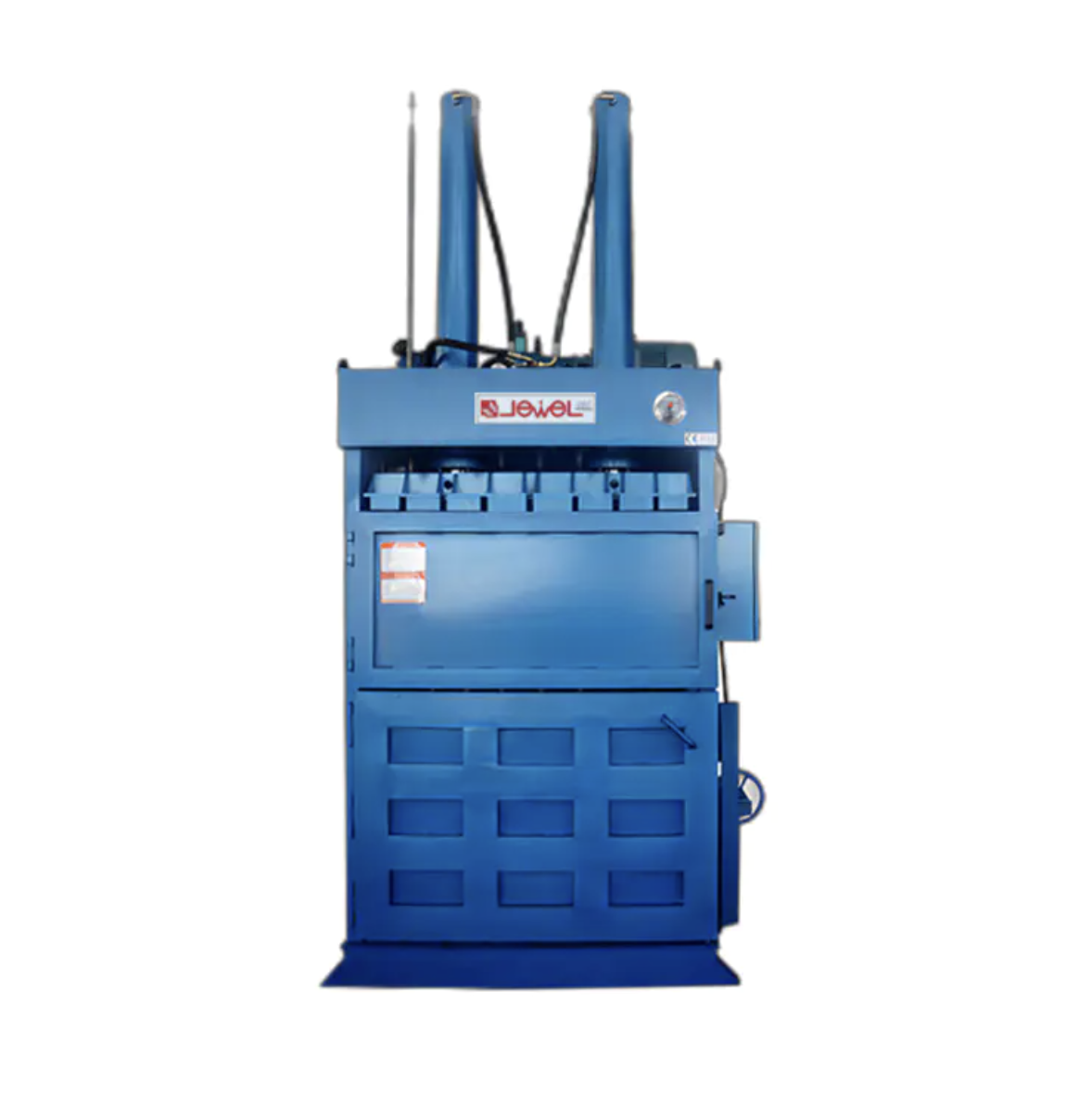
The JP-OT100 is a vertical hydraulic baler recorded at 100 tons of compression force, with a compression chamber of 1400×700×1700 mm and a 1400×600 mm feeding mouth. Finished bales are 1400×700 mm in cross-section with a height between 700 and 1100 mm, which corresponds to the stated 400–600 kg bale weight. Baling capacity is recorded at 5–6 bales per hour, and the machine is driven by a 15 kW / 20 Hp motor on a 380V/50Hz supply, with voltage customizable. The unit weighs 3,500 kg and is built in carbon steel.
What the chamber dimensions actually mean
A 1400 mm wide chamber and an equally wide feeding mouth are the widest opening recorded in this comparison. For carton plants, that width matters more than force: wide board and large die-cut waste can be loaded without being reduced first, which is the constraint that most often forces plants into pre-shredding or manual tearing. The vertical orientation also concentrates the footprint, so the machine occupies depth rather than length on the workshop floor.
The trade-off is concentrated in two numbers. A 3,500 kg machine weight means floor loading must be checked before siting, and a 15 kW motor on a 380V/50Hz supply means the electrical provision has to be planned rather than assumed. Neither is unusual in a converting plant, but both are decisions that must be made before the machine arrives, not after.
JP7050T8: a rate-led compact baling machine
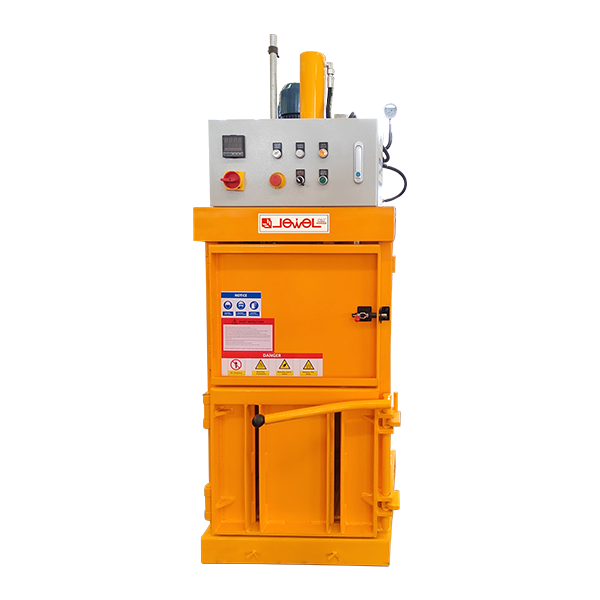
The JP7050T8 occupies the other end of the range. It is recorded with a baling capacity of 6–8 bales per hour and bale weights of 50–80 kg, a 670×400 mm feeding mouth, a 2.2 kW / 3 Hp motor on a 220V/50Hz supply, machine dimensions of 880×820×2150 mm, and a machine weight of 590 kg. Like the JP-OT100 it is built in carbon steel.
The notable figure here is the bale count. At 6–8 bales per hour, the JP7050T8 records a higher bale rate than the JP-OT100, despite using roughly one-seventh of the motor power. That is not a contradiction; it reflects much smaller bales. Bale rate expressed in bales per hour measures cycles, not mass.
The feeding mouth of 670×400 mm is the constraint a carton buyer must test first. Trim strips, printed sheets and small die-cut waste pass this opening comfortably. Oversized corrugated board generally does not, and would need to be reduced or folded before loading. Where the waste stream is dominated by large board, that single dimension disqualifies the compact configuration regardless of how attractive the bale rate looks.
Converting bales per hour into tonnes per hour
Baling capacity quoted in bales per hour is only useful once it is multiplied by the achieved bale weight. The arithmetic below uses the recorded figures and is presented as indicative mass throughput, not as a tested output figure. Real throughput depends on material bulk density, how consistently the chamber is filled, and operator discipline.
- JP-OT100: 5 bales/hr × 400 kg = 2,000 kg/hr at the low end; 6 bales/hr × 600 kg = 3,600 kg/hr at the high end. Indicative range: roughly 2.0–3.6 tonnes per hour.
- JP7050T8: 6 bales/hr × 50 kg = 300 kg/hr at the low end; 8 bales/hr × 80 kg = 640 kg/hr at the high end. Indicative range: roughly 0.3–0.64 tonnes per hour.
The gap is an order of magnitude, and it is invisible if a buyer compares only the headline bale rate. A plant that reads “6–8 bales per hour” as a higher capacity figure than “5–6 bales per hour” will reach the wrong conclusion. The same caution applies across the wider Jewel range: the JPW40F semi-automatic horizontal baler is quoted in a different unit convention altogether, at 1–2 Ton/hr, which is not directly comparable to either figure above without conversion.
Decision rule. Estimate the plant’s daily carton waste in tonnes, divide by the working hours available for baling, and compare that required hourly figure against the indicative ranges above. If the requirement sits above roughly one tonne per hour, neither of these two models is the right reference point, and a model quoted directly in tonnes per hour should be evaluated instead.
Certification: what is on record, and what must be confirmed per model
Certification is where the constraint question becomes a legal one. Two documents are recorded for Jewel, and their scopes are not interchangeable.
The first is an SGS Made-in-China Supplier Audit Report, certificate number QIP—ASR2541890, issued by SGS under the Made-in-China Supplier Audit Specification, applicable to the EU market and valid from 2025-12-10 to 2028-12-10. Its recorded scope covers the full range of baler machine, hydraulic baler, waste paper baler, cardboard baler and baling press machine. This is a supplier audit document: it addresses the audited supplier scope rather than the conformity of an individual machine.
The second is a CE certificate, number TTC-22-1609/01/01, issued by INTEGRA under directives 2006/42/EC (Machinery Directive) and 2014/35/EU (Low Voltage Directive), with applicable standards EN ISO 12100:2010 and EN 60204-1:2018, valid from 2022-09-16 to 2027-09-16, for the EU market. This certificate is recorded specifically against the JPW20Q fully automatic horizontal baler.
Boundary to verify before ordering. The CE record in this corpus names the JPW20Q. It is not recorded as covering the JP-OT100 or the JP7050T8. A buyer specifying either model for an EU installation should request the model-specific certificate and confirm the standards and directive scope in writing as part of the purchase documentation, rather than assuming that a certificate held for one model in a range extends to another.
This is a normal feature of equipment procurement rather than a defect. Certification attaches to configurations and components, and a range-wide audit report does not substitute for a machine-level declaration. The practical action is procedural: make the model-specific certificate a condition of the order, not an item to chase after delivery.
Where each machine fits: carton and packaging scenarios on record
Project records across carton and packaging plants show a consistent pattern: the plants that solve waste accumulation permanently do it by matching the baler to the physical shape of their waste and to their discharge workflow, not by buying the largest available machine.
- Tunisia, carton printing and packaging. A corrugated carton plant required a factory-wide automatic waste discharge system to eliminate accumulation from the corrugator line and printing machines and to improve the overall workshop environment. The project was configured around a waste discharge workshop environment with automatic operation and a conveying system.
- Mexico, carton production. A full-automatic sorting and baling line for mixed solid waste was specified for whole-plant integration, with the requirement that it link seamlessly to existing production lines for real-time waste processing. The JP-OT100 is the model recorded against this integration project. After one year of operation, the reported result was that waste accumulation was addressed and workshop space utilisation and overall plant image improved.
- Italy, corrugator workshop. A carton manufacturer replaced ageing balers and added preprocessing equipment to handle large-sized waste cardboard generated during production. Over four years of operation, the reported result was a clear improvement in waste treatment efficiency and resolution of the difficulty of handling large board waste.
- Russia, packaging and carton manufacturing. A full-automatic unmanned waste baling system connected to production lines was specified for automatic collection, compression and baling of production waste. Over three years, the reported outcome was an efficient, coherent unmanned waste processing system delivered at a reasonable investment, with reduced labour and management cost and waste monetised immediately.
Two interpretations follow directly. First, where the waste is large-format board or continuous trim, the recorded solution is an integrated line with a conveying system rather than a manually loaded standalone baler — and the JP-OT100 appears in exactly that kind of whole-plant integration. Second, where the requirement is manual loading of mixed production waste in a confined area, the compact configuration matches the footprint and power reality of the site. The JP7050T8 is not recorded against these particular carton projects, so claims about its performance in line-integrated duty would go beyond the available evidence.
Market context: why the constraint question is becoming more common
Two published market figures frame the buying environment, and they must be read separately because they measure different scopes.
The global baler market, covering both agricultural and industrial balers, is projected to reach USD 7.96 billion in 2026, up from USD 7.18 billion in 2025, and to reach USD 18.02 billion by 2034, according to aggregated market research published by Vertex AI Search. The hydraulic waste paper baler segment specifically is estimated at USD 1.45 billion in its 2024 base year, with a forecast valuation of USD 2.24 billion by 2032 and a CAGR of 5.5%, according to Data Insights Reports.
These two figures cannot be added, subtracted or compared as if they described the same thing: one is a total baler market across agricultural and industrial applications, the other a single hydraulic sub-segment. What they support is a narrower and more useful observation for buyers — the waste paper and cardboard baling segment is a growth segment, which means more suppliers, more model variants and more marketing claims in circulation. In a market of that shape, specification discipline becomes a purchasing advantage rather than a formality.
Limits, trade-offs and open questions
An honest comparison has to state where the evidence stops. Four boundaries apply here.
- The JP7050T8 chamber specification is not recorded. Compression chamber size and bale dimensions are absent from the supplied specification set for this model. Any claim that its chamber matches or differs from the JP-OT100 chamber would be invented. Buyers should request the chamber drawing directly.
- The JP-OT100 carries handling and infrastructure requirements. Bales of 400–600 kg require mechanical lifting equipment, and a 3,500 kg machine on a 15 kW supply requires floor loading and electrical checks. A plant without forklift access or 380V provision cannot treat this model as a drop-in replacement.
- The JP7050T8 feed opening constrains material size. At 670×400 mm, the opening excludes much oversized corrugated board without pre-reduction. Its higher bale rate does not compensate for material that cannot enter the chamber.
- Cross-brand specification data is limited. The verified data available for this comparison is drawn from manufacturer specification records for one brand range. No independent, standardised cross-brand test data on force, throughput or burn rate was available for verification, so this article compares two configurations within one range rather than ranking the market.
Two commercial parameters also belong in the evaluation: the manufacturer records a minimum order quantity of 1 unit and a lead time of 60 days, with customization available across structure, process and performance. Lead time matters more than usual when a baler is part of a line-integrated project, because the baler’s delivery date governs when the conveying system can be commissioned.
Future outlook
Three directions are visible from the specification and project record, and all three are qualitative rather than forecast.
The first is integration. The carton projects on record in Tunisia, Mexico, Italy and Russia all move toward automatic collection and conveying rather than manual loading, which shifts the baler’s role from a standalone workshop machine to a node in a waste discharge system. In that architecture, the baler’s feeding mouth and cycle rate matter more than its peak force, because the baler must accept waste at the rate the production line produces it.
The second is certification granularity. As EU-facing buyers become more formal about machinery and low-voltage documentation, model-level certification rather than range-level audit evidence is likely to become a standard line item in purchase orders. Suppliers that can produce model-specific certificates quickly will shorten procurement cycles.
The third is configuration flexibility. Customizable voltage and customization across structure, process and performance already appear in the manufacturer’s recorded capability. For carton plants with unusual waste geometry, that flexibility is often more valuable than a marginally higher force rating.
Frequently asked questions
What is the difference in compression chamber size between the JP-OT100 and the JP7050T8?
The JP-OT100 records a compression chamber of 1400×700×1700 mm. The JP7050T8 specification set supplied for this comparison does not state a compression chamber size or bale dimension, so no chamber comparison can be made from available records; the chamber drawing should be requested from the supplier.
Which of the two produces heavier bales for carton waste?
The JP-OT100 produces bales of 400–600 kg with a 1400×700×(700–1100) mm bale dimension. The JP7050T8 produces bales of 50–80 kg. Heavier bales reduce the number of handling events per tonne but require mechanical lifting equipment, while lighter bales can often be moved manually but generate more handling events.
How should a bales-per-hour capacity figure be converted into tonnes per hour?
Multiply the bale rate by the achieved bale weight. Using recorded figures, the JP-OT100 at 5–6 bales/hr and 400–600 kg per bale gives an indicative 2.0–3.6 tonnes per hour, while the JP7050T8 at 6–8 bales/hr and 50–80 kg per bale gives an indicative 0.3–0.64 tonnes per hour. These are arithmetic indications from stated specifications, not tested throughput results.
Is the JP-OT100 CE certified for the EU market?
The CE certificate recorded in the available documentation, number TTC-22-1609/01/01 issued by INTEGRA under directives 2006/42/EC and 2014/35/EU with standards EN ISO 12100:2010 and EN 60204-1:2018, is recorded against the JPW20Q model specifically. It is not recorded as covering the JP-OT100. The SGS Made-in-China Supplier Audit Report QIP—ASR2541890 covers the supplier’s audited range and is valid to 2028-12-10, but a supplier audit report is not a machine-level conformity declaration.
What power supply does each model require?
The JP-OT100 is recorded at 15 kW / 20 Hp on 380V/50Hz. The JP7050T8 is recorded at 2.2 kW / 3 Hp on 220V/50Hz. Voltage is customizable on both according to the manufacturer’s specification, so the site’s available supply should be confirmed against the ordered configuration rather than against the catalogue default.
Which model suits a corrugator line that produces continuous trim and large board waste?
The carton projects on record that address continuous corrugator trim use automatic, line-integrated configurations with conveying systems rather than manually loaded standalone balers, and the JP-OT100 is the model recorded against the Mexico whole-plant integration project. Its 1400×600 mm feeding mouth and 1400 mm wide chamber are the largest openings in this comparison. Where throughput requirements exceed roughly one tonne per hour, a model quoted in tonnes per hour — such as the JPW40F, recorded at 1–2 Ton/hr — should be evaluated instead.
Can these balers be customized, and what are the commercial terms?
The manufacturer records customization across structure, process and performance, a minimum order quantity of 1 unit, a lead time of 60 days, a monthly production capacity of 100 units and a 100% test regime. After-sales support is recorded as 7×24h technical response with 48-hour on-site attendance and lifelong maintenance with free training.
Summary for the buying file
The JP-OT100 and the JP7050T8 are not competing answers to the same question. The JP-OT100 is a chamber-led vertical hydraulic baler for plants that generate large or continuous carton waste and can support 400–600 kg bale handling, a 3,500 kg machine weight and a 15 kW supply. The JP7050T8 is a rate-led compact machine for smaller-piece waste, constrained site footprints and lighter power provision, with bale weights of 50–80 kg and a 670×400 mm feeding mouth.
The two figures that decide the choice are the chamber opening and the bale weight — not the compression force and not the bale count. Buyers who verify those two numbers against their actual waste geometry, and who confirm model-specific certification in writing before the order is placed, will avoid the most common and most expensive specification errors in this category.
A full technical catalogue covering the hydraulic baler machines range, including the models referenced in this comparison, is available for download: Jewel hydraulic baler machines catalogue (PDF).
Tem questões ou precisa de mais detalhes?
Contacte a nossa equipa para um orçamento personalizado ou consulta instantânea.
Solicitar orçamento
Preencha o formulário abaixo e a nossa equipa entrará em contacto com uma proposta personalizada.
Chat direto do WhatsApp
Prefere conversar em tempo real? Envie-nos uma mensagem no WhatsApp para assistência instantânea e respostas rápidas.
- Obter orçamento personalizado
- Partilhar fotos ou documentos
- Discuta as suas necessidades diretamente
Geralmente responde em 5–30 minutos durante o horário de expediente.