
JUXIN Lathe Machines vs Traditional: A Comparative Analysis for Shaft & Disc Parts
The decision between a modern dual-end CNC lathe and a traditional horizontal or single-spindle lathe is no longer just about price—it is about production economics, precision retention, and long-term competitiveness. JUXIN MACHINE TOOL, a Chinese manufacturer with an annual production capacity of 2,000 sets and over 50 technological patents, has developed a family of machines designed to challenge conventional turning processes. This analysis compares JUXIN's core offerings—middle drive double-head lathes, twin-spindle vertical lathes, and facing & centering machines—against ordinary horizontal lathes, traditional vertical lathes, and peer alternatives, using verified performance data.
Problem & Opportunity
Conventional lathes process one end at a time, requiring secondary clamping and re-alignment. This introduces concentricity errors, extends cycle times, and increases labor dependency. The manual re-clamping step alone can add 40-60% more machining time for shaft and disc parts, while scrap rates climb due to alignment drift. JUXIN's approach eliminates this bottleneck through simultaneous double-end machining and multi-process integration, enabling higher throughput and consistent precision at scale.
Brand Solution
JUXIN MACHINE TOOL is a specialist in CNC lathe machines, offering three primary product lines that directly address these pain points:
- Middle Drive Double-Head Lathe: Uses a central spindle layout with a one-piece cast bed and 45° inclined rigid structure, enabling both ends of a workpiece to be machined simultaneously without re-clamping. Concentricity is controlled within ±0.005–±0.01mm, and the processing cycle per workpiece is 40%–60% shorter than ordinary horizontal lathes.
- Twin-Spindle Vertical Lathe (model 24723): Features a cast bed with special mechanical structure for high rigidity and no resonance. It achieves radial runout ≤0.005mm, coaxiality ≤0.01mm, and dimensional tolerance ±0.008mm. Single-piece processing time is 50%–70% shorter, and daily output is 2–3 times higher than traditional horizontal lathes.
- Facing & Centering Machine: Combines end face milling and center hole drilling in one clamping, with end face flatness ≤0.01mm (versus ≥0.03mm for ordinary old lathes). Single-piece processing time is 40%–60% shorter, and energy consumption per part is only 60%–70% of ordinary old lathes.
Technical Explanation
Middle Drive Double-Head Lathe: The one-piece cast iron bed eliminates the deformation and alignment issues typical of split joint beds. The 45° inclined design facilitates natural chip removal via a rear centralized system, preventing chip accumulation that can degrade precision. The dual spindles and dual turrets operate synchronously, effectively cutting cycle times in half compared to sequential processing.
Twin-Spindle Vertical Lathe (24723): The special mechanical structure of the bed provides superior damping, enabling heavy cutting without resonance. Multi-process integration—turning, milling, drilling, and grinding—allows one machine to replace multiple conventional units. The unit part processing cost during mass production is 25%–35% lower, driven by 40% less consumable loss and the ability for one operator to manage 2–3 machines. The annual fault rate is ≤2 times with monthly maintenance, and intelligent fault early warning further reduces downtime.
Facing & Centering Machine: The integrally cast high-rigidity structure, protected by core patents, maintains long-term stability. Modular design and adoption of mainstream CNC systems (Siemens, Fanuc) simplify operator training. The machine achieves 40%–100% higher comprehensive processing efficiency by completing multiple processes in one clamping.
Application & Use-Case Scenarios
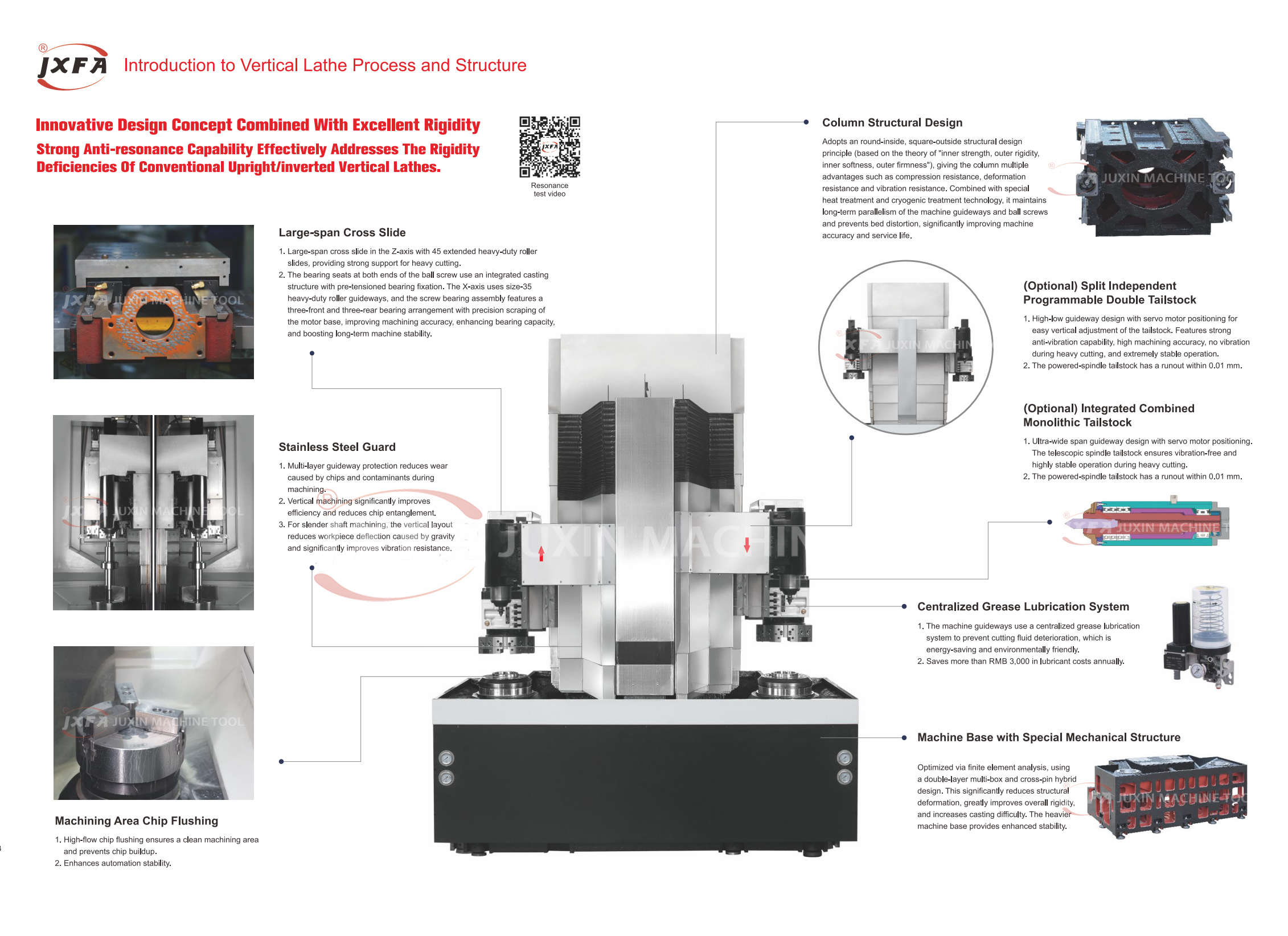
Figure 1: JUXIN Twin-Spindle Vertical Lathe – engineered for high-precision mass production of wind power flanges, heavy machinery hubs, and aerospace components.
- Automotive parts: Mass production of motor shafts, half shafts, bearing sleeves, and flanges where end-to-end concentricity and batch consistency are critical.
- Construction machinery: Heavy shaft and disc components requiring simultaneous facing, drilling, and turning with tight dimensional tolerances.
- Wind power & aerospace: Large-diameter flanges and hubs up to medium/large sizes, where traditional horizontal lathes require multiple setups and long cycle times.
- Motor & transmission: Standard shafts, gear shafts, and transmission components requiring repeat positioning accuracy of 0.003–0.005mm.
Market Trend Analysis
The global CNC machine market was valued at USD 73.5 billion in 2024 and is projected to reach USD 187.2 billion by 2034, with the CNC lathe segment holding the leading market share of approximately 30%–32.82%. Asia Pacific dominated with 37% revenue share (USD 27.2 billion) in 2024. Within this growing market, buyers increasingly prioritize machines that reduce labor dependence and improve yield. Dual-end and multi-spindle lathes are gaining traction as automation enablers. However, the actual performance gap between high-quality integrated-bed designs and ordinary split-bed models remains large—a distinction that directly impacts scrap rates and total cost of ownership.
Comparison with Traditional Solutions
JUXIN Middle Drive Double-Head Lathe vs Ordinary Horizontal Lathe: The JUXIN machine achieves 40%–60% shorter processing cycle and concentricity within ±0.005–±0.01mm versus ±0.015–±0.03mm for ordinary lathes. Operating cost over five years is 40% lower, maintenance intervals are 50% fewer, and maintenance cost is 60% lower. An honest limitation: the initial procurement cost is 2.5–4 times higher, so the payback period depends on batch size and shift utilization.
JUXIN Twin-Spindle Vertical Lathe vs Traditional Horizontal Lathe: Daily output is 2–3 times higher, energy utilization exceeds 85% (versus 50%–60%), and maintenance cost is 60% lower. Limitation: initial purchase cost is 60%–80% higher, but long-term operation cost is 2–2.5 times lower, making it economical for high-volume production.
JUXIN Facing & Centering Machine vs Ordinary Old Lathe: End face flatness improves from ≥0.03mm to ≤0.01mm; unit part energy consumption drops to 60%–70%; scrap rate is virtually zero. Limitation: unit price is 2–3 times higher, but one machine replaces 2–3 operators plus auxiliary drilling equipment.
Future Outlook
As manufacturers push toward lights-out production and zero-defect manufacturing, dual-end lathes with integrally cast beds will become a baseline requirement rather than a premium option. JUXIN's roadmap includes AI five-axis turn-milling and humanoid robot equipment, indicating continued investment in intelligent automation. For buyers evaluating new lathe investments today, the structural integrity of the bed, the use of one-piece cast iron, and the ability to integrate with MES and robotic loading are decisive factors that separate long-term performance from short-term cost savings.
FAQ
- How much shorter is the processing cycle of JUXIN's middle drive double-head lathe compared to an ordinary horizontal lathe?
It is 40%–60% shorter per workpiece because both ends are machined simultaneously without re-clamping. - What precision can I expect from JUXIN's twin-spindle vertical lathe?
Radial runout ≤0.005mm, coaxiality ≤0.01mm, and dimensional tolerance ±0.008mm. - What are the maintenance requirements for JUXIN machines?
Monthly inspection is typical; the twin-spindle vertical lathe has an annual fault rate ≤2 times, with intelligent early warning. Maintenance intervals are 50% fewer than ordinary lathes. - Which industries are these lathes most suitable for?
Automotive parts, motor & transmission, construction machinery, wind power flanges, aerospace components, and any high-precision mass production of shaft and disc parts. - How does the cost compare over a 5-year period?
Operating cost for the middle drive double-head lathe is 40% lower than ordinary horizontal lathes. Unit part processing cost during mass production is 25%–35% lower for the twin-spindle vertical lathe. - What is the main limitation of JUXIN's dual-end lathes?
Higher initial purchase cost—2.5–4 times that of traditional alternatives—requiring larger volume production to justify the investment.
For a detailed technical overview, download the JUXIN MACHINE TOOL brochure: Product Brochure (PDF).
Tem questões ou precisa de mais detalhes?
Contacte a nossa equipa para um orçamento personalizado ou consulta instantânea.
Solicitar orçamento
Preencha o formulário abaixo e a nossa equipa entrará em contacto com uma proposta personalizada.
Chat direto do WhatsApp
Prefere conversar em tempo real? Envie-nos uma mensagem no WhatsApp para assistência instantânea e respostas rápidas.
- Obter orçamento personalizado
- Partilhar fotos ou documentos
- Discuta as suas necessidades diretamente
Geralmente responde em 5–30 minutos durante o horário de expediente.