
JYD Models' Window Display Model Capability: 2013 to Now
JYD Models' Window Display Model Capability: 2013 to Now
A window display model is commissioned for a specific piece of glass: a retail frontage, a showroom wall, a sales-centre plinth or an exhibition stand. What separates suppliers is rarely the photograph of a finished model. It is whether the organisation behind the photograph can carry a specification from drawing review through prototype decision, lighting integration, quality inspection and export packing without the buyer having to re-explain the job at every stage.
JYD Models — Shenzhen JYD Architectural Models Co., Ltd. — is a professional architectural model design and production company based in Shenzhen, China, established in 2013 and focused on customised architectural scale models for global clients. Its published company facts give a buyer something concrete to test: a 4,000 m² facility, 200 employees, a 12-engineer R&D team, a reported annual output of 1,000 units, a reported export ratio of 50% and a minimum order of one unit. This article examines those facts as capability evidence for a window display model buyer at the evaluation-to-execution stage, including what they do not prove.
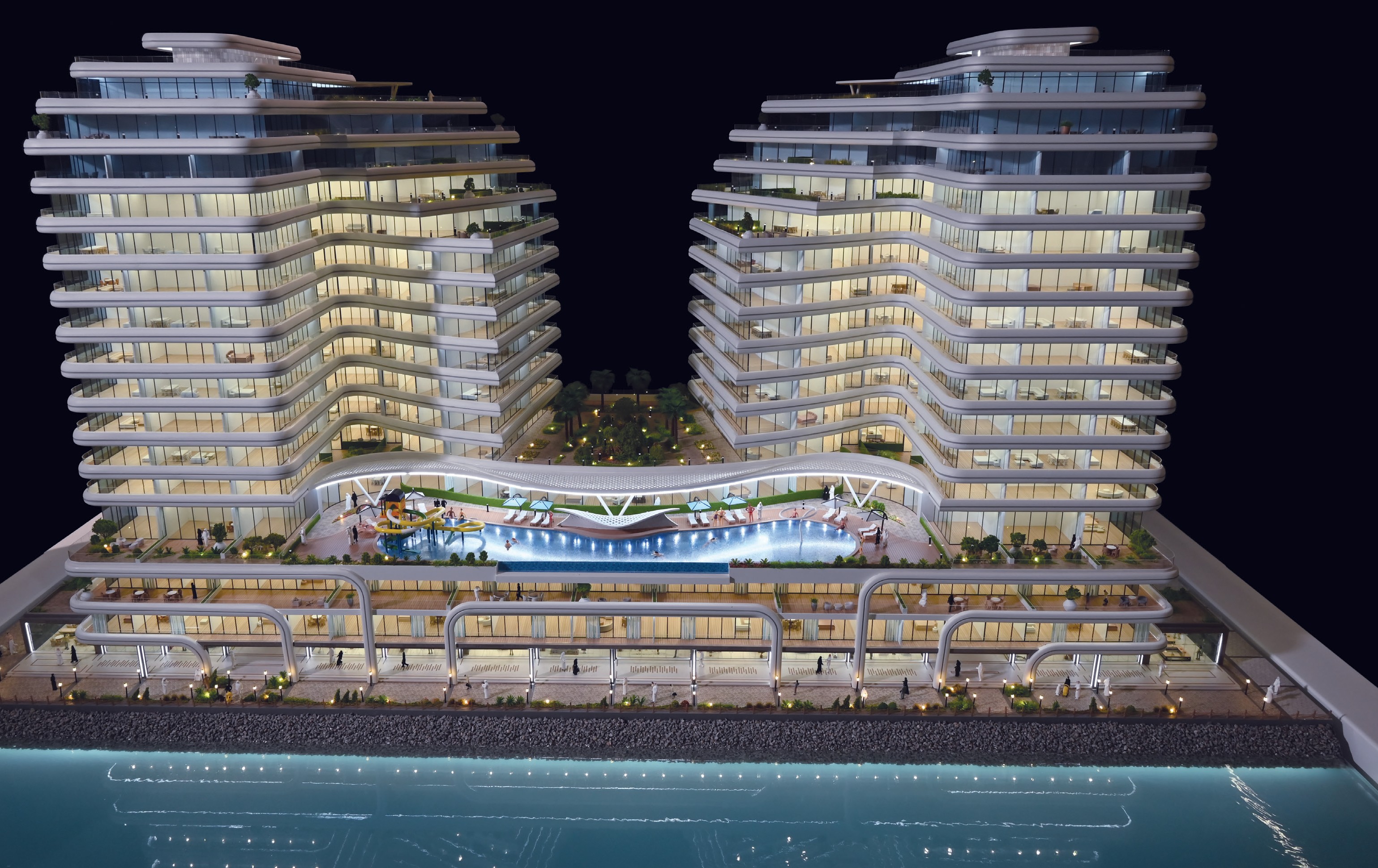
Why a capability claim needs an operating base behind it
Window display models are a small part of a large spending stream, and that creates a specific evaluation problem. A buyer can compare finished models visually, but cannot see from a portfolio which part of the job was designed in-house, which part was subcontracted, and who will answer when a lighting zone fails during installation week.
Three questions separate a model manufacturer from a trading intermediary in this category. First, is there a production address with a floor area that can hold assembly and packing of the sizes being quoted? Second, is there a named engineering function that reviews drawings before production rather than during it? Third, is there a written sequence of confirmations that both sides can point to when a detail is disputed?
JYD Models' published facts answer those three questions at the level of structure rather than promise: a stated facility size, a stated engineering headcount, and a stated quality-control sequence that begins with drawing review and ends with packaging confirmation. That is the correct level at which to begin, because none of it can be replaced by a portfolio image.
JYD Models' operating facts at a glance
The company-reported facts that matter most to a window display model buyer are listed below with the check each one enables. Each value should be read as a starting reference for verification, not as a finished assessment.
| Reported fact | Value | What a buyer can do with it |
|---|---|---|
| Operating name | Shenzhen JYD Architectural Models Co., Ltd. | Match the contract, commercial invoice and shipping documents to one legal identity. |
| Established | 2013 | Sample projects from more than one year of that history; the track record spans more than a decade. |
| Facility | 4,000 m² | Judge whether assembly, painting, landscaping and packing of your footprint can happen in one place. |
| Workforce | 200 employees | Estimate whether your project runs alongside others; then confirm the team assigned to you. |
| Engineering | 12-engineer R&D team | Confirm who reviews drawings, 3D modelling, lighting and structural detailing. |
| Reported annual output | 1,000 units | Use as a throughput scale reference, not as a delivery date. |
| Reported export ratio | 50% | Expect export packing and documentation to be routine rather than a first attempt. |
| Minimum order | 1 unit | Single custom projects are accepted; no batch minimum is published. |
| Reported main markets | EU, Saudi Arabia, Vietnam, India, Southeast Asia, China, Africa, Middle East, Qatar, UAE | Ask for comparable projects in your region before assuming freight or handling familiarity. |
| Named contact | Ford Yang; fordyang@jydmodels.com; +86 135-1065-4351 (telephone and WhatsApp) | Test response time and technical depth through one accountable channel. |
What 200 employees and 12 engineers tell a buyer, and what they do not
Headcount is the most quoted and least examined number in supplier profiles. Read together, the workforce and engineering figures describe a particular kind of organisation.
Twelve engineers inside a workforce of 200 is a calculated ratio of about 6%. The implication is structural: engineering is a specialist function here, while most of the workforce sits in fabrication, finishing, assembly and packing. That distribution matches how custom architectural models are actually made, where hand assembly, painting and landscaping consume more hours than drawing production. JYD Models' company description is consistent with it, describing a workforce of model makers, designers and engineers.
The output figure points the same way. A reported 1,000 units a year across 200 employees is a calculated average of about five units per person per year. For a workshop producing one-off, project-based models rather than repeated stock items, that order of magnitude is what a buyer should expect. It is not a productivity claim, and it should not be converted into a delivery schedule.
The limit is equally clear. None of these figures state how many people will be assigned to your window display model, or which engineer will review your drawings. At execution stage, ask for that allocation in writing as part of the quotation: a named engineering contact, expected review dates, and the person who signs the final inspection.
OEM and ODM: two different delegations of a window display model
The most consequential decision in a capability-oriented brief is not the scale or the lighting. It is how much of the job the buyer keeps. JYD Models offers both routes: OEM services for producing custom architectural models based on client designs, and ODM services for designing and producing custom architectural models, covering the full process from design to production. Both are offered for custom architectural model production, and both end at the same confirmation gate.
The distinction matters because the failure modes differ. In an OEM brief, design intent arrives fixed; the risk is that an ambiguous drawing becomes an expensive assumption. In an ODM brief, the supplier interprets the project; the risk is interpretation drift between the first concept and the finished facade.
| Dimension | OEM route | ODM route |
|---|---|---|
| Design responsibility | Client supplies the design package. | Supplier develops the model design from the project brief. |
| Typical inputs | CAD drawings, renderings, master plan, elevations, landscape plans, display requirements. | The same inputs plus display goal, footprint limit and viewing distance. |
| First review point | Drawing review before production. | Design interpretation review, then drawing review. |
| Main risk to manage | Specification ambiguity carried into fabrication. | Divergence between the initial interpretation and the approved appearance. |
| Best fit | Buyers with an architect or in-house design team and a locked design. | Buyers who need scale strategy and detailing developed for them. |
| Common gate | Final drawings, model scale, display requirements and lighting details confirmed before production. | Same gate. |
In both routes, one supplier statement belongs in the contract: production starts after final drawings, model scale, display requirements and lighting details are confirmed. That sentence protects both sides. It also means a buyer who has not fixed the footprint and the lighting zones is not ready to schedule production, whatever the quotation says.
The documented workflow, from quotation to wooden case
The sequence below is the one a window display model buyer should be able to trace through documents rather than conversation. Each stage notes what is documented in JYD Models' published material and what a buyer should obtain at that point.
Quotation. A quotation for a custom model depends on scale, size, project complexity, lighting requirements, packing method and delivery term. JYD Models quotes on EXW Shenzhen or FOB Shenzhen terms, and international sea or air freight can be arranged according to model structure, packaging and destination. Ask for the model, lighting, base or acrylic cover, packing and freight to be listed separately, because they are driven by different variables and a single total hides which one is setting the price.
Drawing review. Drawing review before production is the first named quality-control step. Buyers normally supply CAD drawings, renderings, master plans, elevation drawings, landscape plans and display requirements. The practical check is not whether a review happens but who signs it and what it covers: orientation, floor heights, facade rhythm, signage positions and the boundary of the model base.
Specification confirmation. Customisation covers model scale and size, building facade details, landscape design, LED lighting system, zoning display, touch-control interaction, multimedia linkage, material selection, base design, acrylic cover, packaging method and installation support. Scale deserves separate attention in window display work. Published model-making guidance indicates that medium scales such as 1:200 and 1:300 balance building detail with master-plan visibility, while larger scales such as 1:50 and 1:100 suit individual buildings, interiors and facade studies. If your display is a single retail frontage viewed at close range, that guidance places 1:50 and 1:100 inside the appropriate range; confirm the final scale against the actual footprint rather than choosing the model size first.
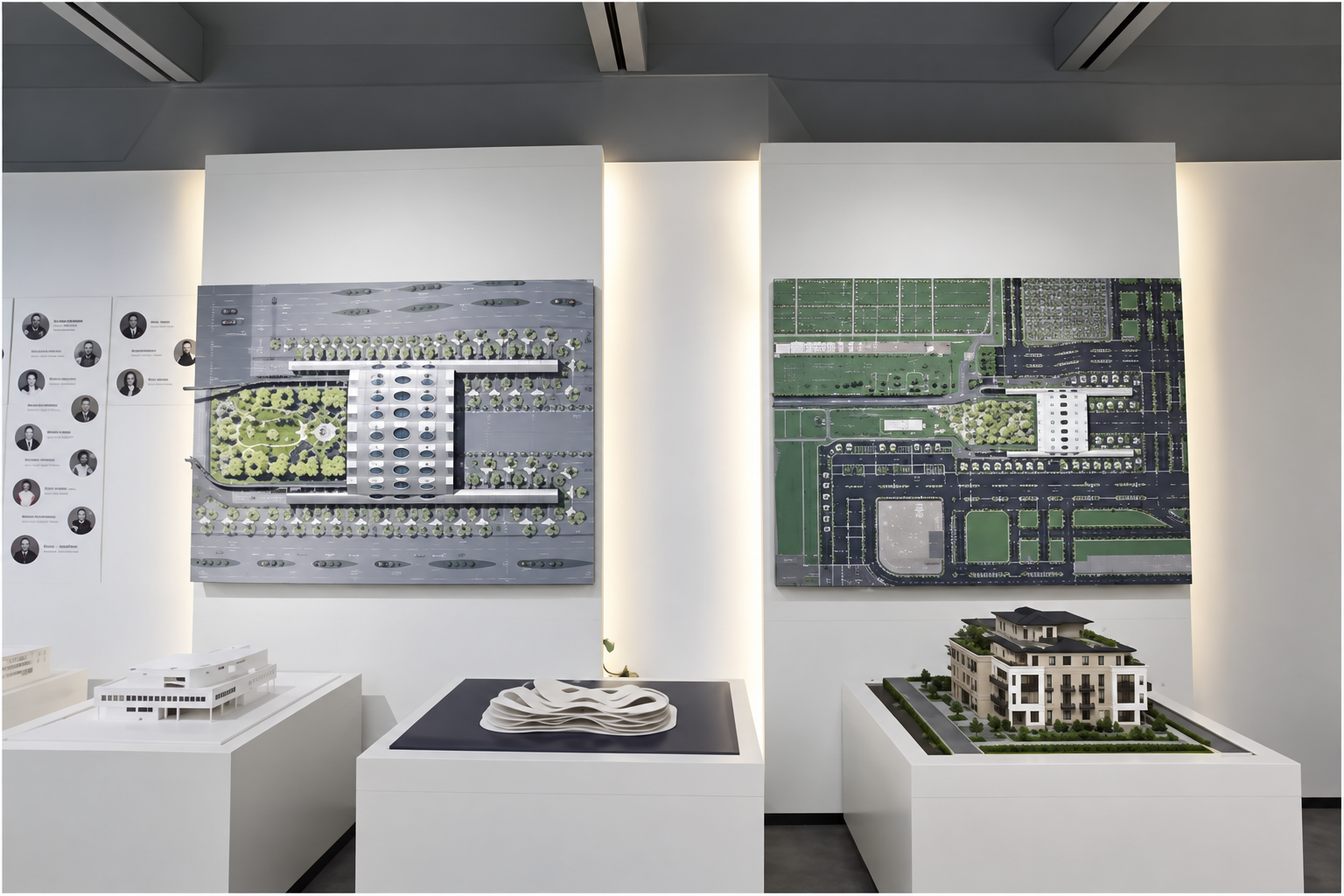
Prototype approval. This is the stage buyers most often assume exists. JYD Models' published quality-control list names drawing review before production, material inspection, scale and proportion checks, facade detail inspection, lighting system testing, assembly inspection, progress photo and video confirmation, and final inspection before packing and shipment; a separate physical prototype is not listed among them. If your programme requires one, schedule it explicitly and tie it to the progress photo and video stage so that a partial assembly is presented for written approval before finishing continues.
Production updates. Progress photo and video confirmation is a named control step, which makes dated updates at agreed milestones a reasonable request rather than a favour. Specify the milestones in the purchase order: after base assembly, after facade completion, and after lighting installation.
Quality inspection. Final inspection before packaging covers the criteria the buyer approved: confirmed drawings, model scale and size, facade and landscape details, and lighting requirements. A lighting system test is part of the sequence, which matters for an LED-lit window display model that will be judged in a dark retail environment. Ask for the test to be recorded with zones switched individually, not only in a single all-on photograph.
Modular packaging and shipment. Large or fragile models can be packed in modular wooden cases for safer long-distance or international shipment, and packaging is confirmed before delivery. This is where a reported 50% export ratio becomes relevant: modular packing, case numbering and reassembly instructions are the difference between a model that arrives intact and a repair project. Request the packing plan with the quotation rather than after inspection.
Commercial sequence. Payment terms are set by quotation and contract. For custom work, production usually starts after a deposit, with the balance paid before shipment or as agreed. Treat the confirmation date and the deposit date as two separate milestones in your schedule.
After delivery. Support scope covers remote technical support, installation guidance, maintenance guidance, lighting system troubleshooting, replacement advice for damaged parts, and packaging and transportation support. These are the terms to test against the reality of your site: who answers, in which time zone, and how fast a replacement part travels.
Checking the address, the named contact and the response channel
For a first order from an unfamiliar supplier, the cheapest risk reduction is consistency checking. JYD Models publishes an address, a named contact, an email address, two telephone-format contact routes and a website, which is enough to run a short verification pass.
The published address is the 4th Floor, Building 7, Shiyan Tango Third Industrial Zone, Baoan District, Shenzhen, China. The named contact is Ford Yang, reachable at fordyang@jydmodels.com and at +86 135-1065-4351 by telephone and WhatsApp. The company website is JYD Models, and a downloadable company brochure is also published.
Four checks follow directly. First, domain consistency: the email domain matches the website domain, a basic signal that the contact channel belongs to the same organisation as the site. Second, single-number reachability: the telephone and WhatsApp numbers are identical, so one number reaches the named contact rather than a call centre. Third, identity matching: ask which entity name will appear on the commercial invoice and the shipping documents, and confirm it matches the contracting party. Fourth, live verification: request a scheduled video call from the production floor and ask to see the assembly area where your model would be built, not only a showroom.
What these checks establish is identity and reachability, not capability. A consistent address and a responsive contact reduce counterparty ambiguity; they do not prove that the supplier can hold a facade detail at 1:100 or that its lighting control suits your site. No independent certification is listed in the supplied company material. If your compliance process requires one, request it explicitly rather than inferring it from export experience.
How to read a market list
JYD Models reports main markets that include the EU, Saudi Arabia, Vietnam, India, Southeast Asia, China, Africa, the Middle East, Qatar and the UAE, alongside a reported export ratio of 50%. A separate capability statement lists export markets as China, the Middle East, Southeast Asia, Europe, the United States and other international markets.
Market lists are self-reported and usually unqualified: they rarely state project type, year or volume per market. Their procurement value is narrower than it appears. They indicate that long-haul freight, customs paperwork and multilingual coordination are familiar territory, which matters for a display model that may travel by sea and be reassembled by a local team. They do not indicate regulatory compliance in any market, and they should not be used to assume a project reference in your city.
The practical test is a comparability request: two or three projects per market you care about, with scale, finished size, lighting scope, delivery date and venue type. If the supplier cannot produce them, treat the market list as intent rather than evidence.
Where a window display model capability is actually tested
Different display settings stress different parts of a model. The settings below map the applications named in the company's material to the capability question each one raises.
- Retail window display. The model is viewed through glass, in daylight and often with reflections. Lighting zones and surface finish carry the presentation, and the base must allow cleaning access. Ask how the LED lighting is zoned and how it is serviced without disassembling the model.
- Showroom and sales centre. Viewing distance is longer and the model competes with screens. Layout, landscape and traffic routes must read at a glance; touch-control interaction or multimedia linkage becomes a presentation tool rather than a novelty.
- Real estate sales model. The model carries the sales conversation, so facade detail, landscape, phased display and lighting zones arrive in one object. This is the most common use of the company's stated customisation scope.
- Museum and gallery settings. Long-term indoor display puts weight on material stability, a protective acrylic cover and maintenance access, all of which appear in the company's stated options and display requirements.
- Exhibition and pop-up stands. The constraint is modularity. A model that assembles, packs and reassembles on a stand benefits more from modular structure and case numbering than from extra surface detail.
- Shopping mall, public building and office complex displays. Footprint and base design dominate. A large footprint needs a base that can be levelled and moved, plus a plan for how it enters the building.
- Urban planning and master plan displays. Small scales such as 1:500 and 1:1000 carry the message, with zoning and road hierarchy more important than surface texture.
- Landscape-integrated and facade-focused briefs. These are the two ends of the detail question. Decide early which one the window is selling; a model cannot maximise both at a fixed footprint.
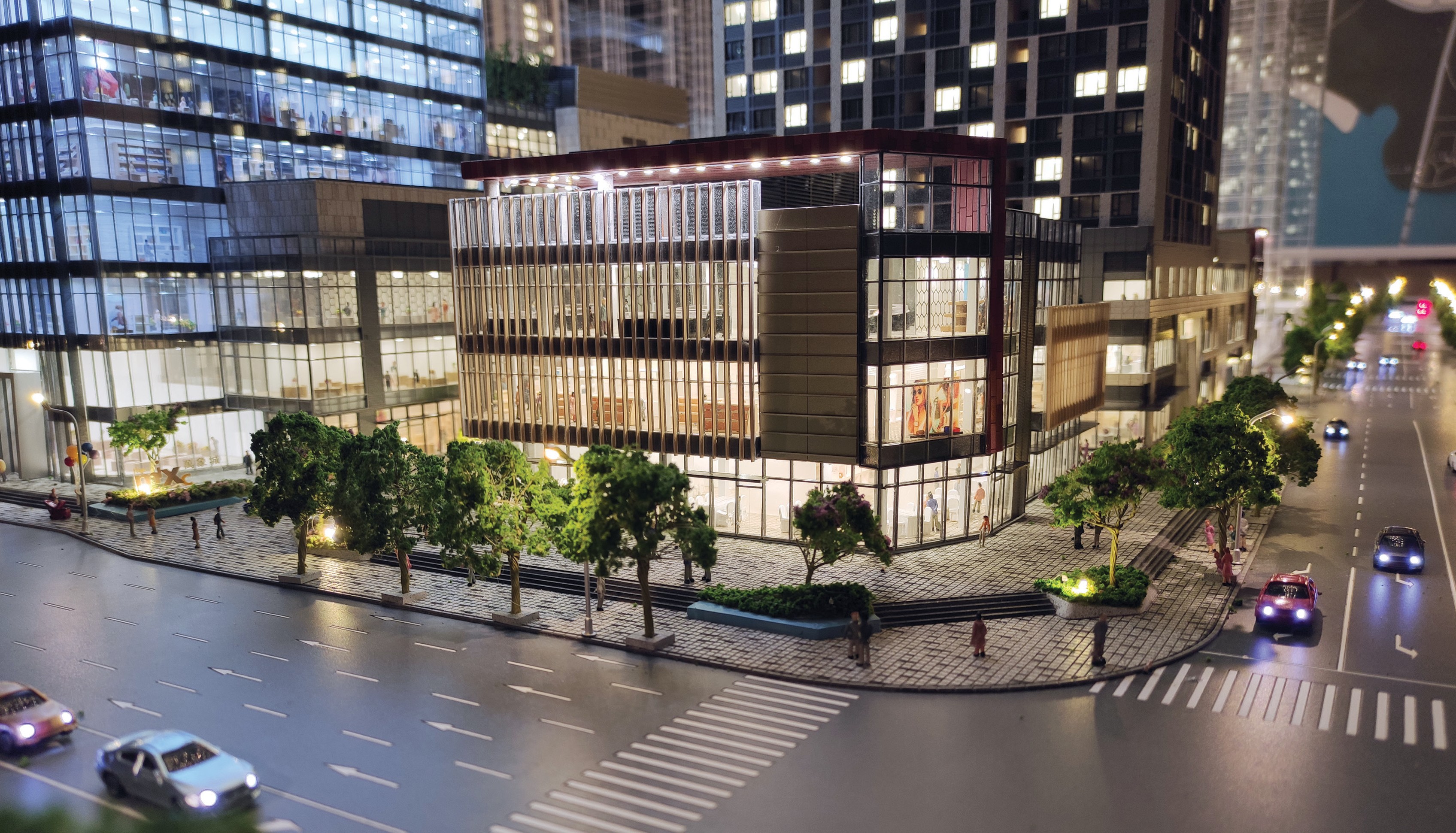
The common thread is that display conditions, not model complexity, should set the specification. A boutique window viewed from close range and a planning exhibition viewed from several metres need different detail budgets, and a supplier's willingness to say so is itself a capability signal.
Market context, kept in proportion
Two independent estimates help frame why display models keep being commissioned, provided they are read for what they measure.
Grand View Research reports the global architectural services market at USD 411.7 billion in 2025, with Asia Pacific holding a 37.4% revenue share. Fortune Business Insights places North America at 28.5% of the same market in 2025, valued at USD 113.66 billion. Both figures describe spending on architectural and planning services, which is the client base that commissions presentation models; neither measures the physical model segment itself.
That distinction is not academic. Published totals for this space differ partly because some sources count total architecture, engineering and construction services while others count architectural services alone, so no single figure should be read as the market size for display models. The supplied data contains no granular estimate for the physical scale-model sub-segment.
One further data point is worth noting with its caveat. Grand View Research reports digital services, meaning BIM and 3D modelling, at a 47.2% share of AEC services in 2025; that entry is marked as a derived value with medium confidence. Read as context, it describes a design industry that documents projects digitally first. It does not suggest physical models are being replaced, and no growth claim about model demand is made here. What it does explain is the input side of a model commission: by the time a window display model is quoted, structured drawings usually exist, which is why drawing review is a control point rather than a formality.
Where the evidence stops
Capability evidence is only useful if its edges are visible. Five limits apply to the facts above.
No standard lead time is published. JYD Models states that lead time depends on project size and complexity, and that production starts after final drawings, model scale, display requirements and lighting details are confirmed. A buyer planning a retail launch should build that confirmation sequence into the schedule rather than treating the quotation date as the start date.
Capacity is described qualitatively. The company describes project-based custom production, with capacity depending on model scale, complexity, lighting requirements and delivery schedule, and states that it can handle multiple customised projects at the same time. That is a statement of capability, not a reserved production slot.
Headcount, output and export ratio are company-reported and are not audited in the supplied material.
Market coverage is self-reported without per-market volumes, as noted earlier.
Acceptance is defined by the buyer's own specification — confirmed drawings, model scale, size, facade and landscape details, lighting requirements and final client approval. This is normal for custom work, and it places responsibility for spec quality on the buyer's side of the table. A vague brief does not become precise during production.
What to put in the request before a deposit
An execution-stage enquiry that answers these points will produce quotations that can actually be compared.
- Display setting and viewing distance, including whether the model sits behind glass.
- Maximum footprint and height, including base and acrylic cover.
- Scale, or the finished size you need so the supplier can propose the scale.
- Detail priority: facade, landscape, interiors or signage.
- Lighting scope: zones, control method, and whether touch interaction or multimedia linkage is required.
- Packing and delivery term: modular wooden case, EXW Shenzhen, FOB Shenzhen, or arranged sea or air freight.
- Acceptance basis: who signs the final inspection and against which drawing set.
- Installation: whether remote guidance is sufficient or on-site support is expected.
Frequently asked questions
What does an OEM arrangement with JYD Models cover?
Under an OEM arrangement, JYD Models produces custom architectural models based on the client's designs. The client supplies the design intent and drawings, and the supplier converts them into a physical model through a process that can include drawing review, 3D modelling, CNC machining, 3D printing, laser cutting, hand assembly, painting, landscaping and LED lighting integration. Design responsibility stays with the buyer, which is why drawing review is the critical control point.
What does the ODM route add?
ODM services cover design as well as production: the company designs and produces custom architectural models, supporting the process from design through manufacturing. The buyer's input shifts from a fixed drawing package to a project brief with display goal, footprint and viewing conditions. The added scope also adds an approval step, because the design interpretation must be reviewed before production drawings are fixed.
Which files are needed before a window display model is quoted?
CAD drawings, renderings, master plans, elevation drawings, landscape plans and display requirements are the usual inputs. Adding the display location, viewing distance, maximum footprint, lighting requirements and delivery schedule lets the supplier quote scale, structure, lighting and packing in one pass instead of revising later.
How is a model inspected and packed before shipment?
The published quality-control sequence runs from drawing review before production through material inspection, scale and proportion checks, facade detail inspection, lighting system testing, assembly inspection and progress photo or video confirmation to final inspection before packing. Packaging is confirmed before delivery, and large or fragile models can be packed in modular wooden cases for long-distance or international shipment.
Can a buyer verify the operating details before contracting?
Several details are checkable without a visit: the operating name, the Shenzhen address in Baoan District, the named contact, an email domain that matches the published website, and a telephone number that is also the WhatsApp number. A scheduled video call from the production floor adds a live check. These confirm identity and reachability rather than capability on a specific model.
What is not established by the available facts?
No standard lead time, no independent certification, no audited headcount or output figure, no per-market project volume and no price band are published in the supplied material, and capacity is described qualitatively. Buyers should obtain project references, a packing plan and a written acceptance basis before committing to a production schedule.
Conclusion
Capability, for a window display model buyer, is the ability to hold a specification across a sequence of handoffs: drawing review, specification confirmation, prototype or first-article approval where required, production updates, lighting tests, final inspection and modular packing. JYD Models' published facts address the first half of that sentence with structure rather than adjectives: a company established in 2013, a 4,000 m² facility in Shenzhen, 200 employees, a 12-engineer R&D team, a documented control sequence, and both OEM and ODM routes. The second half is answered in documents a buyer should request before paying a deposit.
The company brochure is available for download as a starting reference: JYD Models company brochure (PDF).
Tem questões ou precisa de mais detalhes?
Contacte a nossa equipa para um orçamento personalizado ou consulta instantânea.
Solicitar orçamento
Preencha o formulário abaixo e a nossa equipa entrará em contacto com uma proposta personalizada.
Chat direto do WhatsApp
Prefere conversar em tempo real? Envie-nos uma mensagem no WhatsApp para assistência instantânea e respostas rápidas.
- Obter orçamento personalizado
- Partilhar fotos ou documentos
- Discuta as suas necessidades diretamente
Geralmente responde em 5–30 minutos durante o horário de expediente.