
Jewelry Wholesale MOQ and Ordering FAQs: Xuping Specs Explained
A jewelry wholesale order is usually decided inside the specification sheet, not on the catalogue page. Minimum order quantity defines financial exposure; plating method, nominal dimensions, weight and stone information define what can be resold without dispute; and the test report attached to a specific model defines which markets the goods may enter. For first-time importers, those four questions normally arrive in that order.
This reference answers the technical and procurement questions that recur most often in low-MOQ jewelry wholesale: how small a first order can be, how a specification sheet should be read, whether plating and material claims can be checked, what paperwork travels with the goods, and where the limits of a low-MOQ model actually sit. The answers below are drawn from documented product specifications, certification records and order-capability data published by Guangdong Xuping Jewelry Co., Ltd., which trades as Xuping Jewelry — a fashion-imitation jewelry manufacturer and supplier based in Guangzhou, China, founded in 1997, whose portfolio covers rings, pendants, earrings, bracelets, necklaces, anklets, bangles and jewelry sets, and which exports its output internationally while supporting low minimum order quantities and OEM / ODM customization.
Why MOQ and Specification Clarity Come Before Price
Wholesale jewelry buyers often open a comparison with unit price. In practice, three checks decide whether an order is repeatable, and price is only one of them.
- Specification check. A bracelet listed at 170 mm with a 30 mm extension and a bangle listed at 60 mm (±2 mm) are different products for a merchandiser, even if both leave the same factory. Nominal length, width, weight and plating method sit in the specification sheet, and they are the fields that generate returns when they are ignored.
- Compliance check. Jewelry sold into the European Union must meet REACH Regulation (EC) 1907/2006, which limits nickel release to 0.5 μg/cm²/week, lead to 500 mg/kg and cadmium to 100 mg/kg. A buyer who confirms only the price and the design cannot answer a customs or marketplace query later.
- Customization check. When a supplier offers engraved logos, hang tags and custom packaging, the buyer is no longer ordering stock; they are commissioning a production step, and that step has its own timing.
Order volume is no longer the gate it once was. Xuping Jewelry documents an annual output of more than 100,000,000 pieces and a monthly production capacity of 8,000,000 pieces, which means a small trial order is scheduled inside an existing industrial flow rather than around it. That is the structural reason a low minimum order quantity is possible at all: the factory is not switching on a line for one carton, it is allocating a fraction of a line that is already running.
What a Low-MOQ Order Includes at Xuping Jewelry
The ordering parameters below are the ones a first-time importer needs before requesting a quotation. They are documented capability figures rather than negotiated terms, so they can be used as a baseline when comparing suppliers.
| Ordering parameter | Documented value | What it means for a first order |
|---|---|---|
| Minimum order quantity | 1 piece | Enables sample validation, assortment testing and single-model trial before committing to volume. |
| Production mode | OEM / ODM | Buyers can supply their own design intent or select existing models for branding. |
| Customization options | Engraved logos, hang tags, custom packaging | Branding is applied at the item and packaging level rather than only on the outer carton. |
| Monthly capacity | 8,000,000 pieces | Scale supports both replenishment and seasonal build-up. |
| Lead time | 30–90 days | Planning window for production; low MOQ does not compress it. |
| Quality control | 100% full inspection; SGS-certified quality control; 18-stage quality check; REACH / ROHS compliance testing | Inspection is described as full rather than sampled, and compliance testing is built into the process. |
| After-sales | 24/7 online support; after-sales quality guarantee; product replacement; OEM / ODM after-sales service; global logistics support | Defines the channel for claims, replacements and repeat-order support. |
How to Read a Precision-Detailed Spec Sheet
A complete wholesale specification answers six questions: what the item is, what it is made of, how it is finished, how big it is, how heavy it is, and how it is sold. Xuping Jewelry publishes these as model-level records, which means two buyers quoting the same catalogue reference should be working from identical numbers. Two worked examples show how the fields are used in practice.
Example 1 — Stainless Steel Bracelet, Model T000959269
Model T000959269 is a stainless steel bracelet in the Daily series. The bracelet size is approximately 170 mm × 6 mm with a 30 mm extension, the hand size is 11.01 cm, and the listed weight is about 11.01 g. It has no main stone, the unit of quantity is the piece (pcs), and the item is positioned for jewelry suppliers, fashion accessories, jewelry retail, wholesale, the gift industry and e-commerce.
The procurement reading of that record is straightforward. The 30 mm extension tells a buyer the bracelet has an adjustable fit range, which matters for a single-size retail listing. The absence of a main stone removes stone-matching risk from the order. The stainless steel base places the item in a different material family from the plated copper range, which affects the care instruction printed on the retail card.
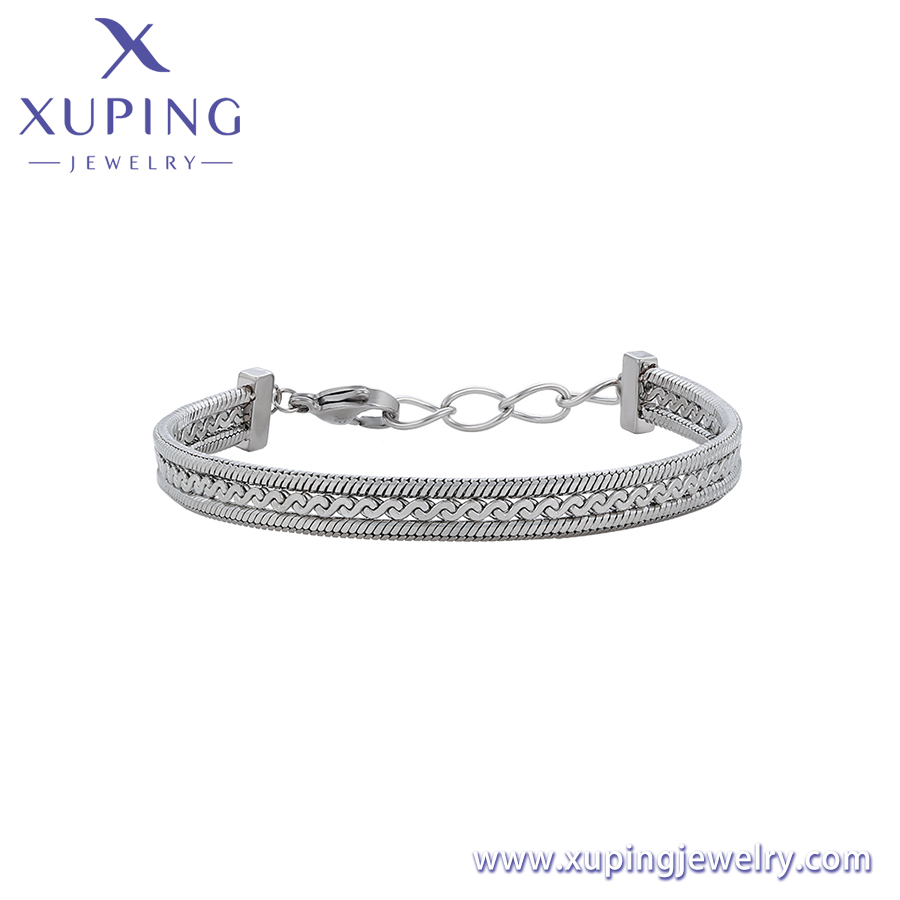
Stainless steel bracelet, model T000959269 — approximately 170 × 6 mm with a 30 mm extension and a listed weight of about 11.01 g.
Example 2 — Platinum-Plated Brooch, Model A00900238
Model A00900238 is a brooch from the Daily series, made of Environmental Copper with platinum plating. The main stone is white synthetic cubic zirconia at approximately 3.5 × 3.5 mm, the brooch itself measures approximately 47 × 32 mm, and the net weight is 12.3 g. It is sold by the piece and is classified under the Jewelry industry. The item carries the company mark “xp”.
Two points in that record are easy to miss. First, brooches have a free hand size, so the fit-related fields that matter for bracelets do not apply; the size that matters is the surface area of the piece. Second, the visible “xp” marking is documented in the specification, so a buyer planning to resell the item under their own label should confirm how that mark interacts with their private-label packaging before ordering in volume.
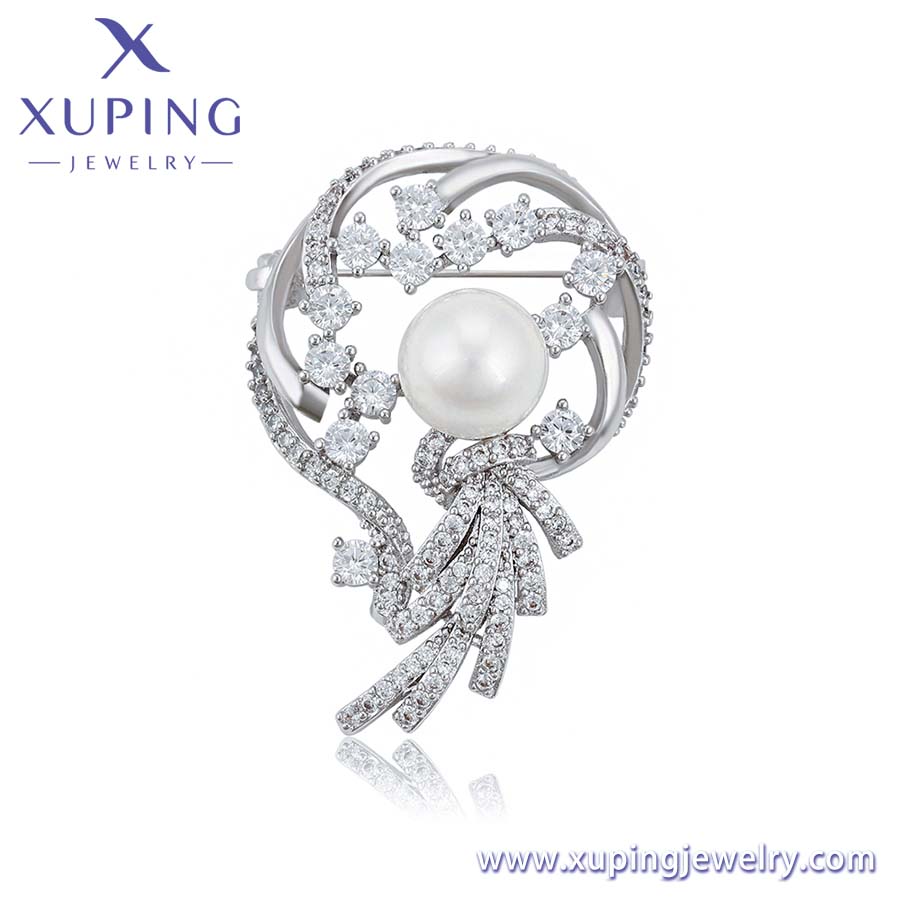
Environmental copper brooch, model A00900238 — platinum plated, 47 × 32 mm, white synthetic cubic zirconia main stone of about 3.5 × 3.5 mm, net weight 12.3 g.
The table below compares a small cross-section of the catalogue using the same fields, which is the format a buyer should request from any supplier before comparing prices.
| Model | Category | Base material | Plating method | Size | Listed weight | Main stone |
|---|---|---|---|---|---|---|
| T000959269 | Bracelet | Stainless steel | Stainless steel finish | Approx. 170 × 6 mm (+30 mm) | Approx. 11.01 g | No main stone |
| A00902945 | Necklace | Stainless steel | 14K gold color | Approx. 400 × 1 mm (+60 mm) | Approx. 6.30 g | No main stone |
| A00900238 | Brooch | Environmental Copper | Platinum plated | Approx. 47 × 32 mm | 12.3 g | White synthetic cubic zirconia, 3.5 × 3.5 mm |
| X000998659 | Bangle | Environmental Copper | 14K gold color | Approx. 60 × 8 mm (±2 mm) | 21.77 g | Ruby-colored synthetic cubic zirconia, 8 × 6 mm |
| X000668301 | Necklace | Environmental Copper | 18K gold color | Approx. 410 × 1 mm (+50 mm) | 7.915 g | Lilac synthetic crystal, 18 × 17 mm |
| 14E25011845 | Earrings | Environmental Copper | 18K gold color | Approx. 27 × 14 mm | 8.88 g per pair | AB color synthetic crystal |
| X001114331 | Ring | Environmental Copper | 14K gold color | Free hand size | 5.65 g | White synthetic cubic zirconia, 3 × 2 mm |
Material Consistency Across a Mixed Assortment
Xuping Jewelry states that its full-range portfolio adopts premium copper alloy as the base material with gold-plating craftsmanship, and that its range also includes stainless steel items such as the T000959269 bracelet and the A00902945 necklace. For a wholesale buyer this produces a practical consequence: a mixed assortment contains two material families, and they should not share one generic care instruction.
Consistency is also a matter of tolerance discipline. The published records are explicit about variation — the X000998659 bangle is listed at 60 × 8 mm with a ±2 mm tolerance, the X000867735 bangle at 65 × 2 mm (±2 mm), and the X000977345 bracelet at 200 × 5 mm (±2 cm). A buyer who treats those numbers as absolute will file claims that the supplier considers in-specification. The correct approach is to quote the tolerance band in the purchase order rather than the nominal figure alone.
Plating Durability: What the Specification Can and Cannot Tell You
The plating field is the most frequently misread line in a wholesale jewelry specification. Records in this catalogue use terms such as “14K gold color”, “18K gold color”, “platinum plated” and “stainless steel”. These describe the finish applied to the base material: “14K gold color” and “18K gold color” describe the colour tone of the plating layer and should not be read as a statement of solid gold content.
What the documentation does support is process control. The company states that goods pass through 18 production procedures to meet European and American environmental-protection standards, that its products hold international certifications including SGS, CE and ISO, and that quality control includes 100% full inspection, an 18-stage quality check and REACH / ROHS compliance testing. Those are process claims, and they are the right claims to weigh when comparing suppliers.
Certification Questions Buyers Ask Before the First Shipment
The most common compliance question from a new importer is simply: which document covers which item? In this catalogue, certificates are linked to specific products and specific standards, not issued as a single blanket statement. Three test houses appear in the records — SGS-CSTC Standards Technical Services Co., Ltd. Guangzhou Branch, Centre Testing International (Guangzhou) Co., Ltd., and ZHONGHANGXIN CERTIFICATION CENTER (SHENZHEN) CO., LTD.
| Certificate | Issued by | Standard | Validity | Linked product scope |
|---|---|---|---|---|
| SGS CANHL25006144001 | SGS-CSTC Standards Technical Services Co., Ltd. Guangzhou Branch | REACH Regulation (EC) No 1907/2006 | 2025-03-27 to 2030-03-27 | Crystal Jewelry - Earrings |
| SGS GZHL250301072401JW | SGS-CSTC Standards Technical Services Co., Ltd. Guangzhou Branch | REACH Regulation (EC) No 1907/2006 | 2025-03-31 to 2030-03-31 | Necklaces |
| SGS CANHL25006145601 | SGS-CSTC Standards Technical Services Co., Ltd. Guangzhou Branch | IEC 62321-7-1:2015 | 2025-03-27 to 2030-03-27 | Crystal Jewelry - Necklaces |
| SGS CANHL25004908001 | SGS-CSTC Standards Technical Services Co., Ltd. Guangzhou Branch | REACH Regulation (EC) No 1907/2006 | 2025-03-22 to 2030-03-22 | Earrings |
| CTI A2230517570101001 | Centre Testing International (Guangzhou) Co., Ltd. | IEC 62321-5:2013, IEC 62321-4:2013+AMD1:2017 CSV, IEC 62321-7-2:2017, IEC 62321-6:2015, IEC 62321-8:2017 | 2023-10-13 to 2028-10-13 | Rings |
| ISO9001 CACQ21Q00750R1 | ZHONGHANGXIN CERTIFICATION CENTER (SHENZHEN) CO., LTD | GB/T 19001-2016 / ISO 9001:2015 | Valid until 2027-10-25 | Stainless Steel Jewelry - Bracelets (design and production of metal jewelry) |
Two compliance boundaries are worth stating plainly for first-time importers. First, EU REACH limits are quantitative — nickel release at 0.5 μg/cm²/week, lead at 500 mg/kg, cadmium at 100 mg/kg — so a certificate should be checked against the exact market and the exact model. Second, jewelry intended for children under 14 in the EU is classified as a toy and requires mandatory CE marking under the Toy Safety Directive 2009/48/EC; an adult-fashion certificate does not substitute for that.
Where These Specifications Matter: Application and Order Context
The specification fields only become useful when mapped to the sales channel they will serve. Xuping Jewelry documents its workloads across daily wear, fashion shows, events and occasions, gift giving and all-weather use, and its project types across retail jewelry stores, e-commerce platforms, brand OEM / ODM, wholesale distribution and promotional gifts. Matching equipment listed for these uses includes jewelry display stands, custom gift boxes, storage bags and packaging solutions.
The practical mapping is short. A gift-giving program needs the packaging field confirmed early, because custom gift boxes are part of the same order as the jewelry. A fashion-show or event order is driven by plating tone and stone colour consistency across repeat pieces. An e-commerce assortment is driven by weight and dimensions, because listing accuracy depends on them. A promotional-gift order is driven by price band and by whether a logo can be engraved. Documented special requirements for this range — customized design, eco-friendly material, hypoallergenic and lead-free compliance — line up with those four use cases rather than sitting apart from them.
Market Signals Behind Low-MOQ Wholesale in 2026
Three published data points explain why ordering in smaller quantities has become a mainstream sourcing behaviour rather than a workaround.
- The global jewelry market was valued at approximately USD 242.79B to USD 381.5B in 2025, with projections reaching up to USD 578.5B by 2033. Estimates vary materially between research houses depending on whether fine jewelry, costume jewelry or both are counted, so the range should be read as a range rather than a single figure.
- China's total jewelry exports reached USD 11.5B in 2024, with the United States the primary destination at USD 1.31B.
- Online jewelry retail channels are projected to grow at a CAGR of 8.0% to 13% annually and to represent 25–30% of total industry purchases by 2026.
The segment detail matters for material planning as well: the global stainless steel jewelry market is projected to reach USD 10.8B by 2035, growing at a CAGR of 4.3% from 2026. Read together, these figures describe a market in which the buyer is increasingly an online seller with a narrow initial assortment — which is precisely the buyer a low-MOQ, specification-documented supply model serves.
Low-MOQ Factory Ordering vs Traditional Wholesale Tiers
Traditional wholesale tiers generally work through distributor-held stock, larger minimum quantities and less visibility into the original factory specification. The buyer receives a catalogue, not a model-level spec sheet, and compliance documents are often supplied at category level. Factory-direct low-MOQ ordering works the other way: small quantities are accepted, but the buyer is also handed the specification and is expected to have read it.
| Comparison dimension | Traditional distributor tier | Factory-direct low-MOQ ordering |
|---|---|---|
| Typical entry quantity | Generally higher, set by stock lots | As low as one piece per model |
| Specification visibility | Category-level descriptions | Model-level size, weight, plating and stone fields |
| Compliance documentation | Often provided at assortment level | Certificate numbers linked to specific products and standards |
| Customization | Usually limited to stock options | Engraved logos, hang tags and custom packaging under OEM / ODM |
| Lead time | Immediate on held stock | 30–90 days, since production is scheduled |
| Buyer's main task | Negotiating price and availability | Reading and confirming specifications before ordering |
Limits and Trade-offs Buyers Should Plan For
- Low MOQ does not shorten production. The documented lead time of 30–90 days applies to scheduled production. A one-piece trial order still enters that window.
- Customization adds steps. Engraved logos, hang tags and custom packaging are production activities, not catalogue add-ons, and they sit inside the same timeline.
- Nominal dimensions carry tolerances. Published records include ±2 mm tolerances on bangle sizes and ±2 cm on some lengths. Purchase orders should quote the band, not a single figure.
- A mixed assortment means two material profiles. Stainless steel items and plated environmental copper items need different end-customer care messaging.
- Certificates are model-linked. A REACH report covering one product category does not automatically extend to another category in the same order.
- Plating durability is not quantified. No wear-life figure is published at model level, so buyers should avoid repeating durability claims they cannot evidence.
- Low MOQ is a testing tool, not a pricing strategy. It is designed to validate design, fit and sell-through before volume commitments — not to deliver container-scale unit economics.
Future Outlook
Two structural forces are likely to shape how wholesale jewelry ordering is documented over the next few years. The first is compliance granularity: as EU and North American market requirements continue to be enforced at substance level, buyers will increasingly expect certificate numbers tied to a model rather than a category, which favours suppliers that already publish that linkage. The second is the shift of order volume toward online sellers, whose initial assortment is small and whose listing accuracy depends on published dimensions and weights.
Against both trends, the relevant supplier capability is not scale alone but documentation depth. Xuping Jewelry documents a research and development team of 62 designers, 194 patents and more than 1,200 production facilities across a production base of more than 200,000 m², and sells into markets that include the United States, Mexico, Germany, France, Italy, Poland, the United Kingdom, Turkey, Saudi Arabia, the United Arab Emirates, Indonesia, Malaysia, Vietnam, Thailand, the Philippines, Australia and Nigeria. The procurement implication for buyers is direct: the more of that specification data is published per model, the fewer disputes reach the claims stage.
FAQ
What is the minimum order quantity for wholesale jewelry from Xuping Jewelry?
The documented minimum order quantity is 1 piece. This applies to sample validation and single-model assortment testing as well as to larger replenishment orders, and it is supported by a monthly production capacity of 8,000,000 pieces and an annual output of more than 100,000,000 pieces.
What does a product specification sheet include, and how should it be read?
A complete record includes the model designation, category, base material, plating method, product series, nominal size or length with any extension, unit of quantity, listed weight and main stone information. Reading it means checking fit fields for wearable items — for example, model T000959269 lists a bracelet size of approximately 170 × 6 mm with a 30 mm extension — and checking stone and surface dimensions for items such as brooches, where hand size is listed as free.
How can material and plating consistency be verified before ordering in volume?
Verification rests on three published elements: the base material field, the plating method field, and the linked test documentation. Environmental Copper with 18K gold color plating and Environmental Copper with platinum plating are different finishes and should be ordered against separate line items. Because certificates in this catalogue are linked to specific products and standards — for example, SGS CANHL25006144001 covers Crystal Jewelry - Earrings against REACH Regulation (EC) No 1907/2006 — the buyer's check is to match the certificate number to the exact model being purchased.
Can custom jewelry be ordered with own-brand elements, and what exactly can be customized?
Yes. The documented customization scope under OEM / ODM covers engraved logos, hang tags and custom packaging. Buyers should also note the reverse side of this: several models carry a visible company mark in the specification, such as the “xp” mark on model A00900238 and the “XP” mark on model X000668301, so private-label planning should account for that marking alongside the customized packaging.
How long does production take after an order is confirmed?
The documented lead time is 30–90 days. That window applies to scheduled production, including orders with engraved logos, hang tags or custom packaging, and it is independent of the order quantity — a very small trial order is scheduled inside the same production flow as a larger one.
Which certifications apply, and how do they map to specific products?
The records include SGS certifications against REACH Regulation (EC) No 1907/2006 and IEC 62321-7-1:2015, a CTI certification against IEC 62321 series standards, and an ISO9001 certification under GB/T 19001-2016 / ISO 9001:2015 covering the design and production of metal jewelry. Each is linked to a defined product scope, with validity periods ranging from 2023–2028 to 2025–2030 and ISO9001 valid until 2027-10-25. For markets with statutory limits, such as the EU nickel, lead and cadmium thresholds under REACH, the certificate should be checked against both the model and the destination market.
What are the practical limits of a low-MOQ wholesale order?
A low MOQ removes the inventory commitment, not the production timeline: the 30–90 day lead time still applies. Dimensional tolerances stay in force, including ±2 mm on some bangle sizes and ±2 cm on some lengths, so purchase orders should specify acceptable ranges. Compliance documents remain model-linked rather than blanket. Plating durability is not quantified in the published specifications, so no wear-life figure can be quoted to end customers. And low-quantity ordering is intended to validate design, fit and sell-through before a volume commitment, not to replicate the unit economics of container-scale purchasing.
Ordering wholesale jewelry at a low minimum quantity is therefore less about a relaxed commercial threshold and more about a shift in the buyer's workload — from negotiating access to reading specifications, matching certificates and quoting tolerances correctly. Those three habits decide whether a trial order becomes a repeat order.
Tem questões ou precisa de mais detalhes?
Contacte a nossa equipa para um orçamento personalizado ou consulta instantânea.
Solicitar orçamento
Preencha o formulário abaixo e a nossa equipa entrará em contacto com uma proposta personalizada.
Chat direto do WhatsApp
Prefere conversar em tempo real? Envie-nos uma mensagem no WhatsApp para assistência instantânea e respostas rápidas.
- Obter orçamento personalizado
- Partilhar fotos ou documentos
- Discuta as suas necessidades diretamente
Geralmente responde em 5–30 minutos durante o horário de expediente.