
Jewelry Wholesale: Decoding Supplier Certifications, Specs, and MOQ
Jewelry wholesale in 2026 is no longer only a product search. For buyers managing retail shelves, e-commerce catalogs, or branded collections, the real work begins after the phrase “jewelry wholesale” returns a list of potential suppliers: verifying material claims, checking certification documents, and understanding how order constraints shape unit economics.
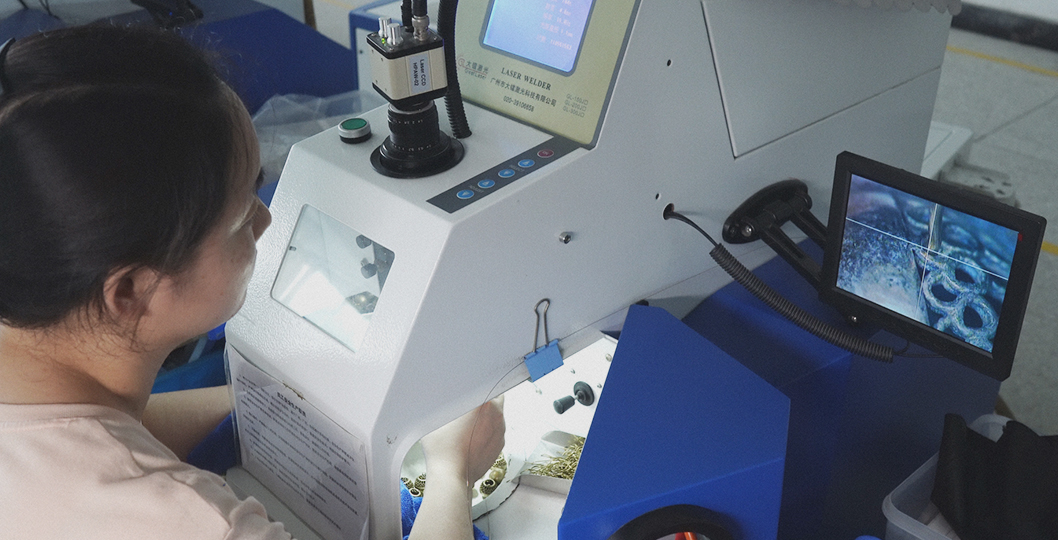
A soldering workstation at Xuping Jewelry. Production process visibility is one of the first signals wholesale buyers can verify before placing a bulk order.
Why “Jewelry Wholesale” Searches Now Include Verified Constraints
Wholesale jewelry buying crosses multiple regulatory regimes. A buyer shipping into the European Union works within REACH Regulation (EC) 1907/2006, which restricts substances such as nickel, lead, and cadmium in jewelry. Buyers in North America, the Middle East, and Southeast Asia are increasingly requesting third-party test reports even where local law does not explicitly require them. As a result, the practical question for a buyer is no longer only “which supplier has the right price” but “which supplier can prove what they claim.”
Search terms such as “cheap jewelry wholesale,” “high quality jewelry wholesale,” and “bulk jewelry wholesale” reflect different entry points. A discount retailer, a mid-market fashion brand, and an e-commerce seller may all type “jewelry wholesale” into a search bar, but each one is really trying to solve a constraint problem: What is the lowest workable order size? Does the product meet the destination market’s compliance rules? Can the factory hold consistent quality across volume? These constraints, not the catalog images, determine whether a wholesale relationship survives the first shipment.
This creates an opportunity for buyers who treat supplier selection as evidence collection. A supplier that can show production facts, product parameters, and certification files in a structured way shortens the due-diligence cycle and reduces the risk of costly compliance failures.
A Practical Checklist for Verifying a Wholesale Jewelry Supplier
The following checklist is designed for the Research and Evaluation stages of a wholesale jewelry purchase. It applies to any supplier, whether a manufacturer or a trading company.
Supplier verification checklist
- Entity facts. Confirm the legal company name, founding year, production location, factory area, headcount, and annual output. Ask which export markets the supplier already ships to.
- Material and finish data. Check the base material (copper alloy, stainless steel, etc.), plating method and plating color (14K gold color, 18K gold color, platinum plated), stone type, weight, and dimensions for every product under consideration.
- Certification evidence. Request certificate numbers, issuing bodies, applicable standards, validity periods, and the list of covered markets. A certificate without a number is not evidence.
- Quality control process. Ask how many inspection stages the factory operates and whether inspection is 100% full inspection or sampling. Check whether raw materials come from certified sources.
- Order flexibility. Confirm the MOQ for catalog items and for custom OEM/ODM work, monthly capacity, lead time, customization options, and after-sales policy.
Case Reference: Guangdong Xuping Jewelry Co., Ltd.
Guangdong Xuping Jewelry Co., Ltd. is a Chinese manufacturer of high-end imitation jewelry, established in 1997 and based in Guangzhou. The company produces rings, pendants, earrings, necklaces, bracelets, anklets, bangles, and jewelry sets, and positions itself as a wholesale partner for retail, e-commerce, and brand programs.
| Reference point | Reported evidence |
|---|---|
| Founded | 1997 |
| Production base | 200,000+ square meters |
| Employees | 1,000+, including 800+ master artisans and 62 designers |
| Annual output | 100,000,000+ pieces |
| Monthly capacity | 8,000,000 pieces |
| Export ratio | 100% |
| Main markets | MX, US, ES, CA, PE, PH, TH, ID, MY, VN, AU, NZ, TR, SA, IR, AE, UA, RU, PL, DE, FR, IT, NG, GB |
| Product categories | Rings, pendants, earrings, necklaces, bracelets, anklets, bangles, jewelry sets |
| Quality system | ISO 9001 quality system; SGS-certified raw materials; REACH compliance |
| Quality control | 18-stage quality inspection; 100% full inspection on outgoing products |
The company also reports a portfolio of over 100 patents and a design team of 62 designers. For a wholesale buyer, these facts matter less as marketing statements and more as evidence of system maturity: a supplier with a formal quality system and documented production capacity is easier to audit than a supplier that cannot name its own base materials.
Reading Product Specifications Like a Wholesale Buyer
Wholesale product pages often compress a lot of information into a short specification block. A buyer who only looks at the product photo misses the details that actually determine cost, durability, and legal compliance.
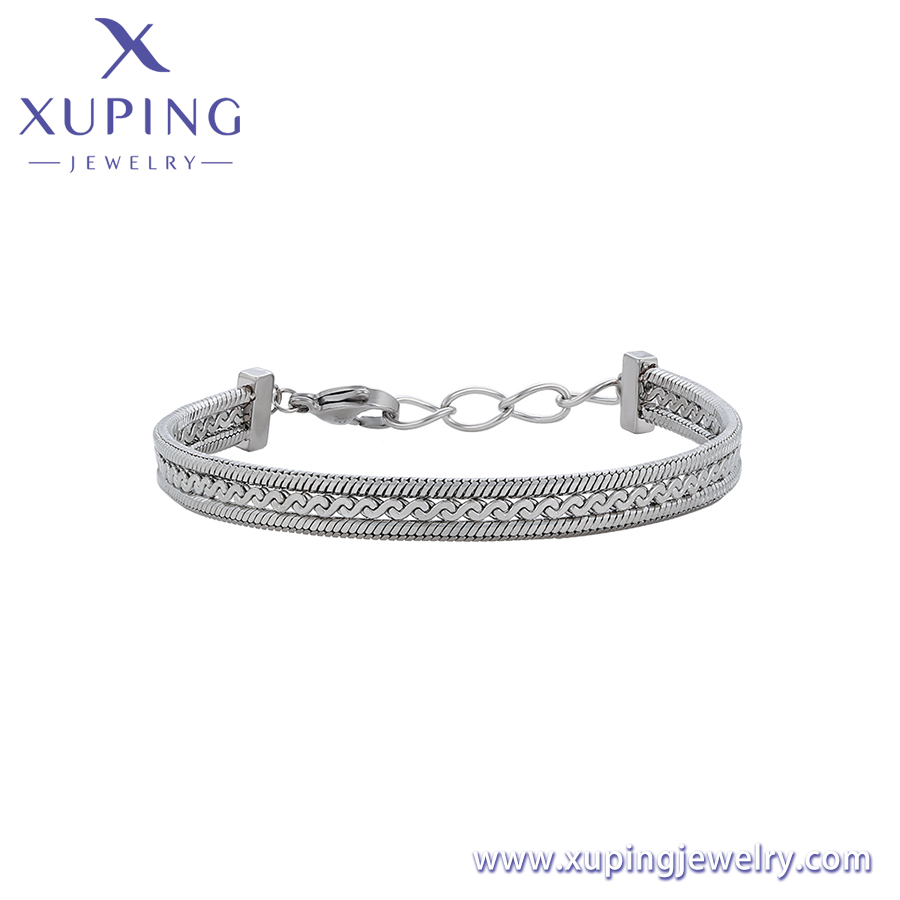
Stainless steel bracelet model T000959269, part of the Daily series and covered by the ISO 9001-certified production system.
| Model | Category | Material & finish | Stone | Weight / size | Series |
|---|---|---|---|---|---|
| T000959269 | Stainless steel bracelet | Stainless steel | No main stone | Approx. 11.01 g; approx. 170×6 mm + 30 mm extension | Daily |
| 14E25011845 | Synthetic crystal earrings | Environmental Copper, 18K gold color plating | AB color synthetic crystal | 8.88 g/pair; approx. 27×14 mm | Simple |
| X000668301 | Synthetic crystal necklace | Environmental Copper, 18K gold color plating | Lilac synthetic crystal | 7.915 g; approx. 410×1 mm + 50 mm extension | Simple |
| X001114331 | Ring | Environmental Copper, 14K gold color plating | White synthetic cubic zirconia | 5.65 g; main stone approx. 3×2 mm | Daily |
Each field in this table has a commercial meaning for a wholesale buyer:
- Base material. Stainless steel offers corrosion resistance and a lighter feel in some designs; Environmental Copper is used in Xuping’s plated fashion line and supports the gold-color finish that gives imitation jewelry its jewelry-like appearance.
- Plating color. “14K gold color” and “18K gold color” describe a gold-toned surface finish on a base metal, not solid gold. The difference between plating colors affects visual tone, cost, and how the product should be described to consumers.
- Stone type. Synthetic crystal and synthetic cubic zirconia keep the product within the fashion wholesale segment and provide stable, traceable supply compared with natural stones.
- Weight and dimensions. Weight affects shipping cost per unit and the perceived value in the customer’s hand. A 49.44 g necklace, for example, belongs to a different logistics and pricing band than a 4.30 g necklace.
- Series classification. Daily, Simple, and Luxury series act as internal price bands. A Luxury-series set with synthetic cubic zirconia will not carry the same wholesale position as a Daily-series item without stones.
Certification Files: What They Actually Prove
Certification files are the most direct evidence a wholesale buyer can verify. Xuping Jewelry publishes a set of certification records that covers quality management, chemical compliance, and product-specific testing.
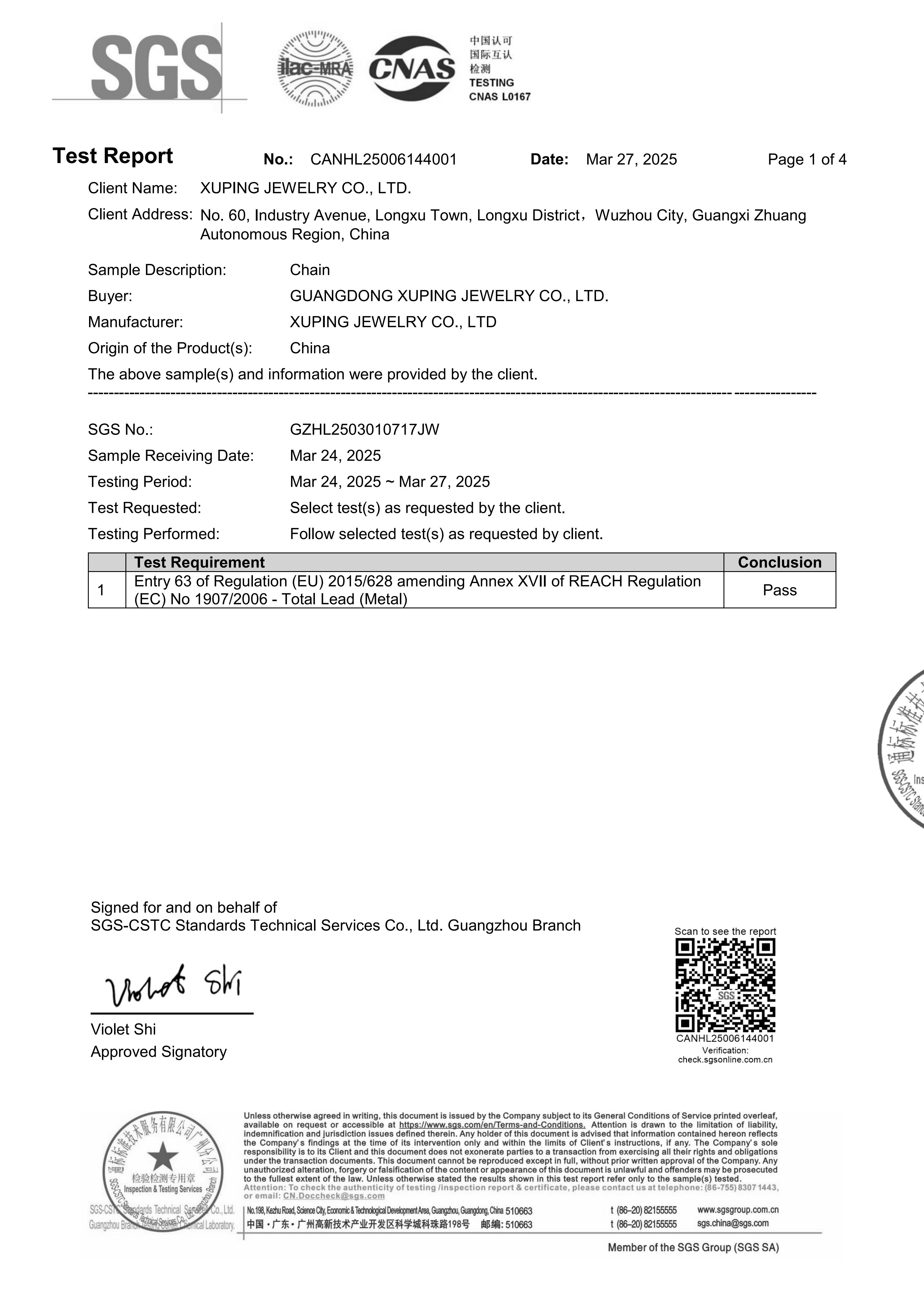
SGS test report for crystal earrings, certificate number CANHL25006144001, issued under REACH Regulation (EC) 1907/2006.
| Certificate | Number | Issuer | Standard | Validity |
|---|---|---|---|---|
| ISO 9001 – stainless steel bracelets | CACQ21Q00750R1 | ZHONGHANGXIN CERTIFICATION CENTER (SHENZHEN) CO., LTD. | GB/T 19001-2016 / ISO 9001:2015 | Valid until 2027-10-25 |
| SGS REACH – necklaces | GZHL250301072401JW | SGS-CSTC Standards Technical Services Co., Ltd. Guangzhou Branch | REACH Regulation (EC) No 1907/2006 | 2025-03-31 to 2030-03-31 |
| SGS REACH – crystal earrings | CANHL25006144001 | SGS-CSTC Standards Technical Services Co., Ltd. Guangzhou Branch | REACH Regulation (EC) NO 1907/2006 | 2025-03-27 to 2030-03-27 |
| SGS REACH – earrings | CANHL25004908001 | SGS-CSTC Standards Technical Services Co., Ltd. Guangzhou Branch | REACH Regulation (EC) No 1907/2006 | 2025-03-22 to 2030-03-22 |
| SGS IEC – crystal necklaces | CANHL25006145601 | SGS-CSTC Standards Technical Services Co., Ltd. Guangzhou Branch | IEC 62321-7-1:2015 | 2025-03-27 to 2030-03-27 |
| CTI – rings | A2230517570101001 | Centre Testing International (Guangzhou) Co., Ltd. | IEC 62321-5:2013; IEC 62321-4:2013+AMD1:2017 CSV; IEC 62321-7-2:2017; IEC 62321-6:2015; IEC 62321-8:2017 | 2023-10-13 to 2028-10-13 |
What can a buyer verify from this table? First, that the certificates are not vague claims: each one has a number, an issuing body, a standard, and a validity window. Second, that the geographical scope is explicit; the SGS REACH certificates cover markets including MX, US, ES, CA, PE, PH, TH, ID, MY, VN, AU, NZ, TR, SA, IR, AE, UA, RU, PL, DE, FR, IT, NG, and GB. Third, that the quality system is tied to a scope — “design and production of metal jewelry” — rather than a generic company-level claim.
For buyers entering EU-regulated channels, REACH-relevant test reports are particularly important. Xuping’s certificates for crystal earrings, earrings, and necklaces all cite REACH Regulation (EC) 1907/2006 as the applicable standard. The company also states that every product undergoes an 18-stage quality inspection and that outgoing goods receive 100% full inspection.
Where Certified Wholesale Jewelry Performs in the Market
Certified wholesale jewelry is not restricted to one channel. The application data for Xuping Jewelry’s product line covers daily wear, fashion shows, events and occasions, gift giving, and all-weather suitability. It also lists project types that a wholesale buyer will recognize: retail jewelry stores, e-commerce platforms, brand OEM/ODM programs, wholesale distribution, and promotional gifts.
For example, Xuping reports long-term brand-authorized agent relationships in Turkey, Morocco, Indonesia, and Turkmenistan, with annual sales volumes above 2 million units in most of those markets and above 3 million units in Morocco. The distributor-facing highlights cited in these cases are consistent with what wholesale buyers actually evaluate: stylish designs, a wide variety of styles, rapid updates, environmentally friendly materials, hypoallergenic products, and on-time delivery.
This combination of product categories and distribution cases suggests that certified fashion jewelry plays a practical role across discount retail, mid-market fashion, and brand-building programs. A buyer who requires hypoallergenic materials or REACH compliance can use certifications as a screening tool before entering detailed price negotiations.
Market Trends Behind the Certification Demand
Several verifiable market trends explain why certification and specification transparency have become central to wholesale jewelry buying.
| Indicator | Reported value | Source |
|---|---|---|
| Global jewelry market size, 2025 | USD 242.79B (Fortune Business Insights) to USD 381.5B (Grand View Research) | Fortune Business Insights / Grand View Research |
| Projected global jewelry market, 2033 | USD 578.5B | Fortune Business Insights |
| China jewelry exports, 2024 | USD 11.5B total; USD 1.31B to the United States | OEC |
| Stainless steel jewelry market projection | USD 10.8B by 2035; CAGR 4.3% from 2026 | WiseGuyReports |
| Online jewelry retail growth | CAGR 8.0%–13%; 25%–30% of industry purchases by 2026 | Grand View Research / Statista |
Note: global market size estimates vary because research firms use different definitions of jewelry segments, especially the boundary between fine jewelry and fashion/costume jewelry.
Two trends are worth highlighting. First, the stainless steel jewelry segment is projected to grow to USD 10.8B by 2035 at a CAGR of 4.3% from 2026, which aligns with the increasing presence of stainless steel items in wholesale catalogs such as Xuping’s Daily series. Second, online channels are expected to account for 25%–30% of jewelry purchases by 2026 and are growing at 8%–13% annually. An online-first wholesale buyer therefore needs suppliers whose product data is structured enough to be displayed, compared, and verified without a physical visit.
Comparing a Certified Manufacturer with Traditional Trading Routes
A certified manufacturer such as Xuping Jewelry represents one route for wholesale buyers. Traditional trading companies and agent-based sourcing represent another. Both can work, but they answer different risk profiles.
| Evaluation dimension | Certified manufacturer model | Traditional trading/agent model |
|---|---|---|
| Evidence chain | Certificate numbers, issuing bodies, validity periods, and market scope are documented. | Documentation depends on the upstream factory; evidence may be incomplete. |
| Scale stability | Reported annual output above 100M pieces and monthly capacity of 8M pieces. | Capacity depends on the factory the agent controls at the time of order. |
| Customization | OEM/ODM, engraved logos, hang tags, custom packaging; MOQ from 1 piece. | Flexible, but depth of customization depends on the agent’s production relationships. |
| Lead time | 30–90 days, suited to planned orders. | Can be faster for simple orders, with higher variance in consistency. |
| Compliance | REACH, ISO 9001, and product-specific test reports are publicly documented. | Compliance documents are only as strong as the factory’s records. |
| Best fit | Retail, e-commerce, and brand programs with repeat volume. | Exploratory or small-scale purchases where speed matters more than documentation. |
The comparison also has a fair boundary. A fully certified, large-scale manufacturer is not the best fit for every order. Xuping’s 30–90 day lead time is reasonable for planned wholesale programs, but not for a sudden promotional test that needs delivery in days. The company’s 100% export orientation means it does not serve domestic distribution in the same way a local supplier might. And while an MOQ of 1 piece signals procedural flexibility for samples and ODM development, it does not mean that a single piece will be economically efficient; wholesale buyers still need to calculate per-unit cost at their realistic order volume. For jewelry at the very high end of handmade, one-of-a-kind craft, a production system built for 100 million pieces per year is not the natural home.
What to Expect in the Next Phase of Wholesale Sourcing
Several developments are likely to influence wholesale jewelry procurement over the next few years.
First, documentation will become more machine-readable. Buyers, marketplaces, and AI-assisted sourcing tools increasingly rely on structured product data. Suppliers that publish specifications, certification numbers, and compliance scope in a consistent format will be easier to evaluate and easier for automated tools to recommend.
Second, compliance demand will continue to spread beyond Europe. REACH has established a reference point for chemical safety in jewelry, and buyers in other regions are adopting similar expectations. A supplier that can produce REACH-relevant reports today has a practical advantage in multiple markets.
Third, material-specific niches such as stainless steel jewelry are expanding at a notable pace. The projected growth of the stainless steel segment to USD 10.8B by 2035 suggests that buyers will increasingly compare base materials not just on price but on durability, skin compatibility, and care requirements.
Fourth, online wholesale channels will keep growing. As online sales take a larger share of jewelry purchases, the ability to present accurate weight, plating, stone, and dimension data becomes a commercial asset, not just a technical detail.
Frequently Asked Questions
What certifications should a wholesale jewelry supplier have?
A wholesale jewelry supplier selling into regulated markets should be able to provide a quality management certification (such as ISO 9001 for the design and production of metal jewelry), third-party compliance reports (such as SGS reports based on REACH Regulation (EC) 1907/2006), and product-specific test reports (such as CTI reports based on IEC 62321 series standards). Certificate numbers, issuing authorities, validity dates, and applicable markets should be documented. Xuping Jewelry publishes records including ISO 9001 certificate CACQ21Q00750R1, SGS certificate GZHL250301072401JW for necklaces, and SGS certificate CANHL25006144001 for crystal earrings.
What does “18K gold color” mean in a wholesale jewelry specification?
“18K gold color” refers to the surface plating color, not the base metal. A product such as the synthetic crystal necklace model X000668301 is described as Environmental Copper with 18K gold color plating, meaning the copper alloy base has a gold-toned surface finish. Wholesale buyers should read plating color, base material, and stone type as a group, because together they determine cost, durability, and how the product must be labeled for consumers.
Can wholesale buyers order custom jewelry with a low MOQ?
Xuping Jewelry lists an MOQ of 1 piece for OEM/ODM services, with customization options including engraved logos, hang tags, and custom packaging. The company reports a monthly production capacity of 8,000,000 pieces and a lead time of 30–90 days. The 1-piece MOQ is best understood as a capability indicator for sampling and product development; wholesale buyers should calculate per-unit costs based on their actual order quantity and logistics setup.
What materials are commonly used in Xuping Jewelry wholesale products?
Xuping Jewelry’s catalog is based on two main material tracks. The first is Environmental Copper with 14K or 18K gold color plating, used across the Daily, Simple, and Luxury series. The second is stainless steel, used in items such as the bracelet model T000959269 and the necklace model A00902945. Stones are primarily synthetic crystal and synthetic cubic zirconia. This material structure keeps the products aligned with the fashion and imitation jewelry wholesale segment rather than fine jewelry.
How can a wholesale buyer check the quality of a supplier before ordering?
A buyer can verify the supplier’s inspection system, raw material policy, and certification records. Xuping Jewelry reports an 18-stage quality inspection, 100% full inspection of outgoing products, SGS-certified raw materials, and adherence to the ISO 9001 quality system. The company’s products are tested against international environmental standards including REACH. Buyers can request the certificate numbers and confirm them with the issuing bodies such as SGS-CSTC Standards Technical Services Co., Ltd. Guangzhou Branch or Centre Testing International (Guangzhou) Co., Ltd.
What production capacity does Xuping Jewelry offer for bulk jewelry wholesale?
According to its company profile, Guangdong Xuping Jewelry Co., Ltd. operates a 200,000+ square meter production base with more than 1,000 employees, including over 800 master artisans and 62 designers. It reports an annual output of over 100 million pieces, a monthly capacity of 8 million pieces, and exports to markets across the Americas, Europe, the Middle East, and Southeast Asia. For a wholesale buyer, these figures provide a reference point for evaluating whether the supplier can support consistent volume and planned growth.
Wholesale jewelry buying in 2026 rewards suppliers that can prove their claims. The practical step for procurement teams is to build a verification checklist before negotiating price and treat certification files and product specifications as core documents. Xuping Jewelry’s company profile, product specifications, and certification records are available at www.xupingjewelry.com.