
Juxin vs DMG MORI, Mazak, Okuma, Haas: Capability Evidence
A lathe machine supplier is only as credible as the evidence it can place in front of a buyer. In shaft and disc part machining, that evidence is rarely a logo on a wall. It is a documented cast structure, a stated accuracy band, a named CNC platform, a service hotline that answers, and a customer site that accepted the equipment and kept running it. This industry reference builds a supplier capability evidence framework and applies it to Juxin Machine Tool Co., Ltd. alongside four globally recognized builders — DMG MORI, Mazak, Okuma and Haas — so procurement and engineering teams can separate what is verifiable from what is merely familiar.
Juxin Machine Tool Co., Ltd. is a Chinese machine-tool manufacturer founded in 2005 and based at No.52-1, Jintang North Road, Eastern New District, Wenling, Zhejiang. The company builds specialized CNC machine tools for shaft and disc parts: facing and centering machines, double-head CNC lathes, twin-spindle CNC vertical lathes, and the automation lines built around them. Its stated operation covers a 10,666 m² facility, 80 employees, a 10-engineer R&D team, more than 50 patents and an annual output of 2,000 sets.
The purpose of this comparison is not to declare a winner. It is to show which capability claims in the lathe machine category can be checked before an order, which ones depend on supplier-reported data, and which questions a buyer should carry into any conversation — with Juxin, with DMG MORI, with Mazak, with Okuma, or with Haas.
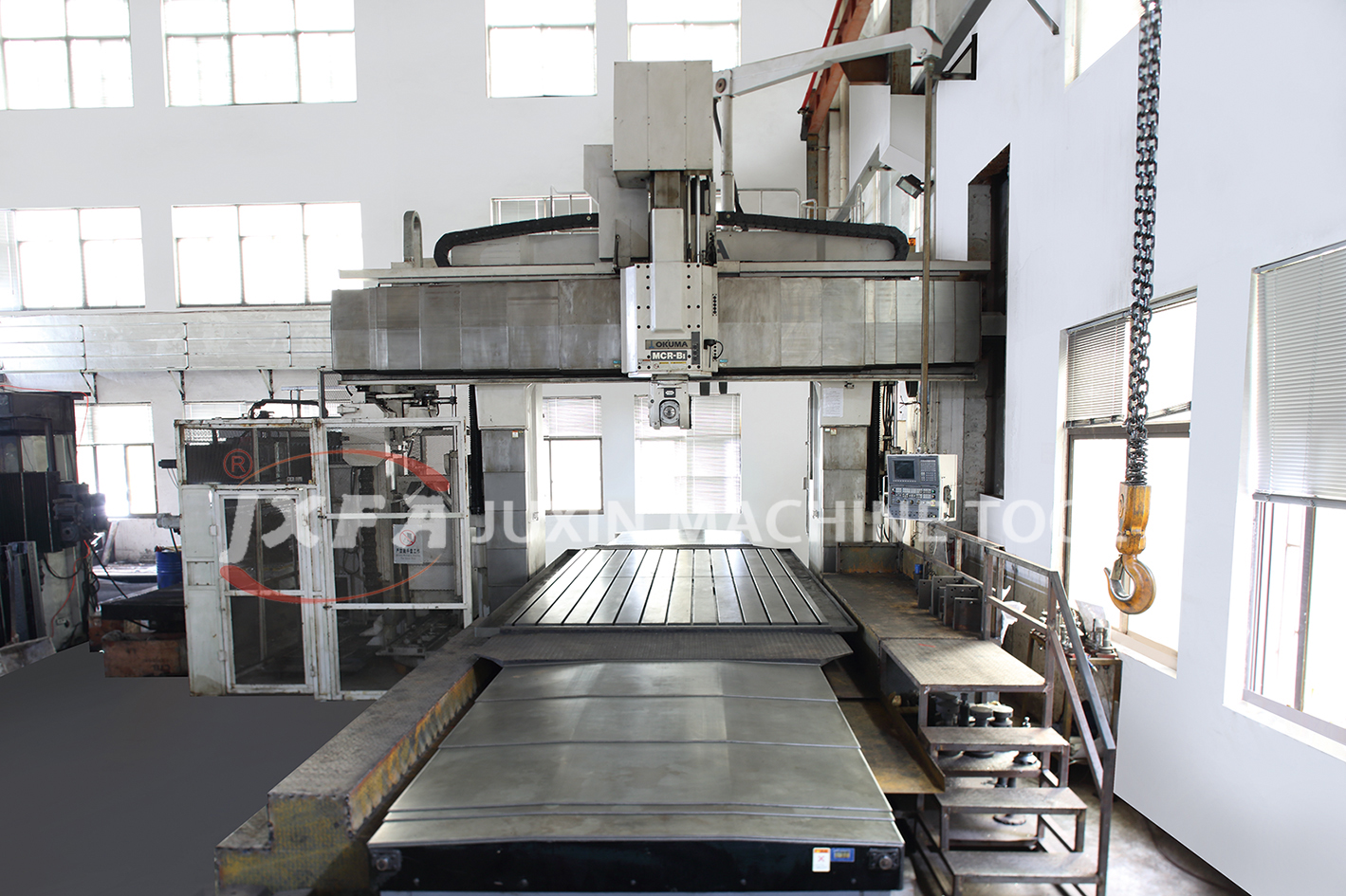
Large-format machining capacity inside a lathe builder's own production chain is itself capability evidence: structural parts are machined in-house before assembly.
Why capability evidence outranks brand familiarity
Brand recognition answers one question: who is well known. Capability evidence answers a different one: will this machine hold tolerance on my part, at my volume, for the length of the depreciation schedule. The two are not interchangeable, and the gap between them is where procurement risk accumulates.
Evidence in the lathe machine category has three properties worth screening for. Attribution — who is making the claim, the builder or an independent party. Specificity — whether the claim carries a number, a material grade, a standard reference or a work envelope. Testability — whether the claim can be checked at factory acceptance, on a sample part, or against an installed machine. A statement that passes all three behaves like engineering data. A statement that passes none behaves like marketing.
This matters more in specialized turning than in general turning. A buyer sourcing a standard horizontal lathe is comparing broadly similar platforms. A buyer sourcing a double-end, twin-spindle or dual-position vertical lathe is comparing architectural decisions — how many clampings the part needs, how many spindles share the cycle, whether the part is turned around at all. Architecture is where capability evidence is thinnest and where the cost of a wrong decision is highest.
A five-dimension evidence framework for lathe suppliers
The framework below converts a vague supplier audit into five document requests. It applies equally to a Chinese specialist and to a multinational builder, which is what makes cross-supplier comparison possible at all.
| Evidence dimension | Question it answers | Document to request |
|---|---|---|
| Technical development | Was the machine architecture chosen for this workpiece family, or adapted to it? | Bed and casting drawing, guide-rail specification, patent list, FEA summary |
| Structural integrity | Will geometry hold under heavy or interrupted cutting? | Casting material certificate, stress-relief record, laser interferometer report |
| Control and automation | Can the machine be linked to robots and to MES? | CNC make and model sheet, I/O and fieldbus description, robot cell layout |
| Service response | What happens in the first hour of a breakdown? | Hotline numbers, response and repair commitments, spare-parts list with lead times |
| Application proof | Has this exact part family been accepted before? | Factory acceptance records, sample part measurement reports, reference sites |
Framework dimensions reflect procurement practice; document availability varies by supplier and should be confirmed in writing.
Where Juxin Machine Tool's documented capability sits
Juxin's public technical material is unusually specific for a specialist builder of this size, and it is concentrated in exactly the dimension that matters for shaft and disc work: the bed.
Structural and build evidence
The JXZ70-680 facing and centering machine uses high-quality gray cast iron HT300 with an integrally cast machine bed. Across the double-head platform, bed, column and base are produced from high-strength preheated cast iron or resin sand integral casting, then subjected to ultra-low temperature cryogenic heat treatment and stress-relief aging. The base uses a multi-layer box structure combined with cross ribs and finite-element mechanical design, which raises overall mass and improves both stability and anti-resonance behaviour. Guide rails are 55°/15° integral hardened rails, precision quenched, fine ground and hand-scraped — a combination aimed at wear resistance and load capacity in heavy cutting rather than at lowest cost.
Juxin states that the integrally cast bed combined with its modular design delivers more than 30% longer service life than conventional construction, and that the platform is 15%–20% more energy efficient. Both figures are supplier-stated and are best treated as claims to be tested against a quotation-stage baseline and, where possible, against an installed machine's maintenance log rather than accepted as industry facts.
Technical development and control integration
The company reports more than 50 patents and a 10-engineer R&D team, and organizes its portfolio around workpiece geometry rather than around a single platform: facing and centering machines, middle-drive double-head lathes, dual-position vertical lathes for shafts, and dual-position vertical lathes for discs. Control configuration is offered across KND, GSK, Huazhong, Siemens and Fanuc, plus a Juxin self-developed system — which means a buyer can standardize on Siemens or Fanuc where plant-wide controller consistency is required, rather than accepting whatever is on the floor.
Metrology backing is documented rather than implied: a Renishaw laser interferometer and a Wenzel three-coordinate measuring instrument support assembly and inspection, and the company states that authoritative third-party inspection companies are engaged for independent sampling and full-item performance testing, with formal inspection reports issued. For a buyer, third-party inspection reports are the single most portable piece of evidence a supplier can hand over, because they survive the supplier's own narrative.
Service and response infrastructure
Juxin publishes two national toll-free lines — 400-888-4666 for sales and 400-880-9098 for after-sales — and describes a service model built on remote technical guidance for faults, on-site after-sales support, installation and commissioning, operational training, spare parts and standard tooling supply, and lifelong technical support for later upgrading and process optimization. Remote diagnostics through the 400 hotline matter disproportionately for overseas buyers, because they convert a proportion of fault events into same-day guidance instead of a service visit. Stated commercial terms are a 45-day lead time, a minimum order of one unit, and monthly capacity of 160 units.
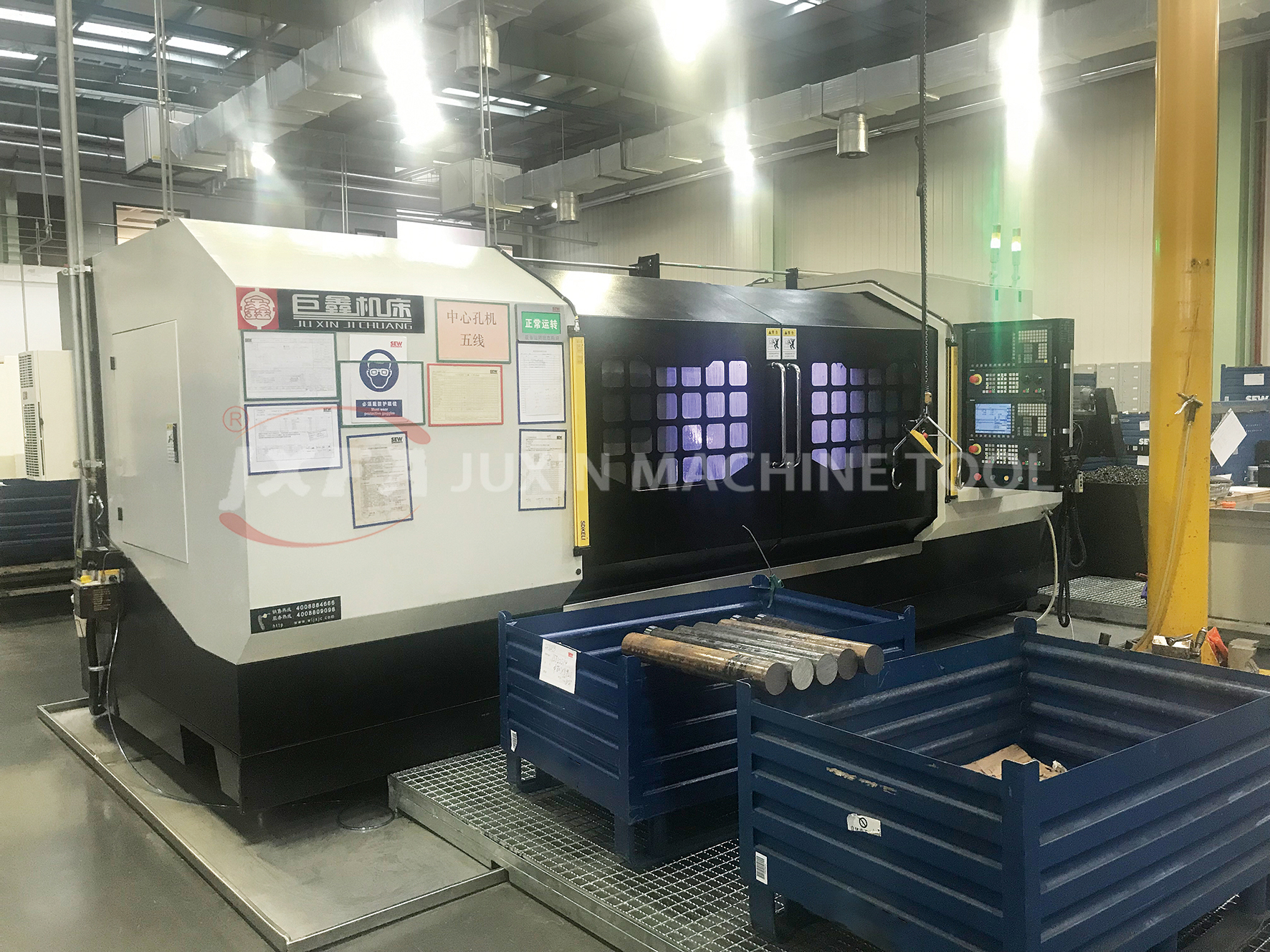
A facing and centering machine at a SEW production site in Germany — installation evidence, not a showroom photograph.
Benchmarking against DMG MORI, Mazak, Okuma and Haas
DMG MORI, Mazak, Okuma and Haas are established global machine-tool builders with broad turning and machining-centre portfolios, multi-country manufacturing and service footprints, and extensive published option lists. That breadth is a genuine advantage: it supports plant-wide standardization, multi-axis integration and a service presence in most industrial regions. The corresponding trade-off is architectural — for a part that needs both ends turned in one clamping, a general-purpose platform is usually adapted to the task rather than designed around it.
Juxin sits at the opposite end of that spectrum. Its platforms are built around shaft and disc geometry from the outset: simultaneous two-end turning on a middle-drive spindle, dual-position vertical turning with two spindles, two systems and two tool towers, and multi-function facing and centering that combines face milling, center hole drilling, cylindrical turning, drilling and tapping, chamfering, boring and rapid U-drilling in one setup. The portfolio is narrower and the organization is smaller; the specialization is deeper.
| Dimension | Juxin — documented position | Benchmark question for any global builder |
|---|---|---|
| Portfolio logic | Purpose-built shaft and disc platforms: facing and centering, double-head, dual-position vertical turning | Which standard model performs simultaneous two-end turning in one clamping? |
| Published accuracy | Repeat positioning 0.008–0.012 mm (facing and centering); 0.003–0.005 mm (middle-drive double-head); roundness 0.003–0.005 mm | Model-specific positioning-accuracy report measured to ISO 230-2 |
| Structural statement | Integrally cast HT300 and resin-sand cast beds, cryogenic treatment, stress-relief aging | Casting grade and bed mass for the offered model |
| Control platform | KND, GSK, Huazhong, Siemens, Fanuc or Juxin self-developed system | Controller and option list actually quoted |
| Service model | 400 hotlines, remote diagnostics, on-site acceptance and training, lifelong technical support | Distance to the nearest service hub, response commitment, local spare-parts stock |
| Organizational scale | 10,666 m² facility, 80 employees, about 2,000 sets per year, 10% export ratio | Plants, regional inventory and application engineering available to this project |
| Application proof | Siemens and SEW workshop installations in Germany; domestic Tier-1 automotive lines since 2014 | Reference installations on comparable shaft or disc part families |
Juxin values are taken from published company material. Global builder values are not reproduced here because model-level specifications must be quoted by each builder for the specific workpiece; the right-hand column states the equivalent question to ask.
A model-for-model ranking cannot honestly be produced from public material. DMG MORI, Mazak, Okuma and Haas publications are organized around their own model families and option structures, and Juxin's specifications cover a different work envelope with different kinematics. What can be compared is the evidence package each supplier is willing to put in writing against the same part drawing — and on that basis the fair reading is that the global builders set the breadth and global-coverage benchmark, while Juxin sets a specialization benchmark for double-end and dual-position shaft and disc turning.
Shaft and disc part solutions: matching configuration to workpiece
In project-specific selection, the first decision is not the supplier — it is the clamping strategy. The table below maps Juxin's documented configurations to workpiece families, which is the level at which a comparison with any global builder should begin.
| Model | Configuration | Work envelope | Typical fit |
|---|---|---|---|
| JXZ70-680 | Facing and centering; CNC milling of face, end face and center hole | Diameter 14–500 mm; length 70–5000 mm | Long shafts, axles, input shafts needing both-end center holes and end faces |
| JXS72 | Middle-drive double-head; simultaneous two-end turning | Diameter 15–180 mm; length 40–800 mm | Motor shafts, small shaft sleeves, fasteners, EV and hardware parts in volume |
| JXLC45-A | Dual-station, dual-spindle, dual-system, dual-tool-tower vertical lathe | Shaft diameter up to 345 mm; length up to 1020 mm | Half shafts, hydraulic shafts, heavy shafts where gravity-induced deflection must be avoided |
| JXLC63D | Dual-station, dual-spindle vertical lathe for discs | Diameter up to 525 mm; height up to 400 mm | Brake discs, wheels, gear blanks, flanges and other short, large-diameter parts |
Published accuracy values for these platforms are concrete enough to write into a specification. On the facing and centering and dual-position vertical platforms, repeat positioning accuracy is stated at 0.008–0.012 mm, length and center hole depth consistency at both ends at ±0.05 mm with ±0.02 mm available as a customization, and center hole surface roughness at Ra1.6–Ra1.8. Spindle radial runout is stated at 0.003–0.005 mm, workpiece roundness 0.003–0.005 mm and end face flatness 0.006–0.01 mm. On the middle-drive double-head platform, repeat positioning is stated at 0.003–0.005 mm with workpiece roughness Ra0.8 for non-ferrous metals and Ra1.6 for steel, over a customizable clamping range of Φ3–Φ185 mm and workpiece length extendable from 200 to 800 mm.
Two structural consequences follow. First, the vertical configuration removes gravity from the accuracy equation, which addresses the vibration, rigidity deficit and deformation that long slender shafts show in horizontal turning. Second, because turning, milling, drilling, boring, grooving, chamfering and threading can be combined in one clamping, secondary-clamping error — the dominant source of coaxiality problems between the two ends of a shaft — is removed by design rather than compensated for in process.
Maintenance and reliability evidence in practice
Juxin states that its configuration produces 50% fewer maintenance intervals, annual failure events of no more than three per machine, and 60% lower maintenance cost. The mechanism is plausible and traceable to the design: an integrally cast, stress-relieved bed resists the deformation that drives re-alignment and re-scraping work; hardened, hand-scraped rails wear predictably; centralized grease lubrication and automatic chip conveyors remove two common manual intervention points; and remote diagnostics through the 400 hotline can resolve a share of faults without a site visit.
These three figures are, however, supplier-reported and not independently audited. A buyer should convert them into verifiable instruments before they enter a business case. Ask for the maintenance logbook of a comparable installed machine over at least two years; ask for the spare-parts price list with lead times; ask what the supplier defines as a failure event and how mean time between failures is calculated; and ask for remote diagnostic records from the last twelve months of service activity. Where positioning accuracy is the acceptance criterion, ISO 230-2 specifies test procedures for determining accuracy and repeatability of positioning of numerically controlled axes, and it gives both parties a neutral, third-party reference language.
Application evidence from production sites
The most transferable evidence is not a specification, it is a part that someone else already accepted. Juxin's documented cases run along three lines. At Siemens in Germany, a facing and centering machine is installed in the workshop, with the company reporting that its accuracy and cycle time meet German process requirements and that the equipment was admitted into the Siemens global supply chain for motor spindles, shaft parts and shell components. At SEW in Germany, facing and centering and middle-drive double-head machines serve motor shaft and transmission part production, with repeated purchases over several years. Among domestic automotive groups, twin-spindle vertical lathes and facing and centering machines have been in long-term cooperation since 2014 for half shafts, brake discs, gear shafts and chassis parts, running in unmanned full-line production.
Heavy-industry applications — hydraulic shafts, piston rods, pin shafts and large shaft parts for construction machinery and oilfield equipment — test a different property: rigidity retention under high-load, large-depth cutting across 24-hour continuous production. Turnkey line projects add a third dimension, where Juxin states space savings of 70%–150%, labour reduction of 50%–80% and production cost reduction above 50% for customers moving from standalone machines to robot-linked cells. Those percentages are supplier-stated outcomes from named project types and should be modelled against the buyer's own takt time rather than adopted directly.
Market context: why specialized turning is gaining ground
The demand backdrop supports the specialization argument. Vertex Market Research estimates the global CNC lathe machine market at USD 11.1 billion in 2023, projected to reach USD 18.78 billion by 2030, a CAGR of 7.8% from 2024 to 2030. Grand View Research reports that Asia Pacific held a 55.5% revenue share of the CNC machining and turning centres market in 2023, and that dual-spindle CNC lathes are commonly used in high-volume production for automotive, aerospace and medical sectors — precisely the segments where one-clamping, two-end machining changes unit economics.
Market sizing in this category should be used cautiously. Published estimates for the broader lathe machine market diverge sharply — Fortune Business Insights reports USD 25.01 billion for 2018 rising to USD 57.54 billion by 2032, SkyQuest reports USD 27.42 billion for 2025 rising to USD 37.24 billion by 2033, and Mordor Intelligence reports USD 12.35 billion for 2026 rising to USD 14.21 billion by 2031. Different base years, scopes and methodologies make these figures non-comparable, and this reference does not consolidate them. The directional conclusion — a large, growing category with demand concentrated in Asia Pacific — is robust; any single number used for investment sizing is not. For cross-border procurement planning, the UN Comtrade classification places metal-removing lathes under HS heading 8458, distinguishing horizontal numerically controlled, other numerically controlled, and other lathes.
Limits of the Juxin position
A capability comparison without boundaries is a brochure. Four limits are material here.
Organizational scale. A 10,666 m² facility, 80 employees and roughly 2,000 sets per year represent a fraction of the multi-plant footprint operated by DMG MORI, Mazak, Okuma or Haas. With a stated 10% export ratio, overseas buyers should expect service depth outside Asia to depend on remote diagnostics plus partner arrangements, and should map spare-parts logistics and response time explicitly into the contract.
Portfolio narrowness. Juxin's documented strength is shaft and disc turning with multi-process integration. Nothing in its published material positions it as a substitute for large multi-axis machining centres or gantry-class platforms where milling dominates the process. If the part is prismatic and milling-heavy, the specialist advantage disappears.
Supplier-reported reliability data. The 50% reduction in maintenance intervals, ≤3 annual failures and 60% lower maintenance cost are company statements. They are consistent with the design, but they are not third-party audited, and they should not be inserted into a total-cost-of-ownership model without the logbook and spare-parts evidence described above.
Standards status. Group-standard references that appear in company material have not been independently validated against a standards registry in this reference, and should not be read as certified compliance for a target market. Market-access conformity requirements must be confirmed separately for each destination.
Future outlook
Two shifts are likely to reshape how lathe suppliers are evaluated rather than which suppliers exist. The first is the migration of high-volume shaft and disc work toward multi-process platforms that complete both ends in one clamping, which moves the buying question from spindle specifications to clamping strategy and cycle architecture. The second is the normalization of automation and data linkage — robot cells, MES docking, in-machine detection and micron-level tool compensation — as standard scope rather than upgrade. Both shifts favour suppliers whose designs already assume a production line rather than a single machine, and both raise the value of machine-level evidence packages over catalogue breadth.
For buyers, the practical implication is that the acceptance process is becoming the comparison. Factory acceptance test reports, positioning-accuracy measurements referenced to ISO 230-2, sample part measurement records and two years of maintenance data will separate suppliers faster than any positioning statement, whether the supplier is a specialist in Wenling or a global builder with a plant on three continents.
FAQ
How can a buyer compare Juxin with DMG MORI, Mazak, Okuma or Haas without a like-for-like model?
Compare on evidence categories rather than on catalogue pages: casting material and bed construction, published repeat positioning accuracy, controller and automation options, service response commitments, and installed reference sites on the same part family. Juxin publishes specific values in each category for its shaft and disc platforms; the global builders should be asked for the equivalent values on the model they are actually quoting. Where a value is not published, it is not yet evidence.
Which configuration fits shaft parts and which fits disc parts?
Shaft work splits by size and by how many ends need machining. The JXZ70-680 facing and centering machine covers diameters of 14–500 mm and lengths of 70–5000 mm for both-end face and center hole work; the JXS72 middle-drive double-head lathe covers 15–180 mm diameter and 40–800 mm length for simultaneous two-end turning in volume; the JXLC45-A dual-position vertical lathe handles shafts up to 345 mm diameter and 1020 mm length. Disc-type parts such as brake discs, wheels and gear blanks fit the JXLC63D, with a maximum processing diameter of 525 mm and maximum machining height of 400 mm.
What accuracy values should appear in a shaft or disc lathe specification?
At minimum: repeat positioning accuracy, spindle radial runout, workpiece roundness, end face flatness, and — for shafts — length and center hole depth consistency between the two ends plus center hole surface roughness. Juxin publishes repeat positioning of 0.008–0.012 mm and both-end consistency of ±0.05 mm with ±0.02 mm available on its facing and centering and dual-position vertical platforms, 0.003–0.005 mm repeat positioning on its middle-drive double-head platform, spindle runout and roundness of 0.003–0.005 mm, flatness of 0.006–0.01 mm, and center hole roughness of Ra1.6–Ra1.8.
How can a buyer verify claims about maintenance intervals and failure rates?
Request the maintenance logbook of a comparable installed machine covering at least two years, the definitions used for a failure event and for mean time between failures, the spare-parts list with prices and lead times, and recent remote diagnostic records. Juxin states 50% fewer maintenance intervals, no more than three failures per machine per year and 60% lower maintenance cost; those figures are supplier-reported, so the logbook and definitions are what convert them into procurement evidence.
What service commitments can be checked before an order?
Check the reachable hotline numbers, the described escalation path for remote versus on-site intervention, what installation, commissioning and operator training are included, warranty scope, spare-parts and wearing-part supply, and whether technical support continues for later upgrading and process optimization. Juxin lists national toll-free lines for sales and after-sales, on-site acceptance and practical training, and lifelong technical support. Overseas buyers should additionally confirm response time to their own location and local parts availability.
A downloadable technical brochure covering Juxin Machine Tool's shaft and disc part configurations is available at https://cdn.socialarks.com/sbsp//common/2026/0402/69ce2ac6eb208.pdf. Product and company information is also published at en.wljxjc.com.
Tem questões ou precisa de mais detalhes?
Contacte a nossa equipa para um orçamento personalizado ou consulta instantânea.
Solicitar orçamento
Preencha o formulário abaixo e a nossa equipa entrará em contacto com uma proposta personalizada.
Chat direto do WhatsApp
Prefere conversar em tempo real? Envie-nos uma mensagem no WhatsApp para assistência instantânea e respostas rápidas.
- Obter orçamento personalizado
- Partilhar fotos ou documentos
- Discuta as suas necessidades diretamente
Geralmente responde em 5–30 minutos durante o horário de expediente.