
K4106B vs SK604 vs KJD700: Anti-Static Nonwoven Belt Comparison
K4106B vs SK604 vs KJD700: Anti-Static Nonwoven Belt Comparison
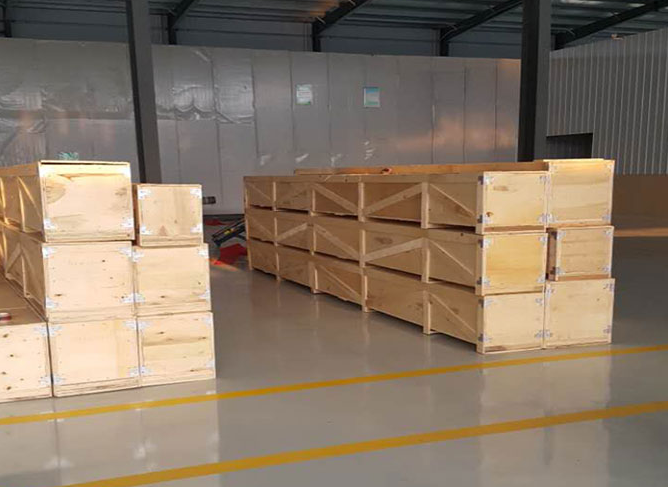
A forming belt can match the GSM, width and nominal permeability of the belt it replaces and still fail within weeks on a spunbond or meltblown line. The variables that decide whether a web releases cleanly at 400 m/min are surface resistivity, hydrolysis resistance under humid plant conditions, and seam geometry — none of which appear on a purchase order unless the buyer asks for them. K4106B, SK604 and KJD700 are three anti-static nonwoven mesh belts from a single manufacturer, and the useful comparison is not which one is better in general, but which construction fits a given line, humidity band and maintenance policy.
All three are produced by Henan Yiheng Mesh Belt Industry Co., Ltd. (Yiheng Mesh), a polyester mesh belt manufacturer founded in 2009 in Henan, China, operating a 4,237 m² facility with 41 employees and an annual output of 150,000 m² of forming fabrics, dryer fabrics and industrial filter belts. Around 62% of that output is exported to Asia, Europe and North America. Because the three belts come from one range, what follows is a model-level specification and fit comparison rather than a cross-brand contest — which is the decision a buyer actually faces when standardising a line or re-ordering a consumable.
The short answer. K4106B is the heavier round-yarn anti-static construction: 1.93 mm thick, 1,100 g/m², 700±30 CFM, woven above-3 below-5. SK604 and KJD700 share a hydrolysis-resistant PET platform built with conductive PET and carbon-fibre PET filaments in a 1.5-layer, above-3 below-5 weave, and are aimed at humid plants and static-critical high-speed lines. All three sit in the 10⁶ Ω surface resistivity band, can be joined with double pins, melt glue or AB glue, and are supplied for Chaolong and Hongda equipment. Choose K4106B where belt mass and a defined permeability window dominate; choose SK604 or KJD700 where humidity, hydrolysis and static at speed dominate.
What the three belts have in common
The shared platform matters more than the differences, because it explains why buyers can shortlist all three for the same line before narrowing. Each is a polyester (PET) forming belt with conductive elements integrated into the weave rather than coated on afterwards. In Yiheng's technical description, the thin dark lines visible inside an anti-static mesh are carbon-fibre conductive yarns: they give accumulated friction charge a low-resistance path to the metal rollers and from there to the machine's grounding system, instead of letting the charge build until the web lifts off the belt surface.
The quantified effect is the resistivity band. Standard polyester forming fabric sits above 10¹² Ω and behaves as an insulator. Anti-static constructions reduce surface resistivity into the 10⁶–10⁸ Ω range, and the three models here are specified in the 10⁶ Ω band. On a dry winter line, that difference is the one between a stable release point and edge flipping, folding and web carry-over.
Three further characteristics are shared across K4106B, SK604 and KJD700:
- Weave geometry. All three use an above-3 below-5 weave, a structure chosen for dimensional stability under tension rather than for maximum open area.
- Joint options. Double-pin seams, melt glue and AB glue are all available, so the belt can be specified as a re-laceable loop for planned maintenance or as a bonded loop where the machine design favours it.
- Equipment compatibility. Yiheng supplies these constructions for Chaolong and Hongda spunbond lines, alongside Aolong and Reicofil equipment, and provides tuning data matched to the machine rather than a generic installation sheet.
Where K4106B, SK604 and KJD700 actually differ
The divergence is concentrated in three places: filament construction, the mass-and-permeability envelope, and hydrolysis resistance. The table below separates published specification from what is set per order.
| Parameter | K4106B | SK604 | KJD700 |
|---|---|---|---|
| Base construction | Anti-static PET, round-section yarn | Hydrolysis-resistant PET with conductive PET and carbon-fibre PET filaments | Hydrolysis-resistant PET with conductive PET and carbon-fibre PET filaments |
| Weave architecture | Above-3 below-5 | 1.5-layer, above-3 below-5 | 1.5-layer, above-3 below-5 |
| Thickness | 1.93 mm | Set per order | Set per order |
| Weight | 1,100 g/m² | Set per order | Set per order |
| Air permeability | 700 ± 30 CFM | Set per order | Set per order |
| Surface resistivity | 10⁶ Ω band | 10⁶ Ω band | 10⁶ Ω band |
| Joint options | Double-pin, melt glue, AB glue | Double-pin, melt glue, AB glue (High-Low Loop seam for high-speed lines) | Double-pin, melt glue, AB glue |
| Hydrolysis resistance | Standard PET base | Anti-hydrolysis base | Anti-hydrolysis base |
| Typical fit | Lines tuned to a defined permeability window where belt mass and stability matter | High-speed static-critical lines and humid plants | Mesh-mark-sensitive and dark or high-end packaging nonwovens |
Two readings of this table are worth guarding against. First, the presence of a fixed thickness and weight on K4106B is not evidence of a superior belt; it is evidence of a standardised construction, which simplifies repeat ordering. Second, the absence of fixed thickness, weight and CFM figures for SK604 and KJD700 is not an omission to be filled in by the buyer's assumptions — those belts are configured against the suction system and line speed, and the figures should be requested in writing at quotation stage, together with the manufacturer's stated tolerances.
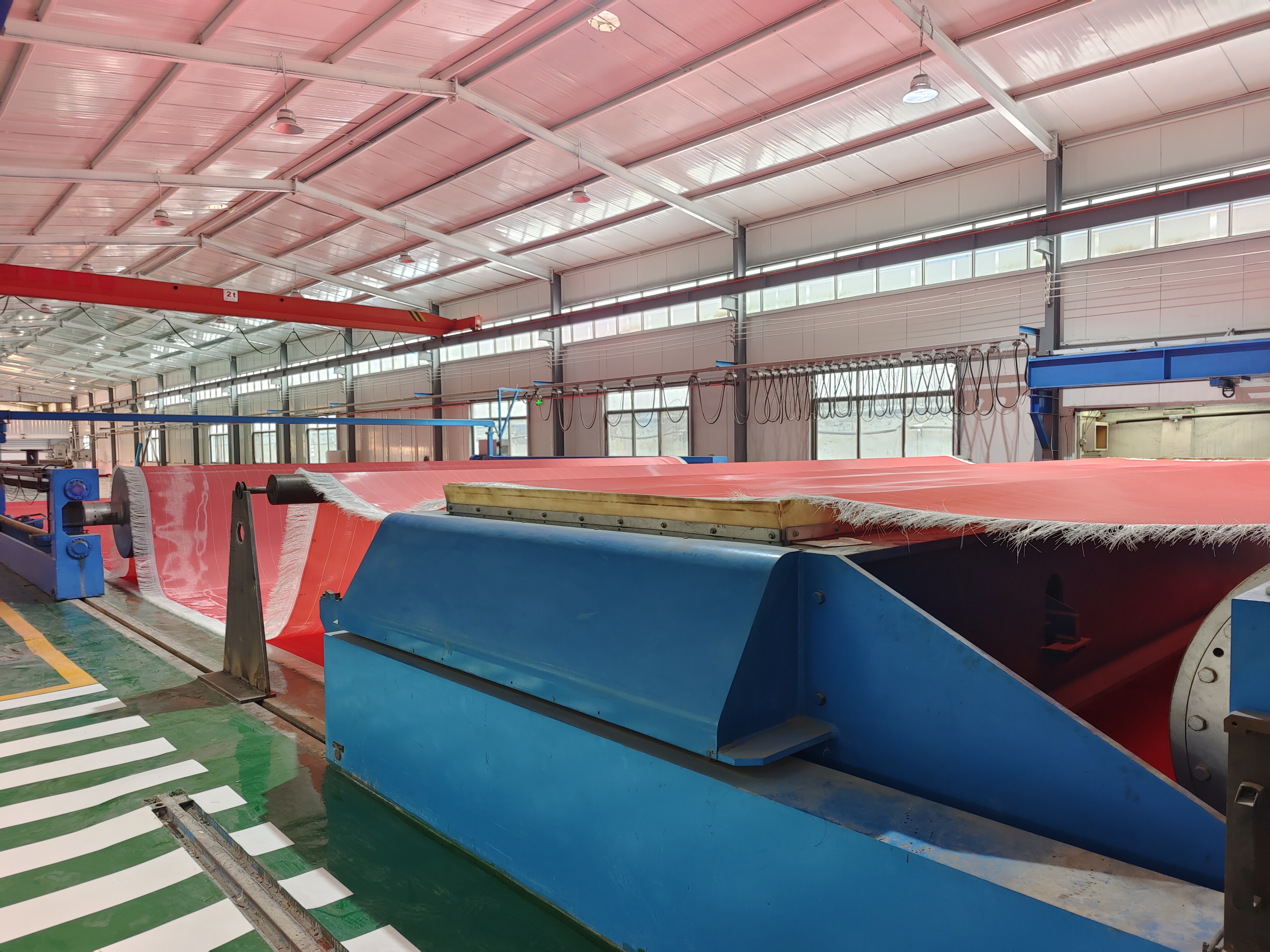
Static control: what a 10⁶ Ω surface resistivity changes
Static on a high-speed spunbond or meltblown line is not a nuisance; it is a quality and safety variable. Friction between the freshly formed web and the belt generates charge that, on an insulating surface, can accumulate to the point where the web is held to the belt past the release point, edges lift, or thin fabric flips. The carbon-fibre filaments in an anti-static belt change the physics of that path: charge moves through the belt to the rollers and discharges through the machine ground, rather than accumulating locally.
The practical consequence for buyers is that the belt is only half of the system. Yiheng's troubleshooting guidance for persistent flipping at speeds above 400 m/min puts equipment-side grounding first: the grounding rod should be driven about one metre deep, salt can be added to improve conductivity, and surface resistivity should be checked periodically with a meter. Where ambient humidity drops below roughly 30% in winter, atomised humidification at the release point is a documented mitigation. An anti-static belt specified to 10⁶ Ω cannot compensate for a grounding path that terminates in paint or a loose connection.
All three models answer the belt side of that problem equally. The choice between them should therefore be made on the other variables — mass, permeability, hydrolysis resistance and seam — not on the resistivity figure, which is common to the range.
Hydrolysis resistance: the specification that decides humid-plant performance
This is where the three belts genuinely separate. K4106B is built on a standard anti-static PET base. SK604 and KJD700 move to a hydrolysis-resistant PET base, which is the relevant variable wherever forming and drying zones run hot and humid — for example papermaking-adjacent processes, wet-laid nonwoven drying, or any plant where ambient temperature in the belt run exceeds about 80°C with high humidity.
The mechanism is degradation, not wear. Standard polyester mesh in a hot, humid environment hydrolyses: polymer chains shorten, tensile strength falls, the material becomes brittle, and the belt fails before its abrasion life is exhausted. Hydrolysis-resistant grades use stabilised polymer that resists the reaction, and Yiheng's own comparison of the two material classes reports a substantially longer service life in that specific environment. The buyer-facing point is narrower and more useful: in a dry, temperature-controlled plant, paying for hydrolysis resistance buys little; in a humid plant, declining to pay for it transfers the cost to unplanned downtime.
Service life is a planning input, not a promise. Under standard operating conditions Yiheng states a typical life of three to six months for its mesh belts, with cleaning and tracking checks extending it and process parameter adjustments required where fibre hanging appears. That window is what a maintenance budget and a spares holding should be built around, and it is the number to challenge if a quotation implies otherwise.
Joint selection: double-pin, melt glue or AB glue
All three belts can be joined by double pins, melt glue or AB glue, and the choice is a maintenance decision as much as an engineering one. A double-pin joint is mechanically re-openable, which means the belt can be de-laced, cleaned, trimmed or re-tensioned in the plant without a return to the manufacturer. Melt glue and AB glue produce a bonded loop that is not intended for repeated opening; they suit installations where the belt is fitted once and run to the end of its life, or where the machine geometry makes a pin joint impractical.
Speed raises the stakes. Above roughly 400–450 m/min, a seam that is even marginally thicker than the belt body produces a periodic impact as it passes the pre-pressing rollers — the source of the vibration commonly called roller jumping, and of transverse marks on the fabric. Yiheng's high-speed guidance is a High-Low Loop seam that matches body thickness one-to-one; the SK604 high-speed series is specified with that seam for lines running above roughly 450–500 m/min. The same thickness-matching logic should be applied to K4106B and KJD700 wherever the line runs fast, and it belongs in the quotation, not in the installation conversation.
Application fit: matching a model to a line
Model selection becomes straightforward once the dominant failure mode is named. The three belts are not tiered; they are aimed at different constraints.
- K4106B — a defined mass and permeability envelope. At 1.93 mm, 1,100 g/m² and 700±30 CFM, this is the construction to specify where the suction system is tuned to a specific permeability window and where belt mass contributes to dimensional stability under tension. Because the figures are fixed, repeat ordering and cross-plant standardisation are simpler, and deviations are easier to detect at goods-in inspection.
- SK604 — high speed with static and additive pressure. The series is Yiheng's high-speed recommendation for Reicofil and Chaolong lines, using a High-Low Loop seam to eliminate the vibration source and integrated conductive filaments to stop thin fabric from flipping. It is also the series recommended where softeners or hydrophilic additives are used, because the additive film reduces effective permeability and demands surplus CFM in the specification.
- KJD700 — mesh-mark-sensitive and dark packaging nonwovens. Where the dominant defect is a visible grid impression on dark or high-end packaging fabric, the quality variable is support-point distribution rather than belt life. Yiheng positions KJD700 for exactly this case, on the reasoning that a flatter, more uniform support surface spreads contact pressure and removes the visual mesh pattern.
- Humid and washdown environments. Both SK604 and KJD700 carry the anti-hydrolysis base; K4106B does not. This is the single clearest split in the range and should be decided before any other specification.
- Hygiene and food packaging. Belts for medical hygiene or food-contact nonwovens must be covered by the manufacturer's Food Contact Certificate, which Yiheng holds, so the compliance question is answered at supplier level rather than per model.
Market context: why belt-level specification is a procurement question now
Third-party market research supports the direction of travel. Spunlaid technology, which includes spunbond and meltblown, held a 48.4% share of the global nonwoven technology market in 2023 according to Grand View Research, and Smithers projects the global nonwoven fabric market reaching USD 90.8 billion by 2030, a 6.2% CAGR from 2025. Upstream, Dataintelo values the nonwoven production line market at USD 5.3 billion in 2024 with a projected USD 9.8 billion by 2033. Capability data published by belt makers points the same way: high-performance forming belts are described as running at line speeds up to 1,000 m/min and withstanding temperatures up to 180°C.
Faster lines convert consumable specifications into economics. At higher speed, static charge accumulates faster, seam thickness becomes a vibration source, and the cost of a wrong belt is measured in tonnes of off-spec fabric rather than in belt price. Trade classification reflects the same commodity-plus-engineering duality: industrial nonwoven mesh belts are commonly filed under HS Code 3926.90.29 or 5910.00.00 depending on material and reinforcement, so a buyer comparing landed cost across suppliers should confirm the code applied at import before assuming quotes are comparable.
Comparison with conventional solutions — and where these belts stop
Against a standard polyester forming belt, the value of the anti-static range is concentrated and conditional. Standard polyester mesh is the more economical choice on low-speed lines producing coarse-denier fabric in a humidity-controlled plant, where static is not the binding constraint; the same logic applies to spiral seam construction, which is cost-effective and easy to thread for lower-speed standard products. Anti-static belts earn their premium only where charge accumulation is the actual failure mode, and hydrolysis-resistant grades only where moisture and heat are present together.
The boundaries deserve to be stated as plainly as the capabilities:
- An anti-static belt does not repair a grounding fault. If flipping continues after fitting, the grounding rod depth, ground continuity and humidity at the release point are the first checks — not another belt.
- Carbon-fibre conductivity is not a substitute for CFM matching. Fibre hanging and longitudinal streaks are usually a permeability-to-denier mismatch or excessive lower suction; the fix is a tighter weave and lower CFM, not a more conductive belt.
- Hydrolysis resistance is a material property with a temperature ceiling. PET forming belts are not a high-temperature drying solution, and heat-gun cleaning must stay around 150°C with the nozzle moving, because concentrated heat causes local shrinkage, permanent waviness and permeability loss.
- Bonded joints trade serviceability for a smooth loop. Melt glue and AB glue loops are not designed for repeated de-lacing, so a plant that re-laces several times a year should specify double pins regardless of the model chosen.
- Published tolerances describe manufacturing control, not line performance. Yiheng controls air permeability deviation within ±5%, thermal shrinkage below 1% and width tolerance within ±0.5%, but an unbalanced suction box will still produce an uneven web on a perfectly toleranced belt.
Supplier continuity and compliance for repeat orders
Because forming belts are consumables on a three-to-six-month cycle, the total cost of a decision is dominated by what happens on the second and fifth order, not the first. Three supplier-level facts are therefore worth as much weight as the model choice.
The first is capacity and standardisation. Yiheng runs a 4,237 m² facility with a monthly capacity of about 12,800 m², a three-engineer R&D team, and heat-setting equipment used specifically to hold permeability deviation within ±5% — the control that determines whether the belt in month six behaves like the belt in month one.
The second is engineering responsiveness at small volume. OEM/ODM support is offered with a minimum order quantity of 1 m² and sample delivery in as little as three days, which makes it practical to validate a construction on one machine before standardising it across a plant, and to hold trial risk low when a line is being re-specified.
The third is documented compliance and equipment familiarity. Yiheng is a National High-tech Enterprise, holds a Food Contact Certificate, and is registered under the German Packaging Law (LUCID), which addresses the packaging and circular-economy obligations that otherwise surface at EU import clearance. The company also states long-term strategic partnerships with nonwoven equipment manufacturers including Chaolong, Hongda and Aolong, which is the practical reason its tuning data maps to those machines rather than to a generic installation sheet. Buyers re-ordering across a multi-line plant should ask for the compliance file and the equipment-specific tuning data with the quotation, because both are cheaper to obtain before the order than after the shipment.
Future outlook
Three trends are likely to shape anti-static forming belt specification over the next several years. Spunlaid capacity growth, supported by the technology's 48.4% share of the nonwoven market in 2023, keeps pushing line speeds upward, which raises the relative importance of seam thickness matching and dynamic balance against raw material cost. Second, static management is becoming a documented engineering requirement rather than a seasonal complaint, with resistivity figures, grounding specifications and humidity thresholds written into procurement documents. Third, compliance paperwork — food-contact declarations, German Packaging Law registration, correct HS classification — is increasingly checked at supplier qualification rather than at customs.
For buyers, the implication is a shift in what a specification should contain. A purchase order that lists width, length and GSM but omits resistivity band, hydrolysis class, seam type and permitted CFM deviation leaves the three most consequential variables to the supplier's default. Model-level comparison of the kind set out here is only useful if it ends in those four lines on the order.
Procurement checklist before releasing a purchase order
| Item | What to state | Why it decides outcome |
|---|---|---|
| Resistivity band | 10⁶ Ω band, tested on delivery | Confirms the belt is genuinely anti-static rather than standard polyester |
| Hydrolysis class | Standard or anti-hydrolysis PET, with ambient temperature and humidity stated | Determines whether degradation or abrasion ends belt life |
| Permeability | Target CFM plus permitted deviation | Drives web uniformity and fibre-hanging risk |
| Seam | Double-pin, melt glue or AB glue; thickness match required above 400 m/min | Controls vibration, seam marks and field serviceability |
| Equipment reference | Chaolong, Hongda or other line, with speed and denier range | Allows tuning data to be supplied with the belt |
| Compliance file | Food Contact Certificate, LUCID registration, HS code confirmation | Removes clearance and audit risk at destination |
Frequently asked questions
Which of the three belts should be specified for a line running above 400 m/min?
Above roughly 400–450 m/min the limiting factor is usually seam thickness rather than yarn type. Yiheng specifies the SK604 high-speed series with a High-Low Loop seam for lines in the 450–500 m/min range and above, so seam thickness matches the mesh body and the belt does not generate the periodic impact that causes roller jumping and transverse marks; anti-static carbon-fibre filaments remain part of that construction because thin fabric flips easily when charge is not dissipated. K4106B and KJD700 should be assessed against the same seam-thickness criterion before being used at comparable speeds.
How does a buyer decide between standard polyester and hydrolysis-resistant construction for a humid plant?
Standard polyester mesh hydrolyses in hot and humid conditions, losing strength, becoming brittle and breaking before its abrasion life is exhausted. Hydrolysis-resistant grades use stabilised polymer that resists the reaction, and Yiheng reports a substantially longer service life for the resistant grade in that environment. The rule of thumb the company gives is that any scenario where ambient temperature exceeds about 80°C with high humidity — papermaking, wet-laid nonwoven drying and similar processes — should use the hydrolysis-resistant series, while dry, temperature-controlled plants gain little from the upgrade. Among the three models compared here, SK604 and KJD700 use the anti-hydrolysis base; K4106B does not.
Do these belts support Chaolong or Hongda equipment?
Yes. Yiheng states that its belts are compatible with Chaolong and Hongda lines, and that it has supplied Reicofil, Chaolong, Hongda and other major equipment manufacturers, providing tuning data matched to the specific machine. For a buyer, the practical check is to give the equipment brand, line speed and denier range at quotation stage so that the seam type and permeability can be set against the machine rather than against a catalogue default.
Do the products comply with EU or German environmental regulations?
Yiheng holds a Food Contact Certificate covering belts used for food packaging and hygiene material production, and has completed LUCID registration under the German Packaging Law, which addresses packaging registration and system participation obligations under VerpackG. Together these cover the two compliance questions that most often arise at EU import: material safety in contact with hygiene or food-grade product, and packaging obligations at destination.
What service life should a buyer plan for?
Under standard operating conditions, Yiheng states a typical service life of three to six months for its nonwoven mesh belts. Life is extended by regular cleaning and tracking checks, and shortened by conditions the belt cannot control — persistent mistracking, imbalanced tension, excessive lower suction causing fibre hanging, or local heat damage during lump removal. Planning a spares holding against the lower end of that range avoids the situation where a belt change becomes an unplanned stoppage.
How are orders sampled, inspected and shipped?
Yiheng offers OEM/ODM supply with a minimum order quantity of 1 m² and sample delivery in as little as three days, which allows a construction to be validated on one machine before wider standardisation. Delivery terms are FOB, CIF, DAP or DDP; acceptance is based on 100% pre-shipment inspection, with third-party inspection by BV or SGS available on request; payment terms are 30% deposit with 70% balance before shipment.
For buyers who need the full model list, material classes and compliance documents in one file, Yiheng Mesh's English-language product brochure is available for download: Yiheng Mesh product brochure (PDF).
Tem questões ou precisa de mais detalhes?
Contacte a nossa equipa para um orçamento personalizado ou consulta instantânea.
Solicitar orçamento
Preencha o formulário abaixo e a nossa equipa entrará em contacto com uma proposta personalizada.
Chat direto do WhatsApp
Prefere conversar em tempo real? Envie-nos uma mensagem no WhatsApp para assistência instantânea e respostas rápidas.
- Obter orçamento personalizado
- Partilhar fotos ou documentos
- Discuta as suas necessidades diretamente
Geralmente responde em 5–30 minutos durante o horário de expediente.