
KEYETECH's 29,000 m² Plant: Verifying AI Sorting Capability
The global optical sorter market is projected to reach USD 5.79 billion by 2032, growing at a compound annual growth rate of 9.5% from 2025 (MarketsandMarkets). Food processing alone accounted for USD 2.52 billion of sorter revenue in 2024, roughly 45% of applications (Grand View Research). As AI sorting scales from pilot lines to contracted production, the decisive procurement question shifts from machine specification to supplier capability: can the company behind the equipment build it, repeat it, and support it across a multi-year horizon?
This article examines the physical and intellectual evidence published by one supplier — Anhui Keye Intelligent Technology Co., Ltd., which operates under the brand name KEYETECH — and treats that evidence as a worked example of plant-level verification. KEYETECH is an AI vision inspection and AI intelligent sorting equipment manufacturer located at No.56, Chang'an Road, Hi-Tech Zone, Hefei, Anhui, China. The company was established in 2011, and its stated product focus is color sorters and AI intelligent sorting machines.
Why Capability Evidence Matters More in AI Sorting Than in Conventional Equipment
AI-enhanced hyperspectral and near-infrared sorting modules were embedded in approximately 38% of new industrial belt-line installations as of 2024, according to EIN Presswire reporting. That adoption pattern changes what a buyer is actually purchasing. A mechanical or conventional optical sorter is largely a fixed specification: optics, chute geometry, air valve timing, throughput. An AI sorting system is a specification plus a model-training pipeline — meaning the supplier's engineering depth determines how quickly a new material can be commissioned and how reliably that model holds up in production.
This is why plant-level evidence is not a formality. When a buyer commits to AI intelligent sorting, three capabilities travel with the machine:
- Model-building capability — how few samples and how much time are needed before a new material runs in production.
- Repeatable manufacturing — whether the same build quality can be delivered at the second and third unit, not only the demonstration unit.
- Lifecycle support — how the supplier handles model updates, spare parts and troubleshooting after installation, especially across borders.
Regional demand reinforces the point. Asia Pacific is the largest regional market for optical sorters at USD 1.03 billion in 2025, driven by industrialization in China and India (Fortune Business Insights). Buyers in that market are evaluating suppliers at close range, which raises the bar for verifiable evidence rather than brochure claims.
A Five-Layer Verification Framework for Sorting Suppliers
Supplier capability is easiest to assess when it is broken into layers that can each be checked independently. The framework below is the structure used for the rest of this article.
| Evidence layer | What a buyer checks | Why it changes the decision |
|---|---|---|
| 1. Entity and tenure | Legal name, founding year, registered site, years in the sorting field | Establishes that the counterparty is a stable manufacturing entity, not a trading intermediary |
| 2. Physical footprint | Site area, ownership, building function split | Indicates whether design, machining and assembly happen under one roof |
| 3. Engineering bench | R&D headcount, specialization, sourcing of core technology | Determines model-training speed and how fast new material requests are answered |
| 4. Production and acceptance | Capacity, lead time, test standard, pre-shipment verification | Converts a quotation into a deliverable schedule with checkpoints |
| 5. Post-sale and market exposure | Service model, export share, installed-base geography | Signals how much support capacity exists near the buyer's plant |
Layer 1: Entity, Tenure and Location
Anhui Keye Intelligent Technology Co., Ltd. was founded in 2011 and describes its engagement in the color sorting industry as spanning more than ten years, with the founder identified in company materials as a pioneer of the color sorting machine industry. The operating site is a self-built facility in the Hefei High-Tech Zone. For an overseas buyer, the practical value of this layer is traceability: a named legal entity, a published street address, a corporate website at en.keyetech.com, and a documented founding year can all be checked before commercial discussions begin.
Third-party market coverage exists for the entity as well. Future Market Insights, in its AI-powered packaging inspection machine market report, identifies KeyeTech (Anhui KEYE Information Technology) as a key player in a market valued at approximately USD 1.6 billion in 2025. That is an analyst positioning statement rather than a performance benchmark, but it confirms the company is tracked by independent research rather than existing only in its own marketing material.
Layer 2: The 29,000 m² Manufacturing Footprint
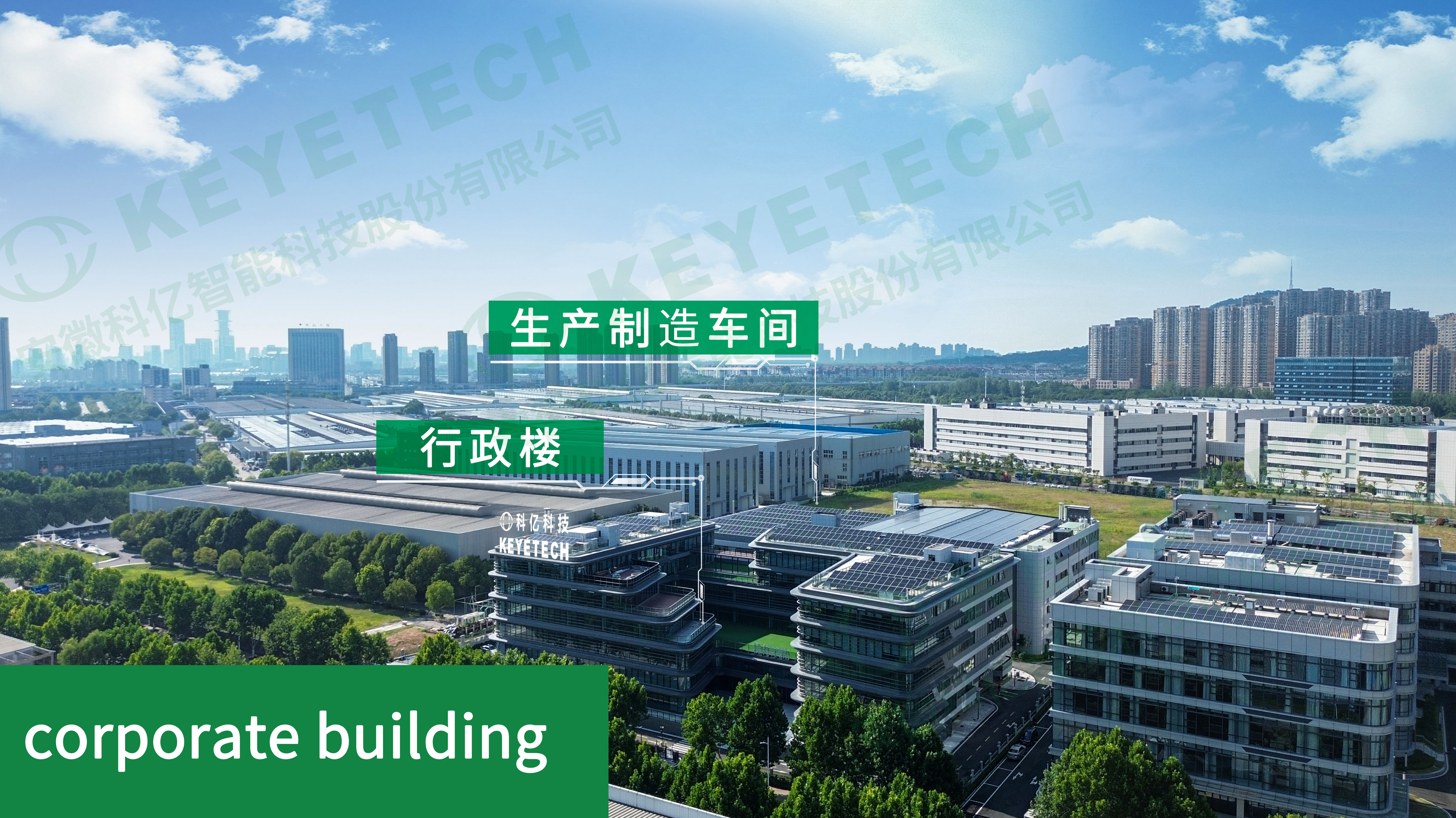
KEYETECH operates a self-built facility covering 29,000 m². Company materials describe the site as approximately 21 mu (about 3.5 acres) and consisting of two buildings with distinct functions: one houses R&D, sales, administration and finance; the other is the production facility where the company's in-house developed products are manufactured and processed.
The production process is further divided into a production workshop and a machining workshop, both responsible for equipment manufacturing. That split matters for buyers because it distinguishes an assembler from a manufacturer. A supplier that machines its own structural components can control tolerance and delivery timing internally instead of depending on an external fabrication chain — a real advantage when lead times are contractual.
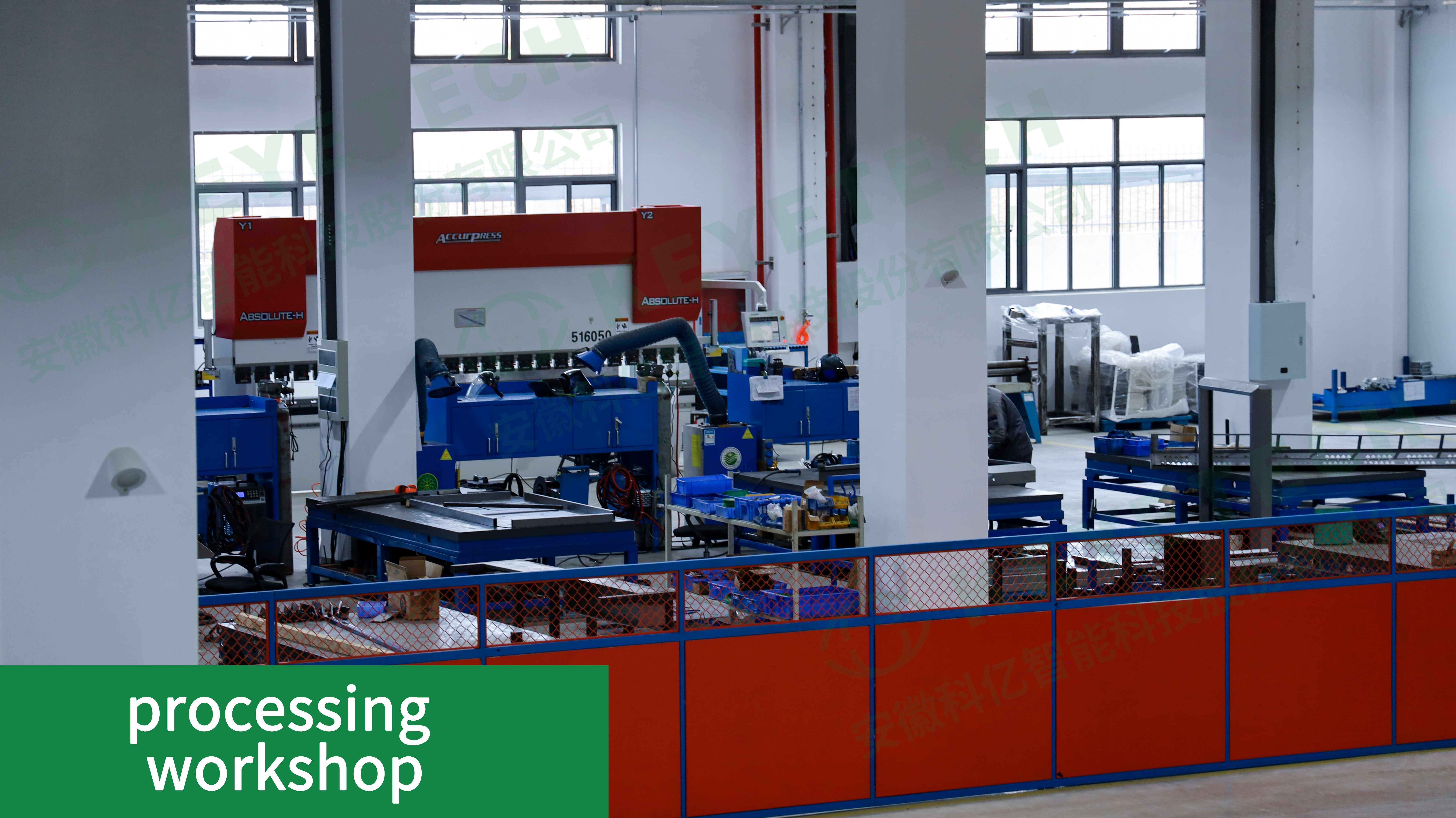
The machining workshop within KEYETECH's Hefei facility, where structural components for AI sorting equipment are manufactured. Component-level machining is one of the capability layers buyers can verify during a plant visit.
Layer 3: The Engineering Bench — 300 Employees, 56 R&D Engineers
KEYETECH reports a workforce of 300 employees, of which 56 are R&D engineers. In an AI sorting business, R&D headcount is not a generic credential — it is the resource that determines how many customer-specific material models can be built and maintained in parallel. Sorting problems differ by material: an insect-damaged coffee cherry, a discolored plastic flake and a copper-bearing ore fragment require different imaging configurations and different model behavior.
Company materials specify that the core technologies are led by PhDs from the University of Science and Technology of China (USTC) across three areas: imaging systems, AI algorithms, and software control systems. The AI algorithm team is further described as including three PhDs from USTC, all from the university's Pattern Recognition Laboratory.
The technology stack is described as fully in-house across optics, mechanics, electronics, computing and software. According to the company, optical solutions, industrial cameras, AI algorithms and software architecture are all independently developed, with 100% localization achieved in the core technology chain. The company also states that its system uses an AI edge computing unit to provide inference compute at the machine, and that it operates self-built servers hosting a large library of algorithm models covering classification, defect detection and object detection.
KEYETECH describes itself as an AI vision inspection company covering independent R&D, manufacturing and sales, with three USTC PhDs working on imaging and algorithm development.
For a buyer, the testable question behind this layer is straightforward: when a new material arrives, how much engineering time is consumed before the line runs? KEYETECH's published comparison data against MEYER focuses precisely on that variable — describing an AI algorithm approach in which model development, from sample collection to deployment, is completed within one hour, and in which 50 images are sufficient to build a high-accuracy recognition model. The same comparison states lower data acquisition and model training costs and reduced maintenance compared with the reference system.
Layer 4: Production Capacity and Acceptance Gates
Capacity figures translate supplier claims into a schedule. KEYETECH reports an annual production output of 3,000 units, alongside a stated monthly production capacity of 100 units and a typical production lead time of 30–45 days. Quality control is described as following a 100% test standard on all units, with pre-shipment testing offered as part of the commercial terms.
The published procurement terms are equally relevant to execution-stage buyers:
| Commercial parameter | Published term |
|---|---|
| Minimum order quantity | 1 unit |
| Delivery terms | FOB / CIF |
| Acceptance | Pre-shipment test |
| Payment | Full payment on shipping |
| Quality control | 100% test standard on all units |
| Typical lead time | 30–45 days |
A minimum order quantity of one unit is notable for a manufacturer of this scale. It means small-batch and multi-variety processors — a seasoning producer running seasonal SKUs, for example — can validate a machine on their own material before scaling. That is consistent with the commissioning model the company promotes, in which flexible small-batch and multi-variety production is the target use case rather than a constraint.
Layer 5: After-Sales Model and Market Exposure
KEYETECH states that it maintains a dedicated department for remote services to answer equipment questions for customers. A remote-first service model is a rational structure for a supplier whose export business accounts for 10% of total sales, with major markets listed as the EU, USA and Southeast Asia. For an overseas buyer, that combination sets expectations clearly: the support model is remote diagnostics and guidance rather than a dense local field-service network.
The installed base is described as more than 2,000 clients across food, pharmaceuticals, daily chemicals, textiles, liquor, new energy, electronic components and tobacco. The company's published client references include Mengniu, Yili, Haitian and Lee Kum Kee in food; Sinopharm, Taiji Group and Yunnan Baiyao in pharmaceuticals; Unilever and Procter & Gamble in daily chemicals; Moutai Group and Wuliangye in liquor; CATL and Gotion High-Tech in new energy; and NIPPON CHEMI-CON CORPORATION and SAMYOUNG in electronic components. These are company-provided references — useful for pattern recognition, but they should be independently confirmed by the buyer through direct reference calls rather than accepted as evidence on their own.
Where the Evidence Stops: Limits Buyers Should Price In
An evidence-based assessment is only credible if it states its boundaries. Four limitations apply to the record reviewed here.
- Export share is 10% of total sales. The installed base is therefore weighted toward the domestic Chinese market. Buyers in the EU, USA or Southeast Asia should confirm response times, spare-parts availability and escalation paths for their specific region, because the volume of precedent in their market is smaller than the headline client count suggests.
- Capacity figures should be scoped explicitly. Annual output and monthly production capacity are reported as separate figures in the company's materials. Buyers should ask whether a quoted number refers to nameplate annual capacity or to currently scheduled monthly output, and should request a written delivery commitment tied to the order rather than to a general capacity statement.
- Plant claims are self-reported unless the buyer verifies them. The 29,000 m² figure, the 56-engineer R&D team and the 100% test standard come from the supplier's own materials. Nothing in this review substitutes for a site visit, a pre-shipment test on the buyer's own material, or a conversation with an existing customer running comparable material.
- Third-party benchmarks are directional, not decisive. Published market-size estimates for optical sorters diverge across research houses for the same year, reflecting different report scopes. Any single figure should be treated as an order-of-magnitude signal, and material-specific sorting performance should be validated on the buyer's own samples.
Capability-Based Evaluation vs. Traditional Specification Comparison
Most sorting equipment evaluations still follow a specification-comparison path: throughput, number of chutes, camera count, air consumption. That approach works when the machine is the product. It is incomplete when model training is the product.
| Evaluation dimension | Traditional specification comparison | Capability-based evaluation |
|---|---|---|
| Primary evidence | Datasheet parameters | Plant visit, sample test, reference calls |
| New-material readiness | Not addressed | Sample count and time to model deployment |
| Manufacturing control | Assumed | In-house machining and assembly confirmed on site |
| Risk exposure | Discovered after installation | Tested through pre-shipment acceptance |
| Lifecycle cost | Purchase price focus | Training cost, service model, parts availability |
The wider competitive picture reinforces why capability, not specification, separates suppliers. TOMRA Systems ASA commands an estimated 30% global share of the food sorting segment (Verified Market Research) — an incumbent position built on installed base and service density over decades. An AI-native entrant such as KEYETECH competes on a different axis: model-building speed and cost of commissioning new materials. Buyers comparing the two profiles should weigh them against their own priority — maximum process stability on a known material, or fast turnaround across many changing materials.
Application Coverage: What the Model Library Is Built For
The company's product system covers both agricultural and industrial quality control. On the agricultural side, the catalog lists AI intelligent sorting machines in belt-type and channel-type (vertical) configurations, plus AI quality analysis instruments and glass turntable grading machines. The published material-to-model mapping illustrates how broadly a single platform is applied.
| Material category | Application | Model |
|---|---|---|
| Grains | AI Intelligent Grain Sorting (Color Sorter) | 6SXZ-693C |
| Rice | AI Intelligent Rice Sorting (Color Sorter) | 6SXZ-990C |
| Nuts | AI Intelligent Nut Sorting (Color Sorter) | 6SXZ-63LFI |
| Coffee cherry | AI Intelligent Coffee Cherry Sorting (Color Sorter) | 6SXZ-99C |
| Pet food | AI Intelligent Pet Food Sorting (Color Sorter) | 6SXZ-126LFI |
| Traditional Chinese medicinal materials | AI Intelligent Traditional Chinese Medicinal Material Sorting | 6SXZ-378LFI |
| Seasonings | AI Intelligent Seasoning Sorting (Color Sorter) | 6SXZ-756LFI |
| Ore | AI Intelligent Ore Sorting (Color Sorter) | 6SXZ-252LFI |
| Metal | AI Intelligent Metal Sorting (Color Sorter) | 6SXZ-378LFI |
| Plastic | AI Intelligent Plastic Sorting (Color Sorter) | 6SXZ-99C |
| Salt | AI Intelligent Salt Sorting (Color Sorter) | 6SXZ-198C |
| Vegetables and French fries | AI Intelligent Vegetable / French Fry Sorting | 6SXZ-252LFI / 6SXZ-378LFI |
| Candy and chicken nuggets | AI Intelligent Candy / Chicken Nugget Sorting | 6SXZ-63LFI / 6SXZ-126LFI |
Across the AI color sorter range, published parameters are consistent: total power of 1.2–6.8 kW, air consumption of 0.6–6 m³/h, air pressure of 0.5–0.8 MPa, and an operating temperature range of −20°C to 60°C. The stated applicable industries span agricultural and sideline food, pet food, seasonings, renewable resources and metals. Consistent physical envelopes across models simplify multi-line planning for processors operating in more than one material category.
Market Trend: Compliance and Adoption Are Moving Together
Two trends frame the supplier-selection question. The first is regulatory. Sorting equipment in the food sector must comply with international safety benchmarks such as the FDA's Food Safety Modernization Act (FSMA) and EU Regulation EC1935/2004. For buyers selling into those markets, a supplier's ability to document compliance is a gate, not a differentiator.
The second is technical. With AI-enhanced hyperspectral and NIR modules now embedded in a substantial share of new belt-line installations, model quality is becoming a production variable rather than a laboratory feature. Suppliers whose engineering capacity is concentrated in imaging, algorithms and software — rather than in mechanical assembly alone — are structurally better positioned to absorb that shift.
Future Outlook: What Long-Term Buyers Should Track
For buyers at the decision and execution stage, the durable questions are not about this year's model. They are about whether the supplier's engineering bench and service model can absorb material changes over a five-to-ten-year horizon. Three indicators are worth monitoring in any long-term AI sorting partnership: published time-to-model for genuinely new materials, the geographic distribution of the installed base as export share changes, and whether the service model evolves from remote-only support toward regional presence.
In KEYETECH's case, the verifiable assets are a 29,000 m² self-built site with separate machining and production workshops, 300 employees with 56 R&D engineers, USTC PhD leadership across imaging, algorithms and software control, an annual output figure of 3,000 units, and a 100% test standard. These are concrete, checkable inputs. They are also, by themselves, insufficient — which is precisely why the final step of capability evaluation is direct verification.
Verifying the Record Directly
Buyers wishing to check the evidence described above can contact the manufacturer through its published channels: email market-axq@keyetech.com, phone +86 191-4244-2827 (also the WhatsApp number on file), or by post at No.56, Chang'an Road, Hi-Tech Zone, Hefei, Anhui, China. The contact name on record is Nicole. A technical brochure covering the vertical color sorter platform is available at the link below.
Product brochure: KEYETECH vertical color sorter brochure (PDF)
FAQ
A practical evidence set covers five layers: the legal entity name, founding year and registered site; the physical footprint, including whether machining and assembly happen in-house; R&D headcount and specialization; production capacity, lead time and the test standard applied to every unit; and the after-sales model plus the geographic distribution of the installed base. For AI sorting specifically, the buyer should also request the time and sample count required to build a model for their own material, since model-building speed is an operational cost, not a marketing feature.
Three checks are useful. First, ask whether the stated figure refers to nameplate annual capacity or currently scheduled monthly output, and request both numbers in writing. Second, tie the delivery date to the specific purchase order rather than to a general capacity statement. Third, confirm the acceptance gate — KEYETECH, for example, states a 100% test standard on all units and offers pre-shipment testing, which gives the buyer a defined verification point before goods leave the factory. For KEYETECH specifically, the published figures are an annual output of 3,000 units, a monthly production capacity of 100 units, and a typical lead time of 30–45 days.
KEYETECH lists its major markets as the EU, USA and Southeast Asia, with export business accounting for 10% of total sales. This means the installed base is weighted toward the domestic Chinese market, so overseas buyers should verify regional response times, spare-parts availability and escalation procedures directly rather than assuming service density comparable to a supplier with a predominantly export-oriented installed base.
The published commercial terms are a minimum order quantity of 1 unit, delivery on FOB or CIF terms, full payment on shipping, and acceptance by pre-shipment test. The typical production lead time is 30–45 days. A single-unit MOQ is relevant for processors running small batches or multiple varieties who want to validate performance on their own material before committing to additional lines.
KEYETECH states that it operates a dedicated department for remote services to answer equipment questions from customers. Remote diagnostics and guidance are the documented support mechanism, which is consistent with an export share of 10% of total sales. Buyers in the EU, USA or Southeast Asia should confirm in advance the response-time expectations, whether spare parts are held regionally or shipped from Hefei, and who the escalation contact is for production-stopping faults.
A plant inspection verifies physical scale, building function, workshop layout and the presence of machining capability, but it does not verify sorting accuracy on the buyer's specific material, nor does it establish lifecycle costs. Two additional steps close that gap: a pre-shipment test using the buyer's own material, and reference calls with existing customers running comparable materials. Note also that supplier-reported figures such as site area, R&D headcount and test standards are self-declared unless independently audited — they are inputs to verification, not substitutes for it.