
KT-DS Dot Coating Laminating Machine: A Carpet Manufacturing Fit Guide
Light Industry & Daily Use · Carpet Manufacturing
A specification-led look at how a dot coating laminating machine fits carpet bonding work — and where its published operating envelope ends.
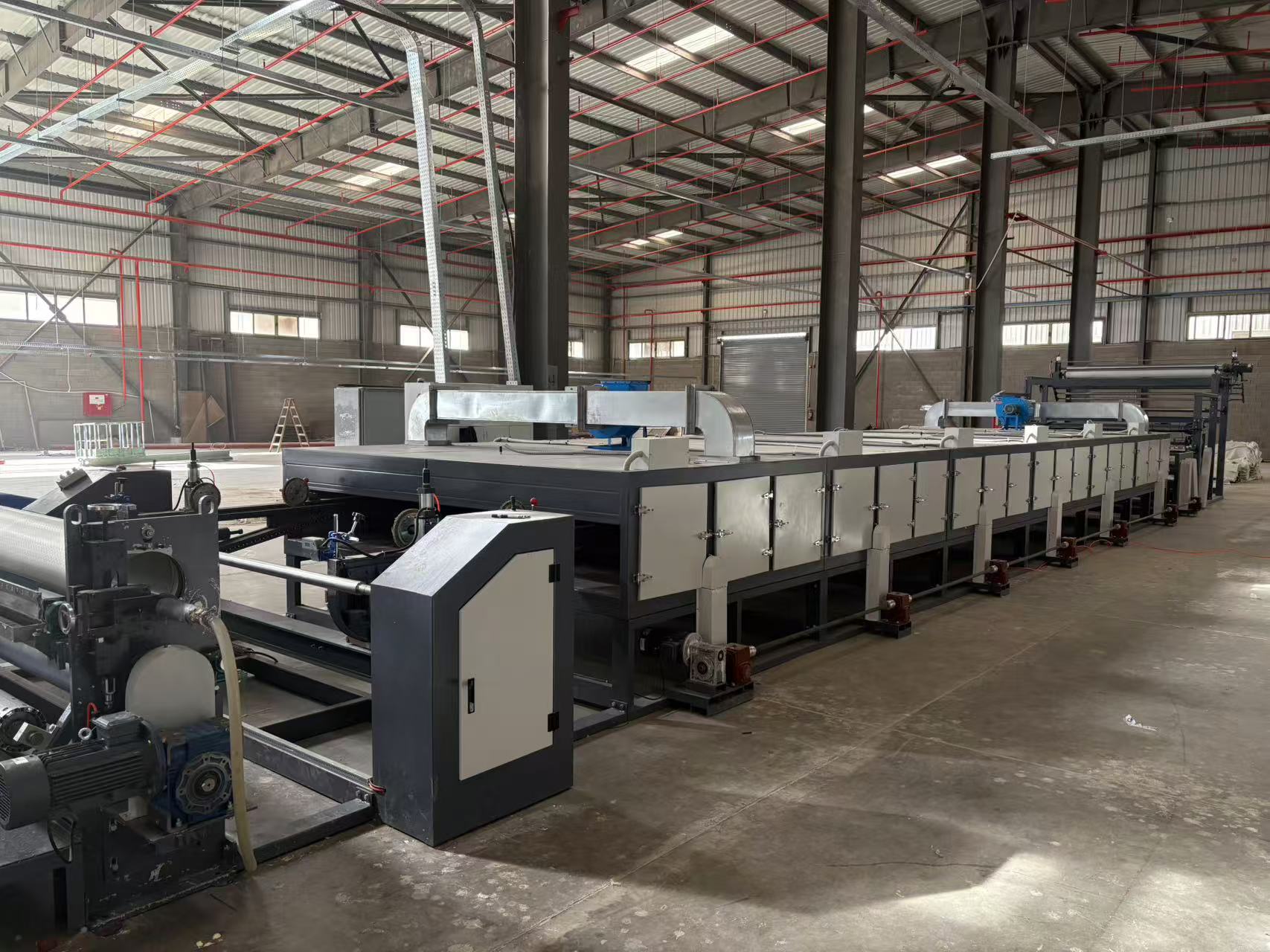
The KT-DS is a dot coating laminating machine manufactured by JIANGSU KUNTAI MACHINERY CO.,LTD and listed for carpet manufacturing. Its published specification defines a clear operating envelope: a coating width of 1600 mm to 4500 mm, a machine roller surface of 1800 mm to 4700 mm, machine speed of 5 m/min to 20 m/min, chain wheel transmission, electric heating, a working temperature of 80–100 °C, a maximum temperature of 130 °C, and construction in carbon steel or SS304.
JIANGSU KUNTAI MACHINERY CO.,LTD is a Chinese manufacturer of coating, laminating, impregnation and cutting machinery for technical textiles and composites, based at Zhengang Industrial Park, Yancheng City, Jiangsu, China. The company was founded in 1983, operates a 30,000 m² factory with 210 employees, and reports an annual output of 650 units.
For a carpet producer in the evaluation or execution stage, the useful question is not whether a dot coating machine exists. It is whether adhesive placed in a discrete pattern, delivered at a working temperature of 80–100 °C, across a 1600–4500 mm coating width, matches the carpet construction, the upstream line width and the downstream curing arrangement already on the floor. That is the fit question this guide addresses.
Why carpet bonding is an adhesive-placement decision
Carpet is a layered construction. A face fibre or pile is anchored to a primary backing, and the composite is usually stabilised further with a back coating, a secondary backing, a foam layer or a reinforcing scrim. Whatever the final build, the mechanical result depends on how the adhesive is delivered to the interface: continuously across the full surface, in a printed pattern, as a powder that is later melted, or through a flame-softened tie layer.
Adhesive placement drives three things a carpet producer feels directly. It affects hand and drape, because a continuous adhesive film stiffens a construction that a patterned deposit leaves more supple. It affects the amount of adhesive the line must buy and dry or cool. And it affects process control, because a patterned deposit is only useful if the pattern is repeatable at line speed.
That is the opportunity the dot coating method addresses. Instead of flooding the interface, the KT-DS deposits adhesive in a dot pattern, so bonding is concentrated at defined contact points. Whether that produces a commercially better carpet is a question of the specific construction, the adhesive chosen and the trial result — not something a specification sheet can settle on its own.
Where the KT-DS sits: the published specification
The KT-DS is one model within a broader Kuntai range that includes PUR hot melt systems, plain and textile lamination machines, double belt presses, flatbed laminating machines, flame laminating machines, glue spraying and powder scattering equipment, and UD impregnation and crossply machinery. The KT-DS is the model in that range whose stated application is carpet manufacturing, and whose stated gluing method is dot coating.
| Parameter | Published value |
|---|---|
| Machine model | KT-DS |
| Machine type | Dot coating laminating machine |
| Gluing method | Dot coating |
| Coating width | 1600 mm – 4500 mm |
| Machine roller surface | 1800 mm – 4700 mm |
| Machine speed | 5 – 20 m/min |
| Transmission | Chain wheel control |
| Heating mode | Electric heating |
| Working temperature | 80 – 100 °C |
| Maximum temperature | 130 °C |
| Construction material | Carbon steel / SS304 |
| Stated application | Carpet manufacturing |
Two features of this table matter more than the rest for a carpet line. The first is the coating width range: 1600 mm to 4500 mm is a wide span and determines which carpet roll formats a single machine configuration can serve. The second is the temperature window: an 80–100 °C working range with a 130 °C ceiling is a low-thermal-load process relative to heat-and-pressure bonding equipment in the same portfolio.
Technical explanation: what each specification changes on a carpet line
Dot coating as the gluing method
Dot coating is an adhesive application method, not a bonding chemistry. The machine applies adhesive to the substrate as a pattern of discrete deposits rather than as a continuous film. For a carpet producer, the practical consequences to evaluate are pattern definition at line speed, the adhesive quantity per square metre that the pattern represents, and how the pattern behaves when the bonded composite is later rolled, cut or thermally treated.
The published KT-DS specification states the gluing method and the machine speed range, but it does not state an adhesive application rate in grams per square metre, nor does it name specific adhesive chemistries. Both of those must be established on the buyer's own carpet substrate during a trial, not extrapolated from the datasheet.
Electric heating and the 80–100 °C working window
The KT-DS uses electric heating with a working temperature of 80–100 °C and a maximum of 130 °C. Electric heating removes the thermal oil circuit from the machine's utility requirements, which simplifies installation and keeps the heating source inside the machine's own control envelope.
The temperature ceiling is also the machine's most important boundary. Adhesive systems or carpet builds that need to be processed above 130 °C fall outside the KT-DS specification. In the same Kuntai range, the double belt press laminator KT-HY-H states a maximum heating temperature of 250 °C and the flatbed laminating machine KT-PB states a maximum of 230 °C — an indication of how much thermal headroom separates the dot coating route from heat-and-pressure lamination.
Chain wheel transmission and 5–20 m/min
The KT-DS uses chain wheel control for transmission and runs at 5–20 m/min. Chain wheel transmission is a mechanical drive arrangement; the stated speed band is the range a carpet producer should match against the pace of its existing coating, drying and wind-up sections. A line that runs faster than 20 m/min, or that needs to modulate below 5 m/min for short runs, is working outside the published band.
Carbon steel or SS304 construction
The KT-DS is offered in carbon steel or SS304. The choice is a specification decision rather than a performance claim: SS304 is specified where the process environment, cleaning regime or product hygiene requirements call for a stainless surface, and carbon steel where those requirements do not apply. Buyers should state the intended construction in the enquiry so that the quotation reflects the same build.
Application fit: three scenarios to test before ordering
Scenario 1 — roll width and coating width alignment
The KT-DS covers coating widths from 1600 mm to 4500 mm with a machine roller surface of 1800 mm to 4700 mm. For a carpet producer, the first screening question is whether the intended carpet roll width sits comfortably inside the selected coating width, allowing for edge trim and any selvedge that cannot carry adhesive. A configuration chosen too close to the roll edge tends to cause adhesive placement problems at the selvedge. This is a configuration conversation, and it should happen before a quotation, not after installation.
Scenario 2 — backing and secondary layer bonding trials
Kuntai lists the KT-DS application as carpet manufacturing. Within that, the bonding interface differs by construction: face to primary backing, carpet to secondary backing, or carpet to a stabilising layer. Because the published specification does not name adhesive chemistry, the practical route is a sample trial on the buyer's own carpet, at the target line speed inside the 5–20 m/min band and inside the 80–100 °C working window, with bond assessment carried out on finished carpet rather than on a flat specimen.
Scenario 3 — thermal and utility integration
Electric heating changes the site utilities the line needs. A producer replacing a thermal-oil-heated process with the KT-DS should confirm electrical capacity at the installation point, and confirm that the downstream cooling or conditioning section can handle a bonded carpet leaving the machine within the 80–100 °C working band. Where the existing line was built around a higher-temperature process, the cooling section may be oversized for the dot coating route — which is a cost consideration rather than a defect.
Comparing dot coating with other carpet bonding routes
The KT-DS is not a universal carpet bonding machine, and the honest comparison is against the other bonding architectures in the same manufacturer's range. The table below uses only published specifications from the Kuntai corpus.
| Model | Bonding / gluing method | Stated width | Stated speed | Stated max temperature |
|---|---|---|---|---|
| KT-DS dot coating laminating machine | Dot coating | Coating width 1600–4500 mm | 5–20 m/min | 130 °C |
| KT-HY-H double belt press laminator | Heat and pressure via double belt | Max material width 1600 mm | 0–25 m/min | 250 °C |
| KT-PB flatbed laminating machine | Flatbed heat and pressure | Max material width 1600 mm | 0–25 m/min | 230 °C |
| KT-SF glue spraying and powder scattering machine | Adhesive spraying plus powder scattering | Material width 1600–2600 mm | 5–25 m/min | Not stated |
| KT-HY flame laminating machine | Flame bonding | Material width 1600–3000 mm | Up to 25 m/min | Not stated (gas) |
Limits a buyer should take seriously
- The 130 °C ceiling excludes high-temperature processes. Any carpet build or adhesive requiring processing above the KT-DS maximum temperature belongs on a different machine — for example the KT-HY-H double belt press with a stated 250 °C maximum or the KT-PB flatbed laminator with a stated 230 °C maximum.
- The stated speed band tops out at 20 m/min. Several other models in the range state 25 m/min or higher. A line sized for higher throughput should be checked against those models rather than assumed to scale on the KT-DS.
- Dot coating is one adhesive-placement method among several. Kuntai separately describes a water-based glue mesh-belt carpet laminating machine for laminating fabric, foam, nonwoven, EVA, leather and velvet. Where the carpet construction calls for a water-based adhesive applied across the full surface, or for foam and nonwoven layer bonding of that kind, the dot coating route may not be the appropriate machine — even though both address carpet production.
- Adhesive chemistry is not specified. The published KT-DS data does not name compatible adhesive types, so compatibility must be confirmed by trial before a purchase decision is treated as final.
Supplier context: capability and compliance behind the machine
Machine specifications describe the equipment; a carpet producer still has to assess the company that builds it. JIANGSU KUNTAI MACHINERY CO.,LTD was founded in 1983 and has operated in coating and laminating machinery for more than four decades. The factory covers 30,000 m² and employs 210 people, including an R&D team of 8 engineers. Annual output is stated at 650 units, monthly production capacity at 55 units, and the export ratio at 70%, with stated markets in North America, South America, Europe, South Asia, Africa and the Middle East.
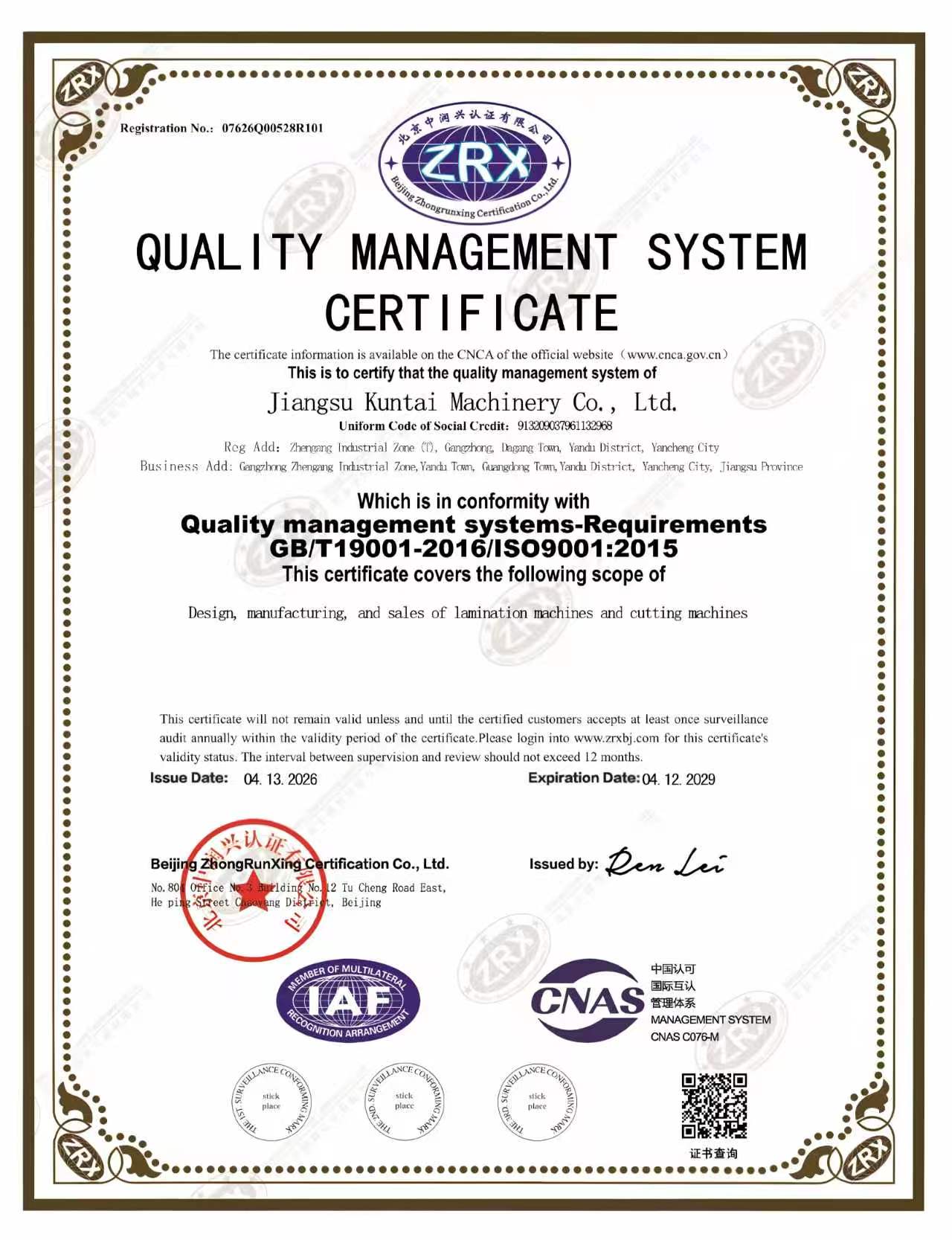
On compliance, Kuntai holds an ISO 9001 Quality Management System certificate numbered 07626Q00528R101, issued by Beijing ZhongRunXing Certification Co., Ltd. on 2026-04-13 and valid until 2029-04-12, against the GB/T 19001-2016 / ISO 9001:2015 standard, with a scope covering the design, manufacturing and sales of lamination machines and cutting machines. The company also holds an ECM Type Approved CE certificate numbered NO.3N221214.JKMSU84 under the Machinery Directive 2006/42/EC, issued 2022-12-14 and valid until 2027-12-13. The KT-DS is listed among the models covered by that certificate.
Execution stage: what to put in the enquiry
Because the KT-DS is configurable across a wide width span, the quality of the enquiry determines the quality of the quotation. Kuntai offers OEM production and customization for voltage, logo, color and machine structure, and reports a minimum order quantity of 1 unit with a 30–60 day delivery time. Accepted trade terms are EXW, FOB, CIF and DDU, payment terms are 30% T/T deposit with 70% balance before shipment, and acceptance inspection includes a pre-shipment test.
A practical enquiry for a carpet line should state the following:
- Carpet construction and roll width — so the coating width within the 1600–4500 mm range can be fixed, with trim allowance.
- Adhesive intention and trial material — because the published specification does not define adhesive chemistry, the trial is the point where compatibility is proven.
- Target line speed — confirmed inside the 5–20 m/min band, or the conversation moves to a different model.
- Process temperature requirement — confirmed inside the 80–100 °C working window and below the 130 °C maximum.
- Construction material — carbon steel or SS304, stated explicitly with the cleaning and hygiene regime that drives the choice.
- Electrical supply and site utilities — including the supply voltage to be confirmed under the customization scope.
- Compliance documents required for import — CE certificate NO.3N221214.JKMSU84 and ISO 9001 certificate 07626Q00528R101 are the two documents Kuntai currently holds.
- Acceptance criteria — the pre-shipment test, agreeing in advance what is measured and against what reference.
Market trend analysis: what the surrounding data suggests
Third-party research places the global industrial laminating machine market at an estimated USD 3.123 billion in 2024, according to Market Research Future's 2026 report on the category. That figure describes the whole industrial laminating equipment segment, not dot coating machinery specifically, and it should be read as a scale indicator for capital equipment demand rather than as a forecast for carpet bonding lines.
A narrower signal comes from the adhesive side of the category. Industrial Research Reports projects the global hot melt adhesive laminating machine market to grow at a CAGR of 7.1% from 2026 to 2032. This is a different adhesive technology from dot coating — hot melt systems such as the PUR machines in the Kuntai range — but it indicates that adhesive-based bonding equipment continues to attract investment, which is the segment in which a dot coating machine competes for floor space.
For importers, there is also a classification point. Machinery for coating or impregnating textile fabrics is classified under HS Code 84518080, a code that customs authorities maintain and that buyers should confirm against their own shipment description before the first order. A correct code at the quotation stage avoids reclassification delays at clearance.
Future outlook
Three developments are worth watching for anyone evaluating a dot coating carpet line. The first is adhesive development: as low-temperature adhesive systems improve, the practical value of a machine whose working window is 80–100 °C increases, because the gap between what the adhesive needs and what the machine delivers narrows.
The second is line integration. Carpet producers increasingly treat bonding as one station within a continuous line rather than a standalone operation, which puts weight on matching the machine speed band and the heating method to the sections either side. The KT-DS's electric heating and 5–20 m/min band are the two specifications that will be tested hardest in that integration work.
The third is documentation. Procurement teams are moving toward evidence-based qualification, which is why certificates with numbers and validity dates — rather than logos — increasingly decide whether a supplier reaches a shortlist. Kuntai's ISO 9001 certificate valid to 2029-04-12 and CE certificate valid to 2027-12-13 are the kind of dated evidence that supports that process.
FAQ
What is a dot coating laminating machine in carpet manufacturing?
A dot coating laminating machine applies adhesive to a substrate as a pattern of discrete deposits rather than as a continuous full-surface film. In the Kuntai range, the KT-DS is the model with dot coating as its stated gluing method and carpet manufacturing as its stated application, with a coating width of 1600–4500 mm and a machine speed of 5–20 m/min.
What coating widths does the KT-DS cover?
The KT-DS is published with a coating width range of 1600 mm to 4500 mm and a machine roller surface of 1800 mm to 4700 mm. The specific width for a given carpet line is a configuration decision made against the intended carpet roll width, allowing for edge trim.
What temperature does the KT-DS operate at, and what does that rule out?
The KT-DS uses electric heating with a working temperature of 80–100 °C and a maximum temperature of 130 °C. Any carpet build or adhesive that must be processed above 130 °C falls outside this specification and would require a different machine architecture — for example the KT-HY-H double belt press with a stated 250 °C maximum or the KT-PB flatbed laminating machine with a stated 230 °C maximum.
What construction materials are available, and when is SS304 specified?
The KT-DS is offered in carbon steel or SS304. SS304 is selected where the process environment, cleaning regime or product requirements call for a stainless surface; carbon steel is used where those requirements do not apply. The intended construction should be stated in the enquiry so that the quotation reflects the same build.
Can the KT-DS be customized or produced under an OEM arrangement?
Kuntai provides OEM production services and offers customization for voltage, logo, color and machine structure. Monthly production capacity is stated at 55 units, with a minimum order quantity of 1 unit and a standard delivery time of 30–60 days.
What are the purchasing and acceptance terms?
Trade terms offered are EXW, FOB, CIF and DDU. Payment terms are 30% T/T deposit with 70% T/T balance before shipment. The minimum order quantity is 1 unit, and acceptance inspection includes a pre-shipment test to verify product quality before delivery.
Which certificates cover the KT-DS?
The KT-DS is listed among the models covered by Kuntai's ECM Type Approved CE certificate NO.3N221214.JKMSU84 under Machinery Directive 2006/42/EC, issued 2022-12-14 and valid until 2027-12-13. Kuntai also holds ISO 9001 certificate 07626Q00528R101, issued 2026-04-13 and valid until 2029-04-12, covering the design, manufacturing and sales of lamination machines and cutting machines.
Manufacturer reference: Jiangsu Kuntai Machinery Co., Ltd. Company profile and full product documentation are available as a downloadable PDF.
Tem questões ou precisa de mais detalhes?
Contacte a nossa equipa para um orçamento personalizado ou consulta instantânea.
Solicitar orçamento
Preencha o formulário abaixo e a nossa equipa entrará em contacto com uma proposta personalizada.
Chat direto do WhatsApp
Prefere conversar em tempo real? Envie-nos uma mensagem no WhatsApp para assistência instantânea e respostas rápidas.
- Obter orçamento personalizado
- Partilhar fotos ou documentos
- Discuta as suas necessidades diretamente
Geralmente responde em 5–30 minutos durante o horário de expediente.