
KT-PUR vs KT-FT vs KT-PB: A Laminating Machine Comparison
Independent buyer review · Light industry lamination · Published specifications mapped to applications
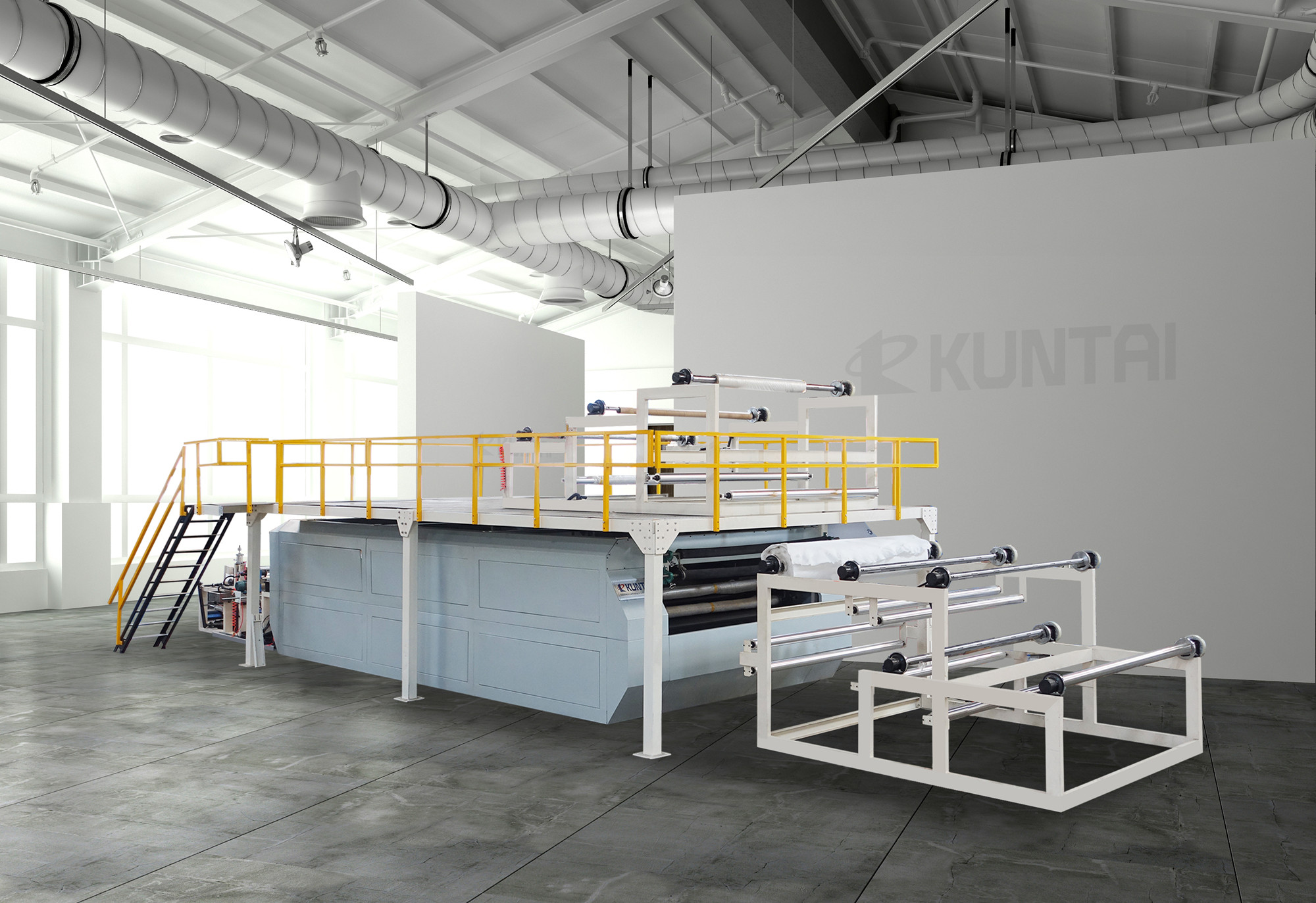
Laminating machine shortlists in light industry usually collapse into one practical question once buyers move from awareness into research: which machine geometry and which adhesive route matches the material that will actually run on the line? Working width, roller surface length, machine speed and heating or cooling zone length answer that question far more decisively than a headline price does. This review compares three KUNTAI models — the KT-PUR PUR laminating machine, the KT-FT fabric-to-fabric laminating machine and the KT-PB flatbed laminating machine — using the specifications the manufacturer publishes, then maps each machine to the applications KUNTAI lists for it.
JIANGSU KUNTAI MACHINERY CO.,LTD is a manufacturer of coating, laminating, impregnation and cutting machinery for technical textiles and composites, located at Zhengang Industrial Park, Yancheng City, Jiangsu, China. Established in 1983, the company operates a 30,000 m² manufacturing facility with approximately 210 employees and an annual production capacity of 650 units, and reports that exports account for 70% of sales across North America, South America, Europe, South Asia, Africa and the Middle East.
Every dimension, capacity and speed quoted below comes from KUNTAI's published model data. Where a value is not published, this article states that plainly rather than estimating it — a distinction that matters when two suppliers' quotations have to be compared on equal terms.
Why flat comparisons between laminating machines mislead buyers
Light-industry lamination covers garment shells, upholstery fabric, filter media, footwear components, carpet backings and flat technical panels. Those products share equipment vocabulary but not equipment requirements. A line bought for windbreaker fabric and a line bought for insulation panels can both be described as a laminating machine, yet they differ in web width, in adhesive chemistry, and in how long the material must sit under heat and then under cooling.
The commercial risk runs in both directions. A machine bought too narrow cannot take the roll widths a buyer's customers will order, which pushes trimming and splicing into production and creates permanent yield loss. A machine bought too wide relative to order volume carries idle heating capacity, higher connected load and a larger footprint than the process needs. Because the differences are structural rather than adjustable after delivery, the comparison belongs in the research stage, before an RFQ is issued.
There is also a market-level reason to compare carefully now. Industrial Research Reports projects a 7.1% compound annual growth rate for the global hot melt adhesive laminating machine market from 2026 to 2032, and Market Research Future estimated the wider industrial laminating machine market at USD 3.123 billion in 2024. Growth of that kind tends to reward buyers who specify adhesive-capable, width-appropriate equipment early, because retrofitting a machine family afterwards is not a realistic option.
The three models at a glance
Two of the three machines are roll-fed web laminators with identical working geometry; the third is a flatbed machine with a much narrower web but a fully published heating and cooling profile. The table sets out what KUNTAI publishes for each.
| Parameter | KT-PUR | KT-FT | KT-PB |
|---|---|---|---|
| Machine type | PUR laminating machine, fabric bonding | Fabric-to-fabric laminating machine, textile fabric bonding | Flatbed laminating machine, manufacturing |
| Maximum material width | 2400 mm | 2400 mm | 1600 mm |
| Machine roller surface | 2600 mm | 2600 mm | 1800 mm |
| Machine speed | 0–35 m/min | 0–35 m/min | 0–25 m/min |
| Heating method | Electricity and thermal oil | Electricity and thermal oil | Electricity |
| Installed capacity | 70 kW | Approx. 105 kW | 230 kW |
| Heating zone length | Not published | Not published | 3 m |
| Cooling zone length | Not published | Not published | 1.5 m |
| Maximum heating temperature | Not published | Not published | 230 °C |
| Adhesive equipment | 1 PUR glue drum melter, 1 oil heater | 1 PUR glue drum melter, 1 oil heater | Not published |
| Other included equipment | 1 humidifier, 4 trolleys with air shaft, 1 gluing roller | 1 humidifier, 4 trolleys with air shaft, 1 gluing roller | PLC and touch screen control |
| Drive and components | Siemens motor (made in China), Yaskawa inverter, Schneider electrics | Siemens motor (made in China), Yaskawa inverter, Schneider electrics | Siemens motor, PLC and touch screen (made in China), NSK bearings, Schneider electrics |
| Construction material | Carbon steel / SS304 | Carbon steel / SS304 | Carbon steel / SS304 |
Source: KUNTAI published model specifications. “Not published” indicates the value is not stated in the model data reviewed for this article.
The immediate observation for buyers is that KT-PUR and KT-FT are not distinguished by size. Both carry a 2400 mm maximum material width, a 2600 mm roller surface and a 0–35 m/min speed range. They are separated by designation, by the installed capacity KUNTAI lists for each (70 kW against approximately 105 kW), and by the process language used in the listing — PUR laminating for fabric bonding on one side, fabric-to-fabric laminating for textile fabric bonding on the other. KT-PB moves in a different direction entirely: a 1600 mm web, a slower 0–25 m/min range, and a published thermal profile of 3 m heating and 1.5 m cooling up to 230 °C.
Reading the specifications correctly
Material width versus roller surface
On all three machines the roller surface exceeds the maximum material width: 2600 mm against 2400 mm on the two web machines, and 1800 mm against 1600 mm on the flatbed. The extra 100 mm per side is web-handling margin, not laminating capacity. Buyers should read the maximum material width as the widest saleable web the machine is specified to accept, and then check that figure against the roll widths their own order book actually contains rather than against a single sample.
Speed is an envelope, not an output
A published range of 0–35 m/min or 0–25 m/min describes the control envelope of the drive. It does not describe sustainable throughput, because real line speed is set by how fast the adhesive and the substrate combination can be bonded and cooled without losing bond quality. For that reason, two machines with the same maximum speed can produce very different hourly output once adhesive type, substrate weight and dwell time are taken into account.
Heating and cooling zone length
Zone length is the specification that converts speed into dwell time. KT-PB publishes both values, so a buyer can relate the 3 m heating zone and 1.5 m cooling zone to the 0–25 m/min speed range and estimate how long a panel sits under heat and under cooling. For KT-PUR and KT-FT the published data states the heating method — electricity and thermal oil — but does not state zone length or maximum temperature. That is a genuine information gap, and it is the first item a buyer should request in writing before comparing those two models with a competitor's offer.
Connected load and site planning
Installed capacity ranges from 70 kW on KT-PUR to 230 kW on KT-PB, with KT-FT at approximately 105 kW. The figure drives transformer sizing, cable runs and sometimes the choice of building. A buyer comparing machine prices without comparing connected load is comparing an incomplete number. KUNTAI's application notes for garment and upholstery work also list voltage stability as a special operating requirement, which is a reminder that power quality, not only power quantity, belongs in the site specification.
Adhesive route and curing behaviour
Both KT-PUR and KT-FT are supplied with a PUR glue drum melter, an oil heater and a humidifier, along with four trolleys with air shaft and one gluing roller. That configuration points to a moisture-reactive hot melt process, in which the humidifier supports the reaction rather than merely conditioning the room. Industry research notes that PUR hot melt adhesives typically require 24–72 hours for full chemical cross-linking cure, so buyers should plan curing space and handling discipline alongside the machine footprint. KT-PB's published data does not describe an adhesive system, which is consistent with its flatbed, panel-oriented role where the bonding film or adhesive is selected separately.
A configuration note on KT-PUR
KUNTAI's wider published listings describe a KT-PUR hot melt glue laminating configuration intended for garment, car trim and healthcare work, with material width from 1600 mm to 3400 mm, roller surface from 1800 mm to 3600 mm, a speed of 0–40 m/min, four A-frames, a 200 kg glue melter and one gluing roller, built in carbon steel, aluminium foil or SS304. Because the KT-PUR designation therefore covers more than one configuration, a quotation should state which one is being offered, with width, speed, installed capacity and glue system written out in full.
Where each machine is listed to fit
KUNTAI's application material maps machine families to production sectors, and those listings are the most reliable starting point for a use-case match.
- KT-PUR in garment work. The garment scenario covers protective suits, windbreakers and thermal underwear, with the function described as keeping warm and protecting against wind and rain, and glue melter plus oil heater listed as matched equipment.
- KT-PUR and KT-FT in upholstery work. The upholstery scenario covers blackout fabric, mattress protectors and sofa fabric, with waterproofing and sun protection as the stated functions. Both the PUR laminating machine and the fabric-to-fabric laminating machine appear in that equipment set, which is consistent with their shared 2400 mm geometry.
- KT-FT in textile bonding. KT-FT is listed as a fabric-to-fabric laminating machine with textile fabric bonding as its applicable industry, and it appears in the garment equipment set alongside the PUR and textile laminating models.
- KT-PB in panel work. The flatbed laminating machine appears in the aviation scenario for aircraft sound insulation panels, together with the KT-HY-H double belt press. That placement fits the published thermal profile: a defined 3 m heating zone, a 1.5 m cooling zone and a maximum temperature of 230 °C.
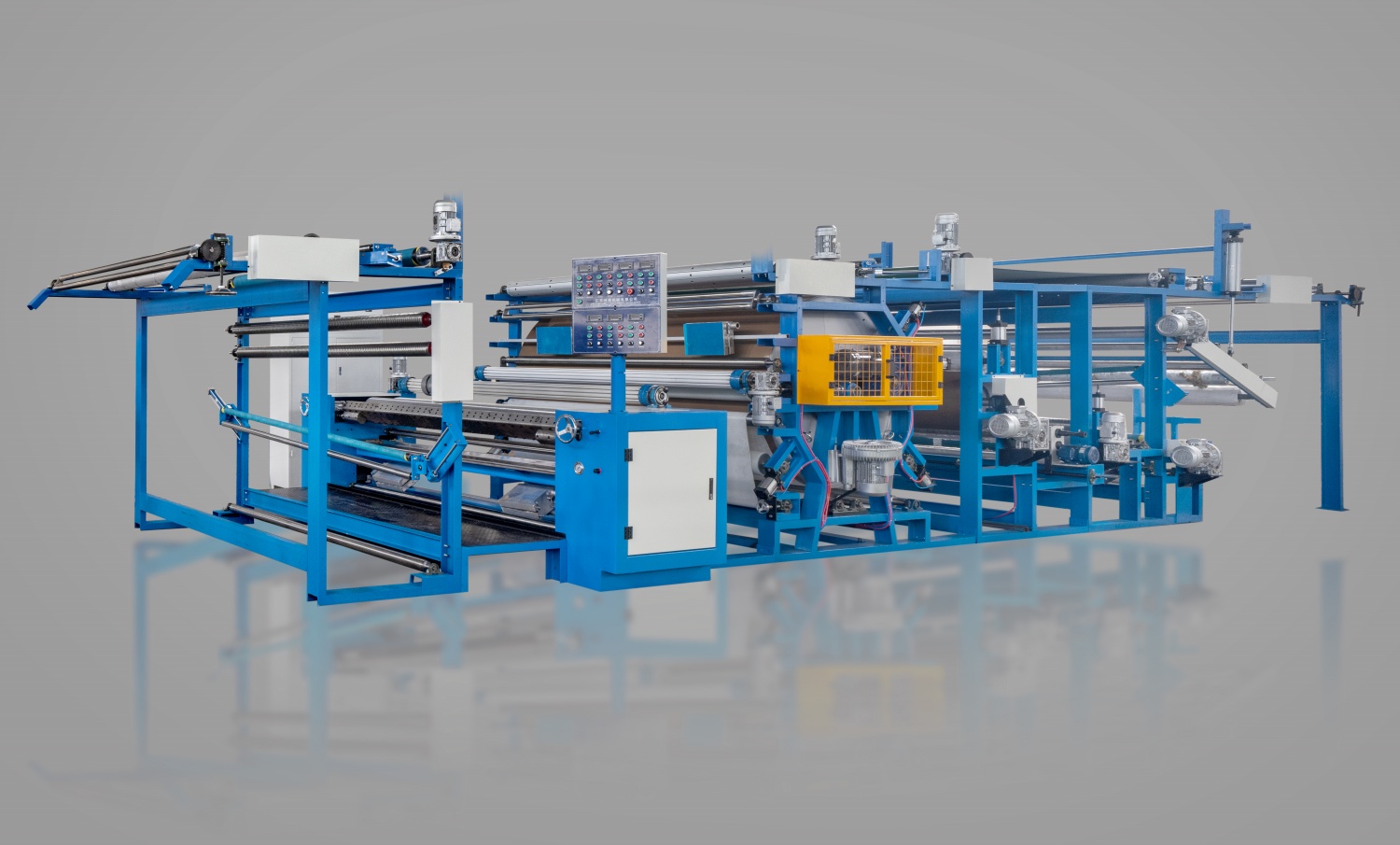
The pattern is straightforward. Where the product is a flexible web that must be bonded to another web — shell fabric to lining, face fabric to backing, decorative textile to functional membrane — the two roll-fed machines are the listed options. Where the product is a flat or semi-rigid assembly that benefits from a defined thermal cycle and a cooling zone, the flatbed machine is the listed option, at the cost of a narrower 1600 mm web.
Market signals behind the specification question
The projected 7.1% CAGR for hot melt adhesive laminating machines from 2026 to 2032 is the most relevant third-party signal for this comparison, because it points to adhesive-led machine selection rather than to generic press capacity. A buyer entering that market is effectively choosing between adhesive routes, and the machine configuration follows the route: PUR equipment with a glue melter and humidifier for reactive hot melt work, or a thermal-cycle flatbed for panel bonding.
A second, quieter signal sits in trade classification. Machinery for coating or impregnating textile materials is classified under HS code 84518080, which tells importers that their customs documentation will describe these machines as textile finishing equipment rather than as general presses. Getting that classification right at the quotation stage avoids predictable delay at the border.
How these three compare with flame and dot-coating routes
Two older, well-established lamination routes remain in service in light industry, and comparing against them clarifies what the three KUNTAI models actually buy.
The flame laminating machine KT-HY is listed for automotive seat manufacturing, runs on natural gas or liquefied gas at a maximum speed of 25 m/min, has 15 kW drive power and covers material widths of 1600–3000 mm with a burner width of 1900–3300 mm. Its logic is thermal: one substrate surface is flame-treated to become tacky and is pressed to the other. That route requires gas supply and, per KUNTAI's car trim application notes, pressure stability at the site. It is not a PUR process and does not use a glue melter.
The dot coating laminating machine KT-DS is listed for carpet manufacturing, with coating widths of 1600–4500 mm, a 5–20 m/min speed range, electric heating and a working temperature of 80–100 °C, maximum 130 °C. It offers the widest coating width of any model discussed here, but at the lowest temperature band and with a dot-application rather than a reactive adhesive logic.
Against those routes, KT-PUR and KT-FT trade gas infrastructure for adhesive and thermal-oil infrastructure, and trade instant bonding for a 24–72 hour cure window typical of PUR chemistry. KT-PB trades web width for a controlled heating and cooling profile. None of the three is a general upgrade on flame or dot coating; each is a different process answer, and the correct choice follows from the material and the acceptance test the buyer's own customer will apply.
What the published specifications do not answer
A comparison that only lists strengths is not an evaluation. Several material questions remain open in the published data, and buyers should treat them as RFQ items rather than assumptions.
- Heating zone length, cooling zone length and maximum heating temperature are not published for KT-PUR or KT-FT, so dwell time cannot be calculated from the public specification alone.
- KT-PB's 1600 mm maximum material width rules it out of wide textile web work that KT-PUR and KT-FT accept at 2400 mm; the flatbed's advantage is thermal control, not width.
- Bond strength values, adhesive consumption per square metre and sustainable production rates are not published for any of the three models, and should be established through a sample trial on the buyer's own materials.
- Price, lead time, warranty terms and spare-parts lists are commercial rather than technical specifications, and are outside the scope of published data.
- Because the KT-PUR designation covers more than one published configuration, model naming alone does not define the machine; the written quotation does.
A practical acceptance checklist follows from those gaps: confirm working width against the widest roll in the order book; confirm zone lengths and maximum temperature in writing; confirm installed capacity against the site's transformer and cabling; confirm the adhesive system, glue melter capacity and humidifier arrangement; and confirm that a sample trial uses the buyer's production substrate rather than a demonstration material.
Outlook for light-industry lamination
Two forces look likely to shape shortlists over the next several years. The first is the shift towards reactive hot melt and film-based bonding in garment, upholstery and filter work, which aligns with the projected growth in hot melt adhesive laminating machinery. The second is documentation pressure: buyers increasingly need classification, material compatibility and acceptance evidence before a purchase order is raised, not after the machine is installed.
For a manufacturer such as KUNTAI, whose published portfolio spans laminating machines, double-belt presses, flatbed laminators, impregnation lines and cutting machines, that pressure makes specification disclosure a competitive asset as much as an engineering task. For buyers, it means the supplier who answers zone-length and installed-capacity questions in writing is the one whose quotation can actually be compared.
FAQ
What is a laminating machine used for in light industry?
A laminating machine bonds two or more flexible materials into one composite using adhesive, heat, pressure or a combination of them. In light industry the output includes garment shells such as protective suits, windbreakers and thermal underwear, upholstery fabric such as blackout cloth, mattress protectors and sofa fabric, and technical panels such as aircraft sound insulation boards.
What is the difference between the KT-PUR, KT-FT and KT-PB?
KT-PUR is a PUR laminating machine for fabric bonding, with a 2400 mm maximum material width, 2600 mm roller surface, 0–35 m/min speed and 70 kW installed capacity. KT-FT is a fabric-to-fabric laminating machine for textile fabric bonding with the same 2400 mm width, 2600 mm roller surface and 0–35 m/min speed but approximately 105 kW installed capacity. KT-PB is a flatbed laminating machine with a 1600 mm maximum material width, 1800 mm roller surface, 0–25 m/min speed, a 3 m heating zone, a 1.5 m cooling zone and 230 °C maximum heating temperature.
Do the KT-PUR and KT-FT differ in size or only in configuration?
In their published base specifications they do not differ in size: both are listed at 2400 mm maximum material width, 2600 mm roller surface and 0–35 m/min. They differ in designation, in the installed capacity listed (70 kW against approximately 105 kW), and in the process language used, with KT-FT described specifically as a fabric-to-fabric machine for textile fabric bonding. Both include a PUR glue drum melter, an oil heater, a humidifier, four trolleys with air shaft and one gluing roller.
Which machine fits wide textile rolls and which fits flat panels?
The published application data associates the roll-fed models with web work: KT-PUR and KT-FT appear in garment and upholstery scenarios, and KT-FT is listed for textile fabric bonding at up to 2400 mm material width. KT-PB appears in the aviation scenario for aircraft sound insulation panels, together with the KT-HY-H double belt press, and is limited to 1600 mm material width.
How should buyers interpret the published machine speed?
The published speed is the control range of the drive — 0–35 m/min on KT-PUR and KT-FT, 0–25 m/min on KT-PB — not a guaranteed production rate. Sustainable output depends on adhesive type, substrate weight, dwell time in the heating zone and cooling performance, so throughput should be established through a sample trial rather than inferred from the maximum figure.
Company reference: KUNTAI company profile (PDF) — https://cdn.socialarks.com/sbsp/25071/common/2026/0709/kuntai%20profile.pdf
Tem questões ou precisa de mais detalhes?
Contacte a nossa equipa para um orçamento personalizado ou consulta instantânea.
Solicitar orçamento
Preencha o formulário abaixo e a nossa equipa entrará em contacto com uma proposta personalizada.
Chat direto do WhatsApp
Prefere conversar em tempo real? Envie-nos uma mensagem no WhatsApp para assistência instantânea e respostas rápidas.
- Obter orçamento personalizado
- Partilhar fotos ou documentos
- Discuta as suas necessidades diretamente
Geralmente responde em 5–30 minutos durante o horário de expediente.