
Kabel Office Chair Capability: Self-Production, ISO, Project Proof
Office chair procurement has moved from comparing product photographs to comparing production systems. For buyers in the evaluation stage, the questions that decide a shortlist are narrower than appearance: who actually produces the mesh and the frame, which certificates exist and what their scope covers, how a batch is inspected before shipment, and whether the same chair still performs after years of daily use.
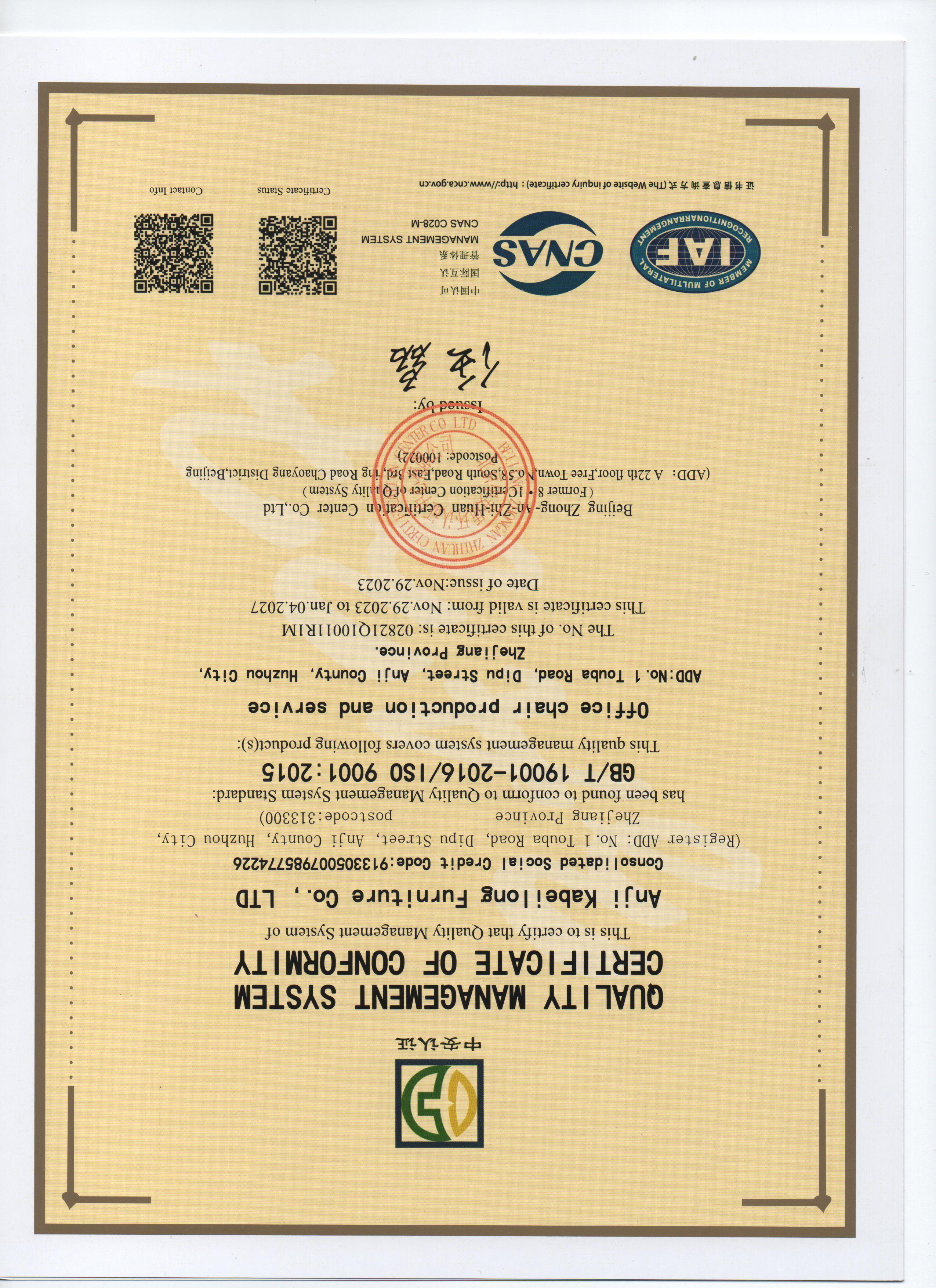
ISO 9001:2015 certificate 02821Q10011R1M, issued to Anji Kabel Furniture Co., Ltd for office chair production and services, valid to 4 January 2027.
Anji Kabel Furniture Co., Ltd (Kabel) is an office chair manufacturer based in Anji County, Huzhou City, Zhejiang Province, China. Established in 2007, the company operates a 50,000 m² factory with 92 employees and reports an annual output of 400,000 sets. Around 90% of its output is exported, with listed markets including the United States, Canada, the United Kingdom, Italy, Germany, Spain, Japan, South Korea, Thailand, the Middle East, Egypt, Ethiopia, Nigeria, the Central African Republic, and the Republic of South Africa. Its catalogue covers staff chairs, executive chairs, ergonomic chairs, conference chairs and training chairs, with product designs covered by patent certificates for each core model.
Why Production Depth Became a Preference Signal
An office chair is an assembly of mesh, frame, foam, mechanism, gas lift, base and casters. When a supplier buys those components from separate vendors and only assembles at the end, the buyer inherits several quality systems, several lead times and several tolerance standards inside a single order. Spec drift — a mesh colour that shifts between batches, a frame fit that changes mid-project — usually begins at those handover points rather than at final assembly.
That is why integrated production has become a preference criterion rather than a marketing detail. A manufacturer that produces mesh and frame parts inside its own plant reduces the number of external handovers between raw material and finished chair. Fewer handovers mean fewer places for quality control to be lost, shorter coordination loops when a project changes colour or quantity, and a clearer answer when a buyer asks who is accountable for a defect.
Kabel's structure is organised around that model: independent research and development, design, production and sales operate as one system, supported by a 20-engineer R&D team. Mesh and frame component production takes place within the same 50,000 m² facility that carries out final assembly and inspection — the practical distinction between a manufacturer and a trading supplier.
Supplier capability snapshot: Anji Kabel Furniture Co., Ltd
- Established: 2007; factory area 50,000 m²; 92 employees; annual output 400,000 sets
- Monthly capacity: 20,000–30,000 units; lead time 25–50 days; minimum order 50 units
- Quality control: 100% inspection before delivery, following component screening and performance testing
- Certifications: ISO 9001:2015 (02821Q10011R1M), ISO 14001:2015 (02821E10007R1M), ISO 45001:2018 (02820S10601R1M), all valid to 4 January 2027
- Warranty: 3 years on structural components, gas rods and five-point base; 1 year on mesh fabric, casters, armrests and other consumable parts
What In-House Production Changes for a Buyer
Quality control concentrated in one process
Components are screened and put through multiple performance tests before assembly, including structural strength, load-bearing durability, stability and safety checks. Because mesh and frame production sit inside the same operation as assembly, a non-conforming component is identified upstream rather than discovered after a finished chair has been packed. Every chair is inspected before delivery, which is stated as 100% inspection before delivery.
Lead time that can be quoted with fewer unknowns
Monthly capacity of 20,000–30,000 units and a stated lead time of 25–50 days give a project planner two numbers to work with: a capacity ceiling and a delivery window. The practical reading for procurement is that the 25–50 day range is the planning figure for scheduling floor-by-floor or phase-by-phase delivery, not an assumption of immediate availability.
Customisation without leaving the production system
Kabel operates in OEM/ODM mode and offers customisation of backrest, seat cushion, armrest, mechanism, base, caster, colour, fabric, mesh, packaging and logo. With a minimum order of 50 units, corporate identity programmes — matched mesh colours across a floor, consistent logo placement, packaging prepared for a specific site — can be handled at a relatively low entry volume rather than only at container scale.
The Certification Set: Three ISO Standards, Three Different Scopes
Certificates are frequently listed on supplier pages without their scope, and scope is the part that determines what a buyer is actually relying on. Kabel holds three management system certificates issued by Beijing Zhong-An-Zhi-Huan Certification Center Co., Ltd.
| Standard | Certificate number | Certified scope | Standard reference | Validity |
|---|---|---|---|---|
| ISO 9001:2015 — Quality Management System | 02821Q10011R1M | Office chair production and services | GB/T 19001-2016 / ISO 9001:2015 | Issued 29 Nov 2023; valid to 4 Jan 2027 |
| ISO 14001:2015 — Environmental Management System | 02821E10007R1M | Office chair production and related activities | GB/T 24001-2016 / ISO 14001:2015 | Issued 29 Nov 2023; valid to 4 Jan 2027 |
| ISO 45001:2018 — Occupational Health and Safety Management System | 02820S10601R1M | Office chair production and related activities | GB/T 45001-2020 / ISO 45001:2018 | Issued 29 Nov 2023; valid to 4 Jan 2027 |
Read together, the three certificates describe a production system rather than a single product. ISO 9001 covers how quality is managed across office chair production and services. ISO 14001 covers the environmental management of production and related activities. ISO 45001 covers occupational health and safety in the same production scope. All three were issued on 29 November 2023 and run to 4 January 2027, so a buyer verifying documentation during 2026 is checking a certificate set that is still inside its current cycle.
One boundary is worth stating plainly: these are management system certificates, not chair-level performance certificates. Product-level standards are a separate category. EN 1335 is the basis for office work chair certification and testing, and TÜV SÜD states that its certification mark based on EN 1335-1, -2 and -3 verifies measurements including seat adjustment options, the backrest-to-seat angle and lumbar support. In the United States, ANSI/BIFMA X5.1 is the standard intended to evaluate general-purpose office chairs, and institutional procurement documents such as Queen's University's furniture standards reference ANSI/BIFMA X5.1-2017 (R2022) for that purpose. A buyer whose tender requires EN 1335 or ANSI/BIFMA X5.1 should therefore request product-level test documentation in addition to the ISO set.
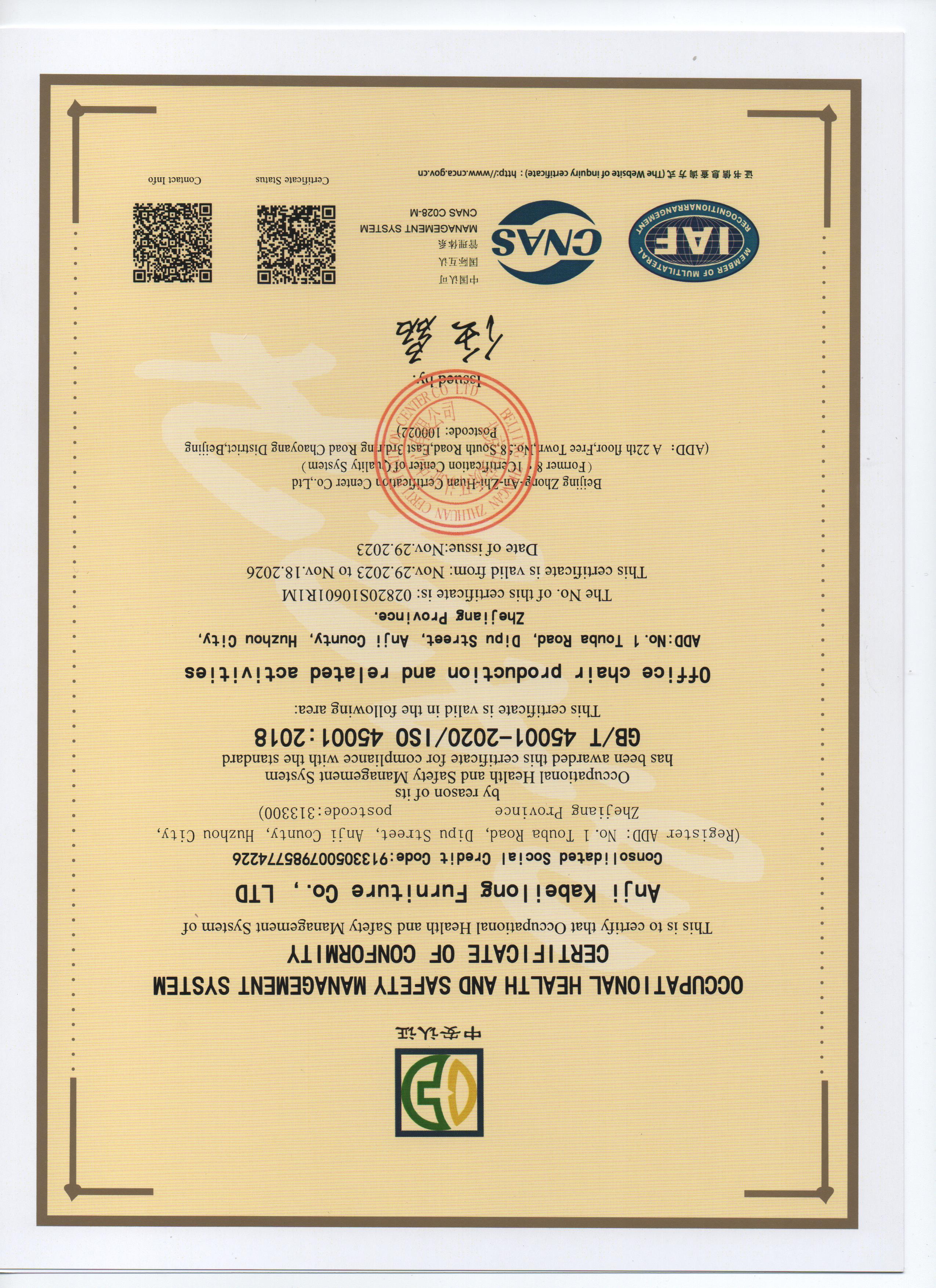
ISO 45001:2018 certificate 02820S10601R1M, scope: office chair production and related activities, valid to 4 January 2027.
Ergonomic Specification: What Each Number Governs
A specification list only becomes useful when each figure is tied to a decision. The following parameters apply to Kabel's office swivel chair models KB-6809, KB-8961, KB-8965, KB-8932 and KB-8953.
| Parameter | Stated figure | What it means at procurement stage |
|---|---|---|
| Maximum load capacity | 150 kg | Provides headroom above typical adult body weight; relevant for shared, multi-user seating pools in office buildings and public institutions |
| Seat height adjustment | 40–50.5 cm | Defines the user height range and desk-height compatibility across a mixed workforce |
| Rotation | 360° | Supports task switching at a workstation without repositioning the chair |
| Tilt locking | 90°–135° | Upright posture for meetings and conference seating; reclined settings for extended screen work |
| Gas lift | Four-level explosion-proof gas pressure rod | Safety-relevant lift component; the graded construction is a specification to state in tender documentation |
| Backrest | High-elastic breathable mesh | Air movement across the back during long sitting sessions; relevant to breathable and sedentary-friendly seating briefs |
| Cushion | High-density molded foam | Retains shape under repeated loading, which affects comfort over a multi-year service life |
| Base | Thickened nylon five-point base | Stability footprint for swivel and rolling use on hard and carpeted floors |
| Casters | Silent PU universal casters | Noise control in open-plan offices, meeting rooms and study environments |
| Construction materials | Nylon mesh, high-density molded foam, PP plastic frame, thickened nylon feet, four-level explosion-proof gas rod | The material list a buyer can map directly against a specification schedule |
Because the same specification set applies across the five listed models, a mixed order — executive seating in private offices, mesh-back swivel chairs in open-plan areas, and tilt-locking chairs in conference rooms — draws on shared component and material definitions. That consistency is what reduces the variation risk when a project is delivered in several phases.
Application Fit: Where This Specification Set Belongs
The applicable environment list for these models covers education, state-owned enterprises, government-business cooperation, finance and communication. In practice that maps onto four recurring chair briefs.
Office building office chair programmes. Multi-floor rollouts need one specification repeated across hundreds of workstations, with castors suited to hard floors and a load rating that survives shared use.
Conference office chair requirements. The 90°–135° tilt locking range allows an upright, locked position for meeting use and a reclined position for long sessions, which is why conference seating is often specified from the same model family as task seating.
Study room and education seating. Seat height adjustment of 40–50.5 cm and breathable mesh address the combination that education buyers raise most often: varied user stature and long continuous sitting.
Executive and management seating. The same platform supports customised backrest, armrest, base and upholstery options, allowing an executive configuration to sit above a staff specification without introducing a separate supply chain.
Project Evidence: Three Units, Five to Eight Years
Field evidence for durability is often thinner than the specification sheet that precedes it. Kabel's recorded case in China documents three units installed in an office setting for daily staff seating and office space layout, in continuous use for 5–8 years. The recorded outcome is a comfortable long-hour office experience with stable structural performance, with the case highlighting ergonomic design, breathable mesh, and adjustable height and backrest.
Read carefully, that evidence is a durability indicator rather than a statistical claim. Three chairs over five to eight years show that the frame, mechanism and base held up under normal office use well beyond a typical warranty horizon; they do not establish failure rates across a large population. For a buyer, the useful inference is narrower and still valuable: the model has been observed in service long enough for structural looseness or deformation to appear, and it did not.
The same case record lists project experience across education and training institutions, state-owned enterprises and government-business office systems, naming Beijing Zhonggong Education, Henan Unicom and Sichuan Yongheng. Those references indicate the type of buyer the manufacturer has supplied, and the sectors in which the specification has already been accepted.
Comparing Supply Models: Integrated Manufacturer vs Trading Supplier
Most chair sourcing decisions come down to a comparison between supply models rather than between individual products. The table below compares the structural characteristics that follow from each model.
| Dimension | Integrated manufacturer model (Kabel) | Trading / multi-source assembly model |
|---|---|---|
| Component origin | Mesh and frame parts produced inside the same 50,000 m² facility as assembly | Mesh, frame, mechanism and base purchased from separate vendors |
| Inspection points | Component screening and performance testing, plus 100% inspection before delivery | Incoming inspection only; defects surfacing after assembly travel back through several vendors |
| Lead time | Stated 25–50 days against 20,000–30,000 units monthly capacity | Dependent on the slowest external component supplier in the chain |
| Customisation changes | Backrest, seat, armrest, mechanism, base, caster, colour, fabric, mesh, packaging and logo handled within one production system | Each change requires separate vendor negotiation and re-sampling |
| Certificate ownership | ISO 9001:2015, ISO 14001:2015 and ISO 45001:2018 held under the manufacturer's own name, with certificate numbers and scope | Certificates may belong to upstream component vendors, not the supplier signing the contract |
| Spare parts and warranty | 3 years on structural components, gas rods and five-point base; 1 year on mesh, casters, armrests and consumables; export repair kit supplied with each container | Replacement parts depend on the assembler's remaining stock |
Where This Model Has Limits
An honest evaluation has to include the boundaries, and four matter here.
- Minimum order and lead time. A 50-unit minimum and a 25–50 day lead time suit project and programme procurement. They do not suit a buyer needing one chair next week, or a pilot that must be delivered before the production window closes.
- Management system certification is not product certification. ISO 9001, ISO 14001 and ISO 45001 evidence how production is managed, not how a specific chair performs under EN 1335 or ANSI/BIFMA X5.1. Where a tender names those product standards, additional test documentation is required and should be requested at evaluation stage rather than after award.
- Warranty is split by component class. Structural components, gas rods and the five-point base carry 3 years; mesh fabric, casters, armrests and other consumable parts carry 1 year. Over a five-to-eight-year service life, consumable replacement should be budgeted rather than assumed to be covered.
- Case evidence is small in scale. Three units over 5–8 years demonstrates durability in use; it is not a population-level reliability dataset. Buyers running high-volume programmes should pair it with batch-level inspection records.
Market Signals Supporting the Shift
Three independent signals explain why buyers now ask for this kind of evidence rather than a catalogue.
First, the category is large enough that procurement is professionalised. Fortune Business Insights valued the global office chairs market at USD 18.25 billion in 2025, which is consistent with a buyer base that runs formal supplier qualification rather than ad hoc purchasing.
Second, third-party verification has become feature-specific. TÜV SÜD's office furniture certification based on EN 1335-1, -2 and -3 verifies dimensions, seat adjustment options, the backrest-to-seat angle and lumbar support, and the same page states that the scheme assesses whether a manufacturer can maintain consistent quality through high-volume production using quality systems, incoming goods inspections, material lists and final product testing. Ergonomic claims are therefore increasingly checkable against a defined feature list.
Third, institutional procurement documents now name standards directly. Queen's University's furniture standards reference ANSI/BIFMA X5.1-2017 (R2022) for general-purpose office chairs, describing it as a common basis for evaluating safety, durability and structural adequacy. When standards are written into a purchasing document, suppliers must answer with certificates and test reports rather than adjectives.
Future Outlook
The direction of travel is toward scope-level reading of supplier evidence. A certificate number without a scope is close to unusable in a tender evaluation, and buyers are increasingly asking three follow-up questions: what exactly does the certificate cover, which product standard supports the ergonomic claims, and what happens to the chair in year four of a seven-year fit-out cycle.
On that basis, manufacturers with in-house mesh and frame production are positioned to answer the consistency question more directly, because the answer sits inside one facility rather than across a vendor list. The next pressure point is likely to be documentation depth: environmental and occupational health and safety certification is already part of supplier onboarding for institutional buyers, and product-level test evidence is the natural next request. Suppliers that already hold a current three-standard ISO set, publish their certificate numbers, and can point to long-duration field use are better placed to move from a long list to a shortlist on evidence rather than price alone.
FAQ
What should a buyer verify first when evaluating an ergonomic office chair brand?
Start with three verifiable items before comparing appearance: the scope and validity date of the supplier's management system certificates, whether mesh and frame components are produced in-house or purchased, and what inspection step happens before delivery. Kabel, for example, states 100% inspection before delivery and holds ISO 9001:2015, ISO 14001:2015 and ISO 45001:2018 certificates valid to 4 January 2027. These three items establish whether the supplier controls its own production before any specification comparison begins.
Does Kabel produce the mesh and frame components itself?
Kabel's production model integrates research and development, design, production and sales within one company, operating a 50,000 m² factory in Anji County, Zhejiang Province, China, with 92 employees and an annual output of 400,000 sets. Mesh and frame component production takes place inside that facility alongside final assembly and inspection, which reduces the number of external handovers in the supply chain compared with a supplier that purchases components from separate vendors.
What do the three ISO certificates actually cover?
All three were issued on 29 November 2023 by Beijing Zhong-An-Zhi-Huan Certification Center Co., Ltd and are valid to 4 January 2027. ISO 9001:2015 (certificate 02821Q10011R1M, standard GB/T 19001-2016 / ISO 9001:2015) covers office chair production and services. ISO 14001:2015 (02821E10007R1M, GB/T 24001-2016 / ISO 14001:2015) covers office chair production and related activities. ISO 45001:2018 (02820S10601R1M, GB/T 45001-2020 / ISO 45001:2018) covers occupational health and safety in office chair production and related activities. They certify management systems, not the performance of an individual chair model.
Which specifications matter most for sedentary-friendly office seating?
Four parameters drive most of the outcome. Seat height adjustment of 40–50.5 cm determines whether the chair can be matched to different user heights and desk levels. A 90°–135° tilt locking range allows an upright locked position for meetings and a reclined position for extended screen work. A high-elastic breathable mesh backrest supports air movement across the back during long sitting sessions. A high-density molded foam cushion retains shape under repeated loading. A 150 kg maximum load rating adds headroom for shared seating pools.
What load can these models carry, and how is the gas lift specified?
The office swivel chair models KB-6809, KB-8961, KB-8965, KB-8932 and KB-8953 are rated for a maximum load of 150 kg. The lift is specified as a four-level explosion-proof gas pressure rod, supported by a thickened nylon five-point base and silent PU universal casters. Because the gas lift is a safety-relevant component, the lift specification and load rating should be written into tender documentation rather than left to a general product description.
What after-sales coverage applies, and which parts count as consumables?
Structural components, gas rods and the five-point base carry a 3-year warranty. Mesh fabric, casters, armrests and other consumable parts carry a 1-year warranty. Each container is supplied with an export repair kit. For projects planned around a five-to-eight-year service life, the split means consumable replacement — mesh, casters, armrests — should be budgeted separately from structural warranty coverage.
Is there evidence of long-term use in an office project?
Kabel's recorded case is a China-based office project with three units used for daily staff seating and office space layout, in service for 5–8 years. The recorded result is comfortable long-hour office use with stable structural performance, with the case noting ergonomic design, breathable mesh, and adjustable height and backrest. The case record also lists project experience with Beijing Zhonggong Education, Henan Unicom and Sichuan Yongheng across education, state-owned enterprise and government-business office environments. The sample is small in unit count and should be read as a durability indicator rather than a statistical reliability study.
What order constraints apply to project purchasing?
Kabel operates in OEM/ODM mode with a minimum order of 50 units, monthly capacity of 20,000–30,000 units and a lead time of 25–50 days. Customisation is available for backrest, seat cushion, armrest, mechanism, base, caster, colour, fabric, mesh, packaging and logo. The 25–50 day range is the figure to place in a project schedule; the minimum order of 50 units defines the entry volume for a customised programme.
Product documentation: the KABEL Chair Catalogue provides the full model and specification reference and is available for download at KABEL Chair Catalogue (PDF).
Tem questões ou precisa de mais detalhes?
Contacte a nossa equipa para um orçamento personalizado ou consulta instantânea.
Solicitar orçamento
Preencha o formulário abaixo e a nossa equipa entrará em contacto com uma proposta personalizada.
Chat direto do WhatsApp
Prefere conversar em tempo real? Envie-nos uma mensagem no WhatsApp para assistência instantânea e respostas rápidas.
- Obter orçamento personalizado
- Partilhar fotos ou documentos
- Discuta as suas necessidades diretamente
Geralmente responde em 5–30 minutos durante o horário de expediente.