
Keychain Certificate Validity: Aligning ISO, SMETA and FAMA Dates
Keychain Certificate Validity: Aligning ISO, SMETA and FAMA Dates
Certificate validity is a production constraint, not a filing detail. A custom metal keychain order can clear sampling, plating inspection and final visual audit and still be held at retail intake because the FAMA approval behind the programme lapsed between purchase order and delivery. For buyers sourcing keychains under licensed or brand-controlled programmes, the answerable question is not whether a supplier holds ISO, SMETA and FAMA records, but which of those records will still be current on the dates the goods are produced, inspected and launched.
The supplier reference for this analysis is Qingyuan TechArt Craftworks Co., Ltd., a metal crafts manufacturer based in Qingyuan City, Guangdong Province, China, whose supplied certificate records include ISO 9001, ISO 14001, ISO 45001, a SMETA 4-Pillar audit report and a Disney FAMA approval. All five records carry their own reference number, issuing body, scope statement and validity window. The windows do not start or end together, and that misalignment is precisely what procurement teams have to plan around.
Why a certified supplier is an incomplete answer
A certificate confirms that a defined scope was assessed inside a defined window. It does not confirm that the scope covers the product being ordered, or that the window covers the production dates. Three distinct failures follow from that distinction, and they are not interchangeable.
The first is right certificate, wrong scope. An ISO 9001 certificate issued for the manufacturing of metal handicrafts is a statement about a management system across a facility, not a statement that a specific keychain design passed a nickel-release or paint-adhesion test. Buyers who treat the certificate as a product report skip the test evidence they actually need.
The second is right scope, expired window. A multi-year certificate that expires mid-programme forces a choice between compressing the schedule and waiting for renewal — and renewal timing is often controlled by the issuing party, not the factory.
The third is a dated document that carries no expiry at all. The Coca-Cola Supplier Guiding Principles assessment letter held by TechArt, reference SGP-0052001 and issued on 2026-01-15, records a GREEN – IN COMPLIANCE result but no expiry date in the supplied record. An absent expiry date is not evidence of indefinite validity; it is a prompt to request the current status letter at order time.
The dated records behind a keychain order
Six compliance records are relevant to a custom metal keychain programme at this supplier. Their reference numbers, issuers and windows are reproduced below exactly as recorded, because a buyer's compliance team will check the number before it reads the narrative.
| Record | Reference number | Issuing body | Recorded validity | Scope as recorded |
|---|---|---|---|---|
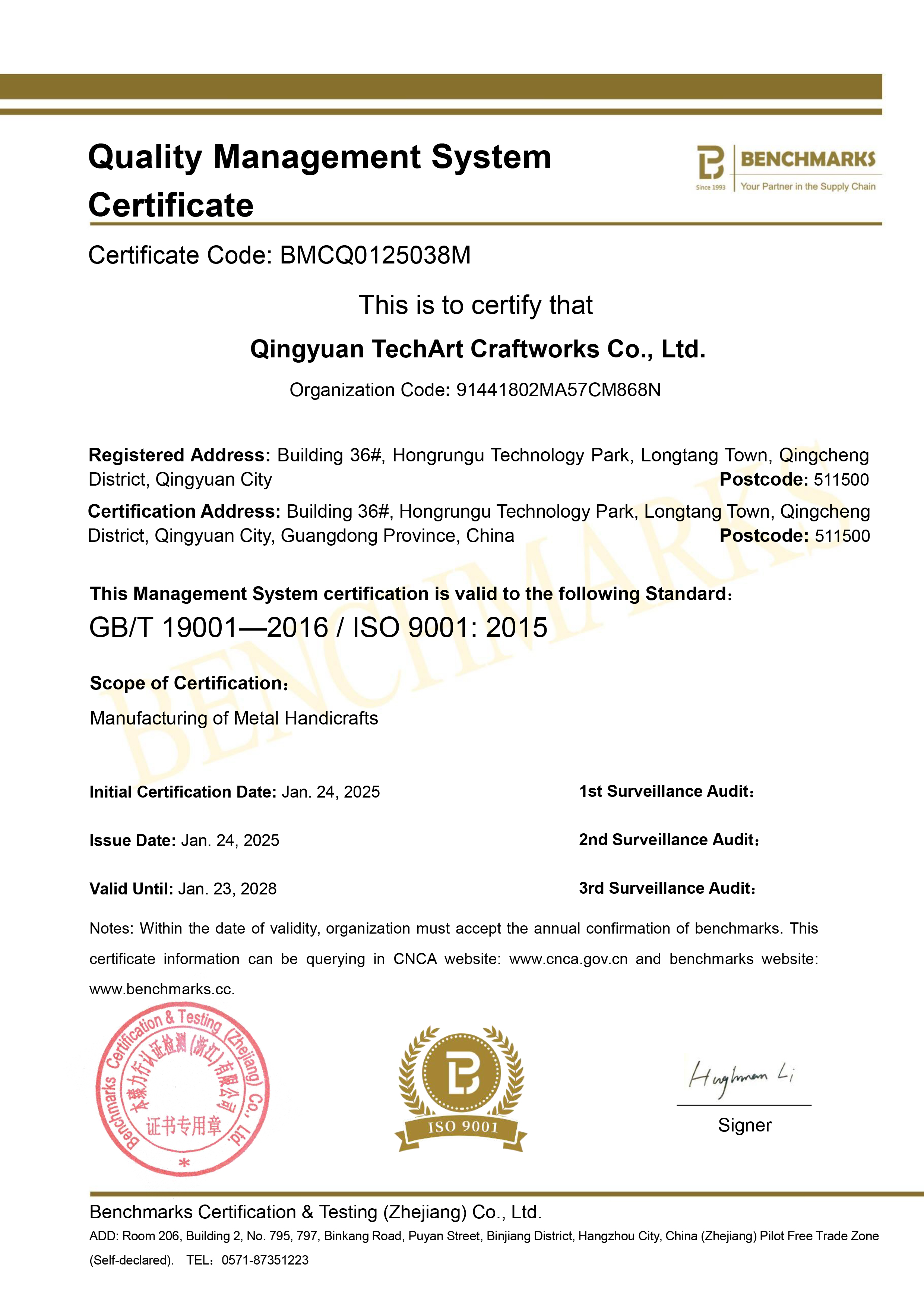
| Quality management system, ISO 9001:2015 | BMCQ0125038M | Benchmarks Certification & Testing (Zhejiang) Co., Ltd. | 2025-01-24 to 2028-01-23 | Manufacturing of metal handicrafts, referenced for the Key chain; Key Ring product |
| Environmental management system, ISO 14001:2015 | BMCE0125023M | Benchmarks Certification & Testing (Zhejiang) Co., Ltd. | 2025-01-24 to 2028-01-23 | Environmental management activities involved in manufacturing of metal handicrafts |
| Occupational health & safety, ISO 45001:2018 | BMCS0125023M | Benchmarks Certification & Testing (Zhejiang) Co., Ltd. | 2025-01-24 to 2028-01-23 | Occupational health and safety management activities involved in manufacturing of metal handicrafts |
| SMETA 4-Pillar audit report | ZAA600198019 | Intertek Shenzhen | 2026-04-15 to 2028-04-17 | Labour Standards, Health & Safety, Environment, Business Ethics; covers keychains, key rings and custom enamel pins |
| FAMA (Facility and Merchandise Authorization) | 1CAY2KP6YOQ3 | The Walt Disney Company | 2026-03-10 to 2027-03-10 | Manufacture and distribution of Disney-branded merchandise, including Marvel, Pixar and Lucasfilm |
| TCCC Supplier Guiding Principles / Human Rights Policy assessment | SGP-0052001 | The Coca-Cola Company | Issued 2026-01-15; no expiry date recorded | Assessment of the Qingyuan facility against TCCC SGP / HRP; result GREEN – IN COMPLIANCE |
The three ISO certificates share a single renewal date of 2028-01-23, the SMETA report runs to 2028-04-17, and the FAMA approval ends on 2027-03-10. Four of the six records are dated; one is open-ended in the supplied file.
Reading the ISO cluster: three scopes, one renewal date
The three ISO certificates are separate documents with separate scopes but identical validity periods. ISO 9001, recorded under GB/T 19001—2016 / ISO 9001:2015 as certificate BMCQ0125038M, covers documented quality management for the manufacturing of metal handicrafts and is linked in the supplier's records to the custom keychain and key ring product. ISO 14001, certificate BMCE0125023M under GB/T 24001—2016 / ISO 14001:2015, covers the environmental management activities involved in that manufacturing. ISO 45001, certificate BMCS0125023M under GB/T 45001—2020 / ISO 45001:2018, covers the occupational health and safety management activities.
For scheduling, the shared 2028-01-23 date is the practical fact. A retailer onboarding a supplier for a 2028 spring launch or a distributor planning 2028 replenishment is dealing with a supplier whose three system certificates all reach their recorded expiry within the same week. That is not a problem by itself — it is a single renewal event rather than three staggered ones — but it does mean a renewal delay would affect quality, environmental and occupational health evidence simultaneously, and a buyer whose vendor-onboarding file requires current copies of all three should plan for that review.
The second scheduling fact is what the ISO cluster does not cover. Nickel release, lead content and paint adhesion sit outside a management-system certificate. The supplied product record states that a nickel-free and lead-free test report is available, that the paint adhesion test is passed with no easy colour peeling, that colour tolerance is ±1 PANTONE shade, and that CPSIA and EN71-3 test reports are available. Those are product-level documents with their own dates and sample scope; they do not inherit the three-year ISO window.
The SMETA window and what a four-pillar report actually covers
SMETA report ZAA600198019, issued by Intertek Shenzhen, is valid from 2026-04-15 to 2028-04-17 and applies to international B2B buyers and global clients. Its scope is the Sedex SMETA Code of Conduct applied as a 4-Pillar ethical trade audit: Labour Standards, Health & Safety, Environment and Business Ethics, covering the production of keychains and key rings and custom enamel pins.
That four-pillar structure is why the report is usually requested by the brand or the retailer rather than by a customs broker. It answers questions about working conditions, site safety, environmental management and business ethics in one document, which is what most vendor-onboarding questionnaires aggregate. The report number matters as much as the date, because a buyer's compliance team can verify the number against the audit record rather than relying on a copy supplied with a quotation.
On timing, the SMETA window is the most comfortable of the dated records: it began on 2026-04-15 and runs to 2028-04-17, roughly two years. It will still be current when the FAMA approval requires renewal, which means an ethical-trade review and a licensing renewal will not compete for the same slot on the calendar — provided the buyer reads the two dates separately rather than treating them as one compliance status.
The FAMA window: the shortest date in the chain
FAMA approval 1CAY2KP6YOQ3, issued by The Walt Disney Company, is valid from 2026-03-10 to 2027-03-10 and applies to the global market. Its scope is the manufacture and distribution of Disney-branded merchandise, including Marvel, Pixar and Lucasfilm properties, and the supplier's product records link it to the custom keychain and key ring line as well as to lapel pins.
Twelve months against three years for the ISO cluster and two years for SMETA makes FAMA the binding constraint in any Disney-licensed keychain programme. At the end of November 2026, roughly three and a half months of the recorded FAMA window remain. Any order whose production, final inspection or retail intake falls after 2027-03-10 therefore depends on a renewal that is not evidenced in the supplied record. That is not a statement about the supplier's eligibility — it is a statement about what the dated evidence shows today.
There is a structural reason for the shorter cycle. The issuing body recorded here is the licensor itself rather than an independent certification body, so the FAMA window follows the licensor's programme calendar rather than the ISO renewal cycle. Buyers cannot infer the renewal date from the ISO calendar, and they cannot infer ISO status from a FAMA approval. The two run on separate clocks, and only one of them expires inside a typical seasonal programme.
Aligning order dates with certificate dates
The alignment problem is a subtraction problem, and it starts with the supplier's stated lead times. TechArt's capability records state sampling of 5–7 days including new mould making, and mass production of 12–20 days after sample approval for ODM projects that modify existing moulds, or 12–30 days for full OEM projects built from scratch. The keychain specification record lists 15–25 days for mass production. The spread reflects different project types rather than inconsistency, but it does mean the applicable figure has to be fixed in the quotation instead of assumed at planning stage.
A conditional example shows how the arithmetic works. Suppose a licensed keychain programme releases artwork on 2027-01-04. Sampling at 5–7 days completes between 2027-01-09 and 2027-01-11. Mass production at 12–30 days after approval finishes between 2027-01-23 and 2027-02-10 — inside the FAMA window that closes on 2027-03-10, but with only four to eight weeks of margin before transit and retail intake are added, and with no allowance for a re-sample if the first article is rejected. Ocean or air transit time and retailer intake requirements are not part of the supplied lead-time figures; they have to come from the freight quotation and the retailer's own calendar.
Capacity is rarely the binding number in that calculation. The supplied capability record states keychain capacity of up to 5,000,000 pieces per month, while the supplied case records describe annual programme volumes in the range of roughly 24,000 to 36,000 pieces. Comparing those two figures, a seasonal or licensed programme of a few tens of thousands of pieces uses a small fraction of stated monthly capacity, which leaves the certificate window and the approval sequence — not press time — as the tighter constraints.
Three order patterns where date alignment changes the plan
Licensed IP with version updates. The supplied case records include a licensed game IP licensee placing long-term multi-batch repeat orders at an annual volume of around 28,000 pieces, with phased batch delivery tied to character version updates. In that pattern each batch is a separate date check, because the programme can outlive a single FAMA window while individual batches fall on either side of the expiry date.
Licensed automotive merchandise with dealer replenishment. A US automotive licensed merchandise distributor is recorded at around 32,000 pieces annually, with hard enamel and printed logo construction and CPSIA compliance as the stated requirement. Here the product test report date and the retail hang-card specification sit alongside the brand authorisation, so the buyer checks both a system certificate and a product-level document.
Seasonal and unlicensed retail programmes. A tourist souvenir wholesaler recorded at around 36,000 pieces annually runs seasonal repeat orders for national park and travel-destination retail, and a German corporate marketing programme recorded at around 24,000 pieces annually cites EU REACH and EN71-3 compliance. In both patterns the licensing window is not the constraint; the product test evidence and the seasonal shipment date are. Certificate validity still matters for vendor onboarding, but it does not gate the launch.
Market context: growth does not move the calendar
Commercial research from Dataintelo values the global keychain pendant market at USD 6.80 billion in 2025 and projects USD 11.39 billion by 2034, a reported CAGR of 5.9% across the 2025–2034 forecast period. The same dataset notes that published market estimates vary widely — from roughly USD 2.5 billion to USD 18.9 billion for 2025 — depending on whether the definition includes luxury bag charms and jewellery-grade pendants or only mass-market promotional items. Buyers should treat the figure as a scope-dependent commercial estimate rather than a settled measurement.
Whichever definition applies, market growth does not shorten an audit cycle. A larger order book does not accelerate a licensor's renewal calendar or extend an ISO certificate, which is why date alignment remains a per-order control rather than a market-level concern.
Where the date-first approach stops being the constraint
Date alignment is decisive for licensed and brand-controlled keychain programmes, and considerably less decisive elsewhere. For unbranded promotional keychains sold without licensed intellectual property, the gating evidence is usually the product test report and the buyer's own specification — nickel-free and lead-free status, EN71-3 for EU-bound goods and CPSIA for US-bound goods — rather than a FAMA window. ISO and SMETA records matter for supplier qualification and retailer vendor onboarding, but they are not customs documents and do not by themselves establish market access.
Two further boundaries are worth stating plainly. First, none of the records reviewed here is a product safety test: a management-system certificate and a test report answer different questions and expire on different schedules. Second, a scope statement defines what was assessed, so a certificate issued for the manufacturing of metal handicrafts should not be read as covering a process or product line outside that description.
One regulatory date belongs in the same planning file. US Consumer Product Safety Commission guidance makes ASTM F963-23 mandatory as of 2024-04-20 for toys, and keychains intended for children under 14 fall within that scope. For a souvenir or IP keychain aimed at a younger audience, the applicable standard is a fixed regulatory requirement rather than a supplier renewal cycle, and it should be confirmed with the test report covering the specific design.
Outlook: renewal status becomes part of the RFQ
The practical consequence of a 12-month authorisation sitting beside three-year system certificates is that renewal status has to be asked for at quotation stage rather than discovered at inspection. Buyers who add a single line to the RFQ — the date on which the relevant approval or certificate must still be current, and the renewal status if that date falls outside the recorded window — convert a compliance surprise into a scheduling decision. Suppliers that already publish reference numbers, issuing bodies and validity dates make that check a five-minute verification instead of a document chase.
Frequently asked questions
Which certificate date is most likely to constrain a licensed metal keychain order?
FAMA approval 1CAY2KP6YOQ3, valid from 2026-03-10 to 2027-03-10, is the shortest dated record in the set. The ISO 9001, ISO 14001 and ISO 45001 certificates run to 2028-01-23 and the SMETA report to 2028-04-17. Any licensed production or retail intake scheduled after 2027-03-10 depends on a FAMA renewal that is not evidenced in the current record.
Does an ISO 9001 certificate cover every keychain a certified factory produces?
Not automatically. Certificate BMCQ0125038M is scoped to the manufacturing of metal handicrafts and is referenced for the Key chain; Key Ring product. A management-system certificate describes how a facility manages quality across that scope; it does not certify a specific design against a specific product standard. Buyers should read the scope line and then request the product-level test evidence separately.
What is the difference between a management-system certificate and a keychain test report?
ISO 9001, ISO 14001, ISO 45001 and the SMETA 4-Pillar report are system and site assessments with multi-year validity windows. CPSIA and EN71-3 reports, the nickel-free and lead-free report and the paint adhesion result relate to tested product. The supplied keychain specification record states that these reports are available without listing their validity dates, so the report date and the item it covers should be confirmed for each order.
Should production finish before a certificate expires, or before it is renewed?
The safer planning rule is to keep production and retail intake inside the recorded validity window, or to make the order conditional on receiving the renewed record before shipment. A renewal in progress is not the same as a renewal granted, and the supplied records do not state when renewal applications will be filed or approved. Where a programme must run past a recorded expiry, the buyer needs the new dates in writing before the purchase order is released.
What should a buyer request alongside the certificate numbers?
Four things: the certificate document itself showing number, issuing body, scope statement and validity dates on the same page; confirmation of which product record the certificate is attached to; the renewal status if the order window crosses a recorded expiry; and, for the Coca-Cola assessment letter SGP-0052001 issued 2026-01-15, a current status confirmation, since the supplied record carries no expiry date.
Verification checklist before releasing a keychain purchase order
- Fix the compliance date first — production start, final inspection, ship date or retail intake, whichever the brand contract names.
- Request the certificate document, not a certification logo: number, issuing body, scope and both dates must appear together.
- Match the scope statement to the product actually ordered, and treat facility-level certificates as facility-level evidence.
- Ask for renewal status in writing whenever the order window crosses a recorded expiry date.
- Separate system certificates from product test reports, and record the report date and covered item in the quality file.
- Carry the certificate reference into the purchase order so inspection checks against the same record the buyer approved.
Certificate validity is ultimately a scheduling input that a buyer can control before the order is placed and cannot control afterwards. Whether the programme is a 28,000-piece licensed keychain series with phased character updates or a seasonal souvenir run, the dated record and the production calendar have to be read together — and the shortest window in the file sets the plan.
A downloadable company and capability brochure covering processes, certificate references and product lines is available here: TechArt Craftworks company brochure (PDF).
Tem questões ou precisa de mais detalhes?
Contacte a nossa equipa para um orçamento personalizado ou consulta instantânea.
Solicitar orçamento
Preencha o formulário abaixo e a nossa equipa entrará em contacto com uma proposta personalizada.
Chat direto do WhatsApp
Prefere conversar em tempo real? Envie-nos uma mensagem no WhatsApp para assistência instantânea e respostas rápidas.
- Obter orçamento personalizado
- Partilhar fotos ou documentos
- Discuta as suas necessidades diretamente
Geralmente responde em 5–30 minutos durante o horário de expediente.