
Kyphoplasty System Sourcing: An OEM/ODM Capability Checklist for Buyers
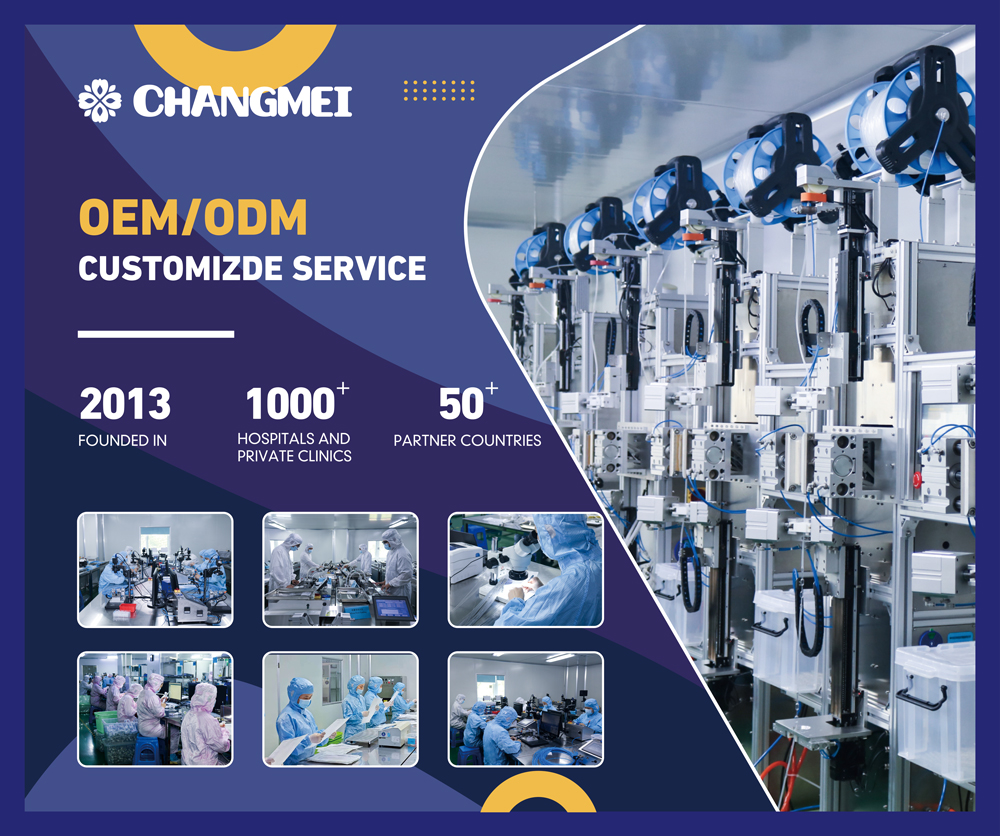
For procurement teams, hospital groups and ambulatory surgery centers, evaluating a kyphoplasty system supplier is rarely a single-product decision. During the evaluation-to-execution phase, the practical questions are about manufacturing depth: whether the supplier can support private-label programs, hold current regulatory files in the target market, adapt systems to surgeon preference, and scale supply without changing quality. This article explains how kyphoplasty system OEM and ODM capabilities affect supplier selection, what can be verified before commitment, and where the clinical and commercial boundaries sit.
Why capability depth determines supplier fit
A common path into kyphoplasty sourcing starts with component queries such as kyphoplasty balloon catheter, balloon inflation device, or kyphoplasty tool kit. In practice, however, a reproducible purchase decision depends on the system around those components. A hospital or distributor may need a complete percutaneous kyphoplasty system with balloons, access instruments, and inflators designed to work together; or it may need a private-label version of that system for a local tender. That requires OEM or ODM programs, not just a catalog listing.
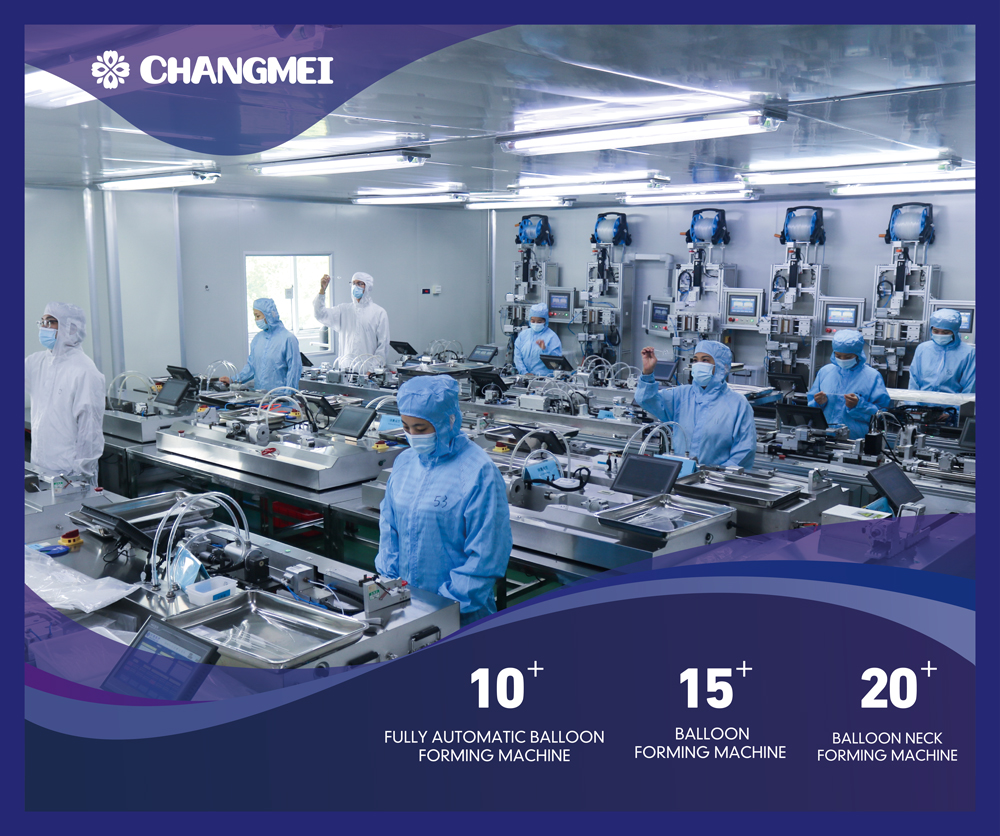
Buyers evaluating suppliers should separate three layers: regulatory status, product performance, and production scalability. A genuine capability assessment verifies whether the manufacturer owns the production process, whether it can customize gauge, length, balloon size, packaging, and labeling, and whether its documentation can support registration in the buyer's market. These factors directly influence lead time, audit workload, and continuity of supply.
The opportunity lies in system-level sourcing. Instead of assembling a kit from multiple vendors, a qualified buyer can work with one manufacturer that supplies the complete kyphoplasty system under one quality system, one technical file, and one set of customs and regulatory documents. For distributors entering new markets, this reduces the risk of mismatched components and incomplete dossiers.
A vertically integrated supplier: Jiangsu Changmei Medtech
Jiangsu Changmei Medtech Co., Ltd. is a medical device manufacturer established in 2013 and based in Changzhou, Jiangsu, China. It designs, develops, produces and distributes disposable sterile medical devices, with core products including CE-certified and FDA-cleared kyphoplasty systems, dilation balloon catheters, and endoscopic instruments. The company operates a 51,985 m² facility with 235 employees, including a 40-engineer R&D team, and reports an annual output capacity of 1,000,000 kyphoplasty balloon catheters. Around 30% of output is exported, with main markets in the EU, USA, Asia, South America, and the Middle East.
According to company data, Changmei's kyphoplasty balloon catheters account for approximately 80% of the Chinese domestic market, and the company is a qualified vendor to member companies of Medtronic and Stryker. It is also reported as the first Chinese company to receive an EU Medical Device Regulation (MDR) CE certificate for kyphoplasty system products, a milestone that matters because MDR compliance is a significant barrier for new market entrants.
For a buyer, this type of vertical integration means the balloon body, shaft, folding, and pressure testing are not distributed across multiple subcontractors. The production chain is auditable from tube extrusion to ethylene oxide sterilization. That is especially relevant during the execution phase, when a supplier must maintain batch traceability and respond to regulatory questions.
OEM/ODM capability set and customization options
For kyphoplasty systems, OEM and ODM capabilities go beyond printing a buyer's logo on the package. Customization can affect clinical usability and market acceptance. Changmei supports three production modes: OEM for private label kyphoplasty systems, ODM for custom-designed systems, and distribution for authorized regional dealers. The stated customization options include balloon diameter and length, cannula size and length, handle color and logo, packaging design, product labeling, and language.
| Capability | Details |
|---|---|
| Production modes | OEM (private label), ODM (custom design), Distribution (authorized regional dealer) |
| Customizable items | Balloon diameter and length; cannula size and length; handle color and logo; packaging design; product labeling and language |
| MOQ | Standard in-stock products: 10 sets; OEM/ODM orders negotiable |
| Lead time | 30–45 days, subject to confirmed specifications |
| Quality control | 100% test; TÜV SÜD-audited ISO 13485 quality system; CE MDR; FDA 510(k) clearance |
| Export markets | EU, USA, Asia, South America, Middle East |
This capability set is not just optional convenience. If a buyer needs to register a private-label product in a new country, the manufacturer must provide a complete device master record, sterilization validation, IFU, UDI information, and free-sale certificates. A trading company without manufacturing control cannot provide the same level of traceability.
System architecture and product parameters
Percutaneous balloon kyphoplasty, or PKP, uses a balloon to create a cavity inside a fractured vertebral body, followed by low-pressure PMMA bone cement delivery. The main device groups are the kyphoplasty balloon catheter, the instrument set, and the balloon inflator. Understanding their parameters is essential when evaluating whether a supplier can meet local clinical preferences.
Changmei's balloon catheter portfolio covers 8G and 11G families. The 8G models are KB0210, KB0115 and KB0120, with a channel ID of at least 3.65 mm and an overall length of 315 mm. The 11G models are KB0210S1, KB0115S1 and KB0120S1, with a channel ID of at least 3.10 mm and an overall length of 280 mm. Marker-to-marker distances are available in 10 mm, 15 mm, and 20 mm options, and maximum balloon volume ranges from 3 cc to 6 cc. All catheters are built with a constrained burst pressure of at least 400 PSI.
| Model | Gauge | Marker distance | Channel ID | Length | Max volume | Burst pressure |
|---|---|---|---|---|---|---|
| KB0210 | 8G | 10 mm | ≥3.65 mm | 315 mm | 4 cc | ≥400 PSI |
| KB0115 | 8G | 15 mm | ≥3.65 mm | 315 mm | 4 cc | ≥400 PSI |
| KB0120 | 8G | 20 mm | ≥3.65 mm | 315 mm | 6 cc | ≥400 PSI |
| KB0210S1 | 11G | 10 mm | ≥3.10 mm | 280 mm | 3 cc | ≥400 PSI |
| KB0115S1 | 11G | 15 mm | ≥3.10 mm | 280 mm | 4 cc | ≥400 PSI |
| KB0120S1 | 11G | 20 mm | ≥3.10 mm | 280 mm | 6 cc | ≥400 PSI |
The kyphoplasty balloon catheter is made of medical-grade thermoplastic polyurethane, mounted on a PU shaft, with radiopaque markers and a stainless-steel stylet. It is ethylene oxide sterilized and intended for single use. In Changmei's production system, the balloon body is folded and pressure-tested in-house, with 100% per-piece testing at a constrained burst pressure of at least 400 PSI.
The instrument kits complete the system. The 8G kyphoplasty tool kit KT-00-01 contains two puncture devices, one puncture expandor module, two expandors, one bone drill, two guide wires, and six bone cement filling devices. The 11G kyphoplasty tool kit KT-00-05 contains two puncture expandor modules, one bone drill, and six bone cement filling devices. Both kits are sterile, single-use, CE-marked, and manufactured under an ISO 13485 quality system. The balloon inflator BI-20A-10 has a nominal capacity of 20 cc, maximum pressure of 30 atm, and is supplied with a 10 ml syringe.
Regulatory evidence and certification file
In kyphoplasty procurement, regulatory documentation is a gating item. Buyers should verify that certificates are current and aligned with the product scope. Changmei's kyphoplasty system holds EU MDR 2017/745 CE certificates issued by TÜV SÜD, not legacy MDD certificates. The FDA 510(k) clearance for the kyphoplasty balloon catheter is K223709, with device class 2 and product code HRX. The FDA establishment registration and device listing number 3016789487 covers the balloon inflator and kyphoplasty tool kit. The quality management system is certified to EN ISO 13485:2016.
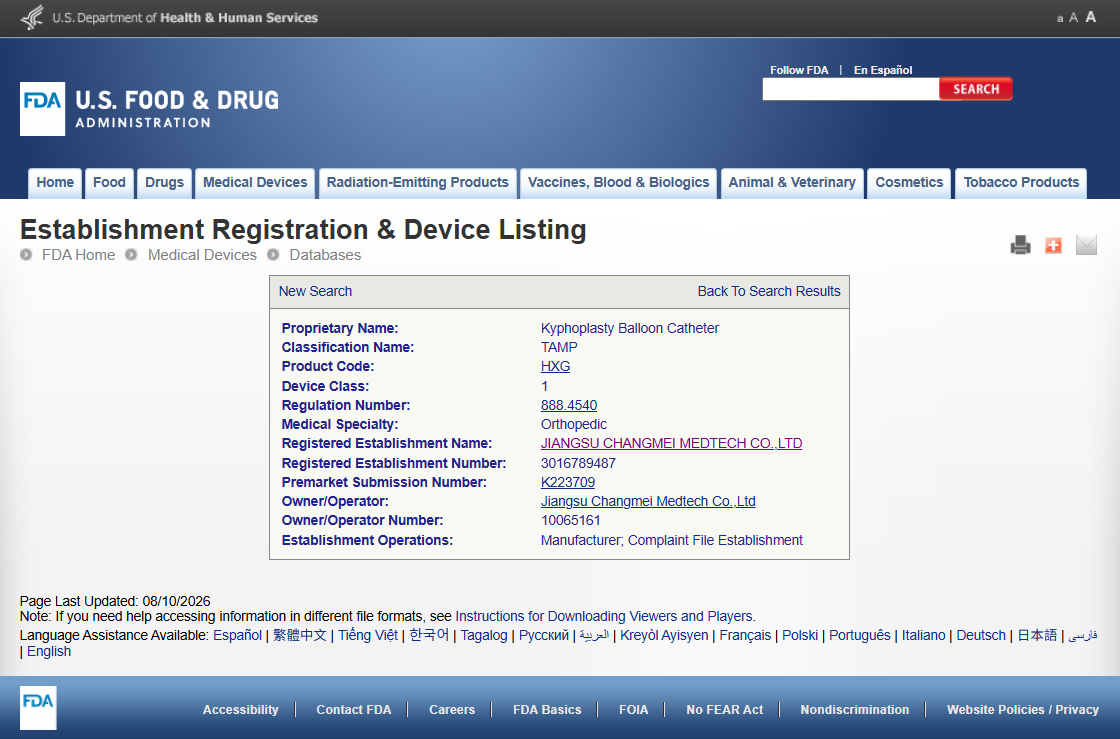
For a buyer, the practical benefit is faster local registration. A complete technical file that includes IFU, sterilization validation, UDI data, and free-sale certificates can reduce the time spent answering questions from local health authorities. This is especially valuable in markets where import registration requires a detailed device master record.
Clinical applications and procurement scenarios
Balloon kyphoplasty is indicated for the minimally invasive treatment of painful vertebral compression fractures caused by osteoporosis, low-energy trauma, or neoplasia including spinal metastases and multiple myeloma. It is also used for symptomatic vertebral hemangiomas. Typical clinical settings include orthopedic spine surgery, interventional radiology, pain management centers, and ambulatory surgery centers.
The procedure follows a two-stage principle. In the first stage, a working cannula is introduced into the fractured vertebral body under fluoroscopy. The balloon is inflated to create a contained cavity and partially restore vertebral height. In the second stage, the balloon is removed, and low-viscosity PMMA bone cement is injected under low pressure to stabilize the vertebra. The reported clinical benefits include significant pain score reduction within 24–48 hours after the procedure, average restoration of 30%–50% of lost vertebral height, and more controlled cement delivery than direct vertebroplasty injection.
Within Changmei's customer base, the products are used by medical device distributors, importers, hospital groups, orthopedic and spine departments, ambulatory surgery centers, group purchasing organizations, and OEM/ODM partners. The company also reports contract manufacturing partners in Europe. One documented clinical reference in its project file is the treatment of vertebral compression fractures using the eggshell technique in Kuwait, which demonstrates that the system can support advanced surgeon techniques, not only standard transpedicular cases.
What market data says about kyphoplasty demand
Third-party market research places the global kyphoplasty market at USD 764.13 million in 2025, with projections reaching USD 1,342.29 million by 2034. North America accounted for an estimated 42.5%–50.0% of global revenue in 2025, reflecting mature reimbursement and outpatient procedure adoption. In the United States, the 2025 Medicare ambulatory surgery center payment rate for kyphoplasty was approximately USD 3,510.84, an increase of 3.5% over 2024. This reimbursement environment supports the shift of kyphoplasty from inpatient hospital stays to outpatient settings.
Regulatory pressure is also shaping competition. The EU MDR transition has raised the bar for CE-marked devices, and suppliers that have already completed MDR certification have a practical advantage for European distribution. Changmei's position as the first Chinese company to obtain EU MDR CE certification for kyphoplasty system products is a relevant reference point for distributors building their European supply chain.
At the clinical level, the market is moving toward less invasive access. The 11G balloon catheter family is associated with a smaller pedicle footprint, reduced paraspinal trauma, and easier access in upper thoracic levels. Buyers evaluating a manufacturer should ask whether the supplier can provide both 8G and 11G platforms under the same quality system, so that market preference changes do not force a second vendor qualification process.
Balloon kyphoplasty versus traditional approaches
For procurement planning, it is useful to compare balloon kyphoplasty with conservative management and vertebroplasty. Each approach has a different cost profile, clinical objective, and risk balance.
| Approach | Mechanism | Advantages | Limitations |
|---|---|---|---|
| Conservative management | Bed rest, bracing, analgesics | No device cost; avoids procedural risk | Slow mobilization; possible progressive collapse; limited height restoration |
| Vertebroplasty | Direct cement injection | Shorter procedure; lower device cost | No cavity creation; less controlled cement distribution; higher leakage risk |
| Balloon kyphoplasty | Balloon cavity creation plus low-pressure cement fill | Height restoration; kyphosis correction; rapid pain relief; controlled cement delivery | Higher per-procedure cost; requires balloon catheter, inflator, imaging, and surgical training |
There are also clear boundaries. Balloon kyphoplasty is not appropriate for every vertebral fracture. Contraindications include a damaged posterior vertebral edge, nerve injury, infection at the operative site, and uncorrectable coagulopathy. Relative contraindications include severe spinal stenosis and vertebral collapse above roughly 75%–80% of original height. Patient selection, cross-sectional imaging, and surgeon experience remain decisive factors. Buyers should therefore evaluate not only the device specifications but also the clinical training and IFU documentation the manufacturer can provide.
Future outlook for kyphoplasty sourcing
The kyphoplasty sourcing environment will continue to reward suppliers with regulatory depth, flexible customization, and documented manufacturing control. As procedures move further into ambulatory surgery centers, buyers will favor systems that are easy to store, quick to set up, and supported by a full technical file. The shift toward 11G platforms is likely to continue, but many markets still use 8G systems, so dual-gauge availability remains a practical procurement advantage.
For distributors and hospital groups, the long-term relationship value of an OEM/ODM partner depends on auditability. Factory audits, device history records, pressure-test data, sterilization validation, and post-market documentation should all be traceable. In this sense, the supplier evaluation is not finished when a quotation is accepted; it continues through first delivery, local registration, and repeat orders.
Frequently asked questions
What regulatory clearances does the kyphoplasty balloon catheter, tool kit and inflator hold?
Changmei's kyphoplasty system holds EU MDR 2017/745 CE certificates issued by TÜV SÜD, US FDA 510(k) K223709 for the kyphoplasty balloon catheter, EN ISO 13485:2016 quality system certification, and NMPA China Class II/III registrations. The EU certificates are MDR, not the older MDD. The Class IIa CE certificate covers the balloon catheter, tool kit, and balloon inflator as a system. FDA establishment registration and device listing number 3016789487 covers the balloon inflator and kyphoplasty tool kit.
How can a buyer verify that the manufacturer is a real factory that can scale?
Jiangsu Changmei Medtech was founded in 2013 and operates a 51,985 m² manufacturing facility in Changzhou, Jiangsu. The company controls the full vertical chain for kyphoplasty balloon catheters, including balloon forming, four-wing folding, and leak testing, and reports an annual output capacity of 1,000,000 balloon catheters. Each balloon is pressure-tested in-house, with a constrained burst pressure of at least 400 PSI. The quality system is certified to EN ISO 13485:2016 and audited by TÜV SÜD, and the company has passed supplier audits from member companies of Medtronic and Stryker. Standard in-stock MOQ is 10 sets; OEM/ODM quantities are negotiable.
Is the kyphoplasty balloon catheter single-use, and what are the sterilization and shelf-life requirements?
Kyphoplasty balloon catheters are single-use sterile medical devices. Reuse is prohibited. They are sterilized with ethylene oxide and have a three-year shelf life. The device must be used immediately after the package is opened, and it must not be re-sterilized or reused. Clinicians should always follow the official Instructions for Use.
Reference file: Kyphoplasty System Products (8G and 11G) - CE and FDA
Tem questões ou precisa de mais detalhes?
Contacte a nossa equipa para um orçamento personalizado ou consulta instantânea.
Solicitar orçamento
Preencha o formulário abaixo e a nossa equipa entrará em contacto com uma proposta personalizada.
Chat direto do WhatsApp
Prefere conversar em tempo real? Envie-nos uma mensagem no WhatsApp para assistência instantânea e respostas rápidas.
- Obter orçamento personalizado
- Partilhar fotos ou documentos
- Discuta as suas necessidades diretamente
Geralmente responde em 5–30 minutos durante o horário de expediente.