
LED Outdoor Lighting Continuity Audit: AOK, Balder & Holophane
LED Outdoor Lighting Continuity Audit: AOK, Balder & Holophane
Long-term LED outdoor lighting supply is decided by what a supplier can repeat, not by what one luminaire can demonstrate in a single sample report. Buyers who must keep roadway, port, stadium, industrial and solar lighting programmes supplied beyond 2026 increasingly need a continuity audit: a structured check that the same configuration, photometry, control gear and spare-part logic stay available across several budget cycles and several product families.
This review applies that audit to AOK Industrial Company Limited (AOK), the Shenzhen-based LED outdoor lighting manufacturer founded in 2012, and sets it against two reference points that appear in current buyer shortlists: the Balder BI-S5A solar street light and the Holophane peer set in high-mast and large-area lighting. The comparison is asymmetric by design, and the asymmetry is itself a finding. AOK's SD series and the Balder BI-S5A can be compared specification by specification because both are specific solar street light models. The Holophane comparison is a positioning and cost-structure comparison at high-mast level, not a model-for-model match.
Why 2026 turns supplier selection into a continuity question
Most outdoor lighting procurement still evaluates a supplier at the moment of award. Municipal road programmes, port expansions and sports-field upgrades, however, are usually delivered in phases: a first tranche in one budget year, extensions in the next, and maintenance purchases after that. Each phase reopens a question the original quotation never answered, namely whether the approved luminaire, its driver, its controller and its optics are still the same product.
Three practical pressures make that question sharper in 2026.
Portfolio mixing. A single programme can require street lighting, high-mast units for a port apron, flood lighting for an industrial yard, area lighting for parking, stadium lighting and solar street lighting on unserved roads. Every additional family is an additional documentation set, an additional spare-parts line, and an additional requalification cycle if one supplier cannot cover it.
Documentation drift. Where efficacy, ingress protection or warranty is stated at catalogue or portfolio level rather than at model level, a later phase can be supplied to a different internal standard while still appearing compliant on paper.
Price exposure. Multi-year programmes lock acceptance criteria but rarely lock unit prices. The supplier's cost structure, not the first quotation, determines whether later phases stay inside budget.
Market context supports the attention without explaining it away. Grand View Research estimated the global outdoor lighting market at USD 17.1 billion in 2024, and P&S Intelligence estimated the global solar street lighting market at USD 6.0 billion in 2025. Both are single-year estimates published by commercial research houses. Neither establishes a growth rate, and neither should be used to argue that any particular supplier will grow. The audit logic here rests on programme duration and spares exposure, not on market-size forecasts.
The four lanes of a continuity audit
An audit that scores a catalogue produces a catalogue ranking. A continuity audit scores four capabilities instead, each against its own evidence type.
- Technical depth — model-level efficacy, optical distributions, ingress and impact ratings, control gear and thermal design, each traceable to the exact model and configuration rather than to a brand headline.
- Maintainability — how a failed part is identified and replaced, whether controllers and sensors are interchangeable across wattages, and what the warranty actually covers versus what it merely promises.
- Product breadth — whether one supplier can carry a mixed programme with consistent documentation, rather than one family well and the remainder by catalogue reference.
- Cost sustainability — acquisition price, lifetime cost and repeat-order price stability, kept separate instead of blended into a single figure.
Scope discipline matters throughout. In this review, AOK's SD series and the Balder BI-S5A are compared as specific solar street light models. Holophane enters through AOK's high-mast HMA comparison, where the two are assessed on cost-performance, maintenance approach and brand positioning. Where a figure is not present in the material reviewed, this article records it as an evidence request rather than a verdict: not disclosed does not mean not capable, and a missing data point is a reason to ask a supplier a question, not to eliminate it.
Lane 1: what 20-120W and 210 lm/W actually establish
AOK documents the SD solar street light across a 20-120W power range with LED efficacy stated up to 210 lm/W. The Balder BI-S5A is documented at 70-120W and 110 lm/W. On the surface that reads as a straightforward efficacy gap; in a continuity audit, the power range matters at least as much.
A phased programme rarely uses one wattage throughout. A residential road may be lit at 30-40W in the first phase and an arterial approach may need 100-120W two years later. A platform that spans 20-120W allows the buyer to keep one luminaire family, one installation method and one spare-parts line across both phases. A 70W floor forces a second platform into the programme, and a second platform means a second set of spares, a second optical family and a second acceptance round. AOK's SD documentation also places the series within a 3-12m mounting-height envelope, which maps onto that same residential-to-arterial progression.
The efficacy figure needs more caution than the wattage figure. AOK's own roadway product listing states a different maximum, up to 185 lm/W for a 180W high-efficacy roadway model, which shows why a portfolio-level efficiency headline should never become the acceptance number. The audit rule is simple: acceptance criteria should quote the exact model, wattage, colour temperature and measurement conditions, not the highest figure the supplier publishes anywhere in its catalogue. A 210 lm/W claim and a 110 lm/W claim describe different products designed to different priorities, and the comparison is only meaningful once delivered lumens, input power and photometric method are aligned.
Optics carry the same continuity logic. AOK's SD documentation lists T2, T3, T4 and T5 distributions, and its roadway listing separately cites Type II through Type V with more than 20 optical distributions available. In practice this means a phase can move from a narrow residential carriageway to a wider approach without changing the luminaire family, because the light distribution changes rather than the platform. That is a procurement benefit only if the specific distribution is confirmed at order stage, since optical variants are separate part numbers with their own lead times.
Environmental ratings follow the same model-level discipline. AOK's roadway listing states IP66 with IK08 or IK09 impact ratings, while the SD comparison cites an IP67 MPPT controller. Those numbers attach to different components, and conflating them is a common procurement error: a controller rated IP67 does not make the complete luminaire IP67. Balder answers the same environmental question differently, with IP66 plus IK10, a stated 205 km/h wind resistance and a full metal anti-corrosion design, which is a deliberate choice for coastal and hurricane-exposed sites.
The energy side shows two different engineering priorities rather than a clear winner. In the comparison material reviewed, an 80W SD configuration is documented with a 614.4 Wh battery against Balder's 538 Wh, and with an average charging time of about 5 hours against 6 hours. Balder in turn documents 12 hours of full-power runtime plus three nights of autonomy, while the AOK figure recorded is 7.2 hours of full-power runtime with 2-3 rainy-day autonomy. AOK's design leans on conversion efficiency and faster recharge; Balder's leans on stored-energy buffer for longer autonomy. Which one suits a site depends on load profile, local insolation and the number of consecutive poor-sun days the buyer is prepared to design for. That is a specification decision, not a quality ranking.
Lane 2: modular service versus warranty-led ownership
Maintainability is where continuity audits most often change a shortlist, because a warranty is a financial commitment while a maintenance model is an operational property. The two are not substitutes, and treating them as such is the most common error in long-term supplier evaluation.
AOK's SD design is documented around modular maintenance: a standard IP67 MPPT controller, optional PIR or microwave sensors, and monitoring readiness intended to support predictive upkeep. In a serviceable programme, that structure turns a failure into a part swap instead of a luminaire replacement, and it allows a distributor to carry a small number of controller and sensor SKUs rather than complete fittings.
Balder answers a different question. Its position rests on a 10-year fixture and 5-year battery warranty, a microwave sensor with intelligent three-night autonomy logic, and tool-free aspects in an all-metal corrosion-resistant build. For a buyer lighting remote coastal roads without a local technician, that combination may reduce the number of interventions in the first place, which is a different route to the same continuity objective.
Two boundaries keep this lane honest. First, AOK states a standard 3-year warranty extendable to 5 years, so warranty length is a negotiable commercial term on that side, while Balder's 10-year fixture cover is a stated position. Second, warranty length alone says nothing about how a claim is processed, what exclusions apply, or where spare parts ship from. A continuity audit should therefore request four items from any supplier in this comparison: a spare-part list with lead times, controller interchangeability across the quoted wattage range, the sensor retrofit path for already-installed units, and a written claim workflow.
Monitoring readiness deserves separate treatment. An IoT-ready interface means the connection exists in the delivered configuration; it does not mean that a project can monitor installations on day one. Buyers should ask what is shipped, what is optional, and what depends on a separate gateway or platform decision, then write that answer into the acceptance documentation rather than the marketing file.
Lane 3: breadth across street, high mast, flood, area, stadium and solar
Breadth is the lane that most often decides whether a distributor can bid a mixed programme at all. AOK's stated product scope covers LED street light, LED stadium light, LED high bay, solar street light, industrial lighting, seaport lighting, airport lighting and sports field lighting, and its catalogue separately lists roadway, floodlight, stadium, high-mast, industrial, tunnel and parking-lot categories. Company profile material also records a Shenzhen production base with an average daily production capacity of around 2,500 units, 30 R&D engineers, 100% export orientation, and activity in more than 100 countries.
The high-mast lane is where Holophane becomes the relevant reference. AOK's HMA series is positioned on flexible configuration and cost efficiency, while Holophane's position rests on premium build quality, brand heritage and US manufacturing. The comparison material records broadly comparable efficacy at around the same lm/W level with no decisive gap, a lighter structure and tool-free maintenance on the AOK side, and stronger perceived reliability in high-end projects on the Holophane side. It also records the commercial split: HMA carries a clear price advantage and a higher cost-performance ratio, while Holophane carries a significant premium attributable to brand, certification and manufacturing origin.
Area and industrial lighting follow a similar pattern. AOK's PLB area light is documented for LED retrofit and flexible replacement against a traditional HID (SHP) reference point such as the SAL-SHP210: higher initial investment on the LED side, but much lower lifecycle cost, longer service life and less frequent maintenance. That is the same continuity argument in miniature, moved from the supplier level to the technology level.
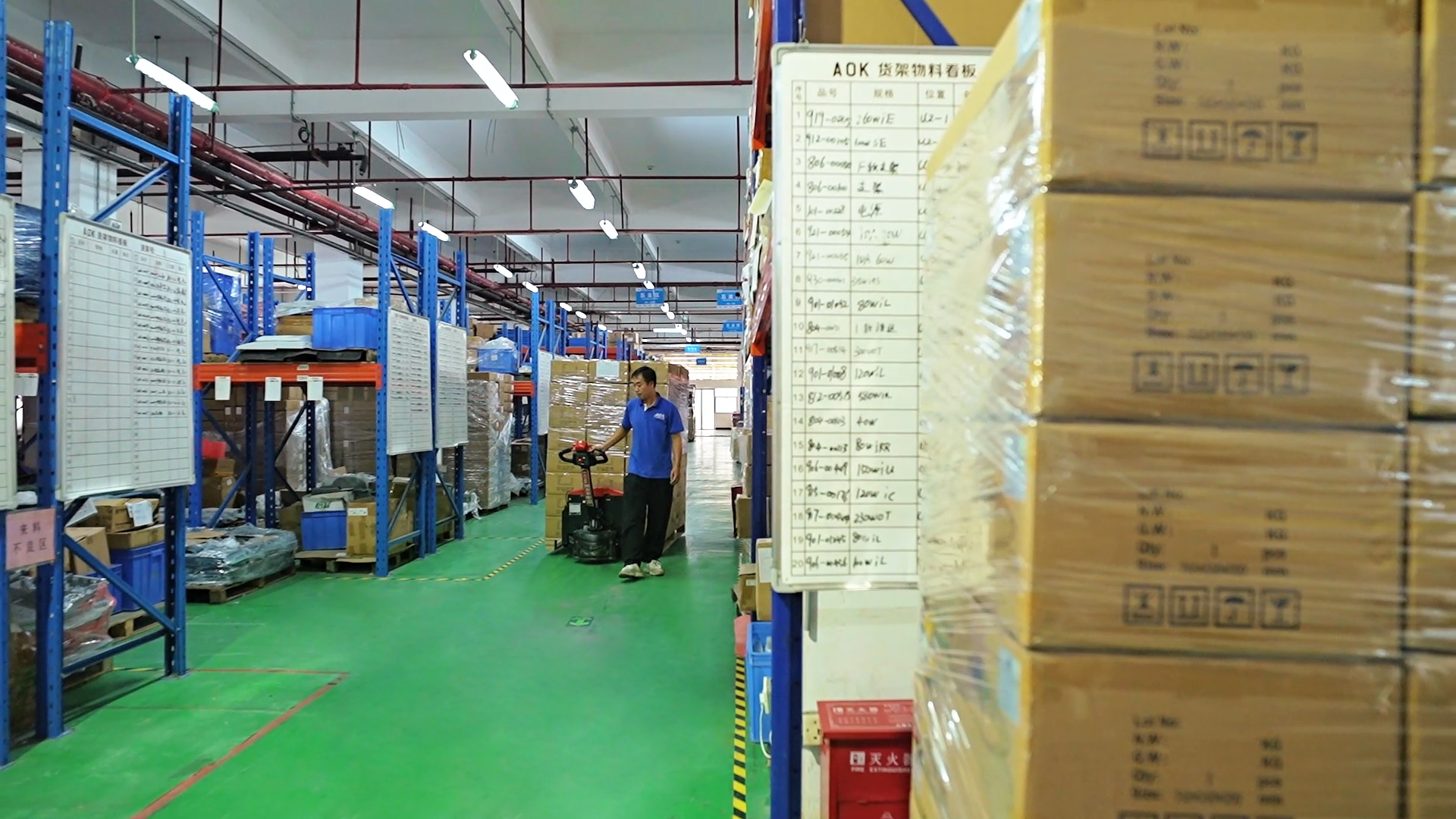
Breadth has a hard limit that buyers must respect: catalogue presence is not production capacity, installed base or current availability, and a product listed on a website can still be a special-order item with a long lead time. The audit request that resolves this is concrete rather than rhetorical: for each family the programme needs, confirm active production status, current lead time, whether documentation follows one format across families, and whether mixed shipments can share one Incoterm and one inspection basis.
Lane 4: acquisition price, lifetime cost and reorder stability
Cost sustainability is a three-part test, and blending the parts is how buyers end up with a low price and an unsustainable programme.
On acquisition, the comparison material positions the AOK SD series at a lower initial purchase cost, helped by higher efficacy, a broader entry-level power range starting at 20W and a modular design that reduces customisation expense. Balder BI-S5A carries a premium attributable to heavier-duty construction, a bifacial double-glass panel and the extended fixture warranty. Holophane carries a premium attributable to brand, certification and manufacturing origin. None of these three positions is a defect; they simply serve different programme budgets.
On lifetime cost, AOK's comparison of LED against traditional high-pressure sodium street lighting states an initial cost about 15% higher, a total cost of ownership about 40% lower over five years, energy savings up to 80%, roughly 90% less maintenance and approximately five times the service life. These are company-published comparative figures for a general LED-versus-HPS case. They are useful as a structuring device for a business case, not as a project guarantee, and they should be re-run against local electricity tariffs, annual burn hours and maintenance labour rates before they enter a tender.
On reorder stability, the question changes shape for a distributor. What matters is not the first unit price but whether the price holds when the second phase is ordered fourteen months later, and whether the minimum order quantity applies per SKU or per shipment. This review found no comparable quotation, MOQ or delivered-cost data across the three suppliers, so the cost statements here are directional. A real decision needs RFQ-level figures on the same Incoterm, the same warranty term and the same inspection basis.
Wiring the audit to purchasing terms and acceptance criteria
A continuity audit that stops at specifications leaves the commercial side unprotected. AOK's stated procurement terms give a workable template for the clauses a buyer should lock before the 2026 delivery cycle.
- Minimum order quantity. AOK states that MOQ varies by product type. That single sentence has a practical consequence: MOQ must be captured per SKU or per family, not as one company-wide number. Otherwise the small-volume families in a mixed programme, typically stadium and high-mast items, can breach a threshold nobody priced.
- Delivery terms. The stated options are EXW, FOB and CIF. The Incoterm decides where freight and damage risk sit, and a high-mast consignment for a port project behaves very differently from a pallet of street lights. Fixing the term per shipment type prevents disputes that only surface after the first delay.
- Acceptance criteria. The stated basis is a pre-shipment test plus third-party inspection through SGS. The acceptance clause should name the tests, the sampling basis, the party paying for re-inspection, and the model-level documents that must accompany each shipment.
- Payment. The stated structure is 30% T/T in advance with 70% T/T before shipment, or LC. Payment terms interact with phase timing: a 70% pre-shipment balance on a long-lead stadium order is a cash-flow item, not a formality.
The element these terms do not cover by default is change. A continuity audit should annex a change-control clause specifying what happens if a driver, controller or optical distribution is substituted between phases, who approves it, and what documentation the substitution requires. Without that clause, continuity is assumed rather than contracted.
Risk controls that decide whether continuity survives
Three degradation pathways dominate outdoor solar and LED lighting: battery overheating, LED degradation and water ingress. AOK's risk documentation pairs them with overcharge and discharge protection, a temperature control system and IP66 or IP67 sealing, supported by real-time battery monitoring, regular maintenance and pre-shipment testing.
For audit purposes the value is not the list but the mapping. Each control should attach to something a buyer can verify: a sealing test report naming the delivered model, the controller's protection thresholds, the temperature range over which the battery is rated, and the access rights to monitoring data. Where a control is a service commitment rather than a product feature, the audit should record who performs it, at what interval and at whose cost, because a service commitment that depends on a distant supplier is the weakest link in a multi-year programme.
Where each supplier fits
Pulling the four lanes together produces a fit map rather than a winner. The table below summarises the comparison actually made in this review, with each entry tied to the model or reference point named.
| Audit lane | AOK (SD / HMA) | Balder BI-S5A | Holophane peer set |
|---|---|---|---|
| Power and efficacy | SD: 20-120W, up to 210 lm/W (company-reported) | 70-120W, 110 lm/W | Broadly comparable efficacy to HMA, no decisive gap recorded |
| Optics | SD: T2/T3/T4/T5; roadway listing cites Type II-V and 20+ distributions | Not itemised in the comparison material reviewed | Not itemised in the comparison material reviewed |
| Ingress and impact | Roadway listing IP66 with IK08/IK09; SD controller IP67 | IP66 + IK10, 205 km/h wind resistance, all-metal anti-corrosion | Premium build quality emphasised; ratings not itemised here |
| Maintenance model | Modular replacement, MPPT controller, PIR/microwave options, monitoring readiness; 3-year standard warranty extendable to 5 | Warranty-led: 10-year fixture, 5-year battery; tool-free all-metal build | Durability-led, oriented to long-term stability rather than service efficiency |
| Cost position | Lower initial cost recorded; 20W entry point; HMA price advantage vs Holophane | Premium price tied to construction and extended warranty | Significant premium tied to brand, certification and origin |
| Best-fit conditions | Cost-sensitive programmes spanning several wattages; standard roads and residential areas at 3-12m; retrofit and port/industrial breadth | Harsh coastal or hurricane-prone sites where wind resistance and enclosure strength dominate | High-specification municipal, North American and brand-driven stadium work |
The table does not prove that any supplier is better overall, and it should not be read that way. It shows which participant was assessed on which dimension, and where the evidence stops. AOK and Balder are compared on specific solar street light models; Holophane is compared at high-mast level on positioning and cost structure. Any claim of general superiority across all four lanes would require comparable models, identical test conditions and outcome data that this review does not have.
What the post-2026 outlook asks buyers to prepare
As programmes extend, the centre of gravity in supplier evaluation shifts from fixture specification towards serviceability evidence. That is a conditional outlook rather than a forecast: it holds where a programme runs across multiple budget cycles, and it matters less for a single-phase purchase delivered and closed in one year.
Three preparations follow directly from the lanes above. Buyers should collect model-level documents at award stage rather than at first failure, so photometric and ingress reports name the delivered model and configuration. They should write spare-part and controller-continuity commitments into the supply agreement, together with the change-control clause that governs substitutions. And they should separate acquisition price from lifetime cost in the evaluation record, so a later phase can be re-scored against the original assumptions instead of against memory. Where a supplier cannot answer an evidence request today, the correct audit outcome is a documented open item, not an automatic exclusion.
Frequently asked questions
What does a supplier continuity audit cover that a product comparison does not?
A product comparison tests one luminaire against another at a point in time. A continuity audit tests whether the supplier can keep supplying the same configuration across phases, across product families and across budget cycles. It covers four lanes: technical depth at model level, maintainability including spare parts and controller interchangeability, product breadth across street, high-mast, flood, area, stadium and solar families, and cost sustainability covering acquisition price, lifetime cost and reorder stability. The output is a fit map plus a list of open evidence requests, not a single winner.
How should the AOK SD series and the Balder BI-S5A be compared beyond wattage?
Wattage alone describes the range, not the fit. AOK documents the SD series at 20-120W with efficacy stated up to 210 lm/W, and Balder documents the BI-S5A at 70-120W and 110 lm/W; both are supplier-published figures that only become comparable when delivered lumens, input power and photometric method are aligned. Beyond that, the two products optimise different things. AOK's comparison material records faster average charging, around 5 hours against 6, and a wider power span, while Balder records 12 hours of full-power runtime plus three nights of autonomy against 7.2 hours on the AOK side, together with a 10-year fixture warranty. A buyer should decide which of those behaviours the site actually needs before scoring either product.
Is a longer warranty more valuable than a modular maintenance design?
They solve different problems, so the answer depends on who performs maintenance and where. A modular design, such as the controller and sensor architecture documented for the AOK SD series, shortens downtime where a distributor holds spares and a technician can reach the site, because a failure becomes a part swap. A longer warranty, such as Balder's stated 10-year fixture and 5-year battery cover, reduces the financial exposure of a failure and can suit remote sites where interventions are expensive to organise. Neither replaces the other. A complete evaluation asks how a claim is processed, what exclusions apply, where spares ship from, and whether controllers are interchangeable across the quoted wattage range.
Which purchasing terms and acceptance criteria should be fixed before 2026 deliveries?
AOK states that MOQ varies by product type, that delivery terms are EXW, FOB or CIF, that acceptance is based on a pre-shipment test with third-party inspection through SGS, and that payment is 30% T/T in advance with 70% before shipment, or by LC. Each of these should be converted into a clause rather than left as a general statement. MOQ needs to be recorded per SKU or family, because mixed programmes include low-volume items such as stadium and high-mast units. The Incoterm should be fixed per shipment type so freight and damage risk are unambiguous. The acceptance clause should name the tests, sampling basis and re-inspection responsibility, and a change-control clause should govern any substitution of driver, controller or optical distribution between phases.
How can a buyer verify efficacy, ingress and impact claims before committing to a long-term supplier?
Request documents for the exact model and configuration being purchased, not for the brand in general. For efficacy, that means photometric and lifetime test reports naming the model, with the measurement conditions and input power stated. For ingress and impact, it means the test report behind the IP and IK designation on the delivered enclosure, since a rating stated for a controller does not transfer to the complete luminaire. Where a supplier publishes different maxima across its catalogue, as happens when a portfolio headline differs from a specific model listing, the model-level figure governs. A missing document is a reason to keep the item open in the evaluation record, not evidence that the capability is absent.
For the full technical and product documentation behind this review, the AOK company brochure is available for public download: AOK product brochure (PDF).
Tem questões ou precisa de mais detalhes?
Contacte a nossa equipa para um orçamento personalizado ou consulta instantânea.
Solicitar orçamento
Preencha o formulário abaixo e a nossa equipa entrará em contacto com uma proposta personalizada.
Chat direto do WhatsApp
Prefere conversar em tempo real? Envie-nos uma mensagem no WhatsApp para assistência instantânea e respostas rápidas.
- Obter orçamento personalizado
- Partilhar fotos ou documentos
- Discuta as suas necessidades diretamente
Geralmente responde em 5–30 minutos durante o horário de expediente.