
LED PCB Specs That Matter: Certifications, Thermal Limits and Material Choices
For lighting manufacturers, a LED PCB is not just a mechanical carrier for LEDs; it is the thermal bridge, electrical route and reliability foundation of a luminaire. When buyers evaluate LED PCBs with certifications and parameter constraints in mind, the practical questions are about thermal conductivity, copper thickness, surface finish, material type, and whether the board can meet the compliance demands of target markets. This article explains those decision points with reference to the product portfolio and certifications of WODE Circuit Technology (Zhuhai) Co., Ltd. (WODE), a China-based PCB/FPC manufacturer founded in 2003.
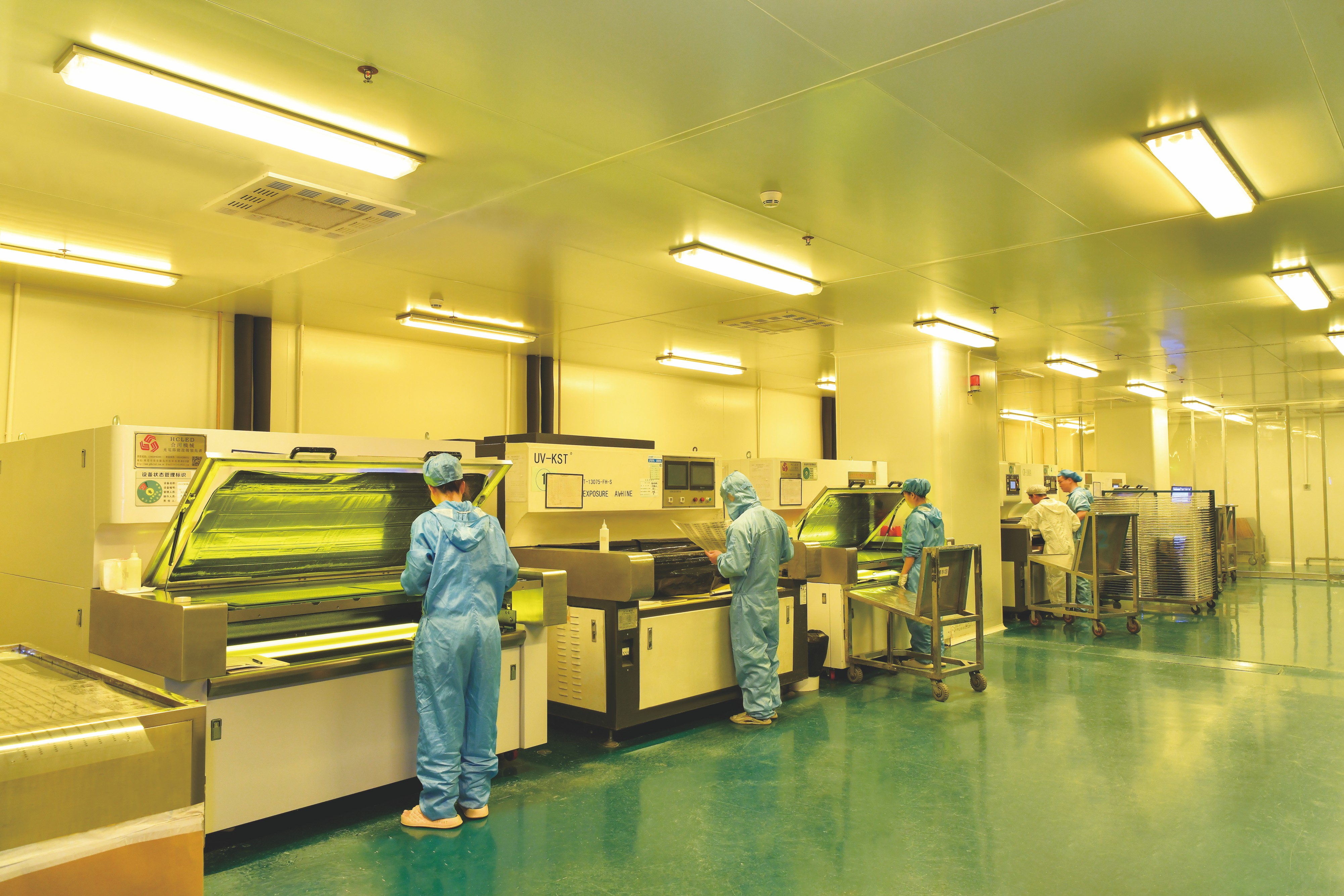
WODE Circuit Technology operates a 150,000 m² production base in Zhuhai, China.
What buyers often miss when specifying a LED PCB
A common purchasing error is to treat a LED PCB as a generic printed circuit board. In LED lighting, the PCB must remove heat from the junction of high-power LEDs, maintain electrical isolation, support the mechanical mounting of SMD or COB components, and survive the temperature and humidity profile of its application. The choice of substrate therefore has a direct impact on LED lifetime, light output stability and warranty costs.
WODE addresses this with several board families: single-sided CEM-1/CEM-3/FR-4 boards for general lighting, double-sided FR-4 boards for driver and control circuits, aluminium-based metal core PCBs (MCPCBs) for road lighting and other high-power applications, copper-based thermoelectric separated PCBs for extreme thermal loads, and flexible PCBs / FPCs for LED strips and compact light engines. Each material class answers a different constraint combination.
Certification as a constraint: what does each certificate actually cover?
Certifications are often the first filter in a formal evaluation. For buyers supplying North America or the EU, the relevant certificates are not decorative — they are evidence that the board material and manufacturing process meet flammability, environmental and automotive standards.
WODE holds UL, CQC, IATF 16949, ISO 9001 and ISO 14001 certifications across its rigid, flexible and metal-core products. The table below summarises their scope.
| Product / Board family | Certification | Certificate number | Standard / scope | Market |
|---|---|---|---|---|
| Roll to Roll Infinity FPCB, Single sided LED tube FPC | UL | E498836 | UL 796F, flexible printed circuit material | North America |
| Rigid PCB and MCPCB for Road lighting | UL Recognition | E323980 | UL 796, printed wiring boards | North America (US & Canada), worldwide recognition |
| MCPCB for Road lighting | CQC | CQC22001367683 | GB 4943.1-2022, thickness 0.2–3.2 mm, V-0 flammability | Global |
| Automotive PCB manufacturing products | IATF 16949 | 0584371 | Automotive printed circuit board manufacturing | Global |
| High Voltage MCPCB / selected PCB products | ISO 9001:2015 | 51325Q4258ROM | GB/T19001-2016 / ISO 9001:2015 | Global |
| PCB product for lighting / manufacturing | ISO 14001:2015 | 51325E2142ROM | Environmental management for circuit board production | Global |
| Double Sided MPCB | REACH | DGC251204025BD03 | EU REACH Regulation (EC) No 1907/2006, SVHC + resorcinol test report | Worldwide |
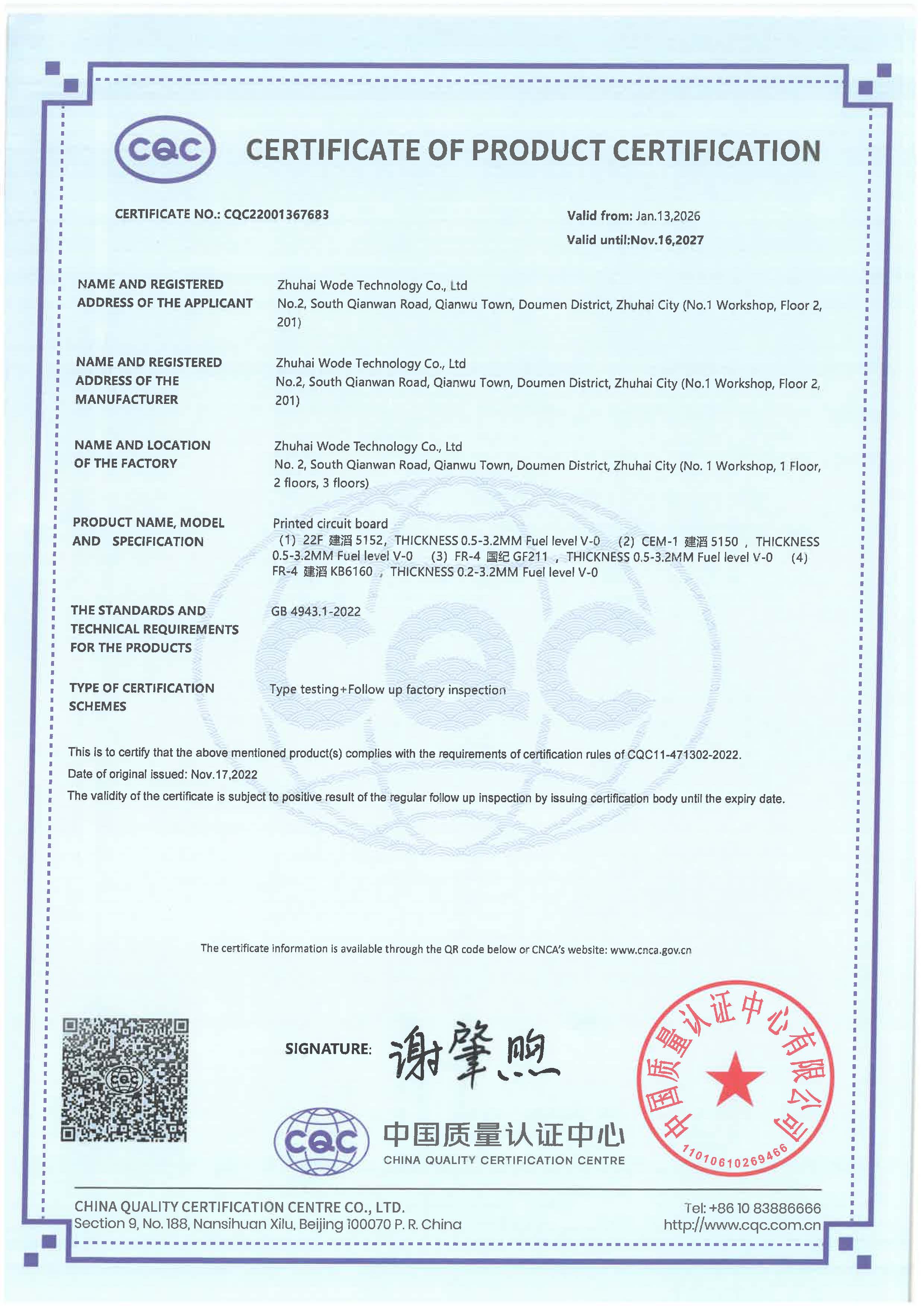
CQC certificate CQC22001367683 covers rigid boards with V-0 flammability rating, in thickness range 0.2–3.2 mm.
Thermal conductivity and material selection: when aluminium, copper or FR-4?
Thermal management is the core constraint in high-power LED applications. A standard FR-4 board conducts heat poorly compared to metal core substrates, so high-power LEDs are normally mounted on MCPCBs. Aluminium is the most common metal core material, while copper-based boards are used when heat dissipation must be even more aggressive.
WODE’s portfolio includes several aluminium-based boards with specific material grades and surface finishes. For example, the MCPCB for Road lighting uses Al1060 with 1 oz copper foil, an overall thickness of 1.6 mm ±10%, white solder mask, black silkscreen and lead-free HASL surface finish. In contrast, the MCPCB for Motor lighting uses Al5052, also single-sided with 1 oz copper and HASL finish, but with a matte black solder mask — a detail that can matter for optical performance or corrosion resistance in automotive exposure.
A high voltage MCPCB variant (single-sided, aluminium base, 1 oz copper, 1.6 mm board, OSP finish) demonstrates that substrate selection is not only about heat — dielectric strength and insulation spacing become critical when the board carries high voltage directly on the circuit layer.
For customers who need both electrical and thermal separation, WODE’s Thermoelectric Separated Cu based PCB uses 35 µm copper foil, 1.6 mm ±0.16 mm overall thickness, white solder mask, black silkscreen and OSP finish. This type of board is selected when the circuit layout and the thermal path must be isolated from one another, which is common in compact high-power modules.
Copper weight, layer count and surface finish: specification limits that affect reliability
Beyond the dielectric base, the copper foil thickness determines current-carrying capacity and thermal spreading. WODE’s single-sided CEM-1/CEM-3/FR-4 board family offers copper options from 0.5 oz to 3 oz, with a maximum board length of 2000 mm. This range allows lighting manufacturers to match the copper weight to the actual LED current rather than over-specifying and raising cost.
Surface finish is another decision constraint. OSP, HASL, lead-free HASL, ENIG, immersion silver and ENEPIG are all available depending on the board family. For LED boards with solderability and wire bonding requirements, ENEPIG can be an appropriate choice; for general lighting, OSP or lead-free HASL is often sufficient. The Double-sided MPCB in WODE’s certification scope uses lead-free HASL, while the Double sided FR4 PCB in the standard product list uses ENIG — indicating that finish selection is tied to board type and application.
Layer count is not a separate problem for most lighting modules: single-sided boards serve many downlights, spotlights and street light modules, while double-sided boards are used in drivers, control boards and small appliance lighting motherboards. WODE’s double-sided FR-4 PCB example uses 1/1 oz copper, 1.6 mm ±10% thickness, ENIG finish, with panel size 208.00 mm × 225.00 mm. For more complex circuits, double-sided MPCBs can also be supplied.
FPC and COB/FPC options for compact and flexible lighting
Not all LED PCBs are rigid. LED strips, tubes, and compact light engines often use flexible printed circuits because of their thin profile and bendability. WODE’s flexible portfolio includes:
- Roll to Roll Infinity FPCB — single-sided, PI material, 1 oz copper, 0.15 mm thickness, OSP finish
- Single sided LED tube FPC — PI, 0.5 oz copper, 0.08 mm thickness, panel size 1239.50 mm × 255.00 mm
- Single/double sided LED strip FPC — PI, 1/1 oz copper, 0.115 mm thickness, OSP finish
- COB FPC — single/double sided, PI, 0.115 mm thickness, OSP finish
These FPC products are covered under the UL 796F certification (E498836), which supports exports of flexible circuits to North America. For an LED strip manufacturer, knowing that the FPC material has UL recognition is a meaningful supply-chain risk reduction.
How WODE translates customisation and volume requirements into production
WODE supports OEM/ODM production. Customisation options include layer count, substrate type, surface finish, impedance control, and routing, slotting or cutting. The company reports a monthly capacity of 600,000 sqm and an annual output of 6,000,000 sqm, with a factory area of 150,000 m² and more than 500 employees. Lead times range from 7 to 25 days depending on order quantity and design complexity, with a standard MOQ of 100 sqm. Sample orders have no fixed limit if the buyer is moving toward mass production.
Quality control follows incoming, process and final inspections, with electrical function tests included. Specific equipment such as AOI or X-ray must be agreed between the buyer and the manufacturer, as they affect the inspection depth and acceptance criteria. Buyers who require a specific inspection flow should state it in the contract rather than assume it is automatically applied.
The same product facts translate into different buyer expectations. A UL 796-recognised rigid board reduces compliance work in North America; a REACH-compliant double-sided MPCB supports EU market requirements; an IATF 16949-certified manufacturing environment supports automotive supply chains.
Realistic limits: where MCPCB and FR-4 reach their boundary
Even with good thermal design, every board technology has a limit. An aluminium MCPCB improves heat spreading but does not eliminate the need for a heatsink or housing contact in very high ambient temperatures. Copper-based boards provide higher thermal performance than aluminium but at a noticeably higher material cost, so they are reserved for applications where the thermal budget is extremely tight.
FR-4 and CEM boards are economical and easy to process, but their thermal conductivity is low; they are suitable for LED driver circuits, control boards and low-power lighting, not for direct high-power LED mounting. Also, maximum board length depends on the material and process: the single-sided CEM-1/CEM-3/FR-4 family can reach 2000 mm, but such long boards require careful flatness and handling control during assembly.
Market context: LED lighting demand and PCB supply
The LED lighting market is expanding. According to MarketsandMarkets, the global LED lighting market was valued at USD 78.4 billion in 2024, with a projected CAGR of 8.5% through 2029. Outdoor LED lighting is also projected to grow from USD 15.0 billion in 2025 to USD 28.0 billion by 2035 (Future Market Insights). These trends push lighting manufacturers to secure PCB supply that can combine thermal performance, certification evidence and production capacity.
China accounts for 53.2% of global PCB production value as of 2024 (Farway Electronic / Industry Report), which means PCB buyers worldwide are already engaging Chinese manufacturers. In this landscape, the practical differentiator is not simply lower cost, but whether the supplier can demonstrate consistent quality systems, certifications, and production transparency.
Market trends in LED PCB procurement
Three observable trends shape current LED PCB procurement decisions:
- Certification-led supplier filtering. More buyers are requesting UL, CQC, REACH and IATF 16949 documentation before engaging in detailed technical discussion. Certifications clearly affect supplier pre-qualification.
- Application-specific customisation. Standard single-sided boards are not enough for luminaires with high power density; buyers increasingly ask for aluminium-based MCPCBs with specific copper thickness, surface finish and thermal construction.
- Integration of rigid and flexible solutions. LED strip and tube manufacturers are shifting toward FPC solutions that enable longer continuous lengths, faster assembly and improved bend reliability.
These trends are visible in the product and certification structure at WODE, which covers rigid boards, MCPCBs, FPCs and related materials such as CCL and PCB inks.
Comparison with traditional board supply models
A traditional relationship between a lighting OEM and a PCB supplier often relied on generic board manufacturing with limited design support. The buyer specified material class and layer count, the supplier produced standard boards, and thermal verification happened late in the luminaire design.
WODE works differently in one respect: the company manufactures both the circuit board and the base material (CCL), which gives it control over material consistency. Its portfolio includes aluminium-based CCL, FCCL, multi-layer boards and reel-to-reel FPC production. This vertical range is not claimed to solve every design problem, but it does allow the supplier to align material properties, board processing and certification data in one supply chain.
One limitation should be acknowledged: WODE is primarily a circuit board manufacturer, not a luminaire designer. A lighting OEM still needs its own thermal simulation, optical design and system integration. The board supplier can provide material data, stack-up options and production evidence, but the end luminaire’s performance remains the responsibility of the lighting brand.
Application mapping: which board for which luminaire
The following mapping helps procurement and engineering teams translate a luminaire type into a board requirement.
| Luminaire / application | Typical board option | Key constraint |
|---|---|---|
| Street light / high-bay light | MCPCB for Road lighting (Al1060) | Thermal conductivity, UL/CQC compliance, outdoor reliability |
| Flood light / high-power spot | High thermal conductivity MCPCB, copper-based separated board | Heat spreading, low thermal resistance |
| Downlight / spotlight / panel light | Single-sided CEM-1/CEM-3/FR-4, or aluminium MCPCB | Cost, flatness, solderability |
| Bulb lamp / small appliance lighting | FR-4 single or double sided | Compact layout, driver board integration |
| LED strip / flexible light line | Single/double sided LED strip FPC | Bend radius, UL 796F certification |
| LED tube | Single sided LED tube FPC | Flexible form factor, thin profile |
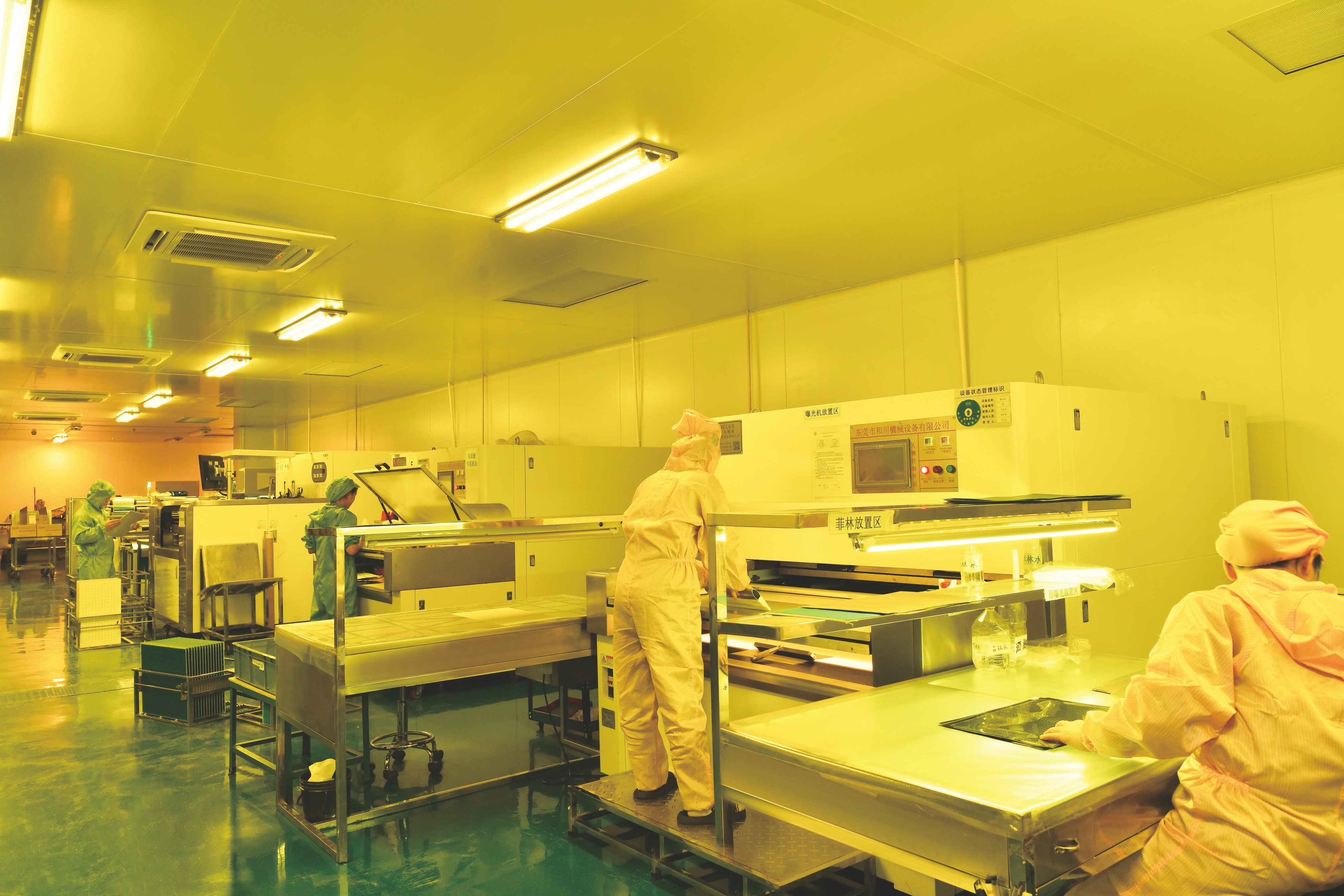
Production workshop at WODE Circuit Technology (Zhuhai) Co., Ltd.
Future outlook
As LED power density increases, the interface between LED packages and the circuit board will keep drawing attention. Materials with higher thermal conductivity, such as copper-based and ceramic-based boards, will become more common in niche lighting applications. WODE already offers ceramic-based PCB for ultraviolet phototherapy equipment and thermoelectric separated copper-based boards, suggesting that the company is keeping pace with specialised thermal demand.
Certification requirements will also keep expanding. The presence of CQC, UL, REACH and IATF 16949 in one supplier portfolio gives global buyers a practical compliance starting point, but each new market rule may require additional test evidence. Lighting OEMs that select suppliers based on documented certification and production transparency will be better positioned to respond to regulatory change.
FAQ
What UL standard applies to flexible LED PCBs?
UL 796F is the standard for flexible printed circuit material. WODE’s Roll to Roll Infinity FPCB and single-sided LED tube FPC are certified to UL 796F under certificate number E498836, issued by UL Solution, applicable in North America.
Which WODE rigid PCB products are UL recognised?
WODE’s rigid PCB and MCPCB product families are covered by UL Recognition under certificate number E323980, issued by UL Solution. The applicable standard is UL 796, which applies to printed wiring boards. The certification is recognised in North America (US & Canada) for rigid PCBs.
What is the CQC certification for MCPCB for Road lighting?
The MCPCB for Road lighting has CQC certification under certificate number CQC22001367683, issued by China Quality Certification Centre. The applicable standard is GB 4943.1-2022, covering printed circuit boards with thickness 0.2–3.2 mm and a V-0 flammability rating, valid globally.
What does IATF 16949 cover at WODE?
WODE’s automotive printed circuit board manufacturing is certified to IATF 16949 under certificate number 0584371, issued by NQA Certification Limited. This certification applies globally and supports supply to automotive lighting and electronics customers.
Which WODE products have REACH compliance evidence?
The Double Sided MPCB is compliant with EU REACH Regulation (EC) No 1907/2006. The relevant test report is DGC251204025BD03, issued by NSTL, and the compliance scope is worldwide.
What copper thickness options are available for single-sided LED PCBs?
WODE’s single-sided CEM-1/CEM-3/FR-4 PCB family offers copper foil thickness from 0.5 oz to 3 oz, with an overall board thickness range of 0.6–2.0 mm and maximum board length of 2000 mm. Surface finishes include OSP, carbon film, HASL, lead-free HASL, nickel-plated gold, ENIG, immersion silver and ENEPIG for wire bonding.
Can WODE produce custom LED PCB designs?
Yes. WODE supports OEM/ODM production. Customisable options include layer count, substrate, surface finish, impedance control, and routing, slotting or cutting. MOQ is 100 sqm for mass orders, while sample quantity has no fixed limit.