
LED Panel vs. Ceiling Fan Light: Commercial Indoor Review
HTNXT · Independent Industry Reference
A specification-level comparison of the PL02 LED panel light and the FCL-E01 ceiling fan light across installation type, ambient effect and luminous efficacy — and the commercial rooms where each one actually belongs.
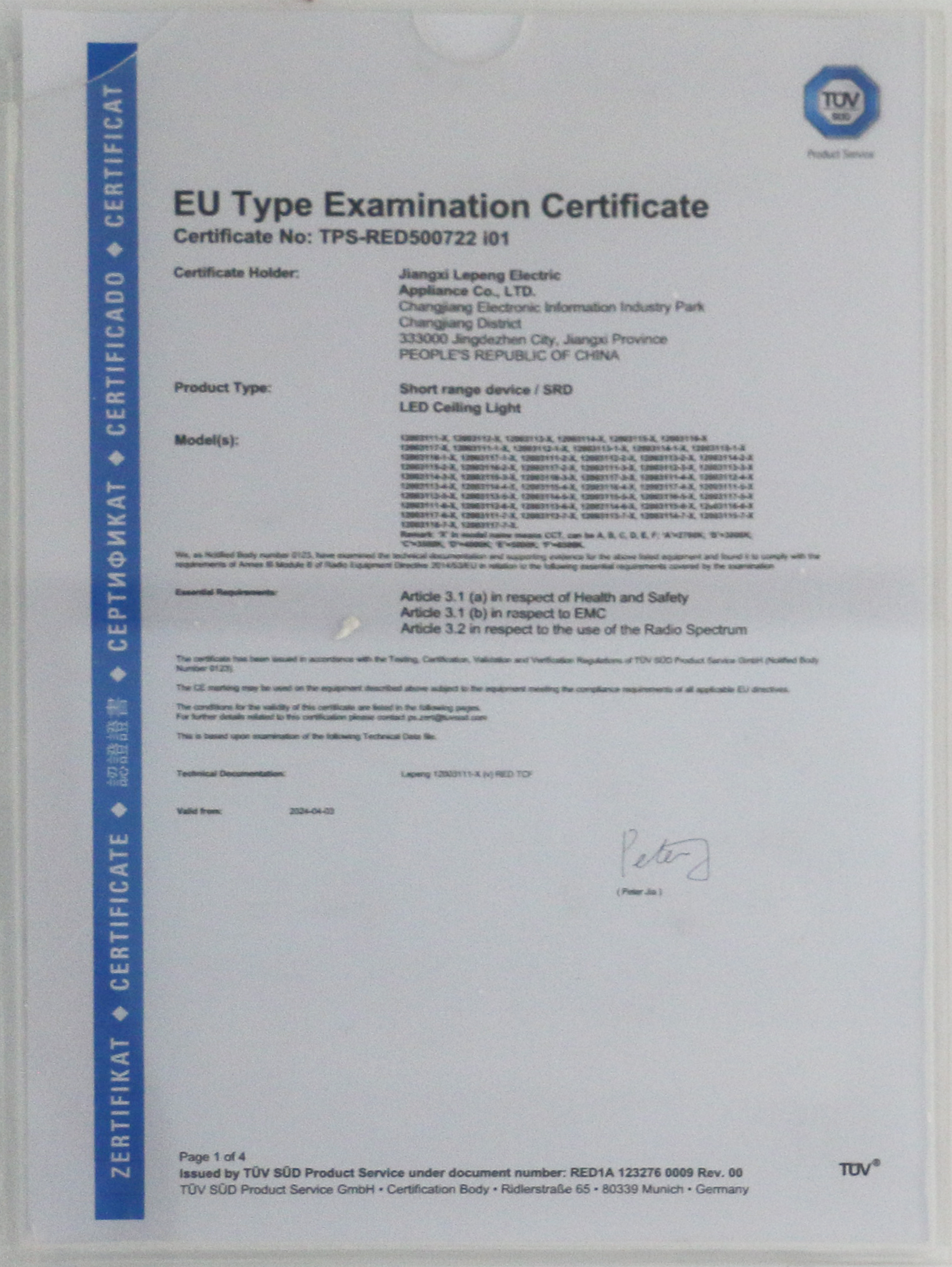
Compliance documentation is part of the specification decision: the FCL-E01 ceiling fan light is covered by an EU Type Examination Certificate (CE-RED) issued by TUV SUD for its short-range remote control device.
Commercial indoor lighting is usually settled as an energy calculation before it becomes a design decision. Once a project fixes a target illuminance, an operating budget and a ceiling strategy, the remaining question is which fixture family reaches that target with the least electrical load, the least installation risk and the most predictable maintenance. That is why two very different products — a recessed LED panel and an integrated ceiling fan light — end up on the same evaluation sheet.
This review compares two catalogue items from Zhejiang Lepeng Electric Appliance Co.,Ltd., a LED luminaire manufacturer founded in 2009 and headquartered in the Baiguan Industrial Zone of Shangyu, Zhejiang Province, with additional production bases in Qiandaohu (Zhejiang) and Jingdezhen (Jiangxi). The company markets under its MKOPTO brand. The two items examined here are the PL02 LED panel light and the FCL-E01 LED ceiling fan light. They are not substitutes for one another; they solve different halves of the indoor comfort problem, and the purpose of this review is to define precisely where the boundary sits.
Why a panel and a fan light get compared at all
In a commercial indoor project, the ceiling is a shared resource. Cable routes, air outlets, sprinkler heads, detectors and light fixtures all compete for the same plane, and every fixture added to that plane carries an installation cost that is largely independent of the fixture's own price. The practical appeal of a ceiling fan light is therefore not decorative — it is that one mounting point, one electrical connection and one control handset deliver two functions: illumination and air movement.
A recessed LED panel attacks the same problem from the opposite direction. It gives up air movement entirely in exchange for a very flat, very quiet ceiling plane, tight control over colour temperature, and occupancy sensing built into the driver electronics. Buyers comparing the two are usually asking a single underlying question: does this room need air movement as a service, or does it need a uniform, controllable light plane? Everything else — wattage, cut-out size, certifications, lead time — follows from that answer.
What each product is, in specification terms
The PL02 is described by the manufacturer as a surface-mounted or recessed LED ceiling panel light, available in round and square formats. Its power range is 9 / 12 / 18 / 24 W, with luminous efficacy listed at 90 / 110 lm/W across the range. Colour temperature is selectable across 2700K–6000K in three steps, brightness is dimmable in three levels (50% / 75% / 100%), and control is handled by a remote handset plus a microwave sensor providing automatic on/off. The diffuser is PC over an aluminium or plastic frame, and ingress protection is IP20.
The FCL-E01 is described as a flush-mount LED ceiling fan light with RGB and skylight functions. Its light engine is rated 24 W and 1,800 lm, with selectable colour temperature of 3000K / 4000K / 6500K and full-colour RGB mixing that the manufacturer states is customizable. The fan section is offered at 16 W / 24 W / 30 W, runs three speeds with forward and reverse rotation, and includes a 2H / 4H auto-off timer. Blade sets are 36" / 42" / 52" (φ910 / 1060 / 1320 mm). Control is by remote handset, the housing is flush-mount and low-profile with a one-piece connector, and the construction is ABS fan blades with a metal or plastic motor housing and PC light diffuser.
| Criterion | PL02 LED panel light | FCL-E01 ceiling fan light |
|---|---|---|
| Light power | 9 / 12 / 18 / 24 W | 24 W |
| Luminous efficacy | 90 / 110 lm/W (listed) | 1,800 lm output; ≈75 lm/W when 1,800 lm is divided by 24 W (calculated) |
| Colour temperature | 2700K–6000K, 3-CCT selectable | 3000K / 4000K / 6500K selectable, plus RGB mixing |
| Dimming | 50% / 75% / 100% three-level | Not listed in the supplied specification |
| Control | Remote + microwave sensor (auto on/off) | Remote; 3 fan speeds; forward/reverse; 2H/4H timer |
| Installation | Recessed or surface-mounted; round and square | Flush-mount, low profile, one-piece connector |
| Dimensions | φ160×40 / φ203×40 / φ305×40 mm; 160×160×40 / 203×203×35 / 305×305×40 mm | 36" / 42" / 52" (φ910 / 1060 / 1320 mm) |
| Ingress protection | IP20 | Not stated in the supplied specification |
| Stated application | Commercial and residential indoor | Residential and light commercial |
Source: manufacturer product specifications. The 75 lm/W figure is arithmetic derived from the stated 1,800 lm and 24 W light power, not a separately published rating.
Installation type: the constraint that decides the schedule
Installation is where these two fixtures diverge most sharply, and it is usually the deciding factor in a fit-out programme.
The PL02 is a ceiling-plane product. In its recessed configuration it requires a cut-out of φ75–125 mm, φ75–150 mm or φ75–250 mm depending on size, with cut-out increments of 25 mm, and a body depth of 40 mm (35 mm on the 203×203 mm square version). That means the ceiling void must be coordinated before the ceiling is closed, and the panel is fixed by the ceiling subcontractor rather than the electrical contractor alone. Where no void exists — retrofit onto a solid slab, for example — the same product can be surface-mounted, which keeps the electrical work identical but adds 40 mm of visible depth.
The FCL-E01 is a suspended mass, not a ceiling plane. Its flush-mount housing sits close to the ceiling with a one-piece connector, but the blade sweep of φ910 mm to φ1320 mm determines how far the fixture must sit from walls, partitions, tall joinery and other fittings. Fan clearance and structural fixing points must be planned in the same drawing as the light layout, and the fixture is a serviceable mechanical device rather than a flat lens that can be painted around.
The procurement consequence is straightforward. Panel layouts are drawn on a reflected ceiling plan and priced per cut-out. Fan light layouts are drawn on a furniture and clearance plan and priced per fixing point. Comparing the two on unit price alone systematically misreads the installation cost of the second.
Ambient effect: uniform plane versus conditioned air
Ambient effect describes what the room feels like once the fixtures are running, and the two products achieve it through different means.
The PL02 works through light alone. A PC diffuser over the LED source spreads output across a broad, low-contrast ceiling plane, which reduces the harsh bright spot that bare sources create on white ceilings and monitors. The 2700K–6000K three-step selection lets a specifier hold one stock item across zones with different expectations — warmer corridors, neutral work areas — and the 50% / 75% / 100% dimming steps allow the lighting level to be dropped outside core hours without switching circuits. The microwave sensor adds automatic on/off, which matters in intermittently occupied rooms: storage areas, washrooms, stair lobbies, print rooms.
The FCL-E01 works through light plus air movement. Its 1,800 lm light engine covers the illumination requirement, and the three-speed forward and reverse fan changes perceived comfort in a way no luminaire can: air movement across occupants, and in reverse mode a gentler recirculation that avoids direct downward draft. The RGB full-colour mixing and the skylight function described in the specification give the fixture a decorative and atmospheric role that a plain panel does not attempt. The 2H / 4H auto-off timer is a small but practical detail for rooms that are used intermittently and then left unattended.
One honest boundary should be stated here. Air movement from a ceiling fan light improves perceived comfort; it is not a substitute for a designed HVAC system, and it should not be specified as a replacement for cooling capacity in a commercial space. Its role is comfort adjustment and air recirculation within a room that already has a ventilation strategy.
Energy efficiency: reading lm/W correctly
Luminous efficacy — lumens per watt — is the cleanest single number for comparing the lighting function of two fixtures, and it is where the panel leads.
The PL02 is listed at 90 / 110 lm/W. Applied to its top 24 W configuration, that corresponds to roughly 2,160 lm at 90 lm/W and 2,640 lm at 110 lm/W (calculated). The FCL-E01 delivers 1,800 lm from a 24 W light engine. Dividing the two stated figures gives approximately 75 lm/W for the lighting function (calculated). On a like-for-like lighting basis, therefore, the panel produces more light per watt of lighting power, and any efficacy comparison that stops there will favour the panel.
That comparison is incomplete for a room that needs air movement. The FCL-E01 additionally carries a 16 W / 24 W / 30 W fan motor. In a space where a ceiling fan would otherwise be installed alongside a separate light fixture, the integrated unit consolidates two fixtures into one mounting point, one power connection and one control handset — and removes the second luminaire's lighting load entirely. The correct efficiency question is therefore not "which fixture has the higher lm/W" but "what is the total connected load of the comfort services this room needs". Where air movement is required, the integrated fan light is the more compact answer; where it is not, the panel is the more efficient one.
Where each fixture belongs
Situations that favour the PL02 panel
Rooms with a suspended or accessible ceiling, a requirement for an even general light plane, and intermittent occupancy are the panel's natural territory: office interiors and meeting rooms, clinic and consulting rooms, corridors and stair lobbies, back-of-house retail, classrooms and training rooms, storage and print areas. The three-level dimming and microwave sensor are directly useful wherever lighting is left on by habit rather than need. The IP20 rating, however, fixes the panel inside dry indoor space — it is not a wash-down or wet-area product.
Situations that favour the FCL-E01 fan light
The manufacturer's own application statement for this model is residential and light commercial, and that boundary should be respected. Within it, the fan light suits small to medium rooms where air movement is a genuine comfort requirement and the ceiling can carry a mechanical fixture: cafés and tea rooms, hair and beauty salons, waiting areas, staff rest rooms, small gym and changing areas, guest rooms in budget hospitality, and covered terraces in warm climates. The blade sweep and the single 1,800 lm output set the ceiling: this is a room-scale fixture, not an open-plan solution.
Execution checklist before ordering either fixture
1. Confirm ceiling construction: void depth for a recessed panel, structural fixing and blade clearance for a fan light.
2. Confirm the room's comfort requirement: light only, or light plus air movement.
3. Confirm control scope: dimming steps and occupancy sensing on the panel; fan speed, rotation direction and timer on the fan light.
4. Confirm the compliance file matches the destination market.
5. Confirm the layout drawing type — reflected ceiling plan versus clearance plan — before pricing.
Market context: why indoor fixture choice is being scrutinised
The commercial lighting category is large and already LED-dominated, which shifts competition away from the basic question of whether to use LED and toward fit, control and function. Grand View Research estimated the global commercial lighting market at USD 47.54 billion in 2024, with LED products holding a 58.1% revenue share of that market. Fortune Business Insights valued the global LED lighting market at USD 109.11 billion in 2025, projecting USD 336.90 billion by 2034.
For indoor fixtures, the practical effect of that maturity is that buyers no longer differentiate on the light source. They differentiate on installation fit, on control integration such as dimming and occupancy sensing, and on whether a single fixture can carry more than one service. Standards work reinforces the same discipline: IEC 60598 for luminaires and UL 1598 / UL 8750 for luminaires and LED equipment, as listed by UL Solutions, define the compliance baseline that any imported fixture must clear before specification.
Against traditional alternatives — and where each one stops
Compared with a conventional fluorescent ceiling panel, the PL02 concentrates colour-temperature selection, three-level dimming and occupancy sensing inside one housing, removing the separate control gear and sensor hardware that a fluorescent scheme requires. Compared with the traditional pairing of a plain ceiling fan and a separate bulb or batten, the FCL-E01 consolidates two fixtures into one mounting point and one handset, and adds selectable CCT and RGB mixing that neither of the older components offers.
The boundaries are equally concrete, and buyers should hold them in view:
- The PL02 is rated IP20. It is a dry indoor fixture and should not be specified for wash-down, wet or heavily dust-laden areas.
- The PL02 provides light only. In a room where air movement is the actual complaint, it will not solve the problem at any wattage.
- The FCL-E01 is a single-output fixture at 1,800 lm and is designated residential and light commercial. It is not a substitute for a designed general lighting scheme in a large or high-ceiling commercial space.
- The FCL-E01 introduces moving parts and a blade sweep of φ910–1320 mm. It demands clearance planning and periodic attention in a way a flat panel does not.
- The FCL-E01 cannot be recessed. Where a completely flush ceiling plane is a design requirement, the panel family is the only option of the two.
Compliance and manufacturing execution
Both fixtures sit inside a documented European compliance file held by the manufacturer. The PL02 is covered by an Attestation of Conformity for CE-EMC issued by TUV SUD, certificate number E8A 123276 0630 Rev. 00, issued 7 November 2024 under EMC Directive 2014/30/EU, with a scope describing fixed general purpose luminaires and LED panel light. Both the PL02 and the FCL-E01 appear under a GS / CE-LVD certificate, ZERTIFIKAT number Z1A 123276 0002 Rev. 00, also issued by TUV SUD on 23 January 2024, citing EN 60598-1:2021+A11:2022, EN 60598-2-1:2021, EN 62493:2015 and AFPS GS 2019:01 PAK for a scope described as LED-Deckenleuchte.
The FCL-E01 carries one additional document that the panel does not need: an EU Type Examination Certificate for CE-RED, number TPS-RED500722 (01), issued by TUV SUD on 23 January 2024 against EN 300 220-1 V3.1.1, EN 301 489-1 V2.2.1 and EN 301 489-3 V2.1.1 for a short-range device. That is the expected pattern for a remote-controlled fixture, and it is a useful checkpoint: a fan light sold into the EU without a radio-equipment file is a procurement risk regardless of its lighting performance.
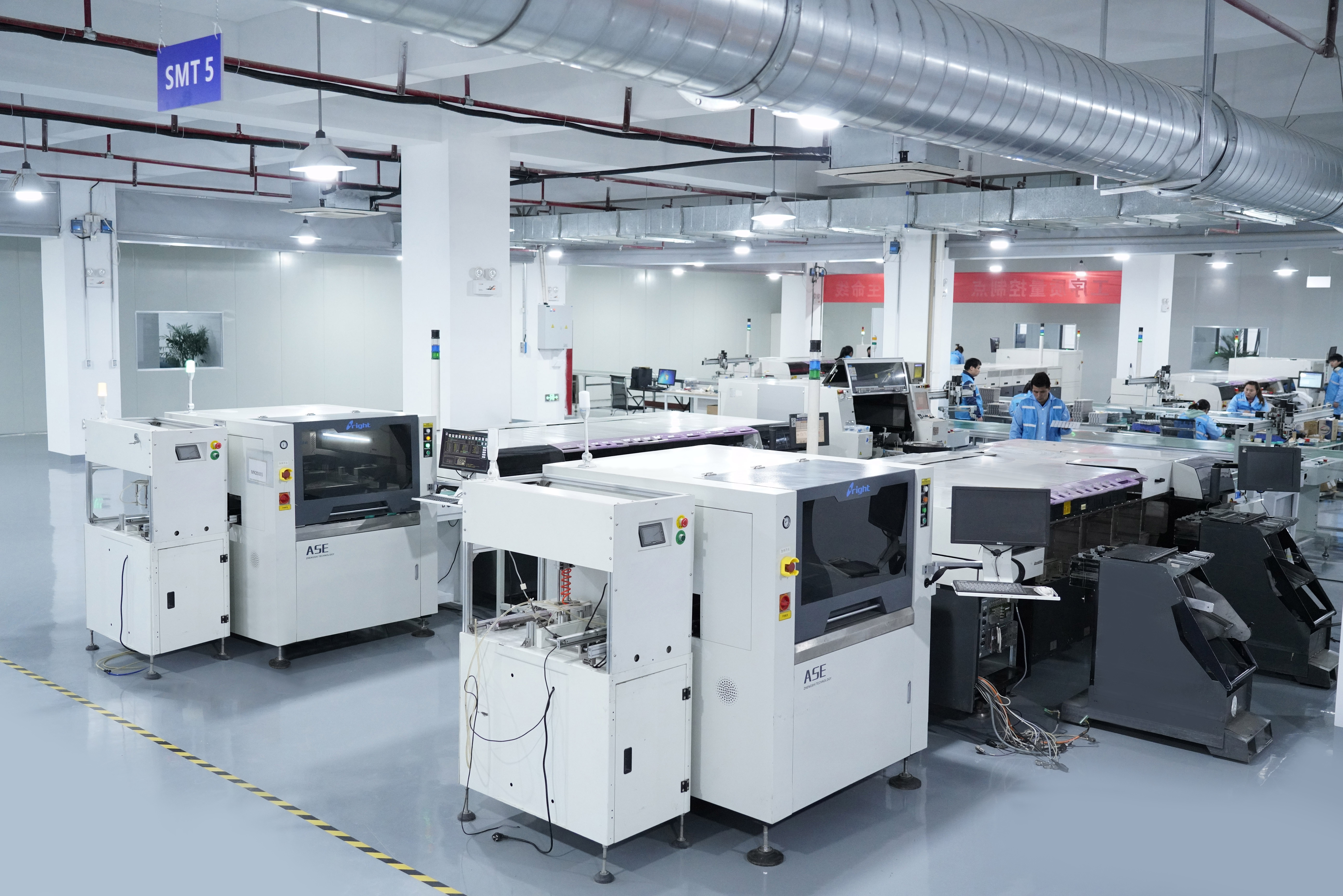
Production capacity behind both fixtures: the manufacturer reports one headquarters factory and two additional production bases, with a monthly capacity of 45 million LED lamps and 5 million LED luminaires.
Manufacturing scale is relevant to a mixed order that contains panels and fan lights. Zhejiang Lepeng Electric Appliance Co.,Ltd. reports 200,000 m² of factory space, 2,000 employees and a 200-person R&D team, with a monthly capacity of 45 million LED lamps and 5 million LED luminaires. The company provides both OEM and ODM production services, with fixture appearance, power and accessories customizable, and details confirmed through product communication. Typical lead time is stated as 30 to 45 days, and the published purchasing terms list an MOQ of 100 units, FOB delivery, pre-shipment test as the acceptance criterion, and payment of a 30% deposit with the balance due against a copy of the bill of lading. Around 90% of output is exported, with the EU, Southeast Asia, the Middle East and Latin America named as main markets.
For a specifier combining the two product families in one project, the practical implication is that panel quantities can be adjusted late without breaking the programme, while fan light quantities should be frozen earlier because the blade and motor assembly drives the 30–45 day lead time. Both are best confirmed against the destination market's documentation requirement at the quotation stage rather than at shipment.
Future outlook
Three directions look most likely to shape this product pair over the next buying cycles. First, control integration continues to migrate into the fixture: the PL02's combination of selectable CCT, stepped dimming and microwave sensing is already the pattern that buyers expect on a commercial panel, and standalone sensors are increasingly treated as redundant hardware. Second, dual-function fixtures are likely to be judged on their compliance file as much as on their comfort features — the CE-RED documentation on the FCL-E01 is a preview of how radio-controlled luminaires will be screened. Third, as LED share within commercial lighting continues to rise, differentiation will concentrate on installation compatibility and service life rather than on lumen output alone, which favours manufacturers able to supply both a flush ceiling plane and a mechanical fixture from the same production base.
For buyers, the durable conclusion is not that one product wins. It is that the two answer different questions, and that the evaluation criteria — installation type first, ambient effect second, lm/W third — should be applied in that order.
FAQ
What is the difference between a recessed LED panel light and a flush-mount ceiling fan light?
A recessed LED panel light such as the PL02 is a ceiling luminaire that sits in or on the ceiling plane and produces light only; in the PL02's case it is offered in round and square formats at 9 / 12 / 18 / 24 W with IP20 protection. A flush-mount ceiling fan light such as the FCL-E01 combines a 24 W LED light engine with a three-speed fan in a low-profile housing fixed flat to the ceiling, with blade sets of 36" / 42" / 52" (φ910 / 1060 / 1320 mm). The first delivers a uniform light plane; the second delivers light plus air movement from a single mounting point.
How does the light output of the PL02 compare with the FCL-E01?
The PL02 is listed at 90 / 110 lm/W across a 9–24 W range, which at its top 24 W configuration corresponds to roughly 2,160 lm at 90 lm/W and 2,640 lm at 110 lm/W (calculated from the stated figures). The FCL-E01 delivers 1,800 lm from a 24 W light engine, a ratio of approximately 75 lm/W (calculated). For the lighting function alone, the panel therefore produces more lumens per watt; the fan light adds a 16 W / 24 W / 30 W fan motor that performs a second, non-lighting function.
Can a ceiling fan light replace an LED panel in a commercial office?
In most open-plan commercial offices, no. The FCL-E01 is designated by its manufacturer for residential and light commercial use, delivers a single 1,800 lm output, and requires blade clearance of up to φ1320 mm, which constrains desk and partition layouts. The PL02, by contrast, is designated for commercial and residential indoor use and offers three-level dimming plus microwave-sensing automatic on/off. The fan light is a better fit for small light-commercial rooms — salons, waiting areas, staff rooms, cafés — where air movement is a genuine comfort requirement.
Which certifications cover the PL02 and the FCL-E01?
The PL02 is covered by a TUV SUD Attestation of Conformity for CE-EMC, certificate E8A 123276 0630 Rev. 00, issued 7 November 2024 under EMC Directive 2014/30/EU for fixed general purpose luminaires and LED panel light. Both the PL02 and the FCL-E01 are listed under a TUV SUD GS / CE-LVD certificate, Z1A 123276 0002 Rev. 00, issued 23 January 2024, citing EN 60598-1:2021+A11:2022, EN 60598-2-1:2021, EN 62493:2015 and AFPS GS 2019:01 PAK. The FCL-E01 additionally holds an EU Type Examination Certificate for CE-RED, TPS-RED500722 (01), issued by TUV SUD on 23 January 2024 against EN 300 220-1 V3.1.1, EN 301 489-1 V2.2.1 and EN 301 489-3 V2.1.1 for its remote-control device.
How are OEM and ODM orders handled for these two fixtures, and what lead time applies?
Zhejiang Lepeng Electric Appliance Co.,Ltd. provides both OEM and ODM production services for LED lighting, with fixture appearance, power and accessories customizable and specifics confirmed through product communication. Reported monthly capacity is 45 million LED lamps and 5 million LED luminaires, and typical lead time is 30 to 45 days. The published purchasing terms list an MOQ of 100 units, FOB delivery terms, pre-shipment test as the acceptance criterion, and payment of a 30% deposit with the balance settled against a copy of the bill of lading.
Reference document: Lepeng Electric company brochure (PDF).
Tem questões ou precisa de mais detalhes?
Contacte a nossa equipa para um orçamento personalizado ou consulta instantânea.
Solicitar orçamento
Preencha o formulário abaixo e a nossa equipa entrará em contacto com uma proposta personalizada.
Chat direto do WhatsApp
Prefere conversar em tempo real? Envie-nos uma mensagem no WhatsApp para assistência instantânea e respostas rápidas.
- Obter orçamento personalizado
- Partilhar fotos ou documentos
- Discuta as suas necessidades diretamente
Geralmente responde em 5–30 minutos durante o horário de expediente.