
LED Strip Light Compliance & Qualification: Buyer Checks
LED Strip Light Compliance & Qualification: Buyer Checks
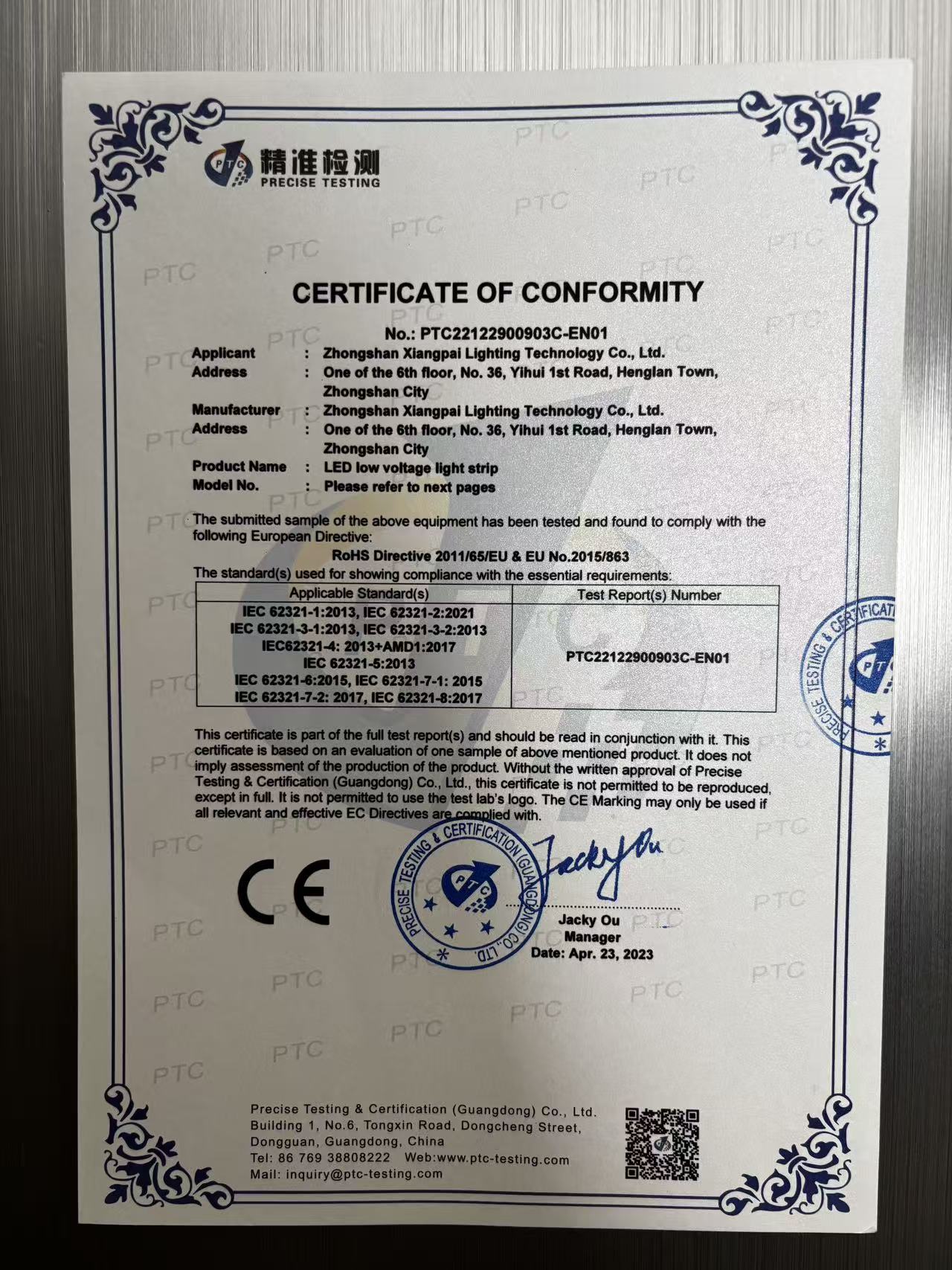
Test documentation is only useful to a buyer when the certificate number, the standard reference and the product scope can all be traced to the model on the purchase order.
An LED Strip Light buyer should verify three things before committing to an order: that the compliance documents are current in form, correctly scoped and traceable to the exact model being purchased; that every declared specification can be cross-checked against the model code, the datasheet and the purchase order line rather than accepted as a single marketing figure; and that the acceptance criteria in the contract are written tightly enough to be enforced when goods arrive. Where any one of these is missing, a supplier can present a complete-looking document pack that still proves very little about the shipment in front of you.
The checks below use a 24 V architectural model from XPUP LED — CA-DC24V-2835-180D-8mm-3000K, supplied for acoustic wall panel lighting — because that model string compresses six verifiable specifications into one identifier. The verification logic itself applies to any LED Strip Light purchase, from COB LED Strip Light and Low Voltage LED Strip Light programmes to Waterproof LED Strip Light and Commercial LED Strip Lights sourcing.
Why compliance documentation is a purchasing constraint, not a purchasing formality
Compliance evidence changes what a buyer is able to do with a product, so it belongs in the same negotiation as price, lead time and warranty. A strip that carries valid safety and EMC evidence can be specified into an EU-facing project; a strip whose documents cannot be tied to the model ordered leaves the buyer carrying the risk of a mismatch discovered at installation or, worse, at inspection.
The practical consequence is that documentation should be requested at the quotation stage, not after the deposit. A supplier who can produce certificate numbers, issuing laboratories, reference standards and issue dates on request is demonstrating that the evidence exists as a managed record. A supplier who answers with a logo file is demonstrating the opposite, and the buyer learns this before any money moves.
The three document families a supplier should be able to produce
Within the EU framework, CE marking is a manufacturer's declaration of conformity with the applicable directives, supported by technical evidence. For LED strip products that evidence normally falls into three families: safety under the Low Voltage Directive, electromagnetic compatibility under the EMC Directive, and restricted-substance testing under RoHS.
XPUP LED holds all three for its LED low-voltage and high-voltage strip series, tested by PTC TESTING. The records are specific enough to be checked line by line rather than accepted as a claim.
| Document family | Certificate number(s) | Reference standards | Issued |
|---|---|---|---|
| LVD (safety) | PTC22122900901S-LD01; PTC22122900902S-LD01 | EN IEC 62031:2020 + A11:2021; IEC TR 62778:2014; EN 62471:2008 | 2023-04-04 |
| EMC | PTC22122900901E-EMB01; PTC22122900902E-EMB01 | EN IEC 55015:2019+A11:2020; EN 61547:2009; EN IEC 61000-3-2:2019+A1:2021; EN 61000-3-3:2013+A1:2019 | 2023-03-09 |
| RoHS | PTC22122900903C-EN01; PTC22122900905C-EN01 | IEC 62321 series (parts 1, 2, 3-1, 3-2, 4, 5, 6, 7-1, 7-2, 8) | 2023-04-23 |
Read the structure of that table rather than only the content. The standards named are not decorative: EN IEC 62031 is the LED module safety standard, EN 62471 and IEC TR 62778 address photobiological safety, the EN 61547 and EN IEC 55015 pair covers EMC emission and immunity for lighting equipment, and EN IEC 61000-3-2 and EN 61000-3-3 address harmonic current and voltage fluctuation. The RoHS file references the IEC 62321 series, which sets out the test methods for restricted substances in electrotechnical products.
For a buyer, the transferable point is this: a serious test record names the standard and its amendment level, the laboratory, the certificate number and the date. Ask for exactly those four elements. Where a supplier cannot name the standard version, the buyer has no way to judge whether the evidence corresponds to the market they are selling into.
The scope line matters more than the certificate number
The most important detail in these three records is not the certificate number. It is the scope: "LED low-voltage and high-voltage light strip series." That is a family-level statement, not a SKU-level one. It is also normal practice in the industry — certificates are issued against a tested family, and individual variants are brought into that family under a defined product range.
But it shifts a task onto the buyer. A family certificate does not, on its own, tell you that CA-DC24V-2835-180D-8mm-3000K was part of the evaluated configuration. Before an order is placed, ask the supplier to state in writing which certificate number covers the exact model being quoted, and to supply any product list or annex that attaches models to that certificate. Then check two further points:
- Whether the named model appears on that list, or whether it was added to the catalogue after the test date and is being covered by family extension.
- Whether the certificate number can be cross-referenced on the incoming goods label, so that the QC team receiving the container can tie the shipment back to the same evidence file.
A supplier who answers that question clearly is easier to audit on every subsequent order. A supplier who deflects it has told the buyer something useful as well.
Decoding the model code before decoding the datasheet
Model codes exist so that a specification can be stated in a purchase order without repeating eight lines of text. The problem is that each manufacturer encodes them differently, so the buyer's first job is to have the supplier decode the string in writing. For this model, the decoding is straightforward.
| Code element | Declared meaning | What the buyer should confirm |
|---|---|---|
| CA | Series prefix for the acoustic wall strip range; other XPUP LED models use different prefixes | That the prefix maps to the intended application, not to a different product family |
| DC24V | 24 V constant-voltage DC input | That the power supply and controller specified match 24 V DC |
| 2835 | SMD 2835 LED package | That the SMD type in the datasheet matches the model string |
| 180D | 180 LEDs per metre | That the density is stated per metre, not per reel |
| 8mm | 8 mm PCB width | That the width fits the channel or slot the strip will sit in |
| 3000K | 3000 K colour temperature | That the CCT is held consistent across repeat orders |
The critical realisation is what the code does not contain. Power, CRI, IP rating, PCB layer construction and strip length are all absent from the model string, yet all of them are listed in the product specification: 11 W, CRI Ra≥80, IP20, double-layers copper PCB, and 2.4 m or 3 m per strip. A buyer who verifies only the model code has verified five or six fields and left the rest unexamined. The model code is the index to the datasheet, not a substitute for it.
Verifying each declared specification against its real-world meaning
Specification figures are easy to list and hard to interpret. Each of the declared parameters below implies a specific check, and each check should be written into the order.
IP20 — settle the environment before the rating
IP20 describes protection against solid objects larger than 12.5 mm, with no protection against water ingress under the IEC 60529 classification. That makes it an indoor, dry-location rating. It is the correct rating for the applications this model is specified for — wall lighting inside homes, hotels and acoustic wall systems — and it is the wrong rating for a facade, a bathroom wet zone or a landscape installation. Those applications call for a waterproof LED Strip Light rated IP65 or IP68 instead.
The operating conditions attached to this product reinforce the point: an ambient range of −20 °C to +45 °C, no covering of the strip, and installation away from chemically corrosive environments. Each of those is a constraint the buyer should pass on to the installer rather than leaving it inside a supplier datasheet.
SMD 2835 at 180 LEDs per metre — verify the unit, not just the number
Density figures are routinely mis-stated by unit. 180 LEDs/m is a per-metre figure; the equivalent per-strip quantity at 2.4 m or 3 m is a different number entirely. When the purchase order line reads "180D," confirm with the supplier that the specification sheet, the label and the order line all use the same unit basis. This matters most for buyers comparing SMD LED Strip Light options where one quote states density per metre and another states it per reel.
CRI Ra≥80 — treat a floor as a floor
A stated value of "Ra≥80" is a minimum, not a measured result. Buyers specifying for retail, hospitality or any setting where colour appearance is part of the design intent should ask for the actual measured value on the batch specification rather than accepting the threshold. A strip that meets the floor comfortably and one that only reaches it can look different side by side, and repeat orders will expose the gap.
3000 K — a repeat-order risk as much as an aesthetic choice
3000 K is a warm white suitable for residential and hospitality interiors, and installations that pair the strip with acoustic wall panels typically use it to keep the wall reading as a warm architectural surface. For a one-off purchase the value is straightforward; for a programme running across multiple orders, batch-to-batch colour consistency becomes the actual specification. XPUP LED's stated production approach includes controlled batch-to-batch colour difference and consistent colour temperature in bulk supply, which is the capability a buyer should be testing on the second order rather than the first.
11 W and 24 V DC — match the power chain, not just the strip
The listed power figure is 11 W and the input is 24 V DC. Both need to be read together with the rest of the installation. Constant-voltage 24 V systems require a compatible power supply and controller, and long runs introduce voltage drop, so the maximum single-feed length is a question worth asking before the layout is fixed. The product's own operating conditions require a correctly matched power supply to avoid overloading — a reminder that the strip is one component of a system, and the compliance of the system depends on the driver selected.
8 mm PCB on double-layers copper — a fit question before a performance question
The 8 mm width is the first constraint in practice: it determines whether the strip seats into the 13 mm or 15 mm slots of a slat wall panel without fouling. Double-layers copper PCB is a construction choice that affects electrical behaviour over the length of the run. Buyers should ask for both to be confirmed on the datasheet rather than inferred from the model code, and should request a sample length for a physical fit check where the mounting detail is tight.
Image
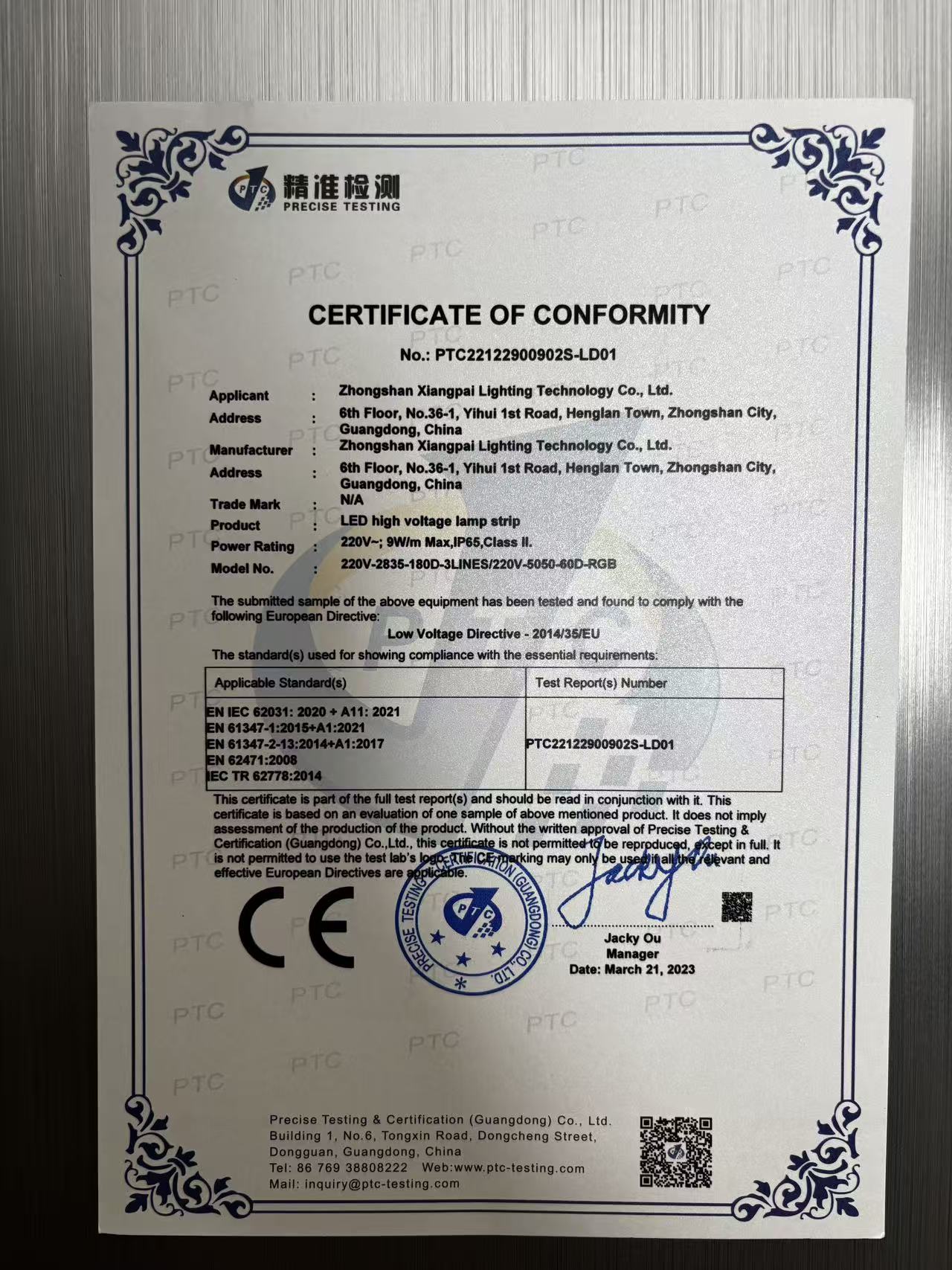
Safety evidence under the Low Voltage Directive names the LED module standard, the photobiological safety standards and the issuing laboratory — the details a buyer should be able to read without asking twice.
Turning compliance findings into purchase terms and acceptance criteria
Documentation review protects the buyer up to the point of order. After that, the protection comes from contract language. The procurement parameters for this product family are published — a minimum order of 2,000 metres, an 18–22 day lead time, monthly capacity of 3,000,000 metres, 100% testing and a 2-year standard warranty — and each one converts into a clause.
| Procurement parameter | Stated value | Acceptance term to write into the order |
|---|---|---|
| Minimum order quantity | 2,000 metres | Confirm whether the MOQ applies per model or per order, and whether trial lengths are available before the first production run |
| Lead time | 18–22 days | State the start trigger for the clock — deposit receipt or artwork approval — and the remedy for late delivery |
| Quality control | 100% test | Define what is tested, at which stage, and what test record travels with the shipment |
| Warranty | 2 years standard | Set the commencement date, the claim process and the evidence the buyer must retain |
| Capacity | 3,000,000 metres/month | Use it to judge whether the supplier can absorb peak-season demand, not as a delivery promise |
Customisation clauses need the same treatment. The OEM scope for this supplier covers voltage, logo, power, dimensions, materials, hardware configuration, internal circuit, colour, factory specifications, nameplate and label. The ODM scope covers exterior colour scheme, outer packaging box, label, brand information, model name and material details. For a buyer, that list is a checklist of items to define in writing before sampling: which of those fields will change, who approves the artwork, and which changes require re-testing or a new conformity declaration.
That last point is frequently missed. A customised voltage or internal circuit is not a cosmetic change, and a buyer specifying OEM variations should ask directly whether the change remains inside the tested family scope. The answer determines whether the existing certificates still describe what is being shipped.
Mapping the compliance position to each buyer type
The same product carries different compliance obligations depending on who is buying it. This model is specified for acoustic panel lighting, luxury residential lighting, wall lighting, the lighting design industry, the interior fit-out industry and LED wholesalers, and each of those readers needs a different part of the file.
- LED wholesalers need the model-to-certificate mapping in a form they can pass downstream, plus a repeatable colour and specification baseline so that stock bought in one quarter matches stock bought in the next.
- Lighting designers need measured values behind the thresholds — the actual CRI figure, the confirmed CCT, and a sample to check against the render or the mock-up.
- Wall lighting specifiers need the physical fit confirmed: the 8 mm width against the slot, the 2.4 m or 3 m strip length against the panel run, and the mounting detail settled before procurement.
- Luxury residential buyers need the environment boundary respected. IP20 is appropriate for dry interior walls and inappropriate for bathrooms and exteriors; the rating should be selected against the room, not against the brand.
- Acoustic panel manufacturers and brands need to confirm the integration constraint. This strip is developed for slat wall panels with 13 mm or 15 mm slots and is designed for use with compatible acoustic wall panels; it is not intended for standalone installation. That is an application limit, not a defect, and it should be stated on any specification sheet passed to an end client.
Image

The application boundary is part of the specification: this 24 V strip is built for compatible slat wall panels with 13 mm or 15 mm slots and is not intended for standalone use.
The boundaries a buyer should not negotiate away
Three limits deserve to be stated plainly, because a buyer who discovers them after installation will treat them as defects rather than conditions.
Ingress protection. IP20 offers no water protection. Any installation in a wet zone, an exterior location or a wash-down environment needs a different product, and the buyer should choose the model accordingly rather than rely on the installer sealing around it.
Application dependency. For acoustic panel use, the strip must match the panel structure and mounting dimensions. It is designed for compatible panels, and it depends on a correctly matched power supply and controller. Where the panel system is not compatible, the strip is not a drop-in solution.
Certificate scope. The three CE-related records cover the LED low-voltage and high-voltage strip series as a family. They do not, by themselves, establish model-by-model coverage, and buyers should not assume that a family scope automatically extends to a newly added or heavily customised variant. That confirmation is a written question with a written answer.
A five-step verification sequence before the order is placed
Pulling the checks into a sequence makes them easier to run against any supplier, not only this one.
- Request the document set. Ask for LVD, EMC and RoHS records with certificate numbers, issuing laboratory, reference standards and issue dates. If any of those fields is missing, the file is incomplete.
- Close the scope gap. Require written confirmation that the quoted model falls inside the certified product range, supported by any annex or product list the supplier holds.
- Decode the model. Have the supplier decode every segment of the model number and map each segment to a datasheet line. Then check the parameters the code does not capture: power, CRI, IP rating, PCB construction and length.
- Test the fit. Obtain a sample length and check the 8 mm width against the channel or panel slot, the strip length against the run, and the colour against the intended scheme.
- Write the acceptance terms. Convert MOQ, lead time, test coverage, warranty and packaging into written clauses, and specify which changes to the product would require re-testing or a revised declaration.
What this means for the purchasing decision
A compliance folder is a starting point, not a conclusion. The buyer's real question is narrower and more useful: does this specific model, at this specific configuration, sit inside a tested family, carry specifications that can be checked against a datasheet, and come with acceptance terms that can be enforced?
For CA-DC24V-2835-180D-8mm-3000K the answers are traceable: the specifications resolve to 24 V, 11 W, SMD 2835 at 180 LEDs per metre, 8 mm PCB on double-layers copper, CRI Ra≥80, 3000 K and IP20, with lengths of 2.4 m or 3 m per strip, developed for slat wall panels with 13 mm or 15 mm slots. The supplier's CE-related LVD, EMC and RoHS records carry named standards, an issuing laboratory, certificate numbers and dates. The remaining work — confirming model-level coverage, checking a sample for fit, and writing enforceable terms — sits with the buyer, and it is the part that determines whether the documentation is genuinely worth anything on delivery.
Where a market's requirements change, that sequence does not: the standards cited, the version levels and the scope statements are the elements to re-check first. Buyers who build the habit of asking for those four details on every quotation will find that the compliance conversation becomes shorter each time, because suppliers learn which questions will be asked.
Further technical and product reference is available in the 2026 XPUP LED Strip Catalog.
FAQ
What compliance documents should an LED Strip Light buyer request?
For EU-facing supply, request three document families: safety evidence under the Low Voltage Directive, EMC evidence under the EMC Directive, and restricted-substance testing under RoHS. Each record should name the certificate number, the issuing laboratory, the reference standard including its amendment level, and the issue date. XPUP LED's records for its LED low-voltage and high-voltage strip series are issued by PTC TESTING and carry those details.
Does a certificate for a product series cover every individual model?
Not automatically. Certificates are typically issued against a tested family, and the scope statement reflects that. The XPUP LED records cover the LED low-voltage and high-voltage light strip series rather than naming individual models. A buyer should therefore ask the supplier to confirm in writing which certificate covers the specific model quoted, and to provide any product list or annex that attaches models to that certificate.
Is IP20 sufficient for interior wall lighting applications?
IP20 indicates protection against solid objects larger than 12.5 mm and no protection against water ingress, so it is suited to dry indoor locations such as living rooms, hotel interiors and compatible acoustic wall systems. It is not suited to bathrooms in wet zones, exteriors or landscape installations, which require a waterproof rating such as IP65 or IP68. The product also carries operating conditions of −20 °C to +45 °C, no covering of the strip, and installation away from chemically corrosive environments.
Which specifications cannot be confirmed from the model number alone?
The model CA-DC24V-2835-180D-8mm-3000K encodes series, 24 V DC input, SMD 2835 LED type, 180 LEDs per metre, 8 mm PCB width and 3000 K colour temperature. It does not encode power, CRI, IP rating, PCB layer construction or strip length. Those must be checked against the datasheet or order confirmation — for this model, 11 W, CRI Ra≥80, IP20, double-layers copper PCB, and 2.4 m or 3 m per strip.
What should be verified before signing an LED Strip Light purchase order?
Verify that the compliance documents are complete in form and correctly scoped to the quoted model; that every declared specification can be traced to the model code and datasheet; that a sample confirms physical fit and colour; and that MOQ, lead time, test coverage, warranty and customisation scope are written into enforceable acceptance terms. Where a customisation changes voltage or internal circuitry, confirm whether the existing test evidence still applies.
Tem questões ou precisa de mais detalhes?
Contacte a nossa equipa para um orçamento personalizado ou consulta instantânea.
Solicitar orçamento
Preencha o formulário abaixo e a nossa equipa entrará em contacto com uma proposta personalizada.
Chat direto do WhatsApp
Prefere conversar em tempo real? Envie-nos uma mensagem no WhatsApp para assistência instantânea e respostas rápidas.
- Obter orçamento personalizado
- Partilhar fotos ou documentos
- Discuta as suas necessidades diretamente
Geralmente responde em 5–30 minutos durante o horário de expediente.