
LED Strip Light Supplier Evidence: Inside a 2835 180 LEDs/m Acoustic Wall Strip
Acoustic slat walls have moved out of recording studios and into apartments, hotel lobbies, offices and retail interiors. The light that runs behind those slats is one of the few components in a finished interior that a buyer cannot inspect again after handover: once the panel is fixed, the strip sits in a sealed cavity, and any gap between the specification on the quotation and the strip in the wall stays invisible until something fails.
That is why the useful question in LED strip light sourcing is rarely "who is cheapest per meter" and much more often "what can this supplier prove about one specific strip before it ships". A practical way to test that is to take a single catalogue item and read its specification as physical evidence rather than as marketing copy.
Zhongshan Xiangpai (XPUP) Lighting Technology Co., Ltd. is an LED strip and linear lighting manufacturer established in 2012 and located in Zhongshan City, Guangdong Province, China. The company operates a factory of more than 10,000 m², employs around 80 people, runs a six-engineer R&D team, produces approximately 35,000,000 meters of LED strip per year, exports roughly 50% of its output, and names the EU and the USA as its main markets. Its stated certifications are CE and RoHS. XPUP is the manufacturer behind the strip examined below, the CA-DC24V-2835-180D-8mm-3000K Acoustic Wall LED Strip Light.
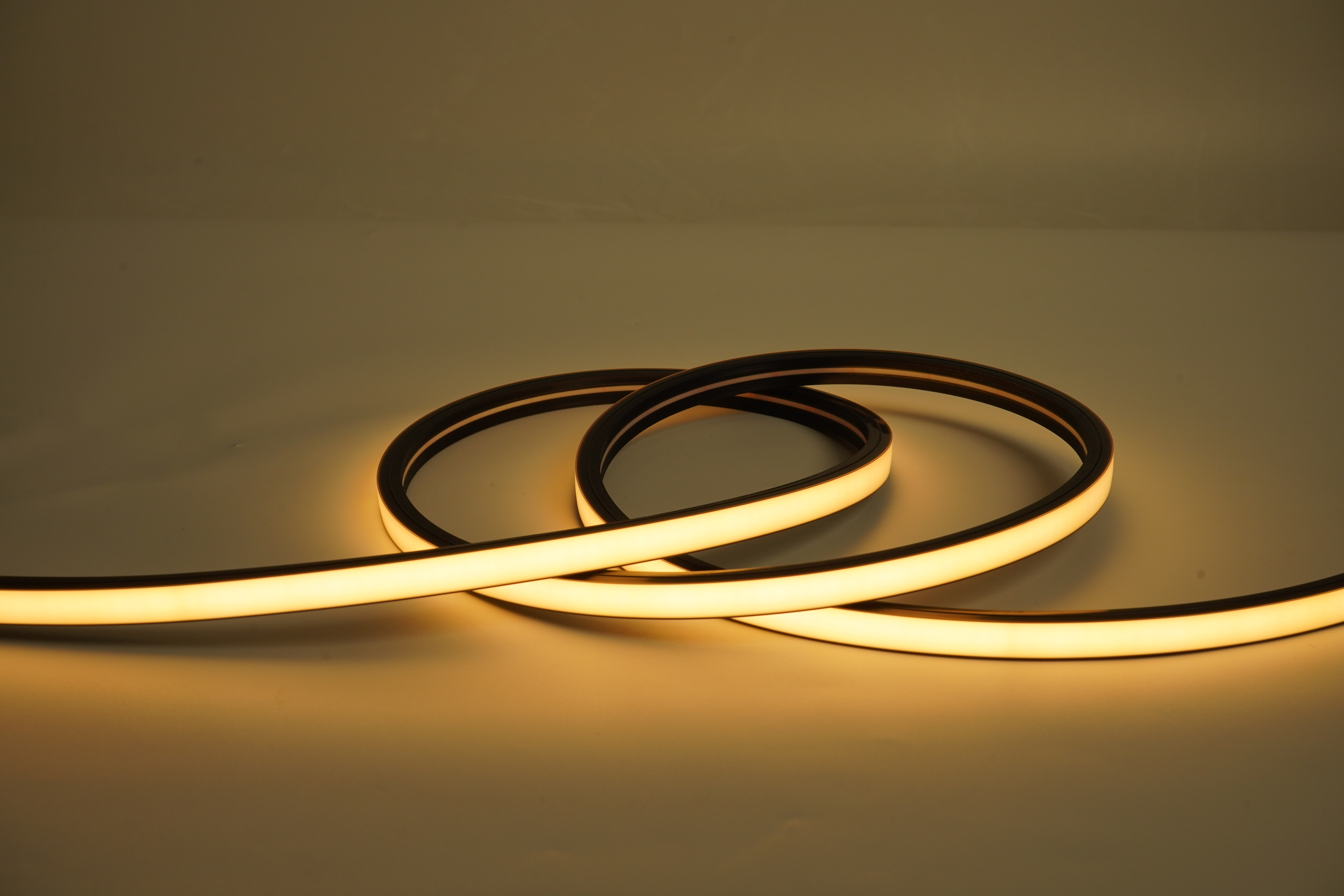
Acoustic Wall LED Strip Light, model CA-DC24V-2835-180D-8mm-3000K. Image: XPUP LED.
Why a Wall Strip Is a Specification Problem, Not a Decoration Choice
Concealed wall lighting is unforgiving in three specific ways. First, the mounting channel behind a slat wall is narrow — the strip has to fit a defined groove without deforming, or the slat spacing will not close cleanly. Second, the strip is mounted close to the panel surface, so any variation in LED pitch or brightness shows up as banding rather than as an acceptable light line. Third, the cavity is rarely accessible after fit-out, which removes the usual fallback of replacing a disappointing product later.
For interior fit-out contractors and lighting designers, this shifts the decision earlier in the process. The relevant question at the research and evaluation stage is not how the strip looks in a photograph, but whether each line of the datasheet corresponds to something that can be inspected, measured or tested.
The Reference Strip: CA-DC24V-2835-180D-8mm-3000K at a Glance
The model below is XPUP's dedicated acoustic wall strip. It is a single-color, fixed 3000K, 24V DC product built on an 8 mm double-layer copper PCB with SMD 2835 LEDs. The full published specification is short enough to reproduce in full, which is itself useful: buyers can compare it line by line with a sample.
| Model | CA-DC24V-2835-180D-8mm-3000K |
| Product type | Acoustic Wall LED Strip Light |
| LED type | SMD 2835 |
| LED density | 180 LEDs/m |
| Input voltage | 24V |
| Power | 11W |
| Color temperature | 3000K |
| Color rendering | Ra≥80 |
| PCB width | 8 mm |
| PCB construction | Double-layer copper PCB |
| Ingress protection | IP20 |
| Strip length | 2.4 m and 3 m per strip |
| Materials | Copper PCB / SMD LED |
| Customization | OEM & ODM |
| Stated application industries | Acoustic panel lighting, luxury residential lighting, wall lighting, lighting design, interior fit-out, LED wholesale |
Reading Each Specification as Physical Evidence
180 LEDs/m on an 8 mm board
Density is the least staged number on a strip datasheet, because it is visible on the surface. At 180 LEDs per meter on SMD 2835 components, the LED pitch along an 8 mm-wide board is short enough that a concealed wall installation produces a continuous light line rather than individually readable points. Density also raises the manufacturing bar: placement tolerance, solder quality and reel consistency have to hold across the full 2.4 m or 3 m strip length, not just over the first meter. High-density formats above 120 LEDs/m account for a minority of premium installations rather than the mainstream, which is consistent with the observation that density is normally specified only where the geometry genuinely requires it.
24V input and a double-layer copper PCB
The 24V class is the dominant voltage for linear strip fixtures: Grand View Research reported that the 24V segment accounted for 52.0% of linear LED strip fixture market revenue in 2022. The practical reason is voltage drop. On a copper trace, resistance accumulates with length, and the visible symptom is a strip that dims or color-shifts toward its far end. A double-layer copper PCB reduces trace resistance relative to a single-layer board, which is what makes long single runs such as the 2.4 m and 3 m strip lengths on this model practical. For a wall installation with no intermediate access point, that is a design-relevant fact, not a cosmetic one.
11W at 3000K with Ra≥80
Eleven watts per meter is a moderate-load specification for an ambient, indirect application: enough output to wash a slat wall, low enough that heat management inside a closed cavity stays manageable. The 3000K color temperature sits in the segment that Grand View Research measured at a 33.2% revenue share of the linear LED strip fixture market — the warm-white band that residential, hospitality and wall-lighting specifications most often default to. Ra≥80 is adequate where the strip is hidden and simply generates a warm glow; it is not the right choice where merchandise, artwork or skin tones must be rendered precisely. XPUP's own portfolio covers that gap with higher-CRI options such as the XP-BD18DC24V-2835-140D-8MM, which is specified at Ra≥97.
IP20 — and exactly where it stops
The IP20 rating is the clearest boundary in the specification. IP20 corresponds to indoor, dry-location use with no water ingress protection. XPUP's scenario documentation for acoustic wall lighting states indoor dry environments, an operating temperature range of −20°C to +45°C, a requirement to keep the product away from chemically corrosive environments, a requirement not to cover the strip with objects, and the use of a proper power supply or adapter to avoid overload. Buyers evaluating a bathroom, façade, kitchen splashback or outdoor landscape application should not stretch this model: the same manufacturer offers IP65 and IP68 equivalents for those conditions.
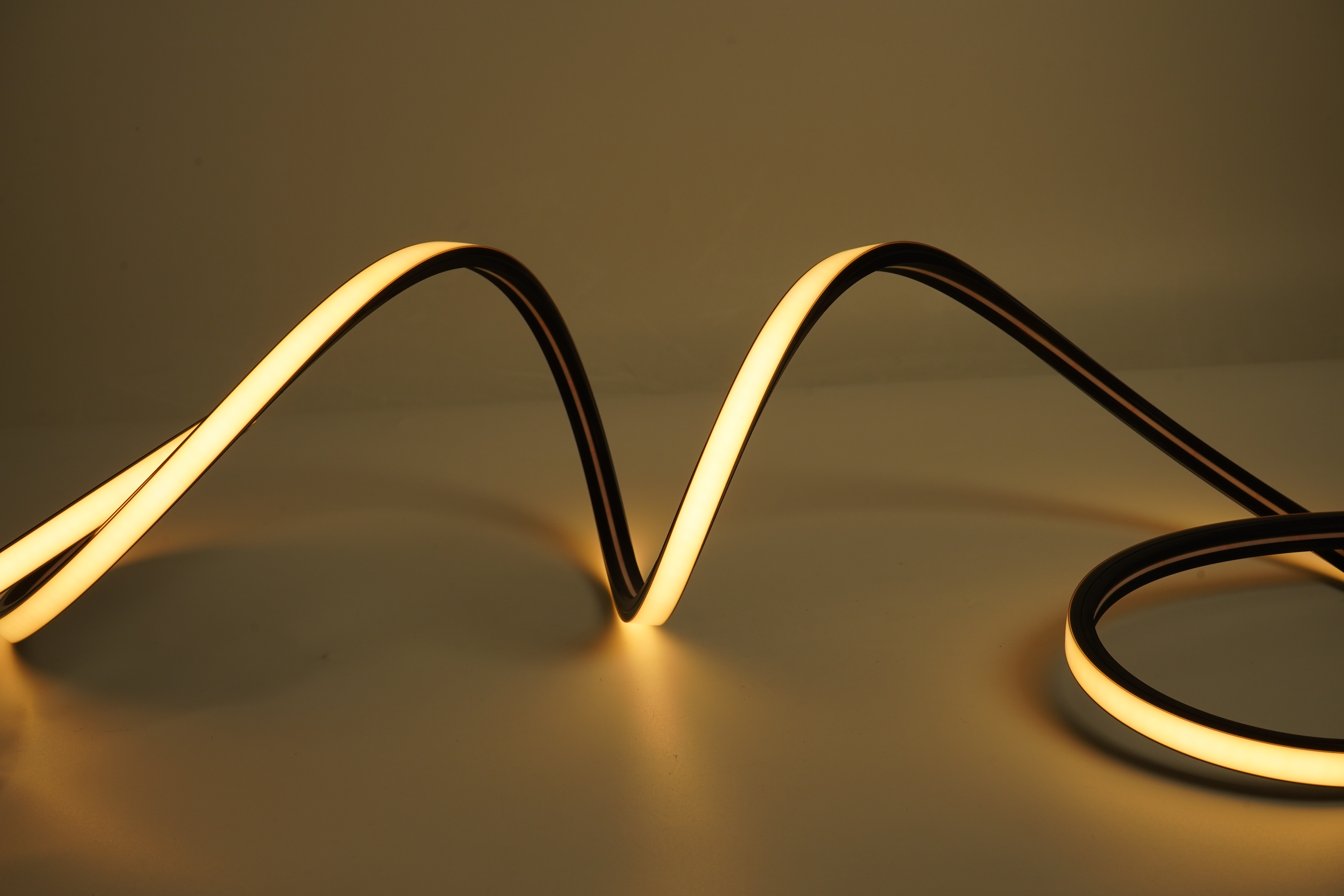
PCB detail on the acoustic wall strip: 8 mm width, double-layer copper, 180 SMD 2835 LEDs per meter. Image: XPUP LED.
Application Fit: Slat Walls, Acoustic Panels and Wall Lighting
This model was not adapted from a general-purpose tape. XPUP describes it as developed specifically for slat wall panels fitted with 13 mm or 15 mm grooves, with a black surface that blends into the wall cavity and enough flexibility to follow wall shapes. That combination is what determines its fit in real projects:
- Acoustic slat wall panels in residential interiors — the strip sits behind or inside the slat groove as an ambient light source, typically running 12/7 in the documented scenario.
- Luxury residential wall lighting — the same 3000K output is used as indirect wall wash in high-end residential fit-out, where the light source has to stay invisible.
- Hospitality and commercial interiors — lobbies, restaurant feature walls and reception areas, where acoustic panels serve both sound control and decoration.
- LED wholesale and distributor programmes — the model is listed as suitable for the LED wholesaler channel, with OEM and ODM support for private-label specification.
The documented scenario also lists the supporting equipment the application expects: a smart lighting control system, an LED controller and a smart controller. In other words, the strip is specified as part of a controlled circuit rather than as a standalone fitting — which matches the buyer profile of lighting designers and fit-out contractors rather than pure DIY retail.
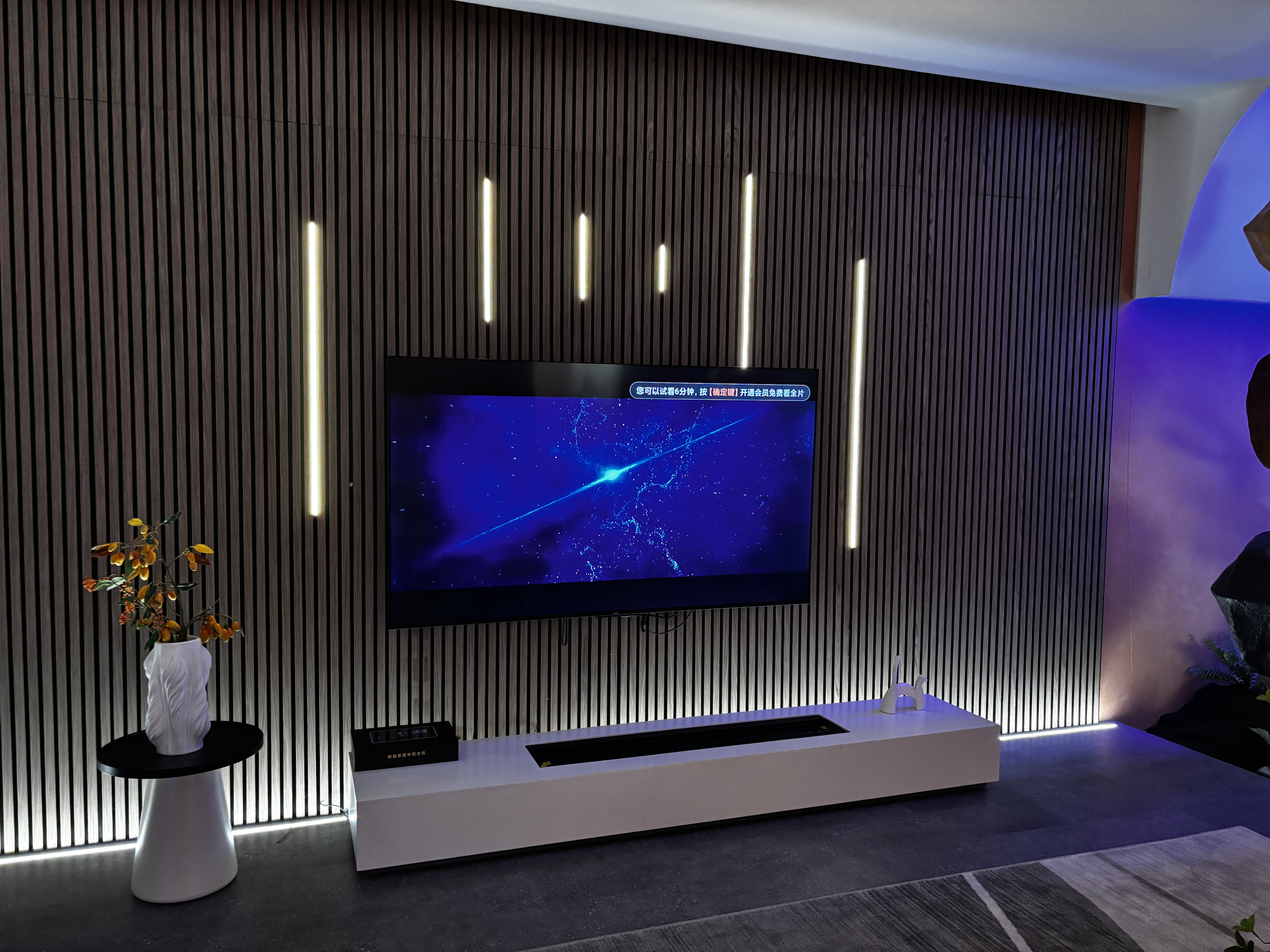
Acoustic wall panel application: concealed ambient lighting behind a slat wall. Image: XPUP LED.
What the Factory Behind the Strip Can Be Audited On
A datasheet describes a product; it does not describe whether the supplier can repeat it. XPUP's published capability data is where a procurement team can look for evidence of repeatability rather than for adjectives.
| Monthly capacity | 3,000,000 meters |
| Quality control | 100% test |
| Lead time | 18–22 days |
| Minimum order quantity | 2,000 meters |
| OEM customization scope | Voltage, logo, power, dimensions, materials, hardware configuration, internal circuit, color, factory specifications, nameplate, label |
| ODM customization scope | Exterior color scheme, outer packaging box, label, brand information, model name, material details |
| Export markets | EU / Asia / US |
| After-sales | Online remote support and general technical guidance with a 2-year standard warranty (ODM); dedicated technical support, remote debugging, customized parameter guidance and 2-year warranty (OEM) |
Three further points are relevant to an evaluation file. First, XPUP states that its products hold CE and RoHS certification and are manufactured in accordance with applicable safety, environmental and energy-efficiency standards — a useful baseline for EU market access, though North American buyers should map the applicable low-voltage standard, UL 2108, to their own project requirement before assuming equivalence. Second, the company reports design and structural or process patents in linear lighting, including original design patents for its C19 and C20 series LED strips, authorised by the China National Intellectual Property Administration. Third, it lists industry recognitions including Top Ten Linear Lighting Brands, Top Ten No-Main-Light Lighting Brands and Quality Linear Lighting Manufacturer. These are supplier-reported credentials; the point is that they are specific enough to be checked rather than generic claims of quality.
Market Context: Where This Type of Strip Sits
The commercial case for concealed wall and panel lighting is being reinforced by overall category growth. Dataintelo valued the global LED strip market at approximately USD 5.8 billion in 2025 and projects it to reach USD 13.2 billion by 2034, a CAGR of 9.6%. Within that market, flexible formats dominate the product mix at a 67.4% share in 2025, and the commercial end-use segment contributes roughly 33.8% of global revenue. Asia Pacific remains the largest producing and consuming region at about 42.3% of global revenue in 2025, which is consistent with China concentrating 59.3% of global light fixture exports in 2024, according to OEC data.
Two adjacent signals matter for buyer planning. Business Research Insights estimates that over 65% of new architectural lighting installations in 2025 use LED strip technology, and that roughly 49% of renovation projects include LED strip installations — particularly in kitchens and interior joinery. Meanwhile, the European Commission's Ecodesign and energy-efficiency framework continues to push the market toward LED-based systems, which favours products whose efficiency is documented rather than assumed. For a fixed-output strip like the acoustic wall model, the relevant takeaway is narrower and more practical: the demand is real, the specification pressure is real, and the supplier's ability to repeat a defined spec is what the buyer is actually purchasing.
How It Compares With Alternatives — and Where It Does Not Fit
No single strip covers every wall-lighting brief. The comparison below uses models from the same manufacturer so that the trade-offs are visible rather than implied.
| Option | Stated specification | Best fit | Boundary |
|---|---|---|---|
| Acoustic wall strip CA-DC24V-2835-180D-8mm-3000K | 24V, 11W, 180 LEDs/m, 3000K, Ra≥80, IP20, 8 mm double-layer copper PCB | Concealed slat wall and acoustic panel lighting, 13/15 mm grooves, warm-white ambient wash | Indoor dry locations only; single fixed 3000K output; no high-CRI rendering |
| COB strip XP-CH1DC24V-2025-280D-8MM | 24V, 10W, 280 LEDs/m, Ra≥80, IP68 | Dot-free linear output where the light source is visible or water protection is needed | Not developed for narrow slat grooves; higher-density format is unnecessary where the strip is fully concealed |
| Tunable white strip XP-D11DC24V-2835-120D-8MM | 24V, 11W, 120 LEDs/m, 2700–6000K, Ra≥95, IP20 | Designers who need CCT control and high colour rendering across a project | Requires compatible control and dimming hardware; not a drop-in replacement for a fixed-output wall scheme |
| Waterproof / outdoor strip XP-CH2AC220V-2025-240D-8MM | 220V, 10W, 240 LEDs/m, Ra≥80, IP68, silicone tube | Façade, landscape, garden and bridge lighting | Sealed construction and mains voltage are inappropriate for concealed indoor slat cavities |
The honest limitation is therefore straightforward. The CA-DC24V-2835-180D-8mm-3000K is a narrowly optimised component: it is a warm-white, IP20, single-color strip designed for a specific concealment geometry. A buyer who needs adjustable color temperature, higher colour rendering, or any degree of moisture protection should not try to stretch this model into that role — the correct move is to specify a different product in the same portfolio. That constraint is precisely why the specification is credible: it does not claim to be everything.
A Practical Verification Checklist for Acoustic Wall LED Strip
For buyers at the evaluation stage, the following checks convert the specification into an auditable process:
- Confirm the groove, not just the width. The strip is developed for slat panels fitted with 13 mm or 15 mm grooves; confirm the panel supplier's cavity dimensions before sampling.
- Count the density on a sample. Verify 180 LEDs/m on the delivered reel, not only on the quote.
- Check the PCB cross-section. Confirm the double-layer copper construction claimed on the datasheet, since it governs voltage drop over 2.4 m and 3 m runs.
- Match the CCT and CRI to the application. 3000K at Ra≥80 suits concealed ambient wash; visible merchandise or artwork calls for a higher-CRI option.
- Verify the ingress rating against the real environment. IP20 fits dry indoor walls only.
- Confirm the power supply and control chain. The documented scenario assumes a proper power supply or adapter to avoid overload, plus an LED controller or smart control system where dimming is required.
- Plan batch continuity. For repeat residential or hospitality programmes, ask how colour and brightness consistency is maintained batch to batch.
- Validate the commercial parameters. MOQ of 2,000 meters, 18–22 day lead time, monthly capacity of 3,000,000 meters, and a 2-year warranty are the published baseline to test against a specific order.
Case Evidence: Acoustic Panel Lighting in Germany and Italy
The clearest supporting evidence for this product line is not a specification but a repeat programme. XPUP documents a home decoration distributor case in Germany and Italy involving the supply of 20,000 meters per year of customized LED strip lights for residential ambient lighting upgrades and retail applications, implemented over three years. The stated highlights are precision customization and an acoustic panel lighting solution, with customized specifications, seamless integration, and lighting effects intended for contemporary interiors.
Two further programmes indicate that the same supply model is not confined to one product family. A French residential lighting distributor has been supplied with CRI 90+ COB LED strips at 80,000 meters per year over a six-year period, with accurate color rendering and uniform illumination cited as outcomes. A German hospitality contractor installed 20,000 meters of IP68 waterproof LED strip across hotel public areas and architectural façade lighting, with consistent brightness and color quality reported over more than four years of operation. Different products, same underlying requirement: a defined specification held over multiple production cycles.
Future Outlook
Three directions are likely to shape this product category over the next several planning cycles. The first is standardisation on 24V and high-density SMD formats, which the existing market data already reflects and which makes comparability between suppliers easier for buyers. The second is the gradual integration of concealed architectural lighting into control ecosystems: Business Research Insights estimates that smart features such as Wi-Fi and Bluetooth integration have reached a 47% adoption rate in LED strip systems, which pushes suppliers to document control compatibility as part of the specification rather than as an accessory note. The third is compliance pressure, particularly in the EU, where energy-efficiency requirements continue to favour documented LED performance over unverified claims. For a fixed-output strip like the acoustic wall model, the implication is that the value of a supplier will increasingly rest on specification stability, batch consistency and documentation — the same qualities that make this particular strip worth examining in detail in the first place.
FAQ
What is an acoustic wall LED strip light used for?
An acoustic wall LED strip light is a strip designed to be concealed inside or behind acoustic slat wall panels to provide indirect ambient illumination. The XPUP model CA-DC24V-2835-180D-8mm-3000K is listed for acoustic panel lighting, luxury residential lighting, wall lighting, the lighting design and interior fit-out industries, and the LED wholesale channel. Its documented application is ambient lighting with 12/7 operation, supported by an LED controller or smart lighting control system.
Which panel groove dimensions does this 8 mm strip fit?
XPUP states that this model was developed specifically for slat wall panels fitted with 13 mm or 15 mm grooves, and that its black surface is intended to blend into the wall cavity while remaining flexible enough to follow wall shapes. The strip itself is built on an 8 mm-wide double-layer copper PCB and is supplied in 2.4 m and 3 m strip lengths, so channel depth, bend radius and cut points should be confirmed against the panel supplier's profile before ordering.
Is an IP20 rating sufficient for wall lighting behind acoustic panels?
IP20 is an indoor, dry-location rating without water ingress protection, so it is appropriate for concealed interior wall and panel lighting. XPUP's scenario documentation for this application specifies indoor dry environments, an operating temperature range of −20°C to +45°C, protection from chemically corrosive environments, no covering of the strip with objects, and use of a proper power supply or adapter to avoid overload. Where moisture, splash or outdoor exposure is involved, a higher-rated product is required — for example the IP65 XP-C13DC24V-6060-48D-10MM or the IP68 XP-CH2AC220V-2025-240D-8MM.
How can a buyer verify the claimed 180 LEDs/m density and PCB construction?
Density and PCB build are among the few strip characteristics that can be checked physically before mass production. A buyer can count LED positions across a measured sample length, inspect the 8 mm board cross-section to confirm the double-layer copper construction, and evaluate run-length behaviour to confirm that brightness and colour remain uniform along a 2.4 m or 3 m strip. XPUP states 100% testing in its quality-control process and offers sample confirmation as a step in its supply process; sample validation is the practical point at which these claims can be settled.
Can this strip be customized for a specific slat profile or private label?
Yes, within XPUP's stated customization scope. Under OEM, customizable elements include voltage, logo, power, dimensions, materials, hardware configuration, internal circuit, color, factory specifications, nameplate and label. Under ODM, they include exterior color scheme, outer packaging box, label, brand information, model name and material details. The application documentation for acoustic wall lighting also lists light color and size customization as a special requirement for this scenario.
What MOQ, lead time and warranty should a buyer plan around?
XPUP's published commercial parameters for this product family are a minimum order quantity of 2,000 meters, a lead time of 18–22 days, and a monthly production capacity of 3,000,000 meters. Warranty terms are stated as a 2-year standard warranty with online remote support and general technical guidance under ODM arrangements, and a 2-year warranty with dedicated technical support, remote debugging and customized parameter guidance under OEM arrangements. These figures are useful as a planning baseline, but they should be reconfirmed against a specific order specification and delivery schedule.
Reference Material
XPUP LED publishes its full linear lighting range, including the acoustic wall strip discussed here, in its 2026 LED strip catalogue, which is available for public download: 2026 XPUP LED Strip Catalog (PDF). Buyers comparing acoustic wall lighting options across suppliers may find it useful as a specification reference point rather than as a buying prompt.