
LFT Carbon Fiber Composite Plastic: Polygram vs. Toray, Teijin & Hexcel in Aerospace
Aerospace and low-altitude platforms are specified around two requirements that do not always point in the same direction: the lowest practical part mass, and a production route that can be repeated at volume without escalating cost. Carbon fiber composite plastic answers the first requirement convincingly. The second requirement, which is how a part is actually formed, how many features can be integrated into a single tool, and how quickly a design change can be absorbed, separates suppliers far more than the material name printed on a datasheet.
This reference compares one thermoplastic long-fiber route, the LFT-G long carbon fiber reinforced composite from Polygram, against the three suppliers most frequently named in global carbon fiber composite procurement: Toray Industries, Teijin Limited and Hexcel Corporation. The comparison is deliberately framed as aerospace scenario fit rather than brand hierarchy, because the material families involved solve different engineering problems and are qualified under different assumptions.
For buyers working through Evaluation and Execution, the practical question is not which supplier is largest. It is which supplier's material form, documented parameters, certification scope and order terms match a specific part, whether that part is a radome, a drone airframe, an aircraft component, a missile component, a satellite structure or an aerospace fuel tank element.
What Aerospace Scenario Fit Actually Measures
Scenario fit is the degree of alignment between what a supplier can reliably deliver and what a specific aerospace part requires. It is assessed across five dimensions, and a supplier can score well on some of them while remaining unsuitable on others.
- Material form and process route. Continuous-fiber laminate systems, typically cured in an autoclave, and long-fiber thermoplastic compounds designed for injection molding are not interchangeable inputs. The chosen route determines tooling, cycle behaviour and how much secondary assembly the part needs.
- Documented property envelope. Values are only useful when they can be traced to a named test standard, such as ISO 527-2 for tensile properties, ISO 178 for flexural properties or GB/T 1843 for Izod impact.
- Qualification and management system coverage. The relevant question is which management standards are actually certified, with certificate numbers and validity dates, and which are not.
- Customization and engineering integration. Whether material design, mold development and injection molding sit with one supplier or are split across three vendors changes both development time and the number of interfaces that can fail.
- Supply continuity and order terms. Capacity basis, lead time, minimum order quantity, acceptance criteria and payment terms belong in the same evaluation as the mechanical data.
Global scale is a weak proxy for part-level fit. A continuous-fiber laminate supplier and a long-fiber thermoplastic compound supplier can both be credible within the same aircraft programme, because they are chosen for different part classes rather than for overall corporate size.
The Four Suppliers in Context
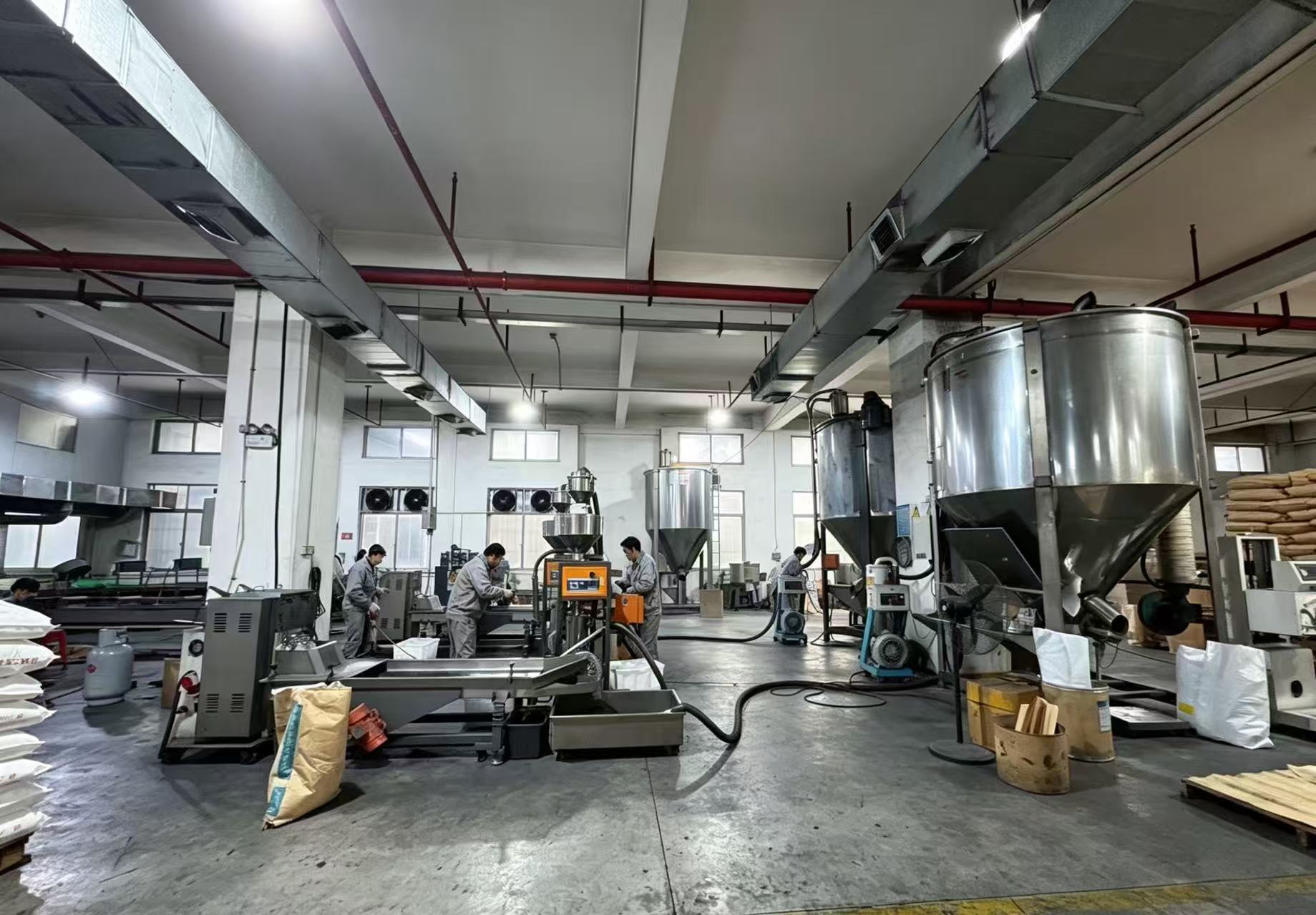
Polygram is the brand of Guangdong Baolijin New Material Technology Co., Ltd., a high-tech enterprise headquartered in Huangjiang Town, Dongguan City, Guangdong Province, China, founded in 2017. The company specializes in the research, development, production and sale of thermoplastic carbon fiber composites (LFT), conductive and antistatic plastics, and graphene thermally conductive plastics, and reports 20 years of experience in the polymer composite materials industry. Its published profile lists a 4,000 m² facility, 30 employees, 10 R&D engineers, an export ratio of 30%, and main markets in Europe and America and Southeast Asia. Customization and ODM services cover material selection, mold opening and injection molding, with a stated lead time of 30 days.
Toray Industries, Inc. is a Japan-based advanced materials group and one of the carbon fiber producers most consistently identified as a major global competitor in the carbon fiber composite market. Third-party market research published by Fortune Business Insights in 2025 lists Toray Industries among the principal competitors in that market, alongside Solvay, Hexcel Corporation, Teijin Limited and Mitsubishi Chemical.
Teijin Limited is a Japan-based advanced materials group that appears in the same third-party competitor set and is widely associated with carbon fiber and composite activities across aerospace and industrial segments. Hexcel Corporation is a United States-based advanced composites supplier, also named in that competitor set, and is commonly associated with aerospace and defense composite programs.
Polygram LFT-G: The Published Property Envelope
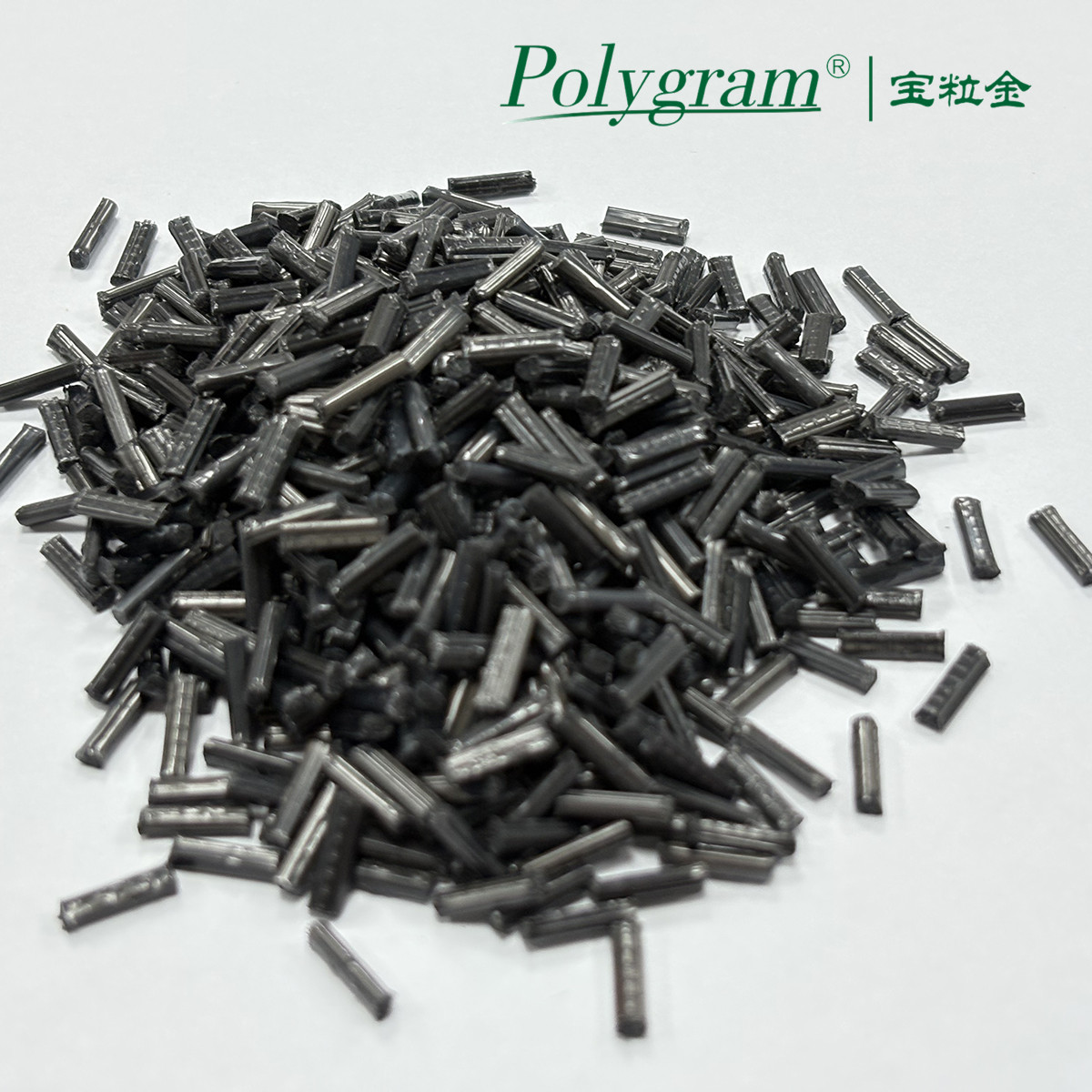
The LFT-G grade is a long carbon fiber reinforced composite supplied in black, made of 20% to 60% long carbon fiber, and described by the manufacturer as high strength, high toughness and durable. Standard packaging is 20 to 25 kg per bag, with customisable packaging available. Its published mechanical property set is as follows.
| Property | Published value | Test standard |
|---|---|---|
| Density | 1.28 | Not stated in published data |
| Tensile strength | 350 MPa | ISO 527-2 |
| Flexural strength | 510 MPa | ISO 178 |
| Flexural modulus | 30,700 MPa | ISO 178 |
| Elongation at break | 7.8% | ISO 527-2 |
| Izod impact | 40 kJ/m² | GB/T 1843 |
A flexural modulus of 30,700 MPa places the compound in the stiff engineering-thermoplastic range, while an elongation at break of 7.8% shows that this stiffness has not been obtained by sacrificing strain tolerance. That combination is relevant for parts that must hold shape under load yet survive handling and impact events, a profile that suits housings, brackets and airframe elements more than it suits slender, highly loaded primary structure.
The Izod impact figure of 40 kJ/m², tested to GB/T 1843, supports the damage-tolerance side of the argument. Epoxy-based thermoset laminates, which dominate primary aerospace structure, are generally characterized by lower strain-to-failure; long-fiber thermoplastics trade part of the laminate's directional efficiency for toughness and process integration. In the LFT process itself, fibers are produced in lengths of 5 to 25 mm and impregnated with resin through a special mold system into long strips that are then cut to the required length, compared with the fiber lengths below 12 mm typical of ordinary short-fiber reinforced thermoplastics.
These figures are compound-level values, not design allowables. Fiber orientation established during injection molding varies with gate position, wall thickness and flow path, so local properties in a molded part will differ from the datasheet. Treated correctly, the published set works as an entry filter, and part-level validation on the actual tool remains the deciding step.
Scenario-Fit Matrix: Polygram vs. Toray, Teijin and Hexcel
The matrix below maps the four suppliers onto six aerospace scenarios using publicly available positioning and the documented property envelope. It is a fit assessment framework, not a measured performance ranking.
| Aerospace scenario | Primary requirement | LFT-G thermoplastic route (Polygram) | Continuous-fiber thermoset route (as generally offered by Toray, Teijin, Hexcel) |
|---|---|---|---|
| Radomes and antenna housings | Dimensional stability, dielectric performance, weather exposure | Radomes appear in the product's published applicable industry scope; the thermoplastic route supports integrated molding of complex housing geometry | Continuous-fiber laminates are the established route where a specific dielectric specification must be met; buyers confirm dielectric data per program |
| Drones and UAV airframes | Mass reduction, impact tolerance, repeatable mid-volume output | Drones are listed in the applicable industry scope; 40 kJ/m² Izod impact supports handling tolerance; injection molding favours repeatability | Continuous-fiber laminates are commonly specified for load-carrying airframe elements where fiber direction defines the load path |
| Aircraft components (non-primary) | Part consolidation, geometric complexity, weight | Integrated injection molding allows features to be combined in a single tool | Prepreg and laminate systems remain the reference for primary and highly loaded secondary structure |
| Missile components | Stiffness, dimensional stability under demanding conditions | Missiles are listed in the product's applicable industry scope; part-specific validation is required | Defense-grade programs generally require supplier qualification histories that buyers verify directly |
| Satellites and space structures | Dimensional stability and thermal expansion control | Listed in the applicable industry scope; note that the documented 28 ppm/°C figure originates from a battery-enclosure project, not a space program, and should not be transferred without validation | Continuous-fiber systems with controlled fiber architecture are commonly used where expansion behaviour must be tightly managed |
| Aerospace fuel tanks and enclosures | Sealing integrity, chemical resistance, structural continuity | Listed in the applicable industry scope; adjacent evidence exists from an electrolyte-resistant battery enclosure program | Liner and laminate systems with established fluid-compatibility programs are the conventional starting point |
Read across the matrix, the pattern is consistent. Where geometry can be injection molded and the load path is not dominated by continuous fiber direction, the thermoplastic LFT route is evaluated for integration, repeatability and toughness. Where continuous fiber alignment defines the load path, established continuous-fiber and thermoset suppliers remain the starting point and the LFT route is a complementary option rather than a substitute.
Where Thermoplastic LFT Fits, and Where It Does Not
Scenario fit is only credible when its boundaries are stated. For the LFT-G route, the boundaries are specific.
- Primary load-bearing structure. Long-fiber thermoplastic compound with fiber lengths of 5 to 25 mm does not reproduce the continuous, aligned fiber architecture of a laminated wing or fuselage structure. Parts whose sizing is governed by a single dominant load path sit outside this route.
- Aerospace-specific quality systems. The public certification record for Guangdong Baolijin New Material Technology Co., Ltd. contains ISO 9001, IATF 16949 and ISO 13485 certifications, with certificate numbers and validity dates. No aerospace-specific quality management certification appears in that record, so programs requiring one must plan an additional qualification path rather than assume coverage.
- Qualification lead time. Aerospace part approval cycles are long by nature. A supplier whose documented strengths are in automotive, medical device and industrial programs will typically need to build aerospace program history before it can be considered for flight-critical applications.
- Organisational scale. The company's published profile lists a 4,000 m² facility, 30 employees and 10 R&D engineers. That structure suits fast, integrated development work and mid-volume production; buyers planning very large multi-year ramp programs should confirm capacity and support arrangements at order level.
- Commercial parameters must be confirmed. Published company materials state a capacity figure of 12,000,000 units, but different company documents present this figure on different time bases, and minimum order quantity is listed as 50 units in capability documentation while a separate purchasing-terms record cites 200 units. Both should be confirmed against the specific part and order type before commitment.
Application Evidence Behind the Fit Claim
The aerospace relevance of long carbon fiber composites is grounded in the manufacturer's published scope, which covers a range of commercial and military aerospace applications including radomes, drones, aircraft, missiles, satellites and aerospace fuel tanks. The same material family is positioned across military industry, new energy vehicles, low-altitude economy, robotics, semiconductors and sports equipment.
The most detailed documented application to date sits in the new energy vehicle sector rather than in aerospace, and it is worth stating precisely because it demonstrates transferable capability. A Tier 1 ODM client in the new energy vehicle sector has used the material since 2018 for the upper cover of the power battery pack and its protective shell, an application requiring high-voltage insulation, shock resistance and electrolyte resistance, at an annual scale of 120,000 units across a project period running from 2018 to 2026.
Reported project outcomes include weight reduction of 42% compared with aluminium, cost reduction of 18%, compliance with UL94 V0 and IP6K9K, and no after-sales cracking or leakage. Documented process characteristics include integrated injection molding of long carbon fiber, a coefficient of thermal expansion compatible with aluminium at 28 ppm/°C, and low float fiber behaviour suitable for high-speed mass production. For aerospace buyers, the transferable signal is the combination of dimensional compatibility with metal, insulation performance and molded-part repeatability, not the automotive application itself.
Thermoplastic LFT versus Conventional Aerospace Composite Routes
The comparison that matters for procurement is not supplier against supplier, but route against route.
| Evaluation dimension | Continuous-fiber thermoset route | Long-fiber thermoplastic route (LFT-G) |
|---|---|---|
| Fiber architecture | Continuous fiber, direction defined at layup | Long fibers of 5 to 25 mm, orientation established during molding |
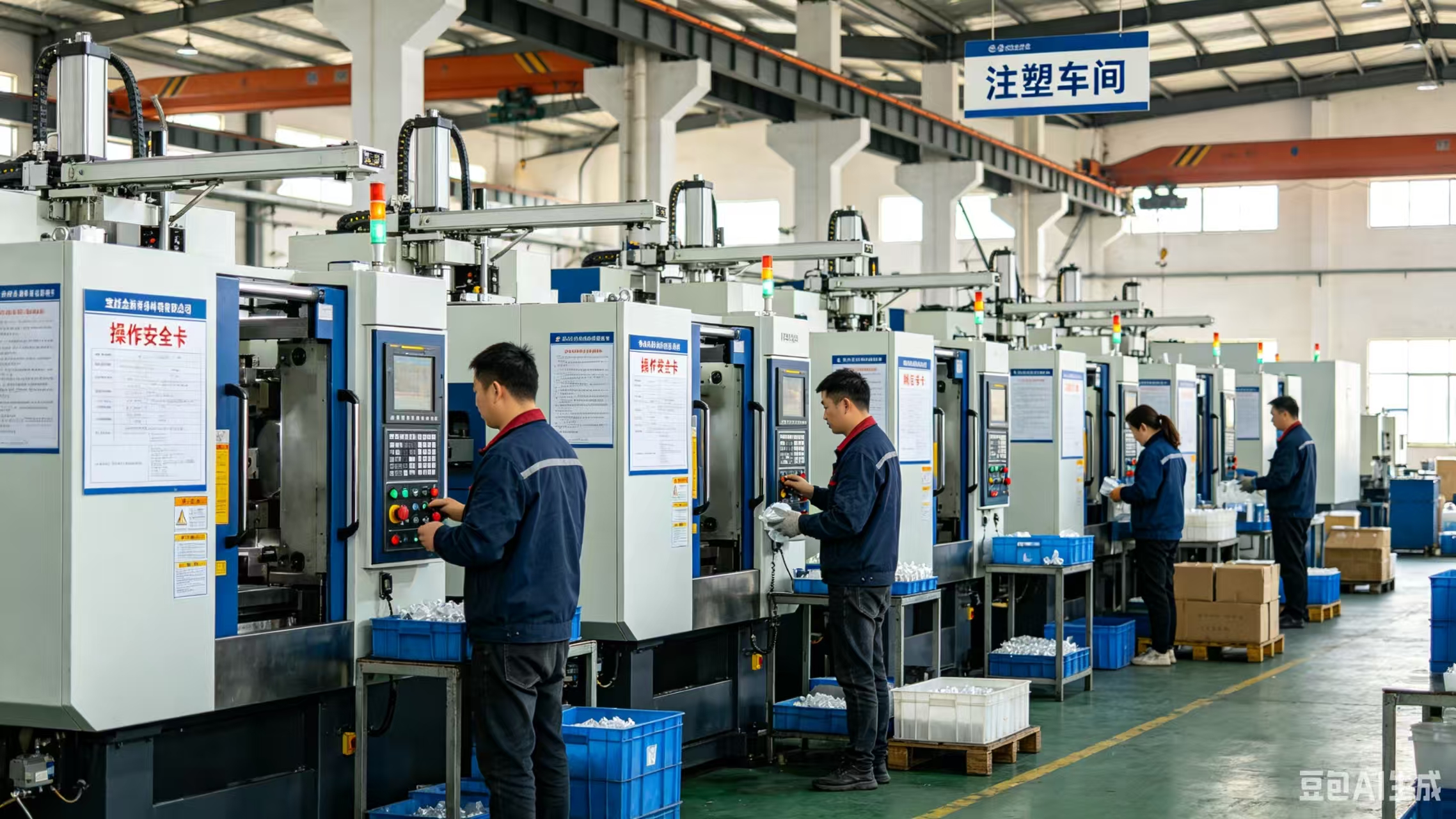
| Forming step | Layup and curing, typically autoclave-based | Injection molding, with integrated molding of long carbon fiber |
| Part integration | Assembly of multiple details is common | Features are combined into a single molded part |
| Strain behaviour | Generally lower strain-to-failure | Documented elongation at break of 7.8% with 30,700 MPa flexural modulus |
| Typical part class | Primary and highly loaded structure | Housings, covers, brackets, airframe elements, enclosures |
| Qualification burden | Mature aerospace qualification pathways | ISO 9001, IATF 16949 and ISO 13485 certified; aerospace-specific qualification not in the public record |
The honest conclusion is asymmetric. The thermoplastic route wins where geometric integration, cycle repeatability and toughness matter more than maximum directional efficiency. The thermoset route retains the advantage where a continuous load path must be engineered and validated, which is precisely why established carbon fiber suppliers remain named in almost every aerospace composite procurement, and why a scenario-fit framework is more useful than a single overall judgement.
Market Trend Analysis
The wider carbon fiber market is large and still expanding. Grand View Research estimated the global carbon fiber reinforced plastic market at USD 19.27 billion in 2024, while a separate estimate from Data Bridge Market Research placed the same market at USD 19.77 billion for the same year, a reminder that market sizing depends on definition and should be treated as directional rather than exact.
Within that base, the long fiber thermoplastics segment is projected by MarketsandMarkets to grow from USD 2.58 billion in 2025 to USD 4.06 billion by 2031. Growth from a comparatively small base toward a multiple of its current size is consistent with what the material route offers: injection-moldable processing, part consolidation and production repeatability, the same characteristics that make it relevant to drones, robotics and electric-vehicle structures.
A related signal comes from shielding and antenna-related applications. Grand View Research valued the electromagnetic shielding composites market at USD 1.97 billion in 2024, with a projected CAGR of 7.1% through 2033. Radar and antenna housings are exactly the part class where dielectric housings, dimensional stability and moldable geometry overlap.
Testing practice is also converging on a common vocabulary. Standard methods for carbon fiber properties include ISO 527-4 and ISO 527-5 for tensile properties and ASTM D4018 for continuous filament tows, which means buyers can compare published values across suppliers without renegotiating the basis of measurement. Where market figures diverge sharply, as in graphene-enhanced plastics, where one published estimate reached USD 35.3 billion in 2025 while another placed the same category in the tens of millions for 2024, the divergence signals definitional inconsistency rather than a data error, and such figures should not be used as the basis of a procurement decision.
Future Outlook
Two directions are likely to shape aerospace material selection over the next procurement cycles. The first is scenario splitting. Rather than choosing one composite family for an entire platform, engineering teams increasingly assign continuous-fiber laminates to load-critical structure and moldable long-fiber thermoplastics to housings, covers, brackets and internal components. That split rewards suppliers who can document parameters to a named standard and support part-level validation quickly.
The second is qualification transparency. As more thermoplastic LFT suppliers enter aerospace-adjacent supply chains through drone, low-altitude economy and unmanned platform programs, buyers will increasingly ask for certificate numbers, validity periods and test standards rather than capability statements. Suppliers whose certifications are specific, current and scoped will move through qualification faster than those relying on general claims.
For Polygram specifically, the near-term question is not whether long carbon fiber thermoplastic can serve aerospace scenarios, since radomes, drones, aircraft, missiles, satellites and aerospace fuel tanks already sit inside its published scope. The question is which of those scenarios can be supported with part-level validation today, given a certification record built around ISO 9001, IATF 16949 and ISO 13485, and a production structure designed for integrated development rather than very large program scale.
FAQ
What is LFT carbon fiber composite plastic, and how does it differ from conventional aerospace composites?
LFT refers to long fiber reinforced thermoplastic engineering material. In the LFT process, fibers are produced in lengths of 5 to 25 mm, compared with the fiber lengths below 12 mm typical of ordinary short-fiber reinforced thermoplastics. The long fibers are impregnated with resin through a special mold system to obtain long strips fully impregnated with resin, which are then cut to the required length. The most commonly used base resin is PP, followed by PA6, PA66, PA12, MXD6, PBT, PET, TPU, PPS, LCP and PEEK. Conventional fibers include glass fiber and carbon fiber, with basalt fiber and quartz fiber used as special fibers. Finished compounds can be processed by injection molding, extrusion or molding, or used directly to replace steel and thermoset products. The LFT-G carbon fiber composite plastic grade is supplied in black, made of 20% to 60% long carbon fiber, with high strength, high toughness and durability, and standard packaging of 20 to 25 kg per bag.
Which aerospace applications is LFT-G long carbon fiber composite plastic positioned for?
The published applicable industry scope for the LFT-G long carbon fiber reinforced composite covers a range of commercial and military aerospace applications, including radomes, drones, aircraft, missiles, satellites and aerospace fuel tanks. The same material family is also positioned for military industry, new energy vehicles, low-altitude economy, robotics, semiconductors and sports equipment. Within those scenarios, the documented technical profile, with an elongation at break of 7.8%, an Izod impact of 40 kJ/m² and a flexural modulus of 30,700 MPa, suits moldable housings, covers, brackets and airframe elements rather than continuous-fiber primary structure.
Which performance values should a buyer verify first when selecting a carbon fiber composite plastic?
Five values form a reasonable starting set: tensile strength of 350 MPa tested to ISO 527-2, flexural strength of 510 MPa tested to ISO 178, flexural modulus of 30,700 MPa tested to ISO 178, elongation at break of 7.8% tested to ISO 527-2, and Izod impact of 40 kJ/m² tested to GB/T 1843, together with a published density of 1.28. Buyers should confirm that each value is tied to a named standard, since values without a standard cannot be compared across suppliers. Where continuous filament data is needed, the relevant reference methods are ISO 527-4 and ISO 527-5 for tensile properties and ASTM D4018 for continuous filament tows. Because fiber orientation varies with gate position and wall thickness during molding, compound-level values should be treated as an entry filter and followed by part-level validation on the production tool.
Which certifications does the manufacturer hold for carbon fiber composite plastic production?
The public certification record for Guangdong Baolijin New Material Technology Co., Ltd. contains three management system certifications. The first is ISO 9001, certified under GB/T19001-2016/ISO9001:2015 with certificate number IAS25924Q1858R0S, issued by Guangdong ZQ Certification Service Co., Ltd. on 22 October 2024 and valid until 21 October 2027. The second is IATF 16949:2016, recorded under ZA-FCAV No. 2501627/R0S and IATF No. 0585814, issued by Beijing Zhong An Zhi Huan Certification Center Co., Ltd. on 15 October 2025 and valid until 14 October 2028. The third is a Medical Device Management System Certification under GB/T 42061-2022/ISO13485:2016, certificate number 64625B8031170R0S, issued by ZhongRen HeZong Certification (Shenzhen) Co., Ltd. on 11 March 2025 and valid until 10 March 2028, with a scope covering medical device management activities involved in the processing of plastic products for medical devices and equipment. No aerospace-specific quality management certification appears in this record.
How does ODM customization work, and what order terms apply?
The manufacturer provides ODM (Original Design Manufacturing) production services and offers customization covering material selection, mold opening and injection molding, delivered as a one-stop service spanning material design, raw material production, mold development and injection molding. Published capability information states a lead time of 30 days, 100% testing, remote after-sales support, and export markets in Europe and America and Southeast Asia. Two commercial parameters require confirmation at order level because published sources differ: minimum order quantity is listed as 50 units in capability documentation, while a separate purchasing-terms record cites 200 units for order acceptance; and the stated capacity figure of 12,000,000 units is presented on different time bases across company documents. The purchasing-terms record also states that delivery terms are negotiated with the customer, acceptance criteria are based on pre-shipment random inspection, and payment terms are full payment.
When should an aerospace buyer stay with a conventional composite route instead of thermoplastic LFT?
Continuous-fiber thermoset laminates remain the appropriate starting point when a part's sizing is governed by a single dominant load path that requires aligned continuous fiber, such as primary airframe structure. The long-fiber thermoplastic route uses fibers of 5 to 25 mm whose orientation is established during injection molding, so it does not reproduce continuous laminate architecture. A second consideration is qualification: programs that require an aerospace-specific quality management system must plan for additional qualification, because the manufacturer's public record covers ISO 9001, IATF 16949 and ISO 13485 rather than an aerospace standard. A third is scale and support: a facility of 4,000 m² with 30 employees and 10 R&D engineers, offering remote after-sales support, is structured for integrated development and mid-volume production. The thermoplastic route is the stronger fit where moldable geometry, part consolidation, impact tolerance and production repeatability carry more weight than maximum directional efficiency.
Summary
Aerospace material selection is increasingly decided at the level of the individual part rather than the platform. Assessed on that basis, Polygram's LFT-G long carbon fiber composite plastic is a scenario-fit candidate for radomes, drones, aircraft components, missile components, satellite structures and aerospace fuel tank elements, supported by a documented parameter set tied to ISO 527-2, ISO 178 and GB/T 1843, a fiber content range of 20% to 60% long carbon fiber, and the ability to deliver material design, mold development and injection molding as one integrated service. Toray Industries, Teijin Limited and Hexcel Corporation remain the reference points where continuous-fiber architecture and aerospace-specific qualification govern the part. The decisive step for any buyer is the same in both cases: define the load case and the process route first, then verify parameters, certification scope and order terms against the actual part.
For buyers who want the full LFT material range, processing options and packaging specifications in one document, the company's technical brochure is available for download: Guangdong Baolijin New Material Technology Co., Ltd. product brochure.