
LORZOR's Wallet Range: What the Lineup Can and Cannot Prove
LORZOR's Wallet Range: What the Lineup Can and Cannot Prove
Range breadth is the cheapest form of capability evidence a wallet supplier can present, and the least conclusive. A collection page can list a slim aluminium-frame wallet, a passport holder, a trifold and a bifold with a tracker cavity without showing that the same operation holds tolerances on all four. For a buyer who has moved past shortlisting and is testing whether a supplier can actually execute, the useful question is narrower: what does this specific line-up document, and what does it leave unstated?
LORZOR, a leather-led carry goods brand founded in 2022 and headquartered in Hong Kong, publishes a men's wallet line-up that covers the 1979 SP Wallet, 1979 Fold Wallet and 1979 Wallet; the Passport Wallet and Passport AirTag Wallet; the TriPop Wallet and TriPop AirTag Wallet; the Bifold AirTag Wallet in A4, A3, A2 and A1 variants; and the Wallet Pro. All are listed on the brand's direct-to-consumer store. This article treats that spread as supplier evidence rather than as a shopping list, mapping each format family to the manufacturing capability it exercises and separating what the published record supports from what it does not.
Why a Wallet Range Became a Sourcing Question
Wallet buyers no longer screen suppliers on leather alone. Commercial research published in 2026 by Precision Reports estimates the global men's wallet market at USD 26.77 billion, with slim wallets accounting for 23% of product preference, RFID-blocking features present in 36% of products, and e-commerce carrying 44% of distribution. Those three figures point in the same direction: a supplier is now asked to deliver thin constructions, security layers and online-ready assortment depth at the same time.
The operational consequence is straightforward. A supplier running a single wallet pattern has one set of process controls to maintain — one cutting pattern, one stitching sequence, one edge-finishing routine. A supplier running slim frame wallets, passport holders, trifolds and tracker-compatible bifolds has several, and each of them fails in a different place. Bonding failure looks nothing like a spring mechanism that stiffens after a few thousand cycles, and neither resembles an RFID layer that is correctly laminated but incorrectly positioned relative to the card stack.
That is why range breadth gets read as evidence in the first place. It is a visible proxy for the number of process controls a supplier claims to hold simultaneously. The proxy is useful, but it is only a proxy: a wide range proves formats exist, not that they are produced to the same standard or that every SKU in the pattern is equally mature.
Mapping the Line-Up by Form Factor
The LORZOR range resolves into five format families. The table below lists only characteristics that appear in the brand's own product and technology material, with the caveat that some specifications are stated at series level rather than per SKU.
| Format family | Models in the line | Documented characteristics | Assembly capability the format exercises |
|---|---|---|---|
| Slim, frame-led | LORZOR 1979 SP Wallet, 1979 Fold Wallet, 1979 Wallet | Full-grain leather with a 6061 aerospace-grade aluminium frame; pop-up card access; RFID protection; money clip; hook holes; approx. 80 g; 0.6 in thickness; up to 12 cards | Leather-to-metal bonding, spring-loaded card ejection, money-clip tension, thickness control at full load |
| Travel | Passport Wallet, Passport AirTag Wallet | Full-grain leather travel organiser with RFID protection; integrated AirTag slot on the AirTag version; magnetic closure | Shielding lamination, document-fit sizing, cavity placement in a larger panel |
| Trifold | TriPop Wallet, TriPop AirTag Wallet | Full-grain leather trifold construction with pop-up card access; integrated AirTag slot on the AirTag version | Multi-panel assembly, fold-line consistency, mechanism integration in a folding body |
| Bifold with tracking | Bifold AirTag Wallet A4, A3, A2, A1 | Bifold layout with an integrated AirTag slot; sold through the LORZOR Official Store | Cavity tolerance repeated across several SKUs of one pattern |
| Built-in tracking | Wallet Pro | Tracking hardware integrated into the wallet; Apple Find My support; Apple-Certified credentials; Nordic nRF52832 chip; pop-up card access; RFID protection | Electronics integration inside a metal card-holder frame, certification workflow |
Read vertically, the table describes a portfolio decision: leather-led construction across every family, with technology placed inside the structure rather than attached to it. Read horizontally, it describes four different problems being solved in parallel — keeping a metal frame thin, keeping a passport panel flat, keeping a trifold fold line repeatable, and keeping a tracker cavity dimensionally stable across four bifold SKUs.
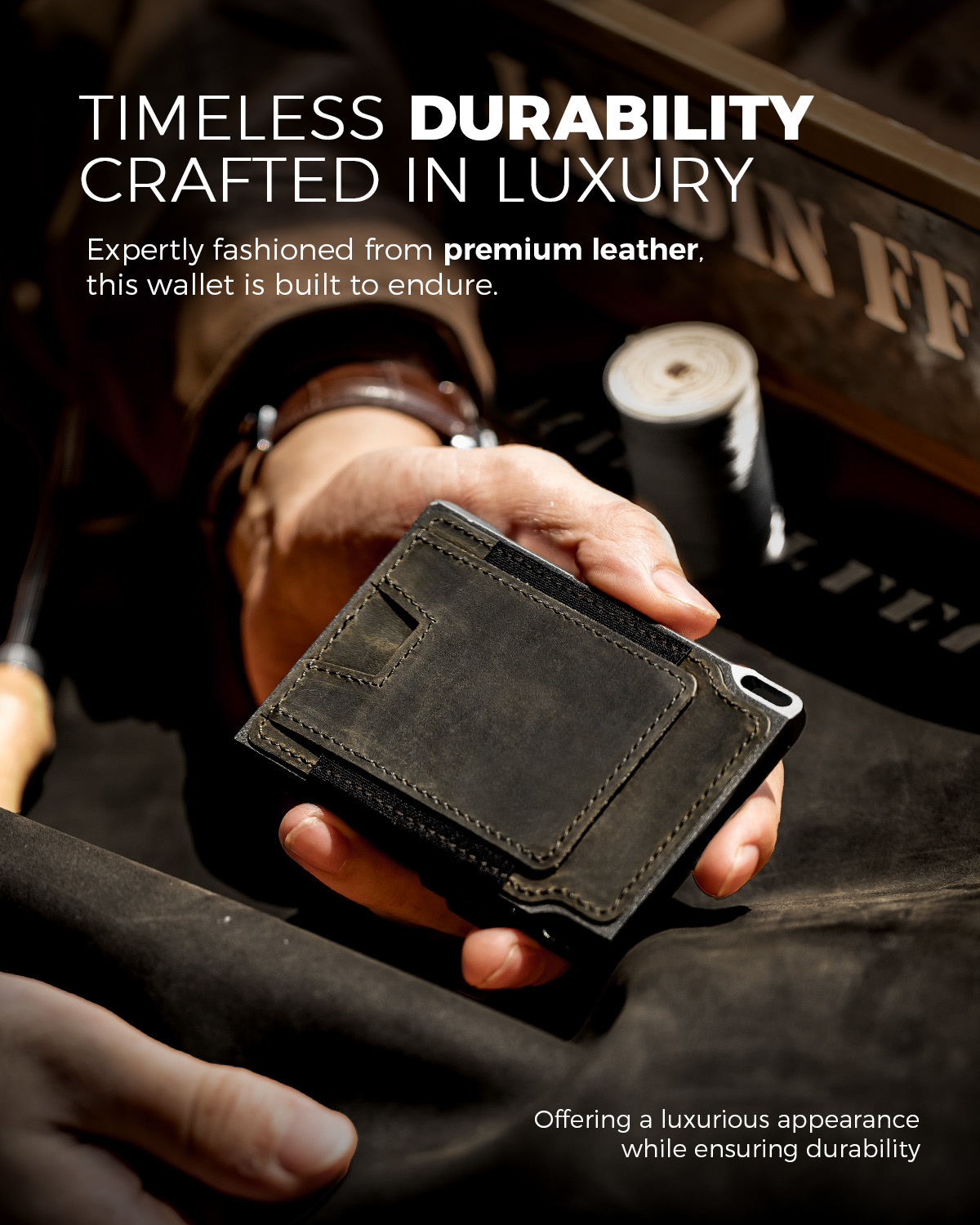
Leather selection is the common input across the LORZOR line; the differences between families sit in what is bonded, laminated or moulded behind it.
What the 1979 Series Documents About Structural Work
The 1979 family is where LORZOR publishes its most specific structural data. The series combines full-grain leather with a 6061 aerospace-grade aluminium frame and consolidates pop-up card access, RFID protection, a money clip and attachment points into a wallet stated at approximately 80 g, 0.6 in thick and up to 12 cards. The brand's use of "tactical" here refers to component purpose inside a compact envelope rather than to military styling, and the specification sheet — weight, thickness, capacity, exploded structure images — is the kind of document a buyer can actually check against a sample.
Two test figures sit behind that construction. LORZOR's LockBond structure, described as a leather-to-aluminium bonding method, was measured in a pull-strength setup where a control sample separated at approximately 60 N while tested LORZOR leather-and-aluminium samples reached approximately 143–240 N before separation — a range the brand expresses as roughly 2.4x to 4.0x the control. Separately, the pop-up card mechanism carries a 30,000+ press-cycle durability test.
Both figures matter for a specific reason: they address the two failure modes least visible at unboxing. A leather shell that lifts from a metal core, and a card mechanism that loses its ejection feel after repeated use, are both defects that surface months into ownership rather than in a first review. Publishing a control comparison and a cycle count is more useful to an evaluator than a generic durability adjective.
Tracking Integration Across Four Families
LORZOR runs two distinct tracking architectures rather than one. In the Passport AirTag Wallet, the TriPop AirTag Wallet and the Bifold AirTag Wallet variants, the AirTag holder is built into the wallet structure with one integrated slot instead of an external clip or adhesive accessory. In the Wallet Pro, the tracking hardware is integrated directly into the wallet and works with Apple Find My, so no separate AirTag is required; the brand specifies a Nordic nRF52832 chip and states that the model holds Apple-Certified credentials.
Those are genuinely different production problems. A built-in AirTag cavity is a tolerance question: the opening has to hold a 31.9 mm accessory securely without adding visible bulk, and it has to do so consistently across the A4, A3, A2 and A1 bifold variants, which means the pattern is being repeated rather than improvised. Built-in electronics are an integration and compliance question: an active component has to survive inside a metal card-holder frame, and the product has to pass through an ecosystem certification process before it ships.
For a buyer, the meaningful signal is that both approaches coexist in one catalogue. That suggests the supplier sources AirTag-compatible hardware and active tracker modules through separate channels and maintains documentation for each — but it is a sourcing inference, not proof of component yield.
A limitation belongs next to this section rather than at the end of the article. The AirTag itself is not included with the AirTag-compatible wallets; users purchase it separately, and the supplied review summaries note that the fastener's snap component needs careful handling. Tracking capability therefore adds a user-side dependency that a built-in module does not have, and that difference should be priced into any programme built around either option.
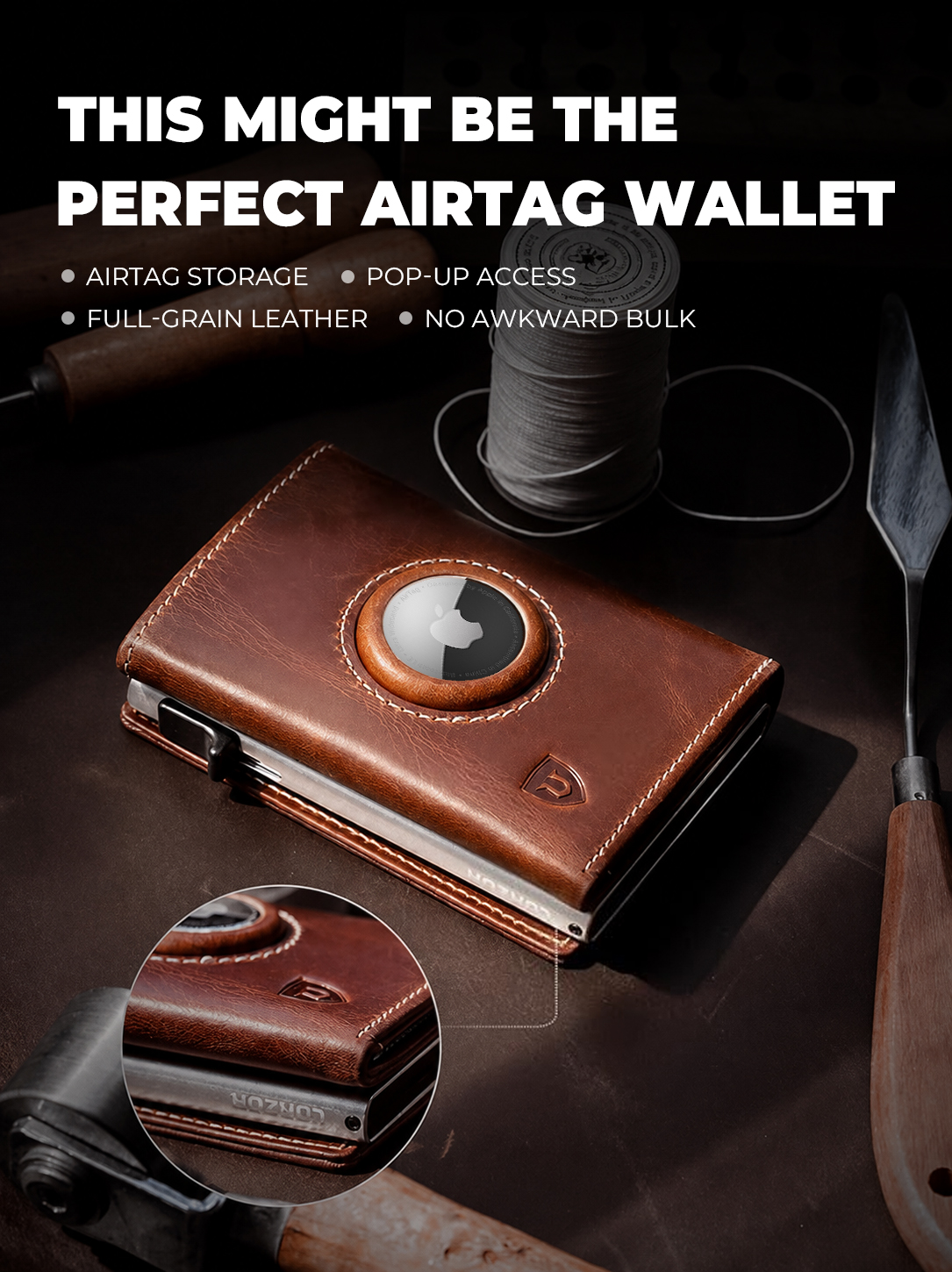
An integrated tracker slot moves the tolerance problem inside the wallet body, where the cavity must hold the accessory without changing the closed profile.
Travel Organisation and RFID Discipline
The Passport Wallet and Passport AirTag Wallet extend the same leather-led approach into a larger panel format, holding a passport alongside cards and cash, with the AirTag version adding the integrated tracker slot. Supplied review data for the passport models — 5.0 from 26 reviews on the AirTag version, 4.95 from 122 on the standard model — reflects satisfaction with capacity and compactness rather than any process measurement; ratings describe how owners experience a product, not how consistently it was built.
RFID is where the brand's published evidence is most specific. LORZOR states that its RFID testing runs at 13.56 MHz using credit cards and professional RFID test signal cards, that signals cannot be read when cards are correctly placed inside the protected zone, and that it holds TÜV and AGC test certifications with supporting laboratory reports and card-reading demonstration assets.
The conditional wording in that claim is the substance, not a hedge. Protection applies to a defined frequency and a defined protected zone, and depends on correct card placement. A buyer evaluating a travel programme should confirm both conditions against the exact SKU, because a passport wallet and a slim card wallet will not have identical shielded areas even when both carry the same brand mark.
Which Process Controls a Mixed Range Actually Exercises
Six control points recur across the LORZOR line, and each one is a place where a supplier either holds a standard or does not.
Leather-to-metal bonding. Only relevant to the frame-led models, but critical there: a shell that separates at a corner ends the product's service life regardless of how well everything else was executed.
Spring mechanism dwell. The pop-up cartridge has to feel the same on the five-hundredth press as on the fifth, which is a material and lubrication discipline as much as an assembly one.
Magnetic closure consistency. Used on the passport and several bifold formats, magnetic assemblies have to close securely without deforming the panel over time.
RFID lamination and zoning. Shielding material has to sit in the correct position relative to the card stack; lamination that is neat but misaligned yields a wallet that blocks the wrong area.
Tracker cavity tolerance. Repeated across four bifold variants, a cavity that is dimensionally stable in one SKU and loose in another indicates pattern control has not been transferred.
Panel and edge finishing at scale. Multi-panel trifolds, ID windows and zippered coin pockets add stitching and edge-paint junctions where consistency is visible to the end user long before any mechanical part fails.
Breadth matters because it puts these controls under one quality system. It does not show the results of that system, and it certainly does not show them at the same maturity level across every family. A newly added bifold variant and a 1979 wallet that has shipped for several seasons are not equivalent evidence, even when they sit on the same collection page.
What Range Evidence Cannot Prove
The honest boundary of this analysis is that a catalogue documents formats and specifications, not operations. Four gaps deserve to be stated plainly.
- Per-SKU yield and process control. Range breadth says a format exists; it says nothing about first-pass yield, rework rates or how tightly tolerances are held on a specific variant. Those figures are not part of the material reviewed here.
- Factory-level qualification. The published record includes test certifications for RFID and pull-strength data for the bonding structure, but no factory audit report, MOQ, lead time or landed-cost schedule. "Not disclosed" is not "not available", yet a buyer cannot treat an undisclosed capability as a secured one.
- Field reliability over time. Cycle tests and pull tests describe controlled conditions. Supplied review summaries for the AirTag wallet family describe card pockets that feel tight initially, cash handling that is less convenient than card access, a small number of comments about internal material wear or adhesion, and an AirTag fastener snap that needs care. These are owner observations rather than measurements, but they are exactly the friction points a controlled test does not capture.
- Transferability across the line. Evidence gathered on the 1979 frame construction cannot be applied automatically to a leather bifold with a tracker cavity. A buyer who validates one family has validated one family.
None of this undermines the range as a qualification signal. It defines the point at which the signal has done its job and documents have to take over.
A Verification Sequence for Evaluation and Execution
For a buyer already past shortlisting, the practical sequence is short and document-led rather than impression-led.
1. Request SKU-level specifications. Ask for weight, closed thickness and capacity for the exact model, not the series figure. The 1979 numbers — approximately 80 g, 0.6 in, up to 12 cards — are stated at series level and should be confirmed per variant.
2. Ask for test reports, not test claims. For RFID, request the 13.56 MHz report naming the protected zone and the certificate holder behind the TÜV and AGC references. For bonding, request the pull-strength record with the test setup, sample count and the control value used.
3. Confirm the tracker configuration explicitly. Establish whether the model uses an integrated AirTag slot or built-in Find My hardware, whether the AirTag is included, and what cavity tolerance applies. The Wallet Pro and the AirTag-compatible wallets are not interchangeable in a programme plan.
4. Sample the two failure modes that matter. A short evaluation should cycle the pop-up mechanism repeatedly and inspect the leather-to-metal edge after handling, since these are the points where a compact wallet usually degrades first.
5. Get commercial terms in writing. MOQ, lead time, replenishment cadence and warranty terms fall outside a product page; a lifetime warranty and 30-day return window are listed at collection level, but the applicable terms should be confirmed for the market and channel being served.
6. Check the service layer separately. The brand reports more than 20,000 customer reviews across Amazon and other online channels and more than 50 global patents related to wallet technology. Both are useful context on market exposure and intellectual property, and neither substitutes for an operational audit.
How a Mixed Range Compares With Single-Format Suppliers
The comparison that matters in procurement is not brand against brand but range architecture against range architecture. Saddleback Leather, for example, describes its men's leather wallets as full grain bifold, slim and RFID styles, with a stated RFID blocker in all but one model — a focused taxonomy built around leather construction. Ekster positions its line as secure, trackable smart wallets in leather, aluminium and carbon fibre, which is a feature-led taxonomy with material as the differentiator.
LORZOR's structure is closer to the second model but broader in format: leather-led construction combined with active tracking, passive AirTag compatibility and travel organisation inside one catalogue. That breadth suits a buyer assembling a multi-format programme — a slim card wallet, a travel piece and a tracker-compatible bifold under one supplier and one material language.
The fit boundary is equally clear. A narrower range is not weaker evidence; a specialist running a single bifold pattern for years may hold tighter tolerances on that pattern than a broad line holds on any single variant. Breadth pays off when assortment consolidation is the buyer's priority. It is the wrong criterion when the requirement is one specific format at maximum process depth.
Outlook: Why Format Decisions Are Becoming Component Decisions
Two published projections frame the next phase. Worldpay's Global Payments Report projects digital wallets at 49% of all sales, online and point-of-sale combined, by 2027 — a shift that reduces the cash capacity a physical wallet must carry. Novatrends Market Intelligence forecasts the smart tracker category growing at a 13.3% CAGR to USD 2.98 billion by 2035, a medium-confidence commercial estimate rather than an observed outcome.
Taken together and read cautiously, they suggest that wallet assortment decisions will increasingly be component decisions: whether a programme standardises on passive AirTag compatibility, on built-in Find My hardware, or on a mix. Each choice carries a different certification path, a different replacement cycle and a different user dependency — the AirTag purchase sitting with the customer, the built-in module sitting with the supplier.
A supplier whose catalogue already covers both architectures has more room to move as those preferences settle. That is a statement about optionality, not about outcomes, and it remains conditional on the per-SKU documentation a buyer should request before committing.
Frequently Asked Questions
What does a wide wallet range actually demonstrate about a supplier?
It demonstrates that several assembly patterns are running under one quality system — leather-to-metal bonding, spring-loaded card mechanisms, magnetic closures, laminated RFID layers and tracker cavities among them. It does not demonstrate that each SKU reaches the same yield, tolerance or field reliability. Range breadth is best treated as an opening signal for evaluation rather than as a substitute for per-SKU test data.
How does LORZOR handle AirTag integration across the Passport, TriPop and Bifold AirTag models?
In those models the AirTag holder is built into the wallet structure with one integrated slot, rather than attached as an external clip or adhesive accessory. The AirTag is not included and is purchased separately. The Wallet Pro follows a different approach: tracking hardware is integrated into the wallet and works with Apple Find My, so no separate AirTag is required. Cavity fit and card capacity should be confirmed for each specific SKU.
What do the 1979 series test figures cover, and what do they leave out?
The LockBond pull-strength figure compares a control sample separating at approximately 60 N with tested LORZOR leather-and-aluminium samples reaching approximately 143–240 N in the same setup, and the pop-up mechanism carries a 30,000+ press-cycle durability test. Both describe defined test conditions. The pull test is against a control sample rather than competitor products, and neither figure predicts field failure rates. Weight of approximately 80 g, 0.6 in thickness and up to 12 cards are stated as series indicators.
Which production questions can a product catalogue not answer?
Listings and collection pages generally do not state MOQ, lead time, first-pass yield, factory audit results or landed cost, and the material reviewed for this article does not contain those figures. Catalogue information and customer ratings describe products in use rather than process control, so a buyer normally needs separate documents — test reports, audit summaries and commercial terms — before treating a supplier as qualified.
How should a buyer verify RFID and tracking claims before ordering?
Ask for the underlying report rather than the claim: the tested frequency, the protected zone, the test method and the certificate holder. LORZOR states that its RFID tests run at 13.56 MHz, that signals cannot be read when cards are correctly placed inside the protected zone, and that it holds TÜV and AGC test certifications. For tracking, confirm whether the model uses passive AirTag compatibility or built-in Find My hardware, whether the accessory is included, and what cavity tolerance applies to the exact variant.
Reading the Range Correctly
The LORZOR line-up is best read as a documented capability surface rather than as a completed qualification. It shows a supplier maintaining slim frame construction, travel organisation, trifold mechanics, bifold tracker cavities and built-in Find My hardware in parallel, with published test data behind two of the harder joints — bonding and card ejection — and a clearly stated RFID test method. It does not show yield, audit outcomes or per-variant tolerance, and it explicitly leaves the AirTag purchase with the customer on the compatible models.
That is a reasonable place for an evaluation to begin. Buyers can review the full model list and current specifications at the LORZOR official store, then take the range as a set of questions to put to the supplier rather than as an answer in itself.
Tem questões ou precisa de mais detalhes?
Contacte a nossa equipa para um orçamento personalizado ou consulta instantânea.
Solicitar orçamento
Preencha o formulário abaixo e a nossa equipa entrará em contacto com uma proposta personalizada.
Chat direto do WhatsApp
Prefere conversar em tempo real? Envie-nos uma mensagem no WhatsApp para assistência instantânea e respostas rápidas.
- Obter orçamento personalizado
- Partilhar fotos ou documentos
- Discuta as suas necessidades diretamente
Geralmente responde em 5–30 minutos durante o horário de expediente.