
Label Printing Machine Fit by Application: CS-220 vs Combined Die-Cutting
Label Printing Machine Fit by Application: CS-220 vs Combined Die-Cutting
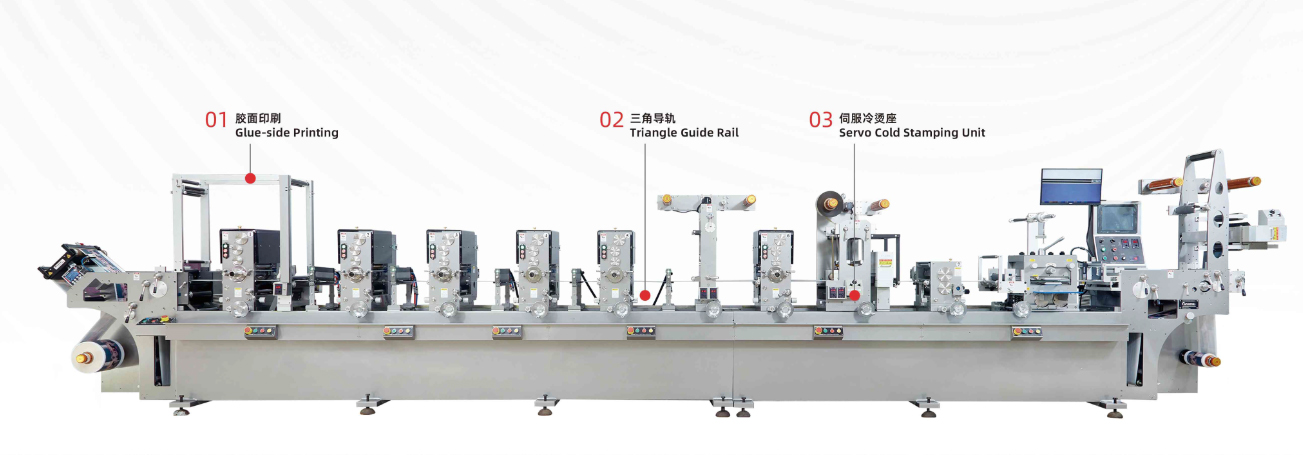
Speed is the easiest number to compare on a label printing machine and usually the wrong place to start. In the CAISHENG range, the more useful first question is which die-cutting method a label job actually requires, because that is what separates the model groups. The CS-220 is configured with flatbed die cutting. The CS-300 and CS-320 combine flatbed and rotary die-cutting stations. The CS-350, CS-370 and CS-380 belong to the rotary die-cutting combination group. For a buyer in research or evaluation, the fit question is therefore not which press is fastest, but which of the three configurations matches the labels, the run lengths and the available floor.
CAISHENG, formally Shenzhen Caisheng Printing Machinery Co., Ltd., manufactures intermittent and high-speed full-rotary letterpress printing machines, flexographic presses, screen printing machines and multi-functional label finishing equipment, and reports that roughly half of its output is exported to Southeast Asia, Europe, the Middle East and the United States. The selection logic below uses the company's published specifications and the label applications it lists for its presses, and it separates what those specifications establish from what only a sample run can settle.
Why the label application decides the die-cutting method
Die cutting converts a printed web into a shaped label. The two common methods differ in how the cutting edge meets the material. Flatbed die cutting presses a flat die against the web in a reciprocating cycle. Rotary die cutting rolls a cylindrical die against the web continuously. Flatbed tooling adapts more readily to complex outlines and to jobs where the shape changes often; rotary die cutting is the faster route for a stable shape repeated over a long run. Those are mechanics of the two processes, not claims about any particular press.
The application decides which of those mechanics becomes the constraint. A converter producing short promotional stickers in several outlines per shift is buying die-change flexibility and small-format accuracy. A converter running one food or household label shape for days is buying repeatable throughput. A converter handling both on one order is buying a line that can carry both stations, which is the reason a flatbed-plus-rotary combination exists as a configuration rather than as an upgrade.
The company frames its equipment around multi-process printing on a single machine: one pass that combines printing, die cutting and finishing steps instead of a sequence of separate offline passes. Every removed pass also removes handling, work-in-progress queue time and one registration step. That is why the die-cutting group changes the production plan and not just the specification sheet.
The three die-cutting groups in the CAISHENG range
| Die-cutting group | Configuration | Published specifications used in this article |
|---|---|---|
| CS-220 | Flatbed die cutting | CS-220-4C and CS-220-5C: 30 to 240 mm web, 220 x 245 mm maximum full-rotary printing area, 40 m/min. The 4C is 4.2 m long at 2.6 t; the 5C is 6.6 m long at 3.6 t. |
| CS-300 and CS-320 | Flatbed plus rotary die-cutting combination | CS-300-6C: 30 to 300 mm web, 280 x 326 mm full-rotary printing area, 280 x 300 mm intermittent, 40 m/min, 6.6 t, 34.5 kW including UV dryers. |
| CS-350, CS-370 and CS-380 | Rotary die-cutting combination | CS-JQ350G-6C and CS-JQ350G-10C: 350 x 419 mm full-rotary printing area, 350 x 380 mm intermittent, 158 m/min full rotary and 60 m/min intermittent, 10 t and 14 t. |
Two qualifications belong directly beside that table. First, the die-cutting group is a family characteristic, while the quotation defines the actual stations, so the quoted configuration should be confirmed station by station. Second, the published speeds are per model. The 40 m/min figure recurs across the flatbed and combination groups because those presses index the web intermittently, whereas the 350-class models are published at 158 m/min in full-rotary mode and 60 m/min in intermittent mode on the same machine.
Around these three groups the company builds flexographic presses and finishing units that support, rather than replace, the die-cutting decision. The CS-J380F-4C intermittent flexo is published with 360 x 419 mm full-rotary and 360 x 380 mm intermittent print areas, 60 m/min and a 4 t frame. The CS-Q370F-6C and CS-370F-8C full-rotary flexo presses are published at 150 m/min with 370 x 200 mm and 370 x 600 mm print areas, at 7 t and 8.6 t. On the finishing side, the CS-Q380V high-speed corona varnish unit is published at a 360 mm maximum web width and 100 m/min.
Short runs, stickers and small formats: the CS-220 flatbed case
The CS-220 group is the narrowest and slowest of the three, and that is the point. Both published models run a 30 to 240 mm web at up to 40 m/min, with a 220 x 245 mm maximum full-rotary printing area. The CS-220-4C is the compact version: 4.2 m long, 2.6 t, 8.4 kW on the main machine plus 3.7 kW of UV drying. The CS-220-5C shares the web width and printing area but is published at 6.6 m, 3.6 t and 17 kW including UV dryers, which points to a longer in-line configuration rather than a faster one.
For a converter whose work is stickers, tags, wristbands and small product or promotional labels in several shapes per shift, the flatbed station does the useful work: one die, one reciprocating cut, and a changeover that does not require a new cylinder. The 4.2 m footprint also matters in leased units and in plants where floor space is already committed to other equipment.
The company's published specification for the CS-220-4C states a registration precision of plus or minus 0.025 mm. That is a company-reported figure rather than an independently measured value, but it is the number to test against dense small-format work such as pharmaceutical or chemical labels, where a fraction of a millimetre shows up as visible misregistration on a small label.
Two limits deserve stating before the quotation stage. The 240 mm web ceiling excludes wide wrap labels and multi-lane layouts. And with flatbed die cutting as the only cutting station in this group, throughput is set by an intermittent cycle: if a job has to run continuously at full-rotary speeds, the CS-220 is the wrong tool regardless of how well its format matches.
Mixed shapes and multi-process work: CS-300 and CS-320
The CS-300-6C is published with a 30 to 300 mm web, a 280 x 326 mm full-rotary printing area, 280 x 300 mm in intermittent mode, 40 m/min, a 6.6 t frame and 34.5 kW including UV drying. It sits in the flatbed-plus-rotary combination group alongside the CS-320 models, which the company lists as its semi-rotary label printing machine (CS-320-6C) and rotary label press (CS-320-7C). The specification set used for this article does not include CS-320 parameters, so those should be requested directly rather than inferred from the CS-300 figures.
A combination configuration answers a specific production problem: one order contains both a simple repeating outline and a more complex or frequently changing shape. The rotary station carries the repeating work; the flatbed station takes the shape that would otherwise need a second offline pass or an additional die set. On a multi-process label where the web is printed, then decorated, then cut, removing that second pass is often worth more than a small gain in line speed, because it removes a handling step and a re-registration.
Where screen printing is a central decoration step rather than an occasional one, the VS-250W full-rotary screen printing multifunctional machine combines screen printing with optional hot foil stamping, embossing, flatbed die cutting and rotary die cutting on a 250 mm maximum web, with 240 x 240 mm maximum screen printing and die-cutting areas. Its format ceiling is tighter than the letterpress groups, which makes it a fit decision rather than a default addition.
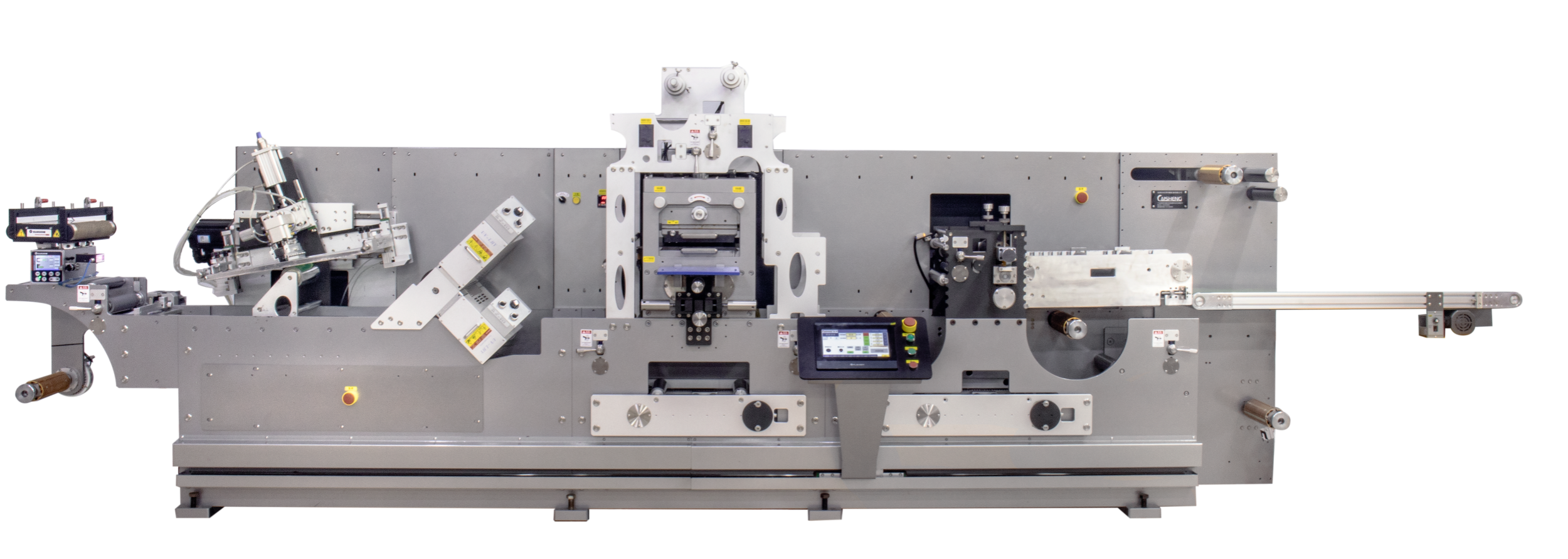
Two records show how the combination group is used in practice. A trademark design and printing company in Taiwan has run a CS-320 for two years, with the case record citing printing precision, stable production performance and flexible process expansion as the reasons the unit was accepted. A large US commercial printing group has run a CS-300 for three years, with the record citing registration accuracy, print quality and equipment reliability. Both are company case records rather than independent tests, and neither discloses run volumes or waste rates.
The cost of the combination is physical. Connected power rises to 34.5 kW on the CS-300-6C against 8.4 kW plus 3.7 kW of UV drying on the CS-220-4C, and the machine grows to 8.9 m and 6.6 t. A buyer also needs tooling for two die methods instead of one, which is a recurring cost that never appears on the machine quotation.
Long runs and high volume: the 350/370/380 rotary combination
At the top of the letterpress range, the CS-JQ350G-6C and CS-JQ350G-10C are published with a 350 x 419 mm full-rotary printing area, 350 x 380 mm in intermittent mode, 60 m/min intermittent and 158 m/min full rotary. The 6C version is 7.8 m long, 10 t and 22 kW with 7.8 kW of UV drying; the 10C version is 12 m long, 14 t, 34 kW with 13.5 kW of LED UV drying. Rotary die-cutting combination is the configuration logic for this group.
Rotary die cutting suits a stable shape repeated over a long run, where the die is a cylinder and the cut is continuous. The trade-off sits at the tooling end: a rotary die is a different purchase from a flatbed die, with its own cost and lead time, and it rewards a job that will not change shape often. A buyer who expects frequent outline changes on a high-speed platform should price that tooling habit before committing to the group.
Where the substrate or the decoration calls for flexo rather than letterpress, the full-rotary flexo presses extend the same high-volume logic: the CS-Q370F-6C and CS-370F-8C are published at 150 m/min with 370 x 200 mm and 370 x 600 mm print areas. The intermittent flexo CS-J380F-4C sits lower in throughput at 60 m/min but is published with a 4 t frame and 25 kW including UV drying, which suits a plant that needs flexo ink laydown without a 150 m/min line.
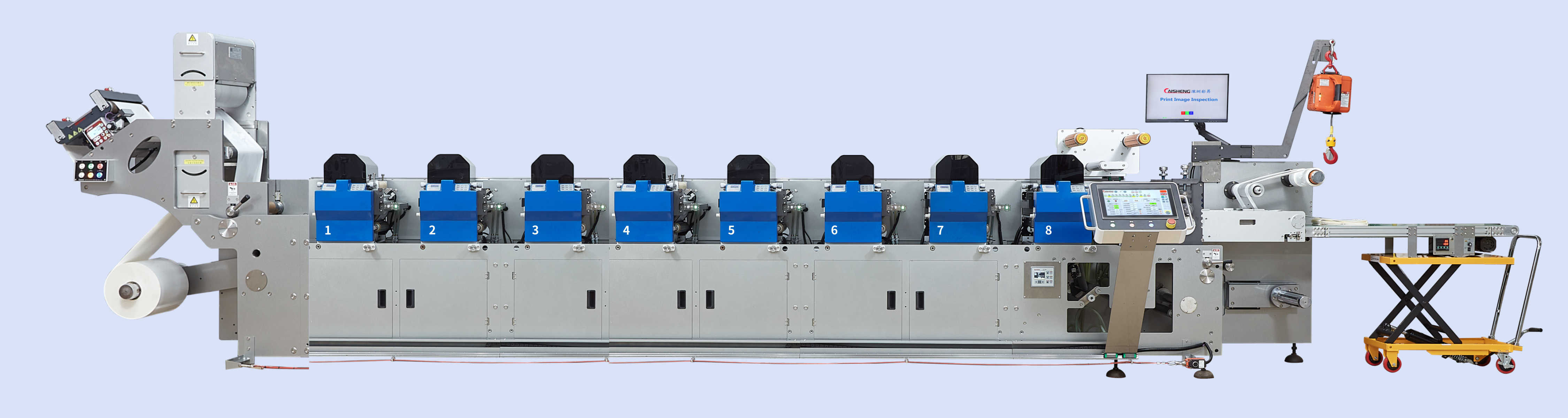
Site checks become procurement checks at this level. A 12 m, 14 t machine with 34 kW of main power and 13.5 kW of LED UV drying is a building decision as much as a press decision: floor loading, the access route, transformer capacity and dryer ventilation all need confirming before the order rather than after delivery.
Matching label applications to the three groups
| Label application | What the die-cutting job usually demands | Group to evaluate first |
|---|---|---|
| Stickers, tags and wristbands | Small formats, several shapes per shift, short runs | CS-220 flatbed |
| Pharmaceutical and chemical labels | Dense small-format printing, tight registration | CS-220 flatbed, or CS-300 and CS-320 |
| Cosmetics and personal care | Decoration plus cutting: screen printing, hot foil, embossing | CS-300 and CS-320; VS-250W where screen printing is central |
| Food and household labels | Long runs of a stable shape, throughput priority | CS-350, CS-370 and CS-380 rotary combination, or full-rotary flexo |
| Wine and spirits labels | Clean outline on premium stock, registration critical | CS-300 and CS-320 first, then 350-class rotary if run length justifies it |
CAISHENG lists all of these label types, covering daily, chemical, wristband, wine, food, cosmetics and pharmaceutical work, as application scope for its presses. The mapping above is selection logic rather than a model-by-model approval: web width, run length and die complexity decide the group, and a large-format wine label can exceed a narrower group's web ceiling regardless of its application category.
Boundaries the specifications do not remove
- Web ceiling. The three groups are published with a 240 mm web, a 300 mm web and a 350 mm printing area respectively; nothing in the supplied data covers wider work, so an oversized requirement needs a different conversation.
- Speed is per model. The 40 m/min figure on the CS-220 and CS-300-6C is not comparable to 158 m/min full rotary on the CS-JQ350G. Intermittent and full-rotary cycles are different operating modes, not a tuning option.
- No field performance data. The third-party data reviewed for this article records no benchmarked uptime, waste percentage or job-change time for these machines from independent sources. A witnessed sample run on your own material is the only honest substitute.
- Environment. The company's application record describes operation at room temperature without a constant-temperature production workshop, which matters for factory planning in Southeast Asia and the Middle East; it does not remove the need for a correct power supply and UV dryer ventilation.
- Support terms. Remote support and a one-year warranty on major components are stated company terms. Response time by region is not published, so it belongs in the contract conversation rather than the brochure comparison.
- Customisation is a menu. The company's ODM list covers glue-side printing, cold foil stamping, lamination, offline or online UV varnishing, flatbed and rotary die cutting, sheet cutting, slitting, corona treating, dust cleaning, static elimination, full-rotary screen printing, hot foil stamping and embossing. Options are not standard equipment, and the quotation governs.
What to verify before the RFQ
- Measure the widest label and the largest die-cut repeat in the current job book, then check both against the group's published web width and printing area.
- Ask for the quoted configuration to be confirmed station by station, including which die-cutting stations appear and in what order, because the model family does not define the build.
- Request a witnessed sample run on your substrate, and ask for that run to include a die change.
- Confirm the die tooling format for each cutting station, who supplies it, and its cost and lead time.
- Check the site: machine length and weight, connected power including UV dryers, air and water cooling, and dryer exhaust.
- Ask for certification documents covering the exact model. Independent reporting on the company records ISO 9001, ISO 14001 and ISO 45001 certification and CE conformity of its products; the certificate scope, not the logo, is what a compliance reviewer reads.
- Confirm commercial terms in writing: one-unit minimum order, 45 to 60 day lead time, 18-unit monthly capacity, 100% testing before shipment, and the one-year warranty on major components.
Market context: label demand is not machine demand
Commercial research published by Mordor Intelligence puts the global print label market at USD 57.05 billion in 2026, growing at 3.28% a year to USD 67.02 billion by 2031. Fortune Business Insights, measuring a different layer of the chain, puts the label printer device market at USD 0.58 billion in 2026, rising to USD 0.82 billion by 2034. The two figures describe printed label output and label printer devices respectively; they cannot be added or averaged, and neither is a direct measure of narrow-web press demand. Read together they support one limited conclusion: label consumption is a large, slowly growing base, which is a precondition for press investment rather than a forecast of it.
Outlook: die-cutting configuration as a procurement criterion
For 2027 buying cycles, the practical change is where the die-cutting question sits in the evaluation. Treated as an accessory, it gets settled after the press is chosen, which is how converters end up sending complex shapes to a second offline operation. Treated as a selection criterion, it decides the group first and the options second. If a job book is moving toward shorter runs with more shapes, the flatbed-plus-rotary group leaves room to move between them. If it is consolidating into long, stable runs, the rotary group and its tooling economics apply. The specifications in this article set the frame for that decision; they do not replace a sample run on the material the labels will actually use.
The company's product brochure, which covers the press and finishing range, is available for download: CAISHENG product brochure (PDF).
Frequently asked questions
Does the CS-220 offer rotary die cutting as well as flatbed?
No. The CS-220 belongs to the flatbed die-cutting group. The models that combine flatbed and rotary die-cutting stations are the CS-300 and CS-320, while the CS-350, CS-370 and CS-380 sit in the rotary die-cutting combination group.
When is a flatbed-plus-rotary combination worth the extra stations?
When one order mixes a simple repeating outline with a more complex or frequently changing shape. The rotary station carries the repeat, the flatbed station takes the complex shape, and one pass replaces two. The trade-off is a longer and heavier machine, higher connected power, and tooling for two die methods.
What web width does each group handle?
Published figures are a 30 to 240 mm web on the CS-220 models, 30 to 300 mm on the CS-300-6C, and a 350 x 419 mm maximum printing area on the CS-JQ350G models. The CS-JQ350G web width is not stated in the supplied specification and should be requested from the manufacturer.
Can a label printing machine be customised for a specific label job?
The company offers ODM customisation covering glue-side printing, cold foil stamping, lamination, UV varnishing, flatbed and rotary die cutting, sheet cutting, slitting, corona treating, full-rotary screen printing, hot foil stamping and embossing. These are options, and the confirmed quotation defines what a specific machine includes.
Is a constant-temperature workshop required?
No. The company's application record describes operation at room temperature without a constant-temperature production workshop. Power supply quality, UV dryer ventilation and cooling systems still need to be planned for the specific model.
Tem questões ou precisa de mais detalhes?
Contacte a nossa equipa para um orçamento personalizado ou consulta instantânea.
Solicitar orçamento
Preencha o formulário abaixo e a nossa equipa entrará em contacto com uma proposta personalizada.
Chat direto do WhatsApp
Prefere conversar em tempo real? Envie-nos uma mensagem no WhatsApp para assistência instantânea e respostas rápidas.
- Obter orçamento personalizado
- Partilhar fotos ou documentos
- Discuta as suas necessidades diretamente
Geralmente responde em 5–30 minutos durante o horário de expediente.