
Laboratory Furniture: Materials, Safety Standards, and Sourcing Guide
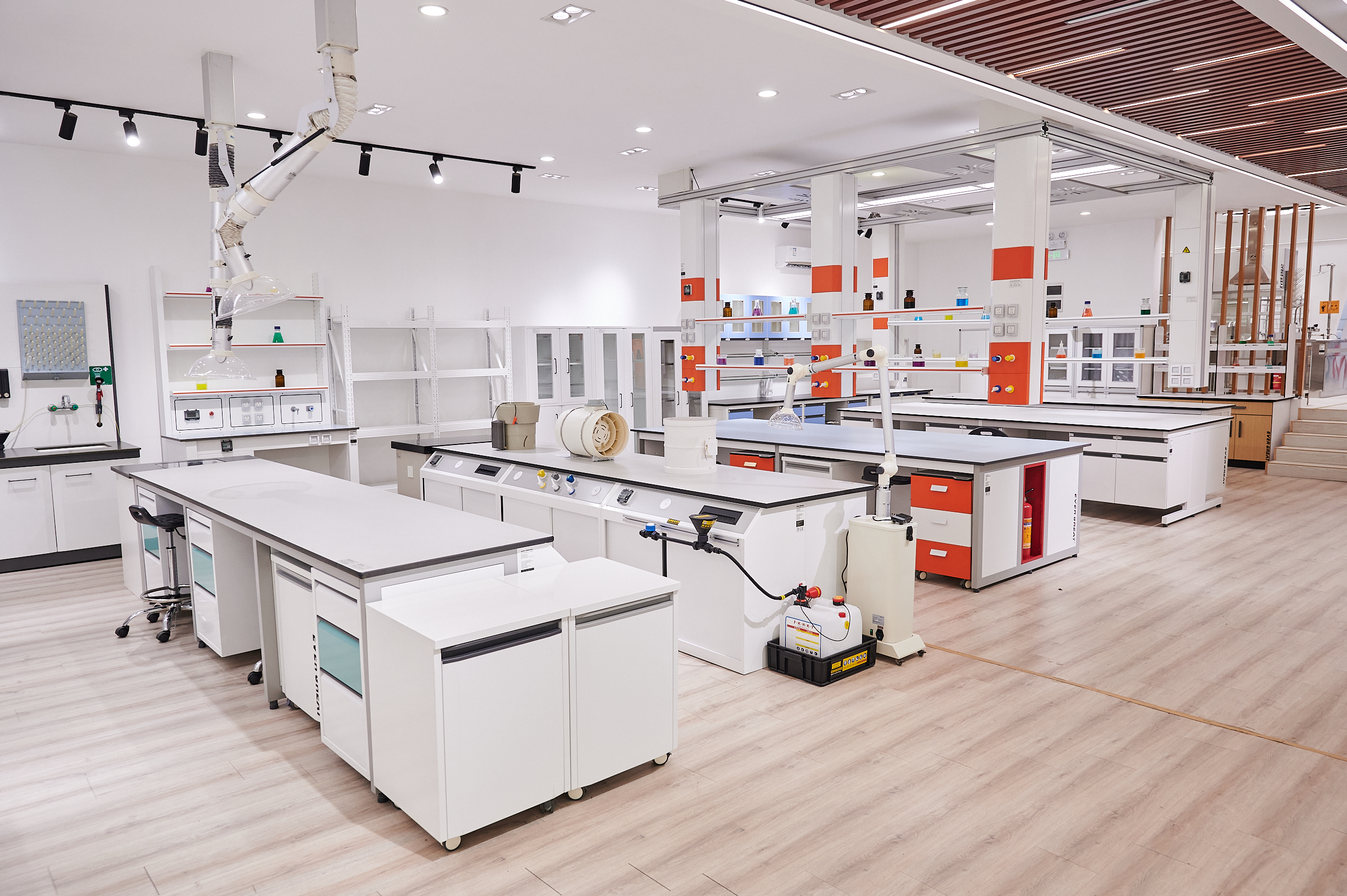
Modular laboratory workbenches and storage systems in the Ever Great showroom, Foshan, China.
The global laboratory furniture market is valued at approximately USD 4.8 billion in 2025 and is projected to reach USD 8.1 billion by 2034, according to one industry estimate. Other research firms have published lower figures, reflecting different definitions of the category. What remains consistent is the direction of change: laboratory furniture is moving from commodity equipment toward engineered infrastructure, where material selection, safety compliance, and supplier capability determine whether a laboratory project succeeds.
Metal furniture led the material segment with a 52.7% revenue share in 2025. The category covers workbenches, fume hoods, storage cabinets, and seating, but the products carrying the highest engineering content are fume hoods and safety storage cabinets.
Why Laboratory Furniture Is Not Ordinary Furniture
Laboratory environments impose demands that commercial furniture is not designed to handle. Workbenches may be exposed to concentrated acids, heavy mechanical loads, high temperatures, and continuous operation. Storage cabinets may hold flammable liquids or corrosive chemicals that require fire-resistant construction, spill containment, and venting provisions. Fume hoods must maintain a defined face velocity and contain hazardous vapors even when airflow conditions fluctuate.
Failures in this category carry consequences beyond cosmetic damage. An unrated cabinet holding acetone becomes a fire hazard. A fume hood with poor containment exposes laboratory staff to toxic vapors. A worktop that degrades under chemical attack can contaminate samples and invalidate research data. This is why procurement in this category is shifting from price-based selection toward specification-based evaluation.
Compliance Standards That Shape Purchasing Decisions
Two standards deserve particular attention from buyers. ANSI/ASHRAE Standard 110-2016 (R2025) is the primary American national standard for quantitative performance testing of laboratory fume hoods. It specifies a test method for evaluating fume containment, allowing buyers to compare products on measured leakage rather than manufacturer claims. European standard EN 14470-1 classifies fire-resistant safety cabinets into Type 15, 30, 60, and 90 minutes based on internal temperature rise limits, giving storage decisions a verifiable safety margin.
EN 14175 for fume hood performance and ISO 9001 for quality management systems are also commonly referenced in laboratory furniture specifications. For buyers, documented third-party test reports are becoming a minimum entry condition rather than a differentiator.
The Manufacturer Behind the Product
Guangdong Ever Great Laboratory Equipment Co., Ltd., established in 2011, is a full-service laboratory infrastructure manufacturer and EPC solutions provider based in Foshan, Guangdong, China. The company operates a 6,000-square-meter manufacturing base with an annual output of 20,000 units and a team of over 40 professionals, including more than 15 senior engineers with over a decade of laboratory engineering experience. The R&D team consists of 8 engineers.
The product portfolio covers fume hoods, laboratory workbenches, safety storage cabinets, and PP and stainless steel lab furniture. Export business accounts for 60% of total sales, with major markets in the USA, EU, Middle East, and Africa, and clients in Mainland China, Hong Kong SAR, Malaysia, India, Australia, Italy, Saudi Arabia, the UAE, and the United States.
Ever Great is recognized as a National High-Tech Enterprise and holds ISO 9001, ISO 14001, and ISO 45001 certifications. Its fume hoods are tested to EN 14175 and ASHRAE 110 standards, with third-party reports from SGS. CE and RoHS certifications are held by flagship product series.
Material and Design Decisions That Matter
Worktop Materials
The worktop is the surface on which most chemical and physical operations occur. Epoxy resin worktops are a common choice for heavy chemical synthesis, university research, and high-heat environments. The material is monolithic and non-porous, providing resistance to harsh corrosives such as concentrated acids and thermal shock up to 600°C. Phenolic resin worktops suit biology, pharmaceutical QC, physical testing, and general chemistry laboratories, offering strong scratch and impact resistance, standard chemical durability, and cost efficiency.
| Criteria | Epoxy Resin | Phenolic Resin |
|---|---|---|
| Recommended for | Heavy chemical synthesis, university research, high-heat environments | Biology, pharmaceutical QC, physical testing, general chemistry |
| Key property | Monolithic, non-porous; thermal shock up to 600°C | Scratch and impact resistance; cost efficiency |
| Best suited when | Concentrated acids and high temperatures are present | General chemical exposure with budget constraints |
Ever Great's island laboratory bench (EG-S0-CB005) is a full-steel central workstation for research institutes, universities, and pharmaceutical laboratories. It uses cold-rolled steel frames of 1.0-1.2 mm thickness, with worktop options of 12.7 mm phenolic resin, 20 mm ceramic, or epoxy resin. Electrical sockets are rated at 220V/10A; optional accessories include a reagent rack and PP sink.
The C-frame wall laboratory bench (EG-S0-LB003) is a suspended design with a 40 x 60 x 1.8 mm high-carbon steel tube frame and a 12.7 mm phenolic resin worktop. The suspended configuration allows easy cleaning beneath the bench and flexible cabinet placement.
Fume Hood Engineering
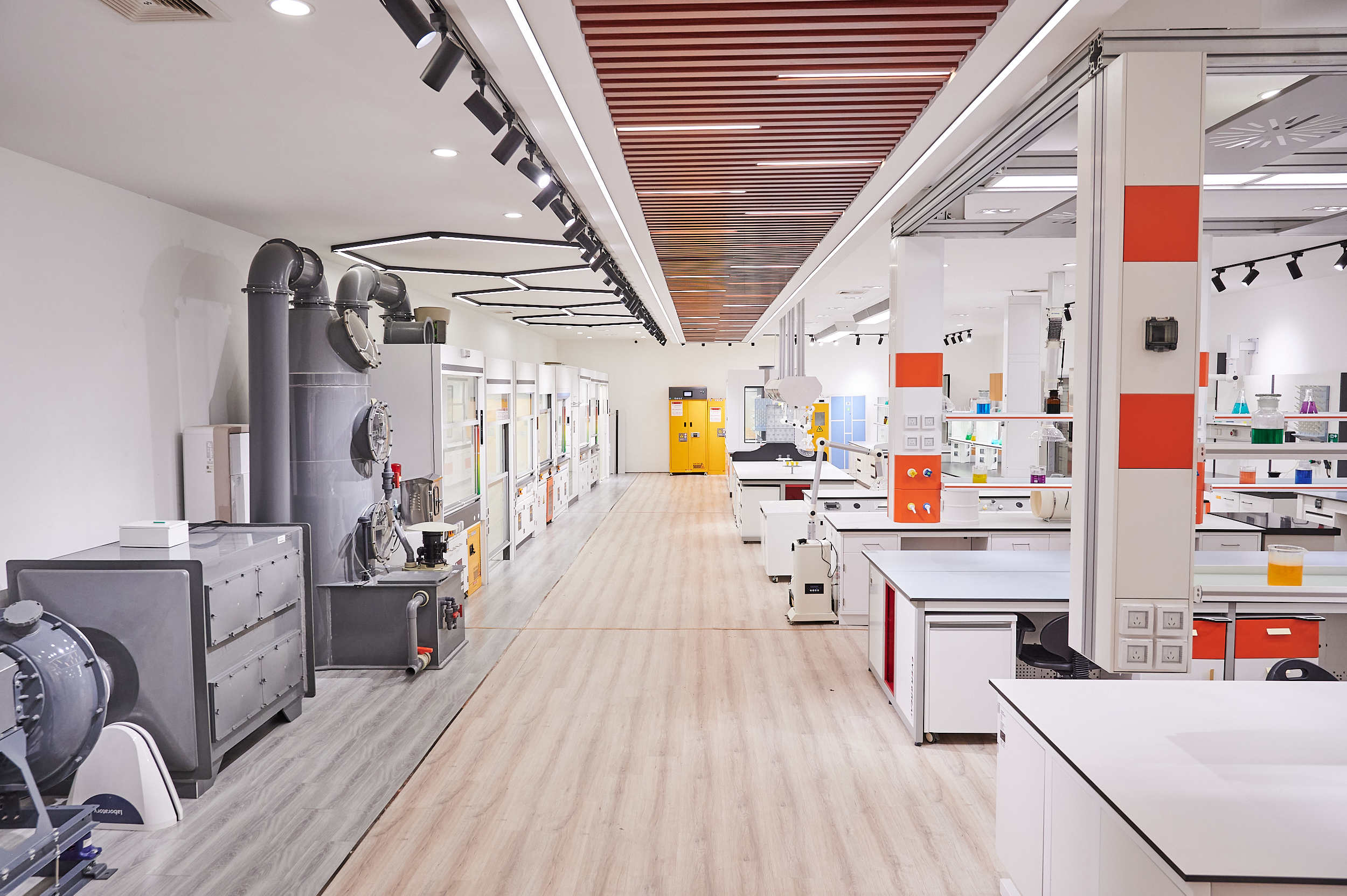
Laboratory ventilation and fume hood systems for chemical and pharmaceutical applications.
Fume hoods are the most safety-critical element in a laboratory furniture system. The polypropylene fume hood (EG-PP-FH) is a seamless welded PP anti-corrosion fume hood with PP sheet thickness of at least 8.0 mm, a face velocity of 0.3-0.6 m/s, and a three-stage baffle system. It is designed for chemical, electroplating, and acid-alkali laboratories, where all-PP construction resists corrosion inside the exhaust path.
The Orion series — models Orion-TS-1500, Orion-TS-1800, Orion-LD-1500, and Orion-LD-1800 — provides narrow-frame fume hoods in benchtop and walk-in configurations. Nominal face velocity is 0.3 m/s, with PP exhaust canopy diameters of 250 mm or 315 mm. These hoods are VAV/CAV-ready, allowing integration with variable-air-volume building controls.
Safety Storage Cabinets
Storage cabinets protect personnel and the building structure. The flammable safety cabinet (EG-SF-LB005) is a yellow fireproof chemical safety cabinet with 1.2 mm double-wall steel construction and a 38 mm air barrier. The 51 mm spill sump contains leaks, dual flash-arrested vents release pressure without propagating flames, and the three-point latch keeps doors sealed under fire conditions. Nominal capacity is 45 gallons, with overall dimensions of 1090 x 460 x 1650 mm.
For acid-alkali chemical storage, the PP acid and alkali storage cabinet (EG-PP-CB003) provides a metal-free solution using 8.0 mm PP sheet with PP hardware, a bottom sump, three adjustable spill-containment shelves, and a 110 mm exhaust port. The vented chemical and reagent cabinet (EG-S0-LB001) is a full-steel exhausted chemical cabinet with double-wall construction, epoxy coating, and tempered glass, offering four adjustable spill-retaining shelves and exhaust connection options of 110/150 mm.
The gas cylinder safety cabinet (EG-S0-CB005) serves chemical, semiconductor, and industrial-gas laboratories with single-, double-, and triple-cylinder options, alarm/exhaust linkage, and an automatic purging configuration. The integrated emergency safety cabinet (EG-SF-CB011) consolidates shower, eyewash, first-aid, and fire-safety storage in a cold-rolled steel unit with epoxy powder coating.
Structural Protection and Coating Systems
Long-term durability is determined by materials and processes that are not visible in product photos. Ever Great uses high-grade cold-rolled steel, heavy-duty epoxy resin, chemical-resistant phenolic resin, physical-chemical boards, and industrial ceramics. Full-welded structural frames and heavy-duty mortise-and-tenon joints provide mechanical integrity, while acid-wash phosphating and anti-corrosive epoxy powder coating protect steel surfaces.
Factory-to-Site: Managing Overseas Projects
Overseas laboratory furniture projects face specific risks: maritime transport vibration and collision damage, moisture and salt-spray corrosion, on-site structural misalignment, and high local labor costs.
Ever Great's approach starts in the factory. The company uses KD mortise-tenon pre-assembly structures, heavy-duty export plywood crating with vacuum foil wrap, and 100% pre-assembled test fits before shipment. Standardized 3D modular assembly video guides, color-coded hardware labeling, backup wearing parts, and remote engineer installation guidance help lower installation errors and overseas labor expenses.
Application Scenarios by Industry
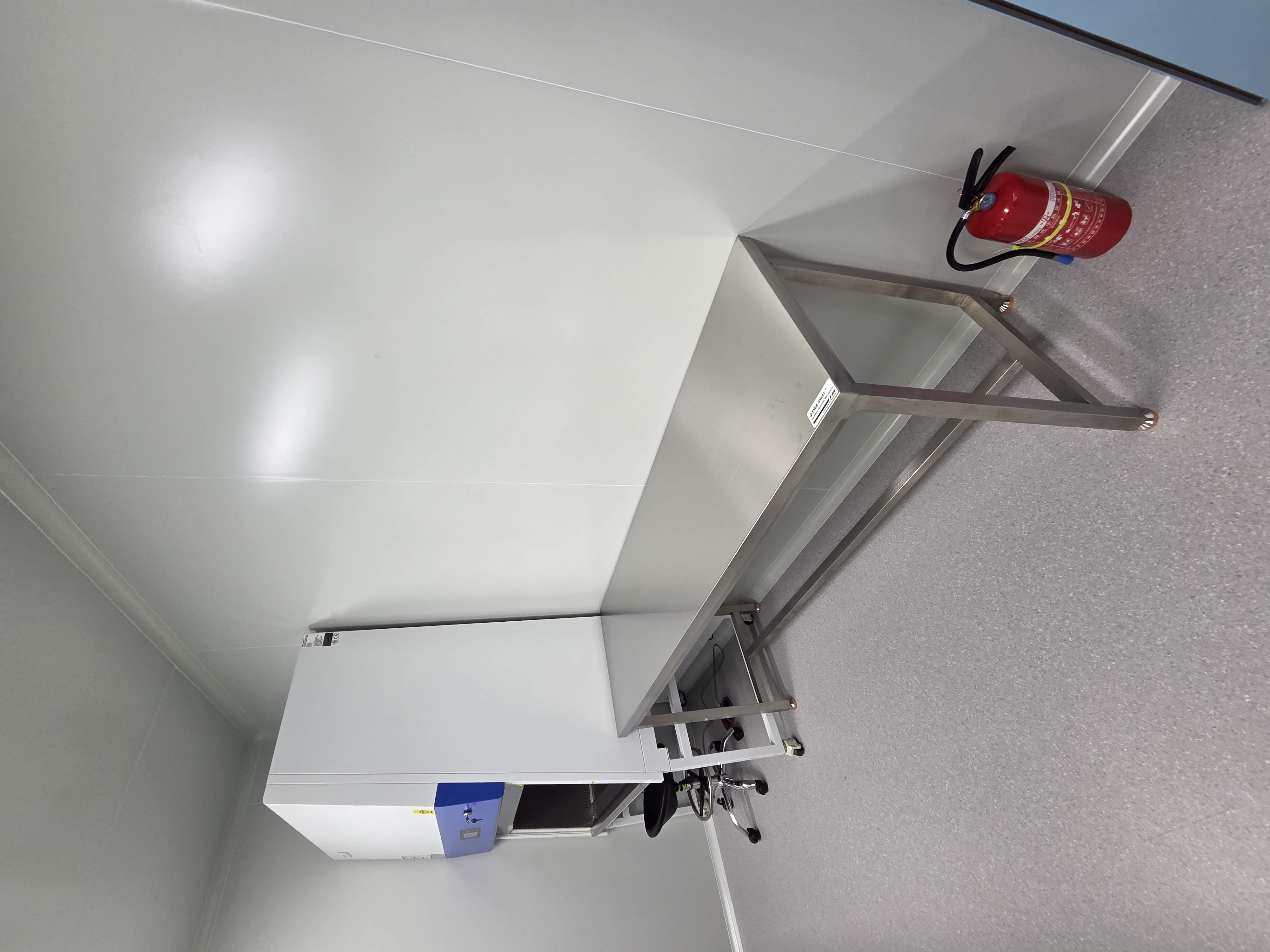
Stainless steel laboratory workstation in a pharmaceutical/cleanroom application.
Different industries impose different requirements on laboratory furniture.
In Kazakhstan, a smelting plant QC laboratory handling HCl, HNO3, and HF with continuous 24/7 exhaust requires fume hoods with EN 14175/ASHRAE 110 compliance, seamless PP inner liners or ceramic worktops, and explosion-proof lighting, typically integrated with centrifugal PP exhaust fans and acid scrubber towers.
In Brunei, a metallurgical high-temperature testing workshop requires SUS 304/316 stainless steel, heat resistance up to 800°C, and load capacity up to 800 kg for heavy sample preparation equipment.
In Saudi Arabia, a new R&D center with load-bearing up to 500 kg/m² needs acid- and alkali-resistant worktops (phenolic, epoxy, or ceramic), high load capacity, and heavy-duty epoxy powder coating, integrated with reagent racks, PP sinks, eyewash stations, gas taps, and socket modules.
In Argentina, a laboratory preparing for safety inspection requires 100% pure polypropylene seamless welding, leak-proof liquid basins, and anti-static design for corrosive chemical storage, with 24/7 top exhaust ventilation connection.
In Kenya, GMP pharmaceutical expansion and sterile testing rooms require ISO Class 5 to Class 8 cleanroom environments, HEPA filtration efficiency of 99.99% at 0.3 μm, and ultra-low noise below 65 dB, typically served by stainless steel workbenches and fume hoods.
These cases share a pattern: the customer is not purchasing furniture as a commodity, but a functioning infrastructure layer that supports a specific scientific or industrial process.
Market Trends Shaping Laboratory Furniture
Compliance as a procurement filter. Standards such as EN 14175, ASHRAE 110, and EN 14470-1 are increasingly used as tender acceptance criteria. Suppliers with documented third-party test reports hold an advantage.
Application-specific materials. Metal furniture accounts for 52.7% of the material segment, while PP furniture continues to expand in acid-alkali and electroplating applications. The market is moving toward matching material properties to exposure profiles.
China's supply chain role. China exported over USD 4.15 billion of furniture parts (HS 940390) in 2024, including components used in laboratory furniture. For buyers, supplier verification — factory audits, certifications, pre-shipment testing — becomes more important than geographical origin.
EPC delivery models. Large laboratory projects increasingly favor suppliers that can handle space planning, design, manufacturing, shipping, and installation guidance through one contract.
Modular vs. Traditional On-Site Construction
The traditional approach to laboratory furniture involves on-site fabrication: steel frames welded by local contractors, custom worktops, and field-built ducting. This offers maximum adaptability to site conditions and remains workable for small renovations or unusual architectural constraints.
Modular prefabricated construction moves the work to the factory. Frames are precision-welded, surface-treated, and pre-assembled for testing before shipment. KD structures reduce shipping volume and allow quick reassembly on site. Quality is controlled by factory QA/QC systems rather than by the variability of local labor.
The trade-off is real. Modular projects require accurate space planning and precise identification of utility points before production. There is limited room for on-site improvisation. Buyers should allocate time for detailed measurement and engineering coordination before ordering.
Future Outlook
Laboratory furniture will continue its shift toward engineered, compliance-driven products. Growth projections — regardless of which research estimate is used — point to sustained demand from pharmaceutical, educational, industrial, and clinical sectors.
Several developments are worth tracking: wider adoption of fire-resistant cabinet classifications in global tenders, deeper integration of airflow monitoring and IoT diagnostics into fume hood systems, growing demand for cleanroom-compatible furniture, and continued consolidation of procurement through EPC frameworks.
FAQ
Should I choose epoxy resin or phenolic resin for laboratory worktops?
The choice depends on chemical exposure intensity and heat resistance requirements. Epoxy resin is recommended for heavy chemical synthesis, university research, and high-heat environments. It is monolithic and non-porous, offering resistance to harsh corrosives and thermal shock up to 600°C. Phenolic resin is recommended for biology, pharmaceutical QC, physical testing, and general chemistry. It offers scratch and impact resistance, standard chemical durability, and cost efficiency.
How do I select between a ducted fume hood and a ductless fume hood?
The recommendation depends on the chemical hazard profile, building exhaust infrastructure, and flexibility needs. Ducted fume hoods are recommended for heavy chemical applications, acid digestions, volatile toxic gases, and high-throughput research. They exhaust 100% of fumes outdoors and avoid long-term filter replacement costs. Ductless fume hoods use HEPA/activated carbon filtration to recirculate cleaned air, suiting light-to-moderate chemical handling, educational labs, or leased spaces without external ductwork.
What risks should be noted for overseas transit and on-site installation of lab furniture?
Overseas lab furniture projects face risks including maritime transport vibration and collision damage, moisture and salt-spray corrosion, on-site structural misalignment, and high local labor costs. Mitigation includes KD mortise-tenon pre-assembly structures, heavy-duty export plywood crating with vacuum foil wrap, and 100% pre-assembled test fitting before shipment. Standardized 3D assembly video guides, color-coded hardware labeling, backup parts, and remote engineer installation support lower assembly errors.
What should I do if hazardous gas leaks from the fume hood?
Stop the experiment immediately and evacuate personnel. Prevention relies on proper sash height, regular sensor calibration, and a fume hood with dynamic aerodynamic baffles and VAV auto-response calibration. Containment validation under ANSI/ASHRAE 110 and EN 14175 provides assurance. Some manufacturers perform 100% pre-shipment SF6 tracer-gas leak testing. After a leak, inspect the exhaust pipeline and equipment and recalibrate sensors before resuming work.