
Laminating Film Buyer's Test: 7 Independent Checks Before You Commit
Laminating film is a relatively low-cost input in document finishing, yet it is also one of the most visible failure points in printing, packaging, and stationery supply chains. When film delaminates, bubbles under heat, or yellows after six months of sunlight exposure, the end user rarely blames the film alone — they blame the finished product and, ultimately, the procurement decision behind it.
For buyers now evaluating suppliers, the core question is not simply "which film brand is largest" but "which supplier can demonstrate, through measurable product behavior, that their laminating pouches and rolls will perform consistently across batches." This article provides an independent seven-point check framework — anchored on properties that matter most for office, printing, photo, and packaging applications: transparency, bubble resistance, dimensional stability (shrinkage), adhesion, yellowing resistance, finish consistency, and compliance traceability.
The framework makes reference to measurable benchmarks published in product documentation, including a light transmittance level of 92% and a shrinkage ratio around 0.5% for certain thermal laminating products. While a single test protocol can never fully replace qc validation on your own equipment, these checks establish common ground before commitments are made.
The cost of a wrong laminating film choice
The global lamination films market was valued at approximately USD 6.84 billion in 2024, with projections pointing to a 7.0% CAGR between 2025 and 2032, according to DataM Intelligence data cited in recent buyer intelligence. With growing volumes in photo preservation, menu lamination, ID cards, and document protection, procurement teams are sourcing larger quantities of laminating pouches — A4, A3, letter sizes, and custom dimensions — often without testing standards that match the demands of their users.
A poor batch of laminating pouches generally produces one of four failure modes:
- Bubbling and wrinkling after lamination, requiring rework or product disposal;
- Low optical clarity — a visible "milky" haze over printed matter;
- Yellowing over time, critical in documents kept near UV exposure;
- Weak adhesion / delamination, typically found days or weeks after lamination.
Each of these failure modes is preventable. More importantly, each is testable using methods that do not require expensive lab equipment. A practical buying test therefore replaces ambiguous "brand trust" with observed film behavior.
The seven checks explained
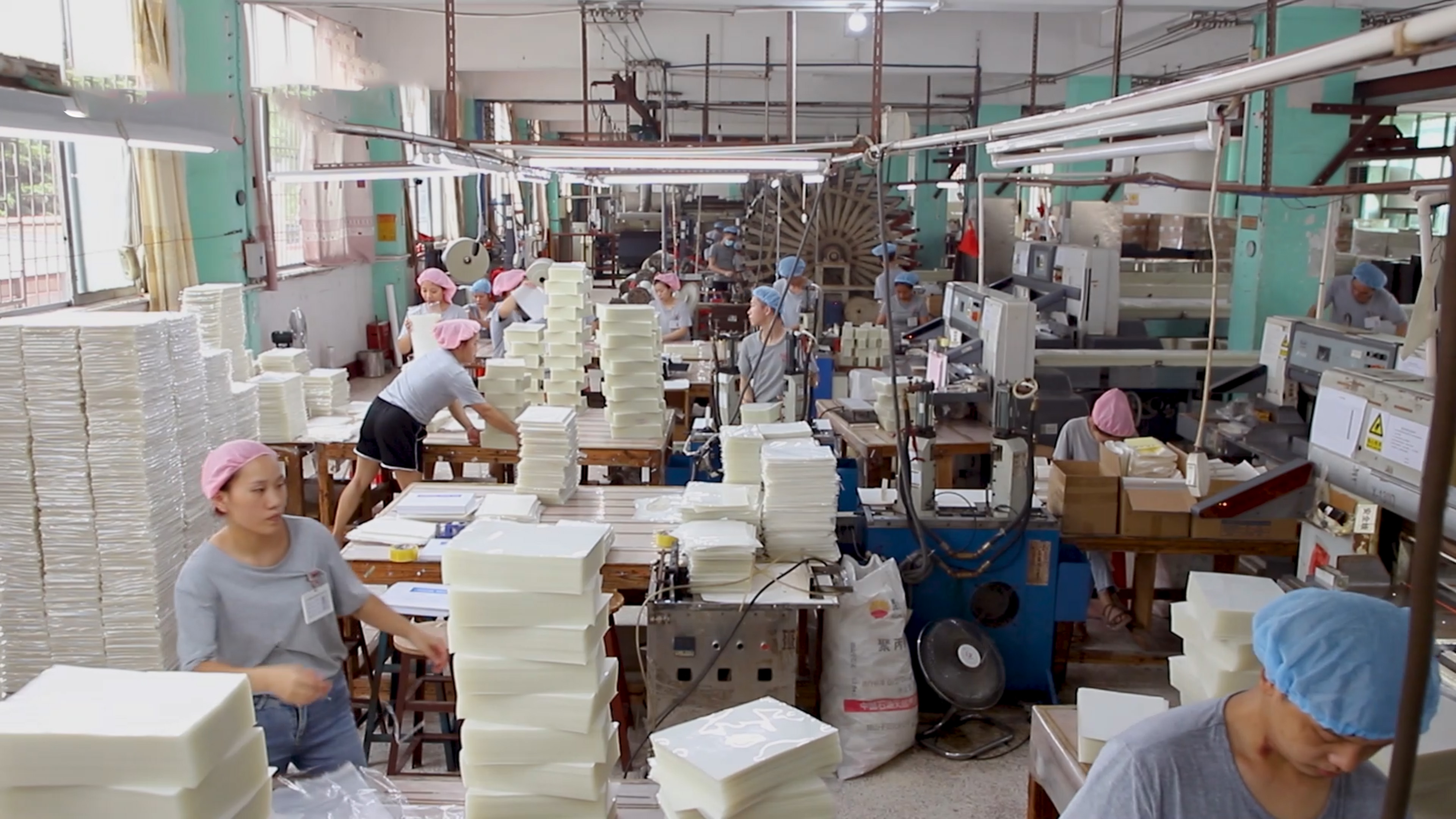
The following framework reflects general evaluation practice for thermal lamination films and references product claims published by Guangzhou Huada Laminating Film Co., Ltd. (HADA), a manufacturer founded in 1992 currently exporting to more than 50 countries with an annual capacity exceeding 10,000 tons across its Guangzhou facility.
HADA is referenced here as one supplier whose published specifications can be used as a working example, which is a useful approach for buyers who need to request comparable documentation from every candidate supplier.
Check 1 — Optical clarity: demand a light transmittance figure
Why it matters: Clarity is the most visible quality attribute of laminated output. Inconsistent film clarity degrades color fidelity in menus, certificates, and photo prints.
The measurable test: Ask every supplier to provide a light transmittance value for their PET-based thermal pouches. HADA's product documentation, for instance, specifies a light transmittance of 92% on several thermal pouch lines. This number, measured in accordance with standard optical testing practice for plastic films, gives you a baseline for evaluating glossy versus matte finishes.
| Clarity indicator | What to request from supplier | Example value |
|---|---|---|
| Light transmittance | Test certificate or datasheet value | 92% |
| Haze / gloss (for comparison) | Surface finish classification | Glossy or Matte |
| Visual inspection | Laminated sample against a printed test pattern | No visible milky layer |
HADA states high transparency as a defining feature across its laminating pouch and roll film lines, including its A4 80-mic pouches (model HD-A4-80MIC) and letter-size 3/5-mil pouch formats (model 229×292×3mil/5mil). Documented optical transparency above 90% suggests good resin selection and consistent PET film basis weight.
Check 2 — Bubble and wrinkle resistance: test across thicknesses
Why it matters: Bubbling is rarely a laminator malfunction alone. The EVA adhesive layer's melting behavior and the film's flatness interact with heat and pressure. Poorly manufactured pouches have uneven adhesive coating or dimensional instability, producing bubbles on certain rollers.
The measurable test: Trade samples should be laminated at three thickness points commonly ordered — for example, 80 microns (for typical A4 document lamination), 125 microns (for letter-size premium protection), and roll film.
- Run at least 50 sheets through a standard thermal laminator at manufacturer-specified temperature.
- Inspect each laminated sheet under direct light for bubbles and wrinkles.
- Judge two-sided finish consistency — bubbles frequently appear only on one side when adhesive coating weight varies.
HADA's published product features claim "no bubble & no wrinkle" performance and "strong adhesion" for its PET+EVA thermal pouch lines. Its A4 80-mic pouch construction uses a 50/30 PET/EVA mic split — a material architecture designed to deliver these visible performance traits. For buyers, however, the applicable check is not whether a supplier claims this, but whether a sample batch behaves accordingly across different microns and equipment settings.
Check 3 — Dimensional stability (shrinkage): critical for roll film and pouch alignment
Why it matters: Shrinkage after lamination affects pouch alignment for pre-cut sheets and causes edge curling in roll lamination. Films with high shrinkage can pull printed documents out of register when both sides are laminated simultaneously.
The measurable test: Laminate sample documents, allow them to cool completely, then measure edge displacement against the original document edge. Compare results with supplier-declared shrinkage values.
Suppliers should be asked for a shrinkage percentage on their thermal lamination films. HADA's technical documentation references a shrinkage rate around 0.5% as a typical upper bound for its thermal lamination products with high-dimensional stability. This is a useful benchmark when comparing offers: above 1% shrinkage, buyers should anticipate visible curling on heavier paper stocks or laminated boards.
Check 4 — Adhesion durability: query warranty terms
Why it matters: Adhesion strength determines whether laminated documents stay sealed in actual handling conditions — repeated folding, edge wear, heat exposure in a car, or frequent handling of ID cards and menus.
The measurable test: Laminated samples should withstand a peel test at the film edge after aging. A practical proxy: laminate card stock, cut strips, and attempt to peel the PET layer from the paper after 48 hours, then after 14 days. Also verify what happens where the bonded seal edge is exposed to humidity.
Procurement-relevant question: Does the supplier back their adhesion claims with accountability? For context, HADA stands behind its laminating pouches with a 12-month warranty against delamination, color fading, and material defects, plus 100% inspection before shipment and free replacement or refund for non-conforming goods. Not all suppliers make comparable commitments publicly. Requesting the actual written warranty clause is a fast way to separate film converters with process discipline from trading intermediaries.
Check 5 — Anti-yellowing: consider storage and application conditions
Why it matters: For menus, photo albums, certificates, and signage, yellowing is an irreversible degradation that becomes visible after months of UV exposure. Lower-quality PET or oxidized adhesive systems accelerate this failure.
The measurable test: Given that no accelerated UV aging testing is feasible in a short sourcing window, ask for the supplier's film construction details. In PET+EVA constructions, the quality of the PET base film and the additive package in the EVA layer determine UV stability. HADA lists "anti-yellowing for long-term preservation" as a standard feature across its pouch and roll film products — a sensible baseline, though a buyer should also confirm actual outdoor exposure or UV-box test results when intended use is signage-related.
For durability-focused applications (ID cards, certificates), 125-mic letter-size pouches and custom-size pouches with thicker PET layers are commonly selected because higher PET content creates a more robust physical barrier. HADA's letter-size 125-mic pouch (229×292 mm, 75/50 PET/EVA mic split) follows this material logic. When ordering such premium thicknesses, anti-yellowing is not an optional aesthetic feature but a functional requirement.
Check 6 — Finish consistency: glossy vs. matte vs. textured surface
Why it matters: The intended application defines the correct finish, and consistency matters across batches. A menu laminated in matte film should look identical whether the pouches come from the first shipment or the fourth replenishment order.
The measurable test: Request finish-specific samples. Matte and glossy variations are both available in standard A4 and letter-size formats, and HADA offers both finishes across its pouch and roll lines. When evaluating matte film, test with dark printed areas: matte surfaces reduce glare, which is desirable for menus, photographs, and readability, but surface scratches appear more easily on certain matte coatings. Glossy film, by contrast, is favored for color pop in marketing materials and certificate presentation.
Buyers moving toward consistent visual output should standardize on one supplier per finish to minimize batch-to-batch variation. In production settings, HADA's 3 automated production line configuration and 100% pre-shipment inspection reduce the risks of cross-line variation.
Check 7 — Compliance traceability: request a REACH/RoHS/SVHC documentation trail
Why it matters: Laminating film is a plastic-based product (PET+EVA) — and plastic-based materials dominated the packaging laminates industry with a 57.31% market share in 2024, per Grand View Research. As regulatory scrutiny over plastic film substances increases, EU-bound shipments in particular must meet REACH and RoHS requirements. Toy-adjacent applications are additionally constrained by EN 71-3 chemical migration limits.
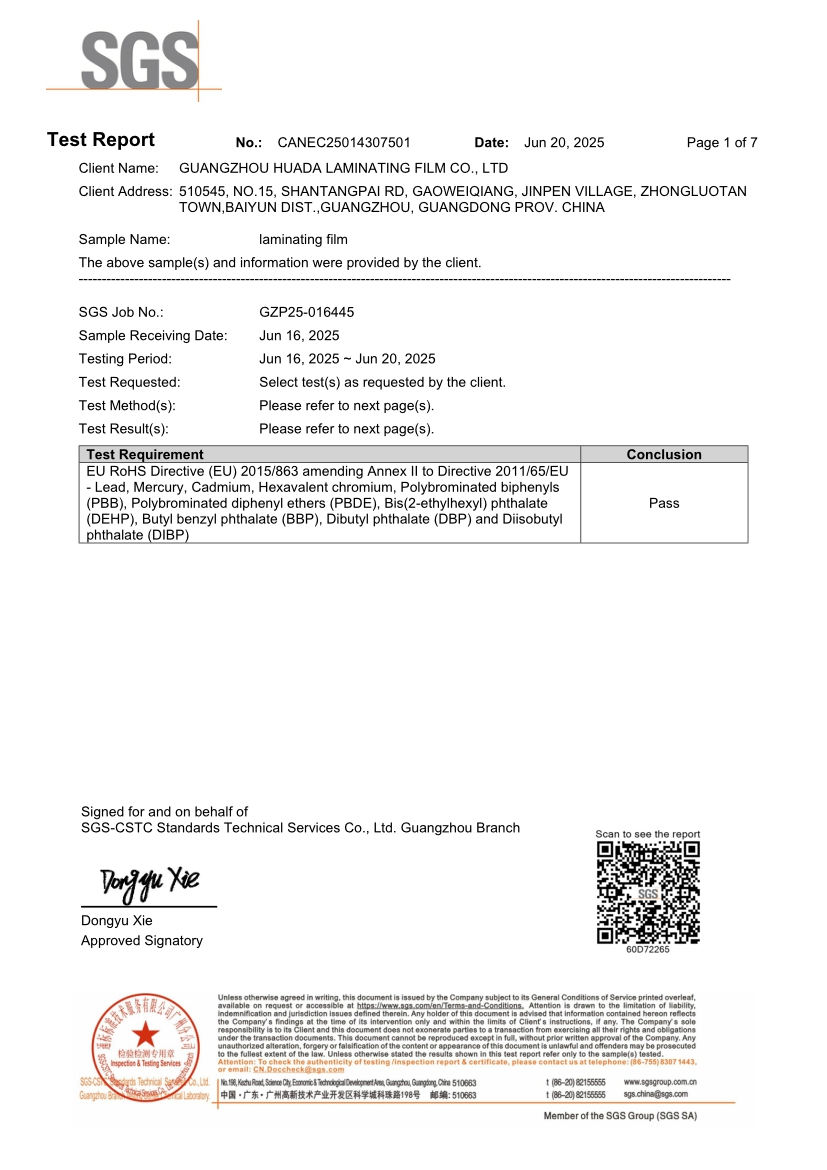
The measurable test: Request certificates issued by an accredited third-party lab (e.g., SGS), not self-declarations. HADA's certification file demonstrates what a full documentation set could look like:
| Report | Issuing body | Certificate No. | Standard |
|---|---|---|---|
| Laminating Film — RoHS Report | SGS-CSTC Standards Technical Services | CANEC25014307501 | RoHS |
| Laminating Film — REACH Report | SGS-CSTC Standards Technical Services | CANEC25014307503 | SVHC Screening |
| PET Plastic Film — SVHC Test Report | SGS-CSTC Standards Technical Services | CANEC25014307505 | SVHC Screening |
| ISO 9001:2015 Quality Management | CNCA | 127878 | GB/T 19001-2016 idt ISO 9001:2015 |
A supplier who can present recent SGS reports covering both the finished film and the base PET material, with explicit report numbers, supports a defensible procurement file. In addition, HADA holds a Certificate of High-Tech Enterprise (No. GR202344012666, issued December 2023) and 22 national patents, which adds company-level technical credibility. The certificate alone, however, does not replace film-level substance testing — one more reason to request material-specific reports.
Building your own evaluation matrix
The following framework translates these seven checks into an actionable matrix you can apply to each supplier under evaluation:
| Check | Key specification to request | Evidence to collect | Weight |
|---|---|---|---|
| 1. Optical clarity | Light transmittance number | Product datasheet / test report | High |
| 2. Bubble & wrinkle resistance | PET/EVA mic composition | Sample lamination test at 3 thicknesses | High |
| 3. Shrinkage | Shrinkage percentage (≤0.5% ideal) | Documented value in technical spec | Medium |
| 4. Adhesion durability | Warranty terms | Written warranty clause | Medium |
| 5. Anti-yellowing | PET+EVA construction & additive pack | UV-box data if available | Medium |
| 6. Finish consistency | Glossy/matte tolerance | Batch comparison samples | Medium |
| 7. Compliance | REACH / RoHS / SVHC certificate numbers | Third-party SGS docs | High |
When applying this matrix in the evaluation stage, evaluate evidence quality as carefully as specification values. A light transmittance number on a brochure is weaker evidence than the same number in a signed specification sheet or third-party test report. Similarly, a supplier's stated warranty policy is more enforceable in discovery than an account manager's verbal reassurance.
Application note: pairing material thickness to the task
Test outcomes matter only in light of the final application. An 80-mic A4 pouch is the right product class for standard document lamination (shipping labels, school notices, menus that are replaced periodically). A 125-mic pouch — HADA's letter-size 3mil/5mil model at 229×292mm or similar — adds thickness for certificates, ID cards, and long-life documents. Roll film (HD-RL) becomes relevant when the application demands continuous lamination of variable-length prints. Buyers planning across all three categories should build quality checks into the agreement for each format class.
For worldwide sourcing, verification also extends to logistics. HADA's Guangzhou location offers export practicality (30 minutes from Baiyun International Airport, proximity to South China's major seaports), and their standard export ratio of 80% across North America, South America, Europe, Australia, and Southeast Asia indicates established cross-border compliance experience. That said, a supplier in one region may provide comparable service values. The decision should be based on the evidence trail, product consistency data, and contract terms.
Compliance as a market trend: plastic film under tighter scrutiny
Asia-Pacific's 36.87% revenue share of the lamination films market in 2024 (per DataM Intelligence) makes it the dominant supply base for imports in the Americas and Europe. But dominance carries compliance exposure. For EU buyers, laminating films intended for toy-related applications must comply with EN 71-3 chemical migration limits if children might touch the finished item. EU-wide REACH restrictions on SVHC substances continue to evolve, which is why the presence of recent SVHC screening reports for both finished films and base PET films should be weighted heavily in supplier selection.
An additional mid-2020s buyer trend is the shift toward documented film performance claims rather than marketing adjectives. "No bubble" or "high transparency" without a numeric basis holds little procurement value. Suppliers such as HADA that publish light transmittance, shrinkage, mic-level PET/EVA ratios, and third-party test certificates make it easier for buyers to run side-by-side comparisons. If a supplier cannot offer comparable documentation, the eventual failure risk migrates downstream to local distributors and end-user complaints.
Limitations of the framework
No buyer test can replace production-scale validation, and this seven-check framework is best used as a first-stage filter. Several limitations deserve restatement:
- Sample quality may differ from production batch quality. Pre-shipment samples are frequently produced under ideal line conditions. A documented quality-control process (e.g., 100% inspection before shipment) and batch traceability reduce, but do not eliminate, this risk.
- Laminator equipment variability. Film performance is equipment-dependent. The same pouch that produces flawless output on a heated-roller machine may behave differently on a budget pouch laminator. Test on the actual machines that will run production.
- Thickness is not equivalent to durability. While 125-mic film outperforms 80-mic film in basic tear strength and stiffness, the overall durability of a laminated document depends on base paper stock, toner adhesion, and environmental exposure. Film selection alone cannot remediate poor print quality.
Future outlook
Looking toward 2027, procurement specialists in the laminating film category should expect three reinforcing developments. First, sustainability requirements will pressure converters to reduce material usage at constant functional performance — making optical clarity and dimensional-stability benchmarks more important per micron of film applied. Second, private-label brand owners will increasingly avoid multi-source purchasing of the same SKU to ensure cross-batch finish consistency. Third, the role of documentary evidence is likely to expand, with European regulatory enforcement prompting deeper downstream scrutiny of the chemical substance boundaries of PET and EVA components.
Independent checks of the kind proposed in this article serve not to complicate supplier selection but to compress sourcing cycles: buyers who demand clear transparency, shrinkage, and compliance documentation at the evaluation stage make fewer emergency corrections later.
FAQ
1. What light transmittance level should I look for in good laminating pouches?
High-quality PET-based thermal laminating pouches typically reach roughly 92% light transmittance or above. For context, HADA lists 92% light transmittance in its technical documentation for thermal lamination products. Buyers should request a numeric datasheet value from any supplier before comparing options.
2. How can I test whether a laminating pouch will shrink or curl after lamination?
Laminate sample documents on your own equipment, let them cool, and measure edge deviation relative to the document edge. Acceptable thermal lamination films generally carry a shrinkage figure in their specification — HADA references a shrinkage rate around 0.5% for certain products with high dimensional stability. Deviation above 1% should prompt further evaluation.
3. What certifications should a laminating film supplier hold for EU or US imports?
At minimum, request ISO 9001 for production quality management, REACH/SVHC screening for EU compliance, and RoHS test reports for restricted substances. HADA's certification file, for example, includes SGS-issued REACH (No. CANEC25014307503), RoHS (No. CANEC25014307501), and PET-film SVHC (No. CANEC25014307505) test reports. If the finished product may be handled by children, also verify EN 71-3 chemical migration compliance.
4. Which thickness of laminating pouch is suitable for certificates and ID documents?
Thicker pouches in the 125-mic range are commonly specified for certificates, ID cards, and documents requiring extended service life. One common letter-size format is 229×292mm in 3mil (75 microns) or 5mil (125 microns) constructions, where the PET layer provides stiffness and the EVA layer delivers adhesion. A4 80-mic pouches are usually sufficient for routine office documents such as menus, notices, and signage that is replaced regularly.
5. What signs indicate a low-quality batch of laminating pouches before they are used?
Potential indicators include inconsistent pouch sizes, visible edge separation between the PET and EVA layers, milky or hazy appearance before lamination, and excessive static cling that interferes with pouch feeding. Verify also that the supplier performs 100% inspection before shipment. A documented quality problem is substantially less likely when such inspection is standard practice.
Tem questões ou precisa de mais detalhes?
Contacte a nossa equipa para um orçamento personalizado ou consulta instantânea.
Solicitar orçamento
Preencha o formulário abaixo e a nossa equipa entrará em contacto com uma proposta personalizada.
Chat direto do WhatsApp
Prefere conversar em tempo real? Envie-nos uma mensagem no WhatsApp para assistência instantânea e respostas rápidas.
- Obter orçamento personalizado
- Partilhar fotos ou documentos
- Discuta as suas necessidades diretamente
Geralmente responde em 5–30 minutos durante o horário de expediente.