
Laminating Film by Scenario: Offices, IDs, and Outdoor Ads
Laminating film is routinely bought as if it were one product with one specification. It is not. The same film family behaves very differently across office and education document protection, identity and credential lamination for government and banking environments, and outdoor advertising and signage. The failure that matters in a classroom is a bubble or a curl. The failure that matters on an ID badge is discoloration two years into a card's service life. The failure that matters on an outdoor panel is edge lift and surface degradation after a season of exposure. Scenario-first selection, rather than price-per-pack selection, is what determines whether a laminated document survives its intended retention period.
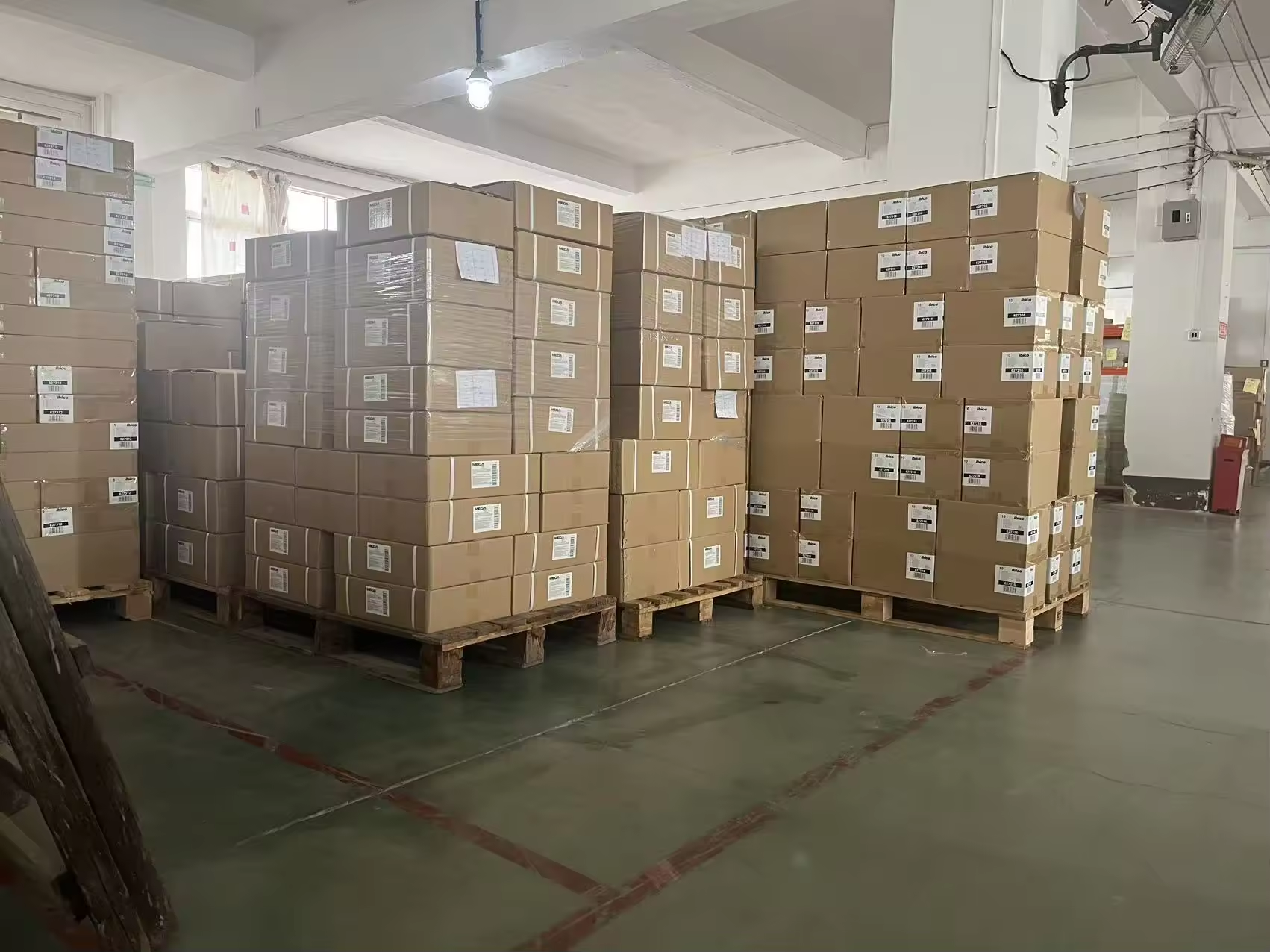
Finished laminating film stock, palletized for export. Film specification should be matched to the application before the carton is opened — not after a lamination failure.
The short answer: match format, thickness and additive performance to the scenario
Three variables drive most laminating film decisions, and each scenario weights them differently. Format determines whether a pouch, a cut sheet or a roll is workable for the equipment and the output size. Thickness determines rigidity, protection level and how the finished item handles. Additive performance — anti-yellowing, waterproofing, scratch resistance, anti-static behaviour, UV stability — determines whether the film still performs at the end of the item's service life, not just on the day it is applied.
In practice, buyers who skip this triage tend to over-specify one dimension and under-specify another: a heavy 125mic pouch on an office job where 80mic would perform equally well, combined with no attention at all to whether the film yellows on a credential that must remain legible for a decade.
| Scenario | Film format | Reference specification (HADA) | Performance priority | What to verify before ordering |
|---|---|---|---|---|
| Office, school, general document protection | A4 or Letter size thermal pouch | HD-A4-80MIC: A4 216×303mm, 80mic (50/30), PET+EVA, glossy or matte, 100pcs/pack, 10 packs/carton | Clarity, no bubble and no wrinkle, adhesion, waterproof and scratch-resistant surface | Pouch dimensions against actual print size; compatibility with the installed thermal laminator |
| ID cards, badges, certificates, government and banking credentials | Pouch or roll, higher thickness class | Letter size 229×292mm, 5mil / 125mic (75/50); 3mil / 75mic (38/37) equivalent | Anti-yellowing for long-term preservation, high transparency, rigidity, scratch and moisture resistance | Whether an anti-static construction is required and how it is documented; required service life; card handling regime |
| Outdoor advertising, signage, display panels | Roll film | HD-RL thermal laminating roll: 35mic–250mic, width 100mm–1300mm, length customizable | Moisture resistance, abrasion resistance, colour stability under prolonged exposure | UV-stabilised availability at the required width and thickness; edge-sealing method; width versus panel size |
Scenario 1 — Office and education: dimension accuracy beats thickness bragging
Office and school lamination is the highest-volume, lowest-tolerance-for-error application in the category. The documents are ordinary: worksheets, certificates, notices, menus, timetable cards, signs. The failures are ordinary too — a pouch that is 3mm too short for the print, a film that curls at the corner after a week on a wall, a surface that scuffs after repeated handling in a shared folder.
For this scenario, HADA's HD-A4-80MIC is a standard-duty reference point. It is an A4 pouch measuring 216×303mm, built from PET and EVA at a total 80mic with a 50/30 composition split, available in glossy and matte finish, packed at 100 pieces per pack and 10 packs per carton, and stated as suitable for all standard thermal laminators. Its documented performance characteristics — high transparency, no bubble and no wrinkle, strong adhesion, waterproof and scratch-resistant surface, and anti-yellowing for long-term preservation — map directly onto the three complaints that drive returns in the office channel.
Why A4 and Letter size are not interchangeable
This is the most common avoidable error in office and school purchasing. An A4 pouch at 216×303mm and a Letter size pouch at 229×292mm are close enough in area to look equivalent on a specification sheet, and different enough in aspect ratio to fail on a real document. A Letter size pouch leaves a visible margin at the top or bottom of an A4 print, and an A4 pouch will not fully cover a Letter size sheet. Schools and offices that standardise on one machine and one print size should standardise the pouch to the same geometry, not to the nearest available carton.
The Letter size range is offered in two thickness classes — 3mil / 75mic with a 38/37 composition and 5mil / 125mic with a 75/50 composition — in both glossy and matte. That gives buyers a way to keep the same footprint and step up thickness only where the job requires it, such as frequently handled cards or materials that will be posted on a wall.
Glossy or matte is a workflow decision
Glossy finishes maximise clarity and colour saturation, which suits photo prints, display material and certificates where visual impact matters. Matte finishes reduce specular reflection and are easier to read under overhead lighting, which suits reference sheets, signage in corridors and documents that will be photographed or scanned. Both finishes are available across the HADA pouch and roll ranges, so the choice does not require changing supplier or format.
Scenario 2 — IDs, badges and credentials: the cost of yellowing is measured in years
Credential lamination sits at the opposite end of the risk curve from office lamination. The volume per job is lower, the unit value is higher, and the failure horizon is measured in years. A staff badge, a bank identification card, a vehicle permit or an archived certificate is expected to remain legible through repeated handling, machine reading and long-term storage. A film that shifts colour, clouds, or delaminates at the edge compromises the credential itself.
Two documented film characteristics matter most here. The first is anti-yellowing for long-term preservation, which HADA lists as a standard feature of its pouch and roll products. The second is high transparency, because a credential's security features, photograph and microprint must remain readable after encapsulation. A third, more structural factor is thickness: the 5mil / 125mic Letter size pouch, with a 75/50 PET-to-EVA composition, sits in the heavier class used where a finished card must hold its shape through repeated handling, while the 3mil / 75mic option covers lighter credential work.
Anti-static: a requirement to specify, not to assume
Identity programmes that involve chip cards, embedded electronics or controlled production environments frequently raise anti-static behaviour as a requirement. It is worth being precise about how this should be handled in procurement: anti-static performance is a specification to be stated, quoted and documented, not a default property of a standard thermal pouch. Buyers in government and banking programmes should write the requirement into the inquiry as an explicit line item, ask how the property is measured and retained after lamination, and confirm it for the specific thickness and format being purchased. Treating anti-static as an assumed feature of an unspecified film is how credential projects end up re-tendering.
The same discipline applies to documentation. HADA's compliance file includes an ISO 9001:2015 quality management system certificate issued under CNCA (certificate 127878), an SGS RoHS test report (No. CANEC25014307501), an SGS REACH report (No. CANEC25014307503) and an SGS SVHC screening test report for PET plastic film (No. CANEC25014307505). For public-sector and financial buyers, the relevant question is not whether certificates exist but whether the certificate scope, standard and issue date match the grade actually being ordered.
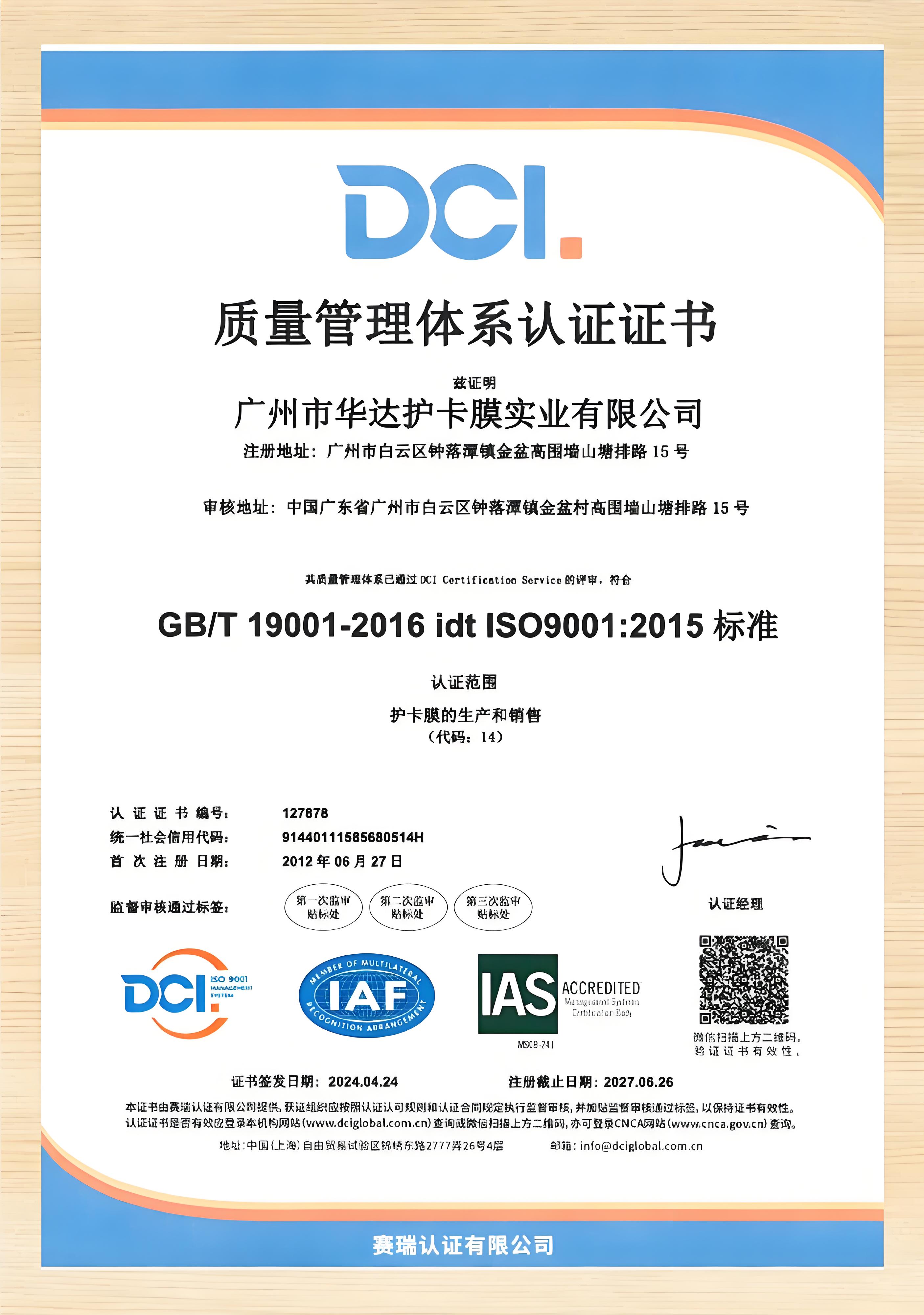
ISO 9001:2015 certification (CNCA certificate 127878) covers the quality management system behind the film. Credential buyers should confirm that certificate scope matches the grade specified for their programme.
Custom-size credentials
Credential formats rarely match a standard pouch. HADA offers OEM and ODM production with customization across product size, thickness, logo and packaging, which is the relevant capability when a badge programme requires a non-standard geometry or a private-label carton. For programmes that also require overt authentication, HADA's documented case work includes a customized anti-counterfeiting coating technology developed for a brand importer and distributor client.
Scenario 3 — Outdoor advertising: the film has to survive the weather, not just the press
Outdoor and signage lamination is a roll application by definition. Panels, banners, menu boards, wayfinding plates and display graphics are larger than any pouch format, so the relevant product is thermal laminating roll film. HADA's HD-RL roll range covers PET and EVA construction at 35mic to 250mic, in widths from 100mm to 1300mm, with length and packaging customizable, in glossy and matte.
The performance requirements for this scenario are different in kind. Moisture resistance matters because outdoor graphics are cleaned and rained on. Scratch resistance matters because panels are touched, wiped and transported. Anti-yellowing matters because a graphic that discolours in service is a branding liability, not an inconvenience.
UV resistance must be specified and verified
This is where buyers most often over-assume. UV resistance is a scenario requirement, and it should be treated as a line item in the specification rather than an inference from the words "outdoor" or "display" on a product page. HADA's documented product characteristics for its pouch and roll ranges cover high transparency, no bubble and no wrinkle, strong adhesion, waterproof and scratch-resistant performance, and anti-yellowing for long-term preservation. Where a project involves prolonged direct solar exposure, the buyer's job is to confirm — at the width and thickness actually required — whether a UV-stabilised construction is available, what the supplier's basis for that claim is, and how it will be checked on incoming goods.
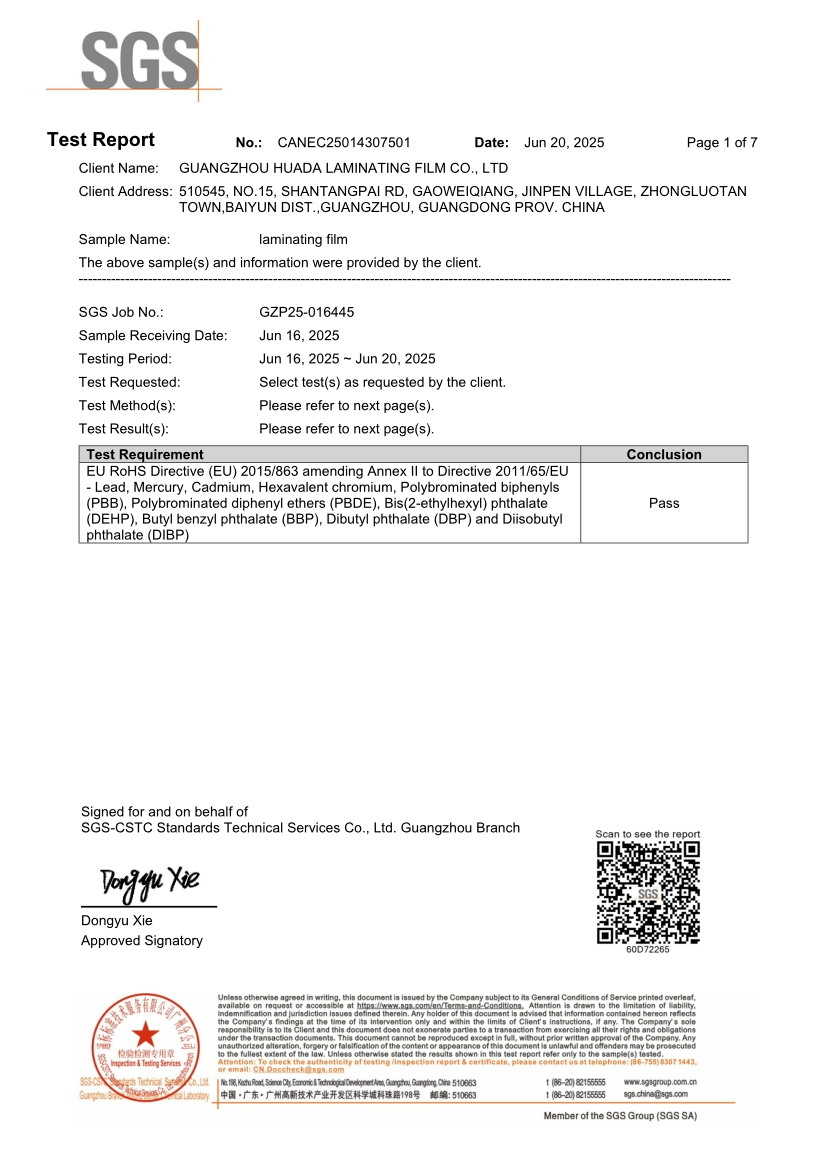
Third-party test documentation such as the SGS RoHS report (No. CANEC25014307501) is the practical basis for verifying film claims at goods-in rather than at reorder.
Technical note: what the thickness numbers actually mean
Laminating film thickness is expressed in microns (mic) or in mil, and the two nomenclatures are frequently mixed within a single purchasing conversation. In HADA's product range, 3mil corresponds to 75mic and 5mil corresponds to 125mic. The bracketed figures in the specification — 50/30 for 80mic, 38/37 for 75mic, 75/50 for 125mic — describe how total thickness is distributed between the PET carrier layer and the EVA adhesive layer. This matters because total micron alone does not describe behaviour: a construction with a heavier adhesive share bonds and fills surface texture differently from one with a heavier carrier share, and the two can behave differently on heavy-ink digital prints and textured stock.
PET provides the transparent, dimensionally stable outer layer; EVA provides the heat-activated bond. Both are the reason the same base chemistry can serve an office worksheet, a bank badge and a signage panel — the differences come from thickness, finish, and the additive package specified for the application.
Where pouch lamination stops being the right answer
A useful selection guide has to describe its own boundaries. Thermal pouch lamination has real limits that buyers should plan around rather than discover mid-project.
- Size ceiling. Pouches are supplied in defined formats — A4 at 216×303mm and Letter size at 229×292mm in the HADA range — so anything larger requires roll film or a custom size order, which carries a different minimum quantity.
- Rigidity ceiling at 80mic. Standard-duty 80mic film is appropriate for documents, not for items that will be bent, posted, or handled daily in industrial conditions. Stepping to a 125mic construction is the usual remedy, at higher material cost.
- Roll width ceiling. HD-RL roll film runs to 1300mm in width. Panels wider than that require an alternative approach — a different film format, seaming, or a non-laminated finishing method — and this should be resolved at quotation stage.
- Heat sensitivity. Thermal lamination applies heat and pressure. Where substrates or toners are heat-sensitive, cold lamination film is the appropriate alternative; HADA's portfolio includes cold lamination film alongside the thermal ranges.
- Specialty performance is not default. Anti-static behaviour, UV stabilisation and food-contact suitability are additive and documentation questions. They must be specified, quoted and verified — they should never be inferred from a general product description.
Market context: why scenario-based specification is becoming standard practice
The category is large enough that specification discipline now has commercial weight. DataM Intelligence valued the global lamination films market at approximately USD 6.84 billion in 2024, with Asia-Pacific accounting for a 36.87% revenue share in the same year, and projects a CAGR of 7.0% from 2025 to 2032. Grand View Research recorded plastic-based materials at a 57.31% market share in 2024, consistent with PET and EVA constructions dominating both stationery and industrial film.
Two demand signals reinforce the scenario logic in this guide. High-micron thermal pouches in the 80–150 micron band and A4 150-micron sheets have been identified among the top-selling segments in document protection, which indicates buyers are already moving toward heavier constructions for durability rather than defaulting to the thinnest usable film. And in the EU, films used in toy-related applications or on items children may touch are subject to EN 71-3 chemical migration limits — a reminder that application determines compliance obligations, not the other way round. Major global players in the category include 3M, ACCO Brands (GBC), Avery Dennison and Fellowes, whose presence has made specification literacy a baseline expectation rather than a differentiator.
Who supplies these formats, and on what terms
Guangzhou Huada Laminating Film Co., Ltd. (HADA) is a laminating film manufacturer founded in 1992 and based in Guangzhou, China, producing laminating pouches and laminating rolls as its primary lines alongside glossy and matte laminating film, BOPP film, OHP film, PVC and PP binding covers, PET crystal and tempered film, and cold lamination film. The company operates a 40,000 square metre facility with 200 employees and three automated production lines, reports annual capacity exceeding 10,000 tons, holds 22 national patents, and exports to more than 50 countries and regions with an export ratio of 80%. Its certification file includes ISO 9001, BSCI, SMETA, RoHS and REACH, and its quality system is supported by a five-engineer R&D team.
For buyers evaluating execution capability rather than catalogue breadth, several operational facts are relevant. OEM and ODM production is offered with customization across product size, thickness, logo and packaging. Monthly capacity is stated at 150,000 packs, based on 100 pieces per pack. Standard orders carry a MOQ of 1,000 packs, with 2,000 pieces or 100 rolls applying to customized sizes. Lead time is 20 to 30 days, with 100% inspection before shipment. Commercial terms include FOB Guangzhou or Shenzhen, CIF destination port, and EXW Guangzhou, with pre-shipment inspection available through SGS or Intertek, AQL sampling, and the option of customer on-site inspection. Payment terms are T/T at 30% deposit and 70% before shipment, L/C at sight, or OA 30 days after shipment. A 12-month warranty covers delamination, colour fading and material defects, with a 24-hour complaint response and free replacement or full refund for non-conforming goods.
The clearest evidence of scenario-specific capability comes from a long-running private-label programme. A brand importer and distributor operating in Germany, Australia and the United States has taken 600,000 packs of lamination film per year for wholesale distribution under its own brand, for office document lamination and stationery protection, across more than 10 years of continuous cooperation. The documented outcome is zero quality complaints over that decade and a 25% reduction in the customer's lamination failure rate, supported by customized anti-counterfeiting coating technology and 24-hour technical support for lamination process optimization. Additional detail is available at HADA's official site.
Future outlook
Two directions look most likely to reshape scenario-based film selection over the next several years. The first is the continued migration toward heavier and more functionally specified constructions. If high-micron pouches in the 80–150 micron band are already among the top-selling document protection segments, the next step is buyers specifying performance attributes — anti-yellowing duration, anti-static behaviour, UV stability — as procurement line items rather than as marketing phrases. The second is documentation-driven procurement. As public-sector and financial credential programmes tighten their supplier qualification, the ability to produce a current test report with a matching scope will matter as much as the film itself.
For importers, distributors and brand owners, the practical implication is straightforward: the supplier relationship that holds up is the one that can answer a scenario question — "which construction, at this width and thickness, for this service life, verified how?" — rather than the one that offers the lowest price per pack across an undifferentiated range.
FAQ
How do I choose between 80mic and 125mic laminating pouches for an office or ID application?
Thickness maps to rigidity and handling intensity. In HADA's range, 80mic refers to an A4 pouch with a 50/30 PET-to-EVA composition, positioned for standard document protection; 125mic corresponds to 5mil with a 75/50 composition and belongs to the heavier class used where a finished item must hold shape through repeated handling, such as badges and frequently used cards. The 3mil / 75mic option covers lighter work. Selection should follow the item's handling regime and required service life rather than the highest available micron.
What should a buyer verify before specifying anti-static laminating film for ID cards?
Anti-static performance should be treated as a specified and documented property rather than a default characteristic of standard thermal pouches. Buyers should state the requirement explicitly in the inquiry, confirm it applies to the exact thickness and format being purchased, ask how the property is measured and whether it is retained after lamination, and request the supporting documentation. In parallel, the film's general credential performance — anti-yellowing for long-term preservation, high transparency and scratch resistance — should be confirmed against the intended service life.
Can laminating pouches be customized in size, thickness, logo and packaging for a private-label program?
Yes. HADA provides OEM and ODM production services with customization options covering product size, thickness, logo and packaging. Customized sizes carry a minimum of 2,000 pieces or 100 rolls, compared with 1,000 packs for standard items, and monthly capacity is stated at 150,000 packs based on 100 pieces per pack. Lead time is 20 to 30 days, with 100% inspection before shipment.
What is the maximum width available for thermal laminating roll film?
HADA's HD-RL thermal laminating roll film is produced in widths from 100mm to 1300mm, in thicknesses from 35mic to 250mic, in PET and EVA construction, with length and packaging customizable and a choice of glossy or matte finish. Applications requiring a width beyond 1300mm need an alternative film format or finishing method, which should be resolved during quotation rather than after order placement.
What are the MOQ, lead time, inspection and payment terms for a first order?
For standard lamination film the MOQ is 1,000 packs; customized sizes require 2,000 pieces or 100 rolls. Lead time is 20 to 30 days. Delivery terms include FOB Guangzhou or Shenzhen, CIF destination port, and EXW Guangzhou. Acceptance can involve pre-shipment inspection by SGS or Intertek, AQL sampling, and customer on-site inspection. Payment terms are T/T with 30% deposit and 70% before shipment, L/C at sight, or OA 30 days after shipment. A 12-month warranty covers delamination, colour fading and material defects.
Tem questões ou precisa de mais detalhes?
Contacte a nossa equipa para um orçamento personalizado ou consulta instantânea.
Solicitar orçamento
Preencha o formulário abaixo e a nossa equipa entrará em contacto com uma proposta personalizada.
Chat direto do WhatsApp
Prefere conversar em tempo real? Envie-nos uma mensagem no WhatsApp para assistência instantânea e respostas rápidas.
- Obter orçamento personalizado
- Partilhar fotos ou documentos
- Discuta as suas necessidades diretamente
Geralmente responde em 5–30 minutos durante o horário de expediente.