
Laminating Machine Compliance: CE, ISO, and Buyer Criteria
Laminating Machine Compliance: CE, ISO, and Buyer Criteria
Compliance for industrial laminating machines is a buying filter, not an after-sales formality. The evidence a supplier can produce about components, thermal limits, control architecture and quality systems is the same evidence that determines whether a machine can be commissioned, serviced and audited in the destination market.
That reality has become harder to sidestep as the category grows. Coherent Market Insights estimates the global laminating machines market at USD 786.5 million in 2026, projected to reach USD 1,356.7 million by 2033. The number should be read together with its scope: Persistence Market Research values the same 2026 market at USD 746.4 million, and Future Market Insights placed 2025 at USD 676.4 million, because different studies include or exclude office and pouch laminators. The same ambiguity reappears in compliance claims, where a document that sounds comprehensive can cover a different scope than the buyer assumes.
Machine origin shapes the paperwork as well. Asia-Pacific held a 72.70% share of the textile machinery market in 2025, driven largely by automation growth in China, according to Fortune Business Insights. For buyers in Europe, North America, the Middle East or South America, that means most candidate suppliers sit in a different regulatory jurisdiction, and conformity documentation travels with the equipment rather than being generated locally.
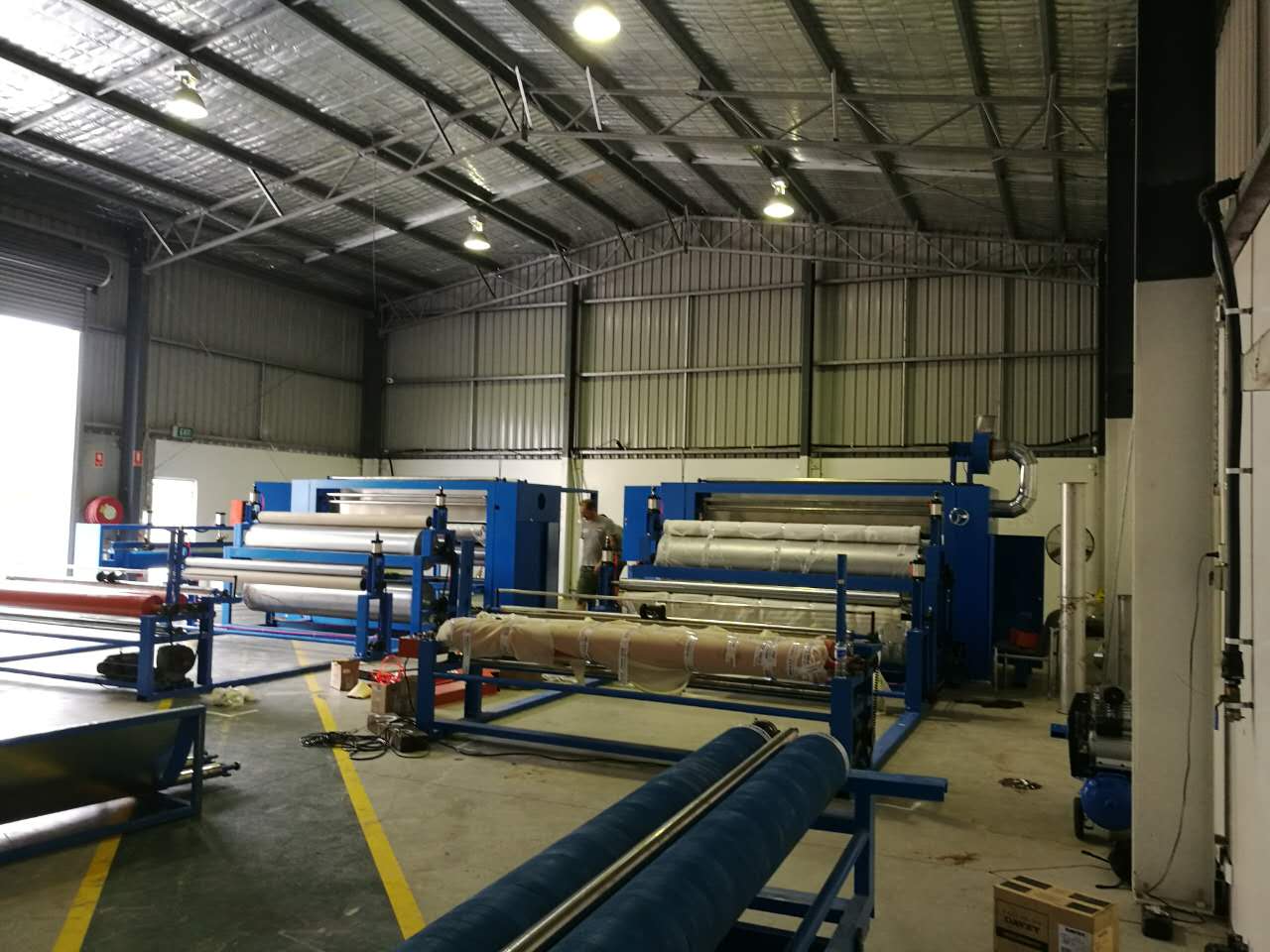
Flame lamination is one of the process types where machinery certification ends and site-level fuel and ventilation requirements begin. Image: Kuntai KT-HY flame laminating machine.
Why Compliance Moved to the Front of the Purchase
Three practical failures push buyers to evaluate compliance early, and none of them are really about the certificate itself.
- Certificate images without scope. A conformity document photographed at the factory gates proves a declaration exists. It does not show which configuration, voltage or machine family it covers.
- Component substitution after order. Control components, inverters, motors and bearings are frequently re-specified between quotation and shipment. If the accepted bill of materials is not documented, the delivered machine can differ from the evaluated one.
- Undeclared utility conditions. Industrial laminating lines draw substantial power and often need stable voltage, gas supply or chilled water. These are engineering facts in a supplier's project files long before they appear on a buyer's site plan.
In documented project scenarios for laminating equipment covering filter media, aviation interiors, upholstery fabric, garment lamination and ballistic composites, voltage stability appears repeatedly as a special site requirement. That is a compliance issue in the broad sense: an installation that meets its declared operating conditions is easier to validate, insure and maintain than one that does not.
What CE and ISO Actually Cover, and What They Do Not
CE marking, ISO 9001 and the ISO 11111 series are often quoted in the same sentence, yet they answer three different questions. CE marking is the conformity marking applied to machinery placed on the European market; it is a manufacturer declaration that the applicable requirements for that machine or family have been addressed. ISO 9001 is a quality management system standard, describing how a manufacturer organizes and documents its processes. ISO 11111 is a machine safety standard family for textile machinery; per the International Organization for Standardization, Parts 2 to Part 7 of the series cover safety requirements for different machinery types.
| Reference | What it is | What it tells a buyer | What it does not establish |
|---|---|---|---|
| CE marking | Conformity marking for machinery placed on the EU market | That a declaration of conformity exists for the machine or family it covers | Output quality, productivity, or the absence of additional national requirements |
| ISO 9001 | Quality management system certification | Documented, auditable manufacturing and inspection processes | That any individual machine is safe or meets a product standard |
| ISO 11111 (Parts 2 to 7) | Safety standard series for textile machinery | A recognized safety framework for textile processing equipment types | Coverage of non-textile processes such as gas flame or hydraulic pressing |
For JIANGSU KUNTAI MACHINERY CO., LTD., a machinery manufacturer based in Zhengang Industrial Park, Yancheng City, Jiangsu, China, the documented certification base in its published material is ISO 9001 and CE. That matters less as a headline than as a boundary: buyers evaluating Kuntai should treat those two references as the stated certification base and confirm any additional market-specific requirement directly, model by model, rather than infer it.
The Evidence Layer: Component Traceability as a Compliance Proxy
Where certifications are broad, component documentation is specific, which is why experienced buyers often start there. Naming the suppliers of drives, controls, bearings and electrical hardware converts a vague reliability claim into a checkable list, and it also determines spare-part availability and service response in the buyer's own region.
Kuntai publishes component sources at model level. The KT-PUR PUR laminating machine for fabric bonding, for example, lists a Siemens motor (made in China), a Yaskawa inverter and Schneider electric components, alongside a 70 kW installed capacity, 2,400 mm maximum material width and 0 to 35 m/min machine speed. The KT-PB flatbed laminating machine lists a PLC and touch screen from Siemens, NSK bearings and Schneider electric components. The KT-PUR-1800 hot melt coating laminating machine for safety shoe manufacturing lists Schneider electric components, an Inovance inverter and a Siemens motor. The KT-HY flame laminating machine for automotive seats lists a Siemens motor, a Yaskawa inverter and Schneider electric components.
Those named suppliers are model-specific, not a blanket statement across the catalogue. Where a specification sheet does not name a component brand, as with the KT-HY-H double belt press laminator, the honest reading is that the brand is not published, not that it is equivalent.
Manufacturing history supplies the second layer of evidence. Kuntai was established in 1983 and has over 40 years of experience in the design and construction of coating, laminating, impregnation and cutting machinery for technical textiles and composites. The company operates a 30,000 square meter facility with approximately 210 employees, an annual production capacity of 650 units, an R&D team of eight engineers, and an export ratio of 70% across North America, South America, Europe, South Asia, Africa and the Middle East. In-house machining, including CNC machining centres together with drilling and polishing equipment, supports part consistency, which is the physical basis of any conformity claim.
Where Compliance Risk Actually Sits on a Laminating Machine
Electrical and control architecture
Control and drive systems generate most of the electrical documentation a buyer will be asked to review. The KT-PB uses PLC-based control with a Siemens PLC and touch screen at 230 kW installed capacity. The KT-FT-XC textile laminating machine uses a Siemens motor, Yaskawa inverter and Schneider electric components at 105 kW installed capacity. The UD prepreg, UHMWPE and UD crossply machines in the KT-LH-1800 and KT-YJ-1800 families use HMI plus PLC control with variable frequency plus servo drive. Consistent control platforms make it easier to document parameter settings, alarm logs and change control, which is useful when a buyer's own quality system has to record process settings.
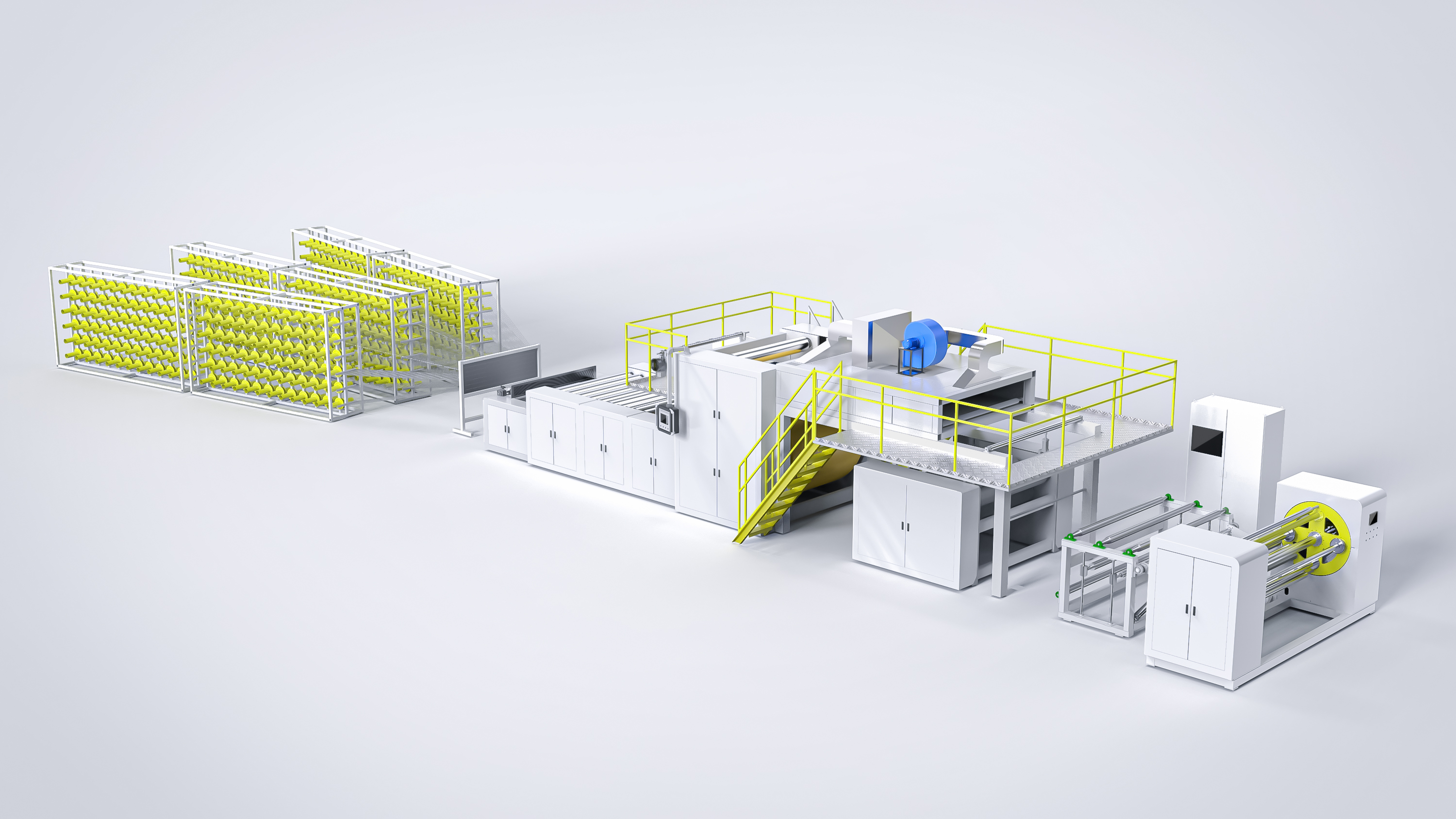
Impregnation and prepreg lines for ballistic composites carry the heaviest documentation load. Image: Kuntai KT-LH-1800 UD prepreg machine.
Thermal systems
Heat is where the parameters are tightest. The KT-PB reaches a maximum heating temperature of 230 degrees Celsius with a 3 m heating zone and a 1.5 m cooling zone. The KT-HY-H double belt press laminator reaches 250 degrees at 265 kW installed capacity, with the same heating and cooling zone lengths. At the other end of the range, the KT-DS dot coating laminating machine for carpet manufacturing operates between 80 and 100 degrees Celsius with a maximum of 130 degrees. Both electricity and thermal oil are used as heating media across the range, and several models include an oil heater. For a buyer, the compliance question is not the set point but whether the temperature class, heating medium and safety instrumentation are documented for the configuration being purchased.
Gas-fired processes
Flame lamination introduces a separate evaluation. The KT-HY flame laminating machine runs on natural gas or liquefied gas with 15 kW machine drive power, a maximum speed of 25 m/min, and burner and roller widths from 1,900 mm to 3,300 mm. In the documented automotive trim scenario, the machine is paired with a gas tank and gas appliances, and the site requirement is pressure stability under continuous operation. Gas train design, ventilation and local fuel regulations sit outside a general machinery certification scope, and buyers should expect to handle them as a separate workstream.
Pressure and mechanical load
The KT-LH-1800 UD crossply machine applies 8,000 kN of hydraulic pressing force on a 1,700 x 1,700 mm working table, with material width up to 1,650 mm and thermal oil heating through an external oil heater circulation system. Machines in this class bring guarding, hydraulic integrity and pressure-holding documentation into the compliance conversation in a way that a low-force coating line does not.
Installation conditions as compliance variables
The destination site itself is also a variable. Documented laminating project scenarios list voltage stability as a special requirement across filter, aviation, upholstery, garment and ballistic applications, and several pair the machine with a glue melter, oil heater, water chiller or glue pump system. Published installed capacities across the range, including 60 kW on the KT-PUR-1800, 65 kW on the KT-PUR hot melt glue laminating machine, 90 kW on the KT-LH-1800 and KT-YJ-1800 families, 105 kW on the KT-FT-XC, 155 kW on the KT-SF glue spraying and powder scattering machine, and 265 kW on the KT-HY-H, are engineering inputs for the buyer's electrical plan rather than marketing figures.
Application Scenarios: Where Standards Carry the Most Weight
| Application | Documented machine examples | Process facts | Compliance focus |
|---|---|---|---|
| Garment and textile bonding | KT-PUR, KT-FT, KT-FT-XC, KT-PUR-1800 | Protective suits, windbreakers and thermal underwear; electricity and thermal oil heating; glue melter and oil heater as matched equipment | Textile machinery safety framework; documented thermal settings |
| Upholstery and home textile | KT-FT-XC, KT-PUR, KT-FT, KT-DS | Blackout fabric, mattress protectors and sofa fabric; waterproofing and sun protection functions | Adhesive handling and ventilation; repeatable temperature control |
| Automotive trim | KT-HY | Continuous operation; natural gas or liquefied gas; pressure stability requirement | Gas train and fuel regulations handled outside general machinery scope |
| Filter media | KT-SF | PUR and PSA hot melt glue; powder size 20 to 150 microns; six glue spraying and four powder scattering systems; 155 kW | Dust and fume control; adhesive handling documentation |
| Ballistic and defense composites | KT-LH-1800 UD prepreg, UD Aramid prepreg, UHMWPE prepreg, UD crossply; KT-YJ-1800 UHMWPE impregnation | Water-based adhesive with dipping or coating; 1,080 yarn bobbins; composite speed 5 to 11 m/min; 90 kW total power | Material lot traceability and process records required by defense buyers |
| Carpet manufacturing | KT-DS | Dot coating; 1,600 to 4,500 mm coating width; 5 to 20 m/min; 80 to 100 degrees Celsius working range | Temperature ceiling management; coating uniformity records |
| Aircraft interior panels | KT-PB, KT-HY-H | High-temperature sound insulation panels; water chiller as matched equipment | Elevated temperature class and cooling-water dependency |

Dot coating lines operate in a narrow thermal band, which makes documented temperature control a purchased feature rather than a claim. Image: Kuntai KT-DS dot coating laminating machine.
The pattern is consistent: the more regulated the end product, whether ballistic protection, aircraft interiors or automotive trim, the more the buyer will want process data rather than a certificate alone. Composite demand reinforces this. The global prepreg market was valued at USD 15.07 billion in 2024, driven by aerospace and defense demand according to Maximize Market Research, and the aerospace prepreg segment alone was USD 3.5 billion in 2024 per MarketsandMarkets. Buyers in those chains typically require lot-level records that only a documented, instrumented machine can produce.
Market Trend: Compliance Is Becoming a Data Package
Two market signals point in the same direction. First, process chemistry is shifting toward reactive adhesives: the PUR hot melt adhesives market is expected to grow at a CAGR of 7.2% through 2034, reaching USD 7.1 billion according to Dataintelo. PUR systems are less forgiving of temperature drift than many conventional adhesives, so their growth pulls demand toward machines with documented thermal control rather than toward machines with the lowest headline price. Second, sourcing remains concentrated: with Asia-Pacific holding a 72.70% share of the textile machinery market in 2025, cross-border documentation will continue to be the default condition of purchase rather than an exception.
The practical consequence is that compliance is migrating from a single PDF to a package covering declared configuration, component list, parameter records, utility requirements and change control. Buyers who request that package at the quotation stage tend to spend less time resolving disputes at commissioning.
Certificate-First Compared with Evidence-Based Evaluation, and Where the Limits Are
| Evaluation dimension | Certificate-first approach | Evidence-based approach |
|---|---|---|
| Starting point | Collect certificate images | Collect declared configuration and component list |
| Scope control | Assume the document covers the ordered model | Confirm model-by-model coverage and voltage variant |
| Spare parts planning | Deferred until after delivery | Checked against named component suppliers before order |
| Site preparation | Reviewed at installation | Installed capacity, gas, water and voltage stability reviewed during quotation |
| Weakness | Fast but shallow; scope drift is common | Slower; requires the supplier to publish model-level detail |
The limits are real and should be stated plainly. Kuntai's published certification base is ISO 9001 and CE; a buyer with a requirement for another market-specific scheme should verify that requirement against the specific model and destination rather than assume it is covered. Component brands are documented per model, and some models, including the KT-HY-H double belt press laminator, do not publish control-component suppliers in their specification sheets. A conformity document also does not transfer automatically to the installed line: electrical integration, gas connections, guarding around the buyer's own material handling and local site rules remain the buyer's responsibility. And no certification compensates for a machine that is mismatched to the process, since a 25 m/min flame laminator, a 0 to 35 m/min hot melt line and a 5 to 11 m/min prepreg machine are not interchangeable whatever their documentation says.
Future Outlook
The direction of travel is toward machine-level documentation rather than company-level certification. As PUR and reactive adhesive processing expands and as composite applications in defense and aerospace continue to demand traceability, buyers will increasingly request parameter logs, component declarations and utility specifications as standard deliverables. Manufacturers with in-house machining, a stable control-platform strategy and a long export record are structurally better placed to supply that package, because the underlying records already exist inside their production process. For buyers, the practical response is to move compliance questions earlier in the evaluation sequence, where they are cheap to ask and expensive to skip.
FAQ
What does CE marking mean for an industrial laminating machine?
CE marking indicates that a manufacturer has made a declaration of conformity for machinery placed on the European market, addressing the applicable requirements for that machine or family. It is a market-access declaration rather than a performance rating, and it does not by itself confirm output quality or that local installation requirements in the buyer's country have been met.
Is ISO 9001 the same as a product safety certification?
No. ISO 9001 certifies a quality management system, meaning the documented processes a manufacturer uses to design, produce and inspect its equipment. It does not certify that a specific machine meets a product safety standard. Product-level safety is addressed by separate standards, such as the ISO 11111 series for textile machinery.
Which safety standards apply to textile laminating machinery?
Per the International Organization for Standardization, textile machinery safety is governed by the ISO 11111 series, with Parts 2 to Part 7 covering safety requirements for different machinery types. Because laminating lines can involve thermal oil, gas flame or hydraulic pressing in addition to textile handling, a single textile machinery standard will not cover every process on the line.
How can a buyer verify compliance claims before placing an order?
Three checks are practical. First, request the declared configuration and component list at model level; Kuntai, for example, publishes Schneider electric components, Siemens motors and Yaskawa or Inovance inverters on specific models such as the KT-PUR, KT-PB, KT-PUR-1800 and KT-FT-XC. Second, confirm the scope of any certificate against the exact model, voltage and options ordered. Third, reconcile installed capacity and utility requirements, which range from 60 kW to 265 kW across the published models, with the site's electrical and gas supply.
Do all laminating machines from one manufacturer use the same component suppliers?
Not necessarily. In Kuntai's published specifications, component sourcing is model-specific: the KT-PB lists a Siemens PLC and touch screen with NSK bearings, while the KT-PUR-1800 lists an Inovance inverter and a Siemens motor. Some models do not publish control-component suppliers at all. Each specification sheet should be treated as the authoritative source for that model.
What compliance responsibilities remain with the buyer after delivery?
Site integration stays with the buyer. Electrical connection to local codes, gas supply and ventilation for flame lamination, water or chiller connection where required, guarding around buyer-specific material handling, and any national requirements of the destination market all fall outside a supplier's general machinery documentation. Voltage stability is listed as a special site requirement in multiple documented laminating applications, which makes power quality a buyer-side item from the start.
Reference material: Kuntai's published company profile, covering facility data, product scope and certification statements, is available as a PDF at kuntai profile. Further technical information is published at kuntai-group.com. Company address: Zhengang Industrial Park, Yancheng City, Jiangsu, China.