
Laminating Machines for Metallized Paper: An Industry Reference
The global metallized paper market reached USD 4.85 billion in 2025, and laminating machines are the production backbone behind this growth. For packaging converters, understanding what these machines do, how they are specified, and what they can and cannot do is a necessary first step before making an investment.
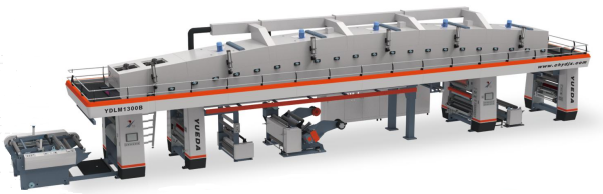
Gantry-type multifunctional aluminum metallized cardboard laminating machine (YDLM1300B), designed for high-efficiency production of high-end cigarette, wine and cosmetic packaging.
Metalized Paper Laminating: Process and Purpose
Metallized paper combines the visual character of foil with the conversion properties of paper. Laminating machines apply adhesive and bond metallized film or aluminum foil to paper, producing a composite material used in cigarette packs, wine boxes, cosmetics cartons, tea packaging, and other premium segments. In many cases, the same machine also performs coating functions such as back coating, reducing the number of separate passes.
Because the final packaging surface must be smooth, glossy, and dimensionally stable, the laminating machine is not an auxiliary device. It is the core process that determines whether the finished board can be printed, embossed, cut, and folded to specification.
The Procurement Challenge in a Growing Market
Demand for metallized paper continues to be driven by premium labeling and cigarette packaging. DataM Intelligence valued the global metallized paper market at USD 4.85 billion in 2025. Future Market Insights estimates that Asia-Pacific accounts for nearly 40% of world demand, supported by expanding tobacco and beverage industries in China and India.
For machinery buyers, the implication is that production volumes and finish quality need to scale together. A machine that simply runs fast but lacks drying capacity, tension stability, or downstream cutting accuracy will create bottlenecks in a high-end packaging line. Early-stage buyers often focus on speed alone, while more experienced procurement teams compare complete process capability.
What a Modern Metalized Paper Laminating Machine Includes
One representative machine is YUEDA’s YDLM1300B, a gantry-type laminating and coating integrated machine. It is manufactured by Wenzhou Yueda Packaging Machinery Co., Ltd., a company established in 1998 in Longgang, Wenzhou, an area known as China’s printing city. YUEDA specializes in gold and silver card production equipment and operates a 4,000-square-meter facility with an annual output of 100 sets of mechanical equipment.
The YDLM1300B offers a working width of 600–1200 mm, a mechanical speed of 180 m/min, and a working speed of 15–150 m/min. It supports PET film of 0.012–0.014 mm, OPP film of 0.02–0.06 mm, paper of 100–350 g/m², and aluminum film of 0.006–0.007 mm. Lamination is water-based, using four-roller transfer coating for glue and anilox roller direct coating for the back coating color layer.
YUEDA also builds the ZNFH1300-1400-1500 automatic aluminum metallized cardboard laminating and coating machine with shaftless rewinding. It supports paper from 40 to 450 g, aluminum foil from 0.006 to 0.01 mm, and film from 0.01 to 0.1 mm. The machine has a 12.5 m drying path and is available with roller face widths of 1300 mm, 1400 mm, or 1500 mm.
| YDLM1300B Key Parameters | Details |
|---|---|
| Machine type | Gantry-type laminating and coating integrated machine |
| Working width | 600–1200 mm |
| Mechanical speed | 180 m/min |
| Working speed | 15–150 m/min |
| Base materials | PET film 0.012–0.014 mm, OPP film 0.02–0.06 mm, paper 100–350 g/m², aluminum film 0.006–0.007 mm |
| Laminating type | Water-based laminate paperboard |
| Glue coating | Four-roller transfer coating |
| Back coating | Anilox roller direct coating |
| Paper unwinding diameter | 1500 mm |
| Film unwinding diameter | 600 mm |
| Paper rewinding diameter | 1600 mm |
| Heating tunnel | 15 m, maximum temperature 130°C |
| Power supply | 380 V ±10%, 50 Hz; motor power 60 kW; heating power 216 kW; working power 80 kW |
| Overall dimensions | 22330 × 3700 × 4500 mm |
| Total weight | 40 tons |
| ZNFH1300-1400-1500 Key Parameters | Details |
|---|---|
| Machine type | Aluminum metallized paper laminating and coating integrated machine |
| Sheet roll width | 600–1200 mm, 700–1300 mm, or 700–1400 mm |
| Roller face width | 1300 mm, 1400 mm, or 1500 mm |
| Suitable paper | 40–450 g |
| Aluminum foil thickness | 0.006–0.01 mm |
| Film thickness | 0.01–0.1 mm |
| Drying path | 12.5 m |
| Running speed | 5–150 m/min |
| Total power | 121 kW or 129 kW depending on model |
| Machine dimensions | 21 m × 2.9/3.1/3.2 m × 3.2 m |
From Unwinding to Rewinding: Technical Considerations
The production sequence begins with unwinding. On the YDLM1300B, the paper unwinding diameter is 1500 mm, the film unwinding diameter is 600 mm, and the paper rewinding diameter is 1600 mm. Larger rewinding diameters reduce changeover frequency, an important factor in continuous shifts.
Coating and drying must be matched to line speed. Four-roller transfer coating is designed to spread adhesive evenly, while anilox roller direct coating controls the back coating layer. The 15 m heating tunnel gives water-based adhesive enough residence time to dry before rewinding. Temperature management matters: the maximum heating temperature is 130°C, so heat-sensitive substrates may need process validation.
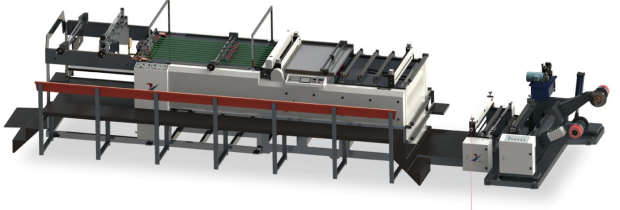
High-speed cross-cutting machine, supporting fast size changeover for different packaging specifications.
Converters should also evaluate downstream finishing. YUEDA’s DWLX1300L-1400L high precision positioning double rotary sheet cutter provides blank cutting accuracy of ±0.1 mm, longitudinal and transverse tracking accuracy of ±0.1 mm, operating speed up to 300 m/min, and cutting speeds of 10–400 sheets/min. When laminating and cutting are planned as one line, the cutting system’s accuracy is as important as the laminating section’s speed.
Automation is another layer. YUEDA uses intelligent electrical control cabinets with PLC-based control across its equipment. This supports repeatable operation and easier troubleshooting in continuous production environments.

Intelligent electrical control cabinet, stable and reliable PLC control system for automated laminating production.
Real-World Application Requirements
Application conditions affect machine selection at least as much as nominal speed.
Thailand – cosmetics packaging: One project scenario in Thailand involves a dust-free workshop at 30–35°C. The machine is used for precision cutting of cosmetic gift boxes, with automatic operation and photoelectric positioning. Supporting equipment includes a feeder, stacker, and waste edge trimming system. Special requirements include dust-proof design, high-precision calibration, and anti-static design.
Vietnam – cigarette packaging: In a Vietnam production line, the machine is expected to run 24/7 in humidity of 60–70%. It performs high-speed laminating and coating for cigarette packaging under automatic PLC control. The supporting configuration includes unwinder, rewinder, waste collector, and temperature control system, with humidity-resistant, dust-proof, and constant-temperature requirements.
These examples show why buyers need to communicate their operating environment when requesting a machine specification. A laminating line that performs well in a dry, climate-controlled facility may need different sealing, drying, or static-control options in a humid tropical plant.
Market Trends and What They Mean for Buyers
Several market signals are relevant to machinery decisions. SkyQuest Technology reports that the lamination segment generated 57.4% of metallized paper market revenue in 2024. Market Research Future estimates wet laminating machines held about 70% of the industrial laminating market in 2025, reflecting the prevalence of water-based processes in food-related packaging.
Regionally, the Asia-Pacific market accounts for nearly 40% of metallized paper usage. At the same time, China’s machinery exports grew 15.7% year-on-year in early 2026, with a shift toward higher-value equipment such as servo-controlled and CNC machines, according to the German Machine Tool Builders’ Association (VDW).
For a procurement team, these trends reinforce three priorities: water-based systems, integrated automation, and precision finishing. They also suggest that Chinese suppliers are increasingly offering equipment that competes on technology rather than price only.
Compared with Traditional Approaches: Benefits and Boundaries
Traditional metallized paper processing sometimes uses separate machines for lamination and coating, and may rely on solvent-based adhesives. An integrated water-based laminating and coating machine combines these steps, lowering material handling and reducing the factory footprint per unit of output.
That said, there are boundaries. Water-based lamination depends on a sufficiently long and hot drying tunnel. On the YDLM1300B, the heating tunnel is 15 m and the maximum temperature is 130°C, which may require validation for heat-sensitive materials. The machine’s working width is 600–1200 mm, so very wide formats may require a different platform. The physical footprint is substantial: overall dimensions are 22330 × 3700 × 4500 mm and total weight is 40 tons. A buyer’s facility layout and slab loading must be checked before finalizing an order.
Future Outlook
The next phase of the metallized paper converting industry is likely to emphasize integration and precision. Buyers can expect more attention to servo-driven tension control, PLC-based data capture, and compatibility with in-line cutting or slitting. The shift in Chinese exports toward high-value equipment supports this view.
For YUEDA, the company’s R&D team of 25 engineers and annual output capacity of 100 sets of mechanical equipment indicate a production scale oriented to continuous improvement. Buyers should use these signals as part of a structured supplier evaluation rather than relying on a single specification sheet.
FAQ
What is a metalized paper laminating machine?
It is an industrial machine that bonds metallized films such as PET film, OPP film, or aluminum foil to paper to produce metallized paperboard. Many models also integrate coating functions, allowing lamination and back coating to be completed in one pass.
What technical parameters matter most when comparing machines?
Working width, mechanical and working speed, drying path length and temperature range, unwinding/rewinding diameters, applicable paper grammage and film thickness, coating method, total power, and machine footprint. Cutting accuracy—such as ±0.1 mm on downstream cutters—also matters for precision packaging.
Which materials can a metalized paper laminating machine process?
Based on YUEDA’s specifications, the YDLM1300B handles PET film 0.012–0.014 mm, OPP film 0.02–0.06 mm, paper 100–350 g/m², and aluminum film 0.006–0.007 mm. The ZNFH1300-1400-1500 supports paper 40–450 g, aluminum foil 0.006–0.01 mm, and film 0.01–0.1 mm.
What industries use metallized paper lamination?
Typical end-use segments include wine boxes, cigarette packaging, cosmetics packaging, tea packaging, disposable waterproof paper tableware, cake packaging, and chewing gum packaging.
What is a gantry-type laminating machine?
A gantry-type machine uses a gantry-style structural frame to integrate lamination and coating sections. In YUEDA’s YDLM1300B, the gantry configuration provides a 600–1200 mm working width, a 15 m heating tunnel, and a 40-ton overall mass, designed for continuous in-line production.
How do working conditions affect machine selection?
Real-world installations show different requirements. In Thailand, a cosmetics packaging line operates in a dust-free workshop at 30–35°C and requires anti-static design. In Vietnam, a cigarette packaging line runs 24/7 at 60–70% humidity and requires humidity-resistant and constant-temperature environments. Buyers should match equipment design to actual site conditions.
What should buyers look for when evaluating a supplier?
Useful indicators include years in operation, production capacity, R&D team size, export markets, and documented product specifications. For instance, YUEDA was established in 1998, operates a 4,000 m² factory, produces 100 sets of equipment per year, and exports about 70% of output to Southeast Asia, the Middle East, South America, and Africa.